Her Family Mocked Her Medals—Then the General Called Her Forward
Her Family Mocked Her Medals—Then the General Called Her Forward
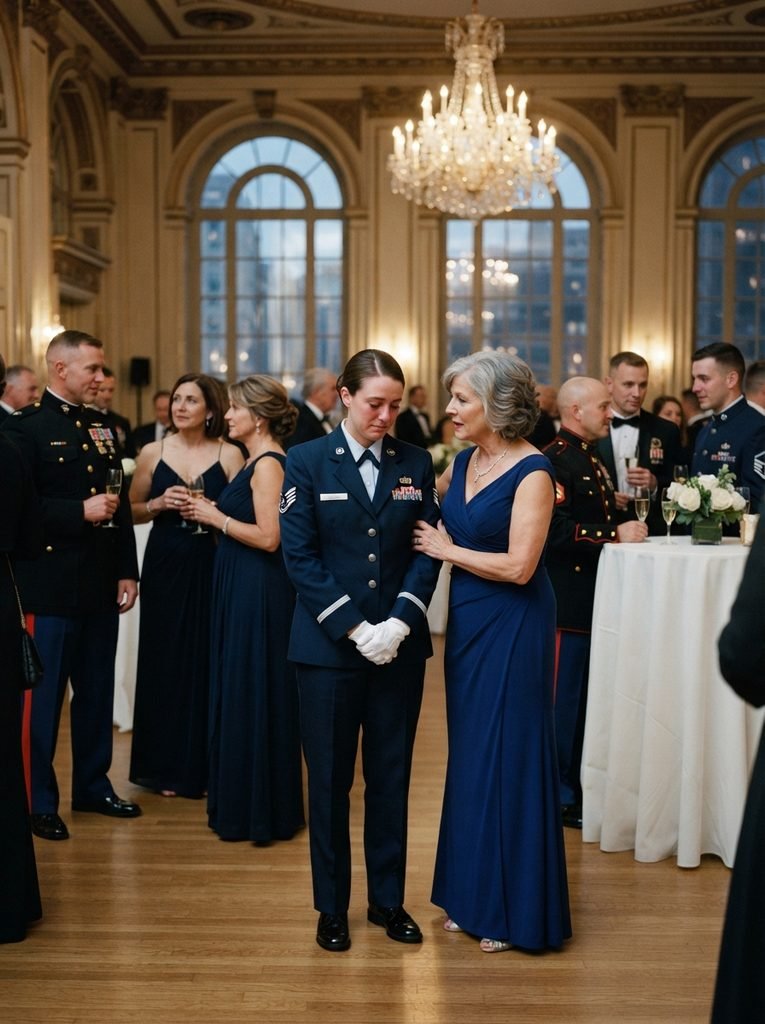
Daniel’s hand shot toward the black folder General Hayes was holding, and every face in the ballroom turned to follow it.
The general moved the folder back before Daniel’s fingers touched it.
Not dramatically. Not angrily. Just enough.
Daniel stopped with one foot near the edge of the stage, suddenly aware that the room he had spent all evening treating like his own celebration was no longer following his lead.
“Daniel,” I said.
He looked at me as though hearing my voice there, from beside a major general, was somehow more offensive than anything else that had happened.
“What is this?” he demanded.
General Hayes kept the folder closed against his palm.
“This,” he said, “is a recognition ceremony that was scheduled before tonight’s promotion event.”
Daniel glanced toward the velvet case beside us.
The Silver Star was still resting inside it under the ballroom lights.
Then he looked at my uniform again.
Really looked this time.
His eyes moved across the ribbons he had dismissed for years, the insignia he had never bothered to understand, and finally the rank on my shoulders.
“You never told me.”
I almost laughed.
Not because anything was funny.
Because that sentence had followed me through most of my adult life in one form or another.
You never told us you were deploying.
You never told us you were promoted.
You never told us you were responsible for people.
You never told us you were doing important work.
Except I had.
I had sent messages.
I had called home when I could.
I had mentioned assignments and moves and ceremonies, only to hear my mother ask whether I would be home for Daniel’s birthday, whether I could send money toward a family gift, whether I had heard that Daniel was being considered for another promotion.
My life had never been completely hidden.
It had simply never been the part of the conversation they wanted to keep.
General Hayes looked at Daniel without changing his expression.
“Your sister’s record was not concealed from her family,” he said. “Her service simply existed whether you paid attention to it or not.”
That landed harder than shouting would have.
Ashley slowly lowered her phone.
Aunt Linda stared down at the champagne glass in her hand.
My mother remained in her chair.
Her fingers were wrapped around the folded program so tightly that the paper had begun to bend.
Daniel pointed toward the medal case.
“So everybody here knew?”
“No,” I said. “Everybody here didn’t know.”
He turned toward me.
“Then why are they standing?”
I let that question sit between us for a second.
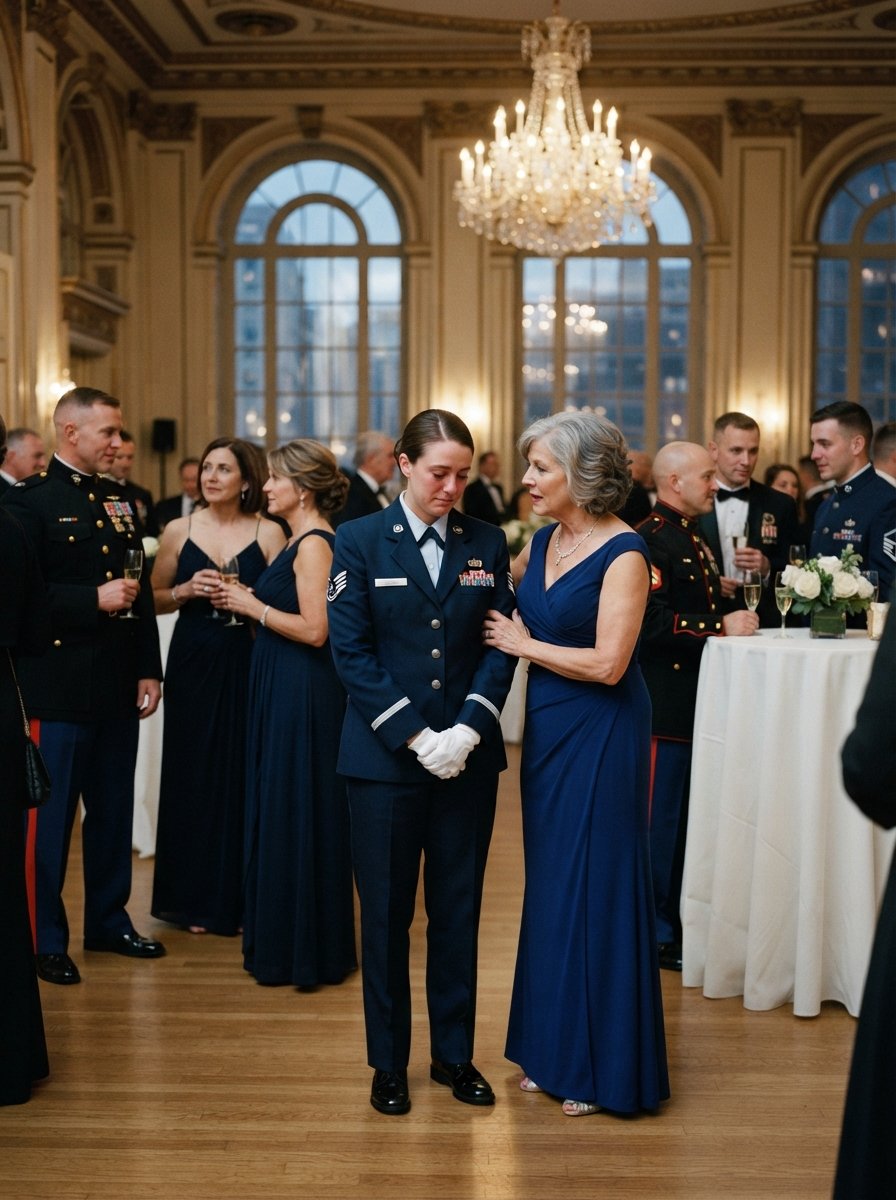
“They know what the uniform means.”
Several officers nearby shifted slightly, but nobody interrupted.
That mattered.
They were not standing because a rumor had spread across the room about my family.
They were not standing because anyone wanted to embarrass Daniel.
They were standing because military people recognize things civilians often overlook: rank, responsibility, years, units, ribbons, decorations, and the quiet weight carried by someone who has spent a career doing the work.
My family had seen the same uniform and somehow decided it was a costume.
General Hayes opened the folder again.
He did not hand it to Daniel.
He read from it.
The language was formal, measured, and specific enough that I stopped hearing the room around me.
I had read the citation before.
I knew every sentence.
Still, hearing it spoken aloud in front of the people who had mocked the evidence on my chest felt different.
The citation described decisions made under pressure, responsibility accepted when circumstances became dangerous, and actions that protected others while placing my own safety second.
No dramatic embellishment was needed.
The facts were enough.
My mother’s face changed before the reading ended.
Not into pride.
Not yet.
First came confusion.
Then calculation.
I knew that expression too.
She was trying to fit this version of me into the family story she had repeated for years.
Daniel was the serious one.
Daniel was the disciplined one.
Daniel was the child who had made something of himself.
Emily was the difficult daughter who stayed away, missed holidays, took strange assignments, and never seemed interested in explaining herself.
That story had worked because nobody in the family ever challenged it.
Until now.
When General Hayes finished, he closed the folder and looked at me.
“Colonel Carter.”
The rank sounded almost ordinary in his voice.
That made it more powerful.
My mother flinched again.
She had whispered “lieutenant colonel” only minutes earlier as though even that rank were impossible.
Now she was hearing another title attached to the daughter whose wrist she had grabbed near the register.
General Hayes lifted the medal from its case.
I stood still.
For years, I had imagined what recognition might feel like.
I had assumed there would be pride.
Maybe relief.
Maybe some clean moment when the work and sacrifice suddenly formed a shape I could understand.
Instead, I noticed ridiculous things.
The faint scent of coffee from the service station near the wall.
The pressure of my shoes against the ballroom floor.
The crease Aunt Linda had left in her napkin.
Ashley’s phone hanging uselessly at her side.
My mother’s hand, the same hand that had closed around my wrist, now resting motionless on her lap.
Then the medal was secured in place.
General Hayes stepped back.
Applause started from somewhere near the front.
It spread quickly.
I did not look for who began it.
I looked at Daniel.
He had moved away from the stage by then, but only by a few feet.
His face was tense.
His promotion had not disappeared.
His work had not suddenly become meaningless.
That was important to me, even then.
I did not want his career taken away simply because mine had finally become visible.
His achievement could remain an achievement.
What could not remain was the idea that his success required my erasure.
When the applause faded, Daniel spoke again.
“So this was planned?”
“Yes,” General Hayes said.
“And nobody thought I should know?”
The general looked toward me before answering.
“That was not my decision to make.”
Daniel understood the message.
If I had wanted him informed, he would have been informed.
I had not.
My mother stood abruptly.
“Emily.”
There was a softness in her voice now that had not existed near the registration table.
I turned toward her.
She took one step forward, then another.
For a second I wondered whether she was coming to hug me.
Instead, she stopped below the stage.
“Why didn’t you tell me?”
There it was again.
I looked at her carefully.
“I did tell you about my promotions.”
“Not this.”
“I couldn’t tell you about something before it was ready to be announced.”
“That’s not what I mean.”
Her voice cracked on the last word.
I knew exactly what she meant.
Why didn’t you force me to understand you?
Why didn’t you make me listen?
Why didn’t you give me one more opportunity to care after all the opportunities I ignored?
I stepped down from the stage.
Now we were standing almost exactly where she had wanted me hours earlier: away from the center, out of Daniel’s way.
Only the entire room was watching us.
“I told you enough,” I said quietly.
She shook her head.
“No, Emily.”
“Yes.”
The word came out calm.
“You knew I was serving. You knew I was moving. You knew there were years I couldn’t come home when you wanted me to. You knew I kept advancing. You knew I had responsibilities. Every time I tried to talk about them, the conversation became Daniel.”
Daniel stepped closer.
“Don’t put this on me.”
“I’m not.”
“You just did.”
“No. Mom did.”
That stopped him.
I faced him fully.
“You earned tonight’s promotion. I never said otherwise.”
His jaw tightened.
“Then why does this feel like you came here to upstage me?”
“Because you were taught that if I was recognized, something was being taken from you.”
Aunt Linda drew in a breath.
My mother looked toward her, then back at me.
Daniel stared at the carpet for a moment.
I did not push.
I had spent enough years proving things to people determined not to see them.
The difference that night was that I finally understood I did not have to keep doing it.
Ashley was the first family member to move toward me without being asked.
She held her phone against her chest.
“I was recording you.”
“I noticed.”
Her cheeks flushed.
“I thought it was funny.”
“I noticed that too.”
She swallowed.
“I didn’t know.”
I looked at the phone.
That little rectangle had been raised because she believed she was capturing the embarrassing aunt or cousin or relative who had shown up pretending to be more important than she was.
Instead, she had recorded the family revealing exactly how little they knew about me.
“You didn’t need to know everything,” I said. “You only needed to not humiliate someone you didn’t understand.”
Ashley’s thumb moved across the screen.
She deleted nothing in front of me.
She made no promise about posting it.
She simply lowered the phone and said, “I’m sorry.”
It was the first apology of the night.
A small one.
But real.
Aunt Linda approached next.
She stared at the Silver Star.
I could see the question forming before she asked it.
This time she stopped herself.
Earlier, she had laughed and asked whether my medals were really mine.
Now she seemed to understand that asking for proof again would only repeat the insult.
“I shouldn’t have said that,” she told me.
“No.”
“I was joking.”
“You were laughing.”
Her mouth tightened.
Then she nodded.
“Fair.”
That was all I needed from her.
My mother was harder.
She waited until the room began resetting for Daniel’s promotion recognition before approaching me again.
Chairs shifted.
Programs opened.
Conversations restarted in quiet pockets.
The event was not canceled.
Daniel’s career did not evaporate because my name had been spoken first.
Life had room for both facts.
My mother stood beside me near the aisle.
“I’m proud of you,” she said.
I believed she wanted that sentence to repair something.
It didn’t.
Not because I wanted revenge.
Because pride offered only after public proof is different from interest given before anyone is watching.
I looked at her.
“Do you know where I was stationed before my last assignment?”
She froze.
I waited.
Her lips parted.
Nothing came out.
“Do you know what my job was before this promotion?”
She looked toward my uniform as if the answer might be printed somewhere she could read quickly.
I asked one more.
“Do you know how long I held my previous rank?”
“Emily, I’m trying.”
“No. You’re reacting.”
She blinked.
There was no cruelty in saying it.
It was simply true.
“Trying starts after tonight,” I said. “If you still want to.”
She looked wounded by that.
For years, I would have rushed to soften it.
I would have explained that of course she was my mother, of course I loved her, of course I wasn’t going anywhere.
That night I let the boundary stand on its own.
Across the ballroom, Daniel was being called into position for the ceremony everyone had originally come to see.
He glanced toward me.
For the first time all evening, there was no smirk.
There was also no apology.
Not yet.
I went back to my seat anyway.
Not the back of the room.
My assigned seat.
The one my mother had told me I did not deserve.
Daniel’s promotion proceeded.
When his name was announced, I stood with everyone else.
I applauded.
My mother looked at me as though that surprised her more than the medal had.
Maybe she expected punishment.
Maybe Daniel did too.
But recognizing his achievement did not diminish mine.
That had been their mistake, not mine.
Afterward, Daniel found me near the same registration table where the evening had begun.
The young captain who had tried to greet me earlier was busy elsewhere now.
The register still lay open.
My signature was there at 6:14 p.m.
Daniel looked at it.
Then at me.
“You really weren’t going to say anything?”
“About what?”
“About tonight.”
“I was invited to attend. I attended.”
“You knew they were recognizing you before my promotion.”
“Yes.”
“And you didn’t think that would be a problem?”
I studied him.
“Why would my recognition be a problem for you?”
He started to answer, stopped, then rubbed a hand across the back of his neck.
That was the first moment all night when he looked less like my mother’s perfect example and more like the brother I remembered growing up with.
Competitive.
Proud.
Sometimes generous.
Sometimes cruel when being admired felt like oxygen.
“I don’t know,” he finally said.
That answer mattered more than an excuse would have.
He looked toward the ballroom.
“Mom told everyone you were barely still in.”
I felt something settle inside me.
Not shock.
The opposite.
Recognition.
“She told people you kept bouncing around because you couldn’t get anywhere,” he continued. “She said you never really wanted a serious career.”
“And you believed her.”
He did not answer immediately.
“I never checked.”
“No.”
His eyes dropped to the register again.
“I should have.”
It was not a full apology.
But it was the first time Daniel had admitted that ignorance had been a choice.
My mother had shaped the story.
He had benefited from it.
Aunt Linda had repeated it.
Ashley had turned it into entertainment.
But none of them had been prevented from asking me a question.
That was the part I had finally stopped carrying for them.
Daniel looked at the medal on my uniform.
“Is it okay if I ask about that?”
The question almost broke me.
Not because it was profound.
Because it was ordinary.
It was the kind of question a brother could have asked years ago.
I nodded.
“Not tonight.”
He accepted that.
“Okay.”
Then he stepped aside so I could pass.
No grand reconciliation followed.
No speech fixed the family.
My mother did not suddenly understand every year she had ignored.
Daniel did not become a different brother before we left the ballroom.
Aunt Linda did not transform into my defender.
Ashley’s apology did not erase the fact that she had wanted strangers online to laugh at me.
But the old family arrangement had cracked.
That was enough for one night.
Before I left, I returned to the table near the entrance and picked up one of the folded programs.
Earlier, it had seemed like another object proving that the evening belonged to Daniel.
Now I opened it and looked at both names associated with the night.
His achievement was there.
Mine was real whether it was printed there or not.
My mother came up beside me.
She did not touch my wrist this time.
“Will you call me?” she asked.
I folded the program once.
“When I’m ready.”
She nodded.
That was new too.
She did not tell me when.
She did not tell me what a good daughter would do.
She did not invoke Daniel, the family, appearances, or embarrassment.
She simply let me leave.
Outside the ballroom doors, the noise softened behind me.
I could still hear glasses being collected and voices moving through the end of the reception.
For most of my life, I had thought being seen by my family would require one perfect moment—one achievement too large to dismiss, one rank too obvious to minimize, one medal too undeniable to mock.
I was wrong.
The medal did not make me worthy.
The general calling my name did not make me belong.
Those things only exposed how much energy I had wasted waiting for people I loved to confirm what years of work had already established.
The next part would be harder than any ceremony.
They would have to decide whether they wanted a relationship with the real me instead of the smaller version they had built for convenience.
And I would have to decide how much access they deserved while they figured it out.
I looked down at the hand my mother had grabbed earlier.
There was no dramatic bruise.
No lasting mark.
Just the memory of her fingers tightening while she told me to stand in the back and pretend I did not belong.
Then I looked at the Silver Star secured to my uniform.
For once, I did not imagine showing it to anyone.
I did not picture my mother explaining it to relatives or Daniel mentioning it to colleagues or Ashley posting a corrected version of the video.
I thought about the people who had already known me without needing a ballroom to prove anything.
Then I walked out carrying the folded program in one hand.
For years, my family had treated every room as though there were only one place of honor and Daniel was standing in it.
That night finally proved something simpler.
There had always been room for both of us.
They were the ones who kept trying to make mine disappear.