My wife was cremated on a Thursday. By Saturday morning, my son-in-law was standing in my kitchen asking about her life insurance policy before the coffee had even finished brewing. He thought I was just a broken old man who didn’t notice things anymore. He was wrong about that.
He was wrong about almost everything. My name is Edgar. I am 63 years old. For 27 years, I worked as a criminal investigator for the IRS out of the Houston field office. My job was not collecting taxes. My job was finding the people who lied about them.
The ones who built elaborate shell companies and offshore accounts and layers of paper designed to look like legitimate business. I found them. I always found them because liars have a tell that has nothing to do with their eyes or their voice. The tell is in the paperwork.
Numbers do not lie. People lie. Numbers just record what people do. I retired four years ago. I thought I was done with that work. I thought Sylvia and I would spend our mornings drinking coffee on the back porch of our
house in the Heights neighborhood of Houston, watching the mocking birds fight over the feeder she had hung from the pecan tree.
She had a way of naming the birds. Not all of them, just the ones with distinct personalities. There was a fat one she called senator. There was a scrappy one with a bent tail she called justice. She said justice always won, even against birds twice her size.
I think she was talking about herself.
Sylvie died 11 days ago. The paramedics said it was cardiac arrest. She was 59 years old and she had a heart condition, a mild arhythmia she had managed with medication for 8 years. The doctor who signed the death certificate knew her medical history.
He said these things happen. He said the heart is unpredictable. He said I should take comfort in knowing she did not suffer.
I had not been taking much comfort in anything when my son-in-law, Ryan, walked into my kitchen that Saturday morning and sat himself down across from me at the breakfast table without being invited.
He was wearing pressed slacks and a collared shirt at 7:00 in the morning. Ryan always dressed like a man who was about to close a deal because he was always about to close a deal.
He was 34 years old, and he had the kind of handsome that only holds up at a distance. Up close, there was something off about it. Something behind the eyes that never quite matched the smile.
He told me he was worried about me. He told me my daughter Annette was worried about me. He told me the estate was complicated and that waiting too long to organize the paperwork would only make things harder.
He set a folder on the table.
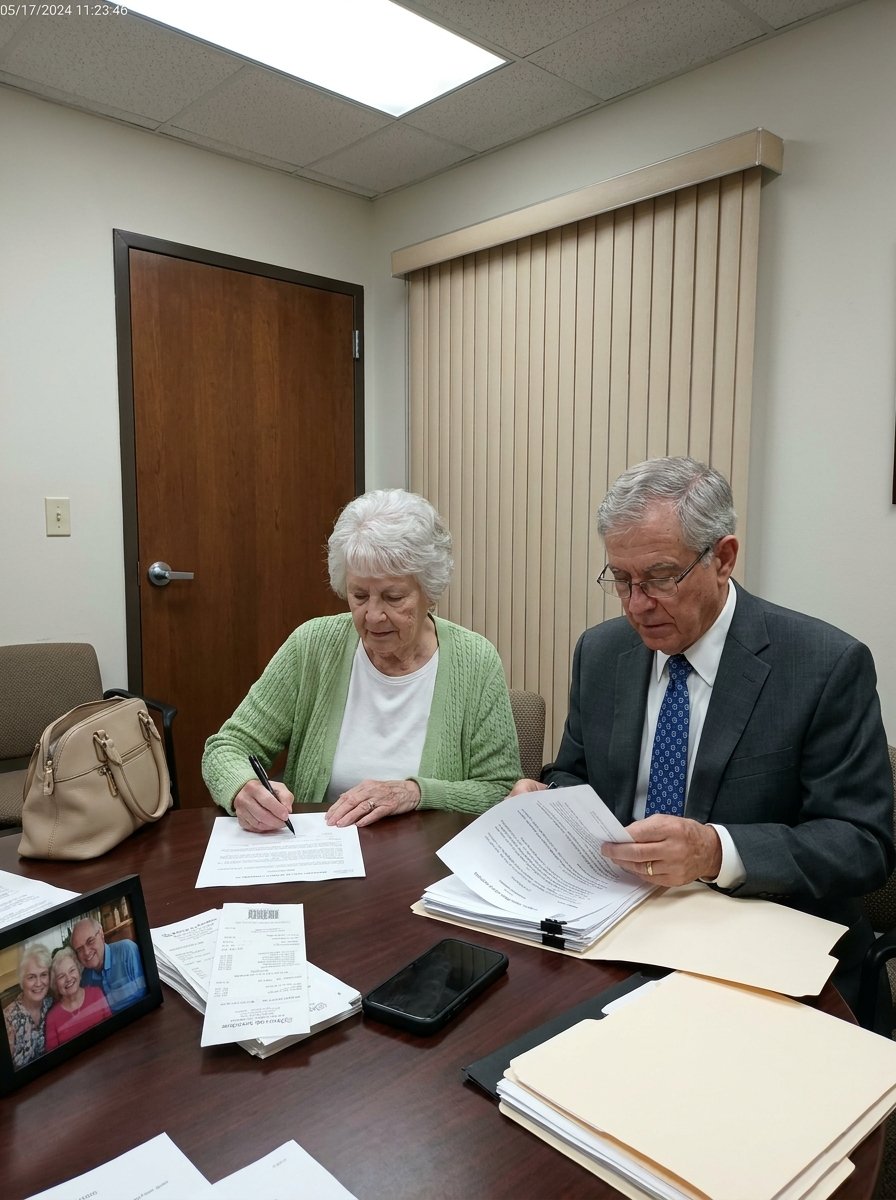
Inside was a document he wanted me to sign, a general power of attorney.
I looked at the document. Then I looked at him. Then I said I needed more coffee. And I stood up and turned my back to him so he would not see my face.
[snorts]
I had drafted enough fraudulent POA documents in my career to recognize the template.
It was a form that would give Ryan authority over my bank accounts, my property, my medical decisions, my everything.
He had printed it on plain copy paper from his home office and filled in the blanks with a pen. He was not even trying very hard.
I told him I needed time to grieve. I told him I could not look at papers right now.
He pushed gently and then less gently, and I watched his hands the whole time. He drumed his fingers on the table. He straightened the folder twice.
He could not keep still.
That was when my phone rang.
The number was unfamiliar. Houston area code, but a neighborhood I did not recognize.
I excused myself and walked to the back porch to answer.
The man on the other end introduced himself as Booker.
His voice was deep and measured, the voice of someone who had spent years in rooms where staying calm was a matter of survival.
He said he was the owner of a small rental property on Cavalcade Street in the fifth ward. He said my wife had been renting a unit from him for the past 2 years, paying in cash monthtomonth, never missing a payment, never causing a problem.
I stood very still on that porch.
A mocking bird landed on the feeder and stared at me.
Booker said Sylvie had left him specific instructions. He said if anything ever happened to her, he was to call me and only me.
He was not to call my daughter.
He was absolutely not to call my daughter’s husband.
He said she had made him write those instructions down and sign them. He said she had given him a copy to keep.
He said there was something in the unit I needed to see, and I needed to see it before anyone else did.
I told Ryan I had to run an errand.
He asked what errand.
I told him it was about the cremation, a clerical matter with the funeral home.
He watched me from the kitchen window as I backed out of the driveway.
His expression was not grief. It was calculation.
The fifth ward is a part of Houston that real estate developers have been trying to gentrify for 20 years without much success.
The streets are wide and sunbleleached, lined with houses that have survived hurricanes and neglect and everything in between.
Booker’s property was a converted craftsman bungalow divided into two units.
He was sitting on the front steps when I arrived. A large man in his 60s with closecropped gray hair and the posture of a former cop, which is what he turned out to be.
22 years with Houston PD, retired as a sergeant.
He shook my hand and did not say he was sorry about Sylvie, which I appreciated.
He just handed me a key and pointed to the side entrance.
The door at the top of the stairs was solid core steel, newly installed with a deadbolt that required a specific key cut.
Sylvia had put that door in herself.
Booker said she had paid a locksmith she found through a church directory, not the internet.
She did not want a digital trail.
I unlocked the door and walked in.
The room was small, maybe 12×4.
There was no furniture except a folding table and a metal chair. The blinds on the single window were painted shut.
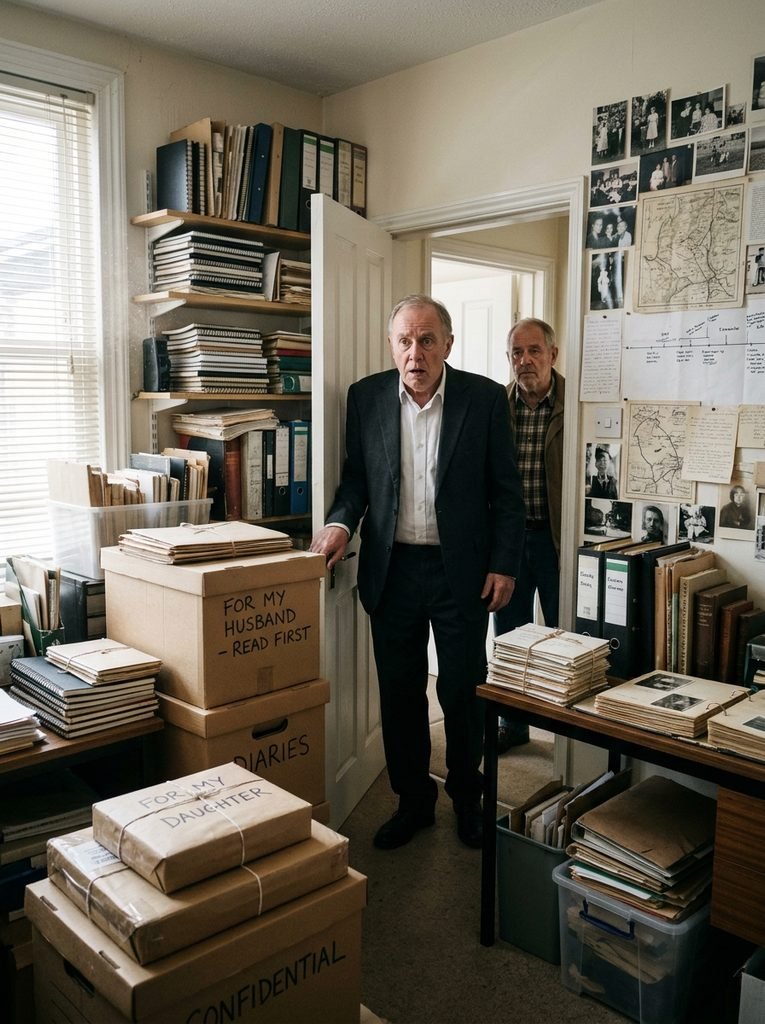
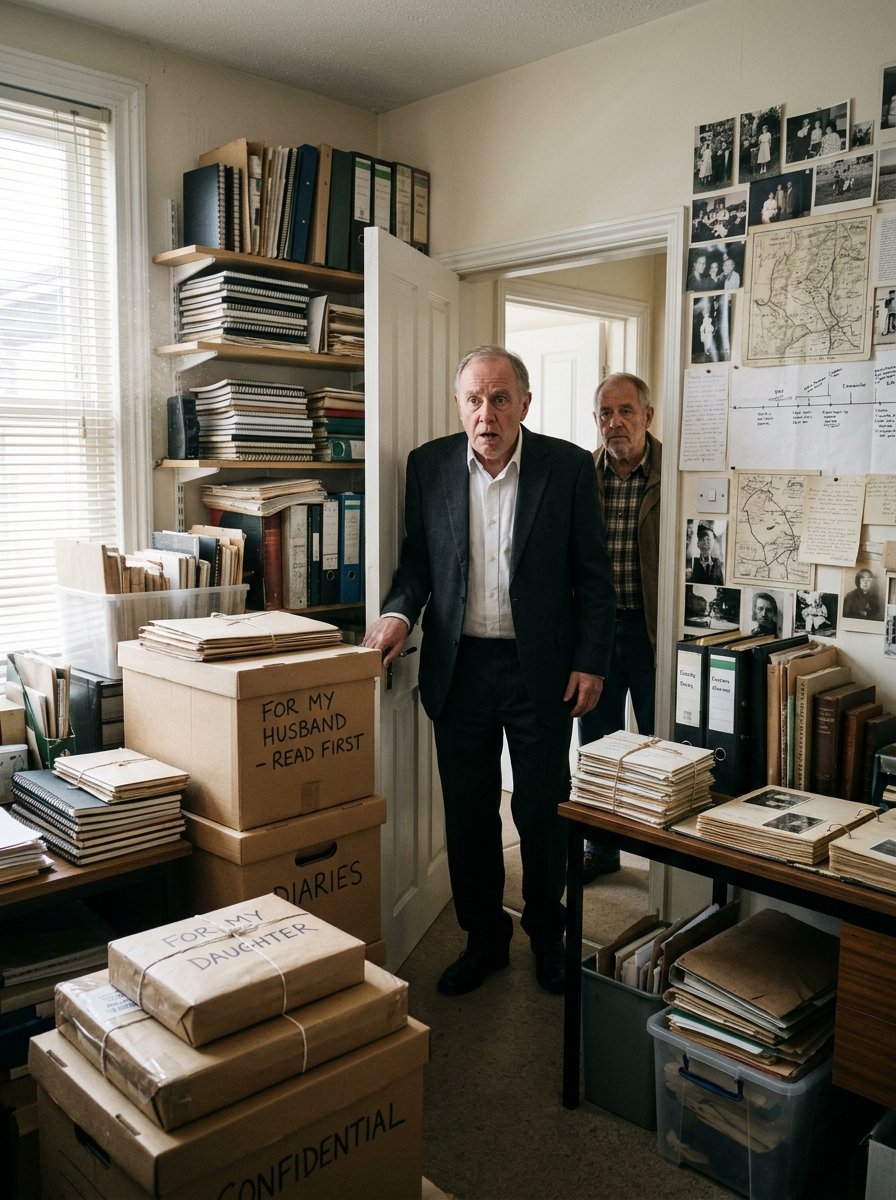
The walls were covered in corkboard panels, and the corkboard was covered in paper, photographs, bank statements, corporate filings, maps of the Houston metro area with addresses circled in red ink, strings of orange yarn connecting documents to names to dates.
At the center of it all was a photograph of Ryan.
She had written one word beneath his photo in black marker.
She wrote it in capital letters and underlined it three times.
The word was thief.
I sat down in the metal chair.
My hands were in my lap.
I looked at what my wife had spent two years building in secret.
And I felt a grief that was different from the grief I had been carrying since she died.
This grief was colder.
It was the grief of realizing that the person you loved most had been fighting a war alone and had not told you because she was afraid of what it would do to you to know.
On the table there was a binder and a sealed envelope with my name on it in her handwriting.
I opened the envelope first.
It was a letter, three pages, front and back, written in her small, careful script.
She began by telling me she loved me, and she said it the way she always said things she meant, plainly without decoration.
Then she told me what she had found.
It had started 2 years ago when she noticed a discrepancy in our joint savings account.
A small one, $200, transferred to an account number she did not recognize.
She mentioned it to Annette casually, the way you mention a confusing line on a phone bill.
Annette had gone very quiet and then changed the subject.
Sylvia had not pushed, but she had started watching.
Over the next 6 months, she traced the transfers.
They were small enough individually to avoid triggering automatic alerts, but she added them up.
The pattern was unmistakable.
Money flowed from our account to a business account registered under a company called Meridian Property Partners LLC.
Meridian Property Partners was owned by Ryan.
She pulled the corporate filings.
Meridian had no employees, no office, no property listings.
It was a box, a very expensive, very empty box.
Ryan used it to receive the money and then move it through a second LLC into a brokerage account in the Cayman Islands.
Sylvie had found the second LLC by searching a database of dissolved Texas corporations.
She had found the Cayman connection through a routing number trace.
She had no business knowing how to run, except that she had spent 30 years as a bookkeeper for a medical practice, and she understood numbers the way I understood lies.
By the time she put the binder together, she had documented $340,000 in unauthorized transfers out of our accounts over 22 months.
She had also documented something worse.
She had found evidence that Ryan had forged my signature on a home equity line of credit 18 months ago, drawing $95,000 against our house in the Heights.
The money had gone to Meridian.
The monthly payments had been quietly deducted from our account in amount smallest enough that I had not questioned them when I reviewed the statements.
She wrote in the letter that she had not told me because she was afraid.
Not afraid of Ryan. She was clear about that.
She was afraid of what I would do.
She said she knew me.
She said she knew I would confront him directly and that if she was right about what Ryan was capable of, a direct confrontation could get me hurt.
She wanted evidence first.
She wanted enough to put him away.
The last paragraph of the letter was the one that changed everything.
She wrote that she had found an orange prescription bottle in the back of the medicine cabinet in Ryan and Annette’s bathroom during a visit 3 weeks before she died.
She had not meant to snoop.
She had been looking for aspirin.
The bottle had her name on it. Her cardiologist name, the correct medication, the correct dosage.
But when she held it up to the light, the pills inside did not look right.
She had taken two of them to a pharmacist she trusted, a man named Dr. Abara, who operated out of a small independent drugstore in my.
He had called her back the following afternoon.
The pills were not her heart medication.
They were a compounded stimulant highdosese caffeine combined with a synthetic ephedrin compound.
For a woman with her particular arhythmia, taking those pills in place of her actual medication would not look like poisoning on a standard toxicological screen.
It would look like her heart had simply stopped.
She wrote, “Eddar, if you are reading this, then it happened. I need you to find Dr. Abara. His address is in the binder. He kept the pills. He kept his notes. Do not go to the police yet. Read the binder first. Read everything. You spent 27 years building cases that held up in federal court. Build this one.”
Then she signed it the way she signed birthday cards and grocery lists and every piece of paper that passed through her hands.
“All my love forever, Sylvie.”
I sat in that room for a long time.
I did not cry.
I would cry later.
Much later, alone on the back porch with the mocking birds.
Right now, I was doing the thing she had asked me to do.
I was reading the binder.
I was building the case.
I drove back to the house in the Heights and I walked through the front door and I sat in the living room and I looked at Ryan and I was the saddest, most confused old man he had ever seen in his life.
I told him my head was pounding.
I told him the errand had taken a lot out of me.
I told him we could talk about the paperwork tomorrow.
He said okay, but his jaw was tight.
He was watching the clock.
He had a timeline and I was not moving fast enough for it.
That evening, I called a woman named Charlotte Fields.
She was an estate attorney out of the Galleria area, and her number was in the binder with a note in Sylvy’s handwriting that said, “She knows everything. She has been ready for 2 months.”
Charlotte answered on the second ring.
When I told her who I was, she said, “I have been waiting for this call. I am so sorry it is the call it is.”
She told me Sylvie had come to her 7 weeks before she died.
She told me that in that meeting, Sylvie had transferred our home into an irrevocable trust named the Sylvie Webb Family Trust with me as the sole trustee.
She told me the house equity line Ryan had drawn it against was now legally invalid because the property it was secured against no longer existed as a personal asset.
She told me she had also secured a meeting with the FBI’s financial crimes unit and that if I was prepared to move, the case was already built.
She said one more thing before we hung up.
She said, “Your wife was one of the most methodical people I have ever worked with.”
She said she was afraid, but she was never confused about what needed to happen.
I said, “I know.”
I said, “I lived with her for 38 years.”
The next morning, I let Ryan hand me the power of attorney form again.
I made my hand shake when I took the pen.
I wrote my name the way a frightened old man writes it, cramped and uneven, the letters collapsing into each other.
Ryan watched with the focused patience of a man watching a timer countdown.
When I finished, he practically snatched the form off the table.
He said we would get to the bank Monday morning.
He said he would make sure everything was taken care of.
He said I was doing the right thing.
I told him thank you.
I told him I did not know what I would do without him and Annette.
I watched him walk out of the kitchen and I thought about Sylvie in that room on Cavalcade Street with her corkboard and her orange yarn, working in silence while Ryan sat at our dinner table three nights a week and ate the food she cooked.
The meeting at the bank happened on Monday.
Ryan brought the power of attorney.
He brought a notary he had arranged himself, a young woman who did not look at the document carefully enough to notice that the signature did not match my actual signature on file or that the notoriization of the document was dated 3 days before I had supposedly signed it.
But the bank’s fraud department did notice.
Charlotte had called the branch manager on Friday.
The accounts were flagged for verification before we arrived.
The manager asked to speak with me privately.
Ryan objected.
I went in alone.
I told the manager everything I needed to tell her.
She picked up her phone.
I went back to the lobby and sat next to Ryan and told him the manager just needed to verify a routing number.
He believed me because he needed to believe me and because he had decided long ago that I was not a threat.
The FBI agents came through the bankside entrance 17 minutes later.
Charlotte had coordinated with the Houston field office and the timing was precise.
Two agents in suits walked into the lobby.
Ryan looked at them and then looked at me.
And for the first time since I had known him, I saw it.
I saw the mask fall completely off.
Underneath it, there was nothing remarkable, just a scared young man who had made a catastrophic miscalculation about the people he had decided to steal from.
I looked at him calmly.
I said, “I spent 27 years finding people like you. The only difference is that this time it was personal.”
He tried to stand.
An agent put a hand on his shoulder and he sat back down.
They arrested him on 14 counts.
Wire fraud, bank fraud, forgery, theft, and when Dr. Abara’s analysis came in 48 hours later, a charge of first-degree murder.
The medical examiner petitioned for a secondary review of Sylvy’s autopsy.
Dr. Abara had kept both pills and his written findings in a sealed envelope he had given Sylvie.
The envelope had her fingerprints on it and a date stamp from the day she visited his pharmacy.
Combined with they’s own security footage from that day, it was enough to compel a full toxicological reanalysis.
The results came back positive for the compound Dr. Abara had identified.
Sylvie had been taking it for weeks slowly every morning in the place of the medication that was supposed to protect her heart.
Annette did not take it well.
That is the easiest and least accurate way I can describe what happened when I sat across from my daughter in the kitchen and laid it out for her.
All of it, beginning to end, the binder and the bank records and the pills and the attorney and the FBI.
She went through five separate emotional states in the space of 20 minutes.
She started with denial and ended somewhere beyond grief in a place I do not have a name for.
She said she had not known.
She said it through tears that were so raw I believed her.
But I also told her quietly and without anger that not knowing is not the same as not seeing.
I told her that I had watched Ryan interrupt her in front of other people.
That I had watched him make small jokes at her expense and call them affection.
That I had watched him isolate her from her friends one scheduling conflict at a time over 5 years and that she had looked me in the eye at every family dinner and told me everything was fine.
I told her that her mother had known something was wrong long before she opened that prescription bottle and that the reason Sylvie had worked alone was because she was afraid Annette would tell Ryan if she knew.
That was not a small thing for me to say and it was not a small thing for Annette to hear.
She moved back in with me after Ryan was arraigned.
I told her she could stay in the guest room for 90 days.
I told her I would not pay her bills.
I would not give her spending money.
And I would not let her spend those 90 days sitting in front of the television processing.
I told her she needed to find work.
She had a degree in accounting she had not used since she married Ryan at 26.
I told her that was not a gap in her resume.
That was a starting point.
She cried when I said it.
I let her cry.
Sylvia used to say that the kindest thing you could do for someone who needed to grow was to hand them the shovel and step back.
I was stepping back.
It was the hardest thing I had done since I read that letter.
Ryan took a plea deal to avoid a full trial.
32 years in federal prison.
His attorney argued that the murder charge should be reduced to manslaughter on grounds of mitigating circumstances.
The judge looked at the evidence that Ryan had systematically replaced Sylv’s heart medication over a period of 6 weeks and declined to find any circumstances mitigating enough.
Ryan was led out in handcuffs wearing the same kind of pressed collared shirt he had worn to every Sunday dinner in my house, and I felt a coldness and a satisfaction that I do not apologize for.
The house in the heights is mine.
The trust Sylvie built to protect it is intact.
The equity line Ryan forged is being contested in civil court and Charlotte is confident we will prevail.
The $340,000 is largely gone, distributed through offshore accounts that the FBI is still untangling.
I do not expect to recover most of it, but the house is mine, and the house is what Sylvie fought to protect.
I go back to the unit on Cavalcade Street.
Sometimes Booker leaves it unlocked for me.
I sit in the metal chair and I look at the corkboard, which I have not taken down yet.
I am not ready to take it down yet.
When I look at it, I do not see grief.
I see intelligence.
I see 38 years of a woman who understood exactly what was at stake and paid the highest possible price to make sure the people she loved were protected.
I took down one thing.
I took down the photograph of Ryan.
I put it in an envelope and I mailed it to his attorney.
I thought he should have something to remember.
The starting point of all this, some record of the moment he underestimated the wrong family.
In the photos place on the corkboard, I pinned a single index card.
I wrote three words on it.
The same words Sylvie said to me when we signed the papers on the house in the heights 31 years ago, standing in the rain with the realtor hovering behind us under an umbrella, the ink going soft at the edges because we had not waited to get inside before we signed.
Worth every fight.
Last week, Annette started a bookkeeping job with a small construction company in the East End.
She called me on her first evening to tell me she had found two errors in the previous month’s accounts.
She sounded surprised by herself, the way people sound when they discover that the thing they abandoned still fits.
I told her that running numbers was in her blood.
I told her her mother would have had a few choice words about the timing, but she would have been proud.
There was a silence on the line and then Annette said, “Dad, I need you to know that I know.”
She was not talking about the fraud.
She was talking about the years before it.
She was talking about every dinner, every warning I softpedled, every moment she had chosen him over the truth of what she was watching with her own eyes.
I said, “I know you know.”
I said, “That’s enough for now.”
The mocking birds are still at the feeder.
Senator is still fat and self-important.
Justice still wins every argument.
I watch them from the porch in the mornings with my coffee, and I talk to Sylvia the way I always did, out loud, as if she just stepped inside for a moment and will be back shortly.
I tell her the case is closed.
I tell her the book’s balance.
I tell her the house is safe and our daughter is learning how to stand without leaning on a man who does not deserve the weight.
I tell her she was right about everything.
I tell her I should have looked closer sooner the way she always did, but I was never as good at reading people as she was.
Numbers were my language.
People were hers.
And in the end, her reading of Ryan was the most important audit this family ever had.
Protect your name.
Protect your assets.
But most of all, protect your own eyes.
Do not let love make you stop looking.
The people who steal from you in daylight always count on the ones who love you too much to believe what they are seeing.
Do not give them that advantage.
Your life savings are only as safe as the people you let near them.
And a kind face has never been evidence of a kind intention.
Trust is earned in the paperwork, not the presentation.
I learned that from 27 years of federal investigations and one extraordinary woman who built a war room in the fifth ward and left me the.