PART 1
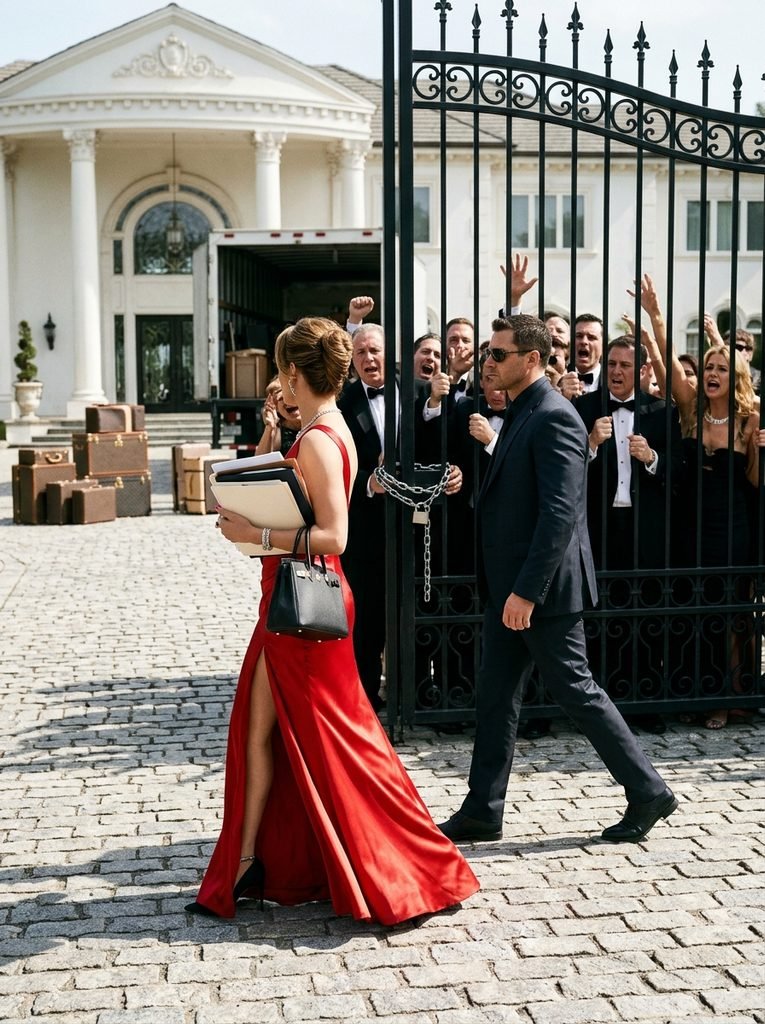
She pointed at my mansion and screamed:
“OPEN THE GATE! THIS HOUSE BELONGS TO THE MONTGOMERYS NOW!”
What Patricia didn’t realize was that the gates had been locked for a reason.
And my attorney was already on her way.
The judge had barely finished signing the final divorce papers when my phone vibrated.
MOTION DETECTED — FRONT GATE.
I sat outside the courthouse in Greenwich, Connecticut, looking down at the cream-colored folder resting on my lap.
Five years of marriage.
Five years of memories.
And now, it was all over.
Across the courthouse steps, Ryan Montgomery walked out as if nothing significant had happened.
He adjusted his expensive suit with the same casual confidence he displayed after closing a business deal.
His mother, Patricia, waited beside the elevator.
Her hair was perfectly styled.
Diamond earrings sparkled against her neck.
Designer sunglasses concealed her eyes.
And that familiar smile remained plastered across her face, the one that had always made me feel as though she knew something I didn’t.
“Well,” she announced loudly enough for me to hear, “at least now everyone can move on.”
Ryan offered no response.
He simply followed her outside.
Then my phone vibrated again.
I opened the security camera feed.
My stomach dropped.
Two moving trucks were parked directly outside my estate in Westport.
Patricia stood beside them.
Ryan’s sister, Vanessa, was there, too.
So was his brother, Brandon.
Several movers were already unloading boxes from the trucks.
They hadn’t come to visit.
They had come to move in.
I stared at the screen, struggling to believe the audacity of what I was seeing.
The mansion behind those gates had belonged to me long before Ryan had entered my life.
I had purchased it three years before our wedding.
My parents had helped me secure the property shortly before they passed away, and I had spent years preserving the home they had helped me obtain.
Ryan had never made a mortgage payment.
He had never contributed to the purchase.
He had never held an ownership interest in the property.
Yet throughout our five-year marriage, he had posed for photographs in front of the mansion and allowed everyone to believe it belonged to the Montgomery fortune.
Then another notification appeared on my screen.
UNAUTHORIZED ACCESS ATTEMPT.
Brandon was repeatedly entering codes into the gate’s keypad.
Vanessa was recording the entire scene on her phone.
And Patricia?
She was pointing toward the mansion as though she were a queen assigning rooms to her servants.
My phone buzzed again.
A message from Ryan appeared.
“Open the gate, Madison. Don’t make this more difficult than it has to be. Mom only needs the guest wing until things settle down.”
I read the message twice.
Then I burst out laughing.
They genuinely believed that our divorce had somehow granted them the right to take possession of my home.
I typed one sentence in response.
“I’ll see you at the gate.”
Then I called my attorney.
“Victoria,” I said.
“They’ve arrived.”
There was a brief silence.
“With moving trucks?”
“Two.”
Her voice suddenly acquired an amused edge.
“Perfect.”
“Perfect?”
“They’ve brought trucks, witnesses, cameras, and enough confidence to make this very easy.”
By the time I reached my estate, the entire street had become a spectacle.
Police vehicles were parked nearby.
Neighbors were watching through their windows.
Vanessa was livestreaming the confrontation.
Brandon paced furiously beside the trucks.
And Patricia was arguing with an officer, desperately attempting to preserve her polished, untouchable image.
The gates remained firmly closed.
Beyond them stood my mansion.
Quiet.
Beautiful.
Mine.
I stepped out of my car.
Patricia spotted me immediately.
“Finally!”
She marched toward the gate.
“Open it, Madison. You’ve embarrassed this family enough.”
I approached her without losing my composure.
“Good afternoon, Patricia.”
Her expression hardened.
“Don’t speak to me like that. Ryan lived here for years. He has every right to this property.”
“No,” I replied.
“He doesn’t.”
Vanessa raised her phone higher.
“Everyone watching this,” she declared to her livestream, “my former sister-in-law is trying to throw an entire family onto the street after taking everything from my brother!”
I looked directly into her camera.
I didn’t argue.
I didn’t attempt to justify myself.
I simply smiled.
Because they had absolutely no idea what my attorney had uncovered during the divorce proceedings.
And in less than ten minutes…
their entire scheme was about to collapse in front of the police, the neighbors, and everyone watching that livestream.
Patricia believed she had arrived to claim a mansion.
She was about to discover that she hadn’t even been standing on the right side of the gate.
Patricia struck the metal gate with the palm of her hand.
“Madison, this is ridiculous! Open it immediately!”
The police officer standing nearby raised one hand.
“Ma’am, please step away from the gate. We need everyone to remain calm.”
Patricia spun toward him.
“Do you know who my family is?”
The officer looked at her without changing his expression.
“Yes, ma’am. You’re the person who’s been trying to enter private property without authorization.”
A few neighbors laughed.
Patricia’s face flushed.
Vanessa immediately turned her camera toward the officer.
“This is unbelievable! My family is being harassed while we’re trying to retrieve what belongs to us!”
I watched her perform for her audience.
For years, the Montgomerys had operated as though the world were a stage and everyone else existed to admire them.
Ryan’s father had built a successful regional construction company decades earlier. The family still enjoyed a comfortable lifestyle, but their reputation was worth more to them than their actual financial circumstances.
They dressed expensively.
They entertained lavishly.
They spoke constantly about investments, connections, and influence.
What they rarely discussed was the debt hidden behind their polished appearance.
Ryan had always insisted that family matters should remain private.
Whenever I asked questions about his business dealings, he would kiss my forehead and tell me not to worry.
Whenever Patricia criticized my spending, she reminded me that marrying a Montgomery meant learning to think about wealth as a family resource.
And whenever I mentioned that the mansion belonged to me alone, Ryan would laugh.
“What’s yours is mine, sweetheart. That’s what marriage means.”
At the time, I thought he was being affectionate.
Eventually, I understood that he was testing how far he could push me.
During the last year of our marriage, Ryan had become increasingly interested in the legal documents associated with my estate.
He asked where I kept the deed.
He wanted to know whether my parents had placed the property in a trust.
He questioned the insurance coverage and asked whether I had ever considered refinancing.
I assumed he was trying to help me manage the house.
Now, watching his family arrive with two moving trucks on the very day our divorce became final, I finally understood why those questions had mattered so much.
They hadn’t been preparing for our future.
They had been preparing to take control of mine.
A black sedan turned onto the street.
Victoria Hale, my attorney, stepped out carrying a leather portfolio.
She wore a charcoal suit and had the calm, measured expression I had come to trust during the most difficult months of my life.
She surveyed the scene.
Two moving trucks.
A crowd of neighbors.
A livestreaming Vanessa.
A furious Patricia.
Then Victoria walked directly toward the police officer.
“Good afternoon, Officer. I’m Victoria Hale, counsel for Madison Reed, the owner of this property. I have documents concerning the ownership and the attempted entry.”
Patricia laughed sharply.
“Documents? We don’t need your documents. My son lived in that house for five years!”
Victoria turned toward her.
“Living in a property does not automatically make someone its owner.”
“Ryan is her husband!”
“Former husband,” I corrected quietly.
The words seemed to strike Patricia harder than anything else I had said.
She stared at me.
“You ungrateful little—”
“Mrs. Montgomery,” Victoria interrupted, “I suggest you choose your next words carefully. Your family is currently standing outside a privately owned residence while attempting to force entry.”
Patricia crossed her arms.
“We aren’t forcing anything. We have every right to be here.”
“Excellent,” Victoria replied. “Then you won’t mind explaining the basis for that right.”
She opened her portfolio and removed several documents.
The first was a certified copy of the deed.
The second was a property record confirming my sole ownership.
The third was a copy of the divorce settlement, which expressly excluded the mansion from the assets being divided between Ryan and me.
Victoria handed the documents to the officer.
He reviewed them carefully.
Patricia leaned forward, attempting to read over his shoulder.
“This is a trick,” she announced.
Victoria didn’t look up.
“No. It’s a public record.”
Brandon stopped pacing.
Vanessa lowered her phone slightly.
Ryan, who had arrived moments earlier in his own car, suddenly looked less confident.
I noticed the change immediately.
He had been standing near the rear truck, speaking to one of the movers.
Now he was staring at Victoria’s portfolio.
“Madison,” he said, forcing a smile, “we don’t need to turn this into a public spectacle.”
I almost laughed again.
“You brought two moving trucks to my house on the day our divorce became final.”
“Mom was only trying to help.”
“Help whom?”
He glanced at his mother.
She glared at him, silently demanding that he take control of the situation.
Ryan cleared his throat.
“We discussed using the guest wing.”
“No,” I replied. “You asked me whether your mother could visit for a few days. You never told me you intended to move her belongings into my home.”
“It’s a misunderstanding.”
Victoria finally closed her portfolio.
“Then perhaps you can explain this.”
She removed a printed email and held it where Ryan could see it.
His expression changed.
I recognized the document immediately.
It was one of the messages Victoria had discovered during the divorce proceedings, buried in an account Ryan had used for correspondence with his family.
The subject line read:
WESTPORT HOUSE — OCCUPANCY PLAN.
Patricia’s smile disappeared.
Vanessa stopped recording for a moment.
Brandon stepped closer.
Ryan stared at the page as if he wished it would vanish.
Victoria read aloud.
“Once the divorce is finalized, we move everyone into the house before Madison has time to change the access arrangements. Ryan can argue that the residence was the marital home, and we can insist that the family has already established occupancy.”
A heavy silence fell over the street.
Victoria continued.
“The trucks should arrive immediately after the court hearing. Patricia will handle the confrontation. Vanessa will record everything so we can portray Madison as unreasonable if she refuses entry.”
Vanessa’s face went pale.
“That’s private correspondence!”
Victoria looked at her.
“It’s correspondence obtained and reviewed through the lawful disclosure process in the divorce proceedings. If you believe its use is improper, your attorney can address that through the appropriate channels.”
Ryan reached for the paper.
Victoria withdrew it before he could touch it.
“Don’t.”
He stopped.
For the first time that afternoon, I saw genuine fear in his eyes.
Not fear of losing me.
Not fear of what his family had done.
Fear that someone had finally seen him clearly.
Patricia pointed at the email.
“That doesn’t prove anything! We were discussing possibilities!”
Victoria nodded.
“Then let’s examine the rest of the correspondence.”
She removed another document.
This one contained a message Ryan had sent to his brother several weeks earlier.
If we can establish occupancy before she changes the locks, it’ll be harder for her to get us out. Once Mom is inside, Madison won’t want the embarrassment of a legal fight. She’ll negotiate.
Brandon swore under his breath.
“You told me she had agreed to this!”
Ryan turned on him.
“Not now.”
“No, Ryan. You said she knew about the move!”
Patricia stepped between them.
“Stop it! You’re making everything worse!”
The officer returned the documents to Victoria.
“Based on what I’ve reviewed, this appears to be private property, and there is no evidence presented here that any of you have permission to enter. I’m directing everyone to remain outside the gate while we determine whether any further action is necessary.”
Patricia stared at him.
“You can’t do this to us!”
“I’m not doing anything to you, ma’am. I’m enforcing the law as it applies to the situation in front of me.”
Victoria turned toward me.
“Madison, there’s one more thing you should know.”
I looked at her.
“What is it?”
She glanced toward Ryan.
“Your former husband appears to have represented to his family that he could grant them access to the property. But the evidence suggests that he may also have used your address in connection with a separate financial arrangement.”
My stomach tightened.
“What kind of arrangement?”
Victoria opened the portfolio again.
“A proposed loan.”
Ryan’s head snapped up.
“That’s confidential.”
“Not when the documents concern a property your family has been attempting to occupy,” Victoria replied.
She handed me a copy.
It was a loan proposal submitted to a private lender several weeks earlier.
The property listed as collateral was my mansion.
My name appeared on the first page.
Beside it was a signature that looked remarkably similar to mine.
But I had never signed that document.
I stared at the page.
The date was from a Tuesday afternoon when I had been working in Manhattan.
Ryan had told me he was attending a conference that day.
I remembered because he had called me twice, asking whether I would be home late.
I looked at the signature again.
It was a forgery.
Ryan stepped toward me.
“Madison, let me explain.”
PART 2
I lifted my eyes.
“You used my name?”
“It was only preliminary paperwork.”
“You listed my house as collateral.”
“I was going to discuss it with you.”
“After you obtained the money?”
He rubbed his forehead.
“You don’t understand the circumstances.”
“Then explain them.”
He looked at his mother.
She said nothing.
For once, Patricia had no clever response.
Ryan lowered his voice.
“My father’s company has been experiencing cash-flow problems. We needed temporary financing to cover a few obligations. I thought the house could help us secure better terms.”
“You thought you could borrow against a property you didn’t own?”
“I thought we could work something out.”
“Without my permission?”
He swallowed.
“I was going to tell you.”
“When?”
He had no answer.
Victoria took the document from my hand.
“The lender has been notified that Madison disputes the signature and denies authorizing the proposed transaction. Any further action will be handled through the appropriate legal channels.”
Ryan looked at me with an expression I had once mistaken for love.
“Please,” he said. “Don’t destroy my family over a misunderstanding.”
I stared at him.
“Your family arrived at my house with two moving trucks and a plan to occupy it before I could stop them. You submitted paperwork bearing my name to a lender. And you’re asking me not to destroy your family?”
His face tightened.
I took a breath.
“I didn’t do any of those things, Ryan. You did.”
Vanessa had started recording again.
She pointed her phone at me.
“You’re twisting everything! My brother was trying to protect the family, and you’re using the police to humiliate us!”
I looked at her camera.
“Then show your viewers the documents.”
She blinked.
“What?”
“You’ve been recording this entire confrontation. Show them the deed. Show them the email. Show them the loan proposal with my forged signature.”
Vanessa’s mouth opened, but no words came out.
For several seconds, the only sounds were the idling trucks and the faint rustle of leaves along the street.
Then a voice came from her phone.
Someone watching the livestream had posted a comment.
Wait. Didn’t Vanessa say yesterday that the house belonged to Ryan?
Another comment appeared.
Why would they need moving trucks if they already had permission?
Then another.
Is that really Madison’s signature on the loan paperwork?
Vanessa quickly tilted her phone away.
“I’m ending this,” she muttered.
But the damage had already been done.
Dozens of viewers had watched the confrontation unfold.
Several neighbors had recorded their own videos.
Patricia had wanted an audience.
Now she had one.
And they were no longer applauding.
She turned toward me, her face burning with humiliation.
“You planned this!”
I shook my head.
“No, Patricia. I planned to finish my divorce and go home.”
“You knew we were coming!”
“I received a security alert. That’s how I found out.”
“You could have handled this privately!”
I stared at her.
“You could have asked before bringing two moving trucks to my property.”
Her lips pressed into a thin line.
For years, Patricia had treated my home as though it were a family asset waiting to be claimed.
When Ryan and I first married, she had toured the mansion and immediately begun suggesting renovations.
She wanted the kitchen expanded, the guest wing redecorated, and the garden redesigned to accommodate larger parties.
She had once told me that the house would make an excellent gathering place for the Montgomery family.
I had smiled politely and explained that I preferred to keep it as my private residence.
She had laughed.
“Oh, Madison. Marriage isn’t about keeping things private. It’s about sharing what you have.”
At the time, I had assumed she was talking about hospitality.
Now I understood that she had never considered the possibility that I might refuse her.
The officer spoke to the movers.
“Please stop unloading anything until this matter is resolved.”
The moving crew immediately obeyed.
They had no interest in becoming involved in a family dispute.
One of the men approached Brandon.
“Sir, are we supposed to take this stuff back?”
Brandon looked at Ryan.
Ryan said nothing.
The mover sighed.
“We have another job scheduled this afternoon. We need a decision.”
Patricia spun around.
“Don’t you dare take those boxes back! We’re paying you to move them!”
The mover remained professional.
“We’re being paid to transport property to an authorized destination, ma’am. We can’t unload into a residence where we don’t have permission to enter.”
Victoria stepped forward.
“That is the correct decision. Please return any belongings that have not been unloaded to the trucks. Anything already placed on the public side of the property should remain there until its owner arranges collection.”
The movers began reversing their work.
Boxes went back into the trucks.
Furniture was wrapped again.
A pair of men carried a large wooden cabinet toward the loading ramp.
Patricia watched the process with mounting fury.
“This is not over,” she said to me.
I met her gaze.
“No. It isn’t.”
Ryan moved closer, lowering his voice so the others wouldn’t hear.
“Madison, we need to talk.”
“We’ve talked enough.”
“Please. Just five minutes.”
I hesitated.
Not because I wanted to reconcile.
Not because I was uncertain about the divorce.
But because some part of me still wanted to understand how the man I had loved could have planned something so calculated.
Victoria studied my expression.
“We can speak with him here, with the officer present, or through counsel,” she said quietly. “You don’t have to discuss anything with him today.”
“I know.”
I looked at Ryan.
“Say what you need to say.”
He glanced at the police officer, then at the neighbors.
“I never wanted it to happen like this.”
“Like what?”
“This public humiliation.”
I almost smiled.
“You mean the consequences?”
He shook his head.
“You know how important my family is to me.”
“Yes,” I replied. “I know how important they are. You made that clear every time you asked me to sacrifice something for them.”
His expression hardened.
“You’re acting as though I never did anything for you.”
“I never said that.”
“I supported you.”
“You lived in my house.”
“I was your husband!”
“And I was your wife. That didn’t give me the right to forge your signature or take your property, Ryan.”
He flinched.
For a moment, I thought he might finally acknowledge what he had done.
Instead, he looked toward the trucks.
“You’re making a terrible mistake.”
I felt something inside me settle.
Not anger.
Not sadness.
Certainty.
“No, Ryan. The mistake was believing that love meant I had to ignore every warning sign.”
I turned away.
Victoria followed me through the pedestrian entrance beside the main gate. The officer had verified my identity and ownership, and the entrance was under my control.
Behind us, Patricia was still arguing.
But her voice sounded smaller now.
The moving trucks were preparing to leave.
And Ryan was standing alone on the driveway, watching the house he had once pretended to own disappear behind the closed gates.
Inside the mansion, the silence felt almost unreal.
I had expected to feel victorious.
Instead, I felt exhausted.
Victoria and I sat in the study, where sunlight fell across the oak desk and the shelves my father had installed years earlier.
She placed the loan documents in front of me.
“We need to address this carefully,” she said. “The immediate priority is protecting your property and making sure the lender understands that you never authorized the transaction.”
“What happens now?”
“That depends on the evidence and the lender’s response. The proposed loan appears to have been stopped before funds were released, but we’ll confirm that in writing. We’ll also preserve the emails and any records related to the submission.”
I nodded.
“Could he have used my information for anything else?”
“We shouldn’t assume that he did. But given what we’ve discovered, I’d recommend reviewing your credit reports, checking your property records, and changing any passwords or access credentials he may have known.”
I looked toward the window.
From where I sat, I could see the front gate.
The same gate my parents and I had stood beside when we first viewed the property.
My father had loved the place immediately.
He had walked through the garden, examined the old stone walls, and stood in the entrance hall with his hands on his hips.
“This house has good bones,” he had told me. “But more importantly, it has room for a life.”
My mother had smiled.
“Then make it yours.”
I had taken those words seriously.
When I bought the mansion, I was thirty years old and had recently sold my share in a small technology company I had helped build.
My parents contributed a modest amount toward the closing costs, insisting that the money was a gift rather than a loan.
The property was purchased in my name alone.
Years later, when they passed away within eighteen months of each other, the house became more than an investment.
It became a place where their memory remained part of my everyday life.
I kept my mother’s favorite rose bushes.
I preserved the reading nook where my father used to sit.
I left the old photographs in the upstairs hallway.
Ryan had known all of this.
He had watched me maintain the garden and repair the stonework.
He had listened when I told him stories about my parents.
Yet somewhere along the way, he had begun treating the mansion as though its history mattered less than the money he believed it represented.
Victoria’s voice brought me back to the present.
“There is another issue.”
I looked at her.
“What now?”
“During the financial disclosures, we found evidence that Ryan had discussed the house with his family’s business associates. We haven’t established that any other documents were submitted, but we should ask the lender to confirm whether the proposal was the only application involving your property.”
I felt a chill.
“How long has this been going on?”
“The correspondence we have begins several weeks ago. We need more information before drawing conclusions.”
I nodded slowly.
“What if they try to come back?”
“We’ll document any further attempts and contact the authorities if necessary. We can also explore appropriate legal measures to protect your property.”
I looked down at the divorce settlement.
The marriage was over.
The paperwork was signed.
But the truth was that Ryan had begun treating my independence as a threat long before the court officially ended our relationship.
For months, I had tried to convince myself that our problems were ordinary marital difficulties.
He worked too much.
His family interfered too often.
We argued about money.
We struggled to communicate.
But every time I tried to set a boundary, Ryan treated it as a personal betrayal.
When I refused to lend money to his brother, he accused me of being selfish.
When I declined to let Patricia organize a large family gathering at the mansion, he said I was embarrassing him.
When I insisted that the house remain solely in my name, he told me I was acting as though I didn’t trust him.
Perhaps I hadn’t wanted to admit the truth.
Trust wasn’t something he had earned merely by marrying me.
It was something he had to demonstrate through his actions.
And now those actions were documented in emails, financial paperwork, and the reckless spectacle outside my gate.
Victoria gathered the papers.
“I’ll coordinate with the lender and prepare a formal notice regarding your ownership and the disputed signature. We’ll also make sure all communication goes through the proper channels.”
“Thank you.”
She paused.
“Madison, there’s something else I think you should consider. Don’t let the public embarrassment distract you from the underlying issue. This isn’t simply a dispute over who gets to use a guest wing. The documents suggest an attempt to gain leverage over a property Ryan did not own.”
I looked at her.
“I understand.”
“Good. Then we’ll handle it one step at a time.”
After she left, I walked through the mansion alone.
The kitchen was exactly as I had left it.
The dining room still held the long table my mother had chosen.
My father’s books remained in the study.
Upstairs, the guest wing stood empty, its doors closed and its beds untouched.
Patricia had planned where she would put her belongings.
Vanessa had apparently expected a room of her own.
Brandon had arranged for furniture to be delivered.
They had made plans for a house they had never owned.
They had treated my divorce as an opportunity.
But they had forgotten one crucial fact.
The mansion had been mine before the Montgomerys entered my life.
And it would remain mine after they were gone.
The following morning, my phone began ringing before eight.
I ignored the first call.
Then the second.
By the fifth, I recognized the pattern.
The story had spread through the Montgomery family.
Ryan’s aunt called to ask whether I had really called the police on his mother.
A cousin sent a message saying I should have handled the matter privately.
One of Ryan’s business associates left a voicemail asking whether the rumors about a disputed property loan were true.
PART 3
I didn’t respond to any of them.
Victoria had advised me not to discuss the matter publicly while the financial records were being reviewed.
I followed her advice.
Vanessa, however, had other ideas.
By midmorning, she had posted a statement online claiming that I had deliberately humiliated her family after the divorce.
She described the mansion as the place where Ryan and I had built our life together.
She claimed that Patricia had only brought a few belongings because she believed she had permission to stay.
She made no mention of the email describing the occupancy plan.
She didn’t mention the proposed loan.
And she certainly didn’t mention the signature that I had never written.
For several hours, the comments were divided.
Some people sympathized with her.
Others questioned why a family would arrive with two moving trucks without written permission.
Then a neighbor uploaded a short video showing Patricia pointing at the gate and demanding entry.
Another clip showed the movers standing beside the trucks while the officer reviewed the ownership documents.
Finally, someone posted a screenshot of Vanessa’s own livestream comments, including the moment viewers began questioning the family’s story.
The narrative began to change.
I watched none of it directly.
Victoria sent me a brief message advising me to preserve anything relevant and avoid engaging with online speculation.
So I turned off my notifications and went to work.
For the first time in months, I spent an entire afternoon without wondering what Ryan would think of my decisions.
It was peaceful.
Then, at six thirty, my doorbell rang.
I checked the security camera.
Ryan stood outside the gate alone.
No Patricia.
No Vanessa.
No moving trucks.
He held a thick envelope in one hand.
I called Victoria before opening the pedestrian entrance.
She advised me to keep the conversation brief and avoid accepting any new financial or legal commitments without review.
I agreed.
Then I met him at the gate.
He looked exhausted.
His suit was wrinkled, his hair uncombed, and the confidence he usually wore like armor had almost disappeared.
“Madison,” he said.
“What do you want?”
He held out the envelope.
“These are the documents from the lender. I thought you should see them.”
I didn’t take it immediately.
“Have you spoken to your attorney?”
“Yes.”
“Then your attorney can send the documents to mine.”
He nodded, accepting the boundary.
“I know.”
For a moment, neither of us spoke.
Then he looked past me toward the mansion.
“I never thought you’d actually keep me out.”
I stared at him.
“You didn’t think I would enforce a boundary you chose to ignore.”
He lowered his eyes.
“Mom said you’d eventually let her stay. She thought once she was inside, you’d calm down and we could work things out.”
“And you agreed?”
He rubbed the back of his neck.
“I thought if she had a place to stay, it would make things easier for everyone.”
“By making decisions about my property without asking me?”
He didn’t answer.
“Ryan, why did you really need the loan?”
He looked away.
For several seconds, I thought he would refuse to tell me.
Then he sighed.
“My father’s company has been struggling. Some payments were overdue. We had obligations we couldn’t cover as quickly as we’d expected.”
“And you decided to use my house?”
“I thought the lender would consider the proposal.”
“Did you sign my name?”
He closed his eyes.
“I submitted the paperwork.”
“That wasn’t my question.”
He opened his eyes again.
“The signature was added to the application.”
“By whom?”
“I don’t know who physically entered it into the final document.”
“Did you have my permission?”
“No.”
The answer came quietly.
But at least it came.
I gripped the gate’s metal railing.
“Did you intend to tell me?”
He swallowed.
“I kept thinking there would be a way to fix everything before you found out.”
“That isn’t the same as asking permission.”
“I know.”
“No, Ryan. I don’t think you do.”
He looked genuinely wounded.
“I loved you.”
I felt the familiar ache in my chest, but it no longer controlled my decisions.
“Maybe you did. But love doesn’t make your choices harmless.”
He stared at the ground.
“I don’t know how to fix this.”
“Then start by telling the truth to the people you’ve misled. Let your attorney cooperate with the lender’s review. Stop using my name, my address, or my property in any financial discussions. And don’t come back here without a legitimate reason and proper authorization.”
He nodded slowly.
“I understand.”
I didn’t know whether he meant it.
For years, I had believed that if I explained my feelings clearly enough, Ryan would finally understand why his actions hurt me.
Now I knew that understanding wasn’t the same as agreement, and regret wasn’t the same as change.
I stepped back from the gate.
“Goodbye, Ryan.”
He stood there for a moment longer.
Then he walked toward his car.
I watched him leave.
And when the street became quiet again, I returned to the house.
The legal review took several weeks.
Victoria communicated with the lender, preserved the relevant correspondence, and arranged for the disputed signature to be examined as part of the appropriate process.
The lender confirmed that the proposed transaction had not been completed and that no funds had been released against my property.
That was a relief.
The lender also confirmed that the application was being reviewed because of the ownership dispute and the questioned authorization.
I provided the records I had, including the dates when I had been away from the house and the messages Ryan had sent me around the time the paperwork was submitted.
Victoria advised me not to speculate about who had created the signature or what everyone involved had known.
I followed her advice.
I didn’t need to embellish anything.
The facts were serious enough.
Meanwhile, the Montgomery family’s financial difficulties became harder to conceal.
Ryan’s father eventually acknowledged that the construction company had been struggling with delayed payments and several expensive commitments.
The business had not collapsed overnight, as some relatives suggested.
Its problems had accumulated over time.
But instead of confronting those problems directly, Ryan had tried to use my property as a shortcut.
Patricia was furious when she learned that I wouldn’t withdraw my objection.
She sent several messages accusing me of destroying the family.
I didn’t answer.
Victoria advised me to preserve the messages and keep any necessary communication in writing.
I did exactly that.
Vanessa eventually deleted her original livestream.
Unfortunately for her, several viewers had already saved clips.
The public conversation moved on, but the people who mattered to the Montgomerys remembered what had happened.
A family friend who had once praised Patricia’s supposed generosity stopped inviting her to certain gatherings.
One of Ryan’s business associates asked him to clarify the circumstances surrounding the proposed loan before discussing future projects.
Brandon, angry that Ryan had told him the move was approved, refused to get involved in any further family plans.
And Patricia, who had expected to enter my home surrounded by boxes and admirers, found herself explaining why the trucks had returned empty.
I took no pleasure in her embarrassment.
I had simply stopped protecting her from the consequences of her own decisions.
Several weeks after the confrontation, I received a letter from Ryan through his attorney.
It contained an apology.
He acknowledged that the proposed loan had involved my property without my authorization. He also admitted that he had allowed his family to believe they could occupy the mansion after the divorce.
The letter did not erase what had happened.
It did, however, establish a written acknowledgment that would become part of the record.
Victoria reviewed it and advised me that no response was necessary unless I wanted to communicate through counsel.
I chose not to reply.
For the first time, I understood that closure did not require one final conversation.
It didn’t require Ryan to understand every hurt he had caused.
It didn’t require Patricia to admit that she had been wrong.
And it certainly didn’t require me to forgive someone before I could move forward.
Closure was the decision to stop participating in a pattern that had made me doubt my own judgment.
The divorce was final.
The house was mine.
And the future no longer depended on the Montgomerys’ approval.
Autumn arrived in Westport with cool mornings and golden leaves scattered across the driveway.
I spent a Saturday tending to my mother’s roses.
Some of the bushes needed pruning, and a few had grown wild during the months when the divorce consumed nearly all my attention.
I worked slowly, trimming dead branches and clearing the soil around their roots.
The task reminded me of something my mother used to say.
“You don’t have to save everything that has stopped growing, Madison. Sometimes you have to make room for what comes next.”
For a long time, I had interpreted those words as advice about the garden.
Now I understood them differently.
I had spent years trying to preserve my marriage by making excuses for Ryan.
I had told myself that his family was demanding because they cared.
I had convinced myself that his secrecy came from stress.
I had mistaken his apologies for change and his confidence for reliability.
When the marriage finally ended, I grieved the future I had imagined.
But I also began to recognize the life I had neglected while trying to keep that future alive.
I reopened the rooms I had stopped using.
I invited friends over for dinner.
I spent evenings reading in my father’s study without worrying that someone would accuse me of being antisocial.
I even rearranged the guest wing, not because Patricia had planned to occupy it, but because I wanted the rooms to reflect my own preferences.
The mansion began to feel like mine again.
Not because I had defeated the Montgomerys.
Because I had stopped asking their permission to live in it.
One Sunday afternoon, Victoria visited to deliver the final set of documents related to the property dispute.
She placed the folder on my desk.
“The ownership records remain in your name,” she said. “The lender’s review has progressed, and your position regarding the disputed authorization has been documented. We’ll keep the file in case anything further arises.”
I thanked her.
Then I asked a question that had been bothering me.
“Do you think I should have handled the confrontation differently?”
Victoria considered it.
“You stayed calm, presented the ownership records, and let the authorities handle the immediate situation. You also avoided making public accusations beyond what the documents supported. From a practical standpoint, those were sensible choices.”
“But what about the family?”
She smiled faintly.
“Madison, you’re not responsible for making an unauthorized move feel comfortable for the people attempting it.”
I laughed.
It was the first time I had laughed about the entire ordeal without feeling a knot of anger beneath it.
After Victoria left, I walked to the front gate.
The same gate Patricia had struck with her palm.
The same gate Brandon had tried to open with codes he had no right to use.
The same gate Vanessa had filmed while telling her audience that I was the villain.
I placed my hand against the cool metal.
For years, I had thought of the gate as a barrier between the outside world and my private life.
Now it represented something more important.
A boundary was not an act of cruelty.
It was a statement about what I would and would not permit.
And I no longer felt guilty for having one.
Nearly three months after the divorce, Patricia appeared outside the estate again.
This time, she arrived alone.
There were no trucks.
No cameras.
No crowd of relatives waiting behind her.
I saw her through the security feed and felt my shoulders tense automatically.
For a moment, I considered letting the call go unanswered.
PART 4
Then I decided I would hear what she wanted to say, provided she remained outside and respected my boundaries.
I spoke through the gate’s intercom.
“What do you need, Patricia?”
She looked directly toward the camera.
“I’d like to speak with you.”
“About what?”
She hesitated.
“Ryan.”
I waited.
“He’s having a difficult time.”
I felt no surprise.
“I’m sorry to hear that.”
“He’s under a great deal of pressure. The company is struggling, and the family is arguing constantly. Everyone blames him for what happened at your house.”
I took a slow breath.
“Patricia, I didn’t create those problems.”
“I know.”
The words were so unexpected that I almost asked her to repeat them.
She adjusted her handbag.
“I didn’t understand the situation at the time.”
“You had an email describing the plan.”
Her face tightened.
“I know what the email said.”
“And you still came with two moving trucks.”
She looked away.
For several seconds, neither of us spoke.
Then she said something I had never expected to hear.
“I thought if I could get inside, I could make you reconsider the divorce.”
I stared at the intercom.
“What?”
She lifted her eyes.
“Ryan told me you were still uncertain. He said you might change your mind if the family could sit down together. I thought being in the house would force a conversation.”
I felt a bitter sadness settle over me.
Even now, Patricia seemed unable to distinguish between a conversation and a confrontation.
“You believed you could use my home to pressure me into returning to a marriage I had already decided to leave?”
She pressed her lips together.
“When you say it like that…”
“How else should I say it?”
She had no answer.
For the first time since I had known her, Patricia looked genuinely uncertain about what to do with herself.
“I was wrong to bring the trucks,” she said eventually.
I remained silent.
“I was wrong to assume the house belonged to Ryan. And I was wrong to treat your decision as something I could override.”
The apology was awkward.
It wasn’t polished.
It didn’t sound like something she had rehearsed in front of a mirror.
But I still didn’t know whether it came from genuine understanding or from the consequences she had faced.
I didn’t need to decide that day.
“Thank you for acknowledging it,” I said.
She nodded.
“Will you forgive me?”
I considered the question.
“I don’t know yet.”
Her expression fell.
“But I won’t argue with you about it,” I continued. “You can decide what kind of person you want to be from here. I have to do the same.”
She looked toward the mansion.
“I suppose you won’t ever let me stay there.”
I almost smiled.
“No, Patricia. I won’t.”
She nodded slowly.
For once, she didn’t argue.
She turned and walked back toward her car.
I watched until she drove away.
Then I closed the intercom and returned to the house.
I didn’t feel triumphant.
I felt free.
A year later, I occasionally heard updates about Ryan through mutual acquaintances.
His family had been forced to make difficult decisions about its finances. The construction company restructured some of its obligations, sold certain assets, and reduced its expenses.
Ryan continued working, but his circumstances changed.
He no longer spoke as confidently about wealth and influence.
Vanessa became less active online.
Brandon kept his distance from the financial matters that had caused so much conflict.
Patricia, according to one mutual friend, had begun staying with relatives when she needed help rather than assuming that someone else would accommodate her.
I hoped those changes were genuine.
But I no longer considered it my responsibility to monitor them.
My own life had moved forward.
I returned to a project I had postponed during the marriage and began expanding my business. I spent more time with friends who had quietly supported me through the divorce.
I also began to appreciate the ordinary moments I had once taken for granted.
Coffee in the kitchen on a quiet morning.
Dinner with friends beneath the chandelier.
The sound of rain against the windows while I read in the study.
The scent of roses drifting through the garden in spring.
None of those things required a public victory.
None required the Montgomerys to admit defeat.
And none depended on Ryan’s approval.
One evening, I stood in the entrance hall and looked at the framed photograph of my parents.
My mother was laughing.
My father had one arm around her shoulders.
They looked happy, relaxed, and entirely unaware that the photograph would one day become one of the things I treasured most.
I thought about the house they had helped me buy.
They had never imagined that it would become the center of a divorce dispute.
They had never imagined that someone would try to use it as leverage.
But I knew what they would have wanted me to do.
They would have wanted me to protect what I had built.
They would have wanted me to stand up for myself.
And they would have wanted me to understand that love was not a debt I owed to anyone who demanded it.
I touched the edge of the photograph.
“I’m all right,” I whispered.
For the first time in a long time, I believed it completely.
The mansion remained quiet behind its gates.
The property records remained in my name.
The locks were secure.
The garden was flourishing.
And my life belonged to me again.
Looking back, I sometimes think about that afternoon when Patricia arrived with two moving trucks.
She believed she was about to take control of my home.
Ryan believed the divorce would leave me vulnerable enough to accept whatever his family demanded.
Vanessa believed a camera could turn their actions into my humiliation.
They had all made the same mistake.
They assumed that because I had once loved Ryan, I would always put his family’s wishes ahead of my own.
They assumed that because I had remained quiet during years of conflict, I had no intention of fighting back.
They assumed that because I wanted a peaceful divorce, I would surrender my rights to avoid an uncomfortable scene.
They were wrong.
I didn’t need to shout.
I didn’t need to insult them.
I didn’t need to threaten anyone or turn the confrontation into a spectacle of my own.
I needed only to know the truth, protect my property, and allow the facts to speak for themselves.
The gate had been locked for a reason.
The deed was in my name for a reason.
And my attorney had arrived because I had prepared for the possibility that the people who claimed to care about me might not respect my boundaries.
In the end, the most important thing I reclaimed wasn’t the mansion.
I had never lost ownership of it.
What I reclaimed was the confidence to trust my own judgment.
The freedom to say no without explaining myself a dozen different ways.
The ability to recognize that someone else’s disappointment did not automatically make me responsible for fixing it.
And the certainty that a relationship could end without taking my dignity along with it.
The Montgomerys had arrived expecting to move into my future.
Instead, they were forced to confront the consequences of their own choices.
I remained in the home my parents had helped me secure, surrounded by the memories they had left me and the life I was finally free to build.
And every time I passed through those gates, I remembered the lesson that had taken me five years to learn.
A person who loves you may ask you to share your life. But someone who respects you will never assume that loving them means surrendering your right to say no.
Post Views: 7,482