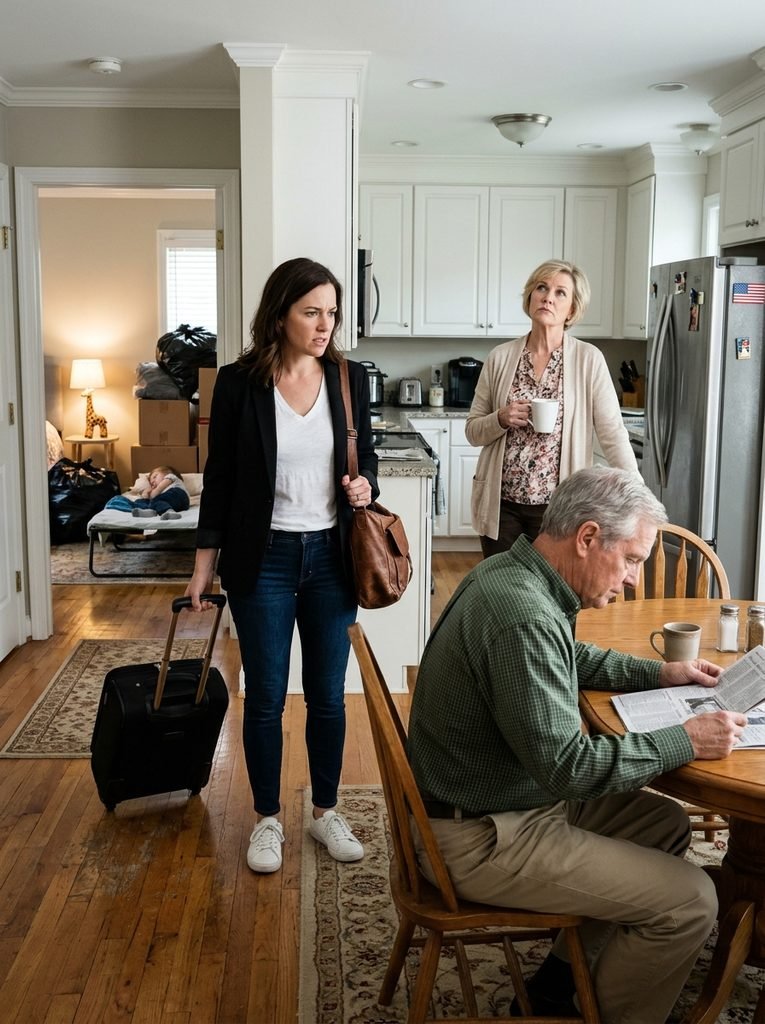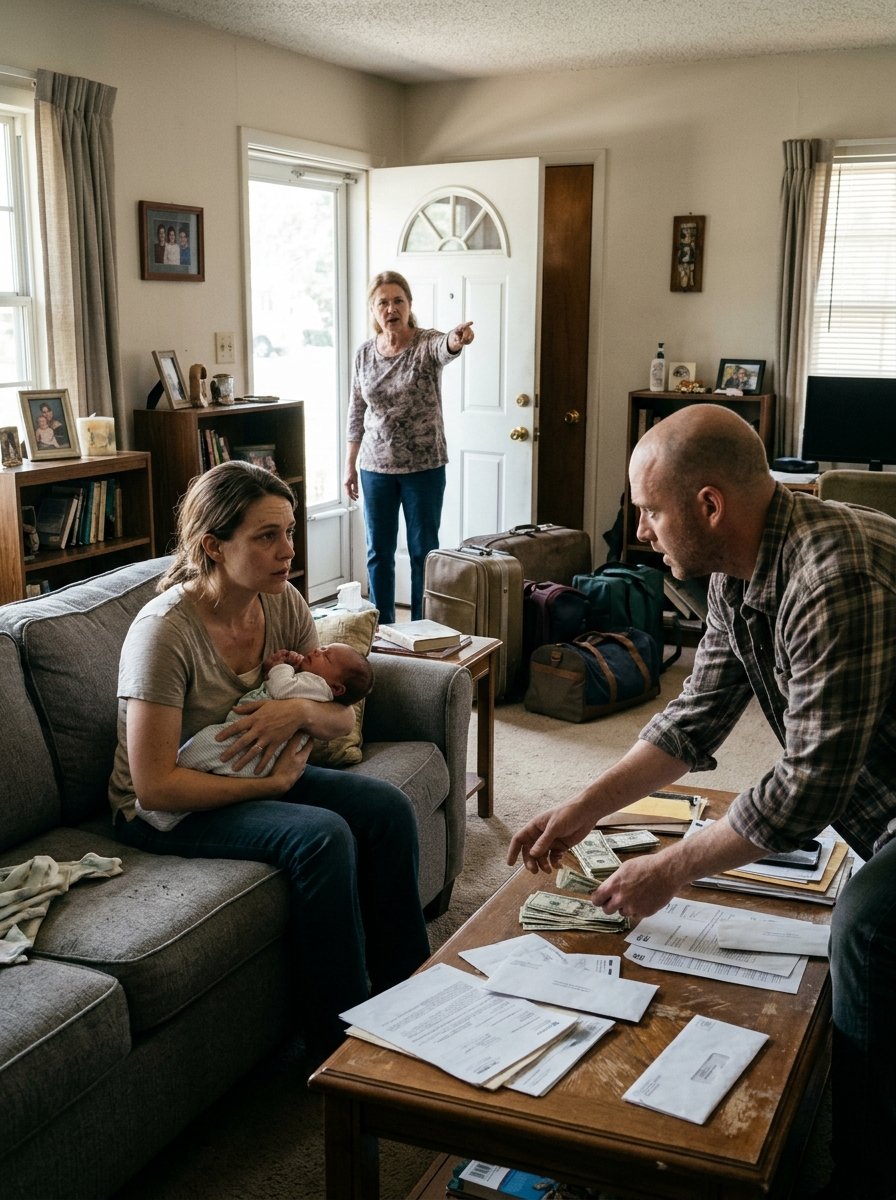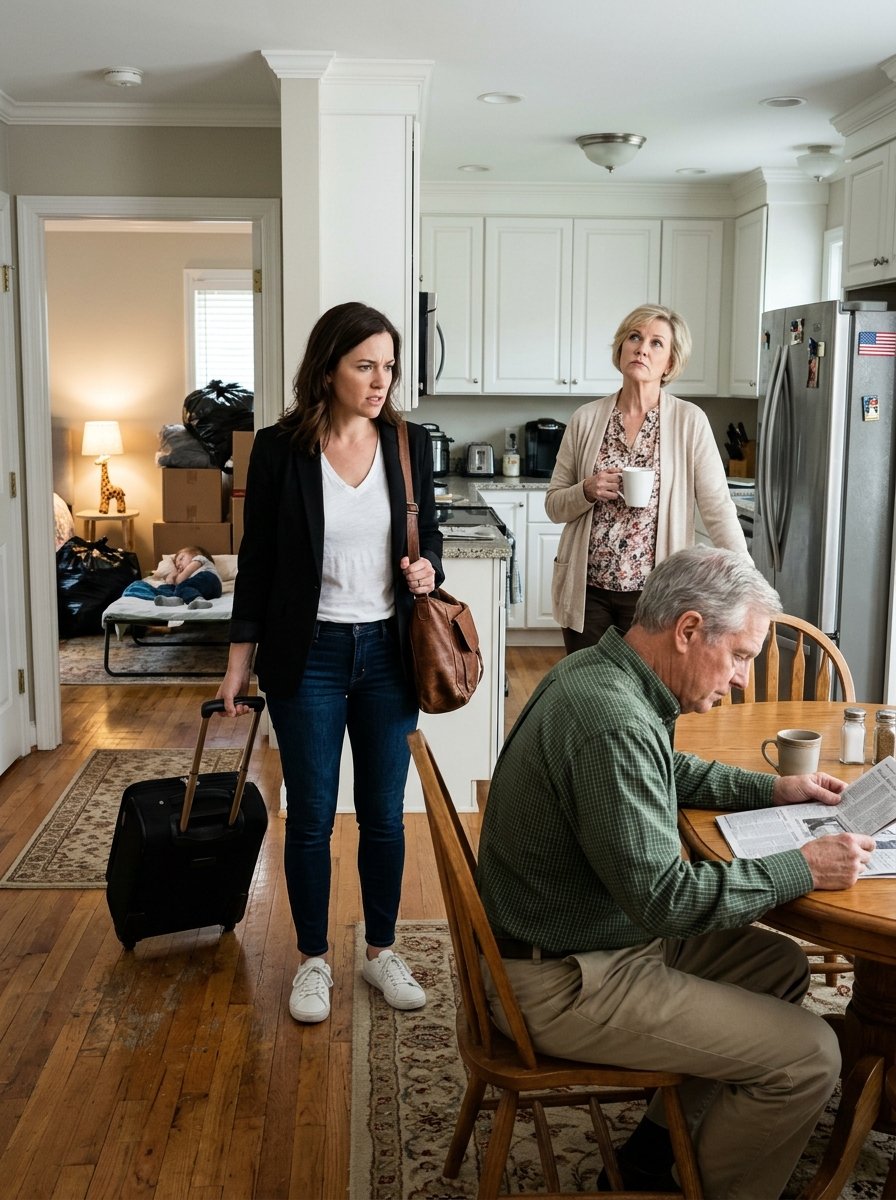
While I was away, my parents gave my 6-year-old daughter’s bedroom to my niece. When I came back, her bed was gone, her clothes were stuffed into trash bags, and her toys were piled up in the garage. “Be grateful you still have a roof over your head,” my mother said. I simply replied, “Alright.” I took my daughter and left. The next morning, they faced the consequences of their actions…
The flight from Denver landed 40 minutes late, which meant Liliana had been waiting longer than I’d promised. That was the first guilt I carried through the terminal.
The specific sharp kind that lives in a mother’s chest when she knows her child has been counting minutes. I’d been gone 11 days. A contract job in Colorado. The kind that pays enough to justify the absence, but never enough to make you stop apologizing for it.
Liliana knew why I went. She’d helped me pack, folding my socks with the seriousness of someone performing surgery.
“Bring me back snow,” she’d said.
I had a ziplockc bag of it in my carry-on, frozen solid and wrapped in three layers of plastic. Ridiculous. Perfect.
My parents’ house sat at the end of Caldwell Street, a two-story colonial with a wraparound porch and the kind of manicured lawn that takes 30 years of Sunday mornings to achieve. My father’s project, his monument. I’d grown up watching him edge that grass with the precision of a man who needed one corner of the world he could fully control.
I didn’t have a key anymore. I’d given it back when Liliana and I moved in 6 months ago. Some gesture of respect that I now recognized as a gesture of submission.
I knocked.
My mother answered before my knuckles finished the second rap, which meant she’d seen the cab from the window. She was already wearing her expression. [clears throat] Not the one she used at church or with neighbors or during the holidays when she needed everyone to believe our family was the kind that loved each other without conditions. The other one. The one I’d learned to read before I learned to read words.
Tight around the jaw, soft around the eyes, in a way that wasn’t softness at all, but strategy.
“You’re late,” she said.
“40-minute delay. Where’s Liliana?”
“Asleep. It’s 10.”
She stepped aside to let me in.
The house smelled like pot roast and pine soul, the combination that had defined every homecoming of my childhood. I left my suitcase by the door and moved toward the stairs, toward the bedroom on the second floor that we’d set up carefully before I left.
Liliana’s comforter, the yellow one with the moons on it. Her shelf of chapter books arranged by color. The small lamp shaped like a giraffe that she’d had since she was two and refused to give up regardless of how old she got.
“She’s not up there,” my mother said from behind me.
I stopped on the third step.
“What?”
“Your cousin Patricia’s daughter needed a proper room. Ranata is 14, Ariana. She needed privacy, a desk, space to do her schoolwork. We made a decision.”
I turned around slowly. The kind of slow that isn’t calm. It’s the opposite of calm wearing calm’s clothes.
“Where is my daughter sleeping?”
My mother lifted her chin.
“The sewing room. She has a cot. It’s perfectly fine.”
The sewing room was 8 ft by 9 ft. It had one window that faced the sidewall of the neighbor’s garage. It smelled like mothballs and the ghost of every alteration project my mother had abandoned since 1994.
I didn’t run. I walked because I needed to see it with my own body moving at a pace I could control.
The door was half open.
The [clears throat] lamp from the hallway threw a pale stripe across the floor, and I followed it in.
Liliana was curled on a folding cot, her knees pulled to her chest, one arm hanging off the edge. She was too big for it. She’d grown since spring, I kept forgetting, and her feet pushed against the metal frame at the bottom.
Her yellow comforter was gone. She was covered with a spare blanket I recognized from the hall closet. The scratchy brown one nobody chose on purpose.
Her books were not on a shelf. They were in a cardboard box in the corner.
Her giraffe lamp was not on a table. It was on the floor, plugged into a socket near the baseboard, tilted sideways, so its neck bent at a sad wrong angle.
I stood there for a moment that felt much longer than a moment.
Then I went back downstairs.
My mother was in the kitchen filling the kettle. My father sat at the table with the newspaper, which I understood was his way of not being present for the part he’d agreed to.
“Her things,” I said. “Where are the rest of her things?”
My mother set the kettle on the burner.
“Her clothes are in bags in her room. The toys she doesn’t use anymore. We put those in the garage. Ranata needs the space. And frankly, an 8-year-old doesn’t need—”
“Bags,” I repeated. “You put her clothes in bags.”
“Trash bags are perfectly good containers, Ariana. Don’t be dramatic.”
My father turned a page of the newspaper.
I looked at them both. My mother with her strategic softness, my father with his strategic absence. The two architectures of my entire childhood, standing in their kitchen that smelled like pot roast and pine saw, having put my daughter’s life into garbage bags while I was gone.
“Be grateful,” my mother said, “that you still have a roof over your head.”
I let the silence sit for exactly 3 seconds.
Then I said, “All right.”
She blinked.
She’d expected tears or argument or the version of me that used to crumble under that particular tone of voice.
I went back upstairs.
I gathered Liliana gently, not waking her, lifting her the way you lift something you’d die before letting fall.
I carried her down to my car.
Then I made four trips.
The cot could stay, but everything else came with me. Her books, her lamp, the trash bags that held her clothes, which I loaded into the trunk with a care that was almost ceremonial.
The last thing I took was the ziplockc bag of snow from my carry-on. I put it in the cup holder next to Liliana’s sleeping face.
We drove away at 11:14 p.m., and I didn’t look back at the house because I already knew exactly what morning was going to look like for the people inside it.
I had 11 days’ worth of silence saved up, and I knew precisely how to spend it.
I checked us into the Harlo Inn at 11:47 p.m., a mid-range hotel 3 mi from my parents’ house that I’d looked up twice in the past 6 months during moments when I needed to know the exit existed.
The woman at the front desk had kind eyes and didn’t ask questions. I appreciated that more than she’ll ever know.
Liliana woke up when I laid her on the bed. Not all the way, just enough to look at me with the particular confusion of a child, pulled from deep sleep into unfamiliar light.
“Mom?”
“I’m here.”
I pulled the covers over her.
“We’re in a hotel, like an adventure.”
She considered this with her eyes half closed.
“Does it have a pool?”
“I’ll check in the morning.”
“Okay.”
She was asleep again before I finished the sentence.
I sat in the chair by the window for a long time. Not crying. Not yet.
Crying would come later in a shower alone. The way mothers cry when they’ve protected their children from seeing the full weight of what happened.
I was thinking, which for me has always looked from the outside like stillness and from the inside like every gear I own turning at once.
Here is what I knew professionally.
I was a parallegal with 11 years of experience, three of them at Whitmore and Associates. The kind of firm that handles civil litigation the way a surgeon handles a scalpel. Clean, deliberate, nothing wasted.
I’d spent a decade learning how systems work, how documents work, how the specific binding language of agreements creates consequences that goodwill cannot undo.
Here is what I knew personally.
My parents were not cruel people in the way that word usually means. They were something more dangerous. People who believed their love gave them jurisdiction over my choices, my gratitude, my daughter’s bedroom.
They’d spent 60 years building a life around the idea that generosity grants authority, and they’d never once been made to examine the invoice they handed to everyone they helped.
Morning was going to be my invoice.
I opened my laptop at 12:30 a.m., and I worked until 4:00.
6 months earlier, when Liliana and I had moved into my parents’ house, I had not moved in empty-handed. I’d paid them rent, $800 a month in checks, every first of the month without exception.
My mother had called it a contribution, like it was a casserole I was bringing to a potluck.
I had called it rent in writing, in a letter I’d sent to their address via certified mail before I ever moved a single box inside. I had a signed return receipt.
I had every canceled check photographed and stored in a cloud folder labeled with the organizational instinct of someone who has spent 11 years watching people wish they documented things.
Payments Caldwell Saint.
That was the first document I opened.
The second was the original lease agreement I’d drafted.
Not a formal legal document, but a written letter of terms that my father had signed because I’d told him it was for my own records, and he’d been in a generous mood and hadn’t read it carefully enough.
It established that in exchange for monthly payment, Liliana and I had occupancy of the northeast bedroom and use of shared common spaces.
It used the word occupancy.
It used the word exclusive.
My father had signed it with his full name, the same signature he used on everything, the one with the long loop on the G.
The third document took me 40 minutes to draft.
It was a formal notice.
Notice of breach of residential agreement and demand for damages, citing the unauthorized removal of my daughter’s possessions from the agreed upon room, the reassignment of said room without notice or consent, and the displacement of a minor child to inadequate accommodations during a legal tenant’s temporary absence.
I was not their daughter in this document.
I was a tenant.
That was the point.
At 4:15 a.m., I printed three copies at the hotel’s business center. One for my records, one to be delivered, one for the attorney I was going to call at 9:00 a.m.
My colleague Dana Whitmore, who owed me a professional favor, and who had on more than one occasion described my parents’ behavior during prior conversations as textbook constructive eviction.
I slept for 3 hours.
Liliana slept for 9.
She woke up and found the ziplockc bag of snow on the nightstand and screamed with a delight so pure and oporatic that the people in the next room probably thought something had gone terribly wrong.
“It’s real snow, Mom. It’s actually real snow.”
“I told you I’d bring it.”
“It’s melting.”
“Touch it fast.”
She touched it. She pressed both palms flat against the bag and closed her eyes like she was receiving a transmission from somewhere very far and very cold.
Then she looked at me with complete seriousness and said, “This is the best thing that has ever happened.”
I made sure she was facing away from me when I let myself feel that fully without managing it.
At 9:00 a.m., while Liliana watched cartoons with the volume low and a bag of complimentary pretzels open in her lap, I made two phone calls.
The first was to Dana, who listened to everything without interrupting, which is how I knew she understood the legal dimension.
When I finished, she said, “Send me the documents.”
And then, “Ariana, this is cleaner than most cases I take to court.”
The second call was to the bank.
My parents had a joint account that my father had added me to years ago for emergencies.
“In case something happens to us,” he’d said, meaning illness, meaning death, meaning the version of emergency that happens to old people.
I had never used that access. Not once.
I wasn’t going to use it now either.
I was going to remove myself from it formally with written notice to the bank because I needed my finances to be unmistakably separate from theirs by the time any document with my name on it crossed a courthouse threshold.
The call took 12 minutes.
The representative confirmed the removal would process within one business day and asked if there was anything else I needed.
“No,” I said. “I just needed that door closed.”
At 10:30, the certified letter arrived at Caldwell Street. I know because I’d arranged for a courier service, the overnight kind, and they sent a delivery confirmation with a time stamp.
My mother signed for it herself.
Dana called me at 11:05.
“She called my office,” Dana said.
And I could hear something careful and professional in her voice that meant she was choosing not to add color commentary.
“She wanted to know if this was really happening.”
“What did you tell her?”
“I told her I couldn’t speak to her directly as she was a represented party in a potential civil matter and that any further communication needed to go through you or through counsel she retained independently.”
A pause.
“She called you a word I’m not going to repeat.”
“I know which word.”
“The damages are real, Ariana. 6 months of unauthorized subleting of a space she was paid to maintain for you. Displacement of a child. Your personal property handled without consent. We’re looking at return of rent paid, compensatory damages, potentially more if we argue emotional distress.”
I looked across the room at Liliana, who had fallen asleep again with a pretzel balanced on her collarbone and a cartoon duck frozen on the paused screen.
“I don’t want to take them to court, Dana.”
Silence.
“I know,” she said finally. “But they don’t know that yet.”
“Correct,” I said. “They don’t know that yet.”
Because the goal was never a courtroom.
The goal was something much more specific and much more permanent than money.
The goal was for my parents to understand, not feel, not sense, but understand in the concrete, document-up supported, lawyer confirmed way that certain people only understand things.
That what they had done had a cost.
That I was not the version of their daughter who swallowed it.
That the quiet “all right” I’d given them in their kitchen the night before was not surrender.
It was the sound of someone who already knew exactly how the next morning was going to go, and now they were living inside it.
My mother called 11 times between noon and 3:00 p.m.
I let every call go to voicemail, not out of cruelty, but because I needed her to understand something she had never been made to understand in 67 years of living.
That silence in the right hands is not absence.
It is pressure.
It is the specific mounting weight of a person who has stopped performing the reactions you depend on to feel in control.
On the 12th call, I answered.
She didn’t begin with an apology. I hadn’t expected her to.
She began with, “Ariana. This has gone far enough.”
Which told me everything I needed to know about where she still believed she was standing, on high ground, looking down, confused about why the water was rising.
“I agree,” I said. “Which is why Dana Whitmore’s office will be sending a follow-up notice by end of business today outlining the full scope of the claim.”
“You’re going to sue your own parents over a bedroom.”
“I’m going to pursue damages against individuals who accepted rent payments in exchange for guaranteed occupancy, violated that agreement while the paying tenant was traveling for work, and placed that tenant’s child’s belongings into trash bags.”
I let that sit for exactly two seconds.
“I’m not describing parents in that sentence, Mom. I’m describing landlords.”
She made a sound I’d never heard from her before. Something between a scoff and something softer. Something that cracked slightly at the edges.
I filed it away without letting it move me. Not yet.
“Your father wants to speak with you.”
“I know.”
I’d been expecting this.
My father was the one who’d signed the letter of terms. He was also the one who understood, in his careful lawn-edging way, when a situation had moved beyond the territory of feelings and into the territory of consequences.
“Put him on.”
My father’s voice was quieter than my mother’s. It always had been. He was a man who’d spent his life letting her set the temperature of every room and then managing the aftermath when it got too hot.
I had spent years being angry at him for that.
What I felt now was more complicated and less useful.
So I set it aside.
“Ariana.”
“Dad, tell me what you need.”
It was the right question.
I’d wondered if he’d find it.
Four words that acknowledged, without stating, that he understood the power in this conversation had shifted, and that the only way through was to ask rather than demand.
“I need you to listen,” I said. “Not to respond, not to explain, just to listen until I’m finished.”
“All right.”
So I told him.
Not with the document language, not with Dana’s legal framing. I’d already deployed those. They’d done their work.
I told him in the plain, unmanaged language of a woman who had stood in a sewing room at 11 p.m. and watched her daughter sleep on a folding cot under a scratchy brown blanket because the people who were supposed to love them both had put her child’s life into garbage bags without a single phone call, without a text, without the basic courtesy of asking.
I told him what Liliana’s room had meant to her, how we’d set it up together the weekend we moved in, how Liliana had arranged her books three different ways before deciding on color order, how she’d asked if she could put stickers on the inside of the closet door, and I’d said yes, and she’d spent an entire Saturday afternoon in there with a sheet of star stickers, making the inside of that door into her own private sky.
I told him I’d stood in the garage after midnight loading her things into my car and that one of the trash bags had torn and her winter sweaters had spilled across the concrete floor, and I’d folded every one of them alone in the dark before putting them into a new bag.
And that was the moment I had understood with complete clarity that I would never be able to unknow what this night had shown me about the conditions attached to their love.
My father didn’t speak for a long time after I finished.
Then, “The stickers are still on the door.”
Something moved in my chest that I hadn’t given permission to move.
I pressed my hand flat against the desk in front of me and breathed through it.
“That’s not enough,” I said. “I need you to understand that.”
“I know.”
“Ranata can keep the room. I’m not asking for the room back. I’m asking for something that a room can’t give me.”
I paused.
“I’m asking you to say out loud that what happened was wrong. Not unfortunate, not complicated. Wrong. And I need to hear it from mom, too, in a conversation where she’s not defending herself or explaining Ranata’s needs or telling me to be grateful. Can you make that happen?”
Another long silence.
Outside the hotel window, the afternoon had gone gray and soft. The kind of overcast that makes everything look like it’s waiting.
“Yes,” he said. “Give me tonight.”
He called back at 7:43 p.m.
He didn’t put my mother on immediately. He spoke first for almost 4 minutes, which was the longest I had ever heard my father speak without being interrupted or deferring mid-sentence.
He said that he had failed to protect Liliana’s space while I was gone, that he had allowed a decision to be made that he knew was wrong because opposing it would have cost him a specific kind of domestic peace, that he had spent 40 years choosing over harder things, that his silence had been its own action, and he was not going to call it anything else.
He said he was sorry.
He said it the way people say it when they mean it.
Without the cushioning words around it, without the “I’m sorry if you felt” or the “I’m sorry, but you have to understand.”
Just the bare, uncushioned thing.
Then my mother got on the phone.
She didn’t find it as easily.
I could hear her looking for the version of the apology that let her keep something. Some fraction of the high ground, some explanatory clause.
I waited.
I had learned in 11 years of litigation work that the most important skill in any confrontation is the willingness to let silence do the work you’d otherwise fill with words.
Finally, she said, “I treated Liliana like she was temporary, and she isn’t. And I’m sorry.”
It wasn’t everything.
It wasn’t the full reckoning I might have written for her if I’d been scripting it, but it was real.
I could hear the place where it cost her, the slight fracture in the last word.
And I had learned also that real is more valuable than complete.
“Thank you,” I said.
“What happens now?” she asked.
“With the lawyer, I’m going to call Dana tomorrow and tell her we’ve reached a private resolution.”
I kept my voice even.
“The documentation stays in my files, not as a threat, as a record, so that everyone involved, including me, remembers that this happened and what it cost.”
My mother was quiet for a moment.
“That’s very cold, Ariana.”
“Yes,” I said. “It is.”
I told Liliana the next morning over hotel waffles she’d made herself with the silver iron and an alarming amount of syrup that we were going to find our own place.
Just ours.
She looked up at me with syrup on her chin and the particular expression she wears when she’s deciding whether news is good or bad.
“Like an apartment?”
“Like an apartment.”
“Can I put stickers on the inside of my closet door?”
I looked at her, this small, complete syrup-covered person who [clears throat] had slept on a folding cot and woken up pressing her hands against a bag of snow like it was a miracle, which it was, which she was.
And I said, “You can put stickers on every surface in the entire place. I don’t care. It’s ours.”
She thought about this seriously.
“Even the ceiling?”
“We’ll discuss the ceiling.”
She went back to her waffle.
I sat across from her in the gray morning light of a hotel breakfast room with Dana’s number in my phone and three copies of a document in my bag and a ziplockc bag of half-melted Colorado snow slowly becoming water in the cup holder of my car in the parking lot outside.
And I felt something I hadn’t felt in a long time, possibly ever, in this specific combination, clean and certain and entirely irrevocably my own.
My mother had told me to be grateful for the roof.
If you came here from Facebook because of this story, please go back to the Facebook post, tap Like, and comment exactly “Powerful” to support the storyteller. That small action means more than it might seem, and it gives the writer real encouragement and motivation to keep sharing more stories like this.
Disclaimer: This story is fictional and created for entertainment purposes only. Any names, characters, places, or events are fictitious or used fictitiously. No real person or organization is intended to be portrayed.