I Showed Up at My Son’s House in a Wheelchair Asking for Help, He Turned Me Away, Then My Late Husband’s Bank Card Changed Everything
“We have a routine, Mom,” my son said. “The kids have school. Ashley works from home. It just wouldn’t work right now.”
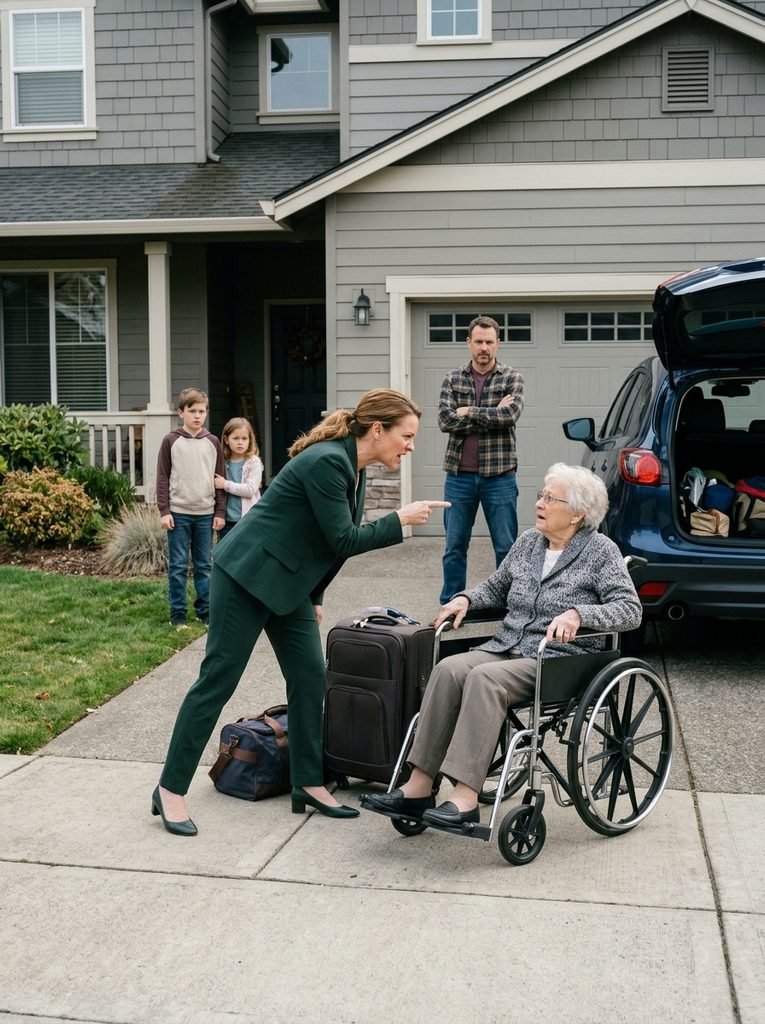
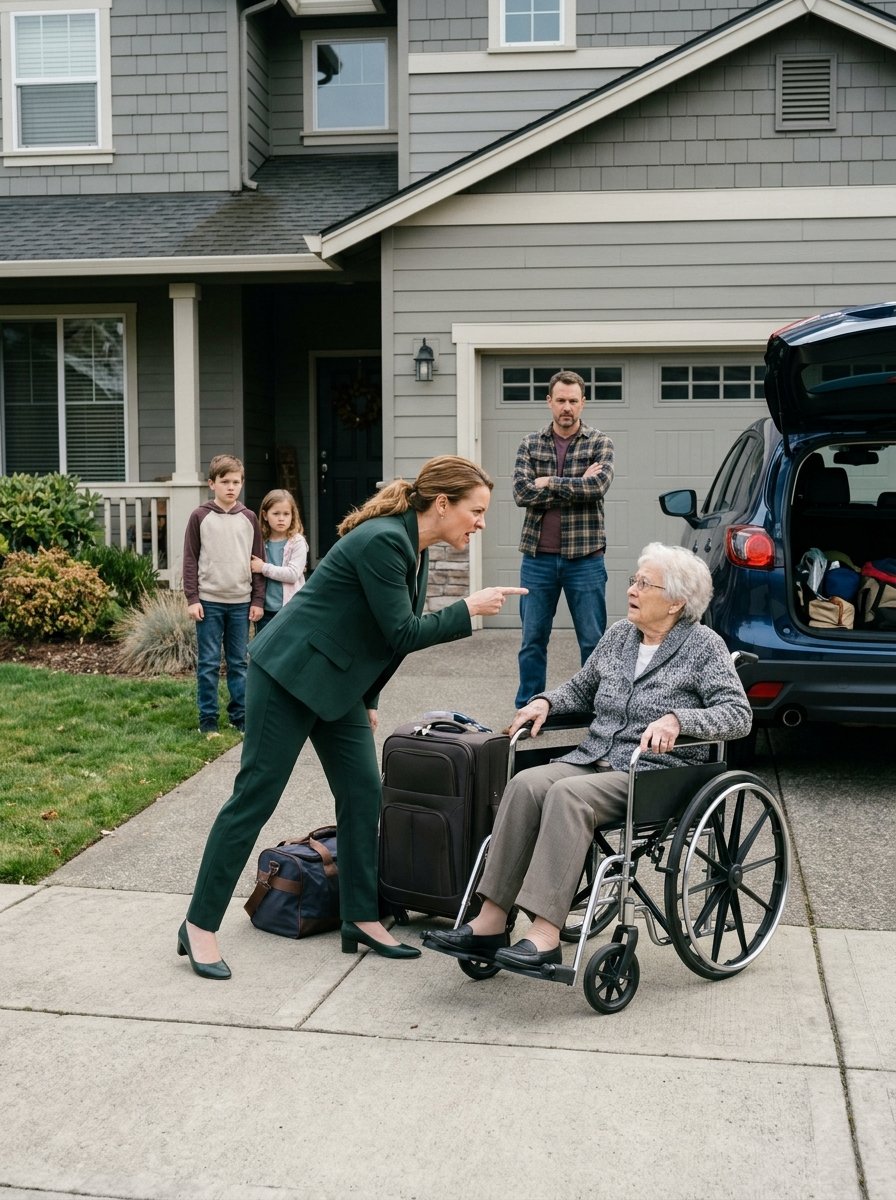
I was sitting in my wheelchair at the bottom of his driveway on a Sunday afternoon in October. It had taken me two buses and forty minutes to get there. My back ached. My hands were raw from pushing the wheels up the slope of his street in the Florida heat.
Michael stood at the top of the driveway with his arms crossed. Behind him, his big two-story house sat on the cul-de-sac with its matching mailbox and its perfect green lawn. Four bedrooms. Three bathrooms. A three-car garage.
His wife, Ashley, stood in the open front doorway in white linen pants, with her arms folded too.
“Michael,” I said. “I’m not asking for much. I just need somewhere safe to sleep. Just for a little while. I can’t get up the stairs in my apartment anymore. I fell in the bathroom twice last month.”
“Mom, that’s exactly why you need real help,” Michael said. “Professional help. There are places for this. Assisted living. Programs. People who handle this kind of thing.”
“The guest room’s being worked on,” Ashley said from the doorway. “We’re having it redone.”
I looked past her into the front hallway. I could see two pairs of children’s sneakers by the door. And two little faces peeking around the corner of the hall, then disappearing.
My grandchildren. Ethan and Lily.
“Please,” I said.
Michael walked down the driveway toward me. For one second, I thought he was going to hug me.
Instead, he put both hands on the handles of my wheelchair. And he turned me around. And he pushed me backward, down the slope of his driveway, to the sidewalk.
“Call me when you’ve looked at some of those places, Mom,” he said. “Ashley can send you some links.”
Then he walked back up the driveway and went inside. Ashley closed the front door.
I sat there on the sidewalk for a long time.
I had $237 in my checking account. My prescription refill was due Wednesday. The copay was $84.
My name is Helen Carter. I’m seventy-two years old. My husband, Robert, had been gone twenty-two months.
And that night, back in my apartment, unable to climb the stairs to my own bed, I slept on the couch. Again.
It was three in the morning when I remembered the card.
Robert gave it to me about a year before he died. A plain white business card with a phone number and an address in downtown St. Petersburg. Pinnacle Private Banking.
On the back, in his handwriting, he’d written three words.
Emergency access only.
“What is this?” I’d asked him.
“Just in case,” he said. He kissed my forehead. “If you ever really need something, Helen, and I’m not here, you go there. Promise me.”
I promised. And then I put the card in my jewelry box and forgot all about it.
Robert repaired air conditioners for forty-one years. He drove the same old white Ford truck for nineteen of them. He came home every night with grease under his fingernails and told me we had enough.
I didn’t think there was anything at Pinnacle Private Banking but maybe a small savings account.
But I was out of options.
The next morning, I put on my good navy blouse. I called a cab I couldn’t afford. And I rolled myself into a marble lobby on Central Avenue with the card in my lap.
A young woman at the front desk looked at the card. Then she looked at me in my wheelchair. Then she picked up her phone.
Two minutes later, a gray-haired man in a dark suit came down the hall. He took one look at the handwriting on the back of that card, and his face softened.
“Mrs. Carter,” he said. “We’ve been waiting for you. Please. Come into my office.”
He held the door. When I rolled inside, he reached behind him and closed it.
Then he turned his computer monitor toward me.
On the screen was a photograph of Robert. Standing outside an industrial warehouse. Smiling that crooked smile he always got when somebody surprised him with a camera.
Underneath his picture was a company name.
Carter Industrial Holdings.
And underneath that was a number.
$8,746,319.42.
I stared at it.
Then I looked at the man.
“I think you’ve made a mistake,” I said.
He pulled a chair closer and sat down beside me.
“My name is Daniel Whitmore, Mrs. Carter. I worked with your husband for fourteen years. There’s no mistake.”
I looked at the screen again.
Eight million dollars.
And yesterday, I’d been begging my son for a place to sleep.
My hands started shaking so badly I had to press them against my knees.
“Robert fixed air conditioners,” I whispered.
Daniel nodded. “He did. But in 2006, he also invested in a small company in Tampa that made industrial cooling systems for warehouses and data centers. He put in $40,000 of his savings. He helped them design their first unit in his own garage.” Daniel smiled a little. “When that company was bought by a national manufacturer in 2019, his ownership share became extremely valuable.”
I remembered Robert coming home late from “side jobs” in Tampa. I remembered the old truck he refused to replace. I remembered him squeezing my hand at the kitchen table and saying, “We’ve got enough, Helen. We’ve always had enough.”
“Why didn’t he ever tell me?”
Daniel opened his desk drawer. He took out a cream-colored envelope.
My name was written across the front.
Helen.
I’d know that crooked H anywhere.
For several seconds, I couldn’t open it. It felt like holding something alive.
Finally, I slid my finger under the flap.
“My dearest Helen,
If you’re reading this, then life has brought you somewhere you need something I can no longer give you myself.
I wish I could be there. I wish I could make you coffee and sit beside you and tell you everything is going to be all right.
But since I can’t, I’ve left you the means to make sure nobody ever decides your worth for you.
There’s something I should have told you about Michael. I was afraid it would break your heart. I was wrong to keep it from you.
Ask Daniel for the blue folder.
And remember, sweetheart, love should never require you to disappear.
Always yours,
Robert.”
I pressed the letter against my chest.
For twenty-two months, I’d been trying to remember the sound of his voice without crying. Now it was like he’d reached across the years and spoken right into my ear.
Daniel waited until I looked up. Then he unlocked a filing cabinet and took out a thick blue folder. He set it on the desk in front of me.
“Mrs. Carter,” he said carefully, “before you read this, I want you to understand that your husband took extraordinary steps to protect you.”
“From what?”
Daniel’s face changed.
“From your son.”
The words landed so heavy I forgot to breathe.
I opened the folder.
The first document was seven years old. A transfer of $180,000 from one of Robert’s investment accounts into a business registered under Michael’s name. Carter Pool and Patio Design.
“Robert helped Michael start his business,” I said. “I remember.”
Daniel shook his head slowly.
“Your husband found out about that transfer after it happened. He believed Michael had gotten into his banking login without permission.”
He pointed to the authorization at the bottom of the page.
Robert Carter.
The signature looked almost right. Almost.
But the R was wrong.
Robert broke three fingers in a fishing boat accident when he was nineteen. Ever since, he wrote his capital R with a narrow, cramped little loop.
This one was wide and round.
“He forged it,” I whispered.
“Your husband believed so.”
The next page was a repayment agreement. Signed by Michael. He promised to pay back every dollar within five years. $3,000 a month.
The payments stopped after eleven months.
Then there was a short letter from Robert, typed, with his signature at the bottom.
“Michael, I won’t destroy your family over money. But if you ever try to take advantage of your mother, I’ll make sure she’s protected from you.”
I stared at those words.
Robert knew. For seven years, he knew. He carried this secret while we ate Sunday dinners together, celebrated birthdays and watched our grandchildren grow up.
“Why didn’t he tell me?”
Daniel folded his hands.
“He told me once that you’d blame yourself for anything your son ever did wrong.”
I looked down at my lap. Because Robert was right. Even sitting there, part of me was wondering what I’d done wrong to raise a man who’d steal from his own father.
Daniel turned to the last document in the folder.
“There’s something more recent,” he said.
It was dated six months earlier. A letter on plain white paper, addressed to Pinnacle Private Banking.
It said that I, Helen Carter, was experiencing cognitive decline after my husband’s death, and that I was authorizing my son, Michael Carter, to manage all of my financial affairs.
My signature was at the bottom.
I never signed it. I’d never even seen it.
“Who sent this?” I asked.
Daniel looked right at me. “Michael.”
My stomach turned over.
“He contacted us and claimed he had authority to manage your finances,” Daniel said. “Our compliance department rejected it. The document wasn’t notarized, and we couldn’t verify the signature with you. We sent a letter to your address asking you to come in and confirm it.”
“I never got any letter.”
“I suspected you might not have,” Daniel said quietly. “Michael listed his own home as your mailing address on the request.”
I remembered Michael standing in his driveway the day before. Assisted living. Programs. People who handle this kind of thing.
Suddenly, it didn’t sound like concern anymore.
It sounded like preparation.
“Can he get this money?” I asked.
“No, ma’am. Your husband placed everything in an irrevocable trust for your benefit. You’re the sole beneficiary. You have full authority under its terms. Nobody else can touch a dollar of it without your written consent. Not even me.”
I wiped my eyes.
“Then I need an attorney,” I said.
Daniel smiled for the first time.
“I was hoping you’d say that.”
By noon, I was sitting across a desk from a woman named Margaret Ellis.
She was sixty-one, with red-framed glasses and short silver hair, and the calm, precise manner of somebody who’d spent thirty years listening to people explain why they deserved things that belonged to someone else. She’d been doing elder law in St. Petersburg since 1995.
She read every document in the blue folder. Then she set them down and took off her glasses.
And she asked me something nobody had asked me in twenty-two months.
“Helen,” she said. “Are you safe at home?”
I almost said yes. Because that’s what I always said.
But I thought about sleeping on the couch every night. The stairs I couldn’t climb anymore. Falling on the bathroom tile and lying there for an hour before I could reach the towel rack and pull myself up. The empty refrigerator. The pill bottles I’d been cutting in half to make them last.
“No,” I said. “I’m not.”
Margaret set down her pen.
“Then that’s our first priority,” she said.
And something inside me broke wide open.
Not because I’d found out I was wealthy.
Because a stranger had asked. And listened.
Within six hours, Margaret had arranged everything.
A furnished, accessible apartment overlooking the Vinoy marina, rented month to month. A home care coordinator coming the next morning. My doctor’s office called to review all my prescriptions. And an independent forensic accountant, a quiet man named Victor Huang, hired to examine every account Michael had touched since Robert died.
I insisted on paying for every bit of it myself.
Margaret smiled. “It’s your money, Helen. You don’t need anybody’s permission.”
That evening, I sat by the apartment window and watched the sailboats rock in their slips as the sky went orange over Tampa Bay.
My wheelchair was parked beside a real bed. A bed I could get into without pain. There was food in the refrigerator. Clean towels in a bathroom with grab bars. And a little vase of yellow roses on the kitchen counter that Margaret had sent over.
I should have felt happy.
Instead, I kept seeing Michael’s face as he pushed me down his driveway.
My phone rang. Michael.
I watched it ring until the screen went dark.
Then a text message came.
“Mom, Ashley found a facility that might work for you. We need to get some paperwork signed. Call me.”
A second one came a minute later.
“Don’t make this difficult.”
I forwarded both of them to Margaret.
Then I turned off my phone.
For the first time in his whole life, I let my son wait.
The next morning, Margaret called before I’d even finished my coffee.
“Helen,” she said. Her voice was different. “I need you to sit down.”
I looked at my wheelchair.
“I already am, Margaret.”
She didn’t laugh.
“Victor’s found transfers out of your personal checking and savings accounts at Regions Bank. Starting a month after Robert died.”
My fingers tightened on the phone.
“How much?”
“About ninety-six thousand dollars so far. Over twenty months.”
I stared at the sunlight spreading across the kitchen floor.
“Where did it go?”
“Several accounts connected to Michael’s business. Some payments look like they covered personal expenses. A boat payment. Private school tuition. A country club membership.”
I thought about the $237 in my checking account. The nights I skipped dinner because groceries were too expensive. The heart medication I’d been cutting in half.
And my son had been taking it from me the whole time.
“Michael had access to my accounts,” I said slowly. “After Robert died, he said he’d help with the bills. I gave him my online banking password.”
“I know,” Margaret said gently. “He used it.”
I closed my eyes.
“Margaret, I don’t want to hurt my grandchildren.”
“I understand.”
“But I can’t let him keep doing this.”
“Then we won’t,” she said.
That afternoon, Michael called seventeen times. Ashley called six.
Not one message asked whether I was safe.
At seven-thirty that night, somebody knocked on my apartment door.
My new home care assistant, Rosa Delgado, a warm, no-nonsense woman from Hialeah, looked through the peephole.
“Mrs. Carter,” she said. “It’s your son. And his wife.”
My heart started pounding. I called Margaret. She told me not to discuss money without her present, and offered to have the building’s security come up.
I looked at that door.
For a moment, I was back on Michael’s driveway. Hearing him say, “We have a routine.”
Then I remembered Robert’s letter. Love should never require you to disappear.
“Tell them my attorney will be in touch,” I told Rosa.
Rosa delivered the message through the door.
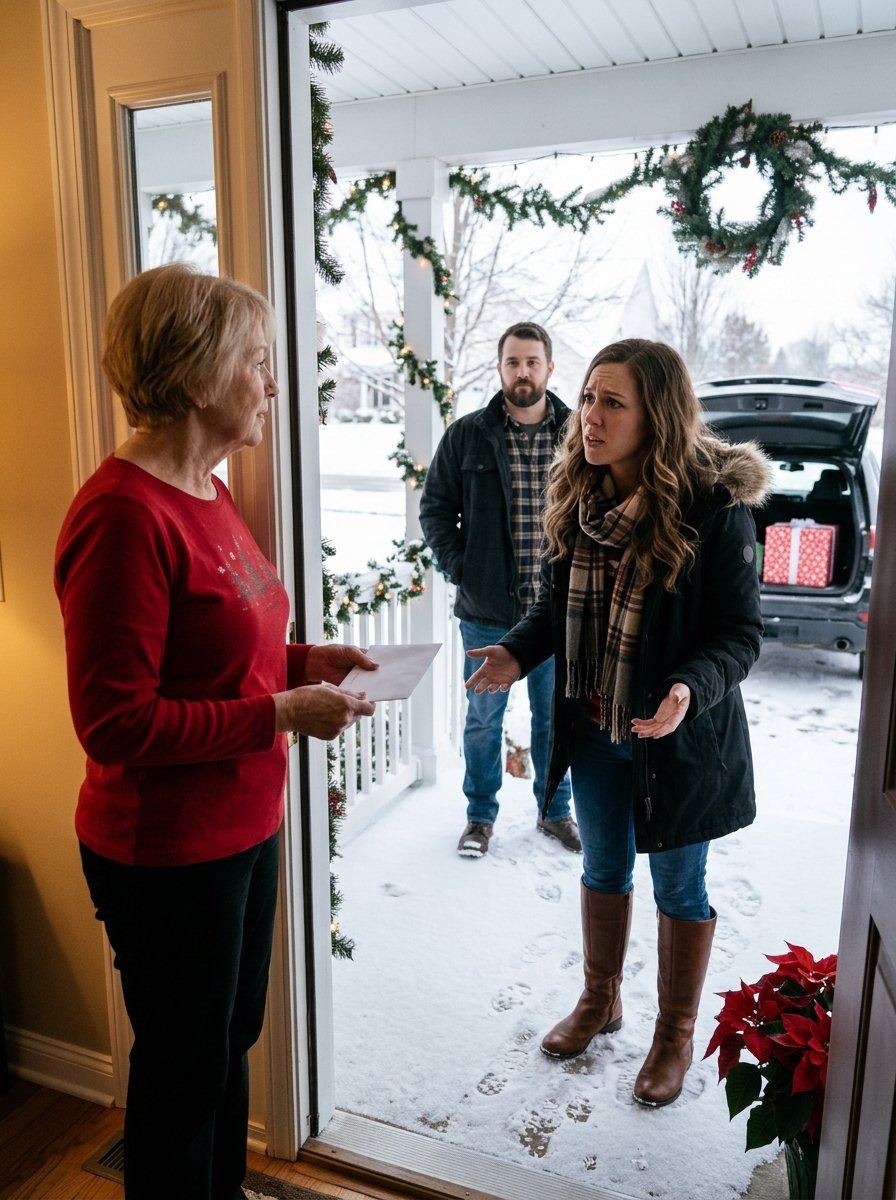
Silence. Then Michael’s voice.
“Mom, this is ridiculous. Please. Just open up.”
Then Ashley.
“Helen, we know you’ve been talking to people at the bank.”
My eyes opened wide. How could she know?
“We’re trying to protect you,” Ashley went on. “You don’t understand what you’re getting involved in.”
I rolled closer to the door. And for once in my life, I didn’t lower my voice.
“I understand enough.”
Sharp silence.
Then Michael said something that stopped my heart.
“You have no idea what Dad did to us.”
“What did you say?”
“Open the door, Mom. We need to tell you the truth.”
Rosa shook her head at me hard.
I kept the door locked.
“Tell me from there,” I said.
Michael hesitated. Then Ashley spoke.
“Robert promised us that money,” she said. “The company money. He told Michael he’d get his share someday. We built our whole life around that promise, Helen. We bought the house. We made decisions. We took risks. And then Robert changed everything and put it all in your name.”
“You mean you spent money you didn’t have,” I said, “because you thought Robert would leave it to you.”
“That’s not fair!” Michael snapped.
“No,” I said quietly. “It isn’t.”
Then I asked the question that had been burning in me since the bank.
“Michael. Did you forge your father’s signature?”
Silence. Somewhere down the hallway, the elevator chimed.
Then, very quietly, through the door, Michael said, “Mom, I was desperate.”
There it was. Not a denial. An admission.
“Did you take money from my accounts after he died?”
“Mom, I was going to pay it back.”
Something inside me went strangely still.
“You let me live on two hundred and thirty-seven dollars,” I said. “You watched me cut my heart pills in half. And when I came to your house in a wheelchair, you pushed me down your driveway.”
“We had our own problems, Helen,” Ashley said.
“Yes,” I whispered. “And apparently you decided I should pay for them.”
Michael started pounding on the door.
“Mom! Please! Just let us explain!”
I turned my wheelchair toward Rosa.
“Call security,” I said.
“Mom! Don’t do this!”
I stopped.
For a moment, I almost turned back. Every instinct I’d built up over forty-four years of being his mother told me to open that door. To fix it. To protect him.
Then I looked down at my hands on the wheels. And I remembered his hands on my handles, pushing me backward.
And I kept rolling.
The next morning, Margaret came to the apartment with another folder.
She sat down across from me at the kitchen table and slid a document toward me.
It was a petition for emergency guardianship. Filed in the Pinellas County Circuit Court three weeks earlier.
My name was at the top.
The petition described me as confused, financially vulnerable and unable to care for myself. It listed missed medications. Falls. Memory lapses.
I recognized some of the details.
They were things I’d told Michael privately. On the phone. At night. Things I’d confessed because he was my son and I was scared.
“He used my own words against me,” I said.
Margaret nodded. “It hasn’t been granted. But it was filed.”
Attached was a sworn statement. Signed by Ashley.
She claimed I’d become irrational after Robert’s death. That I forgot conversations. That I’d shown up at their house unannounced and demanded to move in. That I became hostile when they suggested professional care.
“She planned this,” I said.
Margaret slid another sheet across the table.
“Ashley contacted a memory care facility in Clearwater three weeks before you went to their house. She requested a locked-unit placement. She told them the family expected to have legal authority within a month.”
My hands went cold.
Three weeks before I’d ever asked them for help.
So that whole conversation on the driveway, assisted living, programs, people who handle this, it wasn’t advice.
It was a script.
“There’s one more thing,” Margaret said.
She laid down an invoice.
Victor had traced a payment of $42,000 from Michael’s business account to a company called Bright Path Consulting LLC. Registered with the Florida Division of Corporations under Ashley’s maiden name. Ashley Brandt.
The invoice described the work as “family asset coordination.”
At the bottom of the invoice, somebody had written a note in blue ink.
“Expedite Helen placement before trust review.”
I read those words until they blurred.
They hadn’t just wanted me out of their house.
They wanted me somewhere I couldn’t interfere. Locked away. Declared incapable. With Michael in control of everything Robert left me.
For the first time, I was afraid of what would have happened if I’d signed their paperwork that day in the driveway.
“Do whatever is necessary, Margaret,” I said.
Margaret arranged an independent medical evaluation with a geriatric psychiatrist at Bayfront Health. Three hours of tests. Memory. Reasoning. Judgment.
The doctor’s report was four pages long. The last sentence said: “Mrs. Carter demonstrates full cognitive capacity and is entirely capable of managing her own personal and financial affairs.”
Margaret filed it with the court that afternoon, along with a formal objection to the guardianship petition.
Then she called the Pinellas County Sheriff’s Office financial crimes unit.
Two weeks later, we all met in the conference room at Margaret’s office on First Avenue North.
Michael came in first. He looked thinner. His shirt was wrinkled. There were dark circles under his eyes.
Ashley followed in a cream-colored blazer with a designer handbag, wearing the face of somebody determined to look offended instead of scared.
Their attorney sat beside them. Margaret sat beside me. Daniel Whitmore came with the bank records. Victor Huang came with his laptop.
Nobody said a word for several seconds.
Then Ashley broke the silence.
“This is completely unnecessary.”
Margaret opened her folder. “Mrs. Carter asked for this meeting to give you both a chance to respond to the financial records before further action is taken.”
Michael looked at me. “Mom. Please.”
I watched his hands. They were clasped tightly on the table. Just like Robert’s used to be when he was worried.
For one terrible moment, I wanted to reach across and hold them.
Instead, I asked the question I’d been carrying for weeks.
“Why did you let me leave?”
Michael blinked. “What?”
“That Sunday. When I came to your house.”
He looked down. “I told you, we couldn’t…”
“You have four bedrooms, Michael.”
Ashley shifted. “The guest room was…”
“Please don’t lie to me again, Ashley.”
She stopped.
I looked back at my son.
“I wasn’t asking you to buy me a house. I wasn’t asking for money. I needed somewhere safe to sleep.”
He swallowed. “Mom, things were complicated.”
“Were they complicated when you took ninety-six thousand dollars?”
His face drained.
Ashley turned sharply. “Ninety-six?”
Victor turned his laptop around. Twenty months of transfers. Every one of them highlighted in yellow.
“That’s the amount identified so far,” Margaret said. “The review is still going.”
Daniel slid the forged authorization letter across the table. Then Margaret laid down the guardianship petition and Ashley’s sworn statement.
“We were worried about her health,” Ashley said, sitting up straighter.
“Then why,” Margaret asked calmly, “did Bright Path Consulting receive forty-two thousand dollars from your husband’s company for coordinating her placement?”
The room went completely silent.
Michael slowly turned to look at his wife.
“What consulting company?”
Ashley didn’t answer.
“Ashley?”
“It was administrative work.”
“Forty-two thousand dollars?”
“Michael, don’t start.”
He pushed his chair back. “You told me that money was the deposit for the memory care place.”
Margaret looked up. “The facility in Clearwater confirmed they never received any deposit.”
Ashley went pale.
“You kept it?” Michael whispered.
Ashley looked around the room like she was searching for somebody to rescue her.
“You don’t understand what I’ve had to manage!”
“You told me the paperwork was handled!”
“Because you can’t handle anything!” Ashley snapped.
The words cracked across the room like a whip.
“You couldn’t keep your business afloat. You couldn’t pay the mortgage. You couldn’t even get your own mother to sign one simple authorization!”
She heard it come out of her mouth. Too late.
Margaret calmly capped her pen.
“Would you like to clarify that statement, Mrs. Carter?”
Ashley’s mouth opened. Nothing came out.
Michael sat back down slowly. His face looked hollow.
I watched him. Waiting for an apology. A confession. Something that showed me he finally understood.
Instead, he turned to his wife and said six words.
“You said this would work, Ashley.”
And those six words told me everything.
He wasn’t innocent. He wasn’t just a husband who got manipulated. He knew there was a plan. He was part of it.
And now he was scared because it had failed.
I looked at Margaret. “I’m ready to leave.”
“Mom, wait.” Michael stood up. His eyes were wet. “I never wanted you hurt.”
I looked at him for a long time.
“What did you think would happen when you took my money?” I asked.
He couldn’t answer.
“What did you think would happen when you tried to have me declared incompetent? When you tried to have me locked away?”
His mouth trembled. “Mom…”
“And what did you think would happen when I showed up at your house in a wheelchair and you pushed me down the driveway?”
He lowered his head.
The room was so quiet I could hear the air conditioner clicking.
Finally, he whispered, “I thought you’d figure something out.”
I closed my eyes.
There it was. Not hatred. Not even indifference. Something almost worse. He’d spent his whole life believing I’d survive whatever he did to me. That I’d always find a way. That I’d always forgive. That I’d always be there when he needed something.
I opened my eyes.
“You were right,” I said.
He looked up. Hope flickered across his face.
“I did figure something out,” I said. “I figured out that I can’t keep saving you from the consequences of your own choices.”
I turned my wheelchair toward the door.
This time, nobody stopped me.
The legal process took months.
Interviews. Financial reviews. Hearings at the Pinellas County Justice Center in Clearwater.
The guardianship petition was dismissed in December. The judge’s written order said the statements submitted by Michael and Ashley were “materially inaccurate and contradicted by independent medical evidence.”
The sheriff’s financial crimes detectives reviewed every forged document and every transfer.
In the end, Michael admitted he’d used my online banking access to redirect money into his failing business. He admitted he signed my name to the letter he sent to Pinnacle. And he admitted forging his father’s signature seven years earlier.
Ashley admitted creating fake invoices through Bright Path Consulting.
Their attorney negotiated with the prosecutors. Neither of them escaped responsibility.
Michael pleaded guilty to exploitation of an elderly person and forgery. He was sentenced to two years in state prison, followed by five years of probation, and ordered to repay $96,400 in restitution plus the $180,000 he’d taken from Robert.
Ashley pleaded guilty to fraud for the false invoices. She got eighteen months and restitution of $42,000.
The pool business collapsed. The house on the cul-de-sac was sold to cover their debts. The matching mailboxes. The three-car garage. The perfect lawn.
All of it gone.
But the part that hurt the most wasn’t watching their life fall apart.
It was watching my grandchildren lose the only home they’d ever known.
Ethan was thirteen. Lily was nine.
They hadn’t done anything wrong. I made sure they knew that.
Ashley’s sister, Karen, took them in at her house in Largo while the family sorted things out. I set up an education trust for both of them through Pinnacle, $250,000 each, that neither of their parents could ever touch. I paid for their counseling. Their school fees. Their braces.
Margaret asked me if I was sure.
“The children don’t owe me for what their parents did,” I told her.
Three months after the sentencing, Ethan asked if he could come see me.
He came with his Aunt Karen on a rainy Saturday afternoon. He stood in my doorway in a gray hoodie with his hands shoved in the front pocket.
For a second, he looked so much like Michael at thirteen that my throat closed up.
“Hi, Grandma.”
“Hello, sweetheart.”
By then, I’d bought a small one-story house near Coffee Pot Bayou. Wide doorways. A roll-in shower. A kitchen with lowered counters. A porch overlooking a little garden. No stairs anywhere.
Ethan sat across from me at the kitchen table. He didn’t touch the chocolate chip cookies I’d baked.
Finally, he asked, “Did Dad really steal from you?”
I could have softened it. I could have told him grown-ups make mistakes. I could have protected Michael the way Robert once tried to.
But Ethan deserved the truth.
“Yes,” I said gently.
He looked down. “Why?”
“I don’t know all the reasons, honey.”
“Was it because you wouldn’t help him?”
I shook my head. “I helped him many times. But needing help doesn’t give somebody the right to take what isn’t theirs.”
He rubbed his sleeve across his face.
“Mom said you were trying to ruin our family.”
My chest tightened. “I’m sorry she told you that.”
Then he whispered something I wasn’t ready for.
“I saw you that day.”
“What day, sweetheart?”
“When you came to our house. I was behind the wall in the hallway. I heard you ask Dad if you could stay.” His voice broke. “I saw him push you down the driveway.”
I remembered those two little faces disappearing around the corner.
“I wanted to open the door after you left,” Ethan said. “I wanted to run after you. But Mom said you were angry and needed to calm down. She said if I went outside, I’d be grounded for a month.”
He looked up at me with tears running down his face.
“I should have opened it, Grandma. I should’ve helped you.”
I reached across the table as far as my wheelchair let me. He came around and leaned into my shoulder and cried.
“You were a child,” I whispered into his hair. “You were never responsible for fixing what the grown-ups did. Never.”
He held on tight.
Rain tapped against the kitchen window. The cookies went cold. And something in my family that had been broken started, very slowly, to heal.
Lily came the next weekend. She brought me a drawing. A little yellow house. A garden full of flowers. A woman in a wheelchair under a big blue sky.
Above the house, in purple crayon, she’d written three words.
GRANDMA IS HOME.
I had it framed. It still hangs beside my front door.
The last surprise came almost a year after I first rolled into Pinnacle Private Banking.
Daniel called on a Tuesday morning.
“Helen, we’ve finished the final review of Robert’s personal records. There’s a sealed instruction about a property your husband bought several years before he died.”
“What property?”
“A small parcel on the coast near Cedar Key. It was held in a separate company and transferred into your trust.” He paused. “I think you should see it.”
Two days later, Margaret drove me two hours north, down a narrow road lined with live oaks dripping with Spanish moss. We turned onto a crushed-shell driveway.
At the end stood a small white cottage. Blue shutters. A screened-in porch. A wide wooden deck looking out over a quiet salt marsh inlet.
Beside the front door was a little brass plaque.
HELEN’S PLACE.
I couldn’t move.
Margaret parked. Then she handed me one more envelope. Robert’s handwriting.
“My darling Helen,
You always said that when we retired, you wanted a little house by the water. Somewhere you could hear the birds in the morning and watch the sun go down at night. A porch big enough for two rocking chairs. A garden. Peace.
I bought this place to surprise you on our fiftieth anniversary.
After your accident, I started having it changed so you could enjoy every inch of it. Wider doors. A ramp. A shower you can roll into.
I know you hate that wheelchair. I know you think it took away the life we planned. But sweetheart, a different life can still be a beautiful one.
If you’re reading this without me, I hope you’ll come here. I hope you’ll sit on the porch. I hope you’ll plant those yellow roses you always loved.
And I hope you’ll remember that you were never a burden to me. Not for one day. Not for one minute. Not for one breath.
All my love,
Robert.”
I couldn’t finish reading it.
I pressed the letter against my face and cried so hard that Margaret got down on her knees on the crushed shells beside my wheelchair and held my hand.
Robert bought me a home.
Not to impress anybody. But because he’d listened to every small dream I ever whispered across forty-four years of marriage. The rocking chairs. The garden. The water.
He remembered.
Inside, the cottage smelled like cedar. The doorways were wide. The counters were low. And out on the screened porch sat two wooden rocking chairs.
One with a blue cushion. One with a yellow one.
Robert always liked blue.
I rolled up beside his empty chair and watched the sunlight move across the water.
“You remembered,” I whispered.
A breeze came through the screens. The marsh grass rustled.
And for one impossible second, I could almost hear him answer.
Of course I did, sweetheart.
I moved into the cottage that spring.
I kept the little house near Coffee Pot Bayou for when family visits. But the cottage became my home.
Rosa still comes three days a week. I make her take her days off and stop treating me like a fragile antique. She laughed the first time I said that. Then she taught me how to make Cuban coffee. I taught her Robert’s favorite lemon pound cake.
Margaret visits on Sundays when she can. Daniel came once with his wife and brought a young Meyer lemon tree for the garden.
Ethan and Lily spend weekends with me whenever Karen can bring them up.
We planted yellow roses. We watched dolphins come up in the inlet at sunset. We made pancakes shaped like terrible-looking animals and laughed until Lily knocked the syrup off the table.
Sometimes Ethan sits beside me on the porch and asks about his grandpa.
I tell him everything. How Robert proposed with a ring he bought with three months of savings. How he drove forty miles in the middle of the night to bring me a peach milkshake when I was pregnant with Michael. How he danced with me in the kitchen every time our wedding song came on the radio.
One afternoon, Ethan asked, “Do you still love Dad?”
The question hurt more than I expected.
“Yes,” I said.
“Will you forgive him?”
I watched a pelican glide low across the water.
“I don’t know what forgiveness looks like yet,” I said. “But I hope he becomes someone who understands what he did.”
Ethan leaned his head against my shoulder.
“Grandpa would’ve liked this place,” he said.
“Yes,” I whispered. “He would have.”
Michael wrote to me from prison.
His first letters were full of explanations. His business had failed. Ashley pushed him. He panicked. He never meant for it to go so far.
I read them. Then I put them away in a drawer.
Months later, another letter came. Shorter.
“Mom,
I keep remembering you in the driveway.
I remember how you looked up at me when I grabbed your chair. I remember how light it was. How easy it was to push you.
And I remember feeling relieved when you were gone.
That’s the part I can’t forgive myself for. Not the money. Not the court. That moment.
You needed me. And I was relieved when you went away.
I’m sorry. I don’t expect you to answer.
Michael.”
I read it twice. Then I set it beside Robert’s photograph on the mantel.
For the first time, Michael hadn’t asked me for anything. No money. No help. Not even forgiveness.
Just the truth.
I wrote back.
“Michael,
I love you. That has never changed.
But love doesn’t erase responsibility.
I hope you spend this time becoming a man your children can trust. I hope you learn to tell the truth even when it costs you something.
And I hope that one day, when somebody comes to your door needing help, you’ll remember what it felt like to watch me leave.
Mom.”
I mailed it the next morning.
I don’t know if we’ll ever be close again. I still don’t.
But I no longer believe that not knowing means my life has to stay unfinished.
On the second anniversary of Robert’s death, I woke up before sunrise.
The cottage was quiet. The air smelled like salt and wet grass.
I made coffee. Then I rolled out onto the porch.
The two rocking chairs sat side by side. I set Robert’s old chipped coffee mug on the little table between them.
For a while, I just watched the horizon turn pink over the marsh.
Then I opened the drawer of the little table and took out the old Pinnacle card.
The edges were soft and worn now. Robert’s handwriting had faded a little.
Emergency access only.
For so long, I thought those words meant money. A hidden fortune. A last-minute rescue.
But sitting there, surrounded by yellow roses and the soft morning sounds of the water, I finally understood what Robert really left me.
Not eight million dollars. Not a cottage. Not a trust.
He left me a way back to myself.
A way to remember I was still Helen Carter. A woman who raised a family. Loved a husband for forty-four years. Survived losing him. Survived betrayal.
And somehow found the courage to start again.
I looked at the empty rocking chair with the blue cushion.
“You did good, Robert,” I whispered.
Then I heard a car turning into the shell driveway.
Ethan and Lily were coming for breakfast. I could already hear Lily laughing through the open car window.
The front door banged open.
“Grandma!”
“Out here, sweetheart!”
Their footsteps hurried through the cottage. Lily came first, carrying a white paper bag from the bakery in Cedar Key. Ethan was right behind her with a carton of orange juice.
They came straight to me.
Not because I had money. Not because I owned a beautiful house. Not because I could give them something.
Because they wanted to be there.
Lily climbed up into the rocking chair with the yellow cushion. Ethan leaned against the porch railing. And as the sun came up over the water, my granddaughter reached over and took my hand.
“Grandma,” she asked, “are you happy here?”
I looked at the yellow roses. At Robert’s empty chair. At the two children who’d somehow found their way back to me.
“Yes, sweetheart,” I said. My voice trembled. “For the first time in a very long time, I really am.”
Lily rested her head on my shoulder. Ethan opened the bakery bag, and the smell of warm cinnamon rolls filled the porch.
And I realized something I wish I’d understood years earlier.
A home isn’t measured by how many bedrooms it has. Or how expensive the furniture is. Or how much money sits in a bank account.
A home is the place where somebody sees you coming and opens the door.
Where your being there isn’t an inconvenience. Where your needs aren’t a burden. Where love doesn’t come with conditions.
I once rolled away from my son’s driveway believing I had nowhere left to belong.
I was wrong.
I hadn’t lost my place in the world. I’d just been knocking on the wrong door.
Robert didn’t leave me a fortune so I could prove my son wrong.
He left it so I’d never again have to beg anybody to treat me like I mattered.
I reached for my coffee. The water shimmered beyond the porch.
And for the first time since losing my husband, I wasn’t waiting for anybody to rescue me.
I was already home.
THE END..!