My Sister Kept Calling My Army National Guard Job “That Government Thing” and Told Everyone I Mostly Did Paperwork. At Our Nebraska Family Reunion, a State Emergency Alert Hit My Phone and She Rolled Her Eyes—Until Floodwater Closed the County Roads, Deputies Started Marking the Pasture Behind Us, and a Guard Helicopter Came in Low Over the Farm.
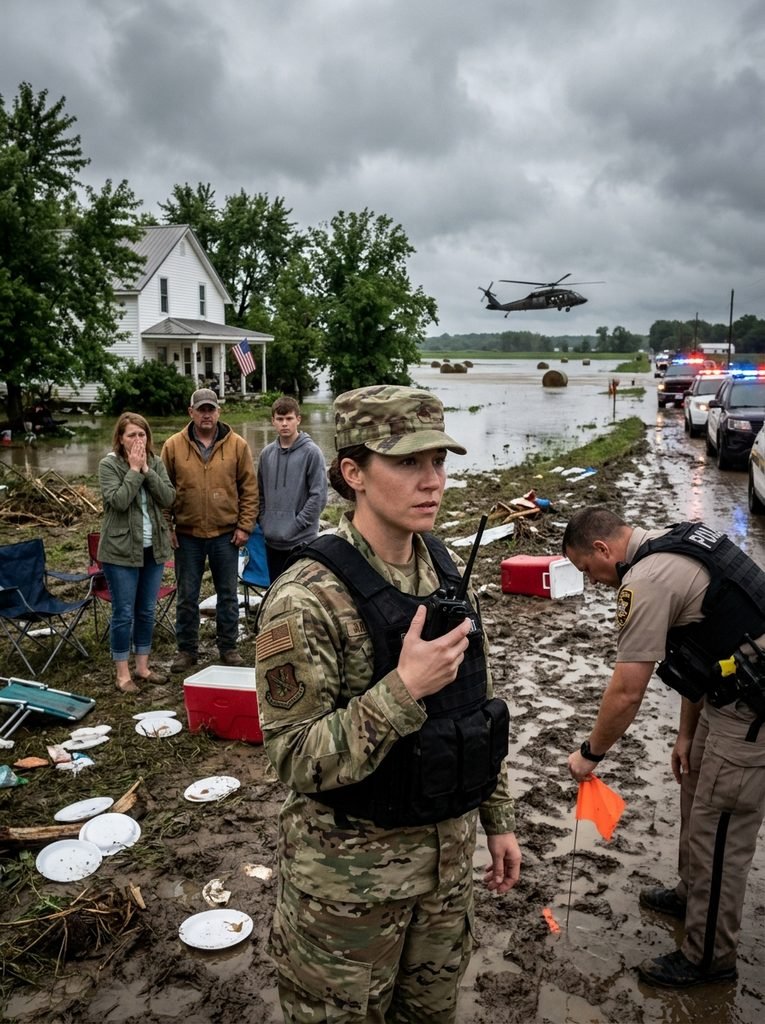
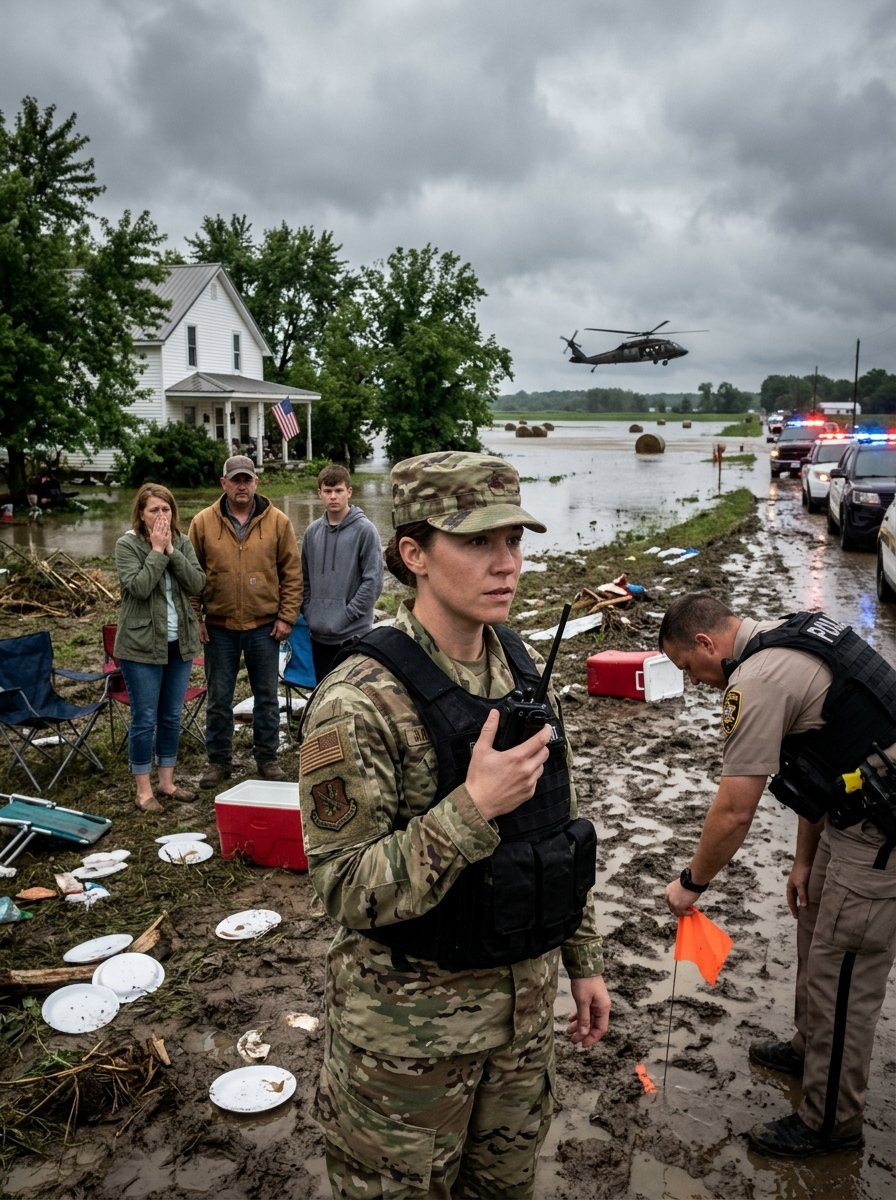
The helicopter did not arrive to rescue my family.
That distinction mattered.
Ray’s house was still safe.
The pasture was being used because other people were not.
The first aircraft brought in two Guard members and equipment, then repositioned to support a county request farther west.
Later, another flight brought three residents from an area that had lost road access.
One was an eighty-two-year-old man carrying an oxygen concentrator.
Another was a woman with a small dog tucked inside her raincoat.
The third was a teenage boy who kept apologizing for not having shoes.
Nobody in my family said much after that.
Drama looks different when the people coming off the helicopter are not actors.
They are wet.
Cold.
Embarrassed.
Carrying grocery bags because that was what they grabbed before leaving home.
Nicole helped my aunt move food from the reunion tables into the kitchen.
Someone made coffee.
My mother found dry socks for the teenager.
Ray stopped worrying about tire tracks in the pasture.
For the next three hours, our reunion became something else.
Not a command center.
Not a military base.
Just a useful piece of high ground.
I moved between the property and the county post twice.
When I was at Ray’s, I stayed in uniform because I was still on duty.
That alone seemed to unsettle my relatives.
They had seen me in uniform before.
Graduations.
Promotion photographs.
Veterans Day events.
But those were ceremonial versions of my job.
This was different.
My radio kept interrupting conversations.
Deputies asked me questions.
I asked them questions back.
Sometimes I knew the answer.
Sometimes I said, “I don’t know yet.”
That may have surprised Nicole most.
She had spent years treating my work as mysterious.
I had spent years helping that impression by speaking as though everything around it was too complicated to explain.
In reality, most emergency work was people sharing incomplete information quickly enough to make the next decent decision.
By late afternoon, the rainfall began moving east.
Water levels were still high, but the immediate situation stabilized.
No one on Ray’s property needed evacuation.
The aircraft left.
Deputies kept the southern road closed overnight.
Most relatives who had planned to drive home stayed.
We spread sleeping bags through the living room, machine shed and campers.
It became the strangest family reunion we had ever had.
Around nine that night, I finally changed out of my wet uniform blouse and put on a sweatshirt Ray gave me.
Nicole was sitting alone on the back steps.
I almost walked past her.
“Hannah.”
I stopped.
She held out a bottle of water.
I took it.
For a minute, neither of us spoke.
Then she said, “I was an ass.”
“Accurate.”
She gave me a tired look.
“You could let me finish.”
“Go ahead.”
“I thought you liked us not knowing.”
That surprised me.
“What?”
“I thought it made you feel important.”
I sat down beside her.
“Why?”
“Because every time anyone asked, you got that look.”
“What look?”
She imitated me badly.
“I can’t really discuss that.”
Despite myself, I laughed.
“I do not sound like that.”
“You absolutely do.”
Then she became serious again.
“You missed Mom’s birthday. You missed Ben’s graduation dinner. You left Christmas early two years ago. Every time we got annoyed, you acted like we were too stupid to understand why.”
I wanted to defend myself.
There were explanations for all of those days.
Real ones.
The birthday happened during tornado cleanup.
Ben’s graduation dinner overlapped with a training requirement I could not move.
Christmas had ended early because a winter storm had turned into an activation.
But Nicole was not questioning whether the reasons existed.
She was telling me what living beside those reasons felt like.
“I should have explained more,” I said.
“Yes.”
“You also could have believed me when I said I had to go.”
“I did believe you.”
“You called my job ‘that government thing’ for ten years.”
“Twelve.”
“That is not better.”
She looked out at the dark pasture.
“I believed the job was real. I just thought you liked being needed somewhere else more than you liked being needed here.”
That one hurt.
Because there had been times when the Guard was easier than family.
At work, roles were clear.
I had a task.
A chain of command.
A problem either fit my responsibility or it did not.
Family was messier.
Nicole could say one sentence at breakfast that made me feel fifteen years old again.
Dad could ask why I was still single and pretend it was curiosity.
Mom could tell me she was proud of my career and then ask whether I was ever going to have “a normal schedule.”
Sometimes being called away had felt like relief.
I had never admitted that.
“I think sometimes I did,” I said.
Nicole turned toward me.
I stared at the pasture.
“That doesn’t mean I wanted emergencies to happen. But yes. There were times duty was easier than being here.”
She nodded slowly.
“I knew it.”
“Don’t enjoy being right too much.”
“I’m trying not to.”
We sat there another minute.
Then she said, “When that helicopter came down, I felt stupid.”
“That wasn’t the goal.”
“I know.”
“And I don’t want you thinking every time I leave dinner, a Black Hawk appears somewhere.”
She laughed.
“That would be inconvenient.”
“Extremely.”
Then she asked something simple.
“What do you actually do when there isn’t a flood?”
So I told her.
Not everything.
Enough.
I explained planning meetings.
Training schedules.
Aviation coordination.
The endless paperwork she had mocked, which did in fact exist.
I explained that domestic emergency missions involved Guard support to civilian authorities, not military officers taking over counties.
I told her the deputies had not “moved because I told them to.”
They moved because county officials had authority over the evacuation and we were all working from the same plan.
“That’s less dramatic,” she said.
“Reality usually is.”
She smiled.
“Still kind of cool.”
“I’ll take it.”
By morning, the northern road reopened fully.
People started packing.
The reunion ended without a group photo.
Nobody cared.
As I was loading my bag, Dad came over.
He looked toward the pasture.
“You know, I always figured you mostly did logistics.”
“I do a lot of logistics.”
He nodded.
“Looked important yesterday.”
“It was important before yesterday too.”
He looked embarrassed.
“I know.”
I was not sure he did.
But I let it stand.
For the next few weeks, something unexpected happened.
My family became interested in my work.
Too interested.
Mom began sending me weather screenshots.
Ray called the first time he saw a military helicopter over the highway.
Dad asked whether I knew “the boys flying that thing,” as though Nebraska had three pilots.
Nicole was the only one who mostly stopped asking silly questions.
Instead, she asked better ones.
Can you tell me where you’re going?
Is this one of the things you can talk about?
Do you know how long you’ll be gone?
Sometimes the answer was yes.
Sometimes no.
But I stopped treating every question like an intrusion.
Three months later, we had Thanksgiving at Nicole’s house.
Halfway through dinner, my phone vibrated.
She looked at me.
I looked at the screen.
A routine scheduling message.
Nothing urgent.
Nicole raised one eyebrow.
“Well?”
I put the phone face down.
“Nothing.”
She nodded and passed me the potatoes.
Nobody made a joke.
That should probably be the clean ending.
It is not.
Nicole still thinks I use work to avoid family sometimes.
I still think she mistakes access for closeness.
Dad still tells people I “coordinate helicopters,” which is not exactly wrong and not exactly what I do.
And I still catch myself giving vague answers when a simple one would be better.
What changed was smaller.
My family stopped treating my silence as proof that there was nothing behind it.
I stopped treating their curiosity as proof they could not understand.
I do not know which of us was more responsible for the misunderstanding.
I suspect that depends on which sister you ask.