A Parade Organizer Told My 81-Year-Old Mother to Leave the Veterans’ Front Row Then a 94-Year-Old Veteran Stopped the Entire Parade
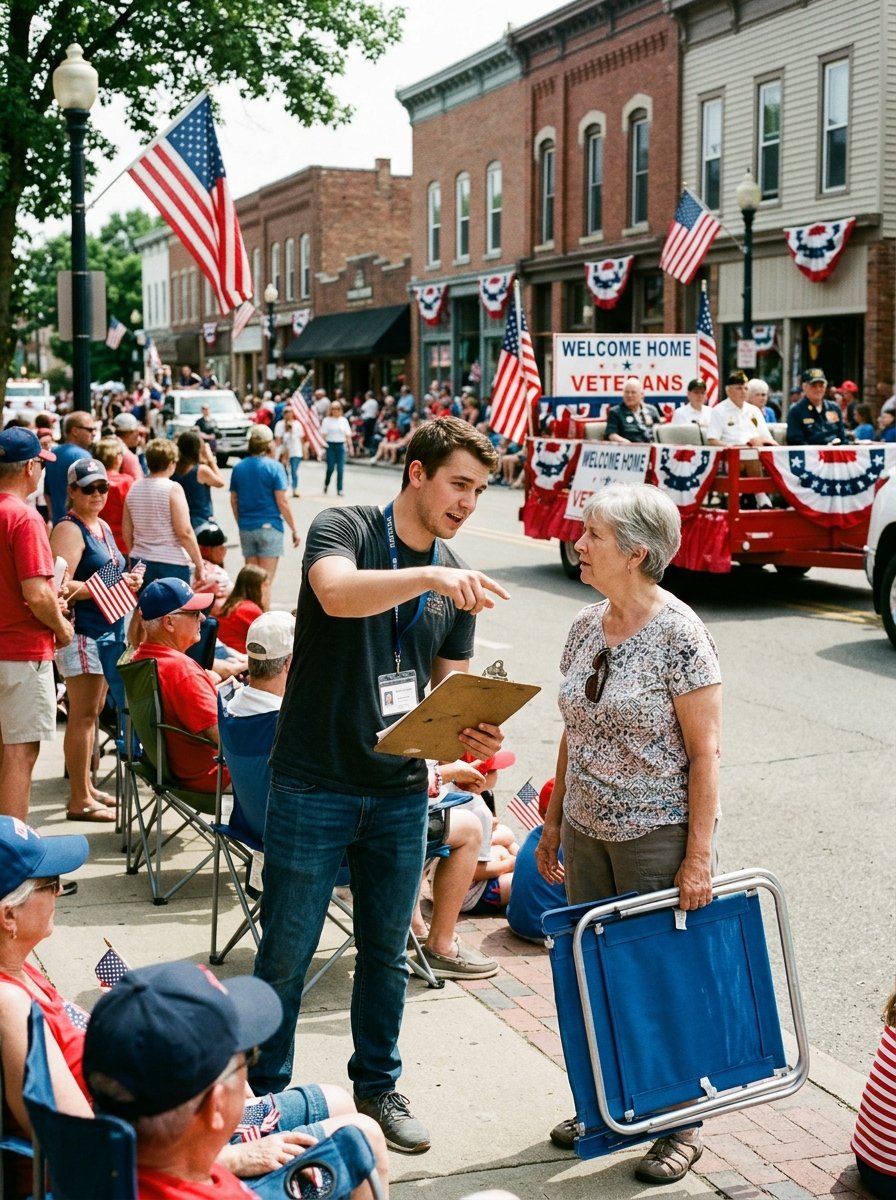
“Ma’am, I’m going to need you to move. This section is for veterans.”
The young man said it politely. He had a clipboard and a lanyard and a red, white, and blue polo shirt with Harmon Parks and Recreation stitched over the pocket. He was maybe twenty-six. He was smiling the way people smile when they’ve already decided how a conversation is going to end.
My mother was sitting in her green lawn chair on the curb in front of Ostby’s Hardware, right where she has sat every Memorial Day for forty-one years.
She was eighty-one. She had on her red cardigan, even though it was already seventy-five degrees at nine-thirty in the morning, because she always wears the red cardigan on Memorial Day. On the left side, just over her heart, was a small enamel pin. A red cross on a white shield. I had seen it every Memorial Day of my life and never once asked what it was.
There was a new rope this year. White nylon, strung on little metal stakes along the edge of the curb for half a block. And every ten feet, a laminated sign zip-tied to the rope.
VETERANS SEATING ONLY.
Mom had set her chair up behind the rope. In front of it, technically. Right where she always set it.
“I know,” she said.
The young man blinked. “You know?”
“I know it’s for veterans.”
“Okay. Great. So if you could just move back behind the barrier, there’s plenty of room back by the bank.” He pointed down the sidewalk with his pen. “We’re trying to make this year really special for our vets. It’s the first year we’ve done reserved seating.”
Mom looked at him for a long moment.
I was standing behind her chair holding two cups of coffee from the Cenex. I opened my mouth.
She lifted one hand off the arm of the chair. Just a little. Just enough.
I closed my mouth.
“Of course,” she said.
She stood up. It took her a second. Her knees aren’t good anymore. She folded the lawn chair, the way she’s folded it a thousand times, snapping the arms in, and she tucked it under her left arm.
The young man smiled. “Thank you so much, ma’am. Enjoy the parade.”
He walked off down the curb toward the next person.
Mom started walking toward the bank.
I followed her with the coffee.
“Mom.”
“Hush.”
“Mom, you were—”
“I said hush, Carol.”
“He doesn’t know.”
“No. He doesn’t.” She kept walking. “And it’s his parade. He’s worked hard on it. You can see he has.”
“It’s not his parade. It’s—”
She stopped and looked at me. It was a look I hadn’t seen since I was about fifteen.
“Carol Ann. I have never in my life asked anyone to make room for me. I’m not going to start on Main Street in front of the whole town.”
She turned and kept walking.
Behind us, the high school band started up at the corner of First Street. The parade had begun.
I need to tell you about my mother. Because I didn’t know most of it myself, not then, and I’ve had to put it together since.
Her name is Margaret Lindahl. Everybody calls her Peg. She was born on a farm outside Harmon, Minnesota in 1945, the youngest of five. She graduated from Harmon High in 1963. She went to nursing school at St. Mary’s in Rochester. She was a good student, she says. Quiet. She liked surgery.
In 1967, she joined the Army Nurse Corps.
She was twenty-two.
I know that because there’s a photograph in her bedroom closet. A young woman in a green uniform with her hair pinned up under a cap, standing in front of a brick building at Fort Sam Houston, Texas. She looks about fifteen. She’s not smiling. She looks like somebody trying very hard to look like she knows what she’s doing.
That’s all I knew. Growing up, that was the whole story. Mom was a nurse in the Army for a while, a long time ago. Then she came home and married my dad and worked at the Harmon hospital for thirty-two years and raised three kids.
She never talked about it.
Not once.
When we were kids, my brother asked her if she’d been in a war. She said, “I was in the Army, honey. Lots of people were.” And then she asked him if he’d finished his homework.
When I was in high school, I had to do a project for American History on someone who’d lived through the 1960s. I asked if I could interview her. She said she didn’t think she’d be very interesting and suggested I talk to Grandpa about the farm crisis instead.
Every Memorial Day, she sat in that green lawn chair in front of Ostby’s. She wore the red cardigan with the little pin. She clapped for the band and the fire trucks and the Boy Scouts. When the veterans’ float came by, she stood up.
She never waved. She never cheered. She just stood up, and put her hand over the pin on her cardigan, and stayed standing until the float had passed. Then she sat back down.
I thought that was just how her generation did things. Respectful. Quiet.
I didn’t know why she was standing.
I didn’t know what the pin meant.
I didn’t know that in 1968, when she was twenty-three years old, my mother had been an operating room nurse at the 71st Evacuation Hospital in Pleiku, in the Central Highlands of South Vietnam.
I didn’t know any of it.
Neither did the young man with the clipboard.
And neither, I found out later, did almost anybody else on Main Street that morning.
Except one.
We walked a block and a half down to the bank. There was a little patch of sidewalk free behind the crowd, in front of the ATM. Mom unfolded her chair and set it down and sat in it and folded her hands in her lap.
From there you couldn’t really see the parade. Just the tops of things going by. Flags on poles. The ladder on the fire truck. A Shriner’s hat.
“Mom, let me go talk to him.”
“No.”
“I’ll be nice. I’ll just tell him—”
“Tell him what? That his mother’s old lady used to be in the Army? Half the people in this town have somebody who was in the Army. Your grandfather was in the Navy. Your uncle Dick was in Germany.”
“That’s not the same and you know it.”
She looked at me.
“How would you know whether it’s the same, Carol?”
I didn’t have an answer.
She was right. I didn’t know. I’d never asked.
So I stood beside her chair in front of the ATM and drank my coffee and looked at the backs of other people’s heads while the parade went by.
The band went past. The Harmon Hawks, in maroon and gold, playing the same Sousa march they’ve played every year since I was in it. Then the color guard from the VFW post. Then the fire department, all three trucks, with the lights going and the sirens off. Then the Girl Scouts. Then a convertible with the Dairy Princess in it, waving.
Then I heard a tractor.
The veterans’ float is always the last one. It’s always the same: Dale Ostby’s old John Deere pulling a hay wagon with straw bales and folding chairs and bunting, and every veteran in the county who’s still able to climb up on it.
This year, there were twelve of them.
Old men, mostly. Two Vietnam guys in their seventies. Some Korea. One World War II, Ernie Bakke, who is a hundred and one and was strapped into his chair with a seatbelt somebody had rigged out of ratchet straps.
And in the very front chair, closest to the tractor, sat Gus Halvorsen.
Gus is ninety-four. He was in Korea. He was a dairy farmer east of town for sixty years. He’s got a voice like a gravel pit and he’s been the unofficial head of the VFW post since before I was born. Every year he rides in the front chair of that hay wagon in his garrison cap and waves at every single person on Main Street like they’re his own grandchildren.
He was waving now. Big slow waves. Left side, right side.
Then he turned his head and looked down the sidewalk toward the bank.
And he stopped waving.
I saw it happen. I was looking right at him. His hand froze in the air. He leaned forward in his chair. He was looking past the crowd, past the rope, past all the folding chairs with the veterans in them.
He was looking at my mother.
Sitting alone in front of the ATM.
His face changed. I can’t describe it any other way. It just changed.
He turned around and banged his fist on the side of the hay wagon. Hard. Three times.
Dale Ostby looked back from the tractor seat.
Gus pointed.
Dale stopped the tractor.
The whole parade stopped behind it.
There was nothing behind it, actually. The veterans’ float was the last one. But everybody on Main Street turned to look. The band, which had gone around the corner at Third Street, stopped playing. You could hear the tractor idling.
Gus stood up.
He’s ninety-four years old. He hasn’t stood up on that float in five years. They strap him into the chair too, now, because of his balance. One of the Vietnam guys, Larry Fossum, reached over and grabbed his belt so he wouldn’t fall.
Gus stood there in his garrison cap on the hay wagon in the middle of Main Street and pointed down the sidewalk at my mother.
Then he looked for the young man with the clipboard.
The young man was standing at the end of the rope, about twenty feet away. He looked confused. He looked like he didn’t know if something was wrong with the tractor.
“You,” Gus said.
His voice carried. That gravel-pit voice. You could have heard it in the next county.
“You. With the clipboard.”
The young man pointed at his own chest.
“Yes. You. Come here.”
The young man walked over to the hay wagon. He looked up at Gus.
“Sir? Is everything okay? Do you need—”
“Who moved Peg Lindahl?”
The young man looked blank.
“I’m sorry?”
“That woman,” Gus said, pointing. “In the red sweater. By the bank. Who moved her?”
The young man followed his finger. He saw my mother. He saw the green lawn chair.
“Oh,” he said. “I asked her to move behind the barrier. That section was reserved for veterans this year. She was very nice about it.”
Gus looked at him for a long time.
I’ve seen a lot of looks in my life. I’d never seen one like that.
“Son,” Gus said. “What’s your name?”
“Mason. Mason Reed. I’m the new coordinator for Parks and—”
“Mason. Do you know what that pin is? On her sweater?”
Mason looked toward my mother. He couldn’t see it from there. He shook his head.
“That’s the insignia of the Army Nurse Corps,” Gus said. “She was an operating room nurse at the 71st Evacuation Hospital. In Pleiku. In 1968.”
The sidewalk had gone completely quiet.
Mason opened his mouth. Nothing came out.
“She’s a veteran,” Gus said. “She’s been a veteran longer than you’ve been alive. Longer than your daddy’s been alive, probably. She’s been sitting in that same spot in front of Ostby’s every Memorial Day for forty years. And every year, when this float comes by, she stands up. And nobody in this whole town has ever thanked her for it.”
He was still pointing.
“And you moved her behind a rope.”
Mason looked like somebody had hit him in the chest.
“I didn’t know,” he said. “Sir, I didn’t— she didn’t say anything. I asked her and she just said she knew it was for veterans, and she moved. I thought she meant—”
“She meant she knew it was for veterans,” Gus said. “She didn’t mean she wasn’t one.”
Mason turned and looked down the sidewalk at my mother.
My mother was sitting very still in her lawn chair with her hands folded. She was looking at Gus. She wasn’t looking at anyone else.
I looked down at her.
“Mom,” I said. “Is that true?”
She didn’t answer me. She was still looking at Gus.
“Peg,” Gus called down the street. “Get up here.”
My mother shook her head. A little. Barely.
“Peg Lindahl. I’m ninety-four years old and I’m standing on a hay wagon in the middle of Main Street. I am not going to sit down until you get up here. And Larry’s not going to be able to hold my belt much longer.”
“I’m fine where I am, Gus,” my mother said.
She didn’t raise her voice. But it was so quiet on that street by then, everyone heard her.
“No, you’re not,” Gus said. “You haven’t been fine where you are since 1968. Neither have I.”
My mother closed her eyes.
Then she opened them. She put her hands on the arms of the lawn chair. And she stood up.
The crowd moved out of her way. Nobody told them to. They just did. They stepped back off the sidewalk into the street and onto the curb and made a path straight from the bank to the hay wagon.
My mother walked down it.
She didn’t hurry. She walked the way she walks into church. Head up. Hands at her sides. Her red cardigan buttoned. The little pin catching the sun.
She stopped at the side of the hay wagon. She looked up at Gus.
“You should sit down before you fall,” she said.
“I’ll sit down when you’re up here.”
“Gus.”
“Peg.” He leaned down toward her. His voice dropped. Not everybody could hear this part. But I was close by then, and I heard it. “You held my boy’s hand. You were the last one. You wrote to Ellen. You told her he wasn’t alone.”
My mother put her hand on the side of the hay wagon. She held onto it.
“I did,” she said.
“I’ve carried that letter in my wallet for fifty-eight years.”
My mother looked up at him.
“I know you have, Gus,” she said. “Ellen told me. At the church. In 1985.”
“Then you know I’m not going to sit down.”
She stood there a long moment.
Then she held up her hand.
Larry Fossum let go of Gus’s belt and reached down and took my mother’s hand, and two of the Korea guys reached down and took her other arm, and between the three of them they lifted my eighty-one-year-old mother up onto the hay wagon.
Gus finally sat down.
He pointed at the empty folding chair beside him. The one closest to the front.
My mother sat in it.
I didn’t know anything about Danny Halvorsen. I want to be honest about that. I’d heard the name. Everybody in Harmon had heard the name. There’s a little plaque at the VFW, and his name is on the memorial in front of the courthouse, the black granite one with the names of the county’s dead from every war.
Daniel G. Halvorsen. Vietnam. 1968.
I’d walked past it a hundred times.
I didn’t know the rest until that afternoon, when my mother finally told me, sitting at her kitchen table with the parade over and the red cardigan hanging on the back of her chair.
She told it slowly. Like she was reading it off a page she’d memorized a long time ago and never said out loud.
“I’d been in country four months,” she said. “The 71st was a big hospital. Quonset huts. Sandbags. The helicopters came in night and day. You’d hear them before you’d see them. The rotor sound. We’d all start moving before they landed.”
“February of sixty-eight. Tet. The whole country was on fire. We worked thirty-six hours, then slept for four, then worked another thirty-six. I don’t remember a lot of it. It runs together.”
She turned her coffee cup around on the table.
“He came in on a Tuesday. I remember because the chaplain had said Mass that morning and I’d missed it again. Chest wound. Abdomen. He’d been carrying another boy out under fire when he got hit. The surgeons worked on him four hours. They couldn’t fix it.”
“They moved him to the ward afterward. There wasn’t anything else to do. I was the nurse on the ward that night.”
She was quiet for a long time.
“He was nineteen,” she said. “He was from Harmon. I didn’t know that till I looked at his chart. I’d been in country four months and I’d never met anyone from home. Not a single soul. And here was this boy from Harmon, Minnesota, and he was dying.”
“He was awake for a while. Not long. He knew where he was. He asked me where I was from. I told him. He laughed. He said, I know your dad. Your dad sells seed corn. I bought a pocketknife at Ostby’s with my first paycheck from your dad’s cousin.”
She smiled a little. It didn’t last.
“He asked me to hold his hand. So I did. He asked me to tell his mom he wasn’t scared. So I said I would. He asked me if his dad would be mad that he got hit. I said no. I said his dad would be proud. I didn’t know his dad. I didn’t know if it was true. I said it anyway.”
“He died a little after four in the morning. I was still holding his hand.”
The kitchen was very quiet.
“I sat there till the sun came up. Then I went back to the nurses’ hooch and I got out a piece of paper and I wrote a letter to Ellen Halvorsen. I’d never met her. I told her he wasn’t alone. I told her he’d talked about home. I told her he’d said he wasn’t scared, and that he’d asked about his dad. I told her he was brave.”
“I sent it through the chaplain. I never heard anything back. I didn’t expect to.”
“I came home in January of sixty-nine. I married your father that summer. I went to work at the hospital. I never said a word about any of it. Not to anyone. Not to your father, even. I put it in a box.”
She looked at me.
“In 1985, at a funeral at Our Savior’s, a woman came up to me in the fellowship hall. I didn’t know her. She took my hand and held onto it and said, Are you Margaret Lindahl? Were you a nurse in Pleiku? And I said yes. And she said, I’m Ellen Halvorsen. You wrote to me about Danny.”
My mother put her hand over her mouth.
“Seventeen years,” she said through her fingers. “She’d been trying to find me for seventeen years. She’d written to the Army. She’d written to the chaplain’s office. She didn’t know my married name. She found me because somebody at that funeral said I’d been an Army nurse and she heard it from across the room.”
“She told me Gus carried my letter in his wallet. Every day. She said he took it out and read it every night before bed. She said it was the only thing that let him sleep.”
“And she asked me not to tell him I was in town. She said he couldn’t bear to look at me. Not yet. She said someday he’d be ready.”
My mother wiped her eyes with the back of her hand.
“Ellen died in 2009. Gus never said a word to me. Not one. In forty years of living in the same town. Not at church. Not at the grocery store. Not at the parade. He’d look at me sometimes. That was all.”
“And every Memorial Day, when that float went by, I stood up. For Danny. And for Gus.”
She was quiet.
“I didn’t know he was looking back,” she said.
But that was later. At the kitchen table.
On Main Street, my mother was sitting in the front chair of the hay wagon next to Gus Halvorsen, and the whole town was staring at her, and Mason Reed was standing beside the wagon with his clipboard hanging at his side, looking like he wanted to die.
Gus waved his hand at Dale Ostby on the tractor.
“All right, Dale. Go on. Slow.”
Dale put it in gear.
The tractor started rolling again. The hay wagon lurched and then smoothed out. And my mother rode down Main Street on the veterans’ float for the first time in her life.
She didn’t wave.
She sat very straight in the folding chair with her hands in her lap. She looked straight ahead.
But the people on the sidewalk started to clap.
It started near the bank. Just a few people. Then the people across the street. Then the folding chairs behind the rope, where the other veterans were sitting, the ones who hadn’t ridden on the float. A man in a Vietnam Veteran cap stood up out of his chair and saluted her as the wagon went past.
Then another one.
Then all of them.
The whole half block behind the white rope. Every veteran who’d been given a reserved seat. They stood up one after another as the wagon rolled by, and every single one of them saluted my mother.
She didn’t look at them. She kept looking straight ahead. But I was walking alongside the wagon by then, and I could see her face, and I could see her chin shaking.
The band, around the corner on Third, started playing again. I don’t know who told them to. They played the Army song. The Caissons one. Slowly. Badly. The trombones were a half step flat.
It was the most beautiful thing I’ve ever heard.
At the end of the parade route, at the courthouse, the float stopped in front of the black granite memorial. Every year, the parade ends there. The VFW chaplain says a prayer. Somebody reads the names of the county’s dead. A bugler plays Taps.
Gus got down off the wagon first. It took two men to help him. Then they helped my mother down.
She stood in front of the memorial. Gus stood beside her, leaning on his cane.
The VFW chaplain, Pastor Ron Gilbertson from Our Savior’s, came over with the list of names. He read it every year. There are sixty-three names on that memorial. World War One through Afghanistan.
He started toward the microphone.
Gus held out his hand.
“Ron,” he said. “Let her read it.”
Pastor Gilbertson stopped.
He looked at my mother.
My mother shook her head.
“Peg,” Gus said quietly. “Please. I’d like to hear Danny’s name in your voice. Just once.”
My mother stood there a long time.
Then she held out her hand for the list.
She read them all.
Sixty-three names. She stood at the microphone in front of the courthouse in her red cardigan and read every single one, slowly, the way you’d read names off a chart at the start of a shift. Last name. First name. Middle initial. War.
When she got to the Vietnam section, her voice changed.
There are four Vietnam names on the Harmon memorial.
She read the first three.
Then she stopped.
She stood there with the paper in her hand, not saying anything. The whole crowd waited. Three hundred people on the courthouse lawn, and you could hear the flag rope clinking against the pole.
Gus put his hand on her back.
“Halvorsen,” my mother said. “Daniel G. Army. Pleiku. February 20, 1968.”
She didn’t read the date off the paper. The date isn’t on the paper. Only the year is.
She said it from memory.
Then she lowered the list. She turned to Gus.
“He wasn’t scared, Gus,” she said. “I want you to hear me say it. Not in a letter. To your face. He asked about you. He wasn’t scared.”
Gus Halvorsen, ninety-four years old, dairy farmer, Korea veteran, head of the VFW post for forty years, stood on the courthouse lawn in front of the whole town and cried like a child.
My mother put her arms around him.
They stood like that while the bugler played Taps.
When it was over, nobody moved. The crowd just stood there on the lawn. People were crying all over. Not the polite kind of Memorial Day crying, the dab-your-eyes kind. Real crying. Men in seed caps with their faces in their hands.
Then Mason Reed walked up.
He stopped in front of my mother. He still had his clipboard. He held it against his chest like a shield.
“Mrs. Lindahl,” he said. His voice was shaking. “I’m so sorry.”
My mother let go of Gus. She turned and looked at him.
“I didn’t know,” Mason said. “I made the signs. I put up the rope. I thought I was doing something good. I thought I was honoring the veterans. And then I walked right past one and asked her to move. And she didn’t say anything. She just folded her chair.”
He looked down at the clipboard.
“I don’t know why I didn’t think it could be you. I guess I just thought. I don’t know what I thought.”
“You thought veterans look like those men,” my mother said, nodding at the hay wagon. “Most people do.”
“I should have asked.”
“Maybe.”
“Why didn’t you tell me?”
My mother looked at him for a long time.
“Because I’ve never told anyone,” she said. “Not my husband. Not my children. I didn’t want to be thanked for it. I didn’t think I’d earned it. I came home. A lot of those boys didn’t. And the ones who came home got spit on at the airport. Who was I to ask for a chair?”
Mason stood there.
“You’re not in trouble, son,” my mother said, more gently. “You made a nice parade. The rope was a good idea. It was.”
“It wasn’t, though,” he said. “Not if it put you behind it.”
My mother almost smiled.
“Well,” she said. “Next year, you’ll know.”
I drove her home after.
She sat in the passenger seat with her folded lawn chair across her knees. She was tired. Her face was blotchy. She looked like she’d run a marathon.
We didn’t say anything for a while.
“Mom,” I said finally. “Why didn’t you ever tell us?”
She looked out the window at the fields.
“Because nobody wanted to hear it, Carol. When I came home in sixty-nine, nobody wanted to hear anything about that war. Not the protesters. Not the VFW, either. Did you know they wouldn’t let women in the VFW back then? Not as members. We could join the auxiliary. Make the coffee for the men.”
I didn’t know that.
“And then the years went by, and I’d never said anything, and then it seemed too late. How do you tell your children, by the way, I held boys while they died, a hundred and some of them, I stopped counting? When do you bring that up? At supper?”
“I would have wanted to know.”
“I know you would have. I’m sorry.”
She was quiet.
“I didn’t want you to look at me different,” she said. “That’s the truth. I wanted to be your mother. Not a war.”
“You’d still have been my mother.”
“I know that now.”
We pulled into the driveway. She didn’t get out.
“There’s a box,” she said. “In my closet. On the top shelf behind the Christmas wrapping. If you want to see it.”
“Do you want me to see it?”
She thought about it.
“Yes,” she said. “I think I do. I’m eighty-one. Somebody ought to know where it is.”
That night, I got the box down.
It was an old Army footlocker, the small kind. Green metal. Her name stenciled on the lid in white. M. JOHNSON, 1LT, ANC. Her maiden name.
Inside was her uniform, folded. Her nurse’s cap. A Bronze Star in a little blue box that I’d never seen and she’d never mentioned.
A stack of letters from my grandmother, tied with a ribbon.
A photograph of a dozen young women in green fatigues, standing in front of a Quonset hut, squinting into the sun. On the back, in my mother’s handwriting: 71st Evac. Pleiku. Christmas 67. We made it to New Year’s.
And a notebook.
A small one. The kind that fits in a breast pocket. The cover had gone soft and brown.
Inside were names.
Page after page of them. In tiny handwriting. Just names and dates. Some had a hometown written next to them. Some had a word or two. Asked for his mother. Wanted a cigarette. Sang. Laughed at the end.
I counted. I didn’t mean to. I just started counting and couldn’t stop.
One hundred and fourteen.
On the page for February 20, 1968, there was only one name.
Halvorsen, Daniel. Harmon, MN. Knew Dad. Asked about his father. Not scared.
I sat on the floor of my mother’s bedroom with that notebook in my hands until it got dark.
The next morning, there was a knock on my mother’s door at seven-thirty.
It was Mason Reed.
He was holding a coffee from the Cenex and a white envelope. He looked like he hadn’t slept.
“Mrs. Lindahl,” he said. “I’m sorry to bother you so early.”
“You’re not bothering me. I’ve been up since five. Come in.”
He came in and sat at her kitchen table. I was there. I’d slept over again.
“I went to the VFW last night,” he said. “After. I talked to Gus. And some of the others. Larry Fossum. I asked them about women who served. In Vietnam.”
“And?”
“Larry said there were about eleven thousand women in Vietnam. Most of them nurses. He said almost nobody knows that. He said there’s a memorial in Washington, just for them. It took until 1993 to get built.”
“That’s right.”
“He said Harmon County had three. Three women from this county served in Vietnam. Two of them have passed. You’re the last one.”
My mother didn’t say anything.
“There’s no plaque,” Mason said. “There’s nothing at the courthouse. There’s nothing at the VFW. There’s nothing anywhere in this town that says there were women. I looked.”
He pushed the envelope across the table.
“I went to the city council this morning. Six a.m. I woke up the mayor. I’m probably going to get in trouble for that.”
My mother opened the envelope.
Inside was a printed sheet. A resolution, passed unanimously at an emergency meeting of the Harmon City Council at 6:15 that morning. It authorized the Parks Department to add a new panel to the black granite memorial in front of the courthouse. Not for the dead. For the living and the dead. For every woman from Harmon County who had served in uniform, in every war, going back to the first one.
Her name would be on it.
And the other two.
And, the resolution said, the names of any others the Parks Department could find, once they’d gone through the county records.
My mother read it twice.
“You did this at six o’clock this morning?”
“Yes ma’am.”
“Why?”
Mason looked at his coffee.
“Because I put up a rope,” he said. “And I made signs. And I spent three weeks planning the best Memorial Day this town ever had for its veterans. And the whole time, I had a picture in my head of what a veteran looked like. And you didn’t fit it. And so I moved you.”
He looked up at her.
“I don’t ever want anybody to fit the wrong picture again. Not in this town. Not while I’m running the parade.”
My mother looked at him for a long time.
Then she reached across the table and put her hand on top of his.
“Your grandmother would be proud of you,” she said.
Mason looked startled.
“You knew my grandmother?”
“Irene Reed. She worked the night desk at the hospital when I was on the floor. Eighteen years. She was the best ward clerk I ever had.” My mother smiled. “You have her eyebrows. I noticed it yesterday when you were telling me to move.”
Mason started laughing. Then he put his hand over his face, and then he wasn’t laughing.
The panel went up in November. Veterans Day.
It’s a smaller piece of black granite, set just to the right of the big memorial. It says, at the top, in gold letters:
THE WOMEN OF HARMON COUNTY WHO SERVED.
There are nineteen names on it. Mason found sixteen more in the county records over the summer. Women who’d been WACs and WAVES in World War Two. A Navy nurse in Korea. A woman who’d flown cargo planes in Iraq. A medic in Afghanistan who’s thirty-four now and teaches second grade in Harmon and never told her students.
My mother’s name is third from the top.
Margaret J. Lindahl. Army Nurse Corps. Vietnam. 1967-1969.
They had a ceremony. Gus Halvorsen insisted on being there, even though it was thirty degrees and windy and he’d been in the hospital in October with pneumonia. His grandson pushed him up in a wheelchair with a blanket over his knees.
When they pulled the cloth off the panel, Gus reached into his coat. He took out his wallet. He opened it with shaking hands and took out a piece of paper, folded so many times it had gone soft as fabric. Yellow. Splitting at the creases.
He held it out to my mother.
“I want you to have this now,” he said.
My mother looked at it.
She knew what it was. She’d written it.
“Gus, no. That’s yours. That’s Ellen’s.”
“Ellen’s gone. And I’m going. Doctor says spring, maybe.” He pushed it toward her. “I read it every night for fifty-eight years. I know every word. I don’t need it anymore. And I don’t want my grandkids finding it in a drawer after and throwing it out because they don’t know what it is.”
My mother took it.
She didn’t open it. She held it against her chest.
“I’ll keep it,” she said. “I’ll put it in the notebook. With his name.”
Gus nodded. He was crying again. He’d cried more in the past six months than in the forty years before, my mother said later. It was good for him.
“Peg,” he said. “Thank you. I should’ve said it in eighty-five. I should’ve said it in sixty-eight. I was a coward.”
“You weren’t a coward, Gus. You were a father.”
“Same thing, sometimes.”
She bent down and kissed the top of his head, right on his garrison cap.
Gus Halvorsen died in April.
My mother sat with him at the end. His grandson called her. She drove to the nursing home at two in the morning and sat beside his bed and held his hand.
She told me later that he was awake for a while near the end. Not long. He knew she was there.
He asked her if Danny had been brave.
She said yes.
He asked her if Ellen would be waiting.
She said yes.
He asked her to stay.
So she did.
This past Memorial Day, I drove her downtown at nine.
The white rope was there again. Strung along the curb in front of Ostby’s. The laminated signs every ten feet.
But they said something different now.
RESERVED FOR THOSE WHO SERVED. ALL OF THEM.
And in front of Ostby’s Hardware, right on the curb, where my mother had sat in her green lawn chair for forty-one years, there was already a chair waiting.
A real chair. Wooden. With a red cushion. Somebody had painted a small red cross on a white shield on the back of it.
Taped to the seat was an index card. In Mason Reed’s handwriting.
Saved for 1LT Lindahl. Please don’t move her.
My mother stood on the sidewalk and looked at it for a long time.
“Oh, for heaven’s sake,” she said.
But she sat down in it.
Mason came by about twenty minutes before the parade started. He had his clipboard. He crouched down beside her chair.
“Good morning, Lieutenant.”
“Oh, stop it.”
“Gus told me to call you that. Last fall. He said you outranked him and nobody in this town ever knew it.”
My mother sighed. “Gus Halvorsen was a corporal. Everybody outranked Gus.”
Mason laughed.
“There’s a seat on the float for you,” he said. “Front row. Gus’s chair. If you want it.”
My mother looked down Main Street toward the corner where the parade would start. Toward the old John Deere and the hay wagon with the straw bales.
She was quiet for a long time.
“No,” she said finally. “Thank you. But I think I’ll stay here.”
“Are you sure?”
“I’m sure.” She smoothed her red cardigan over her knees. “That’s Gus’s chair. Let it ride empty this year. People ought to see it empty.”
Mason nodded slowly.
“Yes ma’am.”
So that’s what they did.
When the veterans’ float came by at the end of the parade, the front chair was empty. Somebody had laid Gus’s garrison cap on the seat. And a small folded flag.
And as the hay wagon passed Ostby’s Hardware, every single veteran on that float turned in their chairs and looked at the curb.
My mother stood up.
She put her hand over the little pin on her cardigan, the way she has every Memorial Day of my whole life.
And this time, every one of them saluted her back.
Then the people on the sidewalk did something I don’t think anyone planned. They didn’t clap. They didn’t cheer. They just stood up out of their lawn chairs, one after another, all along both sides of Main Street, and stayed standing with her until the float had passed.
When it was gone, my mother sat back down.
She folded her hands in her lap.
“Well,” she said to me. “That was nice.”
“Mom.”
“It was. It was very nice.”
“Mom, you’re crying.”
“I know I am, Carol.” She took a tissue out of her cardigan pocket. “I’m eighty-two years old. I’m allowed.”
I sat down on the curb beside her chair. Right on the concrete, the way I did when I was seven. I leaned my head against her knee.
She put her hand on my hair.
Down the street, the band was playing. The fire trucks had their lights on. The Dairy Princess was waving. Somewhere behind us, the bell over Ostby’s door rang as somebody went in for coffee.
“Mom,” I said. “Can I ask you something?”
“You can ask.”
“The notebook. With the names. One hundred and fourteen.”
“Yes.”
“Did you ever write your own name in it?”
She was quiet for a while.
“No,” she said. “Why would I? I came home.”
I didn’t say anything.
But that night, after she’d gone to bed, I took the little brown notebook out of the footlocker. I turned to the last page. The one after all the names.
And in my best handwriting, I wrote:
Lindahl, Margaret. Harmon, MN. Came home. Never asked for a chair. Should have had one all along.
Then I closed it and put it back on the top shelf behind the Christmas wrapping, where it belonged.