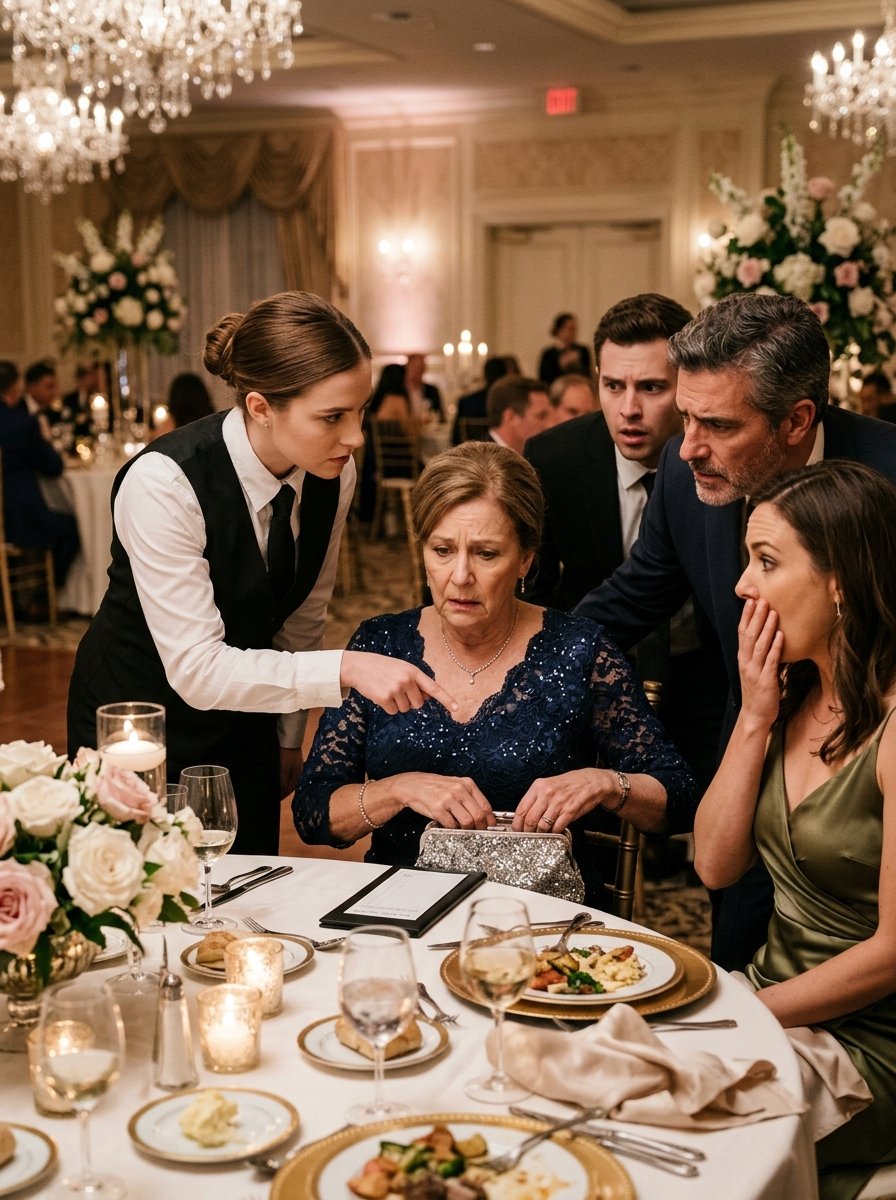
My Daughter-in-Law Threw a $3,000 Dinner Bill in Front of Me and Said I Didn’t Belong Then the Waiter Whispered, “Please Don’t Pay”
At my DIL’s mother’s birthday at an upscale restaurant, my DIL threw me the three-thousand-dollar bill for twenty-seven people. “Consider it your fee to sit with us,” she said. “If you can’t afford this, you don’t belong here.” I reached for my purse. Then the waiter leaned close and whispered, “Ma’am, please don’t pay. You need to see this first.”
I almost didn’t go that night.
I had been standing in front of my closet for twenty minutes, staring at the navy dress I hadn’t worn since my husband’s retirement party eleven years ago, trying to talk myself into something I couldn’t quite name.
Caleb had called three days earlier, voice carefully flat, the way it got when he was asking for something he wasn’t sure he had the right to ask for.
“Mom, it’s Vivian’s birthday dinner Saturday night. Sloane really wants you there.”
I had paused before answering. In two years of marriage, Sloane had wanted me present at exactly four family events, and at each one I had spent most of the evening talking to whoever happened to be seated farthest from her mother. But Caleb’s voice had that particular tightness in it, the same tightness it had every time I asked how things were going and he said, “I’m fine, Mom,” and I knew he wasn’t. And we both knew I knew. Neither of us said anything more about it.
I put on the navy dress. I drove to Laura.
The restaurant sat on the east side of Charlotte, in a neighborhood that had reinvented itself twice in the last decade. Valet parking. A hand-lettered menu board by the door. The kind of place where the lighting was dim enough to make everyone look like they belonged.
I had heard of Laura before, though not the way Vivian likely assumed. My crew had cleaned it the previous night, twelve hours of commercial-grade work that left the kitchen floors gleaming and the dining room smelling like cedar and lemon, not bleach. As I stepped inside, Richard, the general manager, caught my eye from across the host stand. He gave me a small, unhurried nod. I nodded back. Neither of us made anything of it.
The private dining room held twenty-seven guests arranged around a single long table dressed in white silk, candles in hurricane glass, crystal that caught the light like it had been placed there by someone who understood exactly what it was supposed to communicate.
Vivian sat at the head of the table in a beaded gown that probably cost more than my first company van. And she was already mid-sentence when I found my seat, something about the private villa they had considered renting on the Amalfi Coast before settling on a boutique hotel in Monaco instead.
“Martha.” She turned to me with a smile that arrived half a second too late to be genuine. “Caleb told me you run a cleaning service. How lovely.”
“I do,” I said, and left it exactly there.
I watched her recalibrate, the small, almost invisible adjustment behind her eyes when an answer fails to give you what you were hoping for. She moved on quickly, pivoting back to Monaco, and I picked up my water glass and turned to find Caleb.
He was sitting three seats down beside Sloane, wearing a charcoal blazer I didn’t recognize. He looked good, the way people look good when they’ve been trying hard at something. But his shoulders were pulled slightly forward, and he was staring at the bread basket in front of him with the focused attention of a man who was working very hard at not looking at anything else.
When Sloane leaned over to say something in his ear, his jaw tightened just enough for me to notice.
I had last seen him six weeks ago, a Sunday lunch that lasted forty minutes before Sloane remembered an appointment. Before that, four months. The gaps had grown so gradually I had almost convinced myself they were normal. That this was simply what happened when your son built a life of his own. That space was healthy.
That I should not read into the shortening phone calls and the way his voice went careful whenever I asked a direct question. Sitting there, watching him stare at that bread basket, I could not convince myself of any of it anymore.
Vivian’s conversation moved like a current, pulling everything toward the same point. She mentioned her husband’s position, senior VP, she said, though of what she left deliberately vague. Twice in the first ten minutes, she referenced their address in Eastover, the gated neighborhood on the south side of Charlotte where the houses sat behind hedgerows and the HOA fees ran
higher than most people’s rent. She asked the couple beside her whether they had considered the private school in the Myers Park area for their daughter because the waiting list, she said, was something you really needed to get ahead of.
She was performing. And the audience, twenty-seven people who had come for a birthday dinner, was performing right back. Laughing at the right moments. Asking the right follow-up questions. Filling the room with the sound of people who had agreed, without saying so, to treat the evening as something other than what it actually was.
I refilled my own water glass. I watched Caleb’s hand close slowly around the stem of his wine glass and stay there, knuckles going pale. And then I heard Sloane laugh at something across the table.
A particular laugh, high and deliberate, aimed at no one and meant for everyone. And the hair on the back of my neck stood up. Not because of the sound itself, but because of what came just after it. The way her eyes moved, quick and calculating, to land directly on me.
By the time the appetizers arrived, I understood exactly what kind of evening this was going to be.
The wait staff moved around the table with the practiced quiet of people trained never to exist too loudly in a room, setting down plates of seared scallops and whipped ricotta crostini that nobody at our end of the table actually looked at.
Vivian was talking again. She had barely stopped since I sat down, and I had begun to understand that her conversation operated less like an exchange and more like a sonar, sending out signals, waiting to hear what bounced back.
“Martha,” she said, turning to me with that rehearsed warmth she wore the way other women wore a perfume. “Now that you’re winding down, retirement must feel so well deserved. What does a woman do with herself after all those years of, well—” She gestured vaguely, the kind of gesture that was meant to suggest she respected what I did without actually having to name it. “Hard work.”
“I’m not retired,” I said.
“Oh.” A small pause. “Still taking on clients?”
“Still running the company,” I said, and picked up my fork.
Vivian smiled and moved on, but not before I caught the flicker behind her eyes, the rapid, almost invisible recalculation of someone whose math had just come out differently than expected.
Across the table, Sloane set down her champagne glass with a small, deliberate click.
“You know,” Sloane said, her voice pitched to carry just far enough, “in our family, the parents really do everything they can to help the children build a solid foundation. It’s just how we were raised.” She let her gaze drift toward me, unhurried, the way a cat looks at something it has already decided about. “Don’t you think that’s important, Martha?”
“I think it depends on what you mean by help,” I said pleasantly.
Sloane smiled. It was a good smile. She had practiced it.
I turned back to my plate and let the conversation move on without me. But I was not watching the conversation anymore. I was watching Caleb.
He had eaten maybe four bites of his scallop. He held his wine glass with both hands now, elbows on the table in a way that Sloane had already corrected twice with a light touch to his arm, each time without looking at him. The way you correct a habit so automatic it doesn’t even require your full attention.
Every time Vivian laughed too loudly at something, Caleb’s shoulders pulled slightly tighter. Every time Sloane spoke, his jaw moved once, like he was swallowing something.
I had raised that boy. I had watched him learn to walk on the hardwood floors of our house on Sycamore Drive. Had sat with him through four years of high school chemistry that neither of us understood. Had driven him to Charlotte Douglas Airport the morning he left for his first real job with a duffel bag and twenty dollars in his wallet, and the specific terror of a twenty-four-year-old who had decided to believe in himself.
I knew every version of my son’s face. The man sitting three seats away from me was not fine. He had not been fine for a long time, and I had let him tell me he was, month after month, because I had told myself that respecting his marriage meant not asking the questions I already knew the answers to.
That was my failure, not his.
“Martha.” Vivian’s voice pulled me back. She had leaned forward slightly, her pearl-drop earrings catching the candlelight. “I have to ask, do you own your home outright, or are you still—” She made a small sound that was not quite a laugh. “I only ask because real estate in Charlotte has become such a conversation, hasn’t it? We were just saying at our club last month that the families who got in early are sitting on something quite remarkable.”
The table around us had gone slightly quieter. Not obviously. No one stopped their own conversations, but the particular quality of the quiet that settles when people are listening without appearing to.
“I manage just fine,” I said. It was not an answer. Vivian knew it was not an answer. The skin around her eyes tightened for just a moment before her expression reset itself into something softer and more practiced.
“Of course you do,” she said warmly. “Of course.”
I reached for my water glass. And that was when I noticed Sloane was no longer at the table. I had not seen her stand. I had not heard her excuse herself. But her chair was empty, and her champagne glass sat untouched. When I glanced toward the back of the restaurant,
I caught the edge of her silhouette rounding the corner near the host stand. Not toward the hallway marked with the restroom signs. Toward the front. Toward the reception desk. She had something tucked under her arm. It took me a moment to place it. The slim leather folder the waiter had left near the host stand when we first arrived. The one that held the evening’s bill.
My water glass hovered halfway to my mouth. I set it back down without drinking.
Sloane came back from wherever she had been with a look on her face I can only describe as satisfied. The kind of satisfied that makes you check your pockets. She slid back into her chair without apologizing for the absence, smoothed the front of her dress with both hands, and reached for her champagne like a woman who had just finished something she had been planning for a while.
She did not look at me right away. She looked at her mother first. A quick, small glance that passed between them like a signal. And Vivian’s shoulders dropped just slightly, the tension releasing in a way that told me whatever Sloane had gone to do, Vivian had known about it.
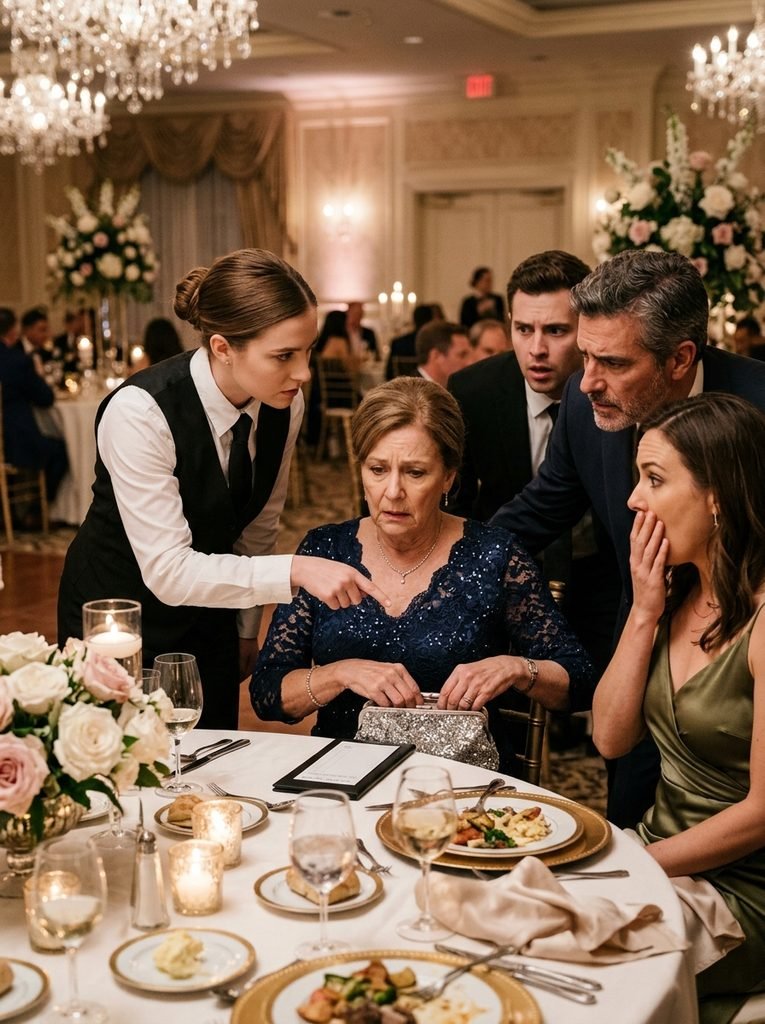
Then Sloane looked at me. She picked up the slim leather bill holder from her lap. I had not even seen her carry it back to the table. And without a word, without any change in her expression, she sent it sliding across the white silk tablecloth toward me. The leather caught on the fabric and made a soft dragging sound before it stopped against the edge of my bread plate.
She reached up and smoothed a strand of hair back from her face. Then she smiled.
“Consider this the cost of being welcome at this table,” she said, her voice clear and unhurried, pitched exactly loud enough for the guests nearest to us to hear every word. “If you can’t even cover this dinner, then clearly you don’t belong here.”
The table went quiet in the way that rooms go quiet when something has happened that everyone will be talking about later. Not a sudden hush. More like a tide pulling back.
Forks were set down. A woman three seats away stopped mid-sentence. The man beside her turned his head just enough to see without appearing to look. Twenty-seven people found something to do with their hands that allowed them to keep their eyes on me.
I did not speak. There was nothing in me that wanted to speak. I looked at the leather folder sitting against my bread plate. I looked at Caleb. He had not moved. His hand was wrapped around his wine glass so tightly that the knuckles had gone the color of the tablecloth beneath them.
He was staring straight down at the stem of the glass, and the muscle along his jaw was working steadily, rhythmically, like a man chewing on something he could not swallow and could not spit out.
He did not look up at me. He did not look up at his wife. He sat there and he held that glass. And he said nothing.
And I felt something tear quietly in the center of my chest. Not anger. Not humiliation. Something older and heavier than either of those. This was my son. This was what two years had made of him.
I reached for my purse. I found the clasp with my fingers and pressed it open. My hand moved inside and closed around my wallet, the same worn brown leather wallet I had carried for nine years.
The one Caleb had given me for Mother’s Day the year he got his first real paycheck and called me from the parking lot of the store because he wanted to hear my voice when he told me he had bought me something with his own money.
My fingers tightened around it.
And then a voice came from just behind my right shoulder, low and close, carrying the particular urgency of someone who does not have much time.
“Ma’am, please don’t. You need to see something right now.”
I turned my head. The young man standing behind me was one of the wait staff. Julian, I would learn later. A server who had worked the Laura floor for two years and who had the careful, professional stillness of someone trained to be invisible until invisibility was the wrong choice.
He was looking at me with an expression that had nothing to do with his job description. His eyes were steady, and his voice had dropped to just above a whisper, but there was nothing uncertain in it.
I looked at him for one full second. He did not explain himself. He simply gave the smallest nod toward the leather folder on the table.
I let go of my wallet. I pulled the folder toward me and opened it. The itemized receipt ran to nearly three thousand dollars. Twenty-seven guests. Four courses.
Two bottles of imported champagne that Vivian had ordered without consulting anyone. And at the bottom of the thermal paper, printed in letters that had bled slightly at the edges, the way thermal ink does when a machine has had to work to produce them, was a single word in red.
Declined.
I read it twice. Then I set the folder down and looked across the table at Sloane. She was still smiling. But something had shifted at the edges of it. A hairline fracture in the confidence so small that if I had not been watching for exactly this kind of thing, I would have missed it entirely.
Her card had been declined before she ever sat back down. She had known when she sent that folder sliding across the tablecloth toward me that there was nothing behind it but nerve and calculation. She had not been asserting power. She had gone to the host stand to attempt the payment.
And when the card came back declined, she had picked up the folder anyway and carried it back to the table. She’d been bluffing with an empty hand and hoping I would fold before anyone looked too closely at her cards.
I placed my hand flat on top of the folder and said nothing.
It was Vivian who broke first. “Oh.” She laughed, a bright and brittle sound that landed wrong in the silence. “The cake. They should be bringing out the cake any moment. Three tiers. I told them, with the spun sugar on top. Yes.”
The door from the kitchen opened. A man in a white apron pushed a cart through it. And on the cart sat a three-tiered cake with ivory frosting and fresh flowers pressed into the sides. He wheeled it to within six feet of the table and stopped. He did not reach for the lighter in his apron pocket.
He did not move to place the candles. He crossed his arms and looked at Vivian with the flat, patient expression of a man who had delivered this particular news before.
“Mrs. Vivian,” he said, loud enough for the near half of the table to hear clearly, “the deposit card on file for this order was declined this afternoon. I’ll need two hundred dollars in cash before I can serve the cake.”
The color left Vivian’s face so completely and so quickly that, for a moment, she looked like a photograph of herself rather than the woman who had been holding court at the head of this table for the past two hours. Around us, the murmuring began.
Vivian recovered faster than I expected. I will give her that. Within seconds of the cake man’s announcement, she had arranged her face back into something resembling composure and turned to the woman seated to her left. Three of them dressed in the particular uniform of Charlotte’s charity circuit.
Statement jewelry. Conservative hemlines. The kind of blowout that cost two hundred dollars and was meant to look effortless.
Vivian touched the arm of the nearest one, a woman with pearl-drop earrings the size of quarters, and leaned in with a laugh that was supposed to sound conspiratorial and fond.
“You know how banks are,” Vivian said, waving her hand as though dismissing a minor inconvenience. “They see international charges and they freeze everything. I was shopping in Charleston last weekend, and the same thing happened at checkout. Ridiculous, honestly.” She squeezed the woman’s arm. “Would you mind spotting me until I sort it out? You know I’m good for it, Barbara.”
Barbara looked at Vivian’s hand on her arm. Then she looked at Vivian’s face. Then she set her champagne flute down on the tablecloth with a precision that suggested she had been waiting for exactly this moment since she arrived.
“Vivian,” Barbara said, and her voice carried the particular clarity of a woman who had decided she was done being careful with her words, “you called me three weeks ago and told me this was a hosted dinner. Your treat, you said. No need to bring anything, you said.”
She glanced around at the women beside her, who were already reaching for their evening bags with the focused energy of people who have identified the nearest exit. “You invited us here to make yourself look like you could afford the room, and now you want us to pay for it.”
The murmuring that had started at the edges of the table sharpened into something more distinct. A man near the far end leaned over to his wife and said something behind his hand. Two couples near the middle were already pushing back their chairs.
“That is not what—” Vivian started.
“I have an early morning,” Barbara said, standing. She smoothed her skirt with both hands, unhurried, the way a woman moves when she has absolutely nothing to apologize for. “Happy birthday, Vivian. I hope the bank gets it sorted.”
One by one, the pearl-and-blowout contingent rose from their seats. A few said nothing at all. One patted Vivian’s shoulder with the brisk sympathy you offer someone at a funeral when you have another engagement to get to. The chairs scraped against the hardwood in a small, steady percussion that seemed to grow louder the quieter Vivian became.
By the time the last of them had gone, six chairs sat empty along Vivian’s side of the table, and the remaining guests had developed a sudden, intense interest in their dessert menus.
Sloane’s composure cracked along a different line than her mother’s. Where Vivian had gone pale and stiff, Sloane went red. A fast-rising flush that started at her throat and moved upward. And she turned it directly on Caleb like something she needed to put somewhere before it burned through her.
“This is your fault,” she said, her voice dropping into a register I had not heard from her before. Lower. Stripped of the careful social polish she had been wearing all evening. “You sat there all night like a piece of furniture. Your mother is sitting right there, and you haven’t done one thing.”
“Sloane,” Caleb said. “Don’t.”
She pointed at him, her finger stopping an inch from his face. “I sacrificed so much to build a life with you. I gave up things you don’t even know about, and you can’t even—” She stopped, seeming to remember the room, and recalibrated. When she spoke again, it was quieter, but the heat behind it had not gone anywhere.
“I bought you that watch for our anniversary. I went without things so you could have something real to wear to evenings like this. The least you could do is act like it.”
I looked at the watch on Caleb’s wrist. It was a clean-looking piece. Silver case. Dark face. The kind of profile that was designed to suggest a certain provenance without committing to it. Thirty years of walking through other people’s homes had taught me things I had never set out to learn.
I had cleaned enough bedside tables with genuine Swiss timepieces laid carefully on their sides to know what a mechanical second hand looked like in motion. The smooth, continuous sweep of a movement that cost what it cost because of what was inside it.
The second hand on Caleb’s watch ticked. One beat. Pause. One beat. Pause. The small, stuttering pulse of a quartz movement that had no idea it was pretending to be something else.
“That’s a quartz movement,” I said. I kept my voice conversational, the way you point out that someone has left their lights on. “A genuine mechanical watch, Rolex or otherwise, the second hand sweeps continuously. It doesn’t tick.”
Sloane’s eyes moved to me so fast I thought she might have hurt her neck. Caleb looked down at his wrist. Something moved across his face. Not surprised, exactly. More like the specific exhaustion of a man watching a thing he had hoped would stay buried come to the surface anyway.
“She didn’t buy it,” he said. His voice was very quiet. He was not looking at anyone in particular. “My last paycheck cleared three weeks ago. The account was gone before I saw a dollar of it.” He turned the watch over on his wrist slowly, like he was seeing it for the first time. “I bought this at a flea market on Independence Boulevard. Fifty dollars. I wore it so she’d stop asking me where the real one was.”
The table had gone very still. Sloane stood up so abruptly her chair shrieked against the floor.
“Give me your card,” she said to Caleb, her voice stretched tight as wire. “Right now. Give Julian your card and let him run it.”
Caleb reached into his jacket pocket. He pulled out his wallet and removed the last card inside it with the particular slowness of a man who already knew what was coming next.
Julian came back with the card machine in under sixty seconds. He did not need to say anything. The look on his face said it all. He set the machine down on the tablecloth beside Caleb’s plate with the careful neutrality of someone who had delivered bad news enough times to know that the kindest thing you can do is deliver it quietly.
The screen faced up. The single word on it was the same word I had seen on the bill holder twenty minutes earlier, printed in the same unambiguous red.
Declined.
Caleb stared at the screen. He did not reach for the machine. He did not look at Sloane. He pulled his phone from his jacket pocket with the slow, deliberate movement of a man who was giving himself one last moment before he confirmed something he was terrified to confirm. His thumb moved across the screen. He opened his banking app. He waited the three seconds it took to load.
I watched his face. I’ve seen a lot of things in sixty years. I have watched the expression on a man’s face when the doctor gives him news he was not prepared for. I have sat across a table from a bank officer who was explaining, with tremendous gentleness, that the numbers did not work the way I needed them to work.
I know what it looks like when something inside a person gives way. Not collapses. Not breaks. But gives way quietly and completely, like a floorboard that has been holding weight it was never meant to hold. That was what happened to Caleb’s face when the balance loaded on his screen.
His jaw went slack for just a moment before he caught it. His eyes moved across the numbers once, then again, the way you reread a sentence when the meaning refuses to land. His throat worked.
And then, very slowly, he raised his head and looked at his wife.
“You took it all,” he said. “The whole thing. Five thousand dollars. Yesterday.”
Sloane had her champagne glass raised halfway to her mouth. She did not put it down. “I needed the bag,” she said. “We can talk about this at home.”
Sloane set her glass down. She opened her mouth to speak. And that was when her phone lit up on the tablecloth. She had left it face up beside her dessert plate. The rose-gold case. The cracked corner on the lower left that she had covered with a decorative sticker of a flower that was now half peeled.
The screen brightened with an incoming notification, and the preview text expanded across it in the large-font display she had set for readability. The guest nearest to us could see it as clearly as I could.
The message was from a contact saved as Home — Henderson Prop. The preview read: This is a courtesy reminder that your account is now 3 months past due. Per your lease agreement, Henderson Property Management has filed the initial documentation to begin legal proceedings. You have 7 days to remit payment in full or vacate the premises. Please contact our office to discuss your options.
Seven days. Three months. I read it twice, the same way I had read the word declined on the bill holder. And both times, the meaning was exactly what it appeared to be.
There was no version of this that was a misunderstanding or a banking error or an administrative confusion that would resolve itself by Monday morning. Sloane and Caleb were seven days from losing the apartment they lived in. They had been three months from losing it for longer than anyone at this table had known.
Caleb had seen it too. He was very still now. Not the wound-tight stillness he had held all evening, the held-breath stillness of a man trying to take up less space.
But something different. Something that reminded me, with a sharpness I had not expected to feel tonight, of the way he used to go still as a boy when he was working something out. When the problem was real and he knew it, and he was deciding what kind of person he wanted to be about it.
“We don’t have a home to go back to,” Caleb said. “Do we?”
It was not a question, the way he said it. Flat. Exhausted. Like a man reading the last line of a story he had been pretending not to see coming. It told me he had already known, or suspected, or refused to let himself know. And the refusing had cost him more than the knowing would have.
I looked at the empty chairs on Vivian’s side of the table. I looked at the cake that had not been cut. I looked at the bill holder sitting at the edge of the table where I had left it, the leather worn at the corners from the evening’s handling. And I felt the shape of the whole thing settle into place around me, the way a room looks different once you find the light switch. Not changed. Just finally visible.
This dinner had not been planned for Vivian’s birthday. It had been planned for me. The restaurant. The silk tablecloths. The twenty-seven guests who were supposed to sit here and watch me understand that I did not belong. All of it had been arranged so that Caleb would feel the weight of his family’s failure pressing down on him in front of an audience.
So that when the moment came, when the bill landed and the silence stretched and every eye in the room turned toward his mother, he would do what desperate people do. He would turn to the only person at the table who looked like she had anything left to give. He would ask me to fix it. And once he asked, once I answered, the door would be open. And it would never fully close again.
I sat with that understanding for a moment. I did not feel angry. I did not feel afraid. I felt something quieter than either of those. A kind of clarity that comes, in my experience, only when you have finally stopped hoping a situation is something other than what it is.
Sloane reached over and turned her phone face down on the tablecloth with a sharp, practiced motion. She looked at Vivian. Vivian looked back at her. Something passed between them. A recalculation. A reassessment. The rapid and wordless communication of two people deciding their next move.
Then Sloane stood up. And what she said next was loud enough for every person remaining at that table to hear.
“You know what your problem is, Martha?” She did not wait for an answer. “You walked in here tonight thinking you had something to offer. Thinking that because you write checks for a few cleaning crews, that gives you a seat at any table you want.” She laughed, a short, sharp sound with nothing warm in it.
“You’re nothing but a cleaning woman. You smell like bleach. You always have. And even if my family loses everything, even if we have to start over from scratch, you do not have the right to sit there and look at us like we are beneath you. You are beneath us. You have always been beneath us. The only difference between you and the people who mop our floors is that no one has handed you a uniform yet.”
The remaining guests had gone very still. I did not stand up right away. I sat with what she had said for a moment. Not because it hurt me, though I will admit that some version of those words aimed at a younger version of me might have landed differently. I sat because I wanted to make sure, before I did anything else, that I understood my own response. That it was mine and not just a reaction.
Thirty years ago, I drove a white cargo van with a cracked windshield and a busted heater across Charlotte in February to clean a dental office on Park Road for two hundred eighty dollars. I did it alone because I could not yet afford to pay anyone else. I did it with hands that were already chapped from the cold and the chemicals.
And I drove home afterward and sat in the parking lot of our apartment complex for ten minutes because I was too tired to get out of the car. And I thought, sitting there in that parking lot with the heater finally starting to work and the city quiet outside the windows, I thought: this is how it starts. You do the work in front of you. You do it well. You do it again tomorrow.
I had done it again the next day. And the day after that. For thirty years. There was nothing in Sloane’s assessment of my life that I was ashamed of. Not one word of it.
I was about to stand when I heard footsteps approaching from the direction of the kitchen hallway. Measured. Unhurried. The footsteps of someone who was not rushing because he did not need to rush.
Richard, Laura’s general manager, came around the edge of the table without looking at Sloane or Vivian. He walked directly to where I was sitting. And he stopped. And he did something I had not seen him do for any other guest that evening. He inclined his head. A small, deliberate gesture. The kind that communicates something specific to the people watching it.
“Mrs. Martha,” his voice was even and unhurried, “I’m glad I have a moment to catch you before the evening wraps up. The team last night did exceptional work. I’ve already heard from two of our kitchen managers this morning about the condition of the prep areas.” He paused just long enough for the words to settle. “On behalf of Laura and the group, we’re very much looking forward to the partnership going forward.”
The table heard every word.
I looked up at Richard. He met my eyes with the steady, professional warmth of a man who had chosen his timing carefully and was satisfied with it.
“Thank you, Richard,” I said. I kept my voice the same way I kept everything that evening. Level. Unhurried. Giving nothing extra away. “We’ll talk through the details on Monday.”
He nodded once and stepped back. And that was the whole of it. It did not need to be more than that.
I had not told Richard to say anything. We had finalized the terms of the contract earlier in the week. Five restaurants in the Laura Group. A twelve-month agreement for commercial cleaning services. The kind of account that had taken me two years of proposals and follow-up calls and one very long presentation to their operations team to land.
When Richard had nodded at me from across the host stand at the beginning of the evening, I had understood that he recognized me. I had not known whether he would say anything. He had made his own decision about that. And he had made it at a moment I could not have engineered if I had tried.
I stood up. I did not look at Vivian. I did not look at Sloane directly, though I was aware of both of them in the way you are aware of weather. As a condition of the environment. Something to account for without giving it more of your attention than it requires.
What I saw in my peripheral vision was that Sloane’s mouth was open and that no sound was coming out of it. I saw Vivian’s hand close around the stem of her empty champagne glass and grip it the way people grip things when they need something solid to hold on to.
What I felt was not satisfaction. It was not vindication. It was something much quieter than either of those. The particular stillness that comes when the truth of a situation has finally surfaced and nothing more needs to be added to it.
I stood and gathered myself. And then I reached for my bag. And then Sloane found her voice again. Her hand shot out and closed around Caleb’s arm so fast I heard the fabric of his sleeve crumple under her fingers. She pulled him toward her and brought her mouth close to his ear. And though she lowered her voice, the room was quiet enough now that the urgency of what she was saying moved through it like heat.
“Get on your knees,” she said, “and beg her. She has money. Make her sign over the house. Do it now, Caleb. Right now.”
I watched my son’s face for a long moment. He did not move at all.
I have replayed what happened next more times than I can count. Not because it surprised me, but because of how long I’d been waiting for it without knowing I was waiting.
Caleb stood up. He stood up slowly, the way a person stands when they have made a decision that they understand is going to cost them something, and they are giving themselves one last second to feel the full weight of it before they pay.
Sloane’s hand was still on his arm. He looked down at it. Not with anger. But with the particular clarity of someone seeing a thing for exactly what it is, perhaps for the first time. Then he stepped back. And her hand fell away. And he walked to the head of the table and turned to face the room.
He did not look at me. Not yet.
“I have something to say,” he said. His voice was quiet. Not the careful, compressed quiet he had held all evening. The quiet of a man trying to disappear. But something different. Something that had room in it. “I’m going to say it once, and I’m not going to apologize for it.”
Sloane made a sound, half laugh, half warning. “Caleb, sit down.”
He did not sit down.
“I have spent two years being afraid of disappointing you,” he said, looking at his wife. His hands were loose at his sides. The shaking I might have expected was not there. In its place was a steadiness that looked hard-won and very new. “Two years of telling my mother I was fine when I wasn’t.
Two years of watching you make decisions that affected both of us and telling myself it was easier to let it go than to fight about it. I told myself that was love.” He stopped. He swallowed once. “It wasn’t love. It was cowardice. And I’m done confusing the two.”
“You are making a scene,” Sloane said, her voice dropping into that lower register I had heard earlier in the evening. Stripped of polish. Sharp at the edges. “In front of all these people, you are making a scene. And when we get home tonight, you are going to be very sorry that you—”
“We don’t have a home,” Caleb said. “You know that. I know that. Everybody at this table who saw your phone knows that.” He looked around the room. Not defensively. Not searching for sympathy. Just acknowledging the people who were there. “I lost my savings. I lost my self-respect. I lost two years of actually talking to my mother because I was ashamed of what she would see if she looked too closely.”
His voice broke on the last word. Just slightly. Just enough.
“That is what I gave up. And I am done.”
He reached up with his right hand and took hold of his wedding ring. The table went very quiet. He worked it off his finger slowly. It had not come off in two years, and his knuckle resisted for just a moment before it cleared. He held it in his palm and looked at it for the length of one breath.
Then he leaned forward and placed it on the china dessert plate in front of him. And the sound it made when it landed, that small, clear, unavoidable clink of metal on porcelain, rang through the silence of the room like something being decided.
“I’ll file the separation papers tomorrow morning,” he said.
Sloane’s chair scraped back so hard it nearly tipped. She was on her feet in an instant, color flooding her face, her voice rising past the careful control she had maintained all evening into something rawer and less rehearsed.
“You think you can just—” She stopped. Started again. “After everything I did for you, after everything I built for us, you are going to throw that away because your feelings are hurt?” She flung her hand toward me, her arm rigid, finger extended. “Because of her? Because she embarrassed you tonight?”
“She didn’t embarrass me,” Caleb said. “You did. I did. I’ve been embarrassing myself for two years and calling it compromise.”
Vivian pushed back from the table, her voice finding its old authority even as her hands shook against the tablecloth. “You are being completely irrational. You are upset and you are not thinking clearly. And tomorrow morning, when you have had some sleep, you will understand that your wife and I have been trying to protect you.”
“From what?” Caleb asked. He looked at his mother-in-law with an expression that held no anger in it whatsoever. Only a genuine, exhausted curiosity. “From knowing the truth about my own bank account? From talking to my own mother? From having to make a hard decision for myself for once in my life?” He shook his head once. “I don’t need that kind of protection. I don’t think I ever did.”
I stood up. I did not plan it. I did not think about what I was going to do, or what it would look like, or what anyone remaining at that table would make of it. I simply stood. And I crossed the three steps between my chair and where my son was standing. And I put my hand on his shoulder. I did not say anything. There was nothing to say that the gesture did not already say better.
He was thirty-two years old. And he was shaking now. Not with weakness, but with the particular trembling of someone who has just put down something very heavy after carrying it for a very long time, and whose body has not yet caught up with the relief of it. I felt it move through his shoulder and into my hand. And I kept my hand there. And I did not move.
He reached up and covered my hand with his. We stood like that for a moment. My son and I. In the middle of a restaurant in Charlotte on a Saturday night, in front of what remained of a birthday party that had never really been a birthday party.
And I thought about the cargo van in February. And the Mother’s Day wallet. And all the Sunday phone calls where I had heard the tightness in his voice and told myself it was not my business to ask. I thought about how long it takes sometimes for the people we love most to find their way back to themselves. And I thought that this, this moment, this restaurant, this terrible dinner, might have been exactly what it needed to take.
Sloane looked at us. Her mouth worked once. Twice. Like she was searching for the argument that would change the shape of what had just happened. No argument came. She turned to her mother. Her mother looked back at her with an expression I had not seen on Vivian’s face all evening.
Not the practiced warmth. Not the social calculation. Not the brittle composure she had worn through the collapsed champagne toast and the declined cards and the empty chairs. Just a woman sitting at a table, understanding that the plan had failed so completely that there was nothing left to manage.
I unclasped my bag from the chair and held it in both hands. I have a rule I learned from thirty years in business. You pay for what is yours. Not a dollar more. Not a dollar less. I had held that rule through lean years and good years. Through contracts that fell through and clients who tried to renegotiate after the work was done.
Through every situation where it would have been easier and faster to just give someone what they wanted and let the night move on. The rule had cost me things over the years. It had also saved me things I did not understand the value of until much later.
I unclasped my evening bag and reached inside. My wallet was still there. The worn brown leather. The brass clasp that stuck slightly in cold weather.
I opened it and counted out three bills. One hundred. Two hundred. Three hundred dollars folded together, which I had carried that evening the way I always carried cash to a dinner I had not planned myself. Because I was raised to be prepared to pay my own way. And thirty years of running a business had done nothing to change that instinct.
I stood and looked for Julian. He was near the service station at the far end of the room, standing with the particular alertness of someone who had been watching our end of the table all evening and was ready for whatever came next. When my eyes found his, he moved toward me immediately. Unhurried but direct. Weaving between the remaining guests with the ease of someone who knew the geography of this room the way I knew the geography of a job site. He stopped beside me and waited.
“This covers my meal and my son’s,” I said, and held out the three bills. “The rest is yours for your honesty tonight.”
He looked at the money in my hand. Something moved across his face. Not surprise, exactly. But a kind of recognition. The look of a young man who had done the right thing without knowing if it was going to cost him anything, and was only now finding out that it had not.
He took the bills carefully, folded them once, and slid them into his apron pocket. “Thank you, ma’am,” he said quietly. And then, after a pause that lasted just long enough to be intentional: “I hope your evening gets better from here.”
“It already has,” I told him.
I picked up the leather bill holder from the edge of the table, where it had sat since I set it down. Since Sloane had sent it sliding across the white silk toward me. Since Julian had stopped my hand. Since the word declined had changed the direction of the entire evening.
I carried it to where Richard was standing near the edge of the room, watching the table with the patient attention of a man who had managed dining rooms long enough to know when a situation was resolving itself and when it required intervention. He saw me coming and stepped forward slightly to meet me.
“Richard,” I said, and held out the bill holder. “I’ve settled my portion and my son’s. The remainder is yours to sort out as you see fit.”
He took it from me with both hands, the way you accept something that carries weight. He glanced inside. A single professional assessment. Then looked up at me with an expression that was entirely composed and entirely serious.
“Of course, Mrs. Martha,” he said. “We’ll handle it from here.”
I nodded once and turned back toward the table. Caleb was waiting for me. He had gathered his jacket from the back of his chair and was holding it folded over one arm. And when he saw me, he straightened in a way that reminded me so forcefully of the boy he used to be, the one who stood up straight when he wanted me to know he was ready for something, that I had to look away for just a moment before I trusted my face again.
I crossed the room to him. We did not speak. We walked together toward the door. And I was aware, without looking back, of every eye in the room following us. The remaining guests. The staff positioned along the walls. Vivian sitting rigid at the head of the table with her hands flat on the tablecloth in front of her.
I was aware of Sloane. She had gone very still in the last few minutes. The frantic energy of the previous half hour settled into something colder and harder to read. She watched us cross the room with an expression I could not fully parse. Not defeat. Not calculation. Something in between. I did not stop to examine it more closely. It was not mine to examine.
We were four steps from the door when Richard’s voice carried across the room behind us. It was not loud. Did not need to be loud. The room had gone quiet enough that a normal speaking voice traveled the full length of it without effort. And Richard spoke in the measured, unhurried tone of a man delivering information he had delivered before and would deliver again, and felt no particular emotion about delivering now.
“Mrs. Vivian. Miss Sloane.” He paused just long enough for both women to look at him. “The remaining balance on this evening is two thousand eight hundred forty dollars. I’ll need that settled before either of you leaves tonight.” Another pause. Shorter this time. “I’ve already contacted the non-emergency line.
An officer should be here in approximately fifteen minutes to help us work through the options. In the meantime, please make yourselves comfortable.”
I pushed open the door. The night air hit my face, and I breathed it in. Cool and clean, carrying the faint smell of the Bradford pear trees that line this block of Charlotte in early spring. The particular sweetness that lasted only a few weeks before it turned sharp and people stopped noticing it. I had always liked that smell. I had always thought it was a shame how quickly people stop noticing the things that were only there for a little while.
Caleb came through the door behind me and let it swing closed. We stood on the sidewalk outside Laura, and neither of us said anything for a moment. The city moved around us. A car passing. Someone laughing half a block away. The distant sound of music from the bar on the corner. The sounds of a Saturday night in Charlotte. Ordinary and unhurried. Entirely indifferent to everything that had happened in the room we had just left.
I looked at my son. He was staring at the middle distance, jaw set, the jacket still folded over his arm. In the light coming through the restaurant’s front windows, warm gold spilling out across the sidewalk, I could see that his eyes were bright in the particular way that comes just before or just after tears. When the body has made a decision about whether it is going to cry and is holding to it by a thin margin.
He was not going to cry. Not out here. Not yet. Maybe later, in the privacy of somewhere he felt safe, he would let himself do that. I hoped he would. I hoped he had somewhere that felt safe to do it.
And then, through the glass behind us, I saw them. Sloane and Vivian sat at the long table with its white silk cloth and its melted candles and its empty chairs and its untouched three-tiered birthday cake. They sat across from each other in the particular stillness of two people who have run out of moves and know it.
Sloane’s hands were in her lap. Vivian’s were still flat on the table between them. The leather bill holder sat where Richard had placed it after showing them the total. Open. Face up. The number visible even from where I stood on the other side of the glass. They were not speaking to each other. There was nothing left to plan.
I watched for a moment. Just a moment. Then I turned back to my son. And the restaurant and everything in it fell away behind me.
Caleb looked at me with the eyes of a man who had just walked out of something he should have walked out of a long time ago, and was only now beginning to understand what the air felt like on the other side of it. He opened his mouth to speak. What he asked me was not what I expected.
“Why didn’t you ever tell me you had money?”
That was what he asked. Not, “Are you okay?” Not, “I’m sorry.” Not, “Thank you for not paying that bill.” He stood on the sidewalk outside Laura with his jacket still folded over his arm and the gold light from the restaurant windows falling across one side of his face. And he asked me why I had never told him.
I looked at him for a moment before I answered. A car moved past on the street behind us, slow and unhurried, its headlights sweeping briefly across the Bradford pears before disappearing around the corner. From somewhere inside the restaurant, muffled by the glass, I could hear the low murmur of Richard’s voice. Steady. Professional. Managing what remained of the evening with the same quiet confidence he brought to everything else.
“Because I didn’t want you to love me for it,” I said.
Caleb looked at me. His brow pulled together. Not in confusion, exactly, but in the way a person looks when they have heard something that requires them to reorder what they thought they understood.
“That’s not—” He stopped. Started again. “Mom, that’s not how it works. That’s not how I work.”
“Maybe not,” I said. “But I didn’t always know that. And by the time I did, it had become a habit. I kept the business separate from everything else because I had watched money do things to families that I did not want it to do to ours.” I paused. “Your father and I agreed on that a long time ago. Keep it quiet. Let people know you if they’re going to know you. The rest is just numbers.”
He was quiet for a moment, turning that over. “Daddy knew,” he said. And his voice shifted slightly on the word. Softer. Carrying the particular weight that his father’s name always carried now, three years after we lost him.
“Your daddy helped me build it,” I said. “He drove that van with me for the first two years before his back gave out. He kept the books on a legal pad at the kitchen table every Sunday night.” I let that sit for a second. “He would have been very proud of you tonight.”
Caleb’s jaw tightened. He looked away down the block at the streetlights and the empty sidewalk, and whatever it is that men look at when they are fighting to keep their composure in public.
“I knew something was wrong,” he said finally. “With Sloane. With all of it. I knew from the first year.” He turned back to me, and his eyes were clear now. Not bright with held-back tears the way they had been in the restaurant. But clear and direct, and carrying the particular exhaustion of someone who has stopped pretending.
“I just kept telling myself I could fix it. That if I worked harder, made more, kept the peace, eventually it would level out.” He laughed once. A short, humorless sound. “It never leveled out.”
“No,” I said. “It rarely does.”
“I was ashamed,” he said. “That’s the real reason I stopped calling as much. Not because of Sloane. Not entirely. Because every time I heard your voice, I knew you would ask how things were going, and I would say fine, and you would know I was lying, and neither of us would say anything about it.” He pressed his lips together. “I couldn’t stand that. I couldn’t stand being the person who needed lying to.”
I reached over and put my hand briefly on his arm. “You were never a burden to me,” I said. “Not once. Not for one single day.”
He nodded. But I could see he was still working through it. Still moving through the wreckage of the evening and trying to figure out which pieces were worth carrying and which ones needed to be left where they fell.
“Can I ask you something else?” he said.
“You can ask me anything.”
“The waiter. Julian.” He frowned slightly. “How did he know? How did he know to stop you before you paid?”
I had been waiting for this question since we walked out the door.
“My crew cleaned Laura last night,” I said. “Twelve-hour job. Started at nine in the evening and finished before the morning prep shift came in. Julian was working a closing shift when we arrived. He stayed late to help us move some of the furniture in the private dining room so we could get to the baseboards.” I paused, remembering it. The particular camaraderie of people working side by side in an empty restaurant at two in the morning.
Passing a thermos of coffee back and forth. Talking about nothing important. “He brought coffee out for the whole crew at midnight. Just showed up with a tray and set it down and didn’t make anything of it. That kind of person, you notice.”
“He heard something,” Caleb said. It was not a question.
“He heard something,” I confirmed. “Sloane came into the restaurant this morning before it opened, while we were still finishing up. She told the host stand she was there to confirm the reservation. Julian was nearby. He heard her on the phone with your mother-in-law, going through the plan. The bill. The timing. The idea that if they put enough pressure on you in front of an audience, you would turn to me.” I looked at my son. “He said he stood there for a minute trying to decide if it was his business. And then he decided it was.”
Caleb was quiet for a long moment. “He could have lost his job,” he said.
“Yes,” I said. “He could have.”
“I want to do something for him.”
“I left him a hundred dollars,” I said, “but I don’t think that’s what you mean.”
“No,” Caleb said. “It’s not.”
We stood there while he thought about it. The city moving around us in its ordinary Saturday-night way. Indifferent and alive. Entirely unconcerned with the dinner we had just walked out of. After a moment, he said he would figure something out. I believed him. He had always been a man who paid his debts when he finally understood what they were.
He shifted his jacket from one arm to the other and looked at me with an expression I recognized. The one he had worn as a boy when he needed to ask for something and was not entirely sure he had earned the right to ask.
“Mom,” he said, “I need a place to stay. Just for a while. Until I can get things sorted out.” He held my gaze. “I’m not asking for money. I’m not asking you to fix anything. I just—” He stopped. “I don’t want to start over alone.”
I had kept his room exactly the way it was. The same blue comforter he had picked out himself at sixteen. The same desk by the window where he had done four years of homework and written exactly one letter to a girl named Ashley who had never written back. The same view of the backyard where his father had built a garden shed the summer before he got sick. The shed that still stood even though neither of us had done anything useful with it in three years.
I had kept it the way it was because I had told myself it was too much trouble to change. But standing on that sidewalk, looking at my son’s face, I understood for the first time that I had kept it the way it was because some part of me had always known, without letting myself say so, that he might need it to still be there.
“I kept your old room exactly the way it was,” I said.
Something moved across his face. Relief and grief and gratitude all arriving at the same moment, the way emotions do when you have been holding them separate for too long and the wall finally comes down. He pulled me into a hug that lasted longer than either of us planned.
Standing on the sidewalk outside a restaurant in Charlotte on a night in early spring, while somewhere behind the glass Vivian and Sloane waited for a police officer to arrive and the untouched birthday cake sat on its cart with its unlit candles and its spun sugar slowly softening in the warm air of the dining room.
I held my son. And I did not say anything. And it was not a silence. It was the opposite of silence. It was everything we had not said for two years finally taking up the space it deserved.
The months that followed were quieter than that dinner in every way that mattered. Real change does not look like the movies. It does not come with a soundtrack or a montage or a single conversation that fixes everything that was broken.
It looks like a thirty-two-year-old man eating cereal at your kitchen table at seven in the morning, still in the clothes he slept in, asking you how your day is going to be before he has even poured himself a cup of coffee. That was the first thing that told me something had actually shifted.
Caleb moved back into his old room on a Sunday. He brought two duffel bags and a box of books and the specific minimalism of a man who had realized, in the space of a single evening, that most of what he owned was either gone or not worth keeping. He set his bags down inside the door of his room and stood there for a moment, looking at the blue comforter and the desk by the window
and the view of the backyard where his father’s shed still stood in the morning light. And I watched something move across his face that I did not have a name for. Something between grief and relief. And the particular tenderness a person feels when they find something they thought they had lost for good.
He did not say anything. He just set his box of books down beside the desk and started unpacking. I went back to the kitchen and made us both breakfast and did not make anything of it.
The first weeks were hard in the quiet way that hard things often are. Caleb slept badly. I could hear him moving around his room at two and three in the morning. The floor creaking in the old way I remembered from when he was seventeen and could not sleep before a game. He did not talk about Sloane except once, briefly, when he mentioned that her attorney had sent a letter requesting
spousal support. He had pulled the letter out of his jacket pocket and set it on the kitchen table and looked at it for a long moment.
“My last three pay stubs,” he said. “That’s all I sent back.”
“And?” I asked.
“Nothing,” he said. “Haven’t heard from them since.”
He folded the letter back up and put it in the recycling bin under the sink. And we did not discuss Sloane again for a long time after that.
He found work in the third week. Not the kind of work he had been doing. No corner office. No company card. No title that required explanation at dinner parties. A logistics coordinator position at a regional freight company off I-85. The kind of job that required him to be there at seven in the morning and rewarded him for solving problems rather than managing appearances. The salary was thirty percent less than what he had been making. He took it without negotiating, which surprised me until he explained why.
“I needed something that was just the work,” he said. “No politics. No one watching to see how I performed in the room. Just show up, do the job, go home.” He shrugged in a way that was trying to be casual and did not quite get there. “I need to remember what that feels like.”
I understood that. I had learned it myself thirty years ago, one clean floor at a time.
He was tired in those early weeks in a way that had nothing to do with the hours he was keeping. It was a different kind of tired. The kind that settles into a person when they have been performing for a long time and have finally stopped. His body was catching up with the relief of not having to be anyone in particular. And that process, I had learned from my own experience, took longer than most people expected it to.
But he got up every morning. He made coffee. He asked about my day. Those small things were not small to me.
About six weeks in, I heard from Caleb that Sloane and Vivian had vacated the apartment. He did not have details beyond that. He had not asked for them. And I did not press. He mentioned it the same way he mentioned the weather. Flatly and without ceremony. And I received it the same way. Whatever Sloane and Vivian were navigating now was theirs to navigate. I had spent enough of the last several years carrying weight that did not belong to me. I was not going to pick up any more of it.
What I noticed instead were the things happening inside my own house. Caleb started cooking on Tuesday nights. Nothing elaborate. Pasta. Occasionally a pot of his father’s chili recipe that he had apparently memorized at some point without telling anyone. He set the table without being asked. He washed his own dishes. Once, he spent an entire Saturday afternoon repairing the gate on the garden shed that had been sticking since the previous spring. And when he came inside for dinner, he had sawdust on his shirt and a look of quiet satisfaction that I had not seen on his face in years.
“Gate works,” he said, like that was the whole story.
“I can see that,” I said.
He sat down and served himself and ate two full plates and told me about a problem he had solved at work that week involving a misrouted shipment and a very unhappy client in Greensboro. And I listened. And it occurred to me somewhere in the middle of it that this was the longest unguarded conversation we had shared in two years. No careful editing. No performance. Just my son telling me about his day.
It was on a Tuesday evening in late April that he asked me about the business. I was at the kitchen table going over the contract details for a new account, a hotel group that wanted to expand our arrangement to include three properties in the Uptown district. When Caleb came in, poured himself a glass of water, and stood at the counter for a moment looking at the papers spread in front of me.
“Mom,” he said, “can I ask you something about the company?”
I set my pen down. “Ask,” I said.
He sat across from me and asked careful, specific questions about the structure of the commercial contracts. About how I handled the staffing model. About what the biggest operational challenge had been in the first five years. Not the questions of a man who wanted something. The questions of a man who was genuinely curious about how something worked and had finally decided he was allowed to be curious about it.
I answered every one of them. We talked for two hours. At some point, I put a pot of decaf on, and neither of us mentioned the time. And when we finally ran out of things to cover, Caleb sat back in his chair and looked at me with an expression I did not immediately have a name for. And then I did. It was the same expression his father used to wear when he was proud of something and did not quite know how to say so without embarrassing himself.
“You built something real,” Caleb said.
“We did,” I told him. “Your father and I. And then I kept building it.”
He nodded slowly. Then he picked up his water glass and held it up slightly. Not a toast. Not quite. Just an acknowledgment. I picked up my coffee cup and held it up in return. And we left it at that.
Later that evening, after Caleb had gone to bed, I walked out into the backyard. April in Charlotte was the best month for it. Warm enough to be comfortable. Cool enough to make you glad of a cardigan. The sky clear and very dark above the neighborhood lights. The garden shed stood at the far end of the yard. The gate hanging straight now, the way it was supposed to.
I stood out there for a while, not thinking about anything in particular. And then I was thinking about a leather bill holder sliding across a white silk tablecloth. And the word declined in red. And the particular sound a wedding ring makes when it meets a china plate. And my son standing straight for the first time all evening.
I did not feel triumphant. I did not feel that the evening had given me anything I had wanted. What it had given me was what it had given both of us. The chance to stop pretending that a situation was something other than what it was. And to find out what was left once the pretending stopped.
What was left was this. My son asleep in his old room down the hall. A gate that finally worked. Two coffee cups in the drying rack. A contract on the kitchen table. And two hours of the most honest conversation we had shared in years.
It was enough. More than enough. It was everything.