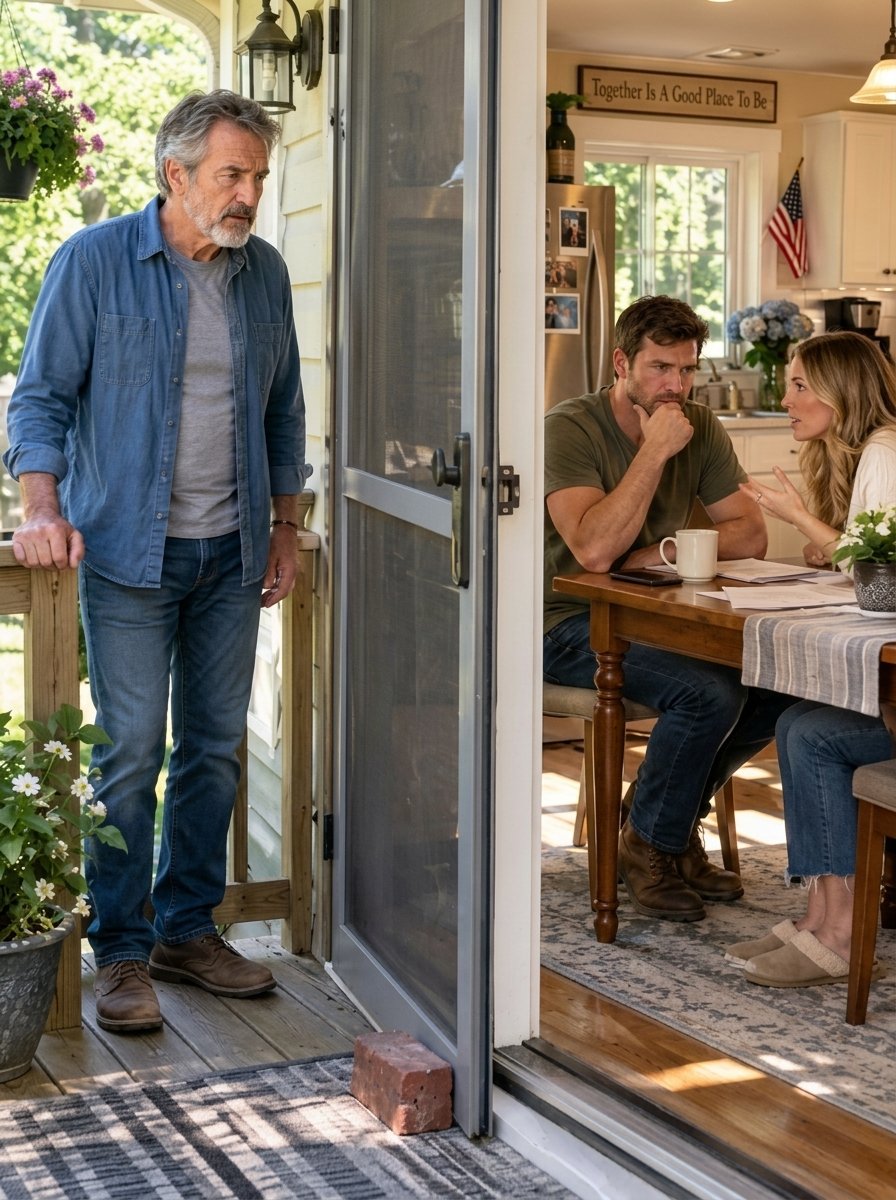
I was driving home from the attorney’s office in a good mood, ready to tell my son his aunt had left me a farmhouse and nearly a million in savings, but when I parked outside, I heard his wife through the back screen door; what she said next made me freeze where I stood.
The drive home from the attorney’s office should have been the best 40 minutes I’d had in years. Windows down, oldies on the radio, thinking about how I’d say it. Clara left me everything.
We’re going to be okay.
I must have rehearsed the line a dozen times on the interstate, adjusting the phrasing, trying to get it right. But when I pulled onto my street and saw my son’s truck still in the driveway, I did something I couldn’t explain then and still can’t fully explain now.
Instead of pulling in, I parked two houses down.
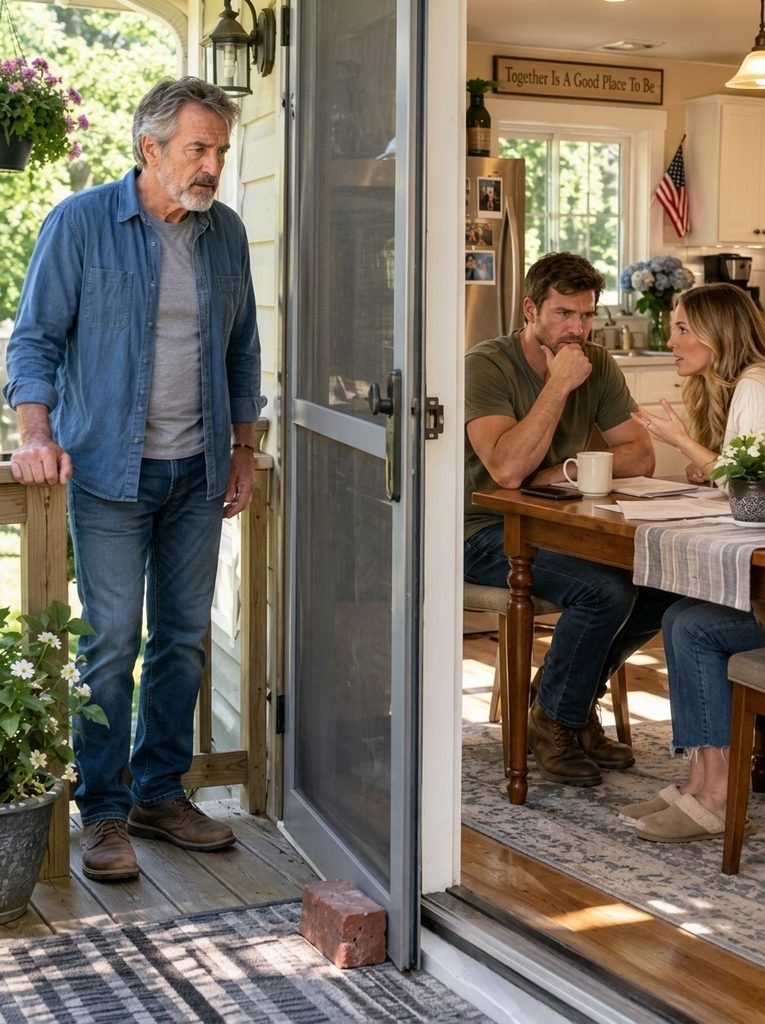
Some instinct, some quiet alarm in the back of my skull. I walked up along the sideyard to the back porch. The screen door was propped open with the brick we’d used for that purpose since my wife was still alive.
June in western North Carolina means the afternoons are heavy and slow, and their voices were drifting out through the mesh like they had nowhere to be.
What I heard next made me stop walking, made me stop breathing, made me stand in my own backyard like a stranger who’d wandered into the wrong yard.
My sister Clara passed in February. Pancreatic cancer, stage 4, diagnosed in December, and gone by Valentine’s Day. That’s how fast it moved.
She’d lived alone out in Henderson County on a piece of property our grandparents had left her. 12 acres, an old farmhouse that she’d spent 30 years restoring beam by beam, and a financial portfolio she’d built through decades of frugal living and smart investing.
Clara never married, never had children, never spent money on things she didn’t need. She taught middle school science for 34 years and put away every extra dollar.
I hadn’t known she’d made me the sole beneficiary. We were close, Sunday phone calls, holidays together, but she’d never mentioned it.
The estate attorney, a composed woman named Elbeth Morse, who worked out of Hendersonville, called me on a Thursday morning and asked me to come in as soon as I was available. I came in the next day.
The farmhouse had been appraised at 1.8 million, she told me. The investment account carried another 920,000. There was also a small life insurance policy, modest by comparison.
The total was just under $2.8 million.
She slid the papers across the desk, and I sat there in that quiet office with the ceiling fan turning overhead, and I didn’t say anything for a long moment.
I’m 64 years old. I spent 31 years as a civil engineer with the state. Retired at 62 on a pension that covers the basics. My house in Asheville is paid off. My savings are modest.
I wasn’t poor, but I wasn’t comfortable the way Clara had been comfortable. And now, suddenly, I was something else entirely.
On the drive home, I thought about my son and my daughter-in-law. They’d been living with me for 10 months.
His landscaping business had gone under the previous summer. Equipment loans, a dry season, two big commercial contracts that fell through.
My daughter-in-law had lost her property management job around the same time. They’d come to me in September saying they needed 3 months, maybe four.
10 months later, they were still in the guest room, and their definition of looking for work had grown loose enough to drive a truck through.
I hadn’t complained. That’s what fathers do.
I was going to tell them about Clara’s estate that evening over dinner. Something simple, something warm.
Good news, things are going to change for all of us.
Maybe offer them the use of the investment income while they got back on their feet. I was still deciding the details when I parked on the street.
2 days earlier, I’d been on the phone with Elbeth Morse to confirm the appointment. I’d taken the call in the kitchen. My daughter-in-law had been home.
I remembered her moving laundry from the washer to the dryer in the hallway, back and forth, that sound of the dryer door opening and closing.
I hadn’t thought anything of it. I hadn’t lowered my voice.
Now, standing at the edge of my own back porch in the June heat, I understood that she had heard every word.
My son’s voice first.
“She inherited that kind of money from a school teacher?”
My daughter-in-law’s voice, quieter but sharper.
“She was frugal her whole life. The farmhouse alone is worth more than this house. We need to think clearly about this.”
“What do you mean, think clearly?”
“I mean we’re not getting out of this debt on our own. You know that. The casino, the credit cards, the equipment loans. We owe close to $280,000. We have collectors calling the cell phone. It’s not going away.”
A pause.
“So, what are you saying?”
“I’m saying your father is 64 years old, and he lives alone, and nobody checks on him.”
Her voice was careful, the way a person’s voice gets when they’ve been rehearsing.
“I’ve been looking into this. There’s an attorney in Brevard, a man named Drummond, who handles elder guardianship cases. For the right fee, he can connect us with a physician who will document cognitive decline, early onset dementia, memory issues, difficulty managing finances. Once a judge grants emergency guardianship, we control the estate.”
The silence that followed felt like something physical pressing against me.
My son said, “He doesn’t have dementia.”
“That doesn’t matter as long as the documentation says he does. Drummond says these proceedings move fast when the family is cooperative and the medical evidence is in place. We could have control of the accounts within 60 days.”
“What about him? Where does he go?”
“Memory care facilities are very good now. He’d have everything he needs, and we’d have access to the estate to manage it on his behalf.”
I had spent 31 years reading structural reports, stress analyses, loadbearing calculations. My entire professional life had been about identifying weakness in systems before those systems failed.
My brain went to that place automatically.
Cold, technical, systematic. Not rage, not tears. Assessment.
I backed away from the porch quietly, one step at a time, and walked back to my car.
I drove to the overlook on Elk Mountain Scenic Highway, the one my wife and I used to go to on Sunday evenings. I sat there with the valley spread out below me, ridge after ridge going blue in the distance, and I thought through what I had just heard the way I’d think through a failed inspection report.
What did I have?
An overheard conversation, no recording, my word against theirs, and my daughter-in-law was smart enough to deny every syllable of it.
I had prosecuted nothing in my life. I was an engineer, not a lawyer.
But I understood evidence the way any careful professional understands evidence.
You document, you verify, you establish a chain of facts that cannot be dismantled.
They were going to contact a man named Drummond in Bvard. They were going to pay him to arrange fraudulent medical documentation, and they were going to do it fast before I could change my will or move assets, which meant I had perhaps 48 hours.
I called my neighbor Sid.
Sydney Puit had retired from the Bunkham County Sheriff’s Office four years ago after 22 years as an investigator. We’d shared a fence line for 12 years and solved a great many of the world’s problems over that fence on summer evenings.
If there was anyone I trusted, it was Sid.
He answered on the second ring.
“Sid,” I said, “I need your help with something serious, not a hypothetical.”
He was at the overlook in 20 minutes.
I told him everything.
He listened the way law enforcement people listen, without expression, taking notes on a small pad he pulled from his shirt pocket, asking only clarifying questions.
When I finished, he looked at the valley for a moment.
“You can’t arrest people for talking,” he said. “You know that. You need them to act.”
“I know.”
“So, we let them act.”
He turned to look at me.
“I’ve got recording equipment from the firm I consult for now. Voice activated, small enough to hide in a shirt pocket. North Carolina is a one party consent state. You can record any conversation you’re a part of, and it’s admissible.”
He paused.
“But we also need them to complete the transaction with Drummond, not just discuss it. Cash changes hands. Fraudulent documents are produced. That’s when we move.”
“You have contacts at the sheriff’s office?”
“Detective named Waverly in the fraud unit. Good investigator. She worked three elder abuse cases last year.”
He closed his notepad.
“I’ll call her tonight.”
We sat there a while longer, working through the sequence, every action, every contingency.
I’m an engineer. I like knowing what happens in each scenario before I commit to a plan.
My daughter-in-law brought me tea that night.
“Chamomile,” she said. “My favorite.”
She carried it up to my room with such practice concern that if I hadn’t been standing outside that screen door 8 hours earlier, I would have been moved by it.
I thanked her. I held the mug in both hands and waited until she left.
The liquid had a faint cloudiness beneath the surface that wasn’t from the tea.
I poured half into a clean pill bottle I’d prepared, sealed it. The rest went down the bathroom sink.
Then I filled the mug back to the same level with tap water, left it on my nightstand.
Downstairs, their voices were quiet.
I sat in the dark and listened to Sid’s recording device. Pick up everything from the kitchen.
My daughter-in-law on the phone confirming an appointment at 9:30 the following morning. Drummond’s office.
She gave the address in Brevard, 40 minutes southwest. She mentioned the payment, $2,000 cash. She mentioned me by name, said I was cooperative, said I didn’t suspect anything.
I forwarded the audio to Sid and to Detective Waverly.
Sid texted back within minutes.
“Waverly’s team positions at 0600. You’re covered.”
I didn’t sleep.
I watched the ceiling and thought about my son as a boy. The way he’d sit on the tailgate of my truck while I explained how a bridge stays standing, how load distributes across a span, how every beam serves a purpose.
He’d listened with that particular attention children have before they decide that parents don’t know much.
Somewhere between that boy and this man, something had gone wrong.
I didn’t know exactly where. Maybe I’d been too busy with work. Maybe I’d missed the years when it mattered to pay closer attention. I didn’t know.
What I knew was that the man in the other bedroom had heard his wife plan to put me in a memory care facility and had said, “What about him? Where does he go?”
And then had said nothing more.
In the morning, my daughter-in-law knocked on my door at 8. Cheerful, solicitus.
She said she’d made an appointment for me with a specialist because she’d noticed I seemed a little forgetful lately and she wanted to make sure I was taken care of.
I said that was thoughtful.
I said I felt a little foggy, but I was sure it was nothing.
I let myself move slowly on the stairs, gripped the banister with both hands.
They drove me to Brevard and my son’s truck.
My son sat in the front, quiet. My daughter-in-law sat beside him and talked about traffic and weather and the summer tourism season, and I watched the mountains pass outside the window.
Drummond’s office was in a strip of older professional suites off Main Street, the kind of building where the carpet in the lobby had been babyed once, and was now something harder to name.
The door said, “Dr. Drummond Consulting and Legal Services.”
A man in his 50s met us in the reception area, smooth, deliberately reassuring, the practiced warmth of someone who has cultivated trustworthiness as a professional skill.
He took me into a small office, asked me a handful of questions, simple ones. Date, location, the name of the current president.
I answered slowly, hesitated on one, said I’d been having trouble with names lately.
He nodded with visible satisfaction.
15 minutes. That was all the evaluation took.
He returned to my daughter-in-law in the waiting area while I sat where I’d been left.
And I heard him say that my cognitive picture was concerning, that he had relationships with the appropriate physicians, that the documentation for an emergency guardianship petition could be ready within 72 hours.
My daughter-in-law opened her purse.
I heard the sound of an envelope changing hands.
The door opened before she could put her purse away.
Detective Waverly entered first, badge visible, two uniform deputies behind her.
She said what law enforcement says at those moments, clear, direct, no room for interpretation.
My daughter-in-law dropped the envelope.
The cash scattered across Drummond’s office floor in a way that looked almost cinematic. Small fan bills against the gray carpet. Evidence in plain sight.
My son stood against the wall with his hands at his sides and his face doing something I recognized as the final collapse of a position he’d been barely holding for a long time.
I stood up from the chair where Drummond had left me, and I stood up straight.
My daughter-in-law looked at me for a moment.
Neither of us said anything.
“Dad.”
Her voice had dropped all its smoothness.
“I heard you through the screen door,” I said. “Yesterday afternoon, I heard the whole conversation.”
The color went out of her face.
“The tea last night is in evidence already. Sid has the recording of your call with Drummond. The recording of what you discussed in the kitchen is timestamped and logged.”
I kept my voice level.
Level was all I had left.
“You’re looking at felony elder abuse in North Carolina. Financial exploitation of an elderly person, conspiracy, bribery of a professional.”
I paused.
“I spent 31 years calculating how structures fail under load. I knew exactly which beams I needed, and I made sure every one of them was in place.”
Detective Waverly read them their rights. Drummond, too.
My son didn’t resist.
He sat down on one of the waiting room chairs and put his face in his hands, and I looked at him for a long moment.
This man I had taught to read blueprints, to measure twice, to understand that buildings stay standing because every connection is sound.
And I turned away.
The drive back to Asheville was with Sid. Neither of us talked much.
The mountains were doing what they do in June, layering ridge behind ridge and colors that don’t have names, and I watched them and tried to feel something clear.
I couldn’t.
What I felt was too many things at once, moving in directions that canceled each other out.
My son pleaded guilty 6 weeks later in exchange for a reduced sentence.
Probation, mandatory counseling, restitution.
My daughter-in-law went to trial. The recording evidence was, as Detective Waverly had predicted, airtight.
She received four years at a minimum security facility in Raleigh and civil judgments for the debt she and my son had accumulated, partly through a gambling problem I hadn’t known existed.
Drummond lost his license and received 18 months.
I called Elizabeth Morse the morning after the arrests and told her to revise my will completely.
I donated a portion of Clara’s investment account to a local organization that works with elder abuse victims.
I kept the farmhouse, not to live in, at least not yet, but because Clara had loved it, and I wasn’t ready to let go of something she’d loved.
My son called once from a number I didn’t recognize.
I listened to the voicemail.
He said he was sorry. He said he knew sorry wasn’t enough. He said he didn’t know how it had gotten so far.
I believed the last part.
I deleted the message, and I didn’t call back.
Maybe I will someday.
I don’t know yet.
The house in Asheville is quiet in the evenings now in a way it wasn’t when they were here.
I eat dinner at the kitchen table, and I read afterward.
And sometimes I walk out to the back porch and stand where that brick still props the screen door, and I think about the 40 minutes of the best drive home I never finished.
Clara always said I was the steady one, the one who measured and verified and didn’t move until he was certain.
I told her once that was just engineering.
You don’t guess at loadbearing capacity, you calculate it.
She’d laughed and said it wasn’t just engineering, it was character.
I think she would have approved of how I built that case.
The part she would have grieved, the part I still grieve, was that it needed to be built at.