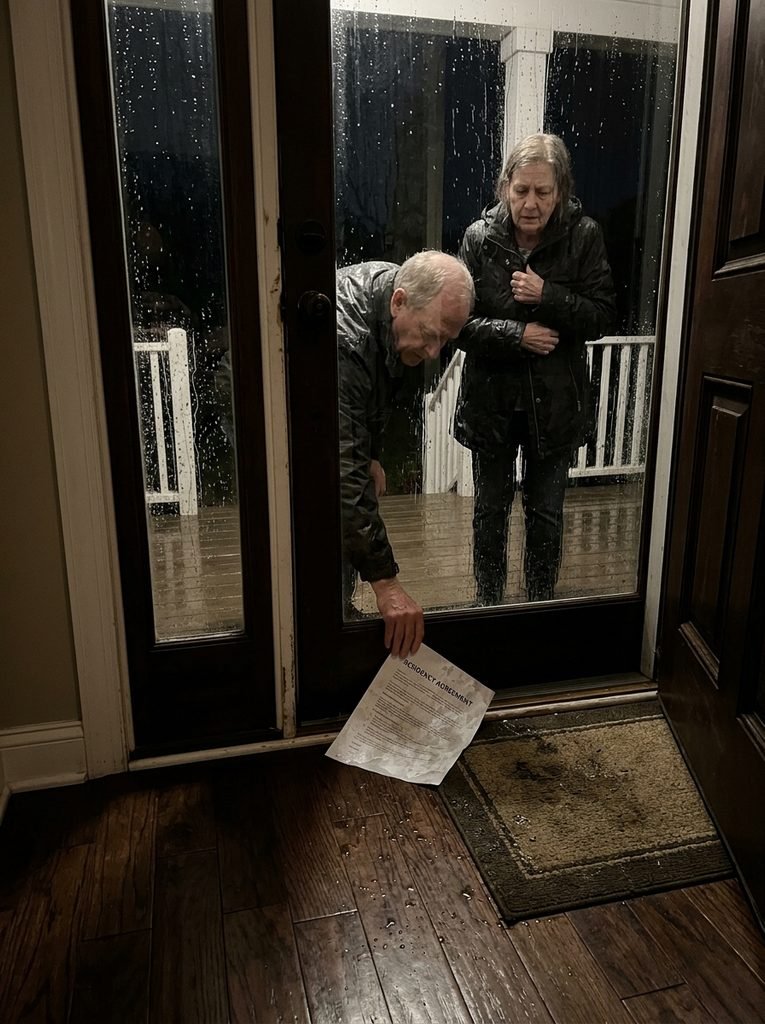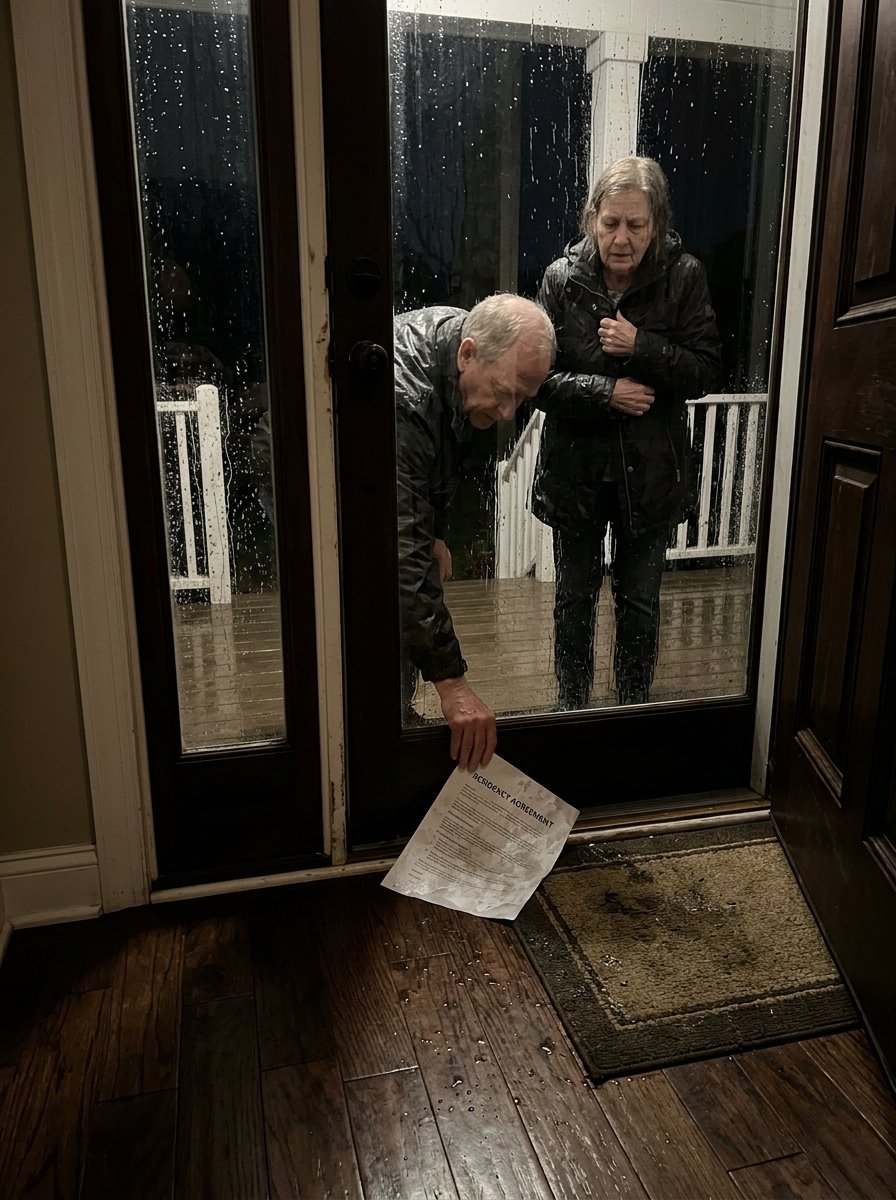
The note was written in my mother’s handwriting.
That’s what got me.
Not the demands, not the language, not even the part where they’d assigned me the unfinished basement.
It was the handwriting.
She’d used her good pen, the one she kept in the outside pocket of her purse, the one she used for birthday cards and thank you notes. Careful, deliberate loops like she’d practiced it, like she’d sat in the passenger seat of that beige Buick parked in my driveway and drafted this while my father steered.
Like this was a document, not a desperation move.
Like this had been the plan all along.
I stood in my entryway holding a folded piece of paper that informed me, in my mother’s careful cursive, that I would be surrendering my master suite, my Lake View guest room, my home office, and five nights a week of my cooking in exchange for $300 a month, while I continued paying the mortgage, the taxes, and every utility.
I looked at it for a long time.
Then I looked at the U-Haul in my driveway.
Then I looked at the Porsche, and I thought, “This didn’t happen last night. This has been coming for years.”
I want to be precise about who I am. Because in stories like this, people make assumptions.
They assume the person who says no is the villain, the cold one, the one who chose money over family.
So, let me be precise.
My name is Carter Miles. I’m 34 years old years.
I’m a software architect. I build back-end infrastructure for midsize SAS companies, which is a sentence that makes most people’s eyes glaze over, but the relevant detail is that it pays well.
And I built my career by working 70our weeks for 6 years straight.
I bought the lakehouse in Mil Haven, Wisconsin, 3 years ago. 1,400 square ft, cedar sided, 40 ft from the water.
I paid $387,000 for it.
I put down $140,000.
Money I’d saved by living on ramen and discipline when I was 26 and 27 and 28.
By saying no to things I wanted so I could say yes to something real later.
I did not inherit anything.
I was not given anything.
Every dollar I have, I assembled myself.
My sister Chloe is 29.
She is talented, magnetic, and genuinely funny. And she has never once in her adult life connected the concept of money going out to the concept of money coming in first.
She has started and abandoned 11 businesses I’ve counted, ranging from a handmade candle operation to a luxury dog grooming brand to a wellness app she paid a developer $18,000 to build and then never launched.
Each one ended the same way, with my parents absorbing the loss and Kloe pivoting to the next idea with the unshakable confidence of someone who has never faced a real consequence.
My parents, Ry and Linda Miles, are good people.
I want to say that clearly.
They are kind. They love their children. And they raised me to work hard and be honest.
But they made one catastrophic parenting error, which was applying those values to me and applying unconditional rescue to Khloe.
And they did it so consistently and for so long that they had completely lost the ability to see the difference between love and enabling.
By the time they sold their house in Columbus, Ohio, the house they’d owned outright since 2009, the house that was supposed to be their retirement, they had bailed Khloe out of debt 17 times.
17.
I know that number because I’d kept track, not out of resentment.
Well, maybe a little out of resentment, but mostly because I’m someone who tracks things.
It’s what I do.
The 17th time cost them $620,000.
The first sign that something was wrong came 6 weeks before the U-Haul.
My mother called on a Tuesday night. She usually called Sundays, and she sounded strange, flattened like someone who’d been crying recently and was trying to sound like they hadn’t.
“Just checking in,” she said.
“You okay?”
“Of course, we’re great.”
She asked me four questions about the lakehouse.
What did my winters look like up there? How was storage? Did I use my guest rooms much?
I told myself it was nosiness.
My mother was a nosier person as she got older, asking about my furniture and my grocery habits, and whether I’d thought about getting a dog.
I did not think to ask why she was asking about guest rooms in a tone that wasn’t quite casual.
I should have asked.
3 weeks later, she called again.
This time, she asked about my property taxes and whether the lakehouse was well insulated.
I said yes.
She said “good” in a way that wasn’t responsive to my answer.
She said it in the way you say “good” when you’ve confirmed something you needed to confirm.
I told myself, “My parents are just getting older. They’re thinking about things differently.”
That was the rationalization I chose.
I had a second option.
Something is being planned and you are not being consulted.
And I did not choose it because I did not want it to be true.
The missed calls started at 6:14 a.m. on a Saturday in November.
15 of them stacked up like dominoes while I slept.
Four from my mother, nine from my father, two from a number I didn’t recognize.
I stood in my kitchen in socks looking at my phone, and my stomach dropped before I even processed why.
15 calls means someone is already in motion.
15 calls means whatever’s happening isn’t a question anymore.
It’s already happening to you.
I opened the front door.
The U-Haul was parked in my driveway.
26 ft.
It was a 26 ft truck. The largest size you can rent without a CDL. Backed up almost to my porch with the rear doors still closed.
Behind it, my father’s beige Buick, engine running, headlights still on in the gray morning.
The rain had started, light, cold, the kind that doesn’t commit.
My father was already coming up the porch steps when I appeared in the doorway.
61 years old, soaked through his jacket, moving with the particular energy of a man who has decided something and needs everyone else to get on board.
“Get a coat,” he said. “We need to unload before the mattresses get wet.”
“What mattresses?”
Not a question.
A refusal to accept the premise.
“Our mattresses. Move, Carter.”
“Dad.” I held the door. “You have a house in Ohio.”
He looked at me with the exact expression he used to give me when I was 10 and saying something he considered obvious.
“We sold it,” he said. “Now move.”
He told me what happened in pieces over my objections while rain darkened his jacket and my mother hovered at the bottom of the porch steps, clutching her purse like a life preserver.
Khloe’s most recent business, a curated lifestyle brand she’d been building for 8 months, had collapsed.
She’d taken out a business loan using her condo as collateral.
The business folded.
She stopped making payments.
The bank began foreclosure proceedings.
My parents found out in September.
By October, they had sold their house.
Sale closed for $620,000.
They paid off Khloe’s mortgage, cleared her business debts, and the part that made my vision blur slightly when I heard it, gave her the remaining $200,000 to start fresh.
“$200,000?” I said.
“She needed a foundation,” my mother said.
Small voice, apologetic, but not apologetic enough to mean she’d have done anything differently.
“And you needed a house,” I said. “You had one.”
“Family helps family,” my father said.
“And now you’re here,” I said. “At my house that I own.”
“6 months,” my mother said quickly. “Just until we’re on our feet. We’ll contribute.”
“300 a month,” my father said, like he’d looked up the number, like he’d decided what my house was worth to him.
I stood in my own doorway in the rain and looked at the 26-ft truck full of their furniture.
“You decided all of this,” I said slowly, “without asking me.”
“We are your parents.”
My father’s voice went up the way it always did when he was losing the argument and needed volume to compensate.
“Family helps family. That’s how this works. That’s how it has always worked.”
He put both hands on my chest and shoved.
Not hard enough to knock me down.
Hard enough to move me backward.
Hard enough to make very clear what he thought of my standing in the doorway of my own house, saying no.
Something in me broke clean in half.
I shoved him back hard.
He hit the porch railing and grabbed it.
Stared at me, genuinely shocked.
Not at himself, but at me.
Like I was the one who’d done something incomprehensible.
“Not one box,” I said.
My voice was steadier than I expected.
“Not tonight. Not ever.”
I closed the door.
I locked the deadbolt.
I put the chain on.
He kicked it six times.
The impacts shook the frame.
He screamed my name into the rain.
I didn’t open it.
I sat in the dark for a long time.
I didn’t turn on lights.
I didn’t make coffee.
I sat in my living room and watched my phone not ring.
The calls had stopped and waited for my breathing to even out.
Then I opened my laptop.
Ohio property records are public.
It took me 4 minutes and a county auditor website to confirm everything my father had said.
Sale recorded November 8th.
$620,000.
New owners listed, gone.
I sat with that for a moment.
The house where I grew up.
The kitchen where my mother made Christmas breakfast.
The garage where my father and I rebuilt a 67 Mustang over three summers when I was a teenager.
The one project where we were purely just two people who like the same thing.
Gone.
Because Kloe needed a foundation.
I opened Instagram.
Khloe had posted 4 hours ago.
Champagne Coops on a white table. Resort architecture behind her.
The kind with infinity pools and architectural lighting.
Caption: “New beginnings. Grateful for people who believe in me.”
43 comments.
I scrolled past them.
2 days before that, a yellow Porsche Boxster, top down, giant red bow on the hood.
Caption: She said, “I needed something reliable. Thanks, Mom and Dad. Never could have done this without you.”
I looked at the Porsche photo for a long time.
My parents were sleeping in a Buick in my driveway.
Their daughter was at a resort in a new sports car with a bow on it.
I turned my security cameras to the driveway feed.
My father was pacing.
My mother was sitting in the porch chair, which I’d left out for fall.
Her shoulders were shaking.
At some point around midnight, my father stopped pacing and sat on the top porch step, and they were quiet for a while, and then they went back to the Buick.
At 2:07 a.m., I… My father got out again and walked to my power meter box around the side of the house.
He cut the breaker.
My house went dark.
My camera switched to battery backup.
I documented the time stamp.
Dawn came gray and cold.
And then at 8:22 a.m., the Porsche came.
I heard it before I saw it.
That specific sound of a sports car that’s been optioned correctly.
Clean exhaust note.
Low rumble.
It pulled into my driveway behind the Buick and the U-Haul, and Khloe stepped out in white faux fur and oversized sunglasses, looking like she’d arrived at a premiere.
“You,” she said, looking at the truck. “Why is all our stuff outside?”
“Carter wouldn’t open the door,” my mother said.
Kloe looked up at my balcony, saw me watching through the window.
“Carter,” she waved with both hands like this was funny, like we were doing a bit. “Stop being so dramatic. I need to plug in my ring light. The outlet situation in here is going to need to be sorted.”
I opened the balcony door.
“Nice car,” I said.
She grinned.
“Right. Does it come with a heated garage, or do you sleep in the trunk?”
The grin went away.
“It’s a business asset.”
“Then go sleep at your business.”
“Mom and dad are my seed investors,” she said.
And I noticed she said it the way people say things they’ve rehearsed.
The way people frame a thing so it sounds reasonable before anyone can react.
“I’m going to return quadruple their investment in 6 months, 18 months tops, so they can afford a hotel,” I said.
My father came around the side of the Buick and slammed his door.
“6 months,” he said. “That’s all we’re asking. 6 months. One year at the outside and then we’ll find our own place.”
6 months.
1 year at the outside.
“No,” I said.
My father’s face went to a place it almost never went.
Not anger exactly.
Something past anger.
Something cold.
“You’re making a mistake,” he said.
I went inside.
20 minutes later, the note slid under my door.
I’ve described the note already.
The residency agreement and my mother’s careful cursive.
The main suite and the guest room and the basement office and the cooking schedule and the $300 a month.
What I haven’t described is how long I stood holding it.
3 minutes, maybe four.
I’ve handled crisis before professionally.
I mean, I’ve been on incident calls at 3:00 a.m. where a production system is failing and half a million users are locked out and my company is losing $40,000 an hour and five engineers are all talking at once.
I’ve learned to go very quiet in those moments to separate the noise from the signal.
So, I went quiet.
Signal.
My parents had sold their home, given the money to my sister, arrived at my door with no plan and no invitation, attempted to move in by force, cut my power at 2:00 a.m., and were now sliding legal adjacent documents under my door.
Signal.
This was not a crisis.
This was a strategy.
I wrote “absolutely not” across the front of the paper in the largest letters that would fit.
Opened the door two inches, chain still on, and fed it back through.
My father read it, his jaw tightened.
He pulled out his phone.
I watched through the window as he made a call.
Short conversation.
He read an address off my mailbox.
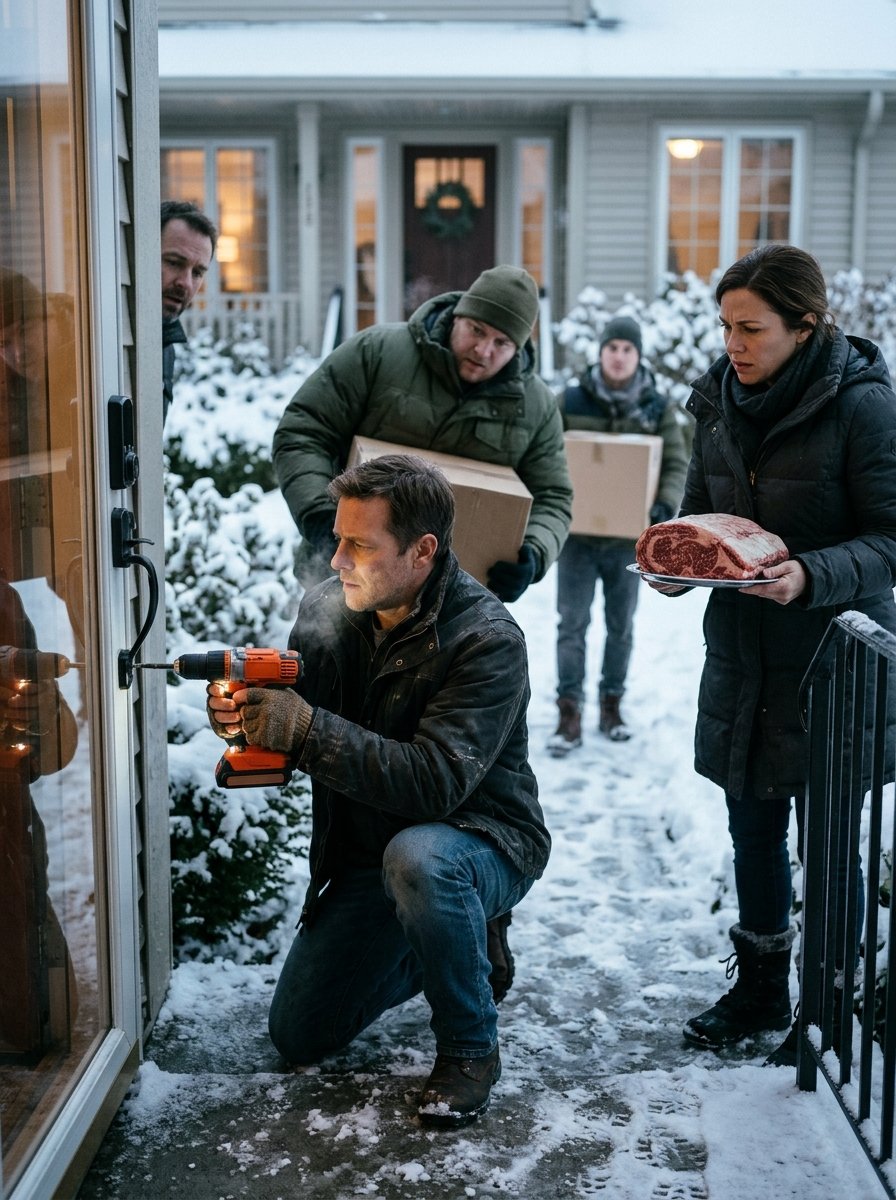
12 minutes later, a white van turned into my driveway.
Apex Locksmith Services logo on the side.
The driver got out and walked toward my front door with a bag of tools before he’d even fully assessed the situation.
My father was already walking toward him with cash.
“My son locked himself in,” he said loud enough for the whole driveway to hear. “He’s having some kind of episode. I need you to drill the lock.”
I went to the window.
“I am the legal owner of this property,” I said loud enough to be heard clearly. “I have the deed. I have documentation. If you touch that door, I will call the police and you will be arrested for breaking and entering a private residence. Do you understand me?”
The locksmith stopped.
He looked at my father.
He looked at the window.
He looked at my father again.
“I can’t do this,” he said.
“I’ll double it,” my father said.
“I cannot do this,” the locksmith said, and he got back in his van and reversed out of my driveway without another word.
My father stood in the driveway for a moment.
Then he picked up my ceramic garden gnome.
I’d had it since I moved in.
It lived by the front step, and I’d always found it funny, and he threw it at my window.
The glass cracked, a spiderweb fracture from center to frame.
I picked up my phone and called 911.
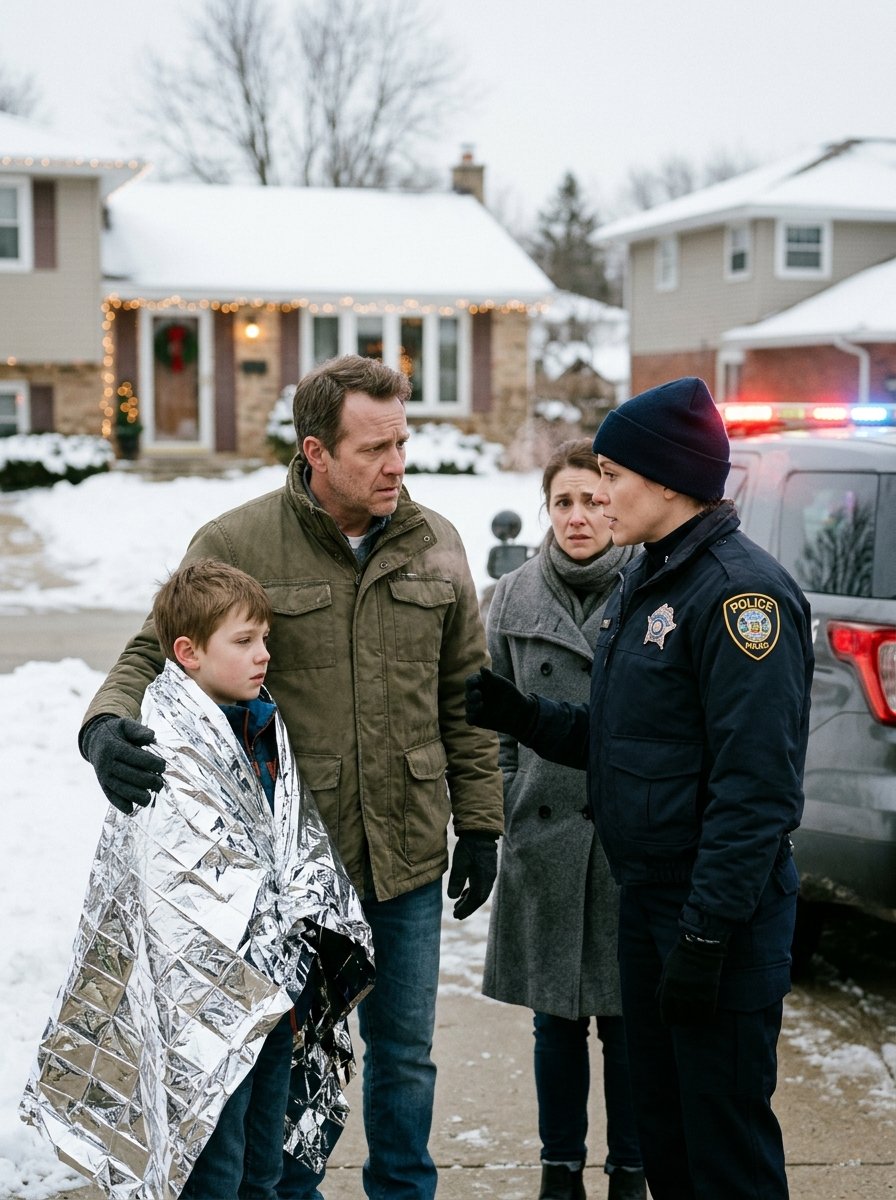
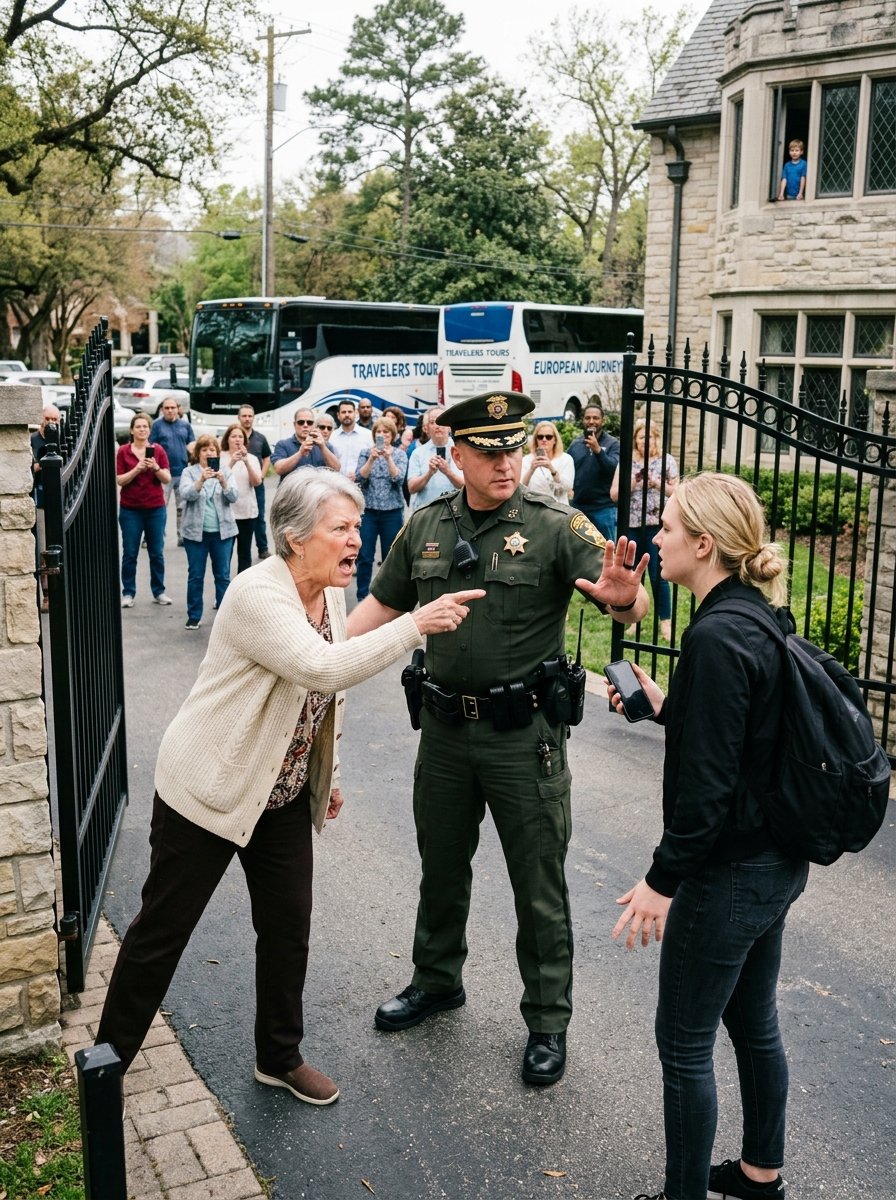
Deputy Aaron Miller, 8 years with the Mil Haven County Sheriff’s Department, arrived at 9:47 a.m.
He was younger than I expected, maybe 30, with the specific energy of someone who has seen enough family disputes to be professionally unsurprised by anything.
He let my father talk first, which I understood.
Always let the agitated party spend their energy.
My father’s story was coherent and confident and structured around the word “family,” the way a lawyer’s brief is structured around the relevant statute.
We were his family.
This was his son.
His son had locked himself in and refused to communicate.
He was worried.
He just needed someone to talk sense into the boy.
Deputy Miller listened with his hands behind his back.
“Do you have a lease?” he said.
“What? No, he’s my son.”
“Do you have keys to the property?”
“He won’t give us keys. That’s the problem.”
“Mail delivered here, utility account in your name?”
My father’s voice went up.
“Because he locked us out, sir.”
Miller’s voice didn’t change register.
“I need you to understand something. Without a lease, keys, or established residency, this property is not your home. You have not been locked out. You have been denied access. There’s a legal difference.”
He turned to me.
I’d come outside by then.
Printed deed in hand.
My phone cued to the security footage.
“Is this your property?”
“Yes. Deed in my name since 2021. Here.”
I handed him the printout.
He glanced at it.
Handed it back.
“Can you show me what you mentioned on the call?”
I played him the footage.
The time stamp.
2:07 a.m.
My father at the breaker box.
The power going out, the camera switching to backup.
Miller watched it twice.
His face changed.
Not dramatically.
A slight tightening around the eyes.
A shift in the set of his mouth.
“Sir,” he said to my father. “Did you cut power to this property?”
“It was an accident.”
“There’s footage of you deliberately opening the breaker panel.”
“I was checking it at 2:00 in the morning.”
My father said nothing.
“Sir, did you also throw an object at the window of this property?”
My mother made a small sound behind him.
“He provoked…”
“That’s a yes or no question.”
Silence.
Miller looked at my window.
The cracked glass was obvious from 15 ft.
“You have two options,” he said. “You leave voluntarily right now, or I take a report for property damage and criminal trespass, and we go from there.”
He paused.
“The window alone is a misdemeanor. The locksmith solicitation is potentially a second one. The power cut is a third.”
Another pause.
“Sir, I’d recommend option one.”
My father looked at me.
I recognized the look.
I’d seen it my entire life.
It was the look he gave when he needed me to step in to smooth things over.
To be the one who let it pass.
“Option one,” I said. “Sounds right to me.”
His shoulders dropped.
Something left his body.
Not the anger, not yet, but the certainty.
The assumption that this would resolve the way things always resolved.
“Load the truck,” he said quietly.
To Kloe.
To my mother.
Nobody moved for a second.
“Load the truck.”
It took them 2 hours.
I stayed inside.
I watched on the camera.
My mother’s shoulders shook the whole time she carried boxes.
Chloe did essentially nothing.
She sat in the Porsche with the heat running and scrolled her phone.
And at one point, she went to my mother and said something I couldn’t hear.
And my mother shook her head and Kloe went back to the car.
My father worked in silence, systematically.
He was always efficient.
That was one of the things I genuinely admired about him.
The way he approached a task.
No wasted motion, no drama, just work.
He’d pointed that quality at the wrong target for 30 years.
When the truck was loaded, he came to the door one more time.
He didn’t knock.
He just stood there.
I could see him on the camera standing on the porch where he’d shoved me 9 hours earlier, looking at the door.
Then he said, and I was watching, but I couldn’t hear.
I read it later from the camera audio.
He said, “You’re dead to us, Carter. You have no family anymore.”
He walked to the Buick.
I opened the front door.
“I haven’t had family in years,” I said. “Only dependence.”
He stopped, didn’t turn around, got in the car.
The Buick pulled out first, the U-Haul second, the Porsche last.
Chloe not even looking at the house as she backed down my driveway.
I stood on my porch and watched until they were gone.
The cracked window caught the morning light, the empty space where my gnome had been.
I went inside.
I sat down, and then I opened my laptop.
Here is what I posted.
I uploaded four things to a public thread.
Not on my personal accounts, but on a burner profile I made in the time it took my father to load a sofa into the U-Haul.
The security footage, all of it.
The power cut at 2:07 a.m.
The locksmith confrontation.
The gnome.
A photo of the cracked window.
A photo of the handwritten residency agreement, redacted for names.
Khloe’s Instagram posts.
The resort, the Porsche with the bow, the Ohio property record, $620,000, transferred.
My caption was seven words.
“Anyone who agrees with them can house them.”
I posted it at 11:44 a.m.
By noon, the family group chat, 14 people, aunts and uncles and cousins going back 30 years, had gone completely silent.
Not silent like nobody noticed.
Silent like everybody had seen it and nobody knew what to say.
My aunt Greta, my father’s older sister, the one who’d never fully approved of how my parents handled Kloe, broke the silence at 12:23 p.m.
She sent a single message to the group.
“Ray, you need to call me.”
My father was not in the group chat after that.
My mother left it 20 minutes later.
Chloe posted an Instagram story at 1:00 p.m.
Her face close up, crying.
Caption: “When your family turns on you, the moment you’re finally building something real. Healing isn’t linear.”
1100 views in 40 minutes.
My phone lit up at 1:17 p.m. with a number I didn’t recognize.
I almost didn’t answer.
I answered.
“Is this Carter Miles?”
“Depends. Who’s asking?”
“My name is David Okafor. I’m a family law attorney in Milwaukee. I have a client who reached out to me this morning about a potential property dispute involving your address.”
A pause.
“I want to make sure you understand your rights before this goes any further.”
I sat up straighter.
“Who’s your client?”
A pause.
Professional.
Careful.
“I’m not at liberty to say, but I’d encourage you to document everything and consult your own counsel.”
Another pause.
“What I can tell you is that I reviewed the footage you posted publicly, and I want to be direct. Your position is legally sound. Your property, no established residency, no legal basis for their claim, but you should be represented.”
“Who hired you?” I said again.
This time the pause was different.
“Your father called me this morning,” he said. “Before you posted anything, he asked me whether there was a legal mechanism to compel a property owner to house family members in a financial crisis.”
I was very still.
“And I said…”
“And I told him there wasn’t. And then I called you.”
I hired my own attorney that afternoon.
Patricia Lond, Mil Haven County.
16 years in real estate and property law.
The kind of lawyer whose office has exactly one decorative item.
A framed print that says “documentation is not optional.”
Who I loved immediately.
I walked her through everything.
The footage, the note, the locksmith, the power cut, the gnome.
She took notes in a yellow legal pad with a mechanical pencil.
When I finished, she clicked the pencil twice.
“Let me ask you something,” she said. “Has your father done anything like this before?”
I thought about it.
Not this, but the pattern of assuming I’d comply.
“Yes.”
“Has he ever been physically aggressive with you before today?”
I thought about the shove on my porch.
“Yes,” I said. “When I was younger.”
She nodded, made a note.
“Here’s what I want you to do,” she said. “I want you to apply for a civil restraining order. Not because I think he’ll come back tonight, but because I want it on record that the first time he tested the boundary, he was met with a documented legal response.”
She looked up.
“People like your father. And I say this having seen a great many of them. They don’t stop at one attempt. They recalibrate. They try a different angle. The question isn’t whether they’ll try again. The question is whether you’ll have paper on them when they do.”
The restraining order was filed November 16th, granted November 21st.
The recalibration came from my mother, not my father.
He was too proud to make the next move himself.
He’d send my mother first the way he always had because my mother’s grief was real and her script was softer and it was harder to say no to her.
She called on the 19th, 3 days after I posted.
“I need you to understand,” she said, “that your father is devastated.”
“I know,” I said.
“He didn’t mean it about you being dead to him.”
“I know he didn’t mean it the way it sounded,” I said. “But Mom, you slid a residency agreement under my door. You’d assigned me the basement.”
Quiet.
“Your father drafted that,” she said quietly.
“Did you sign it?”
Longer.
Quiet.
“Mom, did you sign it?”
“He said it would help Carter take us seriously.”
“It’s a document asserting legal residency in my home,” I said. “That’s not taking you seriously. That’s a formal demand.”
She started crying.
I let her cry for a moment.
Not cruy.
I just didn’t rush in to fix it, which was what everyone had always done, which was how we’d gotten here.
“Where are you staying?” I said.
“Khloe’s.”
A pause.
“She has a new apartment. Very nice. Paid for with the 200,000.”
“Carter…”
“Mom, I need you to hear something. I love you. I’m not abandoning you, but I will not be managed. I will not be presented with a plan that appropriates my home and my life and expected to comply because the word family is attached to it.”
Silence.
“Do you understand me?”
“I hear you,” she said finally.
It wasn’t the same as understanding, but it was the first time in my memory she hadn’t immediately found a way to make my boundary about someone else’s feelings.
4 months later, my parents are renting a two-bedroom apartment in Madison, 38 minutes from Mil Haven.
My father got a job.
He’d been retired for 2 years, but it turns out $620,000 goes faster than expected when your daughter’s lifestyle is one of your line items.
He’s managing a hardware supply warehouse.
He leaves at 6:00 a.m.
He does not love it.
He has not called me.
My mother calls every Sunday.
We are careful with each other in a way we never were before, which sounds like a loss, but actually feels like something closer to honesty.
She doesn’t ask me to forgive anything.
I don’t pretend I already have.
Khloe’s new business launched in January, a premium content subscription platform for aspirational living.
Her first month’s revenue, which she posted publicly, $340.
The Porsche is listed on Marketplace.
Deputy Miller sent me a note through Patricia Lun’s office about 3 weeks after everything.
He’d included a copy of the final incident report and a handwritten line at the bottom.
“Keep that documentation habit. It served you well.”
Patricia framed it as a joke, but she also said it was the best advice anyone had given a client of hers in 16 years.
My window got replaced the week after the incident.
New glass, new frame.
I upgraded to double pane while I was at it.
The gnome got replaced, too.
I named the new one Ray.
He lives by the front step.
Every morning when I leave the house, I look at him.
I think about what it took to earn the right to stand in my own doorway and say no.
I think about how long I waited to do it.
And then I go about my…