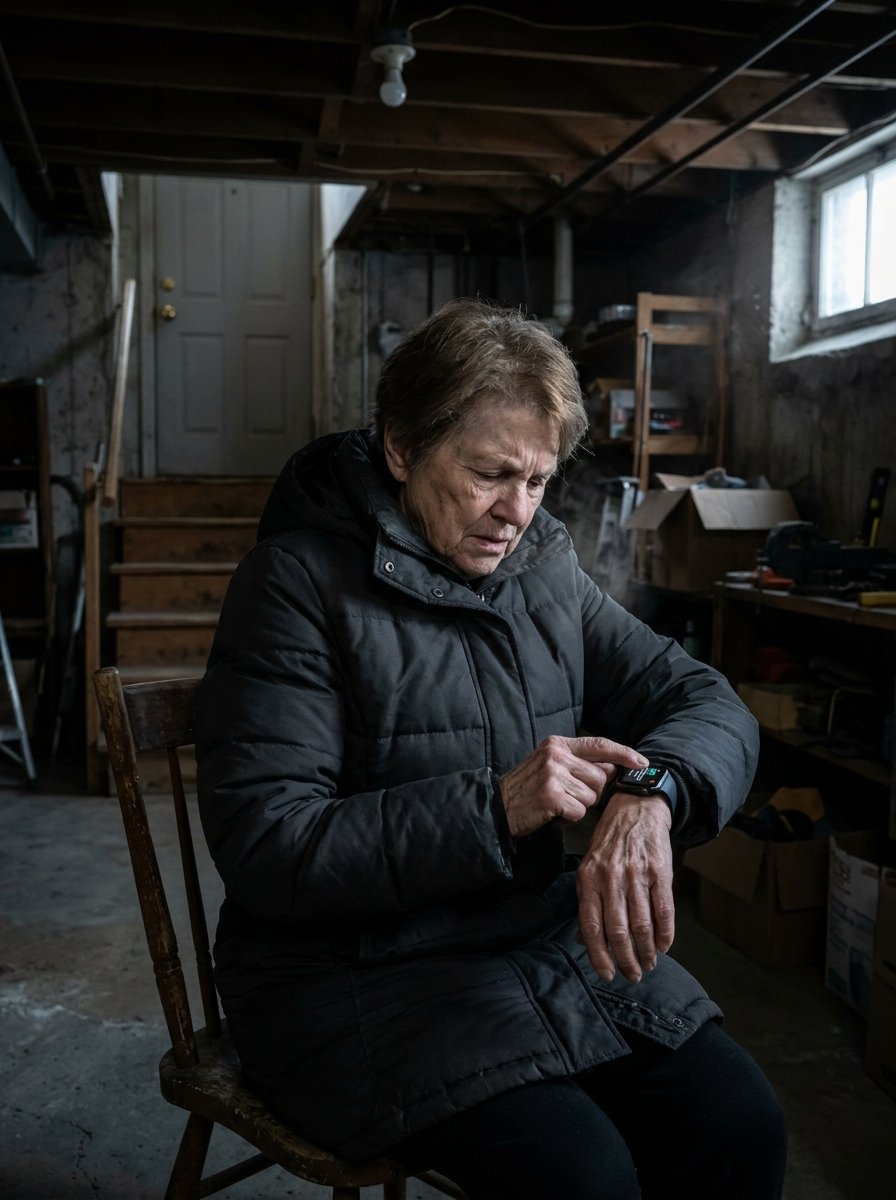
My son’s wife took my phone off the kitchen counter while I was still on the floor, looked at my son standing in the doorway, and told him I could stay in the basement until I was ready to cooperate. My shoulder was bleeding where I had hit the granite edge of the island when she yanked my arm back.
The utility room they put me in had a thermometer on the wall that read 39°.
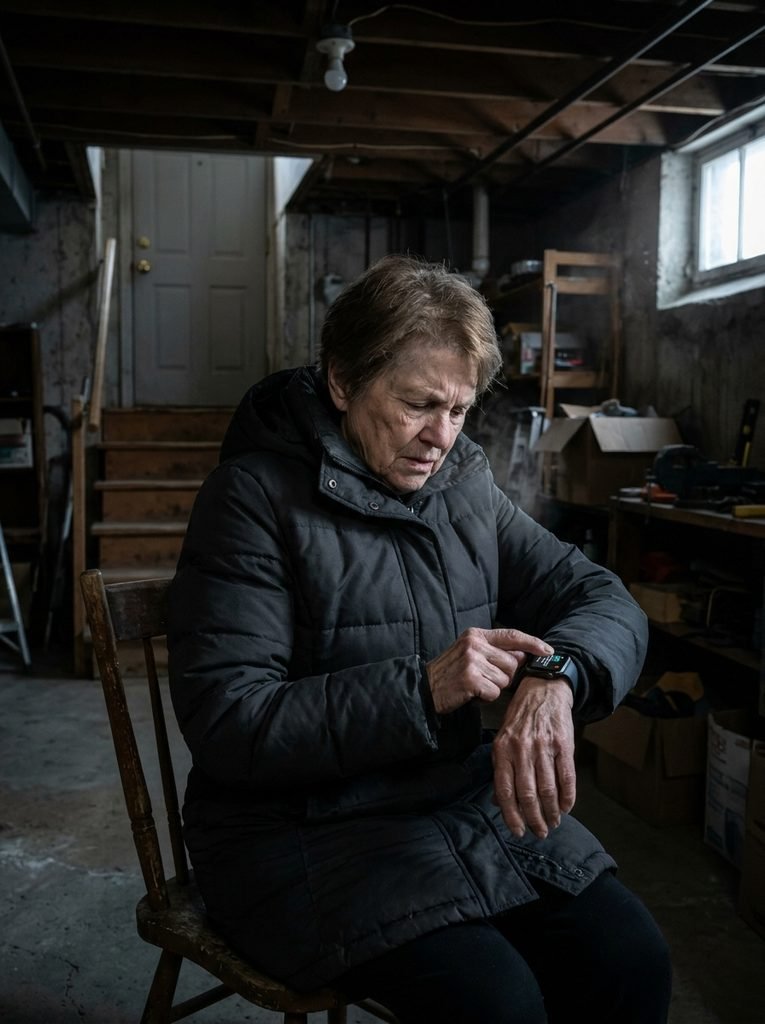
It was January, and the only thing between me and a very bad end was the watch on my right wrist, the one she didn’t see.
That watch sent one message.
What happened next cost my son and his wife everything they had spent 3 years taking from me.
My name is Norman Hail. I spent 31 years as a licensed structural engineer designing bridges and municipal infrastructure across the southeast.
I retired at 60 with a pension, a paidoff home in Raleigh worth $2.3 million, and a grief that had no bottom to it.
My wife of 34 years died of pancreatic cancer 14 months before my son and his wife asked if they could move in.
I said yes.
I want to be honest about that. I wasn’t naive. I knew my son could be careless with money. I knew his wife Shelby had expensive taste she hadn’t earned.
But I was living alone in a five-bedroom house and eating cereal for dinner. And the idea of voices in the hallway again felt like medicine.
I told myself that family was worth the inconvenience. I should have paid more attention to what kind of family they actually were.
They arrived with 6 weeks of temporary plans that stretched into 3 years of permanent occupation.
My son Bradley had been running a gastropub called the Ember House in downtown Raleigh. It looked successful from the outside, but I knew the numbers behind the facade better than he did because I was the facade.
Three years earlier, when his first restaurant had collapsed, and he came to me broke and embarrassed, I had stepped in, not with a check, with something more deliberate.
I called Calvin Wentworth, the corporate attorney who had handled my financial life for 27 years.
We built a private investment LLC called Blue Ridge Hospitality Partners, registered in Delaware, funded entirely by my retirement capital.
On paper, it resembled a regional venture group that spotted promising food concepts.
Blue Ridge Hospitality Partners approached Bradley with a $2.2 million offer.
I watched my son call me from across town to brag that a serious private equity firm had recognized his vision.
He said the industry was finally acknowledging real talent.
I told him I was proud of him and poured myself a drink after I hung up.
I let him believe every word of it.
The investment contract Calvin drafted ran to 68 pages. Most of it was standard language, but buried in section 7, paragraph 9 was a specific mechanism.
It stipulated that if the principal founder engaged in any criminal conduct, demonstrated moral turpitude, or was implicated in elder abuse or financial exploitation of a family member, Blue Ridge Hospitality Partners retained the unilateral right to freeze all operating accounts and recall the full investment immediately without board approval.
Bradley signed it on a Tuesday morning, distracted by the figure at the top of the first page.
He didn’t read past page three.
I know because Calvin told me and because that is exactly the kind of thing Bradley had always done.
Mistake the headline for the whole story.
For a while, the arrangement worked.
The Ember House opened to good reviews. Bradley hired capable people. He developed a menu that got mentioned in a regional food magazine.
Shelby decorated the private dining room and began introducing herself at parties as the creative director of a successful hospitality group.
They leased two cars neither of them owned.
They wore clothes that cost more than my first truck.
They moved into my master suite because they said the other bedrooms were too small.
I moved to the guest room at the end of the hall without making a production of it, because I was trying to be generous.
And because I was still grieving, and because the house felt less empty with them in it, I paid the property taxes.
I paid the utilities.
I bought the groceries.
I stocked the refrigerator and kept the yard maintained and said nothing when Shelby rearranged my kitchen according to her preferences.
I was a man who had spent 31 years calculating how much weight a structure could bear before it failed.
I know now that I was performing the same calculation on myself, and I kept adjusting the number upward because I did not want to know the true answer.
The conversation that ended everything happened on a Thursday evening in January.
I had just come back from a routine orthopedic appointment.
I walked into the kitchen and found Shelby sitting at my dining room table with a folder in front of her and a legal pad covered in handwritten figures.
She had printed what appeared to be a comparative market analysis of my property.
Bradley was leaning against the counter with his arms crossed, wearing an expression that told me they had rehearsed this moment.
Shelby said they needed to talk about the house.
I set down my keys.
She said the market was at a peak and it would be financially irresponsible not to capitalize on the equity.
She said they had found a senior living community in Garner, not a nursing home.
She was careful to specify a community with a nice courtyard and organized activities and everything I could need.
She slid a glossy brochure across the table.
The cover showed a white-haired man playing checkers by himself near a window.
I looked at the brochure.
I looked at my son.
I asked him if he had anything to add.
He said he thought it made sense.
He said it like he was agreeing about the weather.
I picked up the brochure and set it back in front of her slowly.
I told them this was my house, that my wife and I had carried the mortgage on this house for 22 years and paid it off 11 years ago.
That I had welcomed them here as a kindness and not as an invitation to reorganize my life on their behalf.
I told them they had one week to find somewhere else to live.
Shelby’s face changed.
She told me I was being unreasonable.
She said my judgment wasn’t what it used to be and that this was becoming a safety issue.
She used the word liability.
She said my doctor had noted some cognitive slowing, a flat fabrication.
He had said no such thing and that they were simply trying to protect me before something happened.
I walked toward the kitchen counter to pick up the landline.
I was going to call Calvin.
Not the police.
Not yet.
Just Calvin.
I needed a witness to what was being said in this house.
Shelby stepped in front of me.
I told her to move.
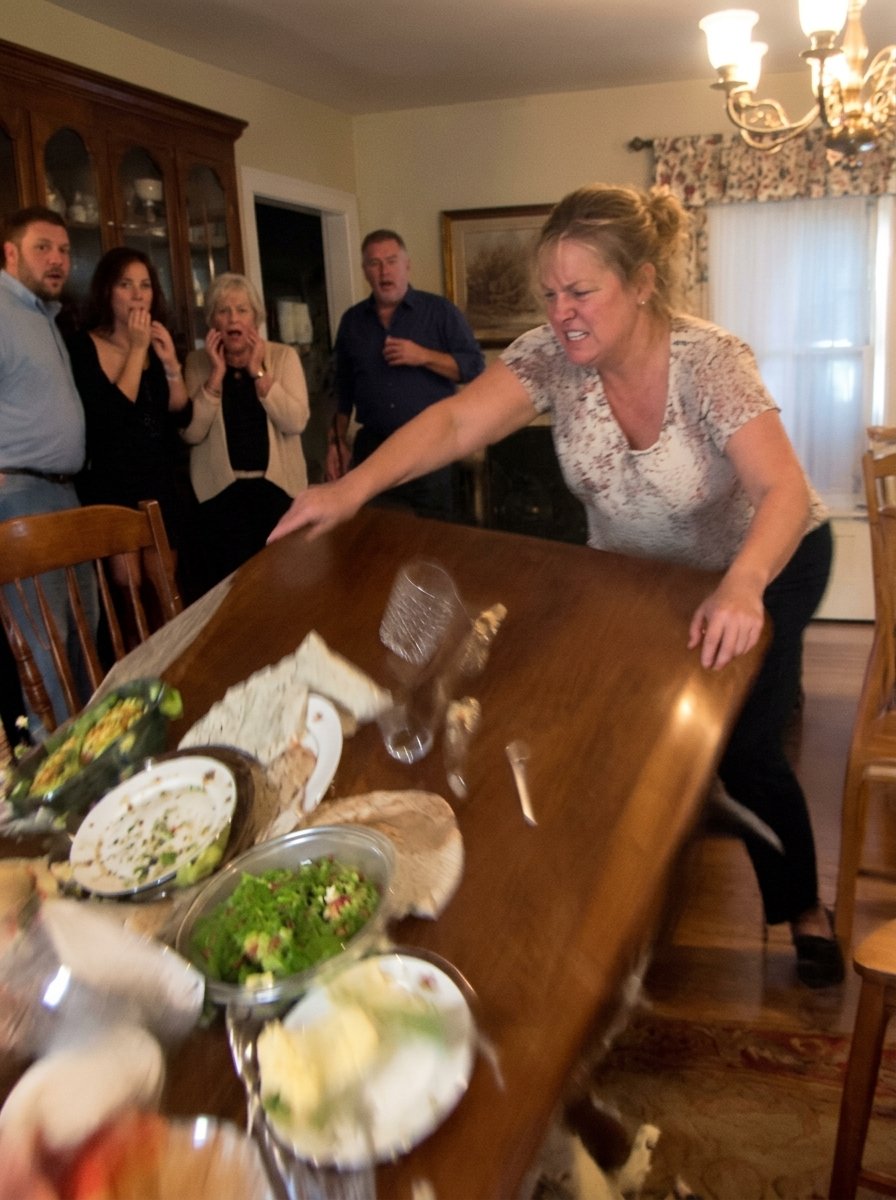
She grabbed my left arm with both hands and yanked it backward to stop me from reaching the phone.
The force spun me sideways.
My hip caught the edge of the kitchen island and my right shoulder hit the granite corner with a force that dropped me immediately to the floor.
The pain was white and absolute.
I felt the joint give in a way that told me something serious had happened.
I lay on the cold tile, staring up at the recess lighting in my own ceiling.
Bradley came around the island and looked down at me.
I told him I was hurt and to call an ambulance.
Shelby picked up my cell phone from where it had fallen out of my jacket pocket.
Bradley said I needed to calm down first.
She told him I would be fine, that I was being dramatic.
She said it without looking at me.
She said it the way you dismiss a problem that has already been categorized as manageable.
Then she told Bradley to help her get me downstairs.
Not to a bedroom, not to the couch.
Downstairs.
They half carried and half dragged me through the door at the top of the basement stairs.
I told them to stop.
I told Bradley to put me down.
He didn’t answer.
Shelby had already opened the door to the utility room at the bottom.
They sat me on an old folding camp chair in that room.
It was 39°.
I know because there was a digital thermometer mounted on the wall that my wife had hung there years ago when she kept seedlings in that corner during late winters.
39° and dropping because January in North Carolina is serious, and that room shared an exterior wall with nothing but the outside.
Shelby reached for my left wrist and removed the dress watch my wife had given me for our 30th anniversary.
What she did not see was my right wrist where my sleeve had fallen down.
Tucked there was the Medical Alert smartwatch.
My doctor had recommended after my blood pressure spiked the previous spring.
It had its own cellular SIM card.
It did not need my phone.
It did not need their Wi-Fi.
It did not need anything from them at all.
They left the room.
The heavy wooden door closed.
I heard the padlock, the one my wife had used for her garden storage cabinet, click shut from the outside.
A few seconds later, I heard their footsteps going back up the stairs.
I heard Shelby say something I could not make out.
I heard my son answer her, then quiet.
I sat in the dark in 39° with what I was already fairly certain was a torn rotator cuff, and I did what I have done in every genuinely dangerous situation in my professional life.
I assessed the load.
I identified the failure point.
I found the structural solution.
I raised my right wrist and pressed the side button on the smartwatch twice.
The screen lit up.
I navigated to messages with my thumb and typed nine words to Calvin Wentworth.
Utility room basement shoulder injury. Initiate the contingency now.
I sent it and put my arm down.
The contingency was something Calvin and I had drafted nearly 2 years earlier when I first allowed myself to look clearly at what was happening in my house and did not look away from what I saw.
It was a straightforward set of instructions.
Once triggered, it would transfer the deed to my property into an irrevocable commercial trust, freeze the Blue Ridge Investment Guarantees supporting the Ember House, and dispatch emergency services to my address.
Calvin had full legal authority to act.
All he needed was that message.
I waited.
43 minutes later, I heard sirens.
Two paramedics came through the utility room door with flashlights and a portable heater they set up without being asked.
A police officer followed them in.
He looked at the padlock in his hand, then at the thermometer on the wall, then at me.
He asked what had happened.
I looked at him steadily.
I looked at my shoulder, which I could not raise.
I looked at the folding chair I had been sitting in for the better part of an hour, and I told him I had been clumsy.
I said I had come down to find something in storage, tripped on the last step, and the door must have blown shut and latched.
I said the lock had been giving me trouble for years.
I made myself sound a little embarrassed.
He did not look like he believed a word of it.
But I needed him not to act on that disbelief yet.
If he arrested Bradley and Shelby tonight, Calvin would be working against a criminal defense funded, partly by accounts I had not yet frozen.
They would hire attorneys.
They would call it an accident.
Shelby would cry with extraordinary conviction.
And she had the kind of face that made juries want to help her.
I needed them to sleep safely tonight.
I needed them to believe the old man had been handled.
The paramedics brought me out through the kitchen.
Bradley and Shelby were in the living room.
Shelby had arranged her face into an expression of deep parental worry.
She touched my good arm as they wheeled me past and said she had no idea I had gone downstairs.
Bradley told the officer he was a very light sleeper and would keep a closer eye on things.
He said the word dad twice while the officer was listening.
I looked at my son and nodded like a man who was grateful for the concern.
I held that expression until the ambulance doors closed.
Through the small rear window, I watched Calvin Wentworth’s black sedan pull up to the curb.
The hospital confirmed a grade 2 rotator cuff tear and early stage hypothermia.
The orthopedic surgeon recommended immediate surgery.
I told her I would schedule it within the week, sign the forms, and put my arm back in the sling.
I needed to be mobile.
I needed to be clear.
By 2:00 in the morning, Calvin was in my hospital room with two associates, a notary, and a document package his firm had spent the evening preparing.
He had already executed the deed transfer.
My house now legally belonged to Piedmont Asset Holdings LLC, a commercial trust in which I held beneficial interest, but no direct management authority.
Any quit claim document shall be produced would be void because I had not owned the property to transfer at the moment she intended to force the signature.
Calvin also confirmed that Blue Ridge Hospitality Partners had triggered the morality clause in Bradley’s investment agreement.
As of that morning, the Ember House operating accounts showed a balance of zero.
The corporate cards were declined.
Vendor contracts were suspended pending legal review.
I signed everything Calvin placed in front of me without any tremor at all.
3 days later, my son came to the hospital alone.
Shelby stayed in the car, which told me precisely how she had assessed the situation.
Bradley sat in the chair beside my bed and rubbed his face with both palms and told me there had been some kind of banking issue at the restaurant.
He said the accounts were frozen and he couldn’t figure out why.
He said he needed my help.
I told him I was sorry to hear that.
He said he also needed me to come home and sign some paperwork to clear up the house situation.
He said Shelby was working with a real estate attorney to make sure everything was handled properly.
He used the word properly.
I told him I was following the doctor’s instructions and needed to rest.
He left looking tired.
That same evening, Calvin sent me a text.
They tried to list the property this afternoon.
Title search came back.
Pidmont Asset Holdings real estate agent walked out.
I set the phone down and slept without difficulty for the first time in 3 years.
They came together the following afternoon.
Shelby had dressed carefully.
She carried a leather portfolio and walked into my room ahead of Bradley, the way a person leads when they have decided the outcome in advance.
She set the portfolio on my tray table, opened it, and placed a stack of documents in front of me with a pen laid across the top.
She said she was going to be direct.
She said the deed transfer to Piedmont appeared to have been executed under conditions that were legally questionable and that their attorney believed a corrective deed signed voluntarily by me would resolve the matter quickly.
She pointed to the signature line.
I looked at the documents.
I looked at her.
I looked at my son standing near the window with his hands in his pockets.
I asked Shelby if she thought I was confused.
She said she thought I was exhausted and in pain and making a difficult situation harder than it needed to be.
I nodded slowly.
I picked up the pen with my good hand.
I let my hand develop a slight tremor.
I let my eyes go soft and uncertain, the way I had watched my father’s eyes go in his final years, and I signed every document she placed in front of me.
I signed three pages.
I let the pen fall from my fingers when I finished.
Shelby picked up the documents and examined each signature with the focused attention of a person checking whether a transaction has fully processed.
Her shoulders settled with relief.
She thanked me warmly, efficiently, the way you thank someone who has just agreed to stop being a problem.
She snapped the portfolio shut.
Bradley said nothing.
They left.
I waited until the door clicked shut.
Then I called Calvin and told him to move to phase two.
Every document Shelby had just collected was completely without legal effect.
The property had been transferred into an irrevocable trust before I put pen to paper.
You cannot convey ownership of something you no longer own.
Calvin had explained this to me carefully, and I had asked him to explain it again, and then once more after that, because I needed to be certain before I sat in that hospital bed and performed the most consequential act of my professional and personal life.
I was certain.
Phase two was the eviction.
Piedmont Asset Holdings through Calvin’s office delivered a formal notice to vacate by certified mail and by process server simultaneously on a Friday morning, 72 hours.
I was watching the security feed from my property on the tablet Calvin had provided when Shelby received the envelope at the front door.
I watched her read the first page.
I watched her expression pass through four distinct stages in about 10 seconds.
Then she closed the door and began pacing the living room on her phone.
Bradley came downstairs and she showed him the paper and he sat down on my couch with his head in his hands.
They had lived in my house for 3 years and never once thought to ask whether the home monitoring system my wife and I installed was still active.
They knew about the alarm keypad by the front door.
They did not know about the cameras.
I had never mentioned them.
That Saturday, Bradley had a major private dinner scheduled at the Ember House.
30 guests, local business community, a city council woman, the food critic from the Raleigh Paper, who had been angling for a reservation for months.
Bradley had spent $4,000 designing the menu.
He had described it to Shelby as a turning point evening, a statement event.
The chef had quit Thursday when his paycheck was returned for insufficient funds.
The sue chef left Friday morning when the produce vendor when the produce vendor refused to unload without payment.
The front of house manager had padlocked the service entrance and called Bradley at 9:00 a.m. to inform him that the restaurant was closed until the outstanding payroll was resolved.
Bradley arrived with Shelby and a locksmith at 11:00.
They opened the service door and walked into a dining room set perfectly for 30 people.
Pressed linen, polished stemware, candles waiting to be lit with no kitchen staff, no servers, no food deliveries, and a company card that had been declined every time they tried to use it for 4 days.
I arrived at the Ember House at 6:45.
Calvin drove me.
I wore the sling.
I carried a cane, but I walked.
Two of Calvin’s associates walked with us.
The hostess stand was unmanned when we came through the front door.
Bradley was in the kitchen in a stained apron attempting to work a commercial range he did not know how to operate.
Shelby was in the private dining room, her voice high and strained, trying to reach anyone who could deliver food for 30 people in 40 minutes.
Guests had been arriving for 15 minutes and were seating themselves without guidance.
I walked to the center of the main dining room.
The Ember House had a Sono sound system I had paid for.
The network account was still registered in my name because Bradley had never thought to transfer it the same way people who inherit furniture never think to change the insurance.
I opened the app on my phone and connected.
I waited until the room was close to full.
Then I said my son’s name.
Bradley came out of the kitchen doorway in the stained apron.
When he saw me standing in the center of his restaurant with Calvin Wentworth beside me and 30 of Raleigh’s most influential people seated at the tables around me, the last of the color left his face.
Shelby came out of the private dining room and stopped walking.
I told the room I had a brief statement to make and that I appreciated everyone’s patience.
I said that the Ember House had been built on an investment from a company called Blue Ridge Hospitality Partners.
I said that as the controlling beneficial party of that investment, I was present to formally notify those assembled that the company’s funds had been frozen as of the preceding week due to a material breach of contract.
I said the breach involved unlawful confinement, elder abuse, and conspiracy to commit financial fraud against a family member.
The council woman set down her water glass.
The food critic opened her notebook.
I told the room I had one piece of documentation I wanted to share.
I pressed play.
The Sonos system filled the restaurant with audio from the security camera in my kitchen.
The recording was 4 days old.
The clarity was good.
The room heard Shelby’s voice tell my son that I could sit in the basement until I was ready to cooperate.
The room heard the padlock close.
The room heard my voice muffled through a heavy door asking for help.
The room heard my son’s footsteps walk away.
And then the room heard Shelby tell Bradley and this was the part that stopped every conversation at every table.
She told him that I was old and stubborn and it wasn’t their problem if I got cold down there.
That was the sentence.
Not dramatic, not theatrical, small and completely assured.
The voice of someone who had already decided another person’s life was a manageable inconvenience.
I stopped the recording.
The council woman was already on her phone.
Shelby took three steps toward me.
She told me I had just destroyed everything they had built.
Her voice was shaking.
She said I was confused and vindictive and she had signed documents proving my intentions and she would take this to court and she would win.
Calvin stepped forward and said very quietly that she was welcome to present those documents to the court when the criminal matter was heard and that the court would find it instructive to examine paperwork signed after the property had already been irrevocably transferred to a commercial entity which would make those signatures evidence of attempted fraud rather than evidence of any legitimate intention on my part.
Shelby looked at Calvin.
She looked at me.
I watched her understand what had been done, not what I had done to her, what she had done to herself.
Two officers from the Raleigh Police Department arrived at 7:15.
They had been contacted by Calvin’s office that afternoon when the formal criminal complaint was filed.
They came through the front door and spoke briefly with the detective who had been assigned the initial incident, a woman named Reeves, who had kept my case file open after she found my tripping story implausible.
And the padlock evidence difficult to reconcile.
Detective Reeves walked to me first.
She looked at my sling.
She said she had been waiting for my memory to improve.
I told her it had improved considerably.
She nodded and crossed the dining room to where Bradley and Shelby were standing near the service bar.
She told them both to keep their hands where she could see them.
Bradley tried to speak.
He said there had been a misunderstanding.
He said I had agreed to go downstairs, that I had been agitated, and they were trying to give everyone a chance to calm down.
Shelby said nothing.
She had finally exhausted her inventory of explanations.
Detective Reeves read them their rights in the center of a dining room with 30 witnesses and a food critic who had her recorder visible on the table.
Bradley was charged with unlawful confinement, elder abuse, and conspiracy to commit financial fraud.
Shelby was charged with the same offenses, plus criminal exploitation of a vulnerable adult, which under North Carolina statute carries a mandatory sentencing enhancement.
They walked them out through the front entrance of the Ember House in handcuffs, past the guests, and past the council woman and past the man from the newspaper, and out onto Glenwood Avenue, where two marked units were waiting.
I sat down at the nearest table because my legs were tired and my shoulder was radiating.
Calvin went behind the bar and found the espresso machine and made me a cup of coffee, and I sat in the restaurant my retirement money had built and drank it while the room gradually emptied around me.
7 months later, a federal judge in Raleigh sentenced Bradley to 4 years at the correctional facility in Butner.
Shelby received 5 years, the enhancement applied, because the prosecution demonstrated that she had been the primary architect of the financial pressure campaign, and had deliberately separated me from my means of communication before initiating the physical confrontation.
The judge read from the presentencing report and noted that my shoulder injury had required surgery after all, that I had spent 11 weeks in physical therapy, and that the utility room temperature was documented at 37° by the time paramedics arrived.
He said what they had done was not a family disagreement that got out of hand.
It was a deliberate campaign to strip a man of his property, his autonomy, and his safety.
He said the sentence was intended to reflect that.
I kept the house.
Piedmont Asset Holdings transferred the deed back to me the week following sentencing.
I had the utility room door replaced with a standard interior door with no exterior lock.
I had the room insulated properly and installed a baseboard heater on a thermostat.
I did those things because I live in that house and intend to continue living in it.
And because there is no reason to let a room sit cold and unused simply because someone once tried to use it as a weapon.
The Ember House was sold through a liquidation proceeding.
The proceeds recovered most of the Blue Ridge Investment.
I donated a portion to the North Carolina Coalition Against Domestic Violence’s Elder Abuse Program.
I did it because Detective Reeves had kept a file open on a case where the supposed victim had looked her in the eye and lied.
And that kind of professional patience deserves acknowledgement.
I did it because the organization does necessary work.
And I did it because my wife, had she still been alive, would have asked me what exactly I plan to do with all that money sitting in a trust, and I would not have wanted to give her a poor answer.
I think about her often in the evenings when I sit on the back porch.
I think about the years we spent in that house when it was full of the right things.
I think about the fact that grief made me careless with trust and that carelessness cost me a year of peace and a shoulder that still aches when the barometric pressure drops.
I think about my son in a federal facility in Butner and I feel something I did not expect to feel which is very little.
The father who would have felt more is the same man who told himself for three years that a son who borrowed without asking and lied without pausing was still somewhere underneath all of it the person he had hoped he was raising.
That man did not survive January.
The man who walked out of that utility room under his own authority is quieter.
He reads in the evenings.
He keeps the yard himself.
He meets Calvin for coffee once a month.
And they talk about things that have nothing to do with law.
He does not wonder when someone is coming home.