My parents left me with Grandma at three—then returned after her funeral to take her house; Mom said, “You were her burden, the house is ours now”; I said nothing, I’d already followed Grandma’s final instruction, then her study door opened…
My parents left me with Grandma at three—then returned after her funeral to take her house; Mom said, “You were her burden, the house is ours now”; I said nothing, I’d already followed Grandma’s final instruction, then her study door opened…
During my abdominal ultrasound, the technician kept glancing at me instead of the monitor. Then she excused herself and came back with a doctor.
He pulled me into the hallway and lowered his voice.
“Do you have another child at home right now?”
“Yes,” I said.
“Then go home right now.”
My stomach dropped.
I drove as fast as I could. But when I reached my driveway, I saw something that stopped me cold.
I’m Cordel Voss, 60 years old, 30 of those years running a drilling and land services company across Harland County, Kentucky.
The pain had started 3 weeks earlier. Low under the ribs, the kind you tell yourself is just eating too fast.
My wife Serena noticed. She’d handled every appointment, every fine print document, every part of our marriage that required reading between the lines for 6 years.
I trusted her the way you trust ground you’ve stood on for a long time.
That was exactly what they were counting on.
She scheduled an abdominal ultrasound in Louisville for Thursday.
What I didn’t know was that the night before, my son, Brixton, 34, living in the cottage behind the house, handling the business paperwork since I’d scaled back, called the imaging clinic, pretending to arrange transportation, and asked how long a full ultrasound typically ran.
90 minutes to 2 hours, they told him.
He thanked them and hung up.
That call was logged automatically.
Nobody thought to look at it.
Not yet.
Thursday morning, we drove to Riverton Imaging.
A technician named Jolene Marsh brought me back.
She warmed the gel and asked Serena to set her phone on the steel instrument tray so it wouldn’t interfere with the equipment.
Serena agreed pleasantly.
10 minutes into the scan, that phone lit up.
“Last box ready. How much longer?”
Jolene’s hand paused on the transducer.
Just a beat, then kept moving.
A second message.
“Trucks pulling in. Garage is open.”
A third.
“Brixton says maybe 40 minutes max. Can you keep him there?”
Jolene set the transducer down.
“I’m going to step out and verify a measurement with the physician,” she said, perfectly calm, and left.
Serena squeezed my hand.
“Don’t catastrophize,” she said. “Whatever it is, we deal with it together.”
The man who came back with Jolene was Dr. Calhoun Briggs.
He asked Serena to wait outside, fewer people in the room while reviewing images, and she left without her phone, without a backward glance.
Alone with me, Briggs sat down at eye level and asked the question that had nothing to do with my gallbladder.
“Do you have anyone at home right now? A child, someone who’d be on your property?”
“My son,” I said. “He lives in the cottage.”
Briggs told me plainly, “Not as medicine, not as diagnosis, off the record entirely. If I had someone at home right now, I would already be in my car. Go,” he said, “and don’t come back to that room.”
I told Serena I needed to review medical history privately, that I’d be right back, and I took the stairs three at a time.
I called Brixton from the on-ramp.
Voicemail.
Called again.
Voicemail.
40 minutes collapsed into what felt like 10.
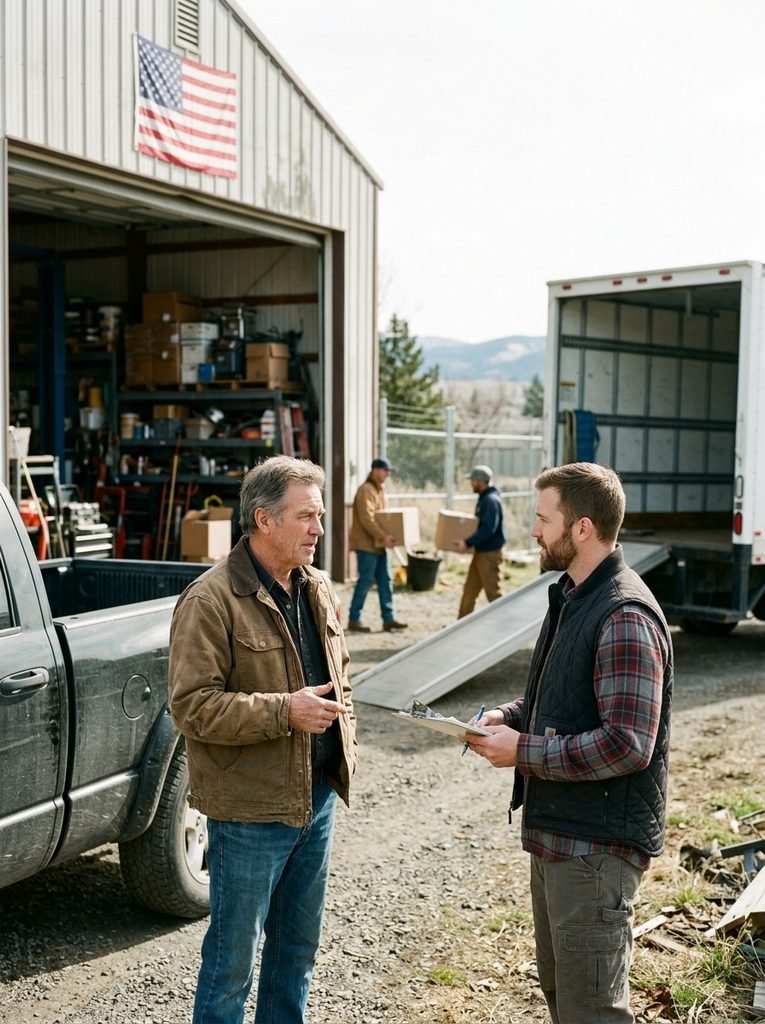
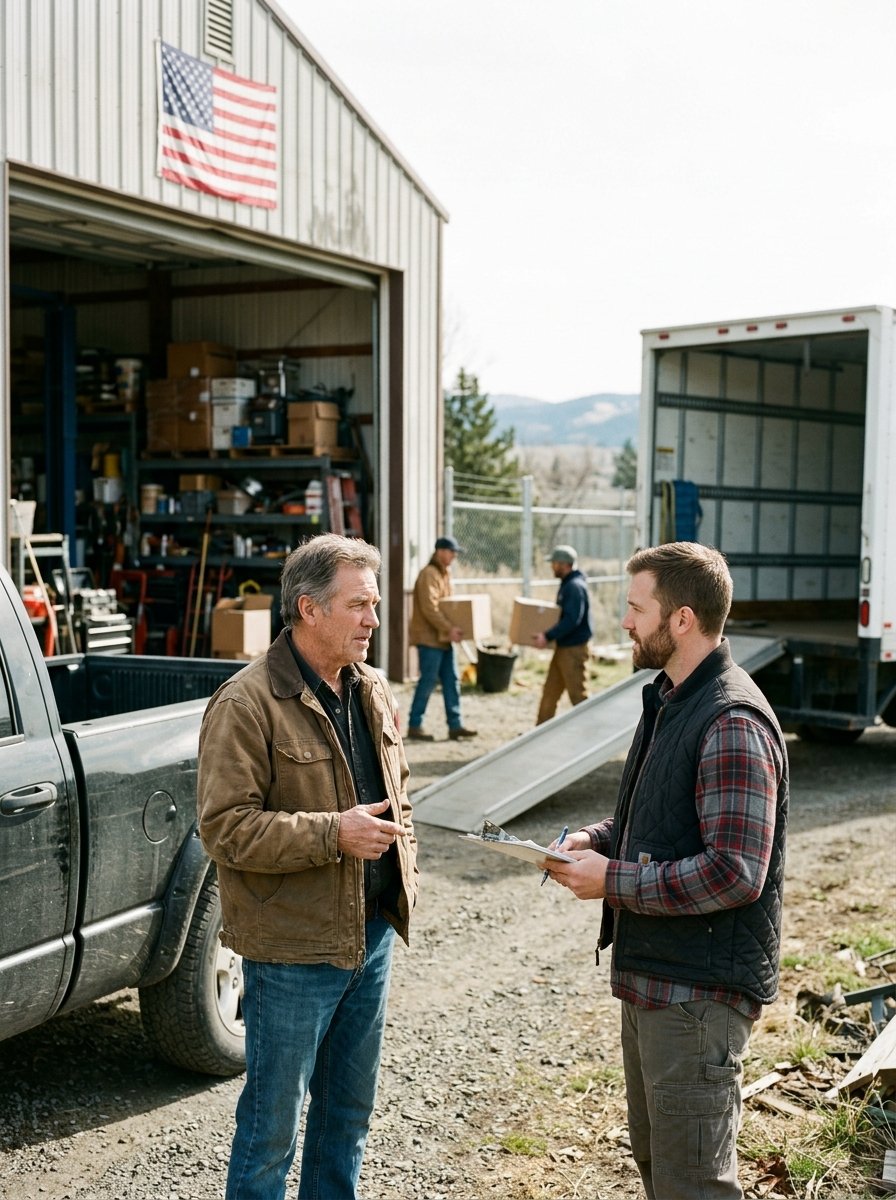
I turned onto my property road and found a white box truck backed against the garage, ramped down, two strangers loading boxes, and Brixton standing there with a clipboard directing them like he owned the place.
He turned, saw my truck, and went rigid.
His first words weren’t, “What happened?” or “Are you okay?”
They were, “Why are you back already?”
Six words that told me more than anything else that morning.
“Electrical issue in the storage room,” he said. “Smooth and ready. Figured I’d move the files while you were out.”
I walked past him into the garage, into my father’s old records room.
The shelves half empty, two archival boxes of survey maps and drilling records already gone.
I said nothing.
I photographed the moving truck’s license plate in my side mirror on the way out and drove 2 miles down the road before I pulled over and called my attorney, Marlo Sutton.
I told her everything in order, the way she’d always taught me to.
“Anger is evidence,” she said.
“If you go in swinging, you become the story instead of the evidence. Don’t confront them. Don’t tell Serena what you found. If anyone hands you a document, don’t sign it. Hand it back. Tell them your attorney reviews everything.”
Over the following days, Marlo’s investigation opened like a trap door.
The truck was hired through a driver named Dale Poot. Paid 800 cash to move boxes and keep quiet.
The company that hired him traced back to a geological consultant named Hadley Fro, a man I’d hired myself 3 years earlier for a survey that had gone nowhere.
A year ago, Brixton had sent Fro scans of my father’s old geological maps without my authorization.
Then came the financial records.
A shell company called Paragrin Advisory had been paying Brixton’s personal checking account $2 to $6,000 every few weeks for eight months, $34,000 total, labeled consulting fees, for a man who’d never consulted on anything.
Then the surveillance photos.
Serena meeting Hadley from seven times over 6 months at a Hampton Inn, a restaurant 50 mi away, a parking lot where her hand rested on his over a phone screen with the easy familiarity of a hundred times before.
6 years of marriage and I hadn’t seen any of it.
Then the document that should have ended everything.
A purchase agreement from a Delaware shell called Ridgemark Holdings offering 60% of assessed value for mineral rights to my father’s untouched west section.
300 acres with an old half-for-gotten note about unusual subsurface formations.
My signature was at the bottom.
I hadn’t signed it.
A forensic examiner confirmed it had been lifted from an old vendor contract and pasted in, and the file itself had been created on Brixton’s laptop at 11:47 p.m. 3 weeks earlier.
Forgery, second degree, a felony.
Marlo filed for divorce.
A court-ordered vehicle search turned up a prepaid burner phone that had connected to Serena’s car 43 times over 7 months.
A federal warrant produced the texts between that phone and Hadley Fro.
“Brixton delivered the last of the survey files,” From had written. “We have everything we need from him now.”
“Does he know that?” Serena asked.
“He thinks he’s a partner,” From answered. “Let him think that until the papers are signed.”
Three people and not one of them fully trusting the other two.
Then a young geologist named Neville Ducket walked into Marlo’s office on his own.
Scared and unrepresented.
He’d refused to sign an altered report from wanted filed.
One designed to make my land look like a liability so a lowball offer would look like a rescue.
And he told us something that changed everything.
The coordinates Brixton had scanned and sent from were wrong.
My father had corrected a surveying error decades ago by hand in a document kept safe in a bank vault, a document Brixton never had access to.
Hadley From had spent nearly a year chasing something 300 m from where it actually was.
A title search delivered the final blow to his whole scheme.
23 years earlier, my father had severed the mineral rights from the surface property entirely and placed them in an irrevocable trust.
Even if the forged signature had gone undetected, even if every part of the plan had worked, Hadley Fro could never have taken what he was trying to steal.
It was never on the table to begin with.
Sheriff Wayne Wright found the 23 boxes of my father’s stolen records intact in a storage unit.
In Corbin.
Brixton, cornered, brought Marlo a recording he’d made of Fro and Serena discussing the endgame.
“Once Cordell signs, Brixton becomes a liability.”
And Serena’s own voice asking, “How soon can we leave?”
From, panicking, tried to fabricate a backdated email making Serena the mastermind.
The metadata proved it was created 3 days earlier on his own company laptop, adding a second forgery charge to his name.
At trial, Jolene Marsh testified about the phone on the tray.
Dr. Briggs testified about the hallway.
Neville Duckett walked the court through two geological reports.
A neighbor named Darlene Colby testified she’d seen the moving truck arrive at 7:32 that morning, 2 hours before Serena and I ever left for the appointment.
Judge Harriet Boon asked Serena one question.
“If her husband had been gravely ill that morning, unable to leave the clinic, what would have happened to those boxes already loaded on the truck?”
Serena didn’t answer.
The judge said she’d take that as responsive.
The prenuptual agreement held.
Every count landed against Hadley from.
7 years federal.
Serena took a plea, 3 years probation, and moved out on a Wednesday morning with an apology that finally sounded honest, if too late.
Brixton left in December without a word, just a key on the counter and his handwriting still on the tape.
I went back to Riverton Imaging 7 months later for a routine follow-up.
I saw Jolene Marsh in the parking lot and told her what her attention that morning had protected.
Things I didn’t even know needed protecting yet.
“I wasn’t certain what it meant,” she told me. “I just saw something wrong and went to get the doctor.”
“That’s exactly what courage looks like,” I told her.
I drove home with the windows down.
I went out to the garage and stopped the way I do most mornings now at my father’s old survey map, his handwriting in the margin, the quiet correction nobody else thought to make.
And beneath it, worn nearly into the paper:
“Never sell what you haven’t fully understood.”
30 years of reading people across contract tables, and I still missed it, until a woman I’d never met looked at a phone on a steel tray and chose to act anyway.
Trust is what you give.
Safety is what you build with careful people, careful records, and the courage to move before you can fully explain why.
The most dangerous betrayal doesn’t come through a broken window.
It walks in through a door you opened.
If you came here from Facebook because of this story, go back to the Facebook post, tap like, and leave exactly “Amazing story” in the comments to support the storyteller. That small action means more than it may seem, and it gives the writer real encouragement to keep bringing you more stories like this.