The Boy Who Bought His Own Skidder
Wendell Lindgren handed my son an envelope on the last Saturday in August, standing in our yard by the machine shed, and he did not even shut his truck off.
Torin opened it right there. He is seventeen and he still opens things the way he did at seven, all at once, like whatever is inside might get away from him.
Six one-hundred-dollar bills. He counted them twice. Then he looked up at his father’s cousin with his mouth a little open, the way you look at a man who has just told you the sky is green.
“That’s six hundred,” Torin said.
“That’s what’s left,” Wendell said. He leaned one arm on the open door of his pickup. “You broke a chain on the Deere back in July. Tire chain. Do you know what those cost? I had to buy a pair. The rest went to that.”
I was standing on the porch steps with a dish towel in my hand. I had come out because I heard the truck and I wanted to see my boy get paid. I had been looking forward to it for a week.
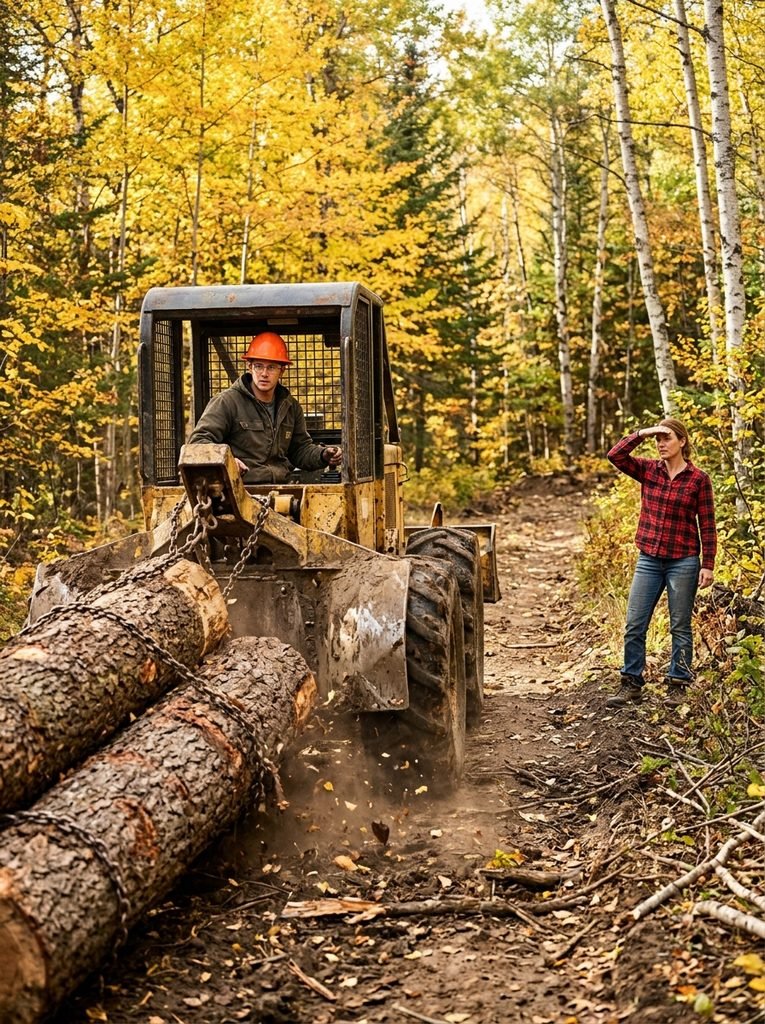
Torin had run Wendell’s skidder all summer. Eleven-hour days, sometimes twelve, out on a timber sale north of Park Falls, dragging aspen and a little balsam out to the landing while Wendell ran the saw and loaded the truck.
Wendell had paid him every Friday through June and July, cash, fifteen dollars an hour. In August he said the mill was slow paying him and he would settle up at the end.
Torin wrote his August hours in a little spiral notebook on the dash. One hundred ninety-four hours, two thousand nine hundred and ten dollars. Wendell said call it twenty-nine hundred, and Torin said that was fine.
“I never broke a chain,” Torin said. His voice was quiet. “We never ran chains. They were hanging on the nail in your shed the whole summer. It was dry, Wendell. It didn’t rain for three weeks in July.”
Wendell smiled at him. It was not a mean smile, exactly. It was worse than mean. It was the smile of a grown man who had already decided how the conversation was going to end.
“You were in that machine every day, bud. Things break. That’s logging. You’ll learn.”
Then he looked at me on the steps, nodded like we had all agreed on something, got in his truck, and backed out onto the town road.
I stood there with that dish towel for a long time. My son stood by the machine shed holding six hundred dollars, and neither of us said a word until the sound of the truck was gone into the trees.
On the next page
The Number We live on a hundred and sixty acres in Price County, Wisconsin, about twelve miles out of Phillips.
The Number
We live on a hundred and sixty acres in Price County, Wisconsin, about twelve miles out of Phillips. My husband Nils runs forty-some beef cows, mostly Angus crosses, and he cuts hay and works part of the winter plowing for the township. I drive a school bus for the district. I have driven the same route for eleven years. I know every mailbox and every dog on it.
We are not poor and we are not anything else either. We are the kind of family where a boy’s summer money matters, and where everybody knows exactly what it is going to.
Torin’s was going to a truck. He had four thousand dollars saved from two summers of baling hay and one of logging, and the twenty-nine hundred was going to put him close enough to buy the half-ton he had been watching on a lot in Prentice since spring.
That night Nils came in from checking the cows and Torin showed him the envelope and the notebook. Nils sat at the kitchen table and read the notebook page by page with his reading glasses down on his nose. He did not say anything for a while.
Wendell is his first cousin. Their fathers were brothers. They grew up a mile apart and hunted the same swamp every November of their lives. When Nils’s dad died, Wendell was a pallbearer. When Wendell’s boy got married, Nils was the one who cooked the hog.
“He’s behind on that new skidder,” Nils said finally. “I heard it at the co-op. Payments on that machine are more than our mortgage. He’s been scrambling since spring.”
“That doesn’t make it my chain,” Torin said.
“No,” Nils said. “It doesn’t.”
He took his glasses off and rubbed his eyes. I could see what it was costing him. A man does not like to find out a thing like that about someone who carried his father’s casket.
“I’ll go over there tomorrow,” he said.
I put my hand on his arm. I had been thinking about it all afternoon, standing at the sink, scrubbing a pot that was already clean.
“And say what?” I said. “He’ll say the chain broke. You’ll say it didn’t. Then you two won’t speak at Christmas, and your mother will cry, and Torin still won’t have his money.”
“Then we get a lawyer.”
“For twenty-three hundred dollars?” I said. “Against your own cousin? It’d be a year, and we’d spend half of it getting the other half, and the whole family would pick sides.”
I am not a hard woman. But I had done the arithmetic in my head that afternoon, and the arithmetic kept coming out the same way. It was Nils’s cousin and it was twenty-three hundred dollars, and I had decided my son would earn it back faster than any court would ever hand it over.
I just did not know how yet.
Torin’s Idea
It was Torin who knew how. He usually does. He gets that from Nils.
He sat on the porch steps the next morning before church with his coffee, looking out over the hayfield toward the Tolliver place, and he said, “Mom. What if I didn’t work for anybody?”
I sat down next to him. The grass was wet. The aspens along the fence line were just starting to go, a few yellow leaves here and there like somebody had been careless with paint.
“You’d need a machine,” I said.
“Old Gunnar up the road is selling his skidder. The old Timberjack. It’s been sitting behind his shed since he quit. I saw it on the board at the feed mill.”
He had logged around here for forty years and quit when his knees gave out. He was eighty-one now. I had his great-grandkids on my bus.
“That thing’s older than you are,” I said.
“It’s a 1989,” Torin said. “It’s a 240 cable. Single drum winch. He wants ninety-five hundred. Mom, it runs. I talked to him after the Fourth. He just doesn’t want to sell it to somebody who’s going to part it out.”
“And where are you going to cut?”
He tipped his coffee cup toward the east, toward the forty acres of aspen that sat between our hayfield and the county road.
“Agnes,” he said. “She told Dad two years ago that stand was getting old and she ought to have somebody cut it before it falls over. Nobody’s come. It’s too small for the big outfits.”
I looked at that stand of aspen and I looked at my son, and something in my chest went very still.
Ninety-five hundred dollars. Torin had four thousand. I had been putting my bus money away for six years, a little out of every check, for a furnace we were going to need someday and for whatever came up. There was fifty-eight hundred dollars in that account.
“Let me pray on it through the service,” I said.
He grinned at me. “You already decided.”
“Let me pray on it anyway,” I said.
The Old Man’s Skidder
Nils did not like it at first. He did not like the idea of his only son out in the woods alone on a thirty-seven-year-old machine. He said so plainly, and I respected him for it.
But on Monday afternoon after my route he drove out to the old logger’s place with us anyway, and he spent an hour and a half crawling around under that skidder while the old man sat on an upturned bucket and told him what was wrong with it.
“Winch line’s good. I put new cable on it the last year I ran,” the old man said. “Clutch on the winch is a little grabby. Front tires are bald as my head. The articulation pins are tight. Engine starts every time if you let the glow plugs work.”
Nils climbed up into the seat and turned it over. It took a second. Then it caught with a cough of black smoke and settled into a low, rough rattle that you could feel in your back teeth.
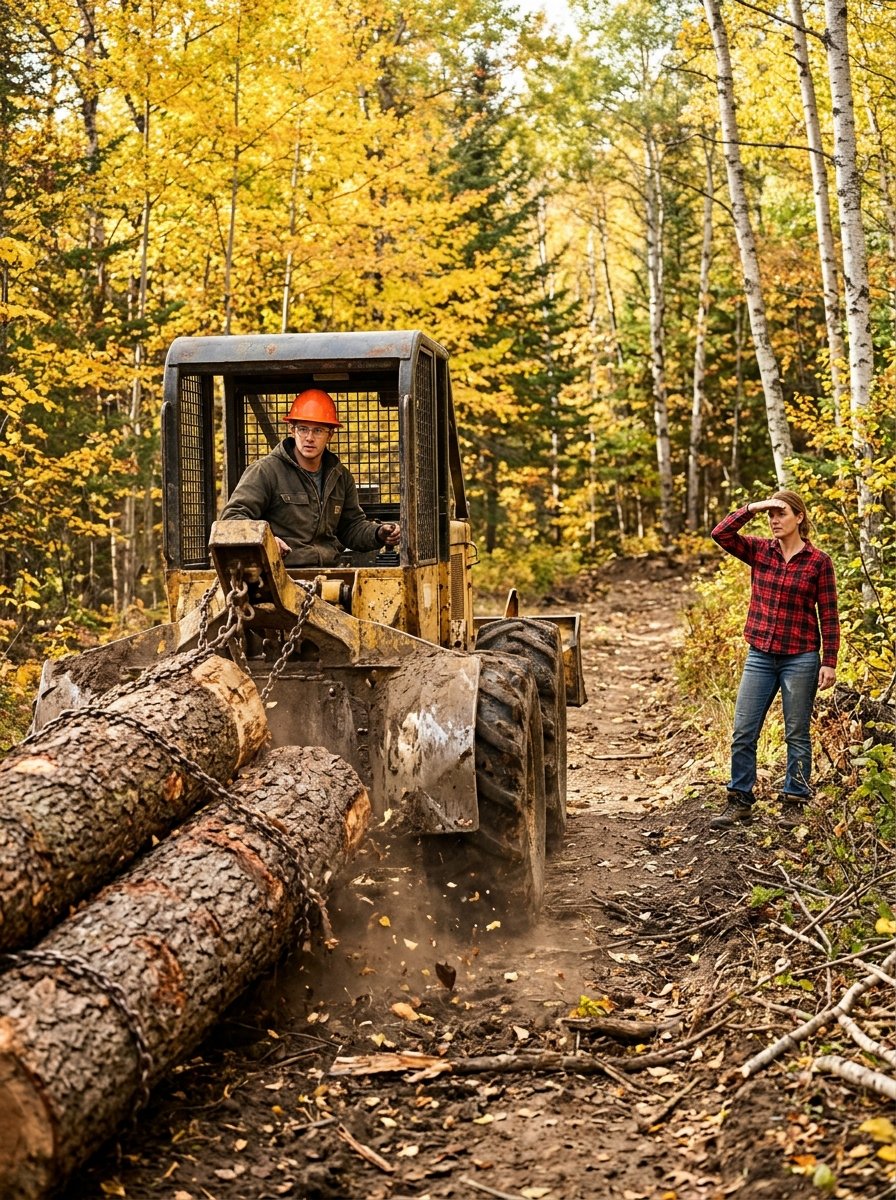
It was yellow, or it had been once. Most of the paint was gone. The blade on the front was dented and scraped from a thousand stumps. The cab had no doors and a crack across the windshield.
It was the ugliest thing I had ever seen, and Torin looked at it like it was a horse he had raised from a colt.
His wife, Ardis, brought out lemonade in jelly glasses. She stood by me while the men talked and she said, “He won’t sell it to the young fellow from Ogema. He says he’d scrap it for the steel.”
“Torin won’t scrap it,” I said.
“No,” she said, watching my son run his hand along the winch drum. “I don’t expect he will.”
Nils came down off the machine and wiped his hands on a rag and walked over to the old man.
“Ninety-five hundred is fair,” he said. “It’s more machine than I thought.”
“Ninety-five for the boy,” the old man said. “Eleven for anybody else.”
I wrote the check that night at the kitchen table. Torin counted out his four thousand in cash from the coffee can in his closet and laid it on the table in neat piles, and then I wrote fifty-five hundred out of my bus account. My hand was steady. I was surprised at how steady.
When I was done there was three hundred dollars left in the account I had been filling for six years.
Nils looked at the check, and then at me.
“The furnace will last another winter,” I said.
He nodded slowly. “It will,” he said. And then he said something I did not expect. “I’ll put new tires on the front. And I’ll weld that crack on the blade. I’ve got the rod.”
Agnes
Agnes Tolliver is seventy and has been a widow for nine years. Her husband farmed with Nils’s dad. She lives alone in the white farmhouse on the county road, she still drives herself to church every Sunday in a Buick older than Torin, and she makes the best rhubarb pie in the county, which she will tell you herself.
Torin went to see her on his own. He asked me not to come. He wanted to do it like a man.
He came back an hour later with flour on his sleeve and a look on his face I had not seen since he was little.
“She said yes,” he said. “She said she’d been praying somebody would come ask, and she didn’t care for the man from the big outfit who came by in the spring. She said he talked to her like she was simple.”
“What did you offer her?”
“The going rate for stumpage. I looked it up at the county forestry office. And I told her I’d leave the oaks and the big white pine along the creek, and I’d keep the trails narrow, and I wouldn’t cut when it was wet so I wouldn’t rut her up.”
“What did she say?”
“She said she’d take a little under the going rate because her husband farmed with my grandpa. I told her no, ma’am. I told her I’d pay her the going rate, same as anybody. She said I was stubborn as a Lindgren.” He grinned. “Then she gave me pie.”
Nils went over with him that weekend and walked the forty with Agnes and the county forester, a young woman who marked the boundaries and the trees to leave. The forty was all old aspen, big and tall and starting to go punky in the middle, with a scattering of balsam and red maple and those oaks along the creek.
The forester stood at the edge of it and looked up.
“This is ready,” she said. “Past ready. This stand is fifty years old. It’ll come back thick as hair once it’s cut. Aspen wants to be cut.”
The First Day
School started the Tuesday after Labor Day. Torin was a senior. He had arranged his schedule so that he was done by twelve-thirty on most days, with two study halls at the end that his counselor let him take as work release.
I would leave at six-fifteen to pick up my bus at the garage in town. Torin would leave at seven-thirty for school. At twelve-thirty he drove straight home, changed into his work clothes in the machine shed, and walked across the hayfield to the skidder.
Nils taught him how to fell that first Saturday. Torin already knew how to run a saw, but there is a difference between bucking up a down tree and laying a seventy-foot aspen exactly where you want it. Nils stood back and watched him cut his notches and his back cuts, and told him once, and then stood back again.
By noon he had stopped telling him anything.
“He’s better at it than I am,” Nils said to me that night. He sounded a little sad and a lot proud, the way fathers do.
The way a cable skidder works, you back the machine toward the logs you have cut. You get off and drag the winch cable through the brush by hand.
You wrap a short chain called a choker around the end of each log, hook the chokers to the cable, climb back up, and winch them in tight against the back of the machine.
Then you drag the whole bundle out to the landing. You drop it, unhook every choker by hand, and go back for more.
It is hard, filthy, slow work. It is all climbing on and climbing off. A grapple skidder does the grabbing with a big claw and the operator never leaves the seat, but a grapple skidder costs ten times what that old Timberjack cost, and we did not have it.
Torin did not complain once. Not that day and not any day.
The Afternoons
My afternoon route ended at three-forty. I would park the bus at the garage, drive home, and walk out across the hayfield to the landing with a sandwich and a jug of water for my son.
The landing was a dirt clearing by the field road where the logs would be piled until a truck could come get them. It grew a little every day. First it was a few logs. Then it was a pile as high as my waist. Then as high as my head.
By the second week of October the aspens had gone full gold. On a sunny afternoon the whole forty would light up like something you would see in a painting at church, and the leaves would come down in the wind and land on everything, on the logs and on the skidder and on my son’s orange hard hat.
He wore that black hooded sweatshirt every single day. I washed it every Saturday night and it was back on him by Sunday afternoon.
I would stand by the landing pile with my hand up against the sun and watch the skidder come grinding out of the woods, Torin high up in the seat with his shaggy brown hair sticking out from under the hard hat, a bundle of aspen dragging behind on the chain. And I would think, that is my boy. That is my boy doing that.
I am not too proud to tell you I cried more than once out there, standing in my old red flannel shirt, glad nobody could hear me over the engine.
But the person I want to tell you about is Agnes.
The Thermos
The third day Torin was in the woods, Agnes came out.
She drove her Buick down the field road as far as she dared and then walked the rest of the way in her church shoes, carrying a green metal thermos and a folding cushion. She found a big aspen stump at the edge of the landing, set the cushion on it, sat down, and poured herself a cup of coffee.
Torin shut the skidder down and climbed off.
“Mrs. Tolliver, you shouldn’t be this close. If a log rolls…”
“I’m sixty feet from anything you’re doing, young man. I measured,” she said. “My husband used to log this forty with a team of horses with his daddy, back in 1974, the year before we got married. I used to bring the coffee then too. Go back to work.”
So he did.
She came out the next day, and the next. Every afternoon that it wasn’t raining, from the middle of September on, Agnes Tolliver sat on that stump with her thermos and watched my son work her land. She did not say much. She did not need to.
Some afternoons I would come out and find the two of them sitting side by side on the stump and the tailgate of his pickup, his hard hat in his lap, drinking her coffee out of the thermos cap and talking about her husband and the horses and what the woods looked like when she was a girl.
One afternoon near the end of September I came across the hayfield and stopped at the edge of the landing, because I could hear her talking, and I did not want to walk in on it.
“We never had a son,” she was saying. “We tried for a long time. It wasn’t the Lord’s plan. He would have liked you, Torin. He would have liked how you leave the trails clean.”
Torin did not say anything for a while.
Then he said, “I’m going to leave the big pine by the creek, Mrs. Tolliver. The one with the double top. Dad said that was the one Mr. Tolliver always talked about.”
She put her hand on his arm. It was a small hand, spotted and thin, and it stayed there.
“Yes,” she said. “That’s the one.”
I turned around and walked back across the hayfield and stood behind the machine shed for a while before I could go back out there.
The Mill
Aspen in our part of Wisconsin mostly goes to the pulp and board mills, sold by the ton. A trucker with a log truck and a loader picks it up at the landing and hauls it to the mill yard.
There it goes across the scale, and the mill writes a ticket with your name and the weight on it. The check goes to the name on the ticket.
We had to set up the account in Torin’s name with me signing as his mother, since he was not eighteen. The woman at the mill office in town looked at the paper for a long time, then over her glasses at me.
Then she signed it and stamped it and said, “Good for him,” in a voice like she meant it. That was the first time anybody outside our family had said it.
The trucker Nils found was a man from Prentice who hauled for half the small crews in the county, a toothpick always in the corner of his mouth. He looked at the landing pile the first week of October and whistled through his teeth.
“The kid did all this by himself?” he said. “With that old cable machine?”
“After school,” Nils said.
The trucker looked at Torin a long time.
“I’ll haul for you,” he said. “Same rate as I give anybody. Not a penny under.”
That was what Torin wanted. Not a favor. The same rate as anybody.
Agnes Tells the Church
We go to a little Lutheran church in town. There are maybe ninety of us on a good Sunday. After the service everybody goes down to the basement for coffee and bars, and that is where the real news in our county gets told.
I had told nobody about Wendell. Not my sister. Not the women on my route. Nils had told nobody either. It was family, and you do not air family.
But Agnes Tolliver did not consider it her family.
The second Sunday in October she stood up in the church basement with her coffee cup in one hand, in front of the bars table, in front of God and the Ladies Aid and half the farmers in the township, and she said, “I want everybody to know who’s cutting my forty.”
The room got quiet. Agnes is not a woman who stands up in the basement.
“It’s Torin Lindgren,” she said. “Nils and Jody’s boy. He bought that old skidder off the road with his own money and his mother’s, and he cuts after school every day, and he leaves my trails clean, and he pays me the full rate when I offered him less. I’ve sat out there and watched him every afternoon for a month.”
She looked around the room.
“And I’ll tell you why he’s doing it,” she said. “Because a grown man paid that boy six hundred dollars for a summer of eleven-hour days and told him the rest went to a chain he never broke. I won’t say the man’s name in church. Most of you can figure it out.”
Then she sat down and ate her lemon bar.
I sat there with my face hot as a stove. Nils sat next to me very still. I did not know whether to be angry with her or to go over and hug her. Torin, on the other side of Nils, was looking at the floor.
But I will tell you what I saw.
I saw an old cattleman from the far side of the Spirit River put his cup down and look at Torin. I saw two of the Ladies Aid women look at each other.
And I saw a dairy farmer in the back row, a man with a hundred acres of timber north of us, take a little notebook out of his shirt pocket and write something down.
Nobody said anything else about it that day. In a church basement, nobody has to.
The Calls
The dairy farmer called on Tuesday. He had eighty acres of mixed aspen and maple that he had been meaning to get cut for five years and he had been waiting on a logger who never showed up. He wanted Torin to come look at it once he was done at Agnes’s.
The old cattleman called on Thursday. He had a twenty-acre aspen stand behind his cow barn that he wanted thinned out next summer.
I stood in the kitchen with the phone in my hand after he hung up and I looked out the window at the forty, all gold, and I could hear the skidder grinding somewhere out in it.
Two jobs. Before Thanksgiving. For a seventeen-year-old with a thirty-seven-year-old machine.
When Torin came in that night I told him. He did not say anything. He just stood in the doorway with sawdust in his hair, and his face did something complicated.
Then he went upstairs to wash up, and I heard him through the floor, in the bathroom, laughing to himself like he had heard a good joke.
Wendell Hears
Of course Wendell heard. In a county like ours, a story told in a church basement on Sunday is at the feed mill on Monday and the bar in Phillips by Monday night.
He did not call. He did not come by. Nils’s mother asked him in a careful voice whether something was going on with Wendell, and he told her it would get worked out.
Nils went quiet that week. He went out to the cows early and came in late. On Thursday night after Torin was in bed I found him sitting in the truck in the yard with the dome light on, not going anywhere.
I got in the passenger side.
“I keep thinking about the funeral,” he said. “Dad’s funeral. Wendell stood in the back of the church the whole visitation. Four hours. Shook every hand. I was so grateful I couldn’t see straight.”
“I know.”
“And then he does this to my boy. To his own blood. Over a skidder payment.”
“He was scared,” I said. “He was behind and he was scared, and he figured a kid wouldn’t push back.”
Nils looked at me. “You’re defending him?”
“No,” I said. “Nothing makes it right. A boy worked eleven-hour days for him all summer. I’m just saying I understand how a man gets there. That’s not the same as letting him stay there.”
He sat with that a long time.
“What do we do?” he said.
“Nothing,” I said. “We don’t do anything. Torin’s doing it.”
The Scale
The first full loads off Agnes’s forty went to the mill yard on a Thursday in the third week of October.
Torin wanted to ride along. He had a half day of school that day for teacher conferences, so I took the afternoon off my route for the first time in four years. The old logger’s wife had told me once you only see your son’s first load go across the scale one time in your life. I did not want to miss it.
We followed the log truck in my car down Highway 13 and out to the mill. It was a bright cold afternoon. The aspens along the highway were past their best but still yellow, and the sky was the hard clean blue you only get in October.
The mill yard is a big gravel lot with mountains of logs on one side and the scale house on the other. The trucks line up and pull across the scale one at a time, and the scale man sits in a little booth with a window and a microphone that crackles out over a speaker on the pole, so the drivers can hear their weights without getting out.
There were four trucks ahead of us.
And two trucks behind us, I saw when I looked in the mirror, was Wendell’s.
I knew it right away. I have known that truck for twenty years. My stomach went tight.
“Torin,” I said quietly. “Look behind us.”
He looked. He did not say anything. He turned back around and sat with his hands on his knees and his jaw set exactly like his father’s.
“You don’t have to get out,” I said.
“I’m getting out,” he said.
The Ticket
When our load pulled up on the scale, Torin got out of my car and walked over to stand by the booth. I got out too and stood beside the car. I had my red flannel on, and I remember I put my hands in the pockets because they were shaking.
The scale man leaned to his microphone. He was a heavy, gray-haired man with a voice like a radio announcer, and he had been calling weights at that mill for longer than Torin had been alive.
He looked down at the ticket. Then he looked up and out the window at my son standing there in his orange hard hat and black sweatshirt, and his eyebrows went up.
Then he keyed the microphone and read it out across the whole yard, slow and loud, the way he must have read ten thousand tickets.
“Load from the Tolliver forty. Supplier, Torin Lindgren. Twenty-nine point four tons.”
Then he let go of the button, and then he pushed it again.
“First load, son?” he said over the speaker.
“Yes, sir,” Torin called back.
“Well, welcome to the yard,” the scale man said, and every driver in that line heard it.
A man leaning on the fender of the truck ahead of us lifted his hand to Torin. The trucker, standing by his door with his toothpick, gave one slow nod. Somebody in the line tapped his horn twice, not loud. Just twice.
And behind us, I heard a truck door open and shut.
I turned around. Wendell was walking up the line toward the scale house.
He was a big man, Wendell, built like all the Lindgren men, wide in the shoulders, and he walked like his boots were heavy. His face was gray. He did not look at me. He walked right past my car and right past the log truck and stopped about six feet from my son.
Every driver in that yard was watching. I could feel it, the way you can feel weather coming.
Torin turned and looked at him. He did not step back. He did not step forward either.
For a long moment nobody said anything. The engines idled. A gust of wind came across the yard and blew yellow leaves off the top of the log pile and across the gravel between them.
Then Wendell said, loud enough that the scale man heard it, and the trucker heard it, and I heard it from twenty feet away:
“There never was a chain.”
Torin did not move.
“I hung those chains on the nail in March and they never came off,” Wendell said. His voice was rough, like it had not been used. “I was behind on the machine. Three payments behind. They were going to take it. And I told myself you were a kid and you wouldn’t fight it. That’s the truth of it.”
He stopped. He swallowed.
“I owe you twenty-three hundred dollars,” he said. “And I owe your mother an apology for standing in her yard and lying to her face.”
He looked at me then, finally. I nodded once. I could not have said a word if you had paid me.
“I can’t pay it all today,” Wendell said to Torin. “I’ll pay it by Christmas. You have my word, for whatever you think it’s worth now.”
My son looked at him for a long time. I have thought about that look a hundred times since. There was no gloating in it. There was not even anger. It was the look of somebody who has already moved past a thing and is a little sorry for the man who has not.
“By Christmas is fine,” Torin said.
Then he did a thing I will never forget. He held out his hand.
Wendell looked at it. And then he took it, and the two of them shook hands in front of the scale house with the whole line watching, and nobody said anything at all.
The scale man keyed his microphone.
“Next,” he said.
By Christmas
Wendell paid it. Three envelopes, one in November and two in December, the last one left in our mailbox the Saturday before Christmas with a card inside. The card had a picture of a deer in the snow on the front and inside it just said, in Wendell’s square handwriting, Torin. Paid in full. I’m sorry. W.
He did not lose his skidder. I heard at the co-op that he caught up on the payments in January. I was glad. I mean that. I did not want the man ruined. I only wanted my son paid.
But things were not the same for him in the county after that, and I do not think they will be. The story got told, and it kept getting told, in the church basement and at the feed mill and in the bar. Two landowners who had been talking to Wendell about cutting next year called Torin instead. People are polite to Wendell. They are just not as warm.
That is the consequence, and I believe it was the right size. He has to live inside it, and he does, and he came to our Christmas Eve service anyway and sat three rows behind us, and when it was over he shook Nils’s hand in the aisle. Nils held on a little longer than he needed to.
They have not hunted together since. Maybe they will next November. Nils says he would like that. I think he would.
Agnes’s Forty
Torin finished cutting Agnes’s forty the second week of March, on frozen ground, with the snow up past the skidder tires.
On the last load the scale man read his name out loud again. “That’s the last of the Tolliver, son? Good clean job, I hear.” Torin went red to his ears.
All told, after Agnes’s stumpage, the trucking, fuel, two hydraulic hoses and a starter, Torin cleared a little over eleven thousand dollars on that forty.
He paid me back every cent of my fifty-five hundred before he spent a dollar on himself. He left the envelope on the kitchen table one night with a note on top in pencil. It said Furnace.
He started on the dairy farmer’s eighty in April and he has the cattleman’s twenty lined up for after haying.
He did not buy the truck from Prentice. He said he would rather put the money into a better winch clutch and a spare set of chokers.
He graduated in May. Agnes came to the open house in our machine shed and sat in a lawn chair by the door with her thermos, like she was still on the stump, and every person who came in had to stop and shake her hand first. She liked that very much.
The aspen on her forty came back that spring exactly like the forester said it would. Thick as hair, little red-green suckers coming up out of every stump by the thousands. By the end of summer they were up to my knees. In twenty years there will be a new stand there, and in fifty somebody will cut it again.
The big white pine by the creek with the double top is still standing. Torin left it. He left a little circle of oaks around it too, so it would not stand out there all alone.
Agnes goes out and sits under it sometimes, on a stump Torin cut level for her and sanded smooth.
The Blade
I want to end with the skidder, because that is where this all came from.
Nils welded the crack in the blade that first fall like he said he would. And in the spring, after Torin finished Agnes’s forty, the two of them pulled it into the machine shed and spent a Saturday on it. They greased every fitting and changed the oil and put new pins in the front articulation.
Then Nils brought out an old can of paint from the back shelf and handed Torin a brush.
He painted two letters, T.L., in black paint and a little crooked, because he did them freehand.
I still walk out to the landing some afternoons after my route. I stand by the pile with my hand up against the sun and watch for it to come grinding out of the woods.
The skidder is yellow and ugly and has Torin’s initials painted on the blade.
The End