I Cried as My Husband Left for a “Two-Year Assignment” in Zurich, but Three Days Earlier I Had Found the Pregnant Woman and the Life He Planned Without Me
My finger was resting on the mouse, right over the blue CONFIRM TRANSFER button, when my phone buzzed on the desk beside the laptop.
$720,000.00.
One click. One second.
I’d spent three days planning that click. I’d opened a new account in my name alone at a different bank. I’d typed in the routing number twice and checked it a third time. All I had to do was press the button, and the money my father left me would move out of the joint account I shared with my husband and into an account he couldn’t touch.
The phone buzzed again.
It was a text from a number I didn’t recognize. It was a photograph.
The photograph wasn’t of Lucas. That was the first thing my mind registered, and for one strange second, I felt relief.
Then I looked closer.
It was a picture of our house in Littleton, Colorado. Our front door. Our porch. It had been taken from across the street at a slight angle, as if someone had been sitting in a parked car under the big maple tree by Mrs. Bellamy’s mailbox.
It showed Lucas and me leaving the house together that morning, dressed for the airport. Lucas was smiling. I was looking down, pretending to search for something in my purse.
It was ordinary, almost dull. Except someone had been watching us.
I enlarged the image with shaking fingers. In the reflection of the living room window, half hidden behind a porch column, a figure stood near the side gate. A woman in a dark coat and sunglasses, with one hand resting on her rounded stomach.
Melanie Harper.
I stared until my eyes burned.
Then a second text arrived.
Don’t transfer the money yet.
The room seemed to tilt.
I looked from the phone to the laptop screen, where the confirmation button still waited.
Every instinct I had was screaming at me to protect what was mine before Lucas could touch it. But that message had cut cleanly through my anger and left something colder behind.
How did this person know what I was about to do?
I typed with my thumb: Who is this?
Three dots appeared. Disappeared. Appeared again.
Someone who knows Lucas is not the only one lying.
I sat down slowly in my desk chair.
My name is Anne Everett. I’m thirty-six. I’m a hospital pharmacist at Swedish Medical Center in Englewood. Until three days before that afternoon, I believed I had a good marriage.
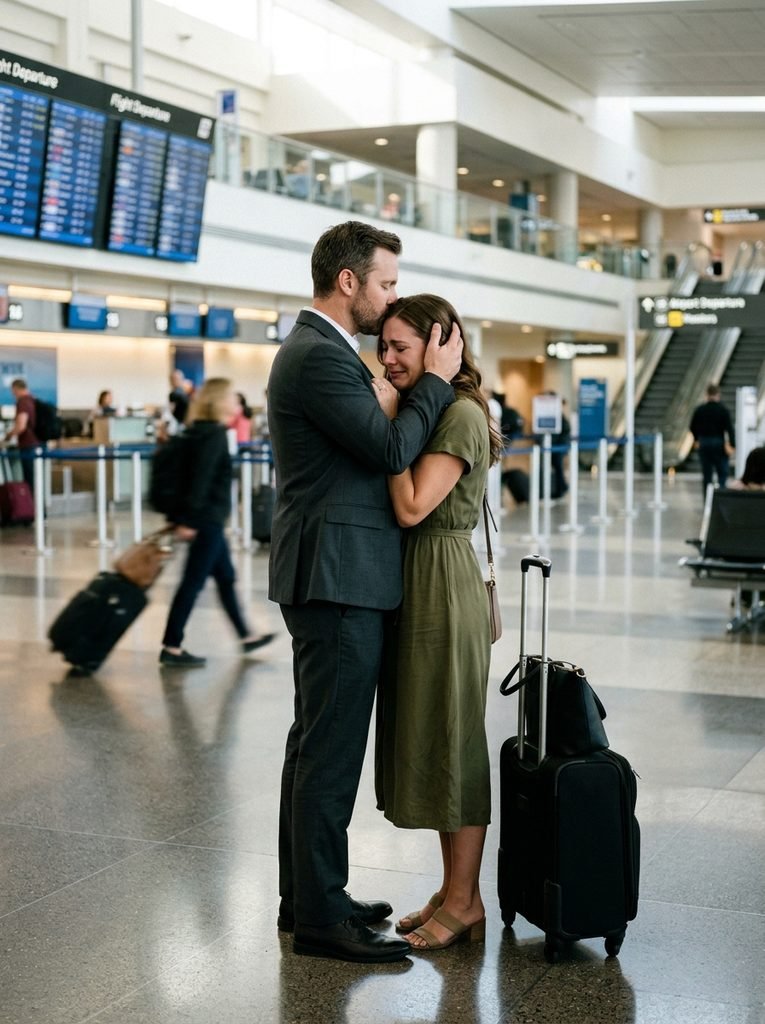
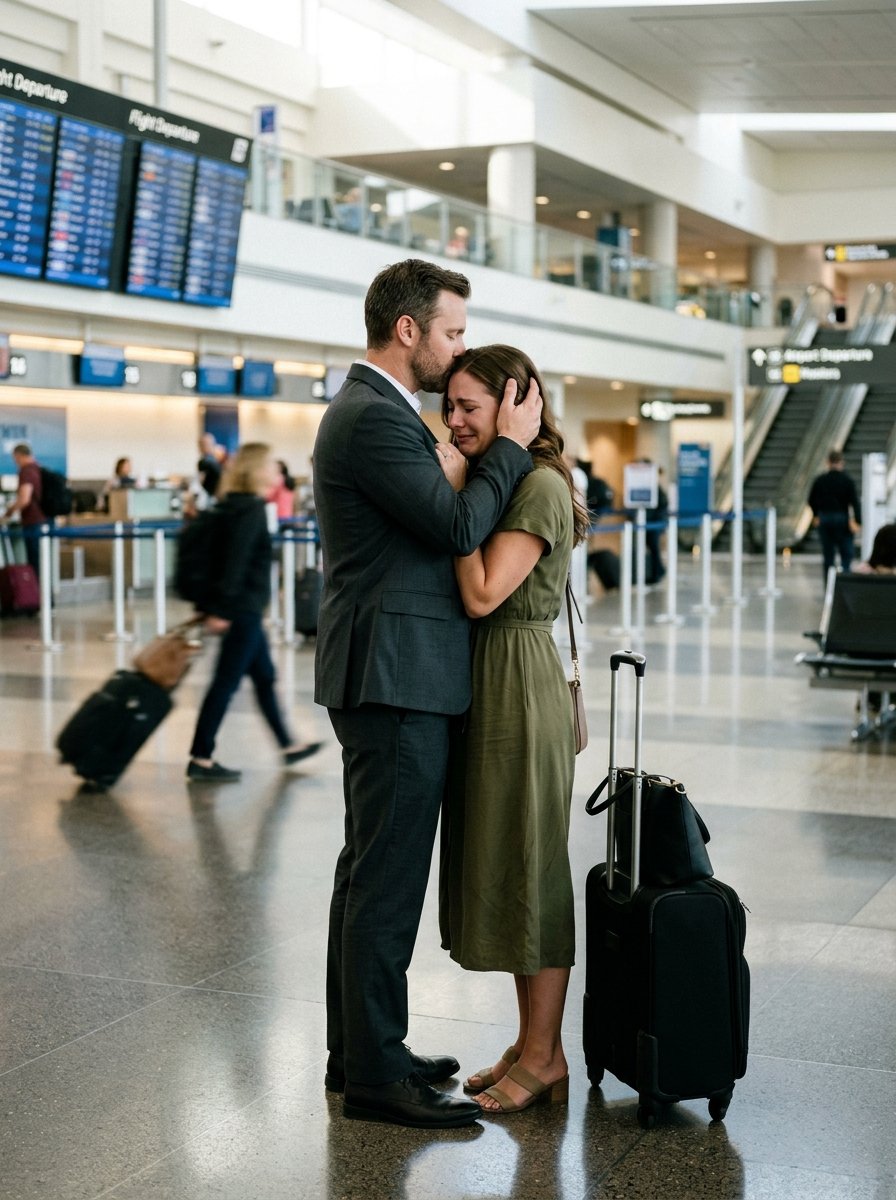
That morning, at Denver International Airport, I’d cried in my husband’s arms as he boarded what he said was a two-year work assignment in Zurich.
I’d known he was lying the whole time. I cried anyway. That was the only part that wasn’t an act.
Three days earlier, on a Saturday, Lucas left his laptop open on the kitchen island when he went for a run.
I wasn’t snooping. I want that on the record. I was looking for the recipe for his mother’s chicken soup, which he kept in a document on his desktop, because I’d promised to make it for our neighbor, whose husband had just had knee surgery.
The laptop woke up. His email was open.
At the top of the inbox was a message from a property management company in Palm Springs, California. The subject line read: Lease Confirmation — Unit 4B, Desert Vista Residences.
The lease was for a two-bedroom condominium. Twelve months, starting July 1st. $4,200 a month. The occupants were listed as Lucas Everett and Melanie Harper.
I knew that name. Melanie was a commercial interior designer Lucas had worked with on a hotel renovation project the year before. She was blonde and pretty, and she’d laughed at his jokes at the company holiday party in December. I’d thought nothing of it.
Below the lease was a folder labeled M.
Inside were text messages Lucas had saved, hundreds of them. Then an ultrasound image. A tiny curled shape in a gray cone of static. Across the top, a date from April and the words HARPER, MELANIE — 14 WEEKS.
Then I found the folder labeled ZURICH.
It contained exactly one document: a letter on his company’s letterhead, offering him a two-year assignment at a partner firm in Switzerland. It was beautifully formatted, convincing in every detail.
And it was fake. I knew because I’d met the CEO of his company, Rob Carver, at that same holiday party. In the letter, Rob’s name was spelled Carvar.
I sat at my kitchen island for twenty minutes, staring at the screen. Then I took pictures of everything with my phone, closed the laptop exactly the way I’d found it, and made the chicken soup.
When Lucas came back from his run, sweaty and smiling, he kissed my cheek.
“Smells amazing in here,” he said.
“Your mom’s recipe,” I said.
I’d been married to Lucas Everett for five years. We met at a charity auction for the children’s hospital, where he outbid everyone for a weekend cabin in Breckenridge and then asked me to go with him. He was charming and attentive and funny. He remembered small details. On our third date, he brought me tea from a shop I’d mentioned once, weeks earlier, in passing.
When my father was dying of Alzheimer’s two years ago, Lucas was patient and gentle in a way that felt like shelter. He sat with Dad in the memory care facility on Sunday afternoons, reading him the sports page. He held my hand at the funeral.
My father left me $720,000. It came from the sale of his private security company and his life insurance. Dad had been a detective with the Jefferson County Sheriff’s Office for twenty years, and after he retired, he built a small security consulting business.
After the estate closed, I deposited the money into our joint account at First Western Bank. Lucas suggested it.
“It’s easier to manage in one place,” he’d said. “We’re a team.”
I’d agreed without thinking twice. I trusted him.
Over the next three days, I learned how to be two people.
On the outside, I was the sad, supportive wife helping her husband pack for Switzerland. I folded his sweaters. I bought him a travel neck pillow. I asked questions about Zurich apartments and Swiss banks and whether he’d need a new phone plan.
On the inside, I was doing math.
I called our bank and asked, very casually, how to open a separate account. I opened one at a different bank, Colorado State Bank & Trust, in my name only. I made a list on a legal pad of everything I knew and everything I needed to find out.
I didn’t confront him. I’m not sure why. Maybe I was afraid of what I’d see in his face. Maybe part of me still hoped I’d misunderstood.
At the airport that morning, he held me at the security line and kissed my forehead.
“Two years goes fast,” he said. “I’ll call every day.”
I cried. Real tears. Then I watched him walk through security with his carry-on bag and his new neck pillow, and he didn’t look back.
When I got home, I sat down at my desk, logged into our joint account, and set up the transfer.
Then the phone buzzed.
A few minutes after the second text, my phone rang. Unknown number. I let it ring twice, watching the screen as if it might show me the caller’s face. On the third ring, I answered.
For a moment, nobody spoke.
Then a woman’s voice said, “Anne?”
It was quiet and careful. Maybe my age, maybe a little older.
“Yes.”
“You don’t know me. I know this is frightening.”
A laugh escaped me, sharp and humorless. “You texted me a photo of my house and told me not to touch my own money. Frightening is one word for it.”
“I’m sorry.”
“Who are you?”
“My name is Grace.”
The name meant nothing to me.
“How do you know Lucas?”
“I don’t. Not really.”
“That’s not an answer.”
“No,” she admitted. “It isn’t.”
I stood up, unable to sit still. My study window looked out on the street. The curtains were open. Anyone outside could see me standing there with my phone pressed to my ear and my laptop glowing on the desk.
I walked over and pulled the curtains shut.
Grace heard the rings slide across the rod.
“Good,” she said softly.
My skin prickled. “Are you watching me right now?”
“No.”
“Were you watching me this morning?”
“Yes.”
The honesty was so blunt it silenced me.
“Why?”
“Because I needed to make sure Lucas actually got on the plane.”
“He did,” I said. “To Zurich.”
“To San Diego,” she said. “He has a private car booked from there to Palm Springs. He’ll be there by evening.”
I closed my eyes.
“How do you know that?”
“Because I’ve been following his arrangements for six weeks.” She took a breath. “Anne, my sister is Melanie Harper.”
That name dropped between us like breaking glass.
For a few seconds, I couldn’t speak.
I’d imagined Melanie in fragments: the other woman, the smiling designer from the holiday party, the woman Lucas texted late at night. I hadn’t imagined her having a sister. A family. Someone worried enough about her to sit in a car outside a stranger’s house.
“Is Melanie with him?” I finally asked.
“No.”
That surprised me. “She isn’t?”
“She thinks he’s in Zurich too.”
I sat back down slowly.
“You need to start from the beginning,” I said.
Grace gave a small, tired laugh. “I wish I knew where the beginning was.”
“Try.”
She told me what she knew. Melanie had met Lucas a year earlier on the hotel renovation project. He told her he was separated. When she found out four months ago that he was still married, she cried for two days. Then Lucas told her that I knew the marriage was over, that we were quietly dividing things, and that he didn’t want to upset me publicly before his work transfer.
“He told her I was emotionally fragile,” I said. “Didn’t he?”
Grace’s silence answered for her.
“I’m not defending her,” Grace said. “I’m just telling you what she believed. She was pregnant and scared and in love. And Lucas is very good at making you believe what he needs you to believe.”
“And now?”
“Now she won’t speak to me. Because I told her Lucas was lying.”
While she talked, I reached over and closed the laptop without completing the transfer. The click sounded louder than it should have.
“You didn’t move the money?” Grace asked.
“No.”
“Good.”
“Don’t mistake that for trust.”
“I don’t.” She paused. “Anne, have you checked your safe today?”
My eyes went to the hallway. We kept a fireproof safe bolted to the floor in the back of the coat closet: passports, insurance policies, the deed to the house, our birth certificates, and my father’s estate papers.
“Why?”
“Lucas came to your house yesterday afternoon while you were at the dentist. I was parked outside. He left with a folder. Blue. Legal size.”
I didn’t say goodbye. I set the phone on speaker, walked to the hallway, and opened the coat closet. The door stuck the way it always does in dry weather. I pushed aside the winter jackets and crouched in front of the safe.
I punched in the code. My birthday. Lucas had always said it was too obvious. I’d joked that burglars didn’t know my birthday. He’d smiled and said, “I do.”
The safe clicked open.
At first, everything looked normal. Passports. The house deed. Insurance files. A small velvet box with my mother’s pearl earrings.
Then I saw the gap.
The blue legal folder was gone.
It held my father’s estate documents: copies of his will, the trust paperwork, the probate court’s final order, and the bank records showing the inheritance came to me alone, as my separate property, two years after Lucas and I were married.
“He took it,” I said.
On the speaker, Grace let out a slow breath.
“Then he’s further along than I thought,” she said. “Anne, I think he’s planning to argue that your inheritance is marital property. That half of it belongs to him.”
I sank back on my heels on the closet floor.
“That won’t work,” I said, though I wasn’t sure.
“Maybe not. But you put it in a joint account, didn’t you?”
I closed my eyes.
“Yes.”
“Then he has an argument,” Grace said quietly. “And without your father’s papers, it’s harder for you to prove where the money came from.”
“Why are you doing this?” I asked her. “Why help me?”
“Because Lucas told Melanie you were greedy. Cold. Difficult. He said you’d destroy him financially just to punish him.” Her voice cracked slightly. “And that’s almost exactly what my ex-husband used to say about me. I know the difference between a complicated marriage and a story designed to make one person look unreasonable. Lucas’s story was too clean.”
I sat on the closet floor with my knees tucked under me.
“What do you want from me?”
“I’ll email you everything I have. Flight details, the condo lease, screenshots Melanie showed me before she cut me off. And Anne?”
“What?”
“Check your joint account again. I think he scheduled something.”
I ran back to the study and logged in again. My fingers were less steady now.
For one merciful second, the balance still read $720,000.00. Then I clicked on account activity.
Pending wire transfer: $350,000.00. Scheduled for processing at 5:00 p.m. Recipient: Desert Horizon Property Holdings LLC.
My ears began to ring. I looked at the clock on the wall.
3:42 p.m.
I called the bank. The hold music felt endless: cheerful piano music playing while my marriage collapsed in scheduled transactions.
When a representative finally answered, I explained as calmly as I could that I needed to stop a pending wire from a joint account. She verified my identity: my mother’s maiden name, the last four digits of my Social Security number, my security phrase.
Then a long silence while she looked.
“I do see the scheduled wire,” she said. “Because this is a joint account, either account holder can initiate transactions. But since it hasn’t processed yet, I can place a temporary hold for fraud review. To do that, I need to ask whether you believe the other account holder is acting fraudulently.”
I looked at the wedding photo on my desk. Lucas in a navy suit, me in ivory lace, his hand at my waist, both of us smiling as if the future were something we’d agreed on.
“Yes,” I said. “I do.”
The word felt heavier than I expected.
Her tone became softer but more formal. She explained that the account would be restricted, with no outgoing transfers without additional verification from both account holders. She strongly advised me to talk to an attorney right away. She gave me a case number and repeated it twice.
I wrote it on the back of an old grocery receipt: FR-2291-0473.
Ten minutes later, Lucas texted.
Boarding went smoothly. Miss you already. Don’t forget to eat something, okay? Love you.
There were so many things I could have written. Where are you really? Who is Melanie? Why did you take my father’s papers?
Instead, I typed: Miss you too. Safe flight.
Then I set the phone face down. It felt less like deception than self-defense.
Grace’s email arrived twenty minutes later. The subject line read: Documents. No greeting, just attachments.
There were screenshots of messages between Lucas and Melanie.
My marriage has been over for years.
Anne understands but she can’t let go.
Once Zurich is settled, everything will be easier.
Two years and we’ll be free.
That last line kept appearing. Two years and we’ll be free. I’d assumed he picked two years because it sounded believable for a work assignment. But it appeared in his messages to Melanie again and again.
Free from what?
The next attachment was a copy of the Palm Springs condo lease, with an extra page I hadn’t seen. Emergency contact: Grace Harper. Grace’s name had been crossed out by hand, and next to it, in Lucas’s handwriting, was another name.
Daniel Voss.
The next attachment was a photo of a business card. Daniel Voss, Private Wealth Strategy Consultant, Voss Meridian Advisory, with an address in San Diego.
The last attachment was a photograph of a handwritten note on yellow paper, a little blurry, as if snapped in a hurry.
L — Do not let A. move funds before the paperwork is filed. Once the account is classified as marital, timeline holds. D.V. says it has to look voluntary. Zurich story buys time. M. must stay calm. No direct conflict until documents are secured.
L. Lucas. A. Anne. M. Melanie. D.V. Daniel Voss.
My anger hardened into something steadier.
Lucas wasn’t improvising. Someone was advising him.
I called the only person I trusted with legal matters: my father’s old attorney, Miriam Kell.
Miriam was seventy-one and sharp-eyed. She’d handled Dad’s estate and his business for twenty years. She once told me that most disasters become less frightening once you sort them into folders. When I was a little girl, she used to visit our house with thick files under one arm and lemon drops in her purse.
She answered on the fourth ring. “Anne. It’s been a while.”
At the sound of her voice, my composure nearly broke.
“Miriam, I need help.”
The warmth vanished from her voice, replaced by focus. “Are you safe?”
“Yes.”
“Good. Start there.”
So I did. Not with the humiliation, or the airport, or the way Lucas had kissed my forehead while planning to empty our life behind my back. I gave her facts. Zurich. Palm Springs. Melanie. The pregnancy. The joint account. The missing folder. The $350,000 wire to Desert Horizon. Daniel Voss.
Miriam listened without interrupting, except to ask for dates, names, and amounts.
When I finished, she said, “Do not move the full balance today.”
“I almost did.”
“I understand why. But if you empty a joint account the same day your husband leaves, his lawyer will say you acted out of spite and you’ll look like the one who grabbed the money. We’re going to be precise instead. Under Colorado law, property you inherit is your separate property, even during a marriage. The problem is that you put it in a joint account, and his lawyer will argue that you turned it into marital property. Our job is to prove where every dollar came from.”
“But the folder from Dad’s estate is gone.”
“I have copies,” Miriam said. “Of everything. The will, the trust, the probate court’s final order, the wire records from the estate account into your bank.”
Relief hit me so hard I had to hold onto the desk.
“You do?”
“Of course I do. Your father was a cautious man.” She paused. “Anne, I need to ask you something delicate. Has Lucas asked you to sign anything recently? Anything he said was routine?”
I frowned. “Last month he asked me to sign some updated tax documents. He said our accountant needed them. I didn’t really read them.”
Miriam was silent for a moment.
“Then that’s our first priority,” she said. “Come to my office at eight tomorrow morning. Bring your phone and everything Grace sent you. Don’t delete anything. And Anne, don’t tell Lucas you know.”
That evening, I went upstairs.
In our bedroom, Lucas had left his side almost bare. His closet was half empty, his dresser drawers pulled clean. But his shaving cream was still by the bathroom sink. A mystery novel was still on his nightstand, half read. His old running shoes were still by the back door.
He’d left just enough behind to make the lie believable. Enough to suggest he’d be coming back. Not enough to inconvenience himself.
I sat on the edge of the bed. Not all of it could have been false, could it? There had been Sunday mornings making pancakes. Snowstorms in front of the fireplace. The night my father died, when Lucas held me while I shook so hard I could barely breathe.
Were those lies too?
My phone rang. LUCAS.
I let it ring once, twice, then answered.
“Hey, sweetheart.”
His voice was smooth and warm and familiar. I closed my eyes.
“Where are you?”
“Still in transit. Long day.”
Technically not a lie.
“I’ve been crying,” I said. That part was true.
“Oh, Anne.” His voice softened. “Please don’t do this to yourself.”
Do this to yourself. Not grieve, not miss me. Do this to yourself. The phrasing landed with a small, precise sting.
“Also,” he said lightly, “I meant to mention, there might be a big transfer out of the joint account. It’s for the Zurich relocation. Housing and tax setup. International stuff. I didn’t want to burden you.”
My eyes opened. “How big?”
“I’m not sure. A few hundred thousand, maybe. But it’s temporary. The company reimburses it.”
“Lucas, that sounds like something we should discuss.”
“We did discuss it. Remember? Last week?”
“No,” I said carefully. “I don’t remember discussing several hundred thousand dollars.”
There was a silence. It lasted only a second, but I heard something change in him.
“Anne,” he said, patient now, “we talked about it. Maybe you were overwhelmed.”
There it was. Gentleness turning into correction. My memory becoming something he could negotiate.
“Maybe,” I said.
“And you signed the authorization forms. The accountant has copies.”
“Can you send them to me?”
A faint laugh. “Right now? I’m traveling.”
“When you can.”
“Of course.” A pause. “Is something wrong?”
I looked at my reflection in the dark bedroom window. A pale woman learning, in real time, how not to give herself away.
“No,” I said. “I’m just tired.”
“Get some sleep. I love you.”
I forced the words out. “I love you too.”
When the call ended, I didn’t cry. I opened the notes app on my phone and typed out everything he’d said, word for word, with the time. Then I emailed it to myself and to Miriam.
At 7:30, Grace texted.
Melanie is missing.
I was standing in the kitchen holding a bowl of soup I’d microwaved and couldn’t eat.
What do you mean, missing?
She left her apartment this afternoon. Phone off. Car gone. Her neighbor saw her with a suitcase. She sent me one text at 2:11.
Grace sent a screenshot.
Melanie: You were right. I found something. I need to think.
Grace: Where are you? What did you find?
Melanie: Don’t call Lucas.
Melanie: Ask Anne about Laurel House.
I stared at those last words.
Laurel House.
The name meant nothing to me. And yet something stirred at the edge of my memory, like music heard through a wall.
What is Laurel House? I typed.
I was hoping you’d know.
I sat at the kitchen table and searched. My email: nothing. My old texts from Lucas: nothing. Then our shared cloud storage, where we kept photos, tax returns, and travel documents.
For several minutes, only unrelated files came up. Then one result appeared: an image file with no title except a date, eight years earlier, three years before I met Lucas.
I opened it.
It was a scanned photograph, old and slightly faded. A large white farmhouse with green shutters and a wraparound porch, set back from a gravel road lined with laurel hedges. Someone had written on the photo’s white border in blue ink: Laurel House, May 1998.
Four people stood on the porch. A woman in her late thirties with long dark hair. A heavyset man with a mustache. A teenage boy with sandy hair and his hands in his pockets. And a little girl in a yellow dress, clutching a stuffed rabbit.
I enlarged the photo.
The boy was young, but there was no mistaking him.
Lucas.
My fingers went cold. Why was this in our files? Why had Lucas never mentioned Laurel House?
I sent the image to Grace. Her reply came a minute later.
Anne. The girl in the yellow dress is Melanie.
Then my phone rang.
“Where did you get this?” Grace demanded. Her voice was shaking badly.
“Our shared cloud storage.”
“That’s my mother,” Grace said. “Caroline. And my stepfather, Peter. And my sister. And that boy…” She stopped. “That’s Luke. Peter’s nephew. He lived with us for two years after his parents died. I was nine. I barely remember him. He was just a quiet older boy who stayed in the basement.”
“Lucas lived with your family?”
“His last name was Brandt then. Luke Brandt.” Grace’s voice was barely a whisper. “Anne, Laurel House was our home. Outside Evergreen, in the mountains west of Denver. We sold it after my mother disappeared.”
“Disappeared?”
“In June 1998. A month after that picture was taken. She went out one night and never came back. The sheriff’s office investigated. They said she probably had a breakdown and left on her own. Peter said she’d been depressed. Melanie and I were sent to live with my grandmother in Fort Collins. Luke went into foster care somewhere. We never saw him again.”
“And your mother?”
“They never found her,” Grace said. “Never. Not a trace.”
I gripped the edge of the kitchen table.
“Lucas told Melanie he met her for the first time last year,” I said slowly. “At a work project.”
“Melanie was six when Mom disappeared,” Grace said. “She wouldn’t remember him. And he changed his last name.” Her voice broke. “He found her, Anne. He went looking for her. On purpose.”
“Why?”
“I don’t know.” I could hear her crying now. “But Melanie found something. And now she’s gone.”
That was when the doorbell rang.
Pages:
The sound tore through the quiet house. I stood up so fast my chair scraped the floor.
“Someone’s here,” I whispered into the phone.
“Don’t open it,” Grace said.
I walked into the front hall. Through the narrow window beside the door, I saw a padded envelope leaning against the doormat. No person. No car in the street.
My name was written across the front in black marker: ANNE EVERETT.
“There’s a package,” I said.
“Leave it.”
But I was already unlocking the door. The porch was empty. The street was quiet. The air smelled of rain and cut grass. I grabbed the envelope and shut the door fast.
Inside was a single old brass house key and a folded piece of lined paper. The handwriting was blocky and unfamiliar.
Your husband did not choose Melanie by accident. Laurel House is where this began. Ask Miriam what your father knew.
My father.
On the back of the paper was an address in Palm Springs. Not the luxury condo. A different address, on a road called Calle Desierto.
And beneath it, one last line.
Melanie is there. She is not alone.
I called Miriam. She answered on the second ring, though it was after nine.
“Anne? Is everything all right?”
“Miriam, what did my father have to do with Laurel House?”
The line went completely silent. Not the silence of a bad connection. The heavy, suffocating silence of someone whose breath had just been taken.
“Where did you hear that name?” she finally whispered.
“Answer me. Did Dad know Caroline Harper? Did he know Lucas?”
A long, shaking sigh.
“Anne, your father was the lead investigator on Caroline Harper’s disappearance. In 1998. With the Jefferson County Sheriff’s Office.”
My knees nearly gave out. I sat down on the bottom stair.
“He never closed it,” Miriam said quietly. “It was the one case that haunted him for the rest of his career. A thirty-eight-year-old woman vanishes from her home in the mountains and leaves two little girls behind. Her husband said she’d been depressed. But your father never believed she left on her own. And he always believed the teenage nephew knew more than he was saying. Luke Brandt was the last person to see her alive.”
“Then why…” My voice cracked. “Why didn’t Dad stop the wedding? Why did he let Lucas into our lives?”
“Because by the time Lucas started dating you, your father’s Alzheimer’s had already begun,” Miriam said, and her own voice broke. “He was confused. He didn’t recognize him. Lucas had changed his name, and he was seventeen years older. Your father thought he was just a nice young man who loved his daughter.” She paused. “But a few months before he moved into memory care, he had a good day. A clear day. He came to my office with a box. He said, ‘Miriam, I think the man Anne’s dating is Luke Brandt from Laurel House. I can’t prove it, and my brain isn’t working right anymore. Keep this safe. If anything happens to Anne, give it to Ray.’”
“Ray?”
“Ray Holloway. Your father’s old partner at the sheriff’s office. He’s retired now, living in Golden.”
“What was in the box?”
“Your father’s private case notes on the Harper disappearance. Copies of the original file. And a list of places he always wanted to search but never got a warrant for.” Miriam took a breath. “Anne, I gave Ray a copy of that box two years ago, after your father died. He’s been watching Lucas ever since.”
I looked down at the brass key in my hand.
“I think Ray sent me something tonight,” I said.
Ray Holloway called me twenty minutes later. His voice was gravelly and slow, the voice of a man who’d smoked for forty years and quit too late.
“Anne. I’m sorry about the theatrics with the envelope. I couldn’t call you directly. I didn’t know if Lucas had access to your phone.”
“Where did you get this key?”
“The house on Calle Desierto belonged to Peter Harper. Caroline’s husband. He moved to Palm Springs in 2005 and died last year. Lucas is the executor of his estate. Peter left everything to his nephew.” He paused. “I’ve been talking to the property manager down there, a woman named Linda Reyes. She got suspicious when Lucas called her last month and asked her to make sure nobody went into the house before he arrived this summer. Not the cleaners, not the pool man. Nobody. She gave me her spare key.”
“Is Melanie there?”
“Linda drove by an hour ago. Melanie’s car is in the driveway. And so is a black rental SUV from the San Diego airport.”
My blood went cold. “Lucas.”
“Anne, listen to me,” Ray said. “I’ve already called the Palm Springs Police Department. And I’ve called a detective at the sheriff’s office here, Sergeant Elena Ruiz. She runs the cold case unit now. She’s been reopening the Harper file with me for six months. She’s on the phone with Palm Springs right now.”
“I’m going down there.”
“No. You’re not. Let the police handle it.”
“He has Melanie. She’s pregnant. And she found something.”
“Anne…”
“My father spent his whole career trying to find out what happened to Caroline Harper,” I said. “And then Lucas married me. I need to be there, Ray.”
He was quiet for a long moment.
“There’s a 6:10 a.m. flight from Denver to Palm Springs,” he said finally. “I’ll be on it with you. And you stay in the car until the police say otherwise. Promise me.”
“I promise,” I said.
I didn’t sleep that night. I sat at the kitchen table with a pot of coffee, reading every page of Grace’s attachments again.
At 8:00 a.m., our flight landed in Palm Springs. Ray Holloway was sixty-eight, tall and stooped, with a gray buzz cut and a Broncos windbreaker. He hugged me at the gate like he’d known me my whole life.
“You look just like your dad,” he said gruffly. “Same stubborn chin.”
We rented a car. Ray drove. On the way, he took a phone call from Sergeant Ruiz.
“Palm Springs PD is setting up near the house,” he told me when he hung up. “Quietly. They want to make sure Melanie’s safe before they go in.”
The GPS guided us away from the resorts and golf courses and down a narrow, unpaved road lined with fan palms. At the very end sat a low mid-century house, shrouded in overgrown bougainvillea.
Melanie’s white Honda was in the driveway. Beside it, a black SUV.
Ray parked along the dirt shoulder a hundred yards away, behind a stand of oleander.
“We wait,” he said.
Through the open car window, faintly, I heard a woman scream.
I was out of the car before Ray could grab my arm.
“Anne!”
I ran up the gravel drive. Behind me, I heard Ray on his phone, his voice urgent: “Shots of a scream from inside, units go now, go now…”
I reached the front door. I had the brass key in my fist. My hands were shaking so badly I could barely fit it into the lock.
Click.
I pushed the door open.
Inside, the house smelled of dust, old wood, and something burning. Furniture was draped in plastic sheets. Afternoon light came dimly through the sliding glass doors to the patio.
Then I heard voices from a room at the back of the house.
“You don’t understand, Melanie.” Lucas’s voice was low and smooth and dangerously calm. It was the exact tone he used when he was trying to convince me I’d misremembered something. “I did all of this for us. For our baby.”
“You lied to me!” Melanie was sobbing. “You told me your wife was crazy. You told me you never knew my family. But I found the photo of Laurel House in your suitcase, Lucas. And I found my mother’s wedding ring in a box in your closet!”
“Your mother left that ring behind when she abandoned you!”
“She didn’t abandon us!” Melanie screamed. “What did you do to her? What did you do to my mother?”
I stepped into the doorway of a small study.
Melanie sat in a wooden desk chair, her wrists bound to the armrests with zip ties. Her face was streaked with tears. One hand was pressed against her rounded stomach as far as the plastic would let it reach.
Lucas stood beside a metal wastebasket, holding a stack of papers over a small fire burning inside it. My father’s blue legal folder lay open on the desk beside a lighter.
For three seconds, nobody moved.
The shock on Lucas’s face was enormous. The color drained out of him. His smooth, effortless mask shattered into a thousand pieces.
“Anne?” he breathed. He stumbled back a step. “How are you here?”
“Zurich is lovely this time of year,” I said. “Isn’t it?”
His eyes darted toward the window, then to his phone on the desk, then back to me. The master manipulator was finally running out of moves.
“Anne, listen to me,” he said, his voice dropping into that soothing register. “You don’t understand what’s happening here. Melanie is unstable. She came here and she…”
“Stop,” I said.
He stopped.
“You burned my father’s papers,” I said. My voice was shaking, but it was clear. “Do you know what’s funny, Lucas? Those were copies. Miriam Kell has the originals. Ray Holloway has another set. Sergeant Elena Ruiz at the Jefferson County Sheriff’s Office has another. My father made four copies of everything. He was a cautious man.”
Lucas went completely still.
“And the money’s frozen,” I said. “The bank put a fraud hold on your wire to Desert Horizon at 3:51 yesterday afternoon. Daniel Voss isn’t getting a dime of my father’s money. Neither are you.”
From far away came the wail of sirens. Then more, closing in from every direction.
Lucas’s face twisted. For one second, I saw something underneath the charm that I’d never seen in five years of marriage. Something cold and empty and very old.
He lunged toward the desk. Whether he was going for the folder, the lighter, or something in the drawer, I’ll never know.
The front door burst open with a crash.
“POLICE! GET ON THE GROUND! HANDS WHERE I CAN SEE THEM!”
Officers flooded the little study. Two of them took Lucas to the floor before he reached the desk drawer. His face was pressed against the dusty hardwood, his arms twisted behind him. The handcuffs clicked shut.
A female officer pulled me gently back into the hallway. Another knelt beside Melanie and cut the zip ties with a pocketknife. Melanie collapsed forward, sobbing, both hands on her stomach.
“Is the baby okay?” an officer asked her. “Are you hurt?”
“I don’t know,” Melanie gasped. “I don’t know. He wouldn’t let me eat. Since last night.”
Paramedics came in with a stretcher.
As they wheeled Melanie past me in the hallway, she reached out and grabbed my hand.
“You’re Anne,” she whispered.
“Yes.”
“I’m so sorry,” she said, crying. “I’m so sorry. He told me you were a monster. He said you’d take everything and leave him with nothing. I believed him.”
“He told me a lot of things too,” I said.
She held on to my hand until the paramedics had to pry her fingers loose.
Lucas lifted his head from the floor as two officers hauled him to his feet. He stared at me, his face streaked with dust.
“Anne,” he said. His voice cracked. Tears were running down his face. “Anne, please. I can explain.”
I looked at him. My husband. The man who held my hand at my father’s funeral while his own father’s crime sat between us like a buried stone.
I didn’t answer him.
I didn’t give him a single word.
I turned and walked out the front door into the bright desert morning, where Ray Holloway was standing in the driveway with his windbreaker flapping in the hot wind.
He put his arms around me.
“You promised you’d stay in the car,” he said into my hair.
“I know,” I said. “I’m sorry.”
“Your father never stayed in the car either,” Ray said. His voice was thick. “Not once in twenty years.”
The rest of it came out over the following weeks, in police reports, court filings, and long phone calls with Ray and Sergeant Ruiz.
Melanie had flown to Palm Springs the day before, a few hours before Lucas, to surprise him at the condo with news about the baby. When she couldn’t find him at the condo, she drove to Peter’s old house on Calle Desierto. Lucas had mentioned it once, saying it was where he’d keep his things while “settling” his late uncle’s estate.
She let herself in with the code to the garage keypad that Lucas had once given her. In the closet of the back bedroom, in a cardboard box, she found her mother’s wedding ring, an old photo of Laurel House, and a small leather diary.
It was Caroline Harper’s diary from the spring of 1998.
In it, Caroline wrote that she’d discovered her nephew-by-marriage, sixteen-year-old Luke, had been stealing money from her husband’s business. Thousands of dollars from the hardware store Peter owned in Evergreen. Caroline wrote that she planned to confront him and then tell Peter.
The last entry was dated June 11th, 1998.
I’m going to talk to Luke tonight, after the girls are asleep. I’m going to give him a chance to tell Peter himself. He’s just a boy. He lost his parents. Maybe he’ll do the right thing.
She disappeared that night.
Lucas arrived at the house in Palm Springs that evening, found Melanie there with the diary, and panicked. He tied her to the chair. He spent the night trying to decide what to do.
That was why he needed my father’s folder. Dad’s private case notes included a hand-drawn map of the Laurel House property. On it, he’d circled one spot in red pencil: a small patch of ground behind the old woodshed, near the property line, where a neighbor had told him she’d seen fresh digging in June 1998.
Dad had asked for a warrant to search there three times. The district attorney turned him down three times, for lack of probable cause.
Lucas had been looking for that map ever since he learned my father’s name.
That was why he married me.
In September, the Jefferson County Sheriff’s Office got a search warrant for the Laurel House property, based on Caroline’s diary, Dad’s notes, and Melanie’s statement. The current owners, a retired couple from Kansas, gave their full cooperation.
Behind the old woodshed, four feet down, the forensic team found human remains.
Dental records confirmed it was Caroline Harper.
Sergeant Ruiz called me herself that afternoon.
“Your father circled the right spot,” she said quietly. “Twenty-six years ago. He was right the whole time.”
I sat on my kitchen floor and cried until I couldn’t breathe.
Lucas Everett, born Lucas Brandt, was charged in Jefferson County with the first-degree murder of Caroline Harper. In California, he was charged with kidnapping and false imprisonment of Melanie Harper. The Riverside County District Attorney agreed to let Colorado try the murder case first.
Daniel Voss turned out to be a former financial advisor who’d lost his license in California three years earlier for defrauding elderly clients. Lucas had hired him to help hide my money. Desert Horizon Property Holdings was a shell company Voss had set up in Nevada. Voss was arrested in San Diego in October on charges of wire fraud and conspiracy.
The “tax documents” Lucas had me sign last month weren’t tax documents at all. One was a letter, written by Voss, stating that I was voluntarily “gifting” my inheritance to the marriage as joint property. The other was a form adding Lucas as a co-owner of the new account I’d opened at Colorado State Bank & Trust. He must have found the paperwork in my desk.
“Neither of those documents will hold up,” Miriam told me in her office, flipping through them with a red pen. “You signed them because he lied to you about what they were. That’s fraud. A court won’t enforce a gift that was obtained by fraud.” She looked at me over her reading glasses. “And now he’s facing murder and kidnapping charges. I don’t think a judge in Arapahoe County is going to be very sympathetic to his claim on your father’s money.”
She filed for divorce on my behalf in October. She also filed a motion asking the court to declare my inheritance my separate property, attaching every page of my father’s original estate file and the bank’s wire records showing the money moving from Dad’s estate account into the joint account two years ago.
Lucas’s court-appointed attorney didn’t contest it.
In December, the judge signed the final divorce decree. It awarded me the house in Littleton and every cent of my father’s $720,000, which the court found was my separate property, traceable from the day the estate closed. It ordered Lucas’s half of our joint retirement account, about $48,000, frozen to pay my attorney’s fees and any restitution ordered in his criminal cases.
Miriam’s bill came to $31,400. I paid it with a check from my own account.
“Your father would have been proud of you,” she said as she took it.
“I almost clicked that button,” I said. “The first day. I almost moved all of it.”
“But you didn’t,” Miriam said. “You stopped and asked questions. That’s what he would have done.”
I sold the house in Littleton in February. I couldn’t stay there anymore. I couldn’t walk past the coat closet without seeing the gap in the safe.
It sold for $612,000 after three days on the market. After paying off the mortgage and closing costs, I walked away with $284,000.
In March, I bought a townhome in downtown Denver, on the fourth floor, with floor-to-ceiling windows looking out at the mountains. I paid for it in cash, with my own money, and put the deed in my name alone.
I also did something with part of my father’s money that I think he would have liked.
With Miriam’s help, I set up a fund through the Denver Foundation called the Frank Delaney Cold Case Fund, in my father’s name. It gives grants to sheriff’s offices and police departments across Colorado to reopen unsolved missing persons cases: DNA testing, forensic searches, and overtime for detectives who refuse to stop looking.
I put $250,000 into it.
Sergeant Elena Ruiz’s cold case unit received the first grant: $40,000 to reopen two disappearances from the 1990s.
“Your dad used to say every case has someone waiting at home,” Ray Holloway told me at the ceremony where the grant was announced. “For twenty-six years, Caroline’s girls were waiting. Now somebody else’s family might not have to wait as long.”
Melanie Harper had a healthy baby girl on a Tuesday morning in late May, at a hospital in Fort Collins. Seven pounds, three ounces.
Grace texted me a photo from the hospital: a tiny pink face in a striped hospital blanket, with a full head of dark hair.
Her name is Caroline, Grace wrote. After our mom.
I looked at that photo for a long time.
Then I wrote back: She’s perfect. Give them both my love.
Lucas’s trial for Caroline Harper’s murder is scheduled for next spring in Jefferson County District Court. His attorney has asked for a plea deal. The district attorney hasn’t decided yet. Grace and Melanie will both testify. So will Ray Holloway.
And so will I.
In June, I drove up to Evergreen, into the mountains west of Denver, to Laurel House.
The retired couple from Kansas let me walk the property. It was a bright, cool morning, and the laurel hedges along the road were in bloom. The white farmhouse looked almost exactly like the one in the photograph, the paint a little more faded and the shutters a darker green.
Behind the old woodshed, the ground had been filled in and smoothed over. Someone had planted wildflowers there: columbines, blue flax, and Indian paintbrush.
Grace and Melanie were already there when I arrived, standing by the flowers. Melanie held baby Caroline in a sling against her chest. Grace held a bouquet of white roses.
For a moment, the three of us just stood there. The other woman, the sister, and the wife. Three women who’d all believed Lucas’s stories at one time or another.
“Thank you for coming,” Grace said.
“Thank you for texting me,” I said. “If you hadn’t, I’d have moved that money, and he’d have come after it. And I’d never have known why.”
Melanie looked down at her daughter, asleep in the sling.
“He told me once that he loved me because I reminded him of home,” she said quietly. “I thought it was romantic.” Her voice shook. “I didn’t know what home meant to him.”
Grace laid the white roses on the ground among the wildflowers.
“Mom loved this place,” she said. “She used to sit on that porch every morning with coffee and watch the deer come down to the creek. She used to say it was the only place she ever felt safe.”
We stood there for a long time without speaking. A breeze moved through the laurel hedges. Somewhere down by the creek, a bird was singing.
“My father spent his whole life looking for her,” I said finally. “He circled this exact spot on a map in 1998. Nobody would listen to him.”
“I know,” Grace said. “Sergeant Ruiz told us. She said he never gave up.”
“He was right,” Melanie said softly. “He was right the whole time. He just ran out of time to prove it.”
“He didn’t run out,” I said. “He just left it for us to finish.”
Before I left, Melanie unwound the sling and handed me her daughter.
Baby Caroline was warm and heavy and smelled like milk and powder. She opened her eyes, dark and serious, and looked up at me. Then she wrapped her whole tiny hand around my index finger and held on.
I stood in the yard behind Laurel House, holding a baby named after a woman my father spent his career trying to find, and I cried. Not from grief this time.
Something else. Something like peace.
That evening, back in Denver, I stood on the balcony of my townhome with a cup of black coffee and watched the sun go down behind the mountains.
The city below was loud and alive. Traffic hummed on Speer Boulevard. Somebody on a balcony nearby was playing music.
On my kitchen counter behind me sat a framed photograph I’d finally had printed and hung: my father in his Jefferson County Sheriff’s Office uniform in 1997, the year before Caroline Harper disappeared. He’s standing beside his old unmarked Crown Victoria, squinting into the sun, with Ray Holloway grinning beside him.
Beneath it, in a smaller frame, was the hand-drawn map from his case notes. The original. Miriam had given it to me from the box in her safe. A rough pencil sketch of the Laurel House property, with one small circle in red pencil behind the woodshed.
Next to the circle, in my father’s careful, slanting handwriting, he’d written two words.
Keep looking.
For five years, I lived beside a man who didn’t exist. I believed I was loved by someone who had married me to find a map and erase the work of a dead man’s life.
I used to think the worst part of what Lucas did was the lying. The fake letter from Zurich, the pregnant girlfriend, the stolen folder, the scheduled wire.
But standing on that balcony, I understood something different.
He hadn’t broken me. He’d shown me who I was. My father’s daughter. A woman who stops before she clicks. A woman who asks questions. A woman who keeps looking.
My phone buzzed on the balcony railing. It was a text from Grace.
Caroline smiled for the first time today. Melanie says it looked just like Mom’s.
I smiled and wrote back: Tell her Aunt Anne says hello.
Then I picked up my coffee, looked out at the mountains going purple in the last light, and took a long, slow breath.
For the first time in a very long time, I wasn’t afraid of what I might find out next.