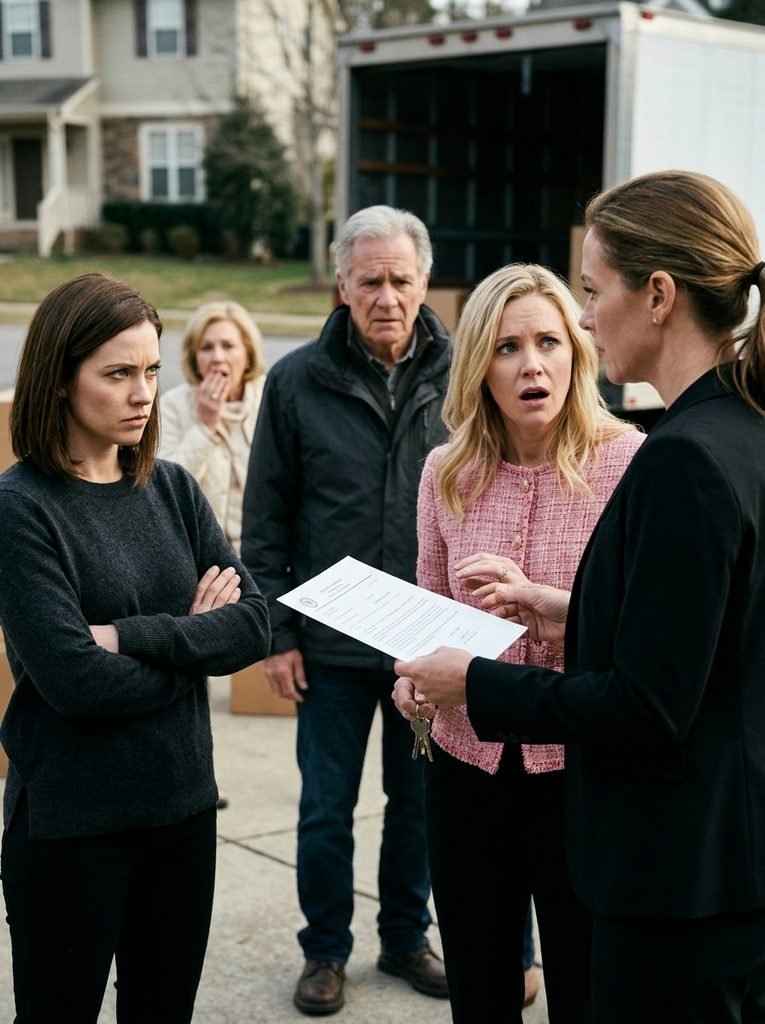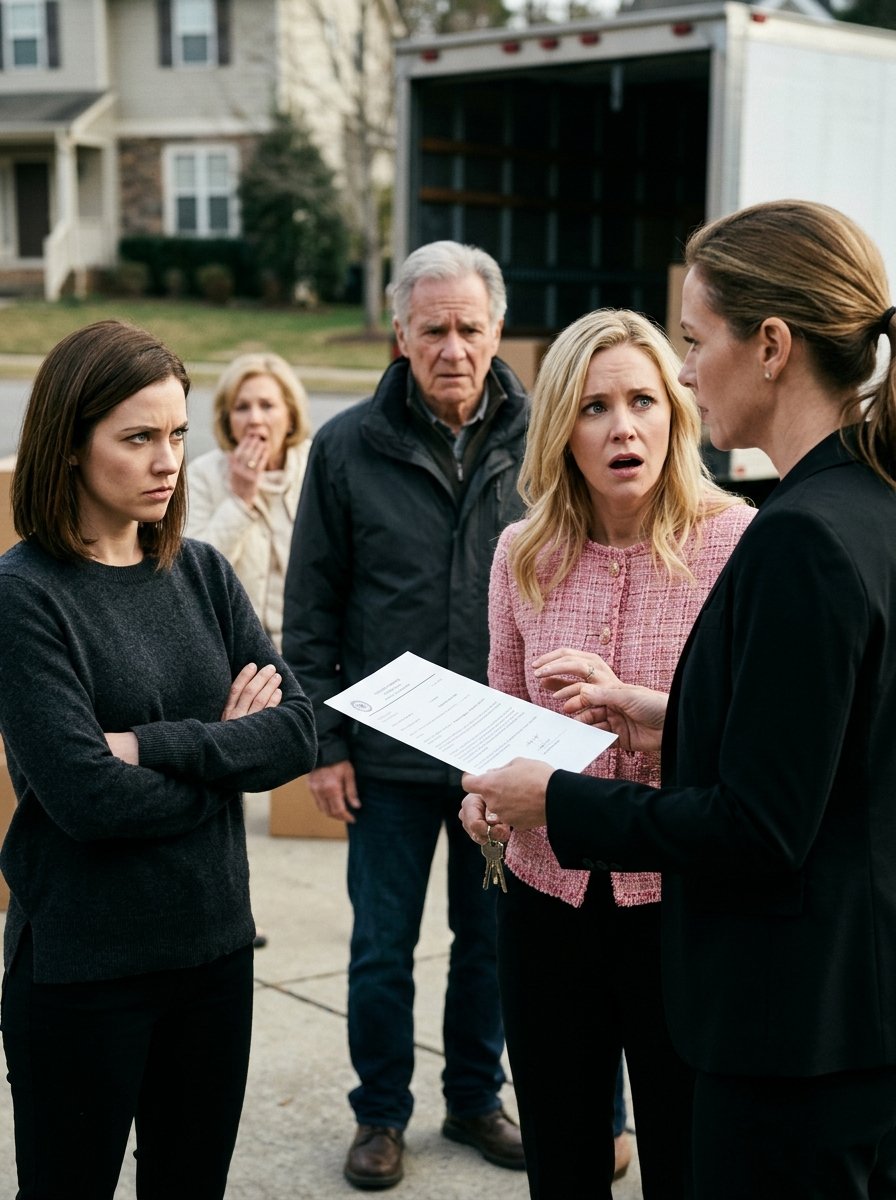
Melissa turned the first page. “The deed transfer you apparently told Alyssa had been completed was never recorded. I confirmed that with the county this morning.”
Mom blinked. Alyssa stared down at the keys. Melissa held up the official county document. “Brooke remains the sole legal owner of this property. The deed is in her name and only her name. Any attempt to enter or remove property without her authorization will be treated accordingly.”
One mover lowered his clipboard. The other stepped away from the dolly. Mom recovered first. “This is a private family matter.”
“No,” Melissa replied. “It became a legal matter when you arrived with a moving truck and keys to property you do not own.”
Then Alyssa spoke. Her voice cracked. “Mom, you told me it was done. You said the house was already mine.”
Something changed in Mom’s face. For the first time, she looked afraid.
Melissa removed another document. “There is also the matter of Brooke’s trust.”
Brooke saw her father’s hand twitch. Melissa saw it too. For decades, he had survived family conflicts by becoming invisible. Never objecting. Never defending. Never taking responsibility. But paperwork had a way of forcing silent people into the light.
Melissa looked directly at him. “Annual reports for Brooke’s trust were mailed to this family beginning when she turned eighteen. We possess copies of every statement, delivery confirmation, beneficiary notice, and the record showing that Brooke transferred the entire balance to a protected account nine days ago.”
Mom’s voice rose. “She was never responsible with money! That’s why we didn’t tell her. She would have wasted it.”
Brooke almost laughed. Never responsible? She remembered dry toast for dinner because payday was two days away. Zachary’s repeated rent rescues. Alyssa’s trips. Alyssa’s jewelry. Alyssa’s mistakes endlessly paid for by Mom and Dad. Brooke had stretched one modest paycheck across impossible distances for years. She had never defaulted. Rarely asked. Always managed.
The accusation was so backwards that it finally clarified everything. It had never been about responsibility. It had been about control.
Melissa continued. “Brooke’s trust is now completely protected. No outside transfer, withdrawal, loan, or interference is authorized. That matter is closed.”
Dad finally looked directly at Brooke. Not dismissively. Not with annoyance. He looked at her like a man realizing, much too late, that the daughter he had underestimated had quietly become someone he could no longer control.
Brooke opened the door. The porch fell silent. She stepped outside. Alyssa still held the keys. Brooke extended her hand.
“Those don’t belong to you.”
Alyssa looked at Mom. For once, Mom gave no instruction. After several seconds, Alyssa placed the keys into Brooke’s palm. The metal felt surprisingly heavy.
Melissa then produced another envelope containing a notarized statement and proof that a formal deed review had already been filed with the county earlier that morning.
Dad read enough to understand. He gripped the porch railing.
“Brooke…”
She waited. She didn’t rescue him from the silence.
Finally, he said, “I didn’t think it would go this far.”
That sentence was worse than denial. Because it was a confession. He had known. He had simply expected Brooke to surrender before anyone had to admit what they were doing.
“You didn’t think I would go this far,” Brooke repeated.
Mom immediately became angry again. “After everything we’ve done for you—”
Brooke looked at her. Just looked. And the sentence died unfinished. There was no definition of “everything” that could survive the documents in Melissa’s folder.
The movers asked whether they should leave.
“Yes,” Melissa said.
Within minutes, the truck pulled away without a single box from Brooke’s house.
Mom watched it go. Alyssa stood on the porch looking suddenly much younger.
“Where am I supposed to live?” she asked.
For most of Brooke’s life, that question would have triggered an automatic response. She would have offered the spare room. The couch. Money. Anything. She had been trained to absorb discomfort so everyone else could remain comfortable.
She felt that old instinct begin. Then, for the first time, she switched it off.
“Ask the people who told you my house was yours.”
Alyssa’s eyes filled with tears. Mom put an arm around her. Dad remained silent.
Melissa handed Brooke copies of the paperwork. Then she said quietly, “You have choices now.”
Choices. That word again.
Brooke looked across her wet driveway. At the crooked mailbox. At the little flag moving in the cold air. At the porch that belonged to her.
She had imagined that victory would feel exciting.
It didn’t.
It felt clean.
Painful, certainly. But clean. Like finally removing something that had been buried beneath the skin for years.
Her parents left. Alyssa went with them. Dad looked back once. Brooke didn’t wave. She watched them disappear. Then she stepped inside her house and locked the door.
The kitchen still smelled faintly of lemon cleaner. Her cold coffee sat on the table. Brooke picked it up. Poured it down the sink. Washed the mug. Dried it. Put it away.
It was the first completely ordinary thing she did after getting her life back.
Over the next several weeks, Melissa handled the remaining legal matters. Brooke handled something else.
Silence.
But for once, it was silence she chose.
Mom called constantly at first. Angry calls. Wounded calls. Eventually almost pleading calls. Brooke answered none.
Zachary suddenly began texting with unusual concern. Was she okay? What had happened? Could they meet?
Brooke recognized the sudden interest for what it was. A man checking whether money he had assumed would someday benefit him had disappeared. He had never shown that much concern when Brooke was struggling.
Alyssa asked twice to come over and talk. Brooke declined.
Eventually, her father mailed a letter. Melissa advised Brooke to open anything sent in writing, just in case.
The letter contained no real apology.
Dad wrote that he was sorry “things had become complicated.” He wished everything had not “gotten so out of hand.” He hoped they could “move past it.”
There was no admission. No moving truck. No forged story about the deed. No seven years of hidden trust statements.
Everything was written as though the situation had simply happened to all of them.
Like bad weather.
Brooke put the letter into the same folder as the evidence.
She finally understood that some families call harm a misunderstanding because naming it honestly would require change. And changing was the one thing they wanted to avoid.
For twenty-five years, Brooke had been trained not to complain. Now she was learning something different.
She didn’t have to explain either.
She didn’t owe them her reasoning. Her forgiveness. Her patience. Or another performance where she made everything easier for everyone except herself.
The trust didn’t magically erase the past.
Money couldn’t return all those sleepless nights. It couldn’t refund the years she had spent frightened about bills. It couldn’t sit beside the younger Brooke counting coins in the laundry room and tell her that everything would someday be okay.
Those years had happened.
She had lived them.
The grief remained.
But the money gave her something she had never truly possessed before.
A locked door she was allowed to lock.
A legal document with her name on it.
A choice that required nobody’s permission.
Ground beneath her feet that her family could no longer pull away.
Months later, spring arrived.
Brooke replaced the weathered flag on the porch. She removed the faded one and put up a new one. Then she stood on the top step holding a cup of coffee.
This time, the coffee stayed hot.
She drank it slowly while the flag moved gently in the afternoon breeze.
Behind her, the house was quiet.
But it wasn’t the quiet she had known as a child. Not the silence of someone trying to stay small. Not the silence of someone waiting to discover what would be demanded next.
This quiet was simply peace.
For the first time in Brooke’s life, silence and peace meant the same thing.
Both belonged to her.
The house belonged to her.
And nobody was coming to take either one away.