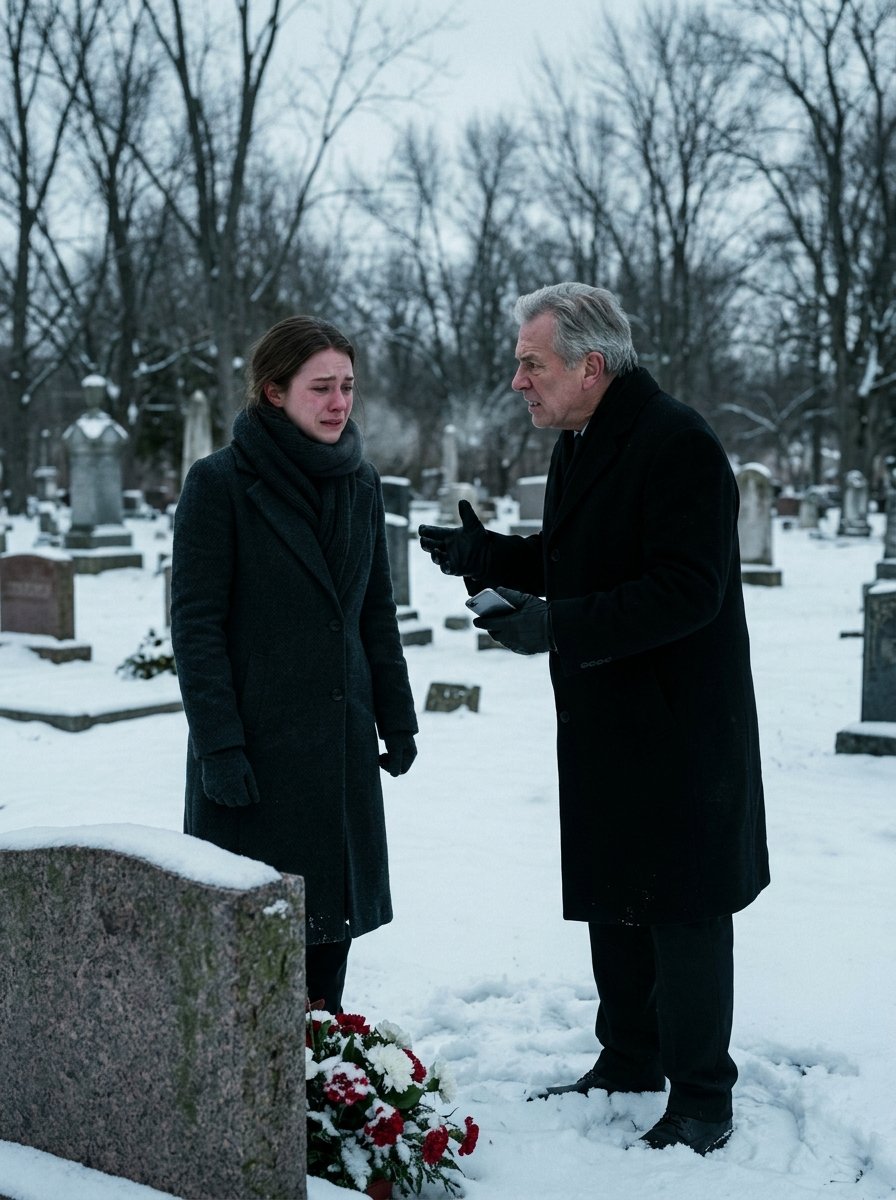
My husband told me my grandfather had cut me off, so I worked at a bakery while pregnant and raised our newborn in a rented duplex.
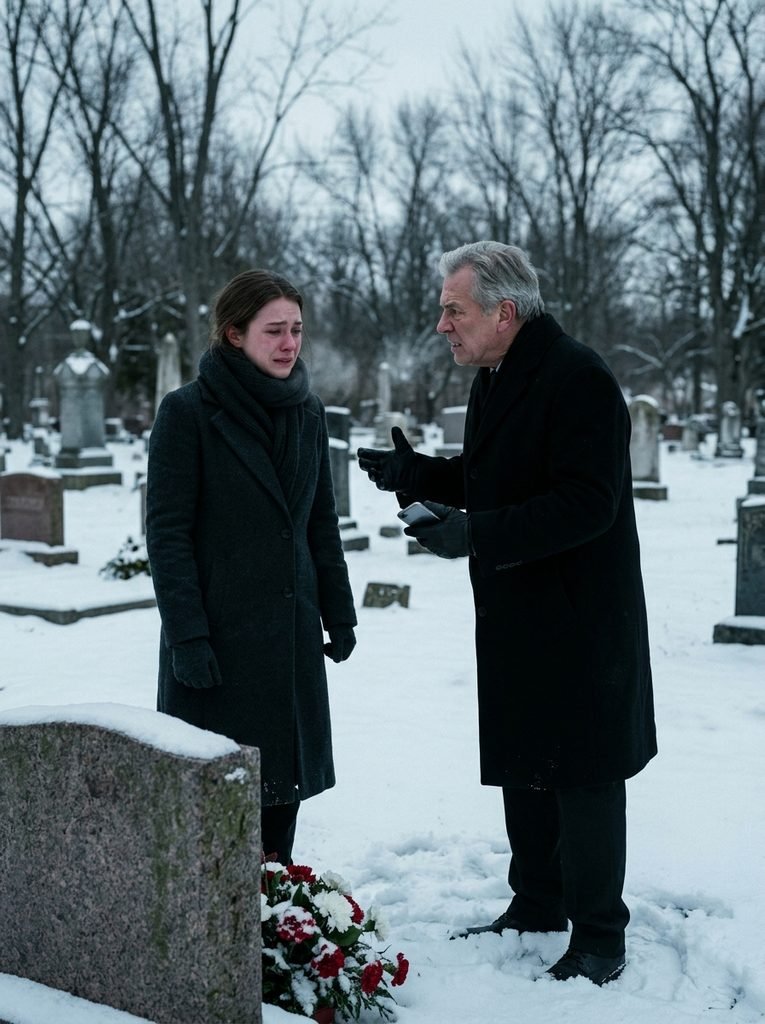
Then, at my grandmother’s grave, Grandpa saw my daughter’s borrowed snowsuit and asked, “Wasn’t $250,000 a month enough?”
I hadn’t received a penny in two years.
When he called his attorney, I remembered four pages my husband had made me sign at our kitchen table…
My grandfather was standing beside my grandmother’s grave with a bucket of yellow chrysanthemums when he asked me a question that made my entire marriage feel like a lie.
“Claire, wasn’t two hundred and fifty thousand dollars a month enough?”
I was holding the handle of my daughter’s stroller.
My little girl was five weeks old, sleeping in a secondhand blue snowsuit that my boss at the bakery had given me because I couldn’t afford a new one.
I was wearing my grandmother’s old gray wool coat.
The cuffs were frayed, the lining was worn thin, and one button had been replaced with another that didn’t quite match.
My grandfather, Walter Ashworth, was eighty-one years old.
He stood there in a beautiful cashmere overcoat, looking from my clothes to the stroller and back to my face.
I thought he was accusing me of wasting money.
He thought I had been receiving $250,000 every single month for the past three years.
Neither of us understood what the other was saying.
“Grandpa,” I whispered, “I haven’t received a single dollar from that trust in two years.”
His expression changed.
“What?”
“Derek told me you stopped the payments.”
My grandfather slowly lowered the flowers.
“I never stopped anything.”
For several seconds, all I could hear was the groundskeeper raking leaves a few rows away.
Then Grandpa took his phone from his pocket.
“Nora,” he said when someone answered.
“It’s Walter.
I need you at the house in an hour.
Bring Tom.”
He listened briefly.
“Yes.
It’s about Claire.”
And just like that, I knew something was terribly wrong.
Because two years earlier, my husband had placed four pages in front of me at our kitchen table and told me they were routine estate documents.
I had signed them without reading every line.
I remembered the date.
February third.
I remembered the pen.
And I remembered how Derek had smiled when he collected the papers.
To understand why I trusted him, you need to understand the family I came from.
My name is Claire Ashworth Vance.
I grew up in Minnesota, and for most of my childhood, I had the kind of financial security that people assume makes life easy.
My grandfather owned a successful lumber business.
His name opened doors, and his money paid for things most families had to save years to afford.
But money didn’t protect me from losing my parents.
I was nine years old when they died in an accident on Interstate 94 during a January ice storm.
One day, I was a little girl with a mother and father.
The next, I was living in my grandparents’ enormous house in Wayzata, trying to understand why everyone kept telling me to be brave.
My grandfather handled the practical things.
He arranged the funeral, dealt with the lawyers, and made sure I had everything I needed.
My grandmother handled me.
Her name was Ruth.
She was the sort of woman who could tell something was wrong just by watching how you buttered your toast.
The night after my parents’ funeral, I couldn’t sleep.
I remember lying in my childhood bed, staring at the ceiling, afraid that if I closed my eyes, something else terrible would happen.
Around three in the morning, Grandma came into my room.
She didn’t tell me everything would be all right.
She didn’t promise that I would stop missing my parents.
She simply held out her hand.
“Come downstairs, sweetheart.”
In the kitchen, she turned on the oven.
“We’re going to make banana bread.”
I told her I wasn’t hungry.
“That’s all right.
We can make it anyway.”
She brought out flour, eggs, bananas, and her old recipe book.
Then she said something I never forgot.
“Hands first, head later.”
That became our little saying.
Whenever I was worried, angry, or overwhelmed, Grandma would find something for us to make.
Sometimes it was bread.
Sometimes cookies.
Sometimes a pie that neither of us particularly wanted to eat.
She believed there was comfort in doing something ordinary when life felt impossible.
She also had a habit of writing dates inside her recipe book.
Birthdays, family visits, small arguments, happy surprises.
Anything she thought was worth remembering.
Eventually, I started doing the same.
My grandfather loved me, too, but he showed it differently.
He paid for my education, bought me a car when I was old enough to drive, and sent me to France one summer.
Whenever I thanked him, he would say, “You don’t have to ask, Claire.
That’s what family is for.”
He meant well.
But he rarely asked what I was feeling.
He understood invoices, contracts, and investments better than tears.
For years, I thought that was simply how men in our family loved people.
They provided.
They protected.
They made decisions.
And the rest of us trusted them.
By the time I was sixteen, I had begun to understand that being an Ashworth came with problems nobody talked about.
I dated a boy from school for four months.
I thought he liked me because we laughed at the same jokes and enjoyed spending time together.
Then one afternoon, I came around the corner near the gym and heard him talking to a friend.
“She’s an Ashworth, man.
Marry into that family and you’re set.”
I stood there with my books against my chest.
He hadn’t seen me.
I went home and cried.
Then I broke up with him.
I never told my grandparents what he’d said.
Instead, I opened Grandma’s recipe book to the cinnamon roll recipe and wrote one sentence beneath it.
“October second.
Found out.”
After that, I became suspicious of anyone who seemed impressed by my last name.
I noticed how people reacted when they heard it.
Some became unusually friendly.
Others immediately asked about my grandfather’s business.
A few made jokes about marrying rich.
I learned to smile politely while keeping my distance.
Grandma understood without my having to explain.
She never told me that money was bad.
She told me that money made some people forget to look at the person standing behind it.
When I was twenty-one, she became seriously ill.
During her final month, she called me into her bedroom and handed me her gray wool coat.
It was old-fashioned, heavy, and not particularly attractive.
I laughed when she held it up.
“Grandma, you know this is ugly.”
She smiled.
“It’s warm.
It’s ugly.
And nobody will ever want it for the money.”
I laughed again.
She didn’t.
“Keep it, Claire.”
She died that March.
I was twenty-two.
Grandpa brought yellow chrysanthemums to her grave because she had always disliked roses.
He kept bringing them every year.
Even after we stopped speaking.
Four years after Grandma died, I met Derek Vance.
I was twenty-six and working in baking and pastry.
I had studied the craft seriously because I loved it, not because I needed a career to survive.
There was something satisfying about taking flour, butter, and patience and turning them into something people enjoyed.
I had been hired to provide desserts for a charity fundraiser in Minneapolis.
Derek was helping at the donation table.
He was thirty-three, a certified public accountant with a small consulting firm.
He wasn’t flashy.
He didn’t wear expensive watches or talk about impressive vacations.
When someone asked who I was, he introduced me by saying, “This is Claire.
She made those pear tarts.”
He didn’t mention Ashworth.
Not once.
I remember feeling almost embarrassingly grateful.
He asked about my baking.
He wanted to know how I learned to make pastry.
He listened when I talked about my grandmother.
And when he finally learned about my family, he didn’t seem impressed.
“That’s your grandfather’s life,” he told me.
“I’m interested in yours.”
I fell in love with that sentence.
Derek was calm, organized, and patient.
He never seemed hurried.
If we disagreed about something, he lowered his voice instead of raising it.
He remembered small details.
He knew how I liked my coffee.
He noticed when I was tired.
He asked about Grandma’s recipes.
For the first time, I felt that someone saw me without seeing my family’s money first.
Six months into our relationship, I brought him to dinner at Grandpa’s house in Wayzata.
I was nervous.
Grandpa had never been especially welcoming to men I dated.
He was polite, but he had a way of asking questions that made dinner feel like a business interview.
That evening was no different.
He asked Derek about his consulting firm.
How much revenue did it generate?
How many clients did he have?
How much debt was he carrying?
Derek answered every question smoothly.
After dinner, while I was helping dry dishes, Grandpa said something that made me furious.
“He answers like a man who’s practiced.”
I turned toward him.
“What is that supposed to mean?”
“Just an observation.”
“No, Grandpa.
You always do this.”
He put down the dish towel.
“Do what?”
“Treat everyone like they’re applying for a loan.”
He looked surprised.
I continued before I could stop myself.
“You’ve never once asked whether somebody loves me.
You only ask what they’re worth.”
Grandpa didn’t answer.
I took his silence as proof that I was right.
Looking back, I think we were both carrying old fears.
He was afraid someone would use me.
I was afraid he would never believe anyone could love me for myself.
Derek understood that tension better than either of us realized.
We married the following June in the garden behind Grandpa’s house.
It was a beautiful wedding.
Grandma’s yellow flowers were everywhere.
I wore a simple dress, and Derek cried when he saw me walking toward him.
I believed every tear.
At the reception, Grandpa handed us a plain white envelope.
Inside wasn’t a check.
It was a one-page summary of a trust established in my name.
The trust would distribute $250,000 every month.
I stared at the paper.
“Grandpa, this is too much.”
He shook his head.
“It’s so you never have to ask anyone’s permission to live.”
Then he added, “Not even mine.”
He explained that Northstar, a professional trust company, would handle the distributions.
He wouldn’t review my statements or monitor my spending.
He wanted me to have independence.
Derek stood beside me reading the page.
His expression barely changed.
“That’s very generous, sir,” he said.
“We’ll be careful with it.”
That night, in our hotel room, Derek told me we should put the money into our joint account and let it accumulate.
“We don’t need to live like wealthy people,” he said.
“We can build something of our own.”
I loved him even more for that.
I thought he was protecting me from the very thing I’d always feared.
For the first year, the money arrived.
I didn’t monitor it closely.
That sounds foolish now, and perhaps it was.
But Derek was an accountant.
He handled financial matters professionally every day.
I trusted him.
We bought a house in Edina.
He handled the closing documents, insurance, bank accounts, and taxes.
Whenever I tried to help, he’d smile.
“You bake.
Let me handle the paperwork.”
It became a joke between us.
My profession was butter.
His was paper.
I liked having separate strengths.
I liked feeling that our marriage was a partnership.
Then came February third.
Derek placed four pages on our kitchen table.
He said Northstar wanted the distributions routed through a dedicated account for tax and estate-planning reasons.
“It’s cleaner this way.”
I asked why Nora, Grandpa’s attorney, hadn’t contacted me.
“She contacted me,” he said.
“I’m the one handling this.”
He showed me where to sign.
Three signatures.
One page mentioned an authorized signer.
I pointed to it.
“What’s that?”
“Just lets me transfer the money into our joint account when it arrives.”
I signed.
He collected the pages, straightened their edges, and placed them in a blue folder.
That evening, I opened Grandma’s recipe book and wrote:
“February third.
Signed Derek’s estate papers.
Kitchen table.”
I didn’t know those four pages would eventually become the most important documents in my marriage.
Three months later, Derek came home looking pale.
He said Grandpa had called his office.
According to Derek, my grandfather was furious that I hadn’t attended his birthday gathering.
Derek told me Grandpa had decided to freeze the trust distributions until I apologized for marrying him.
I was stunned.
“Grandpa said that?”
Derek nodded.
“He thinks I’m taking you away from him.”
I remembered Grandpa’s words at our wedding.
“I’ll be watching.”
And I believed Derek.
I didn’t call my grandfather.
I was angry.
I thought he was trying to control me through money.
Derek said we could manage without the trust.
“We’ll be fine,” he promised.
At first, we were.
Then he began talking about problems with his consulting firm.
Clients were delaying payments.
Contracts weren’t being renewed.
Cash flow was tight.
By August, he said we needed to sell our Edina house.
I cried when we packed.
It was our first home.
I had imagined raising children there.
But Derek assured me the sale was temporary.
“We’re making a practical decision,” he said.
“That’s what responsible adults do.”
We moved into the upstairs unit of a duplex in Columbia Heights.
I found work at Brightwater Bakery on Central Avenue.
The owner, Marisol, hired me after tasting a croissant I’d made.
She didn’t care about my last name.
She cared whether I could laminate dough properly and show up on time.
I started working early mornings.
Sometimes I left the duplex before four.
In winter, I rode the bus in the dark.
Derek kept saying his business would recover.
He drove to Brainerd twice a month to meet investors.
He worked behind a locked office door.
He had a laptop I wasn’t allowed to use because it contained confidential client information.
He collected the mail.
He paid the bills.
Every Sunday, he transferred $300 to my debit card for groceries, transportation, and household necessities.
He called it our temporary cash-flow budget.
I believed him.
I learned to stretch that money.
I compared grocery prices.
I bought clothes secondhand.
I stopped getting my hair cut professionally.
I knew exactly how much butter cost by the pound.
But I couldn’t have told you the account number of a single bank account in my name.
Whenever I considered calling Grandpa, Derek discouraged me.
“You’d only be proving him right.”
He said it gently.
That made it harder to argue.
I didn’t want Grandpa believing I couldn’t survive without his money.
So I stayed silent.
And Grandpa stayed silent, too.
I told myself we were two stubborn people waiting for the other to apologize.
I didn’t realize there was a third person standing between us, controlling what each of us heard.
When I became pregnant, I hoped things would improve.
Derek seemed pleased.
He talked about being a father.
He said the consulting business was close to securing a major contract.
I wanted to believe him.
But as my pregnancy progressed, the money never improved.
I continued working at the bakery.
By thirty-eight weeks, my back hurt so badly that I sometimes leaned against the stainless-steel worktable while folding pastry dough.
One morning, Marisol watched me struggling.
She brought over a stool.
“Sit down.”
“I’m fine.”
“Claire, I didn’t ask.”
Then she placed a cardboard box beside me.
Inside was a washed blue baby snowsuit.
“My son’s,” she said.
“He outgrew it years ago.”
I touched the soft fabric.
“Marisol, I can’t—”
“There’s a crib in my car, too.”
I stared at her.
She folded her arms.
“Don’t say no.
Say thank you.”
I sat down and cried.
She waited until I’d finished.
Then she asked a question nobody else had dared ask.
“Your husband’s an accountant, right?”
“Yes.”
“So where’s his money?”
I gave her the explanation I’d been repeating for months.
Cash flow.
Contracts.
A difficult period for the firm.
Marisol listened.
Then she asked, “Have you ever seen a bank statement?”
I didn’t answer.
She didn’t push.
But I remembered the question.
My daughter arrived three days early.
We named her Ruth.
Ruth Ashworth Vance.
Ruthie for short.
Derek was in Brainerd when I went into labor.
He reached the hospital six hours after she was born, carrying grocery-store carnations.
He said a client had needed him.
I was exhausted, but I was so happy holding my baby that I didn’t want to argue.
Then he saw the birth certificate form.
“Why did you put Ashworth in her name?”
I looked at him.
“Because it’s mine.”
His jaw tightened.
For a moment, I saw an expression I didn’t recognize.
Then he smiled and put his arms around me.
“You’re right.
You’re exhausted.
It’s a beautiful name.”
He kissed my forehead.
Then he whispered, “Your grandfather doesn’t know about her, right?”
“No.”
“Let’s keep it that way until things settle.”
I watched him straighten the blanket in Ruthie’s bassinet.
Then he adjusted the carnations.
Then he adjusted the blanket again.
I didn’t know what to make of it.
But that night, I wrote something different in Grandma’s recipe book.
Instead of recording what Derek had said, I wrote down what he had done.
Five weeks later, I took Ruthie to the cemetery.
I hadn’t expected to see Grandpa.
Derek had promised he wouldn’t be there that year.
But there he stood beside Grandma’s grave.
And when he asked whether $250,000 a month wasn’t enough, everything changed.
After his call to Nora, Grandpa asked where we were living.
I told him.
He asked about my job.
I told him about Brightwater.
He repeated the details slowly.
Then he explained that the trust had never stopped making payments.
He had even called Northstar the previous spring to confirm that the distributions were continuing.
He hadn’t asked where the money went.
He had promised me he wouldn’t interfere.
“Derek said you froze it,” I whispered.
Grandpa shook his head.
“I never did.”
Then he bent toward the stroller.
“What’s her name?”
“Ruth.”
His eyes filled.
He looked away toward the lake.
When he turned back, he gave me a choice.
I could come to the house and meet Nora, or I could go home and confront Derek.
“One of those choices you can undo,” he said.
I looked at my watch.
Derek usually came home at six.
I had several hours.
“I’ll come,” I said.
“But I need to be back before six.”
Grandpa nodded.
He didn’t know about the blue folder in our hall closet.
And I wasn’t ready to tell him.
At his house in Wayzata, almost nothing had changed.
Grandma’s photograph still stood on the mantel.
The dining table was the same.
Even the familiar smell of polished wood brought back memories.
Nora arrived with a man named Tom Reyes.
Nora was sixty-two, with short silver hair and a direct manner.
Tom was a forensic accountant.
Nora introduced him simply.
“He finds money.”
She placed a document in front of me.
It authorized Northstar to release all distribution records and correspondence concerning my trust.
“You’re the beneficiary, Claire,” she said.
“Your signature opens doors.”
I signed.
My hand shook.
Not because I was frightened of signing.
Because I was beginning to understand how much authority I’d had all along.
Nora explained the numbers.
For the first twelve months of my marriage, the distributions had gone into our joint account.
For the following twenty-four months, Northstar had continued paying $250,000 monthly.
That was six million dollars.
Six million dollars.
While I rode the bus to work.
While I stretched $300 across an entire week.
While Marisol gave me a borrowed crib because I couldn’t afford one.
Tom asked whether I had signed any banking documents.
“February third,” I answered immediately.
He looked up.
“You’re sure?”
“Yes.”
“Do you still have them?”
“I think so.”
I told him about the blue folder.
He asked whether I had ever used an email address containing my maiden name.
“No.”
He asked who collected our mail.
“Derek.”
Nora and Tom exchanged a look.
I didn’t like it.
Grandpa offered to send his driver to collect the folder.
I refused.
Our downstairs neighbor knew Derek well enough to mention unusual visitors.
If someone arrived at the duplex asking questions, Derek might find out before I returned.
“I’ll get it myself.”
Nora agreed, but she gave me one instruction.
“Don’t confront him tonight.
Not until we understand what happened.”
I promised.
Before leaving, I looked at Grandma’s photograph.
She was laughing in that ugly gray coat.
I remembered her saying, “Hands first, head later.”
So I decided to do the next practical thing.
Get the papers.
The driver dropped me two blocks from the duplex shortly before five.
I carried Ruthie upstairs, settled her in the borrowed crib, and went to the hall closet.
Derek had installed a lock on it that summer.
He said he needed to protect financial records.
I had never challenged him.
But months earlier, while cleaning the kitchen, I’d discovered a spare key taped beneath an old coffee can.
I retrieved it.
The closet opened.
The blue folder was exactly where I’d left it.
Four pages.
I spread them on the floor.
The first was an account-opening document for Lakeside Bank.
The account was in my name.
Another page granted Derek limited power of attorney for banking transactions.
There was nothing about Northstar requesting an estate restructuring.
Nothing about Nora.
Nothing that matched the explanation Derek had given me.
I photographed every page.
Then I noticed something behind the tax returns.
An opened envelope bearing the Northstar logo.
Inside was a mailing address.
Post Office Box 4471.
Columbia Heights.
Taped to the paper was a small brass key.
I stood there staring at it.
Why would Derek have a post office box connected to my trust?
Why had he hidden the key?
And why had he told me the payments stopped when they apparently never had?
I photographed the envelope.
Then I carefully put the documents back.
But I took the brass key.
I slipped it into the pocket of Grandma’s gray coat.
That night, Derek came home and found me feeding Ruthie on the couch.
“Where did you go today?”
“The cemetery.
Then Marisol’s.”
He nodded.
Then he asked, almost casually, “Was your grandfather there?”
I looked at him.
“No.”
It was the first deliberate lie I’d told my husband.
He watched me for a moment.
Then he picked up a throw pillow and straightened it.
He adjusted it again before walking away.
I barely slept.
The brass key was in the coat pocket beside our bed.
At eleven, when Derek was snoring, I sent Nora the photographs.
She answered almost immediately.
“Good.
Seven-thirty tomorrow.
Bring the baby.”
The next morning, I left before five as usual.
I bundled Ruthie into the blue snowsuit and carried her downstairs.
Derek didn’t wake up.
But instead of taking the bus to Brightwater, I went downtown.
I arrived at Nora’s office with a diaper bag over my shoulder and the brass key in my pocket.
Tom had already spread documents across the conference table.
Northstar had responded to the request I’d signed.
There were twenty-four monthly distributions.
Every one for $250,000.
Every one sent to Lakeside Bank.
An account ending in 2291.
In my name.
Tom pointed to the account records.
“Claire, this is the account you signed for.”
I nodded.
Then he turned another page.
“But the online banking records show that the only person accessing it was Derek.”
The authorized signer was Derek M.
Vance.
The login email was connected to his consulting firm.
Then Tom showed me the transfers.
Forty-seven outgoing transactions over two years.
All directed to the same recipient.
Vance Holdings LLC.
I’d never heard of it.
Tom had researched the company.
It had been formed in January, three weeks before Derek brought those papers to our kitchen table.
It owned property.
A lake house near Brainerd.
And a condominium in Minneapolis’s North Loop.
I thought about all the weekends Derek had supposedly spent meeting investors.
I thought about the house we’d sold in Edina.
I thought about the borrowed snowsuit.
Then I opened Grandma’s recipe book.
I found an entry from August.
“Derek in Brainerd.
Investors.”
I turned it toward Tom.
He studied the date.
Nobody said anything.
Nora slid another document across the table.
It was a letter to Northstar requesting changes to my mailing address, email, and phone number.
The mailing address was Post Office Box 4471.
The email address contained my maiden name.
The phone number wasn’t mine.
And the letter was signed:
Claire A.
Vance.
I stared at the signature.
Then I noticed something tiny.
Something Derek had apparently never known.
My grandmother had taught me a particular way to write the capital C in my name.
I never closed the curve completely.
It was a habit I’d kept since childhood.
The C on the Northstar letter was closed.
A perfect little loop.
I pointed at it.
“That’s not my signature.”
Tom placed the genuine signature from the February banking documents beside it.
The difference was visible.
Nora explained that Northstar had attempted to verify the requested changes by telephone.
But the confirmation number on the letter belonged to someone else.
The records indicated that Derek had answered.
He had apparently confirmed my identity using information he knew about me.
I sat very still.
For two years, I’d believed my grandfather had punished me for marrying Derek.
For two years, I’d believed Derek was struggling financially while trying to protect our marriage.
Now I was looking at evidence that he had redirected millions of dollars and hidden the records.
But the worst discovery hadn’t happened yet.
I took the brass key from my pocket.
“I want to see what’s in that post office box.”
Tom came with me.
Box 4471 was full.
There were Northstar statements.
Tax documents.
Account notices.
Correspondence addressed to me.
Some envelopes had been opened.
Others hadn’t.
We carried everything back in a grocery bag.
I thought that was the worst of it.
Then Grandpa, who had been almost completely silent, took out his phone.
“Nora,” he said, “show her the other thing.”
She placed two printed messages in front of me.
The first was a text sent from Derek’s phone to my grandfather two years earlier.
It said I needed space after the disagreement about Grandpa’s birthday.
It asked him not to contact me until I was ready.
Grandpa had replied that he loved me and would be there whenever I wanted to talk.
I had never seen either message.
Then Nora showed me an email supposedly sent from me.
It asked Grandpa not to call.
It said I needed to discover who I was without the Ashworth name.
I felt sick.
Those words were familiar.
I had said almost exactly the same thing to Derek on our wedding night.
I’d been crying about the boy from high school, about money, and about my fear that nobody would ever love me without wanting something.
Derek had held me and listened.
Now those private words were sitting in an email I hadn’t written.
There were more messages.
Each one seemed designed to keep Grandpa away.
One said I wasn’t ready to talk.
Another said Derek’s business was doing well.
Another insisted we didn’t need financial help.
Grandpa looked at me.
“I thought you wanted independence,” he said quietly.
“I thought you were building your own life.”
His voice broke.
“I was proud of you, Claire.”
I couldn’t answer.
Then I asked him something.
“Did you ever try to come see me?”
He looked down at his hands.
“Last October.”
My heart started pounding.
“I drove to Columbia Heights.
I parked across the street.”
I waited.
“Derek came outside to collect the mail.
He saw me.
He waved.”
Grandpa swallowed.
“I thought you had asked him to tell me you needed space.
So I left.”
I pictured him sitting in his Mercedes across from our duplex.
I pictured myself upstairs, counting grocery money and wondering why my grandfather didn’t care enough to call.
And I pictured Derek walking back inside with the mail.
He had been standing between us the entire time.
Not simply taking money.
Taking our relationship.
Taking the chance for my daughter to know her great-grandfather.
Taking two years that neither of us could ever recover.
I put the papers down.
“I’m not going home tonight.”
Nora nodded.
She began preparing an emergency request to protect the remaining assets.
Grandpa called his driver.
I held Ruthie against my chest and tried to think about what I needed.
Diapers.
Clothes.
Her medical records.
A safe place to sleep.
For the first time, I wasn’t thinking about how to keep Derek from becoming upset.
I was thinking about how to keep my daughter and myself safe while I learned the truth.
I sent Derek a message saying Ruthie wasn’t feeling well and that I was staying with Marisol.
He didn’t reply.
Later, I would learn he’d contacted the bakery and discovered I wasn’t there.
The following evening, Derek arrived at Grandpa’s house carrying flowers.
He stood at the bottom of the front steps.
I went outside alone.
Grandpa stayed inside.
Ruthie was upstairs with a nurse he had arranged to help while I dealt with the situation.
Derek looked at my gray coat.
Then he looked at the house behind me.
“I should have told you the trust was still paying,” he said.
It wasn’t the apology I’d expected.
He didn’t say he’d stolen anything.
He didn’t mention the bank account.
He didn’t mention the properties.
He said he’d been protecting us from Grandpa.
“You know how controlling he can be, Claire.”
I let him speak.
He said he wanted us to have a life that didn’t depend on Walter Ashworth.
He said he’d kept the money somewhere Grandpa couldn’t interfere with it.
Then I asked one question.
“Who created the email address with my maiden name?”
Derek stopped.
Only for a second.
Then he adjusted his collar.
“It was for forwarding paperwork.”
I looked at him.
“Paperwork you didn’t want me to see?”
His expression hardened.
“Claire, you need to think about how this looks.”
He took a step closer.
“Six million dollars went into an account in your name, and you’re telling people you didn’t notice?”
I said nothing.
“A judge is going to ask questions about that.”
Then he looked toward the upstairs windows.
“Especially if we’re talking about who should be making decisions for our daughter.”
There it was.
Ruthie.
He wasn’t simply defending himself anymore.
He was suggesting that my failure to notice his financial arrangements could be used against me as a mother.
My hands went cold inside Grandma’s coat pockets.
“I want to see my daughter,” he said.
“She’s sleeping.”
“Then I’ll wait.”
From inside the house, Grandpa spoke calmly.
“The gate closes at eight.”
Derek stared toward the doorway.
Then he placed the flowers on the step.
He adjusted their stems so they lay neatly together.
And walked back to his car.
I stayed outside until he drove away.
When I went upstairs, I changed the password on Ruthie’s pediatrician portal.
It was a small thing.
But I knew Derek had access to it.
And I was beginning to understand that protecting myself meant knowing who could access what.
The following morning, I went back to Nora’s office.
Tom was waiting.
He looked unusually serious.
“Claire, something happened overnight.”
I sat down with Ruthie in my arms.
Tom placed a transaction alert on the table.
Vance Holdings had attempted to move $800,000 from Lakeside Bank to a cryptocurrency exchange shortly before midnight.
The bank had held the transfer.
The amount triggered additional scrutiny, and Nora had already submitted a fraud alert supported by my authorization.
The money hadn’t gone anywhere.
I stared at the number.
Eight hundred thousand dollars.
After everything he’d said on Grandpa’s steps, Derek had apparently tried to move another enormous amount of money.
Then Grandpa’s phone buzzed.
He looked at the screen.
His face changed.
Without saying anything, he slid the phone across the table.
It was an email from the address that had been pretending to be mine.
“Grandpa, please stop.
Derek and I are working things out.
Call off your lawyers.
You’re scaring me.”
I read it twice.
I was sitting directly across from Grandpa.
My daughter was asleep against my chest.
And someone had just sent him another message pretending to be me.
Tom leaned forward.
He looked at the timestamp.
Then at the account information.
“This one may be especially useful,” he said.
“We can ask investigators to preserve the technical records.”
Nora was watching me.
“Claire, he still seems to think this is a dispute between him and your grandfather.”
I looked at the message again.
For two years, Derek had used my voice to keep Grandpa away.
Now he was using it to try to stop the investigation.
I closed the email.
Then I asked Nora a question.
“What happens if I’m the one who files the complaint?”
She looked at me carefully.
“You mean a criminal complaint?”
“Yes.”
She explained that we had more than one possible legal path.
We could pursue civil recovery of the money and property.
We could address the divorce and custody issues through family court.
And we could report the suspected forgery and theft to law enforcement.
The criminal process could be long, public, and difficult.
There would be interviews.
Documents.
Possibly court testimony.
And my name would be attached to it.
Grandpa shifted in his chair.
“The Ashworth name on a criminal complaint is something I’d rather avoid,” he said.
He didn’t order me to stop.
He simply told me how he felt.
I understood.
For most of my life, our family had handled difficult matters privately.
Quietly.
Through attorneys.
Without public attention.
But I was beginning to wonder whether keeping everything quiet was how Derek had managed to hide so much for so long.
I opened Grandma’s recipe book.
I wrote the date and time.
“October seventeenth, 9:12 a.m.
Derek sent Grandpa another message pretending to be me while I sat across from him.”
Then I closed the book.
For the first time in two years, I didn’t want to write down what Derek might do next.
I wanted to decide what I would do.
Three days later, Derek’s attorney sent a seven-page settlement proposal.
Grandpa and I were sitting in his library when Nora called to explain it.
The proposal offered to return approximately $4.2 million.
Derek would also transfer the Brainerd lake property to me.
We would divorce quietly.
We would share custody of Ruthie equally.
And neither side would make a criminal report.
Everything would remain confidential.
At first, the numbers almost overwhelmed me.
Four million two hundred thousand dollars.
A lake house.
A quick divorce.
No public scandal.
No long legal battle.
Grandpa looked relieved.
“Claire, I can make up whatever money is missing,” he said.
“You and Ruthie won’t have to worry.”
Then Nora directed my attention to a sentence near the end.
It stated that the trust funds had been jointly managed with my knowledge and consent.
I read it again.
Then again.
“Nora, what does that mean?”
“It means you’d be signing a document saying you knew about and agreed to the arrangements.”
“But I didn’t.”
“I know.”
I looked at Grandpa.
He was holding the proposal in his lap.
He wanted peace.
He wanted his granddaughter and great-granddaughter protected.
He wanted to put the nightmare behind us.
And I wanted those things, too.
More than anything.
But I couldn’t stop staring at that sentence.
Derek was offering to return part of my own money in exchange for my signature on a statement I knew was false.
He had taken my signature once and used it to control my life.
Now he wanted me to sign again.
And this time, he wanted me to agree that nothing improper had happened.
I looked at Nora.
“If I refuse, can we still recover the money?”
She nodded.
“The existing asset protections remain subject to the court’s orders.
We can pursue recovery without accepting his version of events.”
I sat back.
Grandpa said softly, “Claire, think about Ruthie.”
I looked toward the bassinet beside the fireplace.
My daughter was sleeping peacefully.
She had no idea that her parents’ marriage was falling apart.
She had no idea what six million dollars meant.
She only knew whether someone held her when she cried.
And suddenly, the decision felt heavier than it had before.
If I accepted the proposal, I could have money and quiet.
If I refused, I might spend years in court.
There could be newspaper stories.
Questions about my judgment.
Arguments about custody.
And the possibility of having to explain everything to Ruthie someday.
I looked at Grandpa.
“I need one night.”
He nodded.
“Take two.”
“One.”
I stood up and picked up the diaper bag.
“Where are you going?” he asked.
“To Marisol’s.”
I wasn’t going to make this decision in the house where other people had always handled difficult things for me.
I needed to think somewhere that felt like my own life.
Marisol opened her door without asking questions.
She made tea.
She let me settle Ruthie on the couch.
Then she listened while I explained the proposal.
When I finished, she told me something I’d never known.
Seven years earlier, during her own divorce, she’d signed an agreement because she wanted everything to remain quiet for her son.
She didn’t tell me all the details.
She simply said, “That quiet has cost me every month since.”
Then she stood up.
“That’s all the advice I’ve got.”
She went upstairs to bed.
I stayed awake.
At two in the morning, I carried the baby monitor into the bakery kitchen.
I turned on the oven.
I took out flour, bananas, eggs, and Grandma’s recipe book.
And I made banana bread.
Hands first.
Head later.
While it baked, I sat on the floor and read through two years of dates.
February third.
The banking papers.
May nineteenth.
The day Derek said Grandpa had frozen the trust.
August ninth.
One of his supposed investor weekends in Brainerd.
The day he changed phones.
The day he told me Grandpa’s attorneys were still refusing to cooperate.
I had written down so many clues.
I had seen so many things that didn’t make sense.
But I had explained them away because the alternative was too painful.
If Derek was lying, then my grandfather might have been right about him.
And I had built so much of my marriage around proving Grandpa wrong.
I opened a bank statement Tom had printed for me.
I read every line.
Some of the terms confused me.
I looked them up.
I read them again.
I realized that not understanding financial documents wasn’t something I needed to be ashamed of.
I could learn.
What I couldn’t afford anymore was refusing to look.
At 5:50 that morning, I called Nora.
She answered on the second ring.
“Claire?”
“Set the meeting with Derek’s attorney.”
“All right.”
“And Nora?”
“Yes?”
“I want to file the criminal report myself.”
She was quiet.
“Are you certain?”
“Yes.”
“It will have your name on it.”
I looked at the recipe book.
“That’s the point.”
I hung up.
Then I wrote one final sentence beneath Grandma’s banana bread recipe.
“October twenty-first.
I decide.”
For the first time in two years, there was no Derek in the sentence.
No Grandpa.
Just me.
I didn’t know how difficult the next few months would be.
I didn’t know how much money could be recovered.
I didn’t know what a court would decide about Ruthie.
But I knew I wasn’t going to sign another lie just to make someone else comfortable.
And when I returned to Grandpa’s house that morning, I told him exactly what I’d decided.
He listened.
Then he looked at me with tears in his eyes.
“I should have gotten out of the car that day,” he said.
“I should have knocked on your door.”
I sat beside him.
“I should have called you, too.”
He shook his head.
“I believed those emails because they said what I wanted to believe.
That you were independent.
That you didn’t need my money.”
I took his hand.
“And I believed Derek because he told me what I wanted to believe.
That someone loved me without caring about the Ashworth name.”
We sat quietly for a while.
Then Grandpa asked what he could do.
I looked at Ruthie.
“Hold her while I sign the papers.”
He did.
Over the next several days, Nora helped me understand the trust.
She explained what a beneficiary could request, what a trustee was responsible for, and how financial oversight worked.
I asked questions I’d once been embarrassed to ask.
Sometimes I needed her to explain the same thing twice.
She never made me feel foolish.
By the third session, I had an idea.
I wanted to become involved directly in the trust’s administration.
I wanted statements sent to an address I controlled.
I wanted changes to my contact information verified through procedures that couldn’t be bypassed by someone answering my phone.
Nora explained what could be done under the trust’s existing terms and what would require Northstar’s agreement.
We began preparing the appropriate documents.
Meanwhile, Tom assembled the evidence for the financial crimes investigators.
The account records.
The suspicious signature.
The transfers to Vance Holdings.
The false contact information.
The emails.
The attempted $800,000 transfer.
And my own written statement.
I wrote four pages by hand.
I began with February third.
The day I signed those documents at our kitchen table.
Then Marisol called.
Her voice sounded different.
“Claire, Derek contacted me.”
I felt my stomach tighten.
“What did he want?”
“He wanted me to say you knew about the trust money.”
I closed my eyes.
“He said it would help keep the custody situation from getting ugly.”
Marisol paused.
“Then he mentioned my bakery lease.”
I sat up.
“What?”
“He knows it’s coming up for renewal.
He brought it into the conversation.”
I could hear how angry she was.
She told me she’d put the call on speaker so another employee could hear.
Then she’d told Derek that a woman who had to borrow a snowsuit at thirty-eight weeks pregnant clearly wasn’t living like someone receiving $250,000 a month.
And she’d hung up.
I was frightened for her.
Marisol had worked hard for that bakery.
She didn’t deserve to be dragged into my marriage.
But when I apologized, she stopped me.
“Claire, write it down.”
So I did.
The date.
The call.
The reference to her lease.
Nora obtained statements from Marisol and the employee who’d heard the conversation.
Derek had now involved someone outside our family.
Someone who had helped me when I had almost nothing.
And he had done it because he thought pressure would make people say what he wanted.
That Friday, we were scheduled to meet Derek and his attorney.
I arrived at Nora’s office just before nine.
Grandpa came with me, but I asked him to wait in another room.
Marisol stayed with Ruthie in the lobby.
I wanted to walk into that meeting as myself.
Not as Walter Ashworth’s granddaughter.
Not as Derek Vance’s wife.
As Claire.
When I entered the conference room, Derek was already sitting at the head of the table.
His attorney, Mr.
Callaway, sat beside him.
The seven-page proposal lay between them.
Derek looked at me.
He gave me the same small, reassuring smile he’d used when he placed the banking papers in front of me two years earlier.
“Claire,” he said, “nobody has to lose here.”
I sat down across from him.
Nora opened her folder.
Tom placed the bank records on the table.
And I took two pieces of paper from my own bag.
One contained my genuine signature.
The other contained the signature on the letter that redirected my trust correspondence.
I placed them side by side.
Then I looked directly at my husband.
“Derek,” I said, “I want you to explain why someone signed my name to this letter.”
He glanced at the documents.
Then he looked back at me.
And for the first time since we’d met, I wasn’t waiting for him to tell me what to believe.
✨THE NEXT PART IS BELOW 👇Don’t forget to switch from “Most Relevant” to “All Comments” to continue reading more 👇
- FULL STORY CONTINUATION
IF FACEBOOK BROUGHT YOU HERE, HERE’S THE CONTINUATION YOU’VE BEEN WAITING FOR.
ENJOY! 👇
Derek looked down at the two signatures.
Then he shrugged.
“Signatures change, Claire.”
I waited.
“You were exhausted.
You were dealing with a lot.
You signed plenty of paperwork.”
I looked at him.
“The letter was written in March two years ago.”
“So?”
“I wasn’t pregnant then, Derek.”
His attorney stopped writing.
I continued.
“Ruthie wasn’t conceived until much later.
You know that.”
Derek leaned back.
“You’re getting caught up in details.”
“Those details matter.”
Nora turned toward Mr.
Callaway.
“The account-opening documents are not in dispute.
Mrs.
Vance acknowledges signing those.
What she disputes is the later request changing her contact information with Northstar.”
Tom placed the Lakeside records on the table.
“Forty-seven outgoing transfers,” he said.
“All directed to Vance Holdings LLC.”
Derek glanced at the pages.
“I was an authorized signer.”
“Yes,” Nora answered.
“You had limited banking authority.
That doesn’t explain a separate letter purporting to be from Claire, changing her mailing address and phone number.”
Callaway looked at the letter.
Then at his client.
I could see him making notes.
Derek folded his arms.
“Claire knew about the account.”
“I knew an account existed,” I said.
“I didn’t know you were hiding the statements.”
Tom pointed to the transaction history.
“There’s also no evidence in these records that Claire accessed the online account herself.”
Derek gave another shrug.
“We shared a home network.
That doesn’t prove anything.”
“Some transfers originated from the internet connection associated with the Brainerd property,” Tom replied.
I opened Grandma’s recipe book.
I turned to the entry I’d marked.
“August ninth.
Derek in Brainerd for investors.”
I placed it beside the records.
Derek looked at my handwriting.
For the first time that morning, he didn’t immediately answer.
Callaway cleared his throat.
“My client had authority to manage banking transactions.”
Nora nodded.
“Authority to conduct banking transactions is not the same as authority to impersonate the beneficiary.”
She tapped the forged letter.
“That is the issue we need addressed.”
Derek looked at me.
His expression changed.
He stopped sounding like an accountant defending a transaction.
He started sounding like my husband.
“Claire, you wanted independence from your grandfather.”
I felt something tighten in my chest.
“You told me that yourself.
You said you didn’t want to spend your whole life being an Ashworth.”
He leaned forward.
“I was trying to build something that belonged to us.”
I stared at him.
“The lake house.
The condo.
The company.
I wanted us to have something Walter couldn’t control.”
He sounded sincere.
That was the frightening part.
I could hear the old Derek in his voice.
The man who had told me he didn’t care about my name.
The man who had promised we would live normally and build something together.
For a moment, I remembered why I’d married him.
Then I remembered riding the bus to Brightwater while eight months pregnant.
I remembered Marisol handing me her son’s old snowsuit.
I remembered Derek giving me $300 on Sundays and telling me to make it last.
“If you were building something for us,” I asked, “why didn’t I know about it?”
He opened his mouth.
I continued.
“Why did you tell me Grandpa stopped the trust?”
“Because he would have interfered.”
“Why did you tell him I didn’t want to speak to him?”
Derek looked away.
“Because you were angry with him.”
“That wasn’t your decision to make.”
He rubbed his forehead.
“Claire, I was trying to protect our marriage.”
I reached into my folder and removed the email sent to Grandpa at 9:12 on October seventeenth.
I placed it in front of him.
“Did you write this?”
He looked down.
“I don’t remember every email.”
“I was sitting beside Grandpa when this arrived.”
He didn’t answer.
“I was holding Ruthie.
You were writing to him as me.”
Derek reached for the stack of papers and squared the edges.
It was such a familiar gesture that it almost hurt to watch.
He used to straighten restaurant menus before ordering.
He straightened pillows on our couch.
He straightened the flowers he brought to the hospital.
Now he was straightening evidence.
Callaway quietly asked him something.
Derek shook his head.
Then he looked at me again.
“Do you really want to do this publicly?”
I felt the direction of the conversation changing.
“You want a divorce?
Fine.
You want the money?
We can work something out.”
He gestured toward the proposal.
“But think about Ruthie.”
I stayed silent.
“A family court judge is going to hear that six million dollars passed through an account in your name and you didn’t notice.”
His voice became sharper.
“You’re living in your grandfather’s mansion with a private nurse.
You haven’t been managing your own finances.
How do you think that looks?”
My stomach dropped.
There it was again.
The suggestion that my trust in my husband made me unfit to care for our daughter.
Part of me was afraid he could make that argument sound convincing.
I had been careless.
I had allowed him to handle everything.
I had ignored warning signs.
But I was no longer going to confuse making mistakes with deserving what he’d done.
I reached into the pocket of Grandma’s gray coat.
I took out a business card.
Then I placed it on the table.
Derek looked at it.
It belonged to an investigator with the Hennepin County Sheriff’s Office financial crimes unit.
“I filed a report this morning,” I said.
The room became very quiet.
“With my own name on it.”
Callaway picked up the card.
I continued.
“And yesterday, you called Marisol and asked her to say I knew about the money.”
Derek’s expression changed.
“She misunderstood.”
“She had another employee listening.
They both gave statements.”
I looked directly at him.
“You also mentioned her lease.”
Callaway turned toward Derek.
“Did you contact her employer?”
Derek didn’t answer immediately.
Then he said, “I was trying to clear things up.”
Callaway closed his notebook.
“I’d like a recess.”
They left the room.
Nora waited until the door closed before speaking.
“How are you feeling?”
I looked at the empty chair across from me.
“Like I’m going to be sick.”
She nodded.
“That’s understandable.”
Tom gathered the records into a neat stack.
I looked at my hands.
They were trembling.
I had expected that standing up to Derek would make me feel powerful.
It didn’t.
It made me feel sad.
I had loved this man.
I’d built a home with him.
I’d carried his daughter.
And now I was sitting in a conference room with attorneys and bank records, trying to prove that he’d been lying to me for two years.
Twenty minutes later, Derek and Callaway returned.
The seven-page proposal was no longer sitting on top of Callaway’s folder.
He spoke first.
“My client is willing to discuss cooperation.”
Nora nodded.
“Then we need to address three things.”
She explained that any agreement would have to account for the recovery of traceable assets under the applicable court orders.
Custody would be handled through the family court process, with an independent evaluation.
And there would be no agreement requiring me to make false statements or conceal suspected criminal conduct.
Callaway listened.
Derek sat very still.
Then he looked at me.
“Can I have five minutes alone with my wife?”
Nora turned toward me.
I thought about refusing.
Then I nodded.
“Five minutes.”
Everyone left.
Derek stood and pulled out the chair beside him.
He had always done that.
At restaurants.
At family dinners.
Even when we were angry with each other.
He would pull out my chair as though good manners could settle everything.
I didn’t sit.
He looked tired.
For the first time, he seemed older than his thirty-something years.
“Your grandfather never liked me,” he said.
I didn’t answer.
“He looked at me like I was a line item on a balance sheet.”
I remembered the dinner in Wayzata.
The questions about revenue.
Clients.
Debt.
“I know,” I said.
“I wasn’t going to spend my whole life being the man who married Walter Ashworth’s granddaughter.”
His voice cracked.
“I wanted to be somebody on my own.”
I believed him.
That was what made the moment so painful.
I believed that he had felt humiliated by Grandpa.
I believed that he had wanted to prove himself.
I even believed that somewhere in his mind, he’d convinced himself he was building something for us.
But none of that explained why he’d let me struggle.
“Then why did you let me ride the bus to work at thirty-eight weeks pregnant?”
He looked at me.
“You chose to work.”
“I chose to work because you told me we had almost no money.”
He looked away.
“You knew I was worried about groceries,” I continued.
“You knew I was borrowing baby clothes.”
“I was going to tell you when everything was finished.”
“When what was finished?”
He didn’t answer.
“The lake house?
The condo?
How much did you need before I was allowed to know?”
He rubbed his face.
“Claire, I made mistakes.”
I waited.
But he didn’t apologize for the forged letter.
He didn’t apologize for the false emails.
He didn’t apologize for separating me from Grandpa.
Instead, he said, “Whatever happens, don’t let Walter raise Ruthie.”
I looked at him.
“Don’t let her grow up thinking money is love.
You know what that did to you.”
I heard my own fears coming back through his mouth.
The boy at the gym.
The Ashworth name.
The worry that nobody could love me without wanting something.
For years, those fears had made me easy to persuade.
But now I could see what Derek had done with them.
He hadn’t protected me from being valued for my money.
He had used my fear of that very thing to control me.
“You’re right about one thing,” I said.
He looked hopeful.
“I didn’t want to be loved for my name.”
I took a breath.
“But you used the name anyway.
And while you were doing it, you made me believe the people who loved me had abandoned me.”
He started to speak.
I continued.
“Ruthie is going to understand money.
She’s going to learn how to read a bank statement.
She’s going to know what belongs to her and what doesn’t.”
My voice shook.
“And she’s going to know that loving someone doesn’t mean handing them control of your entire life.”
Derek looked at the floor.
I walked to the door.
“Claire.”
I stopped.
“I did love you.”
I closed my eyes for a moment.
Maybe he had.
Maybe some part of him still did.
But love without honesty had left me frightened, isolated, and dependent.
And I couldn’t build a future on what he claimed to feel while ignoring what he’d done.
I opened the door.
Grandpa was standing in the hallway beside Nora.
He hadn’t come in.
He hadn’t interrupted.
Derek looked past me at him.
Grandpa looked back.
Neither man spoke.
I walked away first.
That evening, Grandpa showed me my old bedroom.
The bed was freshly made.
A beautiful new crib stood near the wall.
Above it hung a mobile with little felt stars.
My childhood moon-shaped nightlight was plugged in beside the dresser.
Grandpa stood in the doorway.
“I called someone about converting the next room into a nursery.”
I looked around.
He continued.
“You can stay here as long as you want.
Forever, if that’s what you need.”
Then he added, “You never have to ride a bus again.”
I sat on the bed with Ruthie asleep against my chest.
For a moment, I wanted to say yes.
I wanted someone else to handle everything.
I wanted to be nine years old again, standing in Grandma’s warm kitchen while a grown-up made the frightening decisions.
But then I thought about the blue folder.
The locked closet.
The post office box.
And how little I’d known about my own life.
“Grandpa,” I said, “I can’t move back here permanently.”
He looked surprised.
“Why not?”
“Because you’ll take care of everything.”
“Of course I will.”
“I know.
That’s how you love people.”
He waited.
“And I’ll let you, because that’s how I’ve always been loved.”
I looked down at Ruthie.
“But I need to learn how to take care of things myself.”
Grandpa sat beside me.
“I don’t understand.”
“I need my own mailbox.
My own accounts.
My own decisions.”
I swallowed.
“I need to be the person who opens the envelopes.”
He was quiet for a long time.
Then he nodded.
“All right.”
That simple answer meant more than another house ever could have.
The following day, Nora brought the trust documents.
Northstar had agreed to administrative changes that gave me direct oversight and additional safeguards.
I would serve as co-trustee alongside the professional trust company under the approved arrangement.
Statements would come directly to my address.
Changes to contact information would require stronger verification, including my personal participation.
I read the documents.
All of them.
I asked questions.
Then I signed.
Grandpa watched me write my name.
“The open C,” he said softly.
I smiled.
“Grandma taught me.”
Later that afternoon, I put a deposit on a two-bedroom rental in northeast Minneapolis.
It was a short walk from Brightwater Bakery.
Nothing extravagant.
Just a clean, comfortable place with enough room for Ruthie and me.
The lease was in my name.
The key belonged to me.
And the first trust distribution I personally controlled helped pay for it.
I kept Grandma’s gray coat.
I also kept the brass post office box key.
Not because I intended to use that box again.
Because I wanted to remember what it felt like to discover that someone else had been controlling the mail addressed to me.
The legal process continued.
The financial crimes investigation moved forward.
Before Thanksgiving, Derek was charged with theft and forgery-related offenses.
His attorney negotiated through the winter.
In March, Derek pleaded guilty to most of the charges.
The recovery of the assets took time.
The Brainerd lake house was sold.
The North Loop condo was sold.
Investment accounts and remaining bank funds were transferred under the supervision of the attorneys and the applicable court orders.
Not every dollar came back.
Tom’s final accounting showed approximately $5.2 million recovered.
Roughly $800,000 was gone.
Some had been spent.
Some had been lost in speculative transactions.
Some had gone into Derek’s consulting business, which turned out to have far less legitimate activity than I’d believed.
When Tom gave me the final report, I took it home.
I sat at my own kitchen table.
I read every column before calling Nora.
There were still things I needed explained.
But I understood what I was looking at.
That mattered more to me than I could have imagined a year earlier.
The divorce proceeded separately.
The trust assets were treated according to the applicable law and the evidence of their origin and management.
I didn’t have to sign Derek’s false statement about mutual consent.
Custody was handled through the court.
An independent evaluator reviewed the circumstances and recommended supervised visits.
Derek was permitted to see Ruthie for two hours a week at a family center in St.
Paul.
He attended the first few visits.
Then he began missing them.
I didn’t tell Ruthie her father didn’t care.
I didn’t make speeches about what kind of man he was.
I simply kept accurate records.
Dates.
Times.
Visits attended.
Visits missed.
Grandma’s recipe book was still useful for remembering what happened.
But I no longer filled its pages with guesses about Derek’s motives.
I wrote facts.
And I began writing about my own life again.
In January, I returned to Brightwater three mornings a week.
I didn’t need the paycheck.
That was a strange feeling.
But I loved baking.
I loved the quiet concentration of folding pastry dough.
I loved seeing the display case fill before sunrise.
And I loved working for Marisol.
When she offered me a raise, I accepted it.
No embarrassed protest.
No insistence that I didn’t need it.
She was paying me for work I did well.
That was enough.
Every month, my Northstar statement arrived in my own mailbox.
I opened it.
I read every page.
I underlined anything I didn’t understand.
Once every quarter, I met with Nora and asked questions.
Then I paid her bill myself.
Grandpa began coming to dinner on Thursdays.
He parked in front of my rental.
He walked up to the door.
And he knocked.
That might sound like a small thing.
But for us, it meant everything.
He wasn’t sitting across the street wondering whether I wanted to see him.
He wasn’t asking someone else to speak for me.
He was showing up.
And I was opening the door.
Sometimes he brought groceries.
Sometimes he brought flowers.
Sometimes he simply sat on the floor and played with Ruthie while I finished dinner.
He still worried about me.
He still wanted to solve problems with money.
But he was learning to ask before offering.
And I was learning that accepting help didn’t mean surrendering control.
A year after the day everything changed, October came around again.
The Minnesota air was turning cold.
I took Grandma’s gray coat to a tailor on Thirteenth Avenue.
The woman examined the frayed cuffs and worn lining.
“Is this sentimental?”
“Very.”
She smiled.
“Then we’ll make it last.”
She replaced the lining with dark blue silk and repaired both cuffs.
When I picked it up, the coat still looked old-fashioned.
Still gray.
Still heavy.
Still the ugliest coat in Minnesota.
But it was warm.
And I’d paid for the repairs myself.
The night before our annual visit to the cemetery, I called Grandpa.
“Nine o’clock tomorrow?”
He answered on the first ring.
“I’ll be there.”
“Bring the yellow mums.”
He chuckled.
“Of course.”
The following morning, I bundled Ruthie into her coat and drove to the cemetery.
She was thirteen months old now.
Walking a few uncertain steps.
Reaching for everything.
Laughing whenever someone pretended to sneeze.
Grandpa was already beside Grandma’s grave when we arrived.
He wore his cashmere overcoat.
The bucket of yellow chrysanthemums stood at his feet.
When Ruthie saw him, she let go of the stroller.
She took four wobbly steps toward him.
Grandpa bent down.
She grabbed a yellow flower with both hands and pulled.
He laughed and let her have it.
I watched them together.
A year earlier, he’d learned he had a great-granddaughter while standing in that same place.
Now she was tugging at his flowers.
I placed a loaf of banana bread wrapped in brown paper beside Grandma’s headstone.
I’d baked it at three that morning.
Hands first.
Head later.
I told Grandma about Ruthie.
About the apartment.
About Brightwater.
About the repaired coat.
About how Grandpa was finally learning to knock.
Then we stood quietly for a while.
As we prepared to leave, Grandpa looked at me.
“Claire?”
“Yes?”
He hesitated.
“Is it enough?”
I knew what he meant.
The money.
The recovered assets.
The trust.
The life I was building.
A year earlier, he’d asked whether $250,000 a month wasn’t enough.
Back then, the question had sounded like an accusation.
Now it sounded like a grandfather asking whether his granddaughter was all right.
I reached into the pocket of Grandma’s coat.
My house key was there.
So was the latest trust statement, folded into quarters.
In the other pocket was the little brass key to the post office box.
I didn’t need it anymore.
But I kept it as a reminder.
I looked at Grandpa.
“I read every line,” I said.
He smiled.
“And?”
“It’s enough.”
We walked down the hill together.
I pushed Ruthie’s stroller with one hand.
Grandpa carried the flowers.
My phone buzzed.
It was a message from Marisol.
“Croissants are proofing.
Don’t rush.”
I smiled.
For the first time in years, I wasn’t rushing home to explain where I’d been.
I wasn’t waiting for someone to tell me what I could afford.
I wasn’t afraid of opening the mail.
And I wasn’t trying to prove that I could survive without the people who loved me.
I had learned something much more important.
Independence doesn’t mean refusing help.
It means knowing that the final decision belongs to you.
My grandmother had taught me to use my hands when my mind was overwhelmed.
My grandfather had tried to give me enough money that I would never have to ask permission to live.
And my daughter had given me a reason to make sure I understood what that freedom actually required.
I still wear the gray coat.
I still bake banana bread when I can’t sleep.
I still write important dates in Grandma’s recipe book.
But these days, the entries are different.
Ruthie’s first steps.
Grandpa’s Thursday dinners.
The day I signed my own lease.
The day I understood my first complete financial statement.
Ordinary things.
My things.
And every October, I call Grandpa myself.
He answers.
We bring yellow chrysanthemums.
And nobody has to wonder whether the other person wants them there.
THE END.
I’ve shared the complete story, and I truly hope it touched your heart.
If this story moved you, please leave a comment, like, and share the post.
Thank you for reading! ❤️