Everyone Traded In Their Old Metal Shapers — She Bought Four for $30 and Cut Every Gear Around
Everyone Traded In Their Old Metal Shapers — She Bought Four for $30 and Cut Every Gear Around
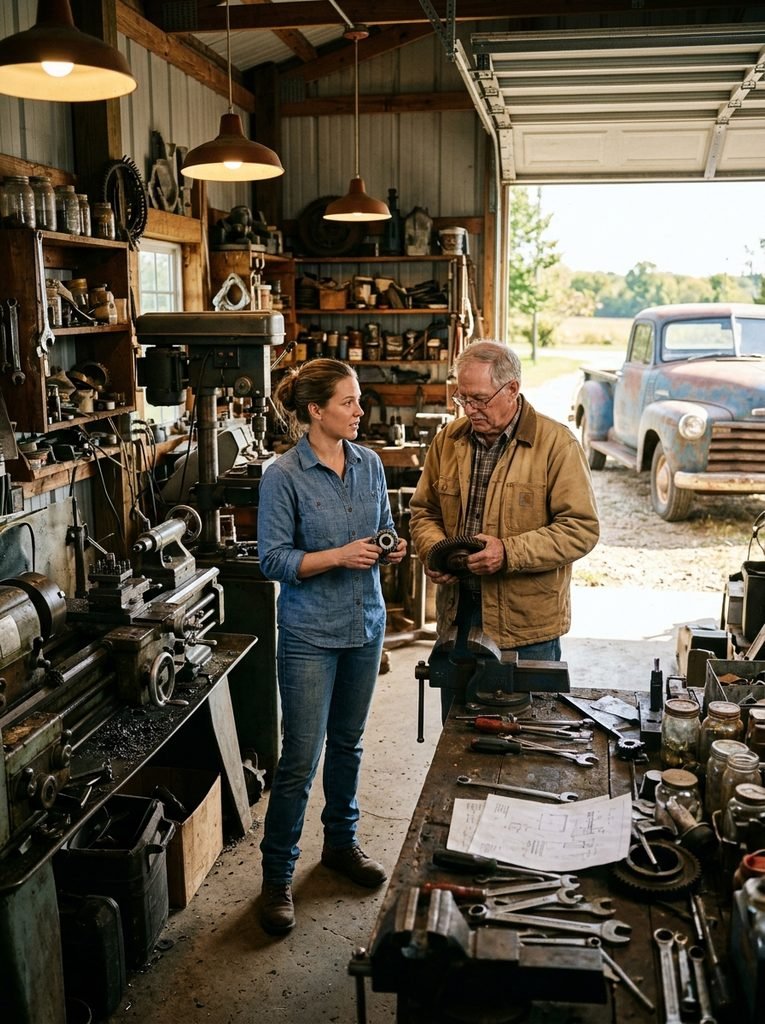
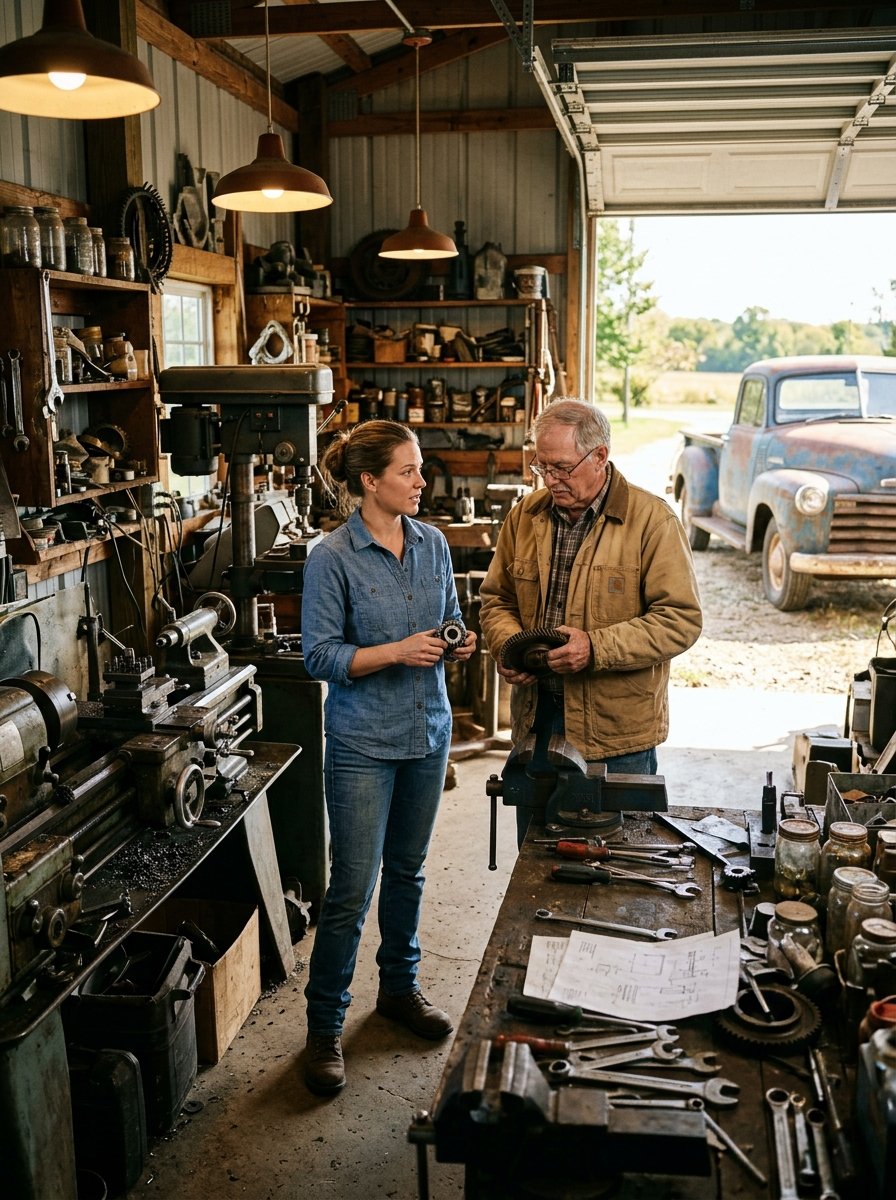
On the first frost of October 1978, the vocational school in Rolfe, Iowa, sold off its metal shop equipment from a row of pallets on the gravel lot behind the old gymnasium. Irene Aukes walked that row twice before she stopped.
She was 43 that fall, a farm wife from 11 mi north of town, and she had driven in alone in a 1966 Ford pickup with a cracked windshield and a utility trailer whose tailgate was tied on with baling wire. Heavy leather welding gloves were tucked behind her belt, and a steel tape worn soft at the hook hung from her coat pocket.
Most of the men at the sale had never seen her in the shop, and most of them had already decided she was there to buy a box of drill bits for her husband. At the end of the third row stood four metal shapers.
The school had run them for 22 years, long enough for the paint to wear off the hand wheels, and for the cast ways to take on a dull silver shine where hands had slid across them.
Three were Cincinnati crank shapers, one dated 1944, and two from the early’50s, and the fourth was a Logan with a bent jib that someone had tried to straighten with a hammer. Each machine weighed close to 900 lb. Each ram still traveled true when pushed by hand.
Each had a strip of orange shop tape across the front of its base that said”Scrap” in the instructor’s square capitals. The school had bought milling machines that spring and had no further use for shapers.
The clerk at the folding table, a young man in a county jacket with a clipboard and a penciled price list, told her the whole lot was going to a scrap dealer in Fort Dodge in the morning.”What do you want for the four at the end?” she asked. He checked the sheet with his finger.”Thirty dollars for the lot.
Scraps paying by the pound this week. Those weigh out at about 3,600 lb together, so you can do the arithmetic yourself.” She counted out $30 in 10s and 5s from a coin purse and asked for a receipt.
He wrote it on the back of a carbon form. Shapers four one lot $30 paid and the date. Earl Hennessey was standing at the next table.
He ran the parts counter at the implement dealership in Pocahontas and could tell any farmer in the county the price of a bearing without looking it up. He had come to the sale to pick up a used arc welder for the dealership shop. When he saw the receipt and read what it was for, he laughed.
A short, hard laugh that carried across the lot and two men near the coffee urn turned around.”Irene, you going to shape a bucket of rust into a tractor?” he said. Nobody repeated it afterward in the way the story later traveled, but it was the only time anyone laughed at her to her face about the shapers.
She answered him with one sentence.”They’ll cut a gear, Earl, if somebody sets them up right.” Then, she went back to the trailer and let down the ramps. Neil Dvorak, who farmed the quarter across the road from her and owed her a weld on his hay rake, had come to the sale to look at a stock trailer.
He saw the ramps go down and walked over without being asked. He did not say anything about scrap. He took the first shaper by the base while Irene took the ram end and they walked it up the boards with a rhythm that suggested they had done it before, though they never had.
The Cincinnati settled onto the trailer deck with the sound like a dropped anvil. The Logan went on last, sitting low on its own weight, and Irene chained each machine to the rails with 3/8 binder chain she had bought at the hardware store in Rolfe for $11.40 a spool the week before when she had first heard the lot was going up for sale.
Before she pulled out, she sat in the cab with a notebook open on the wheel and wrote the serial numbers, the ram strokes, and the weight of each machine as she estimated it from the springs on the trailer. Then, she wrote the date and the word scrap, and under it, in smaller letters, the word material.
Neil Dvorak, leaning on the fender with his hands in his coat, asked what the second word meant. She turned the notebook so he could read it and said nothing else about it. Let me tell you about the first thing she did with the machines, because it is the reason the county later found the story worth repeating.
She did not start them. She did not oil them, paint them, or call anyone to say she had bought them. She drove them home, backed the trailer into the machine shed behind her house, and left them chained where they stood.
And for 3 weeks, she went out every morning before breakfast to look at them through the open door. Irene Aukes was not a talker, and the people who knew her best would have said so without any sharpness.
She had grown up on a dairy farm in the driftless country of northeast Iowa, though her family had moved west in the year she turned 12, and she had learned early to watch a machine for a full season before deciding what it was for. She kept a notebook of the things she saw.
Her husband, who farmed the home place with her and did most of the heavy field work, had long since stopped asking what was in the notebook. He would look at her riding with the same mild patience he gave to weather.
Irene had first met Virgil McCaffrey at a farm auction 12 years earlier in the spring of 1966 when she’d gone to buy a set of hand reamers for her kitchen table repairs and he’d been bidding on a pile of old hand tools in a cardboard box. Virgil was 72 that year.
He had run a machine shop in an old creamery building on the east side of Rolfe for 40 years, and his hands were so knotted at the knuckles that he could not hold a pencil for long without setting it down. He had won the box for $2.20.
When the auctioneer asked whether anyone wanted to bid higher on a rusted lot that had sat in the sale yard since the previous fall, Virgil had lifted one finger and said nothing else. Irene had come up beside him afterward and asked what the box was worth. And he had handed her a pair calipers and told her to read them.
She read them, and he took them back and set them to a clean bolt on the ground and told her the bolt was half a thousandth over its nominal size and that the man who had made it had known exactly what he was doing. Most of this county thinks iron is either good or it’s junk, he told her not unkindly. Iron doesn’t know what it is.
Somebody decides what it’s for, and then the iron has a job or it doesn’t. The man who can’t see the job calls it scrap. She had kept that sentence in her notebook for 12 years.
Virgil had taught her to read a micrometer, to test a flat surface with a surface plate, and a sheet of blue ink, and to listen to a lathe while it cut the way some people listen to a child breathing through a bad cold.
When his hands gave out in the winter of 1971, he moved into a house in town and sent word that anything in the shop was hers to take if she could haul it. She had taken a vise and two drill indexes and a box of cutters. She had not taken the shapers because the shapers belonged to the school.
Eight years later, she bought them. The four shapers sat in the machine shed through October and into November. The first hard frost came on the 11th of that month.
The shed had a dirt floor on the north side and a concrete pad on the south. And Irene had the machines positioned on the concrete where she could reach them from both sides and where the light from the door fell across the ways in the early mornings.
Each morning, she came out with a thermos of coffee and a flashlight and her coat, looked at the machines in turn, and wrote in the notebook what she saw. The Cincinnati of 1944 had a slight wear track on the left way where a single gib had carried more load than the others.
The second Cincinnati had a broken pinion cover that someone had patched with fence wire. The Logan had a cracked gib bracket, a stripped handwheel, and a motor that had been pulled and cut off at the shaft.
Her first real accounting came in the second week of November after she had sat down at the kitchen table with a sheet of ruled paper and listed what the four shapers would require before any of them could cut a single tooth. The ledger went like this.
The Logan’s motor needed rewinding, which a shop in Fort Dodge quoted at $22, and she decided to do it herself with wire from a box lot she had bought at the same sale for $4. The Cincinnati with the worn way needed scraping along a 6-in band, which she would do with a hand scraper that had cost her $11 in 1974.
The broken pinion cover needed a new gasket cut from a sheet of oil-resistant gasket material she had bought for $6.80. The handwheel for the Logan was a cast piece, and she had a spare from the box lot that fit it with a little lapping. Cutting oil, a gallon can, was $4.50.
Hacksaw blades, a box of 12, were $6.85. Two new drive belts came to $9 together. She wrote each figure in its own line, drew a rule under the column, and added them.
The total was $83.05, which was more than all four machines had cost her together, and it was the first time she had ever written down a number that large for a piece of junk.
Janice Verba, who kept the books at the co-op on Main Street in Rolfe, and had known Irene since they were girls at the same Lutheran Sunday school, came out to the farm that Thursday with a box of invoices she had pulled from her own desk drawer for a purchase she had never finished.
She looked at the ledger on the kitchen table, read it top to bottom with her finger, and then looked up.”You’ll want every receipt in place,” Janice said.”Keep them in a folder, not a shoebox. Somebody will ask for them someday, and they’ll want them quick.” Irene said that was what she was going to do.
Janice nodded, pulled a manila folder from the box, and set it beside the notebook. She did not say anything about the shapers. She did not ask what they were for.
Irene noticed that, and later, when people in the county were talking about the gears, she noticed how many of them had never once asked Janice Verba what she had known about the shapers in 1978, because the answer was the same thing Janice had said to her across the kitchen table.”Keep the receipts in one place.”
Let me tell you about the work that followed, because that work is the part most people in the county never saw. Irene cleaned the first shaper, the 1944 Cincinnati, over six evenings in the second half of November.
She took off the ram cover, removed the cutting head and the clapper box, and laid every part on a clean sheet of cardboard in the order she had taken it apart. She could not read the manual, because the school had long since thrown it away. So, she made her own.
On the back of the ledger, she drew the ram, the clapper, the feed screw, and the way gibbs with arrows and numbers, and she wrote beside each number the thing it did when it worked. The feed screw turned a ratchet that advanced the table by a few thousandths of an inch per stroke.
The clapper box rotated on a pivot, so the tool could lift on the return and not drag across the workpiece. By the end of the sixth evening, the machine was apart and labeled. And every surface she had cleaned was coated with a thin film of light oil to keep the rust off.
On the morning of the seventh day, she stood at the open door with her thermos and watched the sun come up over the bean stubble to the east. And she pushed the ram by hand. It moved along its way with a faint even whisper.
The sound of a well-fitted slide. She pushed it again. The second stroke was as clean as the first.
She wrote the time in the notebook, and then she wrote the words the ram made, which were not really words at all, but a short sound she could not write. So, she drew a line. Hold that picture for a moment because the next part of the story goes in a direction the county did not expect.
Irene did not sell anything from the shed that winter. She did not put up a sign. The only people who came out to the farm were Neil Dvorak, who brought a fence post driver to borrow, and Janice Verba, who brought the folder back in January with a receipt she had found tucked inside the back cover that Irene had forgotten.
Those were the two visitors who saw the machines in the shed that winter. And Neil was the one who told the rest of the township that the shapers were running. The shapers had been bought for $30.
And by the time the first cutter reached the work piece, Irene had spent $116.40 on them. She wrote that figure in the ledger, too. The sum was just a figure, and she was not ashamed of it.
She was quietly sure it would be paid back by something she had not yet seen. And she was not wrong. Though the thing that paid it back was not what she expected.
The machines were running by February. The first gear she cut on the Cincinnati of 1944 was a spur gear in cold rolled steel. A piece she made from a 3-in round bar at $2.95 a foot, cut to length on a hacksaw, and then turned down on the Logan’s table.
It had 22 teeth and a pitch of eight, which meant the teeth were cut to a diametral pitch that the old grain drills in the county still required. The cutter was a form cutter, a single piece of hardened steel in the shape of a tooth space.
And she had bought it from a machine shop in Fort Dodge for $44, used with a nick in its edge that she had ground out on the bench grinder before she ever set it in a holder. Setting up a gear on a shaper is slow work.
And it was slower for Irene, who had no formal training in gear cutting, and had learned most of it from Virgil in the old creamery building over four winters. She mounted the blank on a dividing head she had bought at a dealer sale in 1974 for $38.
And she indexed each tooth by counting turns of a worm gear with her left hand, while her right hand held the feed. The head had a crank with 40 holes on its ring, and she set the pin into one hole, turned the crank 40 times, and marked the blank with a scribe. Then she moved to the next position.
She needed to cut 22 teeth, which meant she needed to set the crank for every 20th second of a full rotation. And she needed to do it without error, because one tooth out of place would throw the whole gear off and ruin the blank. The first gear took her a full day.
She cut each tooth in several passes, checking the depth with a gear tooth caliper after every two strokes until the form matched the template she had drawn from the grain drill’s broken gear. She measured the finished gear with a micrometer and a pin set she had made from drill rod.
The tooth thickness came out at a few 10,000s over the nominal dimension, which was within what the drill’s gearbox could tolerate. She knew that before she tested it.
She ran the gear against the drill’s mating gear, which she had taken off the old machine the previous fall for exactly this purpose, and it meshed smooth and quiet with no binding and no backlash that she could feel with her thumb. She wrote the figures in the notebook.
Then, she sat on an upturned bucket in the shed with the gear in her lap and the sun on her face through the open door and let herself think for about a minute that it was going to work. That minute did not last. The second gear she cut was the one that started the rumor.
Randy Buckley, a young man who had graduated from the vocational school in 1976 and now worked days at the county road shop, brought her a broken timing gear from a 1957 planter that a neighbor was using to plant corn. He had asked the implement dealer for a replacement and been quoted a price and a wait.
He did not ask Irene whether she could make it. He left the broken gear on the bench with a note that said the planter was needed in 4 weeks and he drove away. She cut the replacement in 2 days.
The steel cost her $4.15 for the blank and the cutting oil. The gear fit the planter’s shaft on the first try and Randy came back with his neighbor’s truck to pick it up and paid her $8 without asking what he owed because he had seen her ledger on the bench and had understood what the figures meant. That was the first gear the county talked about.
It was not a large thing and it was not a dramatic one. It was an ordinary piece of iron made for a corn planter and it went back into the planter and the planter went to work in May the way a planter should. Virgil McCaffrey came out to see the work in the spring of 1979.
He was 75 and could no longer drive. So, his son-in-law brought him in a car with the seat pushed all the way back. He walked into the shed on a cane and stood for a long time in front of the Cincinnati looking at the ways and the feed screw and the notebook spread open on the bench.
Then he picked up the gear that Irene had cut for the planter, turned it over in his fingers and set it down again with a small nod. He did not say he was proud of her. He asked what the steel was and she told him and he asked what she had used for the cutting oil and she told him that, too.
He told her the oil was the wrong kind for a shaper and gave her the name of the kind he had used in the creamery and she wrote the name in the notebook. That was the most he said about it. Let me tell you about the years that followed because they are the years nobody could have seen from the road.
Irene Aux spent the next 5 years cutting gears in the machine shed, usually in the cold months when the field work was done. She cut gears for grain drills, for corn planters, for an old hay conditioner with a worn pinion, and for a manure spreader that belonged to a family 3 miles to the south. Most of the work came by word of mouth.
A farmer would call Janice Verba at the co-op to ask whether Irene was taking work, and Janice would tell them yes, and that she would need the broken part brought in and the bore measured.
Irene charged for the steel, the cutter wear, and her hours at a rate she set herself in her notebook, which was about 1/3 of what the factory parts counter asked for the same piece. She did not take money she had not earned, and she kept every receipt in the folder. The work was hard in the way that work is hard in a cold shed.
In January of 1980, a gear she had cut for a manure spreader came out with a tooth that was a few thousands too thick on one flank, and she had to strip the blank, re-index it, and recut the whole gear, which cost her 9 days and 41 cents in extra steel.
In March of 1981, the Logans motor failed on the third cut of a bevel gear, and she spent two evenings tearing out the armature, rewinding it by hand with copper wire she had bought in a sealed spool, and testing the windings with a meter she had bought secondhand at the sale barn for $14.
She had no help with any of it except Neil Dvorak, who came over on the weekends in the cold months to hold a piece while she tightened a bolt, and who, once in a while, brought her a sack of cold cider from his mother’s cellar. Virgil McCaffrey died in February 1981 at the age of 74 in the house in town where he had lived since his hands gave out.
His cutter box went to the county school for its metal shop and the rest of his tools came to Irene who took the dividing head and his set of hand reamers home in the back of Neil’s truck.
In the note he left with the cutter box, which was written in pencil and was only 41 words long, he told her to keep the oil in the dark and to check the cutters with a loop before each setup. The years compressed in her notebook.
By the spring of 1982, she had cut 104 gears and her ledger showed the material, the cutter wear, and the hours for everyone. By the spring of 1984, the number had passed 170. The ledger for those years is longer than anything else she wrote and it has the same texture throughout.
A figure for the steel, a figure for the cutter, a figure for the hours, and a line for the customer’s name written in her small square handwriting. Nobody in the county read those ledgers. Nobody asked for them.
Janice Verba kept the receipts in the folder. Through the early 1980s, land values across Iowa fell sharply after several years of high interest rates and many farm operations carried loans they could no longer refinance on the terms they had signed.
Machinery bought on credit sat in sheds across the state and implement dealers reduced their inventories of parts and their parts counter staff. A number of families who had farmed the same ground for three generations sold out in those years.
Irene Oaks was not one of them, though the ground she farmed had lost a good part of its value on paper, and she had to decide that spring how much of her own work she could afford to carry on credit. She kept the notebook open on the kitchen table and did the arithmetic every evening.
The gear that changed the county’s view of the shapers came in the autumn of 1984, on a day in late September when the sky over the Des Moines River Valley was the color of pewter and the first combines were running on the north side of Rolfe.
A grain drill belonging to a farmer named Dwayne Mauer, 4 miles east of the county line, had lost a drive gear in the middle of seeding. The machine was a 1961 model that the factory had discontinued in 1971, and its replacement gear, the one the dealer could order, had been quoted at $58.40 with a wait of 6 weeks from the factory in Ohio.
Mauer had winter wheat in the ground and no way to plant the rest of the field without that gear. He had come to the parts counter at Farmers Implement in Pocahontas, and the parts manager, Earl Hennessy, had given him the quote and the 6 weeks. Mauer had driven straight to the Oaks farm.
Irene read the broken gear with her fingers and then with the loop. The tooth profile was worn but intact on 11 teeth and the bore was scored on one side. She told Mauer she could cut the replacement in 3 days if he could bring her the drill’s mating gear for a fit check, and she quoted him a figure that was less than a fifth of the factory price.
Mauer asked her whether she was sure. She said that she was sure about the gear and she was sure about the shaper. He drove home to get the mating gear, and she set the blank that afternoon.
The gear took her 3 days in the shed cutting the 26 teeth in six separate setups with the dividing head and the form cutter, checking each tooth with a gear tooth caliper and a pin set, and taking the final passes with a finishing cutter she had ground herself the spring before. The steel blank cost $4.50.
The cutter wear and the cutting oil came to a little under $2 more. She spent a total of 19 hours of her own time, which she logged, and the entire cost of the part came to $7.11, which she wrote in the ledger and underlined twice. On the fourth morning, Mauer came back with his son and a flatbed.
Irene handed him the gear wrapped in a clean shop rag. He turned it over in his hands, ran his thumb across the teeth the way Irene had taught Randy Buckley to do, and asked her how long she had been cutting gears. She said since 1979.
He asked whether she had cut any for the factory line. She said no. He asked whether she was going to charge him for the 3 days, and she said she had already told him the figure, and he could read the receipt when he got home.
Mauer had the drill back in the field by noon. That afternoon, a little after 2:00, he drove into the implement dealership parking lot in Pocahontas with the drive gear in the cab of his pickup, and walked into the parts department with it in his hand. Earl Hennessy was behind the counter with his reading glasses pushed up into his hair.
Mauer set the gear down on the glass in front of him and asked him to read the figure stamped in the rough finish on the back of the hub, which said nothing but a serial number and a pitch. Then, he set down the Oaks receipt beside it.”Earl, I was told $6 and $58.40 for the same gear.” Mowrer said.”Irene Oaks cut this one in 3 days for $7.11.
It’s in my drill and it’s planting.” Earl read the receipt twice. He did not laugh.
The two men waiting at the counter behind Mowrer stopped talking and the sound of the radio on the shelf above the cash register seemed to get louder, though it had not changed. Earl said, after a moment,”Seven dollars and 11 cents.” He said it to nobody in particular and then he said it again, as if checking that he had read it correctly.
And he picked up the gear and turned it under the fluorescent light and looked at the teeth the way Virgil McCaffrey used to look at a bolt. Nobody in the parts department said anything for a long time. That was the moment the county recalibrated.
It did not happen in a single afternoon and it did not happen in a single sentence. But, by the next Monday, the story of the gear was everywhere in town and it had a figure in it that people could repeat. And the figure was $7.11 against $58.40.
Those were the two numbers that did the work. Nobody needed to argue about shapers or scrap. The arithmetic was on the counter in front of Earl Hennessy and he had read it aloud.
The story that traveled that week started at the sale barn where Mauer’s brother-in-law told the auctioneer, who told the feed store clerk, who told the co-op counter, where Janice Verba heard it and said nothing.
From the co-op, it moved to the cafe on Main Street, where the men who ate breakfast there argued about whether the figure had been right. From the cafe, it went to the church lot on Sunday, where two women from the altar society repeated it to a third woman who had sold her grain drill for scrap the summer before.
By the time the story reached the Ox farm, it had changed in a dozen small ways. The gear was 28 teeth, not 26. The shapers were Brown and Sharps.
Irene had been a welder at the Fort Dodge plant before she married. None of those details was true. The figure was the only part that held.
The story that traveled later was a different story, and it had a different shape. Two winters after the gear, a man from Storm Lake came to the farm asking about a set of pinion gears for a 1950s hay baler. And when Irene quoted him the price, he asked her where she had learned to cut them.
She told him she had learned from a man named Virgil McCaffrey, and that the rest she had learned from the shed. He wrote the name down in his notebook. By the time the second story reached the county, it had dropped the figures entirely and kept only the sentence about the shed.
Now, the part of the story that people in Rolfe still talk about, when they talk about Irene Ox at all, in the spring of 1986, Earl Hennessy drove out to the farm on a Saturday in April with a broken worm gear in the back of his own pickup.
He had a customer, an old man who had bought a 1948 tractor at an estate sale, and wanted to keep it running for the next 10 years. The factory had no gear for it. The dealer had no gear for it.
Earl had come to the shed without a call, stood at the open door with his cap in his hand, and asked whether Irene might look at it. She looked at it. She measured the bore, counted the teeth, and set the broken gear on the bench beside the notebook.
She told him she could cut a replacement in a 4 days, and she quoted him a figure. Earl asked whether she would take the job, and she said yes without any ceremony at all, and wrote his name in the ledger. He did not apologize.
He did not talk about the parts counter. He stood in the shed for a few minutes after she had started the blank, watching the form cutter come down on the first pass, and then he went back to his truck and drove home. The gear was ready on the Wednesday after Easter.
The total came to $9.50, which he paid in cash at the end of the driveway without arguing. Janice Verba, when she heard about the visit, said only that Earl had come a long way for a small part. Irene agreed that he had.
The rest of the county changed its habits in small ways. Dealers in Pocahontas and Rolfe began sending customers out to the Ox farm for certain gears, and the parts counter at Farmers Implement kept Irene’s business card under the glass next to the bearing list.
Neil Dvorak, who had watched the first gears come off the shapers and had helped hold the blanks through three winters, bought his own dividing head at a dealer sale in 1987, and began cutting his own pinions in the Dvorak machine shed. He never called it a shop.
He called it the back room, and he cut for himself and for his brother’s grain operation 2 mi south. By then, Irene had cut more than 340 gears, and the folder Janice had handed her years before was so thick that Irene had bought a second folder and started a third. None of the figures in the folders were large.
Most were under $12. The largest single ledger entry was a worm gear for a stationary engine that had cost $18.40 in steel and cutter wear, and the hours for that job came to 9 days.
The county had a number of mechanics who could cut gears, but none of them had Irene’s ledger, and none of them had the patience to sit on a bucket in a cold shed for 3 hours in order to index 22 teeth without a single mistake.
Let me tell you about the thing she started in the late’80s, because it was the last real change in the shed before she slowed down. Randy Buckley had come back to the county road shop as a full-time machinist after the state vocational program moved its metal classes to a larger campus in Fort Dodge.
He had grown into a quiet, careful man with a habit of checking his work twice, and in the winter of 1989, he came to the Ox farm with a question that had nothing to do with a broken part.
He wanted to know whether the shapers could be set up to cut a small run of helical gears for a snowblower gearbox that a local company was making for a small order. The company had a drawing and a number, but no tooling.
Randy said the company had asked whether a county machinist could produce 12 units by the 1st of June, and he had said he would find out. Irene looked at the drawing for a long time.
Then she looked at the Logan, which had the stripped handwheel she had replaced in 1980, and then at the Cincinnati of 1944, which had the worn way she had scraped in the first winter. She said the helical cut was beyond what the shapers could do without a tilt fixture, and she had never built one.
Randy said he had a tilt fixture in the road shop from an old milling job. She said,”Then bring it out Saturday, and we’ll see whether the table take it.” He asked whether she was sure.
She said she was not sure of anything about it, and that was the honest answer, and he could bring the fixture. They worked on the fixture for three weekends.
Randy drove the parts in from the road shop in the back of a county pickup, and Irene measured every bore and every bracket, and wrote the figures in a new notebook she had bought at the drugstore in Rolfe. By the 1st of June, the company had its 12 gearboxes and a receipt that Janice Verba had typed up and filed in the co-op’s own ledger.
Randy had asked Irene whether she wanted the work recorded under her name, and she had said that the receipt should show the shop that did the cutting, and the shop was the shed, and the shed was hers, so the name on the receipt should be his. That was the first transmission the county noticed, though nobody called it that.
The next idea Randy proposed in the shed a year later was a gear pattern for a belt-driven hay elevator that the county had not been able to buy since 1985. And when he asked whether they should try it, Irene said,”Yes.” the same afternoon and handed him the drawing.
She did not tell him how to set up the dividing head or how many teeth to cut. She let him find out what the first gear looked like on the bench. And when he brought it to her with a faint line of error on one flank, she took the loop out of her pocket and showed him where to look.
By 1990, Randy Buckley was cutting gears in the shed on his own weekends, and Irene’s notebook had two handwriting styles in it, both small and square.
Irene Aux is still alive, and she’s still in the shed on most mornings in the cold months, though the shapers now sit in a row on the concrete pad with a canvas cover over the Cincinnati of 1944 to keep the dust off. The Logan’s motor has been rewound three times.
The ways on the second Cincinnati have been scraped twice, and the notebook on the bench has been replaced by three more notebooks, each one labeled with a year and the county stamp.
The cutters are kept in a wooden box that Virgil McCaffrey made in the creamery in 1948, and the dividing head that once belonged to a dealer sale in 1974 hangs in its own oiled case on the wall beside the door. Here is the arithmetic she would give anyone who asked. Four shapers, $30.
Restoration, parts, and wire, $83.05 for the first winter, and 116 dollars and 40 cents in the first full year. Every gear cut since then has its own line in a ledger. Each with its own figure for steel, cutter, and hours.
Across 40 years, the shed has produced more than 480 gears for farmers, dealers, a manufacturer’s small run, and a stationary engine collector two counties away. And the largest of them cost less than 20 dollars to make.
The factory price for the drive gear on Dwayne Mauer’s drill, which nobody in the county has forgotten, was 58 dollars and 40 cents. It is still the number people use when they want to explain what the shapers did.
Irene Oaks keeps the receipts in one place in a folder marked with the county stamp, and she sometimes takes the oldest one out on a slow afternoon and reads the entry for the first gear she ever cut. The planter gear went to Randy Buckley for eight dollars in February 1979.
And his handwriting on the receipt is the same handwriting he uses today when he signs a gear card for a customer. He has his own shed now on the north side of his place with a row of cutters and a dividing head that he bought from a dealer sale in 2002 for 41 dollars.
Irene looks at the receipt, reads the figure, and then closes the folder and goes back to the bench. The shapers are running. The ram is moving true along its way.
It is a little after 7:00 in the morning and the sun is coming up over the bean stubble, and there’s a gear on the dividing head with 22 teeth that needs one more pass.