“At our family reunion, my aunt glared across the table and said,
“At our family reunion, my aunt glared across the table and said, “You don’t even count—you’re just the kid they should’ve left behind.”
My cousin snorted.
My mom stayed silent.
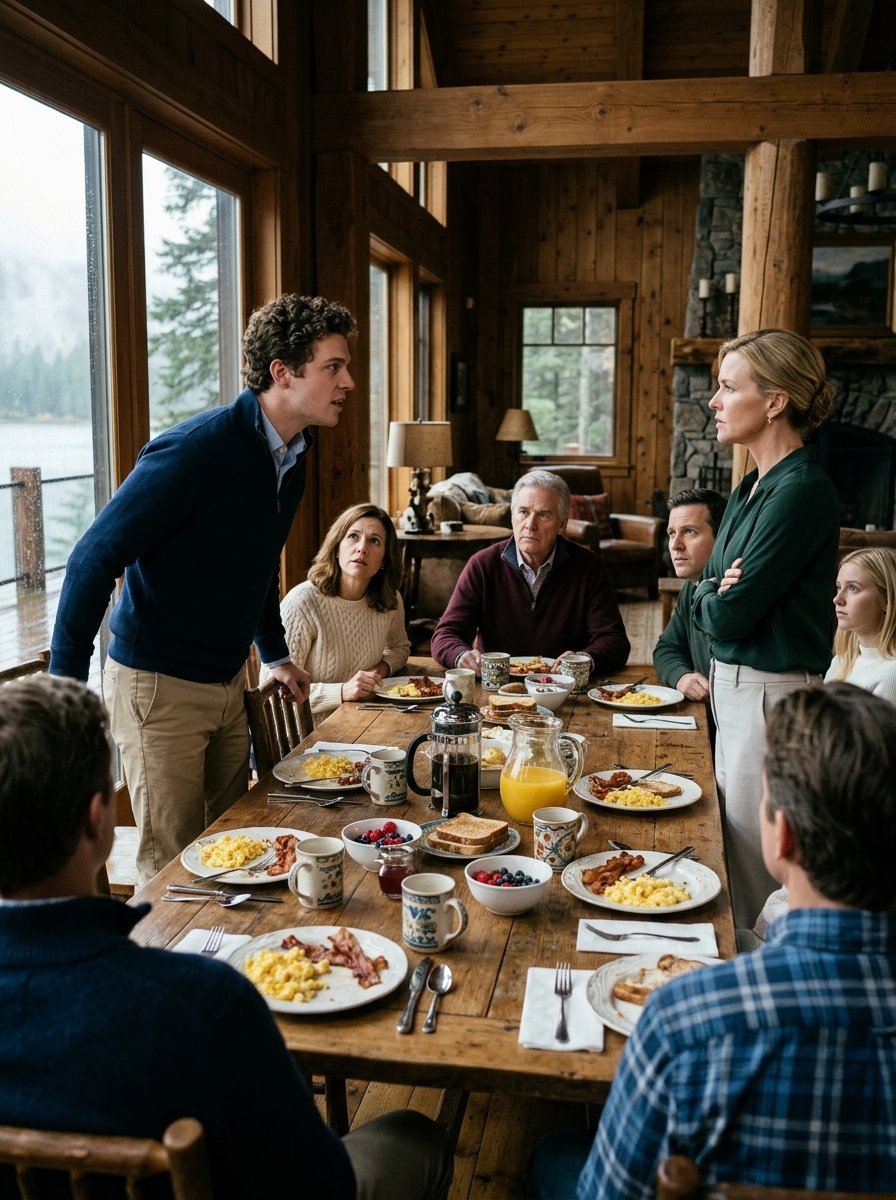
And right then, with plates still full and rain already pouring outside, I stood up and said, “This isn’t your reunion.
This is my property.
Get out.”
And I watched every one of them scramble into the storm.
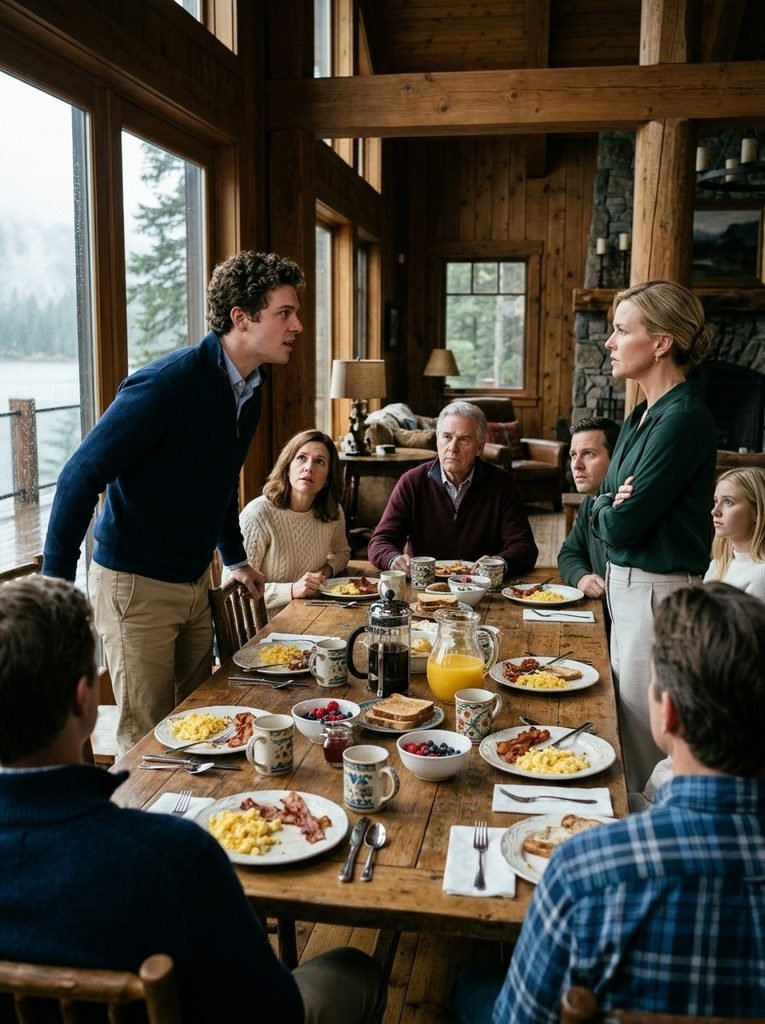
“You don’t even count,” Aunt Melinda said across my own dining table.
“You’re just the kid they should’ve left behind.”
My cousin snorted.
Jess laughed under her breath.
My mother sat three seats away with one hand around her water glass and said absolutely nothing.
Rain hammered the windows behind them.
I set my fork down.
For three days, these people had filled the lake house with luggage, coolers, wet towels, half-finished drinks, and complaints.
I had cooked for them, cleaned after them, fixed what they broke, and listened while they treated me like the relative lucky enough to be allowed in the room.
Now Melinda was smiling at me like she had finally found the line that would put me back in my place.
She had no idea whose place she was sitting in.
My name is Kayn.
I’m 27, and the two-story lake house on that wooded Oregon property belongs to me.
Almost nobody in my family knew.
My grandfather left it to me.
He was the one person who never treated my quiet personality like a defect.
After he died, I kept the deed private, paid the taxes, replaced the roof, maintained the dock, cut the grass, and let everyone assume my mother still owned the place.
They never asked.
That assumption became convenient for them.
Every summer for three years, the family reunion happened there.
And every year, I handled everything.
I stocked almond milk for Jess, gluten-free snacks for Aunt Rachel, sugar-free lemonade for Uncle Mike.
I checked the plumbing, bought towels, cleared the dock, arranged food, and made sure every bedroom was ready.
Nobody thanked me.
They walked in without knocking.
This year was worse.
A week before the reunion, Mom called and said, “I told Melinda you’d have the house ready.”
Not asked.
Told.
Then I learned Melinda had invited fifteen extra people—second cousins, neighbors, new in-laws, people I barely knew.
Friday morning, SUVs rolled down my gravel driveway one after another.
Doors slammed.
Coolers hit the ground.
Kids ran through the entryway.
Jess walked inside and called, “Kayn, be a gem and grab the cooler.”
So I grabbed it.
That first night, I stayed mostly in the kitchen while everyone else laughed around the dining table.
When the water heater acted up, I fixed it.
When gum ended up stuck beneath a chair, I cleaned it.
Saturday afternoon, Melinda sat on the patio surveying the property like an inspector.
“You really should do something about those bushes,” she said.
“And that dock still leans.”
I looked at her.
She wasn’t finished.
“This house used to have charm.
Shame nobody takes care of it anymore.”
Something shifted in me, but I swallowed it.
That evening, I tried sitting with everyone.
My cousin Tyler looked across the table.
“So, Kayn, you still doing that computer thing.”
“Remote cybersecurity.”
He gave me a fake-impressed look.
“Wow.
Guess that’s a real job now, huh.”
The table erupted.
Even my mother laughed.
I walked outside and sat near the dock until the noise behind me became muffled.
By Sunday brunch, I had stopped expecting anything different.
I made pancakes, bacon, fruit platters—the whole spread.
Around noon, gray clouds covered the lake and rain began tapping the windows.
Everyone crowded around the long dining table.
My plate was already getting cold when Melinda leaned forward.
Her eyes narrowed.
Then came the sentence.
“You don’t even count.
You’re just the kid they should’ve left behind.”
A few people laughed.
My mother stayed silent.
The rain came harder.
I watched a drop of water slide down the outside of the window.
Then another.
My hand shook once.
I put the fork down carefully and pushed my chair back.
The legs scraped across the hardwood.
Every conversation stopped.
I stood.
“This isn’t your reunion,” I said.
Melinda’s smirk held.
I looked directly at her.
“This is my property.
Get out.”
Nobody moved.
Jess blinked.
Tyler stared.
My mother’s brow tightened like she was trying to decide whether I had finally lost my mind.
Melinda actually leaned back in her chair.
“Excuse me.”
“You heard me.”
I walked around the table toward the sliding glass doors.
“Get out.
All of you.”
Melinda folded her hands and gave me that familiar patronizing smile.
“You’re being dramatic.
Sit down before you embarrass yourself.”
I opened the patio door.
Cold rain and the smell of wet pine rushed into the room.
Wind pushed mist across the threshold.
Somewhere beyond the lake, thunder rolled.
I turned around.
Nobody was laughing anymore.
“This isn’t a request.”
Tyler gave a nervous chuckle.
“Kayn, come on.
You’re not seriously kicking everyone out over a joke.”
“A joke.”
I looked around the table.
“You spent the entire weekend using this place like a free resort.
You ate food I bought.
Slept in rooms I cleaned.
Complained about property I maintain.
Then she called me a mistake to my face.”
I looked at my mother.
“And every one of you let her.”
Her fingers tightened around the glass.
Still nothing.
Aunt Rachel finally spoke.
“You can’t throw your own family into a storm.”
“You’ve treated me like less than family for years.”
Melinda stood slowly.
“This is ridiculous.
You don’t own this place.”
There it was.
The assumption underneath everything.
I stepped away from the open door.
Rain drummed against the deck.
The room had gone so quiet I could hear silverware shifting on a plate.
Melinda crossed her arms.
“This is your mother’s house.
Stop pretending you have authority you don’t have.”
For the first time all weekend, I smiled.
Not because anything was funny.
Because upstairs, inside the top drawer of my desk, was a folder they had never seen.
The deed.
The tax records.
The letter from my grandfather.
I looked from Melinda to my mother, then back to the table full of people who had spent years deciding exactly how little I mattered.
“This house is mine,” I said.
“My name is on the deed.”
Melinda’s face changed.
And before anyone could speak, I turned toward the stairs.”
The treads groaned under my sneakers, each measured step echoing up into the heavy, vaulted ceiling of the stairwell.
Behind me in the great room, nobody spoke.
The silence was thick and sudden, broken only by the cold draft whipping through the open patio door and the violent rattle of wind-driven rain against the tall glass.
My lungs felt tight, cold air expanding inside my chest like sharp glass, yet my pulse remained unnervingly steady.
I reached the landing, turned the corner down the hallway, and walked into the small, cedar-paneled office that had once been my grandfather’s private study.
The room smelled faintly of old paper, dried lavender, and pipe tobacco long after his passing.
I did not hesitate.
I pulled open the center drawer of the roll-top desk.
From the back corner, I lifted the stiff, navy-blue leather binder embossed with the county seal.
Beneath it lay the unbroken parchment envelope addressed to me in his spidery, unshakable black ink.
Downstairs, a chair scraped violently backward.
Melinda’s voice cut through the floorboards, sharp and frayed around the edges.
“Evelyn, tell me this is a sick joke.
Tell me right now.”
My mother didn’t answer.
Not a syllable.
Holding the binder against my ribs, I walked back down the stairs.
Every single face turned toward me in unison.
Tyler stood awkwardly by the credenza, his thumbs hooked into his belt loops, his cheeks flushed with mottled red patches.
Jess had her phone clutched flat against her collarbone, her jaw hanging slack.
Aunt Rachel was whispering fiercely into Uncle Mike’s ear, her fingers digging into his flannel sleeve as he stared at me with blank, uncomprehending eyes.
Only my mother remained in her seat.
Her head was bowed, her eyes glued to the tiny pool of condensation forming at the base of her tall glass.
Melinda stood at the head of the table, her chin thrust forward, refusing to yield an inch of ground.
“You think waving a piece of paper makes you a man.”
Melinda sneered, though her throat bobbed in a visible swallow.
“Dad built this family on structure.
He would never give his legacy to a reclusive nobody who spends his life hiding behind screens.
Evelyn is the oldest.
She inherited everything.
She just let you play caretaker because you have nothing better to do with your life.”
I walked straight to the table.
I didn’t raise my voice.
I didn’t throw the binder.
I placed it flat on the polished oak between Melinda’s half-eaten waffle and the pitcher of orange juice.
With two fingers, I flipped it open to the certified warranty deed.
Gold notary foil glinted beneath the chandelier.
Right there, stamped four years ago by the Clackamas County Recorder: Grantee: Kayn Alexander Vance.
Sole and Separate Owner.
“Read it,” I said, my tone as quiet and unyielding as granite.
Melinda’s fingers twitched.
She hesitated, then bent down to squint at the embossed text.
Her eyes darted across the legal descriptions, the tax parcel identification, and the unmistakable, heavy pen strokes of Arthur Vance’s signature.
The color drained from her face so fast it looked like someone had pulled a plug beneath her skin.
Her lips parted, dry and pale.
“No,” she whispered, a hollow, reedy sound.
“No.
This is. this is invalid.
Dad was confused near the end.
He was medicated.
Evelyn, stand up and tell him this isn’t real.”
My mother didn’t flinch.
She kept her eyes locked on the water glass.
A single tremor ran through her shoulders, making her cardigan rustle.
“Evelyn.”
Melinda barked, her voice cracking into a panicked shriek.
“Say something.
You’ve been letting us come here.
You approved the invitations.
You told me last week that the lakefront was ours to enjoy.”
Slowly, agonizingly, my mother lifted her chin.
Her eyes were rimmed with dark, bruised shadows, completely devoid of the superiority she wore when entertaining her siblings.
“It’s his, Melinda,” Mom said, barely above the sound of the wind.
“It’s always been his.”
A stunned, suffocating gasp rippled through the guests.
Tyler straightened up so abruptly he knocked a decorative pinecone off the sideboard; it thudded against the floorboards.
“What are you saying.”
Melinda’s fingers curled into tight, trembling fists.
“You knew.
You sat back and let a twentysomething hold title over the entire estate.”
“Dad didn’t consult me,” Mom murmured, her voice wavering with decades of deep-seated resentment.
“He changed his will six months before he passed.
He told me the day he filed it.
He said. he said none of us deserved the timber or the water.
He said we were vultures who only knew how to take.”
“And you never disputed it.”
Melinda screeched, her spit flying across the table runner.
“You let him hand multi-million-dollar waterfront acres to a boy who doesn’t even speak at Christmas.”
“I couldn’t dispute it,” Mom confessed, her voice breaking into a thin, humiliated whisper.
“Dad’s lawyer made it ironclad.
If any heir challenged the will, they were instantly disinherited from his cash accounts too.
I took the pension payout.
Kayn took the house.
I made him promise never to bring it up.
I couldn’t.
I couldn’t bear the humiliation of you all knowing that Dad chose my son over me.”
The entire room froze.
The air seemed to evaporate from the space.
I looked at my mother, feeling a profound, dull ache in my chest.
She hadn’t protected me.
She hadn’t kept the secret out of respect for my boundaries or my peace.
She had hidden the truth because she was ashamed of being passed over, and she had gladly thrown me to the wolves every single summer just to maintain her fragile status as the generous hostess.
“So every time you volunteered this house,” I said, looking squarely at her, “every time you commanded me to mow the lawns, scrub their toilets, and stand in the kitchen while they mocked my existence. you did that to protect your pride.”
Mom couldn’t look me in the eye.
She shrank back into the high-backed dining chair, her lower lip quivering pathetically.
“Kayn. it was family tradition.
I didn’t think it mattered who held the title.”
“It matters now,” I said.
Melinda suddenly stepped around the table, her eyes flashing with a wild, predatory frenzy.
She snatched the leather binder off the table, her manicured nails clawing into the smooth surface.
“This is fraud.
You manipulated him.
You lived near him during his final year while the rest of us were working.
You poisoned his mind against his own daughters.”
“Melinda, put it down,” Uncle Mike mumbled, his face creased with sudden panic as he stepped forward.
“Don’t do this.
Let’s just pack up and—” “Shut up, Mike.” she roared, whipping her head around.
“Do you know what this parcel is worth.
The lakefront alone was appraised at two point two million before Dad got sick.
I’ve been spending thousands on architectural sketches to subdivide the lower acreage for Tyler and Jess.”
The entire room went dead.
Even the pouring rain seemed to muffle against the crushing weight of her unintentional admission.
Tyler stepped back, his eyes widening with guilt.
Jess froze, dropping her arms.
I felt a cold spark ignite deep within me.
“Architectural sketches.”
I asked, stepping toward her.
“You brought surveyors out here last month, didn’t you.”
Melinda’s mouth snapped shut.
A flicker of pure terror finally pierced her bravado.
“I. that was just exploratory.
For the family.”
“You were planning to force my mother to sell off the timberline to fund Tyler’s business,” I said, piecing together the stray conversations I’d overheard over the weekend.
“You called me a mistake because you thought I was a helpless dependent living off my mother’s charity.
You thought you could bully me out of the guest room so your kids could stake their claim on the property.”
Melinda clutched the binder against her chest like a shield.
“You’re ungrateful.
We are your elders.
We raised you.
You owe this family a sanctuary.”
“You didn’t raise me,” I replied, my voice dropping lower, deadlier, every word striking like a hammer on iron.
“My grandfather did.
When my father walked out and my mother spent three years locked in her bedroom weeping over lost country club status, Arthur drove me to school.
Arthur bought my first computer.
Arthur taught me how to wire an alternator and sand a pine plank.
None of you ever visited him unless his investments matured or you needed a cosigner for a boat loan.”
Melinda turned wildly to the rest of the room.
“Are you listening to him.
Are you going to let a disrespectful brat dictate terms to us.
Tyler, grab the keys.
We’re not going anywhere.”
Tyler swallowed hard.
He looked at his mother, then looked at me.
I was not the timid, slouched boy he remembered from high school.
I was a grown man standing in the center of my own hall, rooted deep into the very ground beneath his boots.
“Mom,” Tyler muttered, stepping away from the counter, “let’s just. let’s just pack our bags.”
“Traitor.” she screamed at her own son.
She spun back to me, her face contorted with spiteful venom.
“You want us out.
Fine.
Call the sheriff.
Have them drag your own blood out into a torrential downpour.
See how that looks to the county.
You’ll be pariahs.
You’ll never show your face in this town again.”
I pulled my phone from my pocket.
The screen lit up against the gray afternoon.
I didn’t dial the station.
I tapped my home security terminal.
With three swift swipes, the entire smart infrastructure of the compound responded.
The overhead dining lights flickered and shut down.
The refrigerator hum cut out entirely.
The HVAC blowers wound down into a dying sigh.
And from the perimeter, the audible click of solenoids echoed as the water main locked shut.
The house plunged into a cold, rain-lit shadow.
The only illumination came from the stormy sky beyond the open glass doors, where sheets of water splashed onto the hardwood floorboards.
“Power is off,” I said calmly.
“Water is off.
The electronic gates at the end of the quarter-mile gravel drive are timed to lock in exactly fifteen minutes.
If your vehicles are still on this side of the gate when they close, they stay here until the tow trucks arrive on Monday morning.”
“You wouldn’t dare.”
Melinda screamed, her voice shrill against the roar of the storm.
“Fourteen minutes and forty seconds,” I said, never breaking eye contact.
The spell broke instantly.
Panic, raw and undignified, swept through the gathering.
Aunt Rachel gasped, tripping over her own handbag as she lunged toward the hallway.
“Mike.
The medicines.
Get the cooler.”
Uncle Mike didn’t even bother with the cooler; he snatched his duffel bag and bolted straight out the front door, his running shoes skidding on the wet gravel outside.
Jess began crying, stuffing her designer clothes haphazardly into an open tote bag while yelling at Tyler to find her car keys.
Footsteps thundered overhead as second cousins scrambled to empty the guest rooms.
Doors banged against walls.
Suitcases thumped down the stairs, bouncing off the woodwork in a frantic rush to beat the clock.
Nobody asked about the food.
Nobody offered an apology.
Nobody even looked at Aunt Melinda.
They poured past me like refugees fleeing a sinking vessel, their faces sheathed in cold rain the instant they crossed the threshold.
Car engines roared to life in the driveway.
Headlights cut through the darkening gloom, tires churning wet mud and gravel as the first two SUVs careened toward the exit.
Melinda stood alone in the shadows of the great room.
Her hair, ordinarily sprayed into an immaculate helmet, had fallen limp around her face.
Her mascara was smudged from furious, unspent tears.
She slammed the navy binder down onto the counter, her chest heaving.
“You ruined this family,” she hissed, her voice trembling with impotent loathing.
“You’re a cold, miserable, hollow creature.
You’ll sit in this empty mansion and rot all by yourself.”
“I’d rather be alone with the trees,” I whispered softly, “than surrounded by people who make me feel invisible.”
She turned, her heels clicking erratically on the floor, and stormed out into the deluge.
A gust of wind ripped her umbrella inside out the second she cleared the porch.
I watched from the window as she fought with the bent metal spokes, her expensive silk blouse plastering instantly to her skin, before she threw it furiously into the bushes and scrambled into the passenger side of her husband’s truck.
The tail-lights flashed red through the pines, disappearing down the drive.
The heavy iron security gates slid closed with a distant, resounding clang.
Then, there was only the rain.
The house stood silent.
The air smelled of wet earth, cold lake spray, and the lingering, unwanted ghosts of perfume and cologne.
I walked over to the sliding doors and pulled them shut, sliding the heavy brass deadbolt into place.
The deafening roar of the storm muffled to a steady, rhythmic murmur.
I turned around.
My mother was still sitting at the table.
She hadn’t moved.
She hadn’t packed a bag.
Her hands lay flat on the wood, the water glass empty beside her.
Her face looked hollowed out, aged by ten years in a matter of minutes.
“Kayn,” she spoke, her voice cracked and papery.
I didn’t move closer.
I leaned against the doorframe, arms resting at my sides.
“Why didn’t you tell them four years ago.”
I asked.
She flinched, pulling her hands inward toward her lap.
“Because. because they would have laughed at me.
They always thought Arthur favored me because I stayed in the valley.
If they knew he bypassed me entirely—that he trusted my twenty-three-year-old son more than his own daughter—I would have had nothing left in that family.”
“You already had nothing with them, Mom,” I said gently, the harshness draining out of me, leaving behind only exhaustion.
“They didn’t respect you.
They used you to get a free vacation.
Melinda treated you like an errand girl, and you passed that down to me so you wouldn’t have to feel the sting yourself.”
A tear slipped free, tracing a crease beside her mouth.
She didn’t wipe it away.
“I know,” she whispered.
“I knew it every time they spoke.
I was just. so terrified of being cast out.”
“And so you cast me out instead,” I said.
“At my own table.”
She buried her face in her hands.
Her shoulders heaved, silent sobs shaking her fragile frame.
There was no theatrical wailing, no defensive arguments.
Just the terrible, unvarnished weight of a woman realizing she had spent half her life poisoning the only well that had ever truly sustained her.
I didn’t rush over to hug her.
I didn’t offer easy platitudes to soothe her guilt.
Decades of subtle abandonment could not be washed clean by a single moment of weeping.
Instead, I walked to the counter and picked up the unopened parchment envelope my grandfather had left inside the binder.
I carried it over and set it down in front of her.
“He wrote this two weeks before he died,” I said.
“He told me never to open it unless the house was empty.”
My mother sniffled, looking up with red, swollen eyes.
“Arthur. left a letter.”
“For both of us.”
With trembling fingers, she reached out and broke the amber wax seal.
She unfolded the thick cream paper.
Arthur’s familiar handwriting, broad and deliberate, filled the page.
She read the first few lines, and a sharp gasp caught in her throat.
“Evelyn,” the letter began, as she read aloud in a broken voice.
*“If you are reading this, it means you have finally stopped performing for people who do not love you.
I gave the lake house to Kayn not to punish you, my dear girl, but to protect him from the very machinery that crushed your own spirit.
Your sister Melinda has spent her entire existence measuring her worth in what she can strip from others.
If I left this house to you, she would have swallowed it whole and left you with the scraps.
I had to give it to the one person with the quiet spine to hold it.
When the storm clears, look at your son.
He is the only thing you ever made that cannot be bought.”* The letter slipped from her fingers, settling gently onto the table.
She looked at me, truly looked at me, perhaps for the first time since I was a small boy sitting on Arthur’s dock with a bamboo fishing rod.
“He knew,” she whispered.
“He always knew.”
“He wanted you to be free of them, Mom,” I said, my voice softening.
“He just knew you couldn’t do it on your own.”
Outside, the wind began to lose its furious edge.
The heavy curtains of rain slowed to a soft, plinking drizzle against the eaves.
Between the ragged gray clouds over the far ridge, a faint sliver of pale gold sunlight broke through, striking the calm surface of the water.
I walked over to the circuit panel in the pantry and switched the breakers back on.
The warm, low amber lamps flickered to life, filling the room with a gentle, golden glow.
The refrigerator hummed peacefully.
The water pipes settled.
I went into the kitchen, retrieved a fresh kettle, filled it from the tap, and set it on the stove.
I pulled down two ceramic mugs—the ones Arthur had bought at the coastal market years ago—and dropped in two bags of chamomile.
When the water boiled, I poured it, carried the mugs over, and placed one directly in front of my mother.
She wrapped her shaking hands around the warm clay, breathing in the steam.
“I’m sorry, Kayn,” she said, her voice quieter now, grounded in a new, raw honesty.
“I’m so sorry for every time I made you feel like you didn’t belong.”
I sat down in the chair opposite her.
For the first time in my life, the table did not feel crowded or suffocating.
It just felt vast, open, and clean.
“We’re going to clear out the leftover dishes,” I said calmly.
“Then we’re going to strip the beds and wash the linens.
And tomorrow, if you want to stay, we’ll sit out on the dock and just listen to the water.
No schedule.
No relatives.
No performances.”
My mother looked up, a small, fragile smile touching the corners of her eyes for the very first time all summer.
“I would like that,” she said.
“I would really like that.”
Through the tall pines, the lake stretched out, placid and mirror-smooth, reflecting a quiet sky washed clean by the passing storm.