At 58, My Wife Took the House, Emptied the Joint Account, Changed the Locks on the Shoe-Repair Shop I’d Run for 26 Years, and Told Me to “Rot in Hell”—So With $37 Left, I Walked Into a Pawnshop Carrying the Only Things She Hadn’t Taken: My Army Medals
The pawnshop owner offered me ninety dollars for thirty-five years of my life.
I almost accepted before she noticed the back of one medal.
At fifty-eight, sentiment is easier to surrender when you have been sleeping inside a pickup truck.
My name is Arthur Keene.
Most people called me Art.
I had repaired shoes in Bellwood, Pennsylvania, for twenty-six years.
Work boots mostly.
Steel-toe boots ruined by concrete dust.
Dress shoes men refused to replace because their wives had bought them twenty years earlier.
Baseball gloves.
Leather jackets.
Purses if the repair was straightforward and the customer had patience.
My shop was called Keene Repair.
The name on the window had begun peeling around the K.
I kept meaning to replace it.
Life was full of things I kept meaning to do.
Janice handled everything I did not.
We married when I was twenty-seven.
She worked bookkeeping jobs.
I worked with my uncle Walter learning leather repair until he retired.
When I opened my own shop, Janice kept the books.
Paid taxes.
Negotiated the lease.
Eventually formed an LLC because an accountant said it made sense for the business.
I repaired things.
She organized them.
For a long time, the division worked.
Then it became a weapon neither of us realized we were building.
Our marriage did not collapse because of one enormous betrayal.
That would have been simpler.
Janice grew tired of the shop.
Tired of me coming home smelling like leather dye and adhesive.
Tired of vacations being planned around whether I could afford to close for a week.
I grew tired of being reminded that the business had never become what she thought it should.
She wanted to travel after fifty.
I wanted to keep working because work was the thing I understood.
We became two people auditing each other’s disappointments.
The final fight happened over dinner.
Janice said:
“I’ve spent thirty years waiting for you to become more.”
I asked:
“More what?”
She could not answer without sounding cruel.
That did not stop her.
“More than the man people bring broken shoes to.”
I remember looking at my hands.
Leather dye under one nail.
Small scar on my thumb from a trimming knife.
I said:
“I like being that man.”
She stared at me.
That was when I knew the marriage was done.
Within two weeks, she hired an attorney.
The house had belonged to her parents before we married.
Legally, the situation was complicated.
The shop lease was under an LLC she had managed for years.
The business assets were marital property, but proving which tools, accounts, inventory, and liabilities belonged where would take time.
That distinction meant nothing on the first Friday after she left.
What mattered was that I could not get into the house.
Could not get into the shop.
And the joint savings account contained less than two hundred dollars because Janice had transferred most of the balance to an account her lawyer described as being held pending equitable distribution.
My lawyer later told me she should not have handled it that way.
That knowledge did not buy gasoline Friday night.
I had thirty-seven dollars.
One truck.
Two changes of clothes.
And an old Army duffel.
Janice had missed the duffel because it had been behind a box of artificial Christmas garland in the garage.
Maybe she saw it and did not care.
Inside were things from before her.
Letters.
Unit patches.
A photograph of six twenty-something-year-old soldiers squinting against desert sun.
And four medals.
I served in the Army from 1987 to 1992.
Transportation unit.
I was never career military.
Never Special Forces.
Never one of those men who built his entire identity around a uniform.
I drove.
Recovered vehicles.
Moved equipment.
Spent months repairing what heat and sand did to machines supposedly designed for heat and sand.
During Desert Storm, our convoy operated along supply routes in Saudi Arabia and Kuwait.
One night in February 1991, a fuel truck two vehicles ahead of mine was hit during a chaotic roadside incident.
I remember noise.
Smoke.
Someone yelling that the driver was still inside.
The official details became blurry over the years.
Memory does that.
What I remember clearly is running toward a burning cab when every sensible part of my body said move the other direction.
The driver, Specialist Calvin Reed, had been knocked partly unconscious.
His door jammed.
Another soldier and I pulled him out through the passenger side.
Then ammunition or something inside a nearby vehicle started cooking off.
We dragged Reed into a drainage depression.
I injured my shoulder.
Could barely hear properly for days.
Nobody died.
That seemed like the important part.
Months later, our commander presented me with an Army Commendation Medal.
There was a small bronze V device attached to the ribbon.
Valor.
My platoon sergeant scratched a notation into the back of the presentation case.
26 FEB 91 — K17 — V
K17 was our convoy call sign.
I put it away.
Finished my enlistment.
Came home.
That was that.
At least I thought it was.
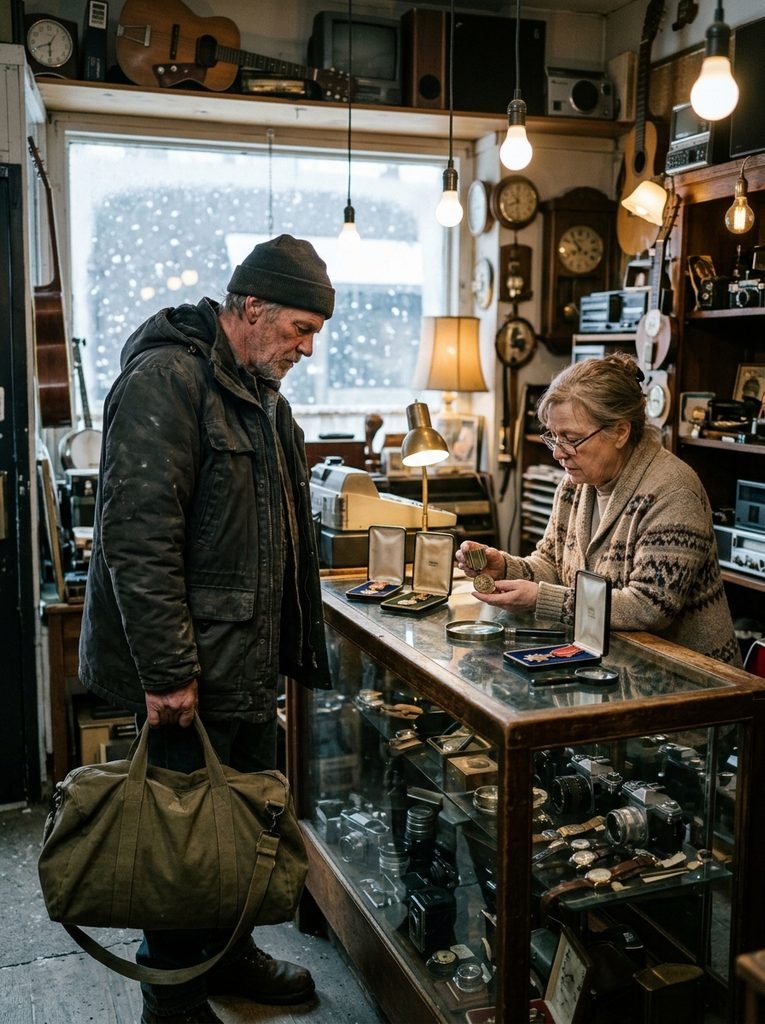
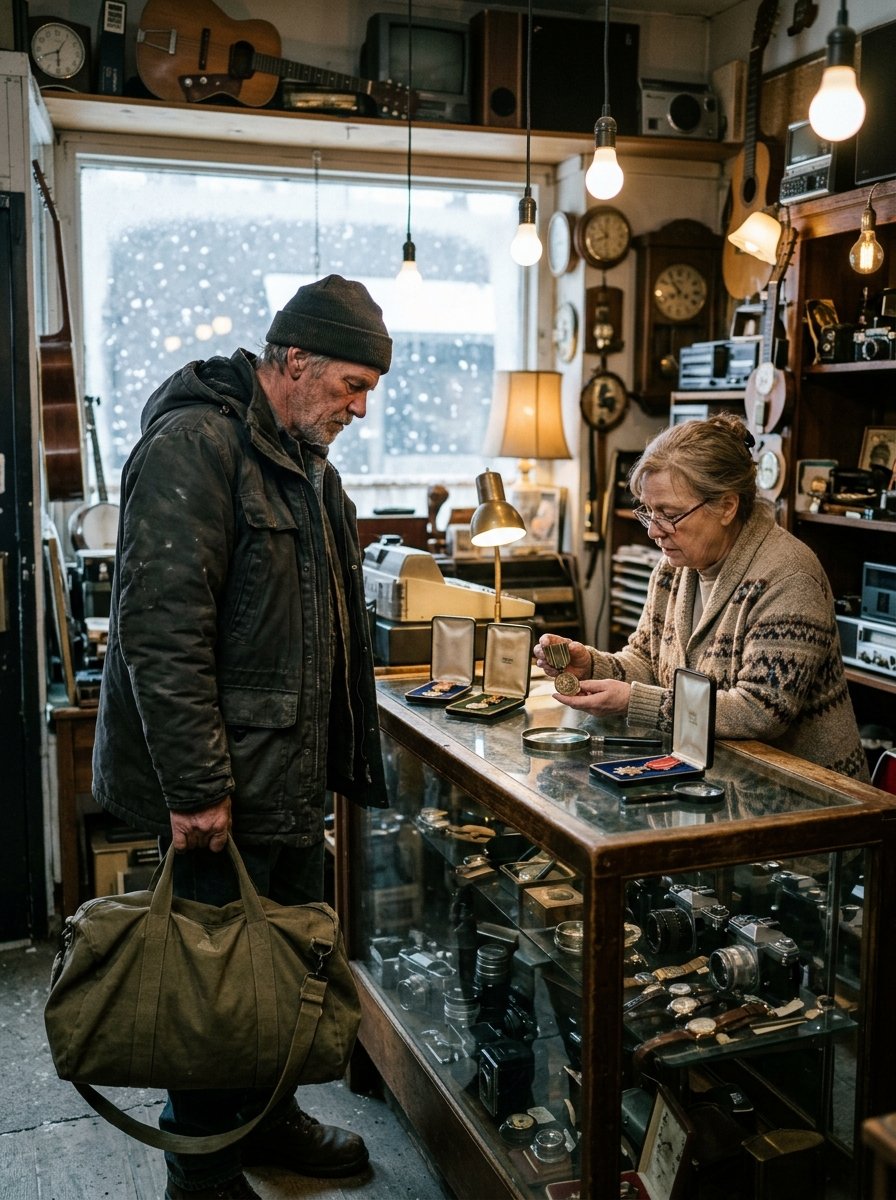
At Palmer Pawn & Loan, Nora Alvarez turned the medal over twice.
Then asked for my DD-214.
The official discharge record listed an Army Commendation Medal.
No V device.
I shrugged.
“Paperwork mistake.”
“Maybe.”
“Thirty-five years ago.”
“Still a paperwork mistake.”
I wanted ninety dollars.
Nora wanted accuracy.
She called somebody named Leon Burke at the county veterans service office.
Nora had served eight years in Army personnel before opening the pawnshop with her husband.
That explained why she cared.
Leon arrived twenty minutes later carrying a travel mug and the expression of a man accustomed to veterans insisting they did not need anything.
He read the discharge record.
Looked at the medal.
Then asked:
“What happened February twenty-sixth?”
“Convoy incident.”
“What kind?”
I told him.
Not dramatically.
The fuel truck.
Reed.
The shoulder.
The noise.
Leon wrote notes.
“You ever file a VA disability claim?”
“No.”
“Hearing?”
“Bad.”
“How bad?”
“My customers say I make them repeat everything.”
“Shoulder?”
“Works.”
“That wasn’t the question.”
I moved it.
Pain shot across the joint.
Nora stared.
“Very convincing.”
I became irritated.
“I did not come here looking for benefits.”
Leon nodded.
“Most people don’t.”
“I came for ninety dollars.”
“Then take ninety dollars for something else.”
Nora pointed at the commendation medal.
“You’re not pawning that here.”
“I thought businesses liked customers.”
“We do. Bad decisions are optional.”
She bought an old pocket watch that had been in the duffel and two duplicate commemorative coins for ninety-five dollars.
The medals went back into my bag.
Leon gave me his card.
I almost threw it away.
Instead I called Monday.
Maybe because the motel room cost sixty-two dollars.
Maybe because sleeping in my truck had made stubbornness less romantic.
The process moved slowly.
Military records request.
Medical records.
Old personnel files.
The National Personnel Records Center located most of my service documents.
The award file was incomplete.
But there was a reference in unit orders to an Army Commendation Medal for valor.
A control number.
That led to archived supporting correspondence.
Not some secret Pentagon file waiting with my name in red ink.
A forgotten administrative trail.
Old photocopies.
A recommendation.
Two witness statements.
One from my platoon sergeant.
Another from Calvin Reed.
The papers described the convoy fire.
They described me entering a hazardous area to help remove Reed from the disabled vehicle.
They described a shoulder injury I had never followed up on after separation.
And blast exposure documented in a field medical note.
Leon looked at me after reading it.
“You said nobody died.”
“Nobody did.”
“You know that doesn’t mean nothing happened to you.”
I disliked that sentence.
For most of my adult life, if I could still work, I considered myself fine.
Fine is a dangerous word for men who make a living with their hands.
Hearing testing showed significant loss, worse on the left.
My shoulder had an old injury and enough arthritis to explain why reaching overhead had become difficult.
None of it turned me into a disabled hero.
It gave names to problems I had treated as aging.
We filed claims.
We also filed a request to correct the military record so the valor designation shown in the old orders would appear accurately.
That took months.
Meanwhile, my civilian life remained a mess.
My divorce attorney, Rachel Powell, worked with a veterans legal-aid clinic Leon recommended.
Free initial help.
Reduced fees afterward.
Janice had not legally stolen my entire shoe business.
She had simply used paperwork and access in a way that made it feel that way.
The leaseholding LLC was marital.
The equipment had been purchased with marital funds.
Customer receivables were traceable.
Inventory was traceable.
My labor obviously belonged to no one.
The court eventually entered temporary orders giving me access to the shop during the case.
The first morning I unlocked Keene Repair again, I stood inside for almost ten minutes.
Dust.
Leather.
Glue.
The broken bell.
Everything exactly where it had been.
Except me.
I had changed.
Janice came by in the afternoon.
Not to fight.
To collect bookkeeping files her attorney had requested.
She saw the Army duffel beside my bench.
“You still have that thing?”
“Yes.”
“What are you doing with it?”
“Nothing.”
She looked exhausted.
Divorce had not made her happy either.
That surprised some ugly part of me.
I had imagined her thriving immediately would prove I was the failure.
Instead, we were both fifty-eight and tired.
She asked:
“Where are you staying?”
“Apartment above McKenna Hardware.”
That was new.
Mr. McKenna, one of my oldest customers, owned a small apartment over his store.
When he heard I had been sleeping in the truck, he offered it at a rent I could manage.
Janice looked down.
“I didn’t know you were sleeping in the truck.”
“You told me to rot in hell.”
She closed her eyes.
“I was angry.”
“So was I.”
“I shouldn’t have said it.”
“No.”
That was the first apology either of us offered.
It did not save the marriage.
Apologies do not always function as glue.
Sometimes they simply keep broken pieces from cutting people later.
The legal process lasted nine months.
Janice kept the house.
That made sense.
It had come from her family, though I received compensation for some documented marital improvements.
I kept the repair business, its equipment, customer list, and liabilities.
Savings were divided fairly after attorneys finished arguing.
Nobody ended rich.
Nobody ended destroyed.
Real divorce is disappointingly administrative.
The military record correction arrived two months later.
My official file was updated to reflect the Army Commendation Medal with valor device.
One line.
That was all.
No television.
No Pentagon ceremony.
No general at my door.
Leon printed the corrected record and slid it across his desk.
“Thirty-five years late.”
I looked at it.
“I already had the medal.”
“Now the government agrees you had it.”
I laughed.
Nora was right.
Accuracy mattered.
The VA claim took longer.
Hearing loss.
Tinnitus.
Shoulder condition.
Eventually I received a disability rating that came with monthly compensation and healthcare eligibility for several service-connected problems.
The amount did not transform my life.
It paid rent.
Some months, that felt transformative enough.
More important, I received hearing aids.
The first day I wore them inside the shop, the bell above the door rang.
I froze.
A customer stepped inside.
“You okay, Art?”
I looked at the bell.
It had not been broken since 2017.
I simply had not been hearing it.
That shook me.
There are losses you can normalize so completely that recovery feels like discovering a new sense.
I called Nora.
“The bell works.”
“What bell?”
“My shop bell.”
She understood.
“Oh.”
“I thought it was broken.”
She was quiet.
Then:
“You owe me.”
“For what?”
“Being right.”
“That is not how debt works.”
“It should be.”
Calvin Reed contacted me that winter.
The man from the burning fuel truck.
Leon had located him while gathering a witness statement.
Calvin lived in Arizona.
Seventy years old.
Retired high-school shop teacher.
We spoke on the phone.
His voice was gravelly.
“You sound old.”
“So do you.”
“That’s rude. You dragged me out of a truck. Show respect.”
I laughed harder than I had in months.
Then he became quiet.
“I tried finding you after I retired.”
“Why?”
“To say thank you when neither of us was twenty-three and stupid.”
“We were definitely stupid.”
“You saved my life.”
“I helped.”
“You always do that?”
“What?”
“Make things smaller.”
I stared at the repaired boot on my bench.
“I don’t know.”
He did.
Calvin remembered more of the incident than I did.
He remembered me going back toward the cab after someone said there might be another soldier inside.
There wasn’t.
He remembered Sergeant Wells physically grabbing me and pulling me down before another explosion.
I remembered none of that clearly.
Trauma edits.
He said:
“You were shaking so badly afterward you couldn’t light a cigarette.”
“I didn’t smoke.”
“You were trying to light mine.”
That sounded possible.
We talked almost two hours.
When the call ended, I took the Army medal out of the case.
For thirty-five years, I had treated it like an object from another man’s life.
Young Art.
Army Art.
Someone who had done one useful thing and then become ordinary.
That division stopped making sense.
The same man who ran toward a burning vehicle spent twenty-six years repairing strangers’ boots because throwing useful things away bothered him.
Maybe the scale changed.
The instinct didn’t.
Keene Repair survived the divorce.
Barely at first.
Some customers had assumed I closed.
I put a handwritten sign in the window:
ART IS BACK. SAME BAD COFFEE.
Business returned.
Nora brought in three pairs of boots at once.
“You don’t even wear work boots.”
“My nephews do.”
“You have one nephew.”
“Stop auditing my family.”
She became a friend.
Leon too.
Every Tuesday morning, several veterans from the county office started meeting at the diner across the street.
I occasionally joined them.
Not every veteran wants to spend breakfast telling war stories.
Mostly we complained about property taxes and cholesterol.
That felt healthier.
One afternoon, a nineteen-year-old named Mason came into the shop carrying combat boots.
New Army recruit.
He wanted a seam reinforced before basic training.
I told him the boots would probably survive without my help.
He said:
“My granddad says always fix things before they become emergencies.”
Smart granddad.
While I worked, Mason noticed the medal case on a shelf.
I kept it there now.
Not displayed like a shrine.
Just visible.
“You were Army?”
“Long time ago.”
“What’d you do?”
“Transportation.”
He waited.
That was all I gave him.
Then he smiled.
“My mom thinks I’m making a mistake.”
“She might be right.”
He looked horrified.
I laughed.
“You can make a good decision and still discover parts of it were mistakes.”
That seemed to disappoint him.
Good.
Young people deserve fewer slogans.
After he left, I thought about Janice.
For years I blamed her for making me feel small.
She contributed.
Absolutely.
But she did not invent the belief.
I had been making myself small long before she said the words.
My service was nothing special.
My shop was just shoes.
My shoulder just hurt.
My hearing was just age.
My needs were inconvenient.
My memories were old.
I had reduced myself so consistently that when Janice finally left and took everything she legally could reach first, I believed the remaining pieces were worth ninety dollars.
That was the real reason the pawnshop mattered.
Not because Nora discovered a secret fortune.
There wasn’t one.
Not because Washington had been waiting to reward me.
It hadn’t.
A bureaucracy had made a record incomplete thirty-five years earlier.
A woman who knew what she was looking at noticed.
Then she refused to let my desperation turn that mistake into a permanent loss.
A year after the divorce became final, I went back to Palmer Pawn & Loan.
I carried the Army Commendation Medal.
Nora looked at it.
“No.”
“I haven’t asked anything.”
“You’re still not selling it.”
“I know.”
I placed a small wooden frame on the counter.
Inside was a copy of my corrected service record and the medal.
“I need you to hang this somewhere.”
She stared.
“In my pawnshop?”
“You started it.”
She became suspiciously interested in rearranging papers.
“You’re trying to make me emotional at work.”
“Yes.”
“Terrible customer.”
“I’m not a customer.”
She looked at me.
Then smiled.
“No. I guess you aren’t.”
The frame hangs behind her counter now.
Most customers never notice it.
That’s fine.
Recognition does not need an audience to be real.
I still repair shoes.
I still live above McKenna Hardware, although I could afford a slightly better apartment now.
I like the place.
My truck still has rust over the rear wheel.
Calvin says I should replace it before it disintegrates.
He calls every few weeks.
Janice and I speak occasionally.
Birthdays.
Tax documents.
A mutual friend’s funeral.
We are kinder divorced than married.
That happens.
She once asked whether I hated her.
I said no.
I meant it.
Then she asked whether I forgave her.
I told her:
“Some days.”
That was honest too.
At fifty-eight, I thought my life had collapsed because my wife took the house, the accounts, and the keys to my shop.
At fifty-nine, I understood something different.
The worst thing I had lost happened years before the divorce.
I had stopped keeping track of my own worth.
Not financial worth.
Usefulness.
History.
The things my hands had done.
The people I had helped.
The life I had built one repaired sole at a time.
A medal could not restore all of that.
Neither could a corrected record.
But when Nora turned that little piece of metal over in her hand and refused to buy it, she forced me to ask a question I had avoided for decades.
What if the things I had dismissed as ordinary were never ordinary at all?
I never pawned the medal.
I still have the ninety-five dollars receipt from the watch and coins.
It sits inside the old Army duffel.
A reminder that on the poorest day of my adult life, I walked into a pawnshop believing everything left of me could be priced.
I was wrong.
Disclaimer: This story is fictional and created for entertainment purposes only. Any names, characters, places, or events are fictitious or used fictitiously. No real person or organization is intended to be portrayed.