My mom said I wasn’t welcome at my own lake house—after I spent
“””My mom said I wasn’t welcome
at my own lake house—after I spent
$67K fixing it up.
So I sold it
while they were still inside.
True story.
You won’t believe what they found
when they got home….
My mom said I wasn’t welcome
at my own lake house—after I spent
$67,000 fixing it up.
So I sold it
while they were still inside.
My name is Claire Bennett,
and the lake house sits outside
Coeur d’Alene, Idaho.
My grandfather left it to me
when he died,
along with a handwritten note that said,
“Make this place yours
before someone else decides
what it should be.”
For six years,
I did exactly that.
The roof leaked.
The deck had rotted through.
The kitchen still had
avocado-green cabinets from 1978.
I refinanced my condo,
picked up weekend consulting work,
and poured $67,000 into making
the place livable again.
New plumbing.
New windows.
A rebuilt dock.
I even restored the stone fireplace
my grandfather had built himself.
Then my mother, Diane,
started calling it “the family lake house.”
At first,
I let it slide.
She asked to spend
one weekend there with my stepfather, Mark.
Then my younger sister, Kayla,
came with her husband and kids.
Soon, they were leaving clothes
in the closets,
food in the freezer,
and boats tied to my dock
without asking.
The breaking point came
on Memorial Day weekend.
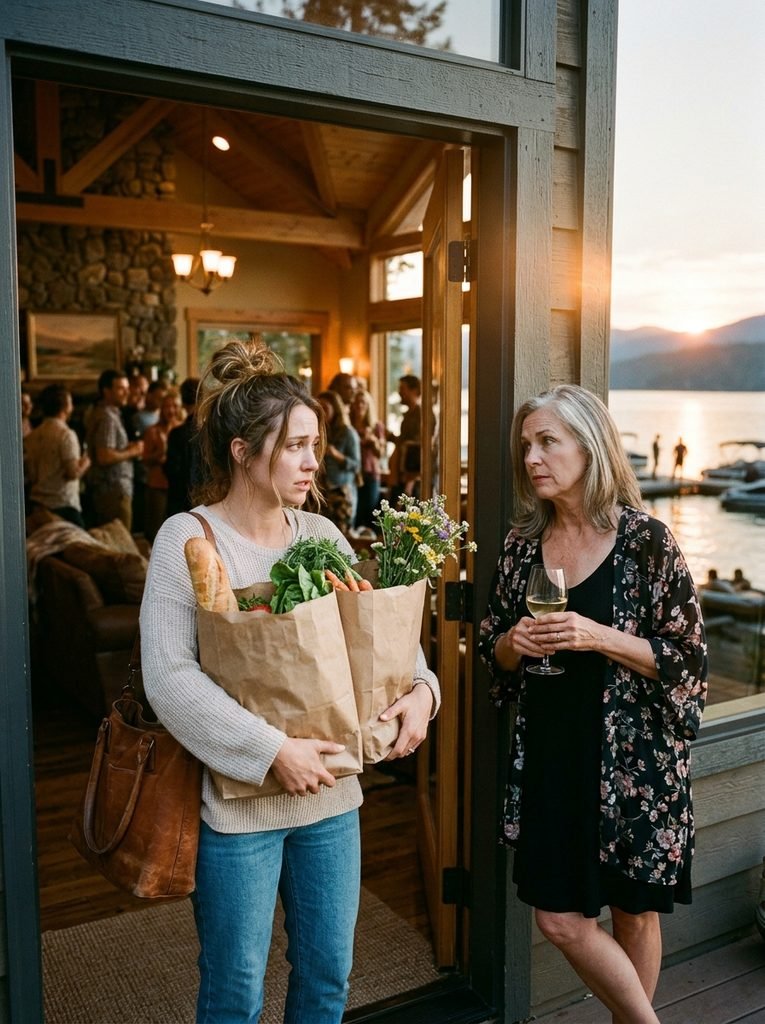
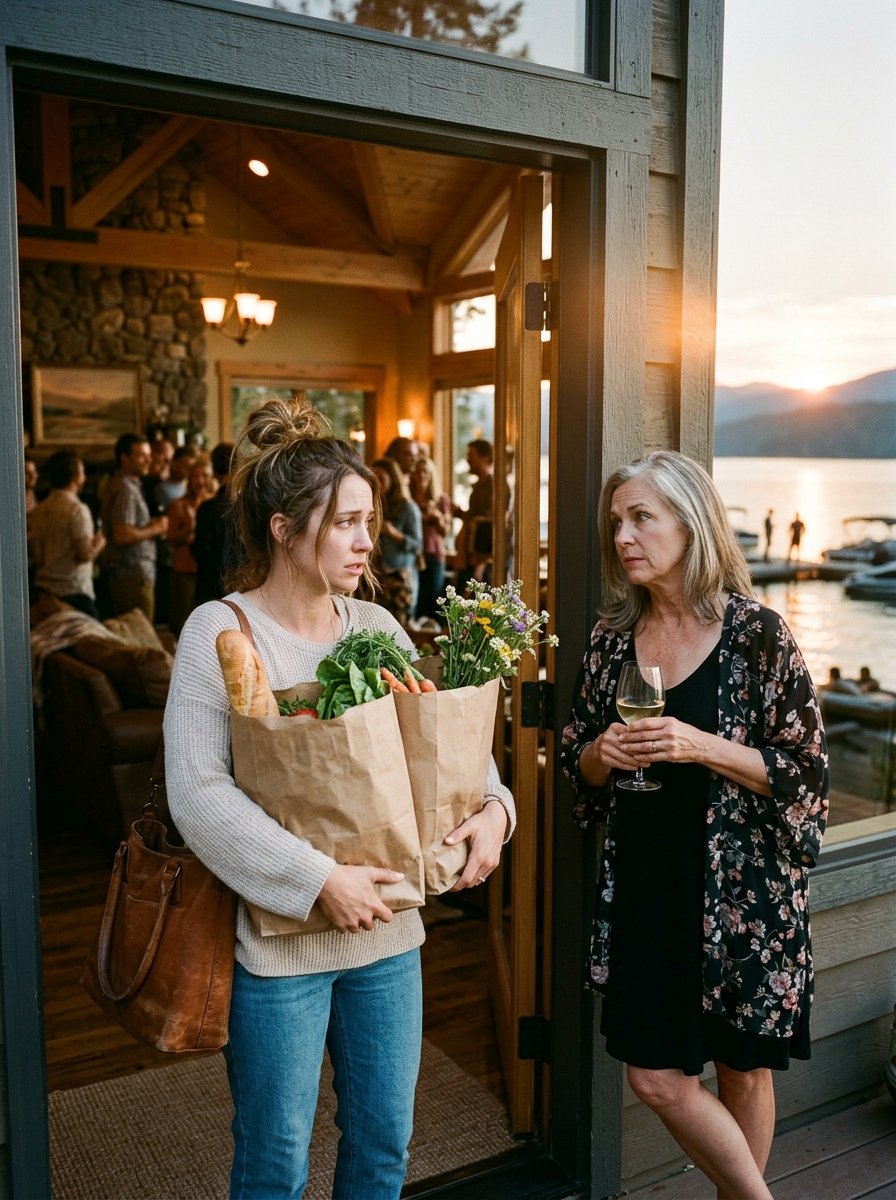
I drove up after work
with groceries in the back seat
and found eight cars in my driveway.
Music was blasting from the deck.
Kayla’s kids were jumping off
my restored dock.
Mark had dragged my new patio furniture
down to the firepit.
Mom met me at the front door
holding a glass of wine.
“Oh,” she said.
“You came.”
I stared at her.
“It’s my house.”
Her smile disappeared.
“We’re having family time, Claire.
You always make things tense.”
I thought I had misheard her.
“Are you telling me to leave?”
She lowered her voice.
“I’m telling you
that you’re not welcome tonight.”
Behind her,
my sister laughed
at something someone said inside.
For a few seconds,
I could hear nothing
except the screen door rattling
in the wind.
I had paid every tax bill.
Every contractor.
Every utility.
My name was the only name
on the deed.
And my mother was standing
in my doorway
telling me I didn’t belong there.
So I smiled.
“Okay,” I said.
She looked relieved.
That was her mistake.
I drove back to Spokane that night,
opened my laptop,
and emailed the realtor
who had been trying to buy
the property for one of her clients
since spring.
By 9:17 the next morning,
I had accepted a cash offer.
There was just one problem.
My family had absolutely no idea
I was selling.
And the buyer wanted possession
in forty-eight hours…
You won’t believe what happened next…
We were genuinely moved by this one.
Curious how it lands with you —
the story continues just below”””
At 9:18,
my phone rang.
It was my realtor,
a woman named Meredith Shaw,
who had spent twenty years selling
lakefront properties around northern Idaho.
She didn’t sound excited.
She sounded concerned.
“Claire, before we go any further,
I need to ask you something.”
I looked at the lake house
photographs open on my laptop.
“What?”
“Is anyone living in the property?”
I almost laughed.
Then I remembered my mother’s wineglass.
The way she’d stood
in my doorway.
The casual certainty
with which she’d ordered me
out of my own home.
“My family is staying there
for Memorial Day weekend.”
Meredith went quiet.
“Are they tenants?”
“No.”
“Do they pay rent?”
“Absolutely not.”
“Do they have a written agreement
allowing them to occupy the house?”
“No.”
“Then I need you
to speak with an attorney
before we promise vacant possession.”
I leaned back in my chair.
The excitement I’d felt
while accepting the offer
began to settle into something heavier.
“What about the forty-eight hours?”
“That’s the buyer’s requested timeline.
It isn’t a completed closing.”
She paused.
“And Claire?”
“Yes?”
“Please don’t change the locks
while anyone is inside.
Don’t touch their belongings.
Let’s handle this properly.”
I closed my eyes.
For one reckless moment,
I’d imagined arriving with a locksmith,
watching my mother discover
that the house she’d claimed
no longer belonged to me.
But Meredith was right.
I wasn’t going to trade
six years of hard work
for a moment of revenge
that could create a legal nightmare.
I wanted something better.
I wanted to be finished.
Permanently.
So I called an attorney.
Her name was Rebecca Sloan.
She listened without interrupting
as I explained the inheritance,
the renovations,
the unpaid bills,
and the Memorial Day confrontation.
When I reached the part
about my mother telling me to leave,
Rebecca asked one simple question.
“Why did you leave?”
I stared at the wall.
“Because she told me to.”
“But you owned the house.”
“I know.”
“Did you want to leave?”
“No.”
The silence that followed
was almost unbearable.
Then Rebecca said something
I hadn’t expected.
“Claire, you’ve spent a long time
treating your own boundaries
as something other people can overrule.”
I swallowed.
She continued gently.
“Let’s make sure
that doesn’t happen again.”
We discussed the sale.
The temporary nature
of my family’s visits.
The personal property
they had accumulated inside.
The importance of documenting
the withdrawal of their permission
to use the house.
And the possibility
that closing might need
to be postponed
until the property was vacant.
I agreed to everything.
There would be no illegal lockout.
No discarded belongings.
No dramatic confrontation
involving a moving truck
and a sheriff.
Just a documented sale,
a lawful end
to their use of my property,
and a woman finally taking control
of something she’d paid for herself.
When the call ended,
I opened my family group chat.
Forty-three unread messages
waited beneath a photograph
Kayla had posted that morning.
My mother stood on the dock,
holding a coffee mug.
The caption read:
“Another perfect morning
at our family paradise.”
Our.
I stared at that word.
Then I started typing.
“Mom, Mark, and Kayla,
I’m notifying you
that I’m selling the lake house.
Your permission to use the property
is being withdrawn.
Please don’t make additional plans
to stay there.
I’ll contact you shortly
about collecting your belongings.”
I read it twice.
Then I pressed send.
Three little dots appeared.
Disappeared.
Appeared again.
My phone rang.
Mom.
I let it ring.
She called again.
Then Kayla.
Then Mark.
The group chat exploded.
“WHAT DO YOU MEAN SELLING?”
“Claire, this isn’t funny.”
“Mom is crying.”
“Call us RIGHT NOW.”
I placed the phone facedown
and walked into my kitchen.
For the first time
in nearly twenty-four hours,
I noticed that I was hungry.
I made two pieces of toast.
Poured myself some coffee.
Sat beside the window.
And ate breakfast
while my family discovered
that my silence
had not meant surrender.
It had meant
I was finally making a decision
without asking their permission.
By eleven,
my mother had left
six voicemails.
I listened to the first.
“Claire, sweetheart,
I think you’ve misunderstood
what happened last night.”
Her voice was soft.
Almost affectionate.
“We were all just tired.
You know how holidays get.
Nobody meant to hurt you.”
I deleted it.
The second voicemail
was less gentle.
“You cannot make decisions
about a family property
without discussing them with us.”
I saved that one.
The third was from Mark.
“Listen, Claire,
your mother is very upset.
We’ve invested a lot
in making that house comfortable
for everyone.
You need to stop this nonsense.”
I almost dropped my coffee.
Invested?
Mark had purchased
a twelve-dollar bag of charcoal
the previous summer.
He’d also backed his boat trailer
into my new fence
and never offered to repair it.
That was the extent
of his financial investment.
Meanwhile,
I had a folder containing
six years of contractor invoices,
property tax records,
insurance payments,
and utility statements.
I knew exactly
who had paid for that house.
And it wasn’t Mark.
At noon,
Meredith sent me
the purchase agreement.
The buyer was a woman
named Evelyn Harper.
Sixty-two years old.
Recently retired.
A widow,
according to Meredith.
She’d visited the property
with her daughter in April
and fallen in love
with the restored fireplace.
Her offer was strong.
More than enough
to pay off the remaining
balance on my condo refinance,
cover the transaction costs,
and leave me
with a substantial amount
of money afterward.
For six years,
I’d treated every extra dollar
as something the lake house needed.
A new gutter.
A replacement window.
Another plumbing repair.
I’d declined vacations.
Worked Saturdays.
Missed dinners with friends.
And every time
I walked through that front door,
I convinced myself
the sacrifice was worth it.
Because the house
belonged to me.
Except lately,
it hadn’t felt that way.
It had felt like
an expensive place
where I was expected
to keep everyone else happy.
I signed the agreement,
subject to the necessary
title and closing arrangements.
Then I called Meredith.
“Tell Evelyn
the property needs to be vacated
before closing.
I won’t promise something
I can’t legally deliver.”
“Understood.”
“And Meredith?”
“Yes?”
“Please tell her
I hope she’ll love it
as much as my grandfather did.”
There was a pause.
“I think she already does.”
That afternoon,
I drove back to the lake.
Not to confront my mother.
Not to throw anyone out.
I wanted photographs
of the property
and a complete inventory
of the belongings
my family had left inside.
Rebecca had suggested
that I bring a witness.
So I called my friend Nora.
She answered on the second ring.
“Are you finally telling me
what happened yesterday?”
I told her everything.
By the time I finished,
she was silent.
Then she said,
“Claire, I’m coming with you.”
“You don’t have to.”
“That’s not what I said.”
Nora had known me
since our first year of college.
She’d watched me work
through every holiday
my mother had volunteered me
to organize.
She’d helped me paint
the lake house bedrooms.
She’d brought sandwiches
when I was repairing the deck
because I kept forgetting to eat.
And unlike my family,
she had never once
called the property hers.
When she arrived,
she brought a notebook,
a camera,
and a bag of chocolate-covered almonds.
“Emergency supplies,” she said.
“For what?”
“Whatever version of your mother
we encounter today.”
Despite everything,
I laughed.
It felt strange.
Almost unfamiliar.
We drove north
through rolling green hills,
past farms,
pine trees,
and little roadside stands
selling cherries and fresh bread.
The sky was clear.
The lake glittered
between the trees.
I had made that drive
hundreds of times.
Usually,
I felt a quiet happiness
when the water first appeared.
That afternoon,
my stomach tightened.
Eight cars were still there.
The music was louder.
Someone had hung
a bright plastic banner
across my front porch.
It read:
WELCOME TO THE BENNETT FAMILY RETREAT.
Nora stared through the windshield.
“Oh, absolutely not.”
I parked beside the garage.
Before I could open my door,
Mom came marching
down the front steps.
Kayla followed her.
Mark stood behind them,
his arms folded.
“Claire!”
Mom’s voice carried
across the driveway.
“What is this ridiculous message
about selling the house?”
I stepped out.
Nora joined me.
“I’m selling the house, Mom.”
“No, you’re not.”
It was such a familiar response
that I almost smiled.
Whenever I made a decision
my mother disliked,
she treated it
as a misunderstanding
that could be corrected
through sheer disapproval.
But this time,
there was nothing to correct.
“I accepted an offer this morning.”
Kayla let out
a disbelieving laugh.
“You’re joking.”
“No.”
Mom looked at Nora.
“Could you give us
some privacy, please?”
Nora didn’t move.
“Claire asked me to come.”
“This is a family matter.”
I stepped forward.
“Nora is staying.”
Mom’s expression hardened.
Then she turned back to me.
“Fine. Explain yourself.”
I looked past her.
At the porch.
At the banner.
At the house
my grandfather had loved.
“Yesterday, you told me
I wasn’t welcome here.”
Mom rolled her eyes.
“Oh, for heaven’s sake.”
“You told me to leave.”
“Because you were being difficult.”
I nodded.
“Then I decided
I didn’t want to own
a house where I wasn’t welcome.”
Mark stepped forward.
“You don’t sell real estate
because somebody hurts your feelings.”
“No,” I said.
“You sell real estate
because you own it
and decide you want to sell.”
His mouth opened.
Nothing came out.
Kayla gestured toward the house.
“What about the kids?”
“What about them?”
“They love this place!”
“So do I.”
“Then why are you destroying it?”
The question landed harder
than I expected.
For a moment,
I saw my grandfather
sitting on the dock
with a fishing rod
resting across his knees.
I remembered the first summer
he taught me to swim.
The smell of pine needles.
The cold water.
His laughter
when I caught my first fish
and immediately dropped it
back into the lake.
I wasn’t destroying anything.
I was letting it go
before the people I loved
destroyed every happy memory
I had left there.
But Kayla wasn’t waiting
for an answer.
She was already crying.
“You’ve always been selfish, Claire.”
Nora inhaled sharply.
I raised one hand.
“It’s okay.”
Then I looked at my sister.
“Tell me one thing, Kayla.”
“What?”
“How much did you contribute
to the new roof?”
She blinked.
“What does that have to do
with anything?”
“How much?”
“Nothing, but—”
“The dock?”
“Claire—”
“The plumbing?”
She looked at Mom.
“The insurance?
The property taxes?
The new electrical panel?”
Mom interrupted.
“Families don’t keep score.”
I turned toward her.
“No. But families also don’t
tell the person paying every bill
that she isn’t welcome
in her own home.”
For a moment,
nobody spoke.
Then Mark pointed
toward the driveway.
“We’re not leaving
because you’re having a tantrum.”
I looked directly at him.
“I’m not asking you
to leave without notice.
You’ll receive the arrangements
for collecting your things
and ending your use of the property.”
“You think some realtor
can just show up
and kick us out?”
“No.”
My voice stayed calm.
“That’s why I hired an attorney.”
That changed the atmosphere.
Mom’s eyes narrowed.
“An attorney?”
“Yes.”
“You’re bringing lawyers
into a family disagreement?”
“I’m handling
a real estate transaction.”
She stared at me.
I continued.
“I’m here to document
the condition of the house
and identify the belongings
that need to be collected.
Nora is my witness.”
Kayla suddenly looked nervous.
“Document the condition?”
I glanced toward the deck.
Then I noticed
something that made
my stomach drop.
My grandfather’s wooden canoe
was no longer hanging
beneath the covered storage area.
I turned toward Mark.
“Where’s the canoe?”
He looked away.
“What canoe?”
“The wooden canoe
that was hanging
under the east side
of the boathouse.”
“Oh, that old thing?”
My fingers went cold.
“Where is it?”
Mark shrugged.
“I moved it.”
“Where?”
“Don’t start, Claire.”
Nora stepped closer to me.
“Mark, she asked you
where her canoe is.”
He gave a dismissive laugh.
“It was taking up space.
A guy at the marina
said he could use it.”
I stared at him.
“You gave away
my grandfather’s canoe?”
“It was falling apart.”
“No, it wasn’t.”
I’d spent an entire summer
restoring that canoe.
Sanding the hull.
Repairing the wooden seats.
Replacing damaged fasteners.
Applying coat after coat
of marine varnish
until the old cedar
glowed beneath the sunlight.
My grandfather had built it
with his own hands.
And Mark had given it away.
“Who has it?”
He shifted his weight.
“Some guy named Peter.”
“His full name.”
“I don’t know.”
“His phone number.”
Mark exhaled loudly.
“You’re being ridiculous.”
I took out my phone.
“Then I’ll contact the marina.
If necessary,
I’ll make a police report
about the missing canoe.”
Mom immediately stepped between us.
“Stop threatening your stepfather!”
I looked at her.
“I’m asking for my property back.”
“It’s an old boat!”
“It belonged to Grandpa.”
Her expression changed.
Not with understanding.
With irritation.
“Oh, here we go again.
Everything is always
about your grandfather.”
Something inside me
went perfectly still.
Because suddenly,
I understood
what had been happening
for years.
My grandfather had left me
something my mother couldn’t control.
She hadn’t been able
to change his will.
She couldn’t put her name
on the deed.
So she’d tried
to turn my ownership
into an obligation.
A family responsibility.
A debt I was expected
to repay forever.
And whenever I reminded her
that the house belonged to me,
she made me feel
as though I were betraying
the people I loved.
I looked at her.
“Yes, Mom.
It is about Grandpa.”
She crossed her arms.
“He would be ashamed
of what you’re doing.”
For a moment,
I couldn’t speak.
Then Nora said quietly,
“I don’t think you know that.”
Mom turned on her.
“Stay out of this.”
Nora didn’t raise her voice.
“You don’t get to tell Claire
what her grandfather would think.”
I looked down
at the gravel beneath my shoes.
My hands were shaking.
But not because
I doubted my decision.
Because I finally understood
how long I’d been afraid
to make one.
I looked at Mark again.
“I need the canoe returned.”
He reached into his pocket.
Pulled out his phone.
And made a call.
Thirty seconds later,
he handed me the device.
“Here. Talk to him yourself.”
A man’s voice answered.
“Hello?”
“My name is Claire Bennett.
I understand you have
a wooden canoe
that belongs to me.”
“Oh.”
There was a pause.
Then he said,
“You’re the granddaughter?”
My throat tightened.
“Yes.”
“I’m Peter Lawson.
Your grandfather used to bring
that canoe to the marina
when I was a kid.”
I closed my eyes.
Peter continued.
“Mark told me
the family didn’t want it anymore.
I was planning to restore it
for my son.”
“It’s already been restored.”
Another pause.
“Then I think
there’s been a misunderstanding.”
His voice softened.
“I’ll bring it back tomorrow.
I wouldn’t have taken it
if I’d known.”
I thanked him.
Returned Mark’s phone.
And walked past my family
toward the house.
Nobody tried to stop me.
Inside,
the living room smelled
of sunscreen,
stale beer,
and barbecue smoke.
Someone had moved
my grandfather’s rocking chair
into the corner
and piled beach towels
across the seat.
Plastic cups covered
the antique sideboard.
A wet swimsuit hung
from the brass fireplace screen.
My mother’s purse
sat on the kitchen counter
beside a shopping bag
filled with decorative signs.
One said:
LAKE LIFE IS THE BEST LIFE.
Another:
FAMILY IS EVERYTHING.
I almost laughed.
Then I noticed
a stack of papers
on the dining table.
At first,
I thought they were menus.
But when I moved closer,
I saw a floor plan
of my lake house.
Someone had drawn
a large red rectangle
around the downstairs bedroom.
Beside it,
in my mother’s handwriting,
were the words:
CLAIRE’S ROOM — STORAGE.
My mouth went dry.
I picked up the paper.
Underneath was another sheet.
A handwritten schedule.
Summer weekends.
Fourth of July.
Labor Day.
Thanksgiving.
Christmas.
Every major holiday
had been divided
between Mom and Mark,
Kayla and her family,
and several relatives
I barely knew.
My name appeared once.
Beside the last weekend
in October.
The note beside it read:
CLAIRE — MAINTENANCE WEEKEND.
I stood there
holding the papers
while the room tilted
around me.
Six years.
Six years of weekend work.
Six years of missed vacations.
And somewhere along the way,
my family had decided
I was no longer
the owner of the house.
I was the caretaker.
The person who paid the bills.
The person who fixed things.
The person who showed up
when the dishwasher broke
or the roof needed cleaning.
And in return,
they had generously assigned me
one weekend in October.
To perform maintenance.
Nora came into the kitchen.
“Claire?”
I handed her the schedule.
She read it.
Then she looked at me.
“Please tell me
I’m misunderstanding this.”
I shook my head.
She turned the paper over.
There was more writing
on the back.
A shopping list.
New patio heater.
Extra bunk beds.
Outdoor kitchen.
Kayla’s handwriting appeared
near the bottom.
“Ask Claire to pay
before July Fourth.”
Nora slowly placed
the papers on the counter.
“Take photographs of everything.”
I did.
Then I opened the refrigerator.
Half the shelves
were filled with food
I’d never purchased.
Several bottles of expensive wine
stood beside a container
of homemade potato salad.
One bottle had a note.
DO NOT TOUCH — MOM’S.
I stared at it.
Then I opened
the bottom kitchen drawer.
My grandfather’s old recipe book
was gone.
I looked in the pantry.
Nothing.
I checked the cabinets.
Still nothing.
Finally,
I walked into the living room.
“Mom, where’s Grandpa’s recipe book?”
She was sitting
on the sofa now,
talking quietly with Kayla.
“What recipe book?”
“The blue notebook
with his handwritten recipes.”
“Oh, I took that home.”
“Why?”
“Because I wanted it.”
I looked at her.
“That was in the house
when Grandpa left it to me.”
“Claire, he was my father.”
“I know.”
“So I think
I’m entitled to keep
a few things of his.”
I nodded slowly.
“Then why didn’t you ask?”
She looked annoyed.
“Because I shouldn’t have to.”
There it was.
The sentence that explained
nearly everything.
She shouldn’t have to ask.
Not before using my house.
Not before inviting guests.
Not before giving away belongings.
Not before deciding
which weekends I could visit.
Not before telling me
I wasn’t welcome.
Because asking
would mean acknowledging
that the answer
might be no.
I looked at her.
“Please bring the notebook back
when you collect your belongings.”
Then I walked away.
I photographed the rooms.
The damaged patio furniture.
The scratched dining table.
The broken latch
on the boathouse door.
I documented the personal items
my family had left behind.
And when Nora and I finished,
we went outside
to sit near the water.
The afternoon sun
was beginning to turn gold.
A fishing boat moved slowly
across the far side
of the lake.
For a while,
neither of us spoke.
Then Nora asked,
“Are you sure
you want to sell it?”
I looked at the house.
The restored windows.
The pale blue siding.
The stone chimney.
“I don’t know.”
It was the first time
I’d admitted that
to anyone.
“I love this place.”
“I know.”
“I put everything into it.”
“I know.”
“And now I’m selling it
because my mother
was cruel to me.”
Nora shook her head.
“No.”
I looked at her.
“You’re selling it
because you finally realized
that loving something
doesn’t mean you have
to keep sacrificing yourself
to protect it.”
I stared across the water.
She continued.
“You could keep the house.
You could stop letting
your family use it.
You have choices, Claire.”
“I know.”
“But if you want to sell,
that can be your choice too.”
I thought about
the last six years.
Every Saturday morning
spent repairing something.
Every holiday
spent accommodating someone.
Every phone call
that began with
“We need to talk
about the lake house.”
I pictured myself
five years from now.
Ten years from now.
Still driving up here
to fix things
for people who resented
my right to say no.
Then I pictured something else.
A quiet Saturday morning
in my own condo.
Coffee beside an open window.
A vacation I didn’t cancel.
Money in the bank.
A life that belonged
entirely to me.
I turned to Nora.
“I’m sure.”
She took my hand.
“Then sell it.”
We stayed beside the lake
until the shadows lengthened.
When I finally stood,
my mother was watching us
from the porch.
She didn’t wave.
Neither did I.
The following morning,
Peter Lawson returned the canoe.
He arrived at nine,
driving an old pickup truck
with a small trailer attached.
I was waiting in the driveway
with Nora.
Peter climbed out
and extended his hand.
“Claire Bennett?”
“That’s me.”
He studied my face.
Then he smiled.
“You have your grandfather’s eyes.”
My throat tightened.
“You knew him well?”
“Better than most.”
Peter walked toward the trailer.
Together,
we carefully unloaded
the wooden canoe.
The cedar hull
was exactly as I’d left it.
The varnish still shone.
The brass fittings
caught the morning light.
Peter ran one hand
along the gunwale.
“He built this
the summer I turned fourteen.”
I looked at him.
“You were there?”
He nodded.
“Helped him carry
the lumber down to the water.”
I stared at the canoe.
My grandfather had told me
how he’d built it.
But he’d never mentioned Peter.
“He said he wanted
something light enough
for a little girl
to paddle someday.”
Peter smiled.
“That little girl was you.”
I looked away.
For a moment,
I was eight years old again,
sitting in the front seat
of that canoe
while Grandpa paddled
through the morning mist.
Peter reached into his truck
and retrieved a small envelope.
“Your grandfather gave me this
a few years before he passed.
I found it
while looking for old photographs
to help me restore the canoe.”
I accepted it.
Inside was a faded photograph.
Grandpa stood beside
the unfinished canoe,
holding a sanding block.
A teenage Peter
grinned beside him.
And in the background,
near the water,
stood my mother.
Young.
Barefoot.
Smiling.
I stared at her face.
She looked happy.
Not angry.
Not disappointed.
Not burdened
by everything she believed
other people owed her.
Just happy.
Peter noticed my expression.
“Your mother loved this lake
when she was young.”
“I know.”
“Your grandfather did too.”
He hesitated.
“That’s why he was
so particular about
who got the house.”
I looked up.
“What do you mean?”
Peter glanced toward the porch.
Mom had appeared
behind the screen door.
He lowered his voice.
“Maybe that’s something
you should ask her.”
Then he helped me
carry the canoe
back to the boathouse.
Before leaving,
he offered one final thought.
“Your grandfather always said
a house should be
a place you can breathe.”
I looked toward the water.
“That’s what he wanted
this place to be.”
Peter nodded.
“For you.”
After he drove away,
I stood alone
beside the canoe.
The wind moved gently
through the pine trees.
I touched the smooth cedar.
Then I went inside
to find my mother.
She was sitting
at the kitchen table.
A cup of coffee
rested beside her hand.
“Peter said Grandpa
was particular about
who got the house.”
Her expression changed.
“What did he tell you?”
“Nothing specific.”
She looked away.
I sat across from her.
“Why did Grandpa leave it
to me, Mom?”
She sighed.
“Because you were his favorite.”
“That’s not an answer.”
“It is the answer.”
“Then why are you angry
that he left it to me?”
Her eyes flashed.
“I’m not angry.”
“Mom.”
She stared at her coffee.
For a long time,
the only sound
was the refrigerator humming
behind us.
Finally,
she spoke.
“Your grandfather promised me
that house when I was younger.”
I felt something shift
inside my chest.
“When?”
“After your grandmother died.”
“What happened?”
She pressed her lips together.
“We disagreed.”
“About what?”
She laughed bitterly.
“About everything.”
I waited.
She looked toward the window.
“Mark wanted us
to sell the property.
We could have paid off
our mortgage,
taken a proper vacation,
maybe even retired early.”
I stared at her.
“Grandpa was still alive.”
“I know.”
“And you wanted him
to sell his home?”
“We wanted him
to consider his options.”
“What did he say?”
She didn’t answer.
Then, very quietly,
“He said
it wasn’t ours to sell.”
The words settled
between us.
I looked at the fireplace.
At the mantel
I’d carefully refinished.
At the old photographs
I’d arranged there
after Grandpa died.
“And he left it to me.”
Mom nodded.
“Yes.”
“Why?”
She looked directly at me.
“Because you never asked him
for anything.”
Something in her voice
made my throat tighten.
“He used to say
you were the only one
who came up here
without wanting something.”
I thought about
those summers.
Sitting beside Grandpa
while he repaired fishing reels.
Helping him carry firewood.
Listening to stories
I’d heard a dozen times.
I’d never thought
those afternoons
were worth anything.
They were simply
where I wanted to be.
Mom’s eyes filled.
“I was his daughter, Claire.”
“I know.”
“That should have counted
for something.”
“It did.”
“Not enough.”
I looked at her.
For the first time,
I saw that her anger
wasn’t really about
the Memorial Day weekend.
It was about an inheritance
she believed should have been hers.
A decision made
by a man
who was no longer alive
to defend it.
And every time
I refused to let her
treat the house as her own,
she experienced that refusal
as another rejection
from her father.
I understood her pain.
But understanding it
didn’t make me responsible
for surrendering my property
to relieve it.
“Mom, Grandpa left me
the lake house.”
She wiped her eyes.
“I know that.”
“And for six years,
I’ve tried to make sure
you could enjoy it too.”
She looked away.
“But yesterday,
you told me
I wasn’t welcome.”
“I was upset.”
“You meant it.”
She didn’t answer.
“You looked me in the eye
and told me to leave.”
Her mouth trembled.
“Claire, I didn’t think
you would actually go.”
I stared at her.
“What did you think
I would do?”
She hesitated.
Then she said,
“I thought you’d apologize.”
The answer hurt
more than I expected.
Not because it surprised me.
Because it didn’t.
She’d expected me
to apologize
for arriving at my own house.
For being inconvenient.
For reminding her
that someone else
had been chosen.
I stood.
“That’s why I’m selling.”
Mom looked up sharply.
“Claire, please.”
“I love this house.
But I can’t keep living
inside a disagreement
between you and Grandpa.”
She began to cry.
I wanted to comfort her.
The old instinct
was almost overwhelming.
But I stayed where I was.
Because sometimes
the kindest thing
you can do for yourself
is stop rescuing someone
from the consequences
of their own behavior.
“I’ll arrange a time
for everyone to collect
their belongings,” I said.
Then I went outside.
By Wednesday,
the sale was moving forward.
Meredith had confirmed
that Evelyn’s funds
were available.
The title company
had started its final review.
The buyer’s inspection
was scheduled for Thursday.
But the requested
forty-eight-hour possession
wasn’t going to happen.
Rebecca had advised me
that any final handover
needed to account
for my family’s occupancy,
the removal of their belongings,
and the closing requirements.
Evelyn agreed
to extend the timeline.
She wanted the house
more than she wanted
an unnecessarily rushed transaction.
That was a relief.
But it created
one more difficult conversation.
I called Kayla.
She answered immediately.
“Have you come to your senses?”
“No.”
I heard her sigh.
“Then what do you want?”
“I’m calling about
your belongings at the lake.”
“Mom says
you’re not actually selling.”
“The sale is proceeding.”
A long silence followed.
Then Kayla said,
“You’re really doing this.”
“Yes.”
She inhaled sharply.
“Fine. Then I’ll never
speak to you again.”
I closed my eyes.
“That’s your decision.”
She made a small sound
as though I’d slapped her.
“You don’t care?”
“Of course I care.”
“Then stop selling the house!”
“Kayla, our relationship
cannot depend on
whether I let you
use my property.”
She didn’t answer.
I continued.
“I’m not taking
the kids’ memories away.
I’m selling a house.”
“You know they think
it’s our family home.”
“Because that’s what
you’ve been telling them.”
She fell silent.
Then she said something
that made me sit down.
“Mom told us
you were planning
to transfer the house
into a family trust.”
I stared at the wall.
“What?”
“She said you wanted
everyone to have
an equal share.”
My hand tightened
around the phone.
“I never said that.”
“She told us
you were just waiting
until the renovations were finished.”
I remembered the floor plan.
The summer schedule.
The proposed outdoor kitchen.
The shopping list
with my name beside it.
Suddenly,
everything made sense.
They hadn’t merely assumed
they could use my house.
My mother had been telling them
that it would eventually
belong to everyone.
I took a slow breath.
“Kayla, I never agreed
to transfer the property
to anyone.”
She sounded confused.
“But Mom said—”
“Mom doesn’t own it.”
Another silence.
Then I heard
my sister begin to cry.
Not loudly.
Not dramatically.
Just a quiet,
exhausted sound.
“I promised the kids
we’d spend every summer there.”
I looked at
the photograph of Grandpa
on my desk.
“I’m sorry
you made that promise
without talking to me.”
Kayla didn’t respond.
But she didn’t hang up.
A moment later,
she asked,
“Can we at least
come get our things?”
“Of course.”
I gave her
the arrangements Rebecca
had helped me prepare.
A scheduled collection.
A clear list
of the family’s belongings.
And a plan
for returning my keys
once the house was vacated.
Kayla listened.
Then she said quietly,
“Okay.”
It was the first time
in years
my sister had accepted
an answer she didn’t like
without demanding
that I change it.
That evening,
my mother called.
She didn’t bother
with a greeting.
“Why did you tell Kayla
I lied to her?”
I stood in my kitchen,
watching rain slide
down the window.
“Did you tell her
I was putting the house
into a family trust?”
She went quiet.
“Mom?”
“I told her
we had discussed it.”
“We never discussed it.”
“Well, I thought
it would be fair.”
“Fair to whom?”
“To everyone.”
I looked around my condo.
At the small dining table
I’d purchased secondhand.
At the kitchen cabinets
I still hadn’t replaced.
At the furniture
I’d postponed buying
because the lake house
always needed something.
“Mom, I spent $67,000
repairing that property.”
“You keep bringing up money.”
“Because you keep pretending
the work and money
came from nowhere.”
She exhaled.
“You’ve always been
so dramatic about everything.”
I closed my eyes.
There it was again.
The familiar dismissal.
The attempt to turn
a factual disagreement
into a flaw
in my personality.
But this time,
I didn’t argue.
“I’ve made my decision.”
“Then don’t expect
to be invited
to family Thanksgiving.”
The words hung
between us.
For years,
that threat
would have worked.
I would have imagined
the empty chair.
The photographs
I’d never appear in.
The stories told
about my absence.
I would have apologized
just to avoid
being left out.
But now,
I remembered Memorial Day.
The house full of people.
The music.
The laughter.
My mother standing
in the doorway
of a home I owned.
And the simple truth
that I’d already been excluded.
Even while paying
for everyone else’s comfort.
“Okay, Mom.”
She inhaled.
“What?”
“I said okay.”
“You’re choosing a house
over your family?”
“No.”
I looked out
at the falling rain.
“I’m choosing
not to be mistreated
in order to belong.”
She hung up.
I stood there
for several minutes.
My hands were shaking again.
But I didn’t call her back.
And that night,
I slept for eight hours
without waking once.
On Thursday,
the inspection went smoothly.
A few ordinary maintenance items
appeared in the report.
Nothing unexpected.
Nothing that threatened the sale.
Evelyn called Meredith afterward
and asked whether
she could speak with me.
I agreed.
We arranged to meet
at the lake house
the following morning.
When Evelyn arrived,
she wore a blue cardigan
and carried a small
leather-bound notebook.
Her daughter, Hannah,
came with her.
I met them
on the front steps.
Evelyn smiled.
“Claire, it’s lovely
to finally meet you.”
“Likewise.”
She looked past me
toward the lake.
“I’ve been thinking
about this house
since I first saw it.”
I opened the door.
“Come inside.”
We walked through
the living room
toward the fireplace.
Evelyn stopped
in front of the mantel.
She rested her fingertips
against the smooth stone.
“Did you restore this yourself?”
“Most of it.”
“It’s beautiful.”
“My grandfather built it.”
She smiled.
“I know.”
I turned toward her.
“You do?”
She opened her notebook.
Inside was an old photograph.
Two men stood
beside the fireplace.
One was my grandfather.
The other was a younger man
I didn’t recognize.
Evelyn pointed toward him.
“That’s my husband, Daniel.”
I stared at the photograph.
“Your husband knew Grandpa?”
“He worked with him
on the fireplace.”
For a moment,
I couldn’t speak.
Evelyn continued.
“Daniel was a stone mason
when we first got married.
Your grandfather hired him
to help finish this room.”
I looked toward the fireplace.
I’d spent weeks restoring it.
Scraping away old paint.
Replacing damaged mortar.
Cleaning years of soot
from the stone.
I knew every uneven edge.
Every small imperfection.
Every place
where Grandpa’s hands
had shaped the work.
But I’d never known
who had helped him.
Evelyn turned another page.
A photograph showed
my grandfather and Daniel
sitting on the dock
with fishing rods
balanced across their knees.
“Daniel loved this place.”
Her voice softened.
“He always said
the lake was the only place
where he could hear himself think.”
Hannah stepped closer.
“Dad brought us here
a few times
when we were little.”
I looked at her.
“I don’t remember.”
“You were probably
still a baby.”
Evelyn smiled.
“Your grandfather
was very proud of you.”
My throat tightened.
She turned another page.
There was a photograph
of a little girl
sitting in the canoe.
My canoe.
The child wore
a yellow life jacket
and had a crooked ponytail.
I stared.
“That’s me.”
Evelyn nodded.
“Daniel took that picture.”
I touched the edge
of the photograph.
I’d never seen it before.
Grandpa had kept albums,
but many pictures
had been lost
when water damaged
the old storage room.
Evelyn carefully removed
the photograph
from the notebook.
“I brought this for you.”
I looked at her.
“I can’t take it.”
“Of course you can.”
Her eyes softened.
“Daniel would have wanted
you to have it.”
I accepted the photograph.
For a moment,
we stood in silence.
Then Evelyn said,
“I should explain something
about the offer.”
I looked up.
She smiled gently.
“When Meredith first showed me
the house this spring,
I didn’t recognize it.”
She gestured toward
the restored windows.
“The siding was different.
The deck was new.
The kitchen had changed.”
She touched the mantel.
“But then I saw
this little mark.”
She pointed toward
the lower right corner
of the fireplace.
A tiny star
had been carved
into the stone.
I’d noticed it
while cleaning the mortar,
but I’d never understood
what it meant.
“Daniel carved that
when he finished the fireplace.”
I looked closer.
Beside the star
were two faint initials.
D.H.
“Your husband?”
She nodded.
“He said every good craftsman
should leave something
only the people who cared
would notice.”
I smiled through my tears.
Evelyn reached into her purse.
Then she handed me
a small envelope.
“There’s something else.”
Inside was a letter.
The paper had yellowed.
The handwriting
was unmistakably Grandpa’s.
Dear Daniel,
Thank you for helping me
finish the fireplace.
One day,
Claire will have this place.
I hope she’ll love it
as much as I do.
If she ever decides
she wants a different life,
I hope she’ll know
that a home is supposed
to give you freedom,
not take it away.
Your friend,
Arthur.
I read the letter twice.
Then a third time.
The room blurred.
Evelyn placed
a gentle hand
on my shoulder.
“Daniel kept that letter
for thirty years.”
I covered my mouth.
She continued.
“When I told him
I wanted a little house
by the water,
he used to say
we should find somewhere
like Arthur’s place.”
Her voice trembled.
“He died before
we could make it happen.”
Hannah took her mother’s hand.
Evelyn looked around the room.
“When Meredith showed me
this property,
I recognized the fireplace.
And I knew.”
She smiled through tears.
“This is where
I want to spend
the next part of my life.”
I looked at the letter.
Then at the house.
For weeks,
I’d felt guilty
about selling something
Grandpa had left me.
But there,
in his own handwriting,
was permission
I hadn’t known
I was looking for.
A home was supposed
to give me freedom.
Not take it away.
I handed Evelyn
the letter back.
She shook her head.
“Keep it.”
“But it’s yours.”
“It’s a letter
about your grandfather’s wishes
for you.”
She closed my fingers
around the paper.
“I think it belongs
with the photograph.”
For the first time
since Memorial Day,
I began to cry
without trying to stop myself.
Not because I was angry.
Not because I was frightened.
Because I could finally imagine
letting the house go
without feeling
that I was abandoning
the person who’d given it to me.
Evelyn waited quietly.
When I could speak,
I asked her something
that had been weighing on me.
“Will you keep the fireplace?”
She smiled.
“Claire, I bought the house
because of the fireplace.”
We laughed.
And something inside me
finally began to loosen.
The next week
wasn’t easy.
My family had agreed
to collect their belongings,
but agreement
didn’t mean cooperation.
Mark complained
about the schedule.
Kayla cried
over the children’s toys.
Mom sent messages
asking whether I was
“really willing to destroy
our family over money.”
I stopped answering
anything that wasn’t
directly related
to the property.
Rebecca handled
the formal communications.
Meredith coordinated
the inspection and closing arrangements.
And I went to work
every morning
like a person
whose entire life
wasn’t hanging
on a single decision.
That was harder
than it sounds.
For years,
I’d measured my worth
by how useful
I could be.
At work,
I was the person
who accepted difficult projects
when everyone else
had gone home.
In my family,
I was the person
who solved emergencies.
At the lake house,
I was the person
who fixed whatever broke.
Without those responsibilities,
I didn’t immediately know
what to do with myself.
One Saturday,
I woke at six
out of habit.
I made coffee.
Checked my phone.
No emergencies.
No contractor messages.
No requests
to buy groceries
for a dozen people.
I sat on the sofa
and stared at the wall.
Then I called Nora.
“What do normal people do
on Saturdays?”
She laughed.
“Anything they want.”
“That’s not helpful.”
“Okay.
What do you want to do?”
I thought about it.
For a long time,
I genuinely didn’t know.
Then I remembered
a little bookstore
I’d passed a hundred times
on my way home
from work.
“I think I want
to buy a book.”
“Then buy a book.”
“Just because?”
“Especially because.”
So I did.
I spent two hours
wandering between shelves,
reading the backs of novels
and drinking coffee
from a paper cup.
I bought three books.
One was about gardening.
One was a mystery.
And one was a collection
of essays about
starting over in middle age.
I went home.
Sat beside the window.
And read until sunset.
Nobody needed anything.
Nothing broke.
I didn’t feel guilty.
At least,
not for very long.
The following Tuesday,
Kayla called again.
This time,
her voice was different.
“Claire, can I talk
to you about something
that isn’t the house?”
I hesitated.
“Okay.”
She took a breath.
“I owe you an apology.”
I sat down.
She continued.
“I went through
our old family messages.”
I didn’t interrupt.
“I found the ones
where Mom told us
you were paying
for the roof repairs.”
Her voice cracked.
“And I found the ones
where she said
you’d agreed to host
the entire family
for every summer holiday.”
I closed my eyes.
“I never agreed to that.”
“I know.”
She inhaled shakily.
“I also found
that message you sent
three years ago
asking everyone
to help pay
for the dock.”
I remembered.
I’d sent it
after receiving an estimate
that made my stomach drop.
Nobody had responded.
Two weeks later,
I’d taken another consulting project
and paid for it myself.
Kayla continued.
“Mom told me afterward
that you didn’t need help.
That you were doing it
because you wanted
to increase your property value.”
I stared at the floor.
“That’s what she told you?”
“Yes.”
I laughed once.
A short,
humorless sound.
“I couldn’t afford
to take a vacation
that summer, Kayla.”
She started crying.
“I know that now.”
For a moment,
I felt the old instinct
to comfort her.
To say it was fine.
To assure her
that nothing had happened.
But something had happened.
Years of things.
So I stayed quiet.
Finally,
Kayla said,
“I was wrong
to call you selfish.”
“Yes,” I said.
“You were.”
She cried harder.
Then she asked,
“Do you hate me?”
I looked out the window.
“No.”
“Really?”
“I hate the way
you treated me.”
She was silent.
“But I don’t hate you.”
I heard her exhale.
“Can we fix this?”
I thought about
the old version of me.
The one who would
have said yes immediately.
The one who would
have promised
that everything was forgiven
because someone had finally
offered a small apology.
But I wasn’t ready
to pretend
that one conversation
could erase six years.
“I’d like to try.”
Kayla sniffed.
“How?”
“By being honest
with each other.”
“Okay.”
“And by not making
our relationship
depend on the lake house.”
She paused.
Then she said,
“Okay.”
It was a beginning.
Not a complete repair.
But a beginning.
That weekend,
Kayla came to collect
the remaining belongings
she had left at the property.
Her husband, Jason,
arrived with her.
He looked embarrassed
when he saw me.
“Claire, I’m sorry
about the furniture.”
I glanced toward
the patio chairs.
“What happened?”
Jason rubbed
the back of his neck.
“Mark told us
you were planning
to replace everything anyway.”
I waited.
“So we took two chairs
to our house last month.”
I stared at him.
“You took my patio furniture?”
He nodded.
“Without asking.”
“Yes.”
I inhaled slowly.
“Please bring it back.”
“We will.”
“And the folding kayak?”
Jason looked startled.
“You know about that?”
I almost laughed.
“Yes, Jason.
I know what’s missing
from my own house.”
He lowered his eyes.
“I’ll bring that too.”
Kayla stepped forward.
“Claire, I didn’t know
he’d taken the kayak.”
Jason looked at her.
She folded her arms.
“You told me
Claire said we could borrow it.”
He stared at the ground.
“I thought it was okay.”
I shook my head.
“That’s the problem.
Everyone kept deciding
what was okay
without asking me.”
Neither of them argued.
For the first time,
they seemed to understand
that my anger
wasn’t about
a single holiday weekend.
It was about
years of assumptions.
Years of taking.
Years of being treated
like a resource
instead of a person.
When they finished loading
their belongings,
Kayla lingered
beside the driveway.
Her children,
Lily and Noah,
waited in the back seat.
Lily was eleven.
Noah was eight.
They’d spent nearly every summer
playing along that shoreline.
I knew they would miss it.
I would too.
Kayla looked toward the water.
“Can the kids
say goodbye to the lake?”
I nodded.
“Of course.”
We walked down
to the dock together.
Lily held my hand.
She’d always been
a quiet child.
The sort who noticed
when someone was sad
even if nobody
said anything.
When we reached the water,
she looked up at me.
“Aunt Claire?”
“Yes, sweetheart?”
“Did Grandma really tell you
you couldn’t come
to your own house?”
Kayla closed her eyes.
I looked at Lily.
“Yes.”
She frowned.
“Why?”
I took a moment
before answering.
“Sometimes grown-ups
make decisions
they shouldn’t make.”
Lily looked toward the house.
“Mom says
you don’t want us
to come here anymore.”
I glanced at Kayla.
Her face went pale.
I knelt beside Lily.
“That’s not why
I’m selling the house.”
“Then why?”
“Because I want
to do something different
with my life.”
She thought about that.
“Like when Mom sold
our old car
and bought a new one?”
I smiled.
“A little like that.”
“Will you still
come to my birthday?”
The question nearly broke me.
I pulled her close.
“Of course I will.”
“Even without the lake house?”
“Especially without
the lake house.”
She hugged me tightly.
Then Noah asked
whether he could
skip one stone
before they left.
I found a smooth,
flat rock
near the shoreline.
He threw it.
It bounced twice.
Then disappeared
beneath the water.
“Two!” he shouted.
“That’s a new record!”
I laughed.
For one brief moment,
everything felt
the way it should have.
Not because
I owned the house.
But because
I was standing
beside people I loved
without being asked
to prove my love
by giving something away.
Before they left,
Kayla hugged me.
It was awkward.
We hadn’t hugged
without an audience
in years.
“I’m sorry,” she whispered.
“I know.”
She pulled back.
“Can I call you
next week?”
I nodded.
“Yes.”
She smiled faintly.
And for the first time,
I believed
we might eventually
find a way
to be sisters
without my mother
standing between us.
The final confrontation
came four days
before closing.
I was at work
when Meredith called.
“Claire, we have a problem.”
My stomach tightened.
“What happened?”
“Your mother is
at the lake house.”
I closed my eyes.
“Is she collecting
the rest of her things?”
“No.”
Meredith hesitated.
“She’s meeting
with a moving company.”
I sat upright.
“What moving company?”
“According to the neighbor,
she’s trying to remove
some of the furniture.”
For a moment,
I couldn’t speak.
The dining table.
The antique sideboard.
The rocking chair.
The furniture
my grandfather had left me.
“Is Mark with her?”
“Yes.”
I stood immediately.
“I’m going up there.”
Rebecca was already
on a conference call
when I reached her office.
She listened carefully,
then told me
what to document
and how to handle
the situation safely.
Meredith contacted
the moving company
and explained
that ownership of
the disputed furniture
needed to be verified
before anything was removed.
Then Nora picked me up.
Neither of us spoke
during the first
twenty minutes
of the drive.
I was too angry.
Not the hot,
explosive anger
I’d always imagined
I would feel
if my family
finally pushed me too far.
This was colder.
Sharper.
The kind of anger
that arrives
when someone crosses
a boundary
you’ve already explained
in every possible way.
When we reached
the lake house,
a large moving truck
stood in the driveway.
Two workers were waiting
beside the open rear door.
Mark stood on the porch.
Mom was inside.
I walked straight
through the front door.
She was standing
beside the dining table,
holding a roll
of packing tape.
“What are you doing?”
She looked startled.
“Claire.”
“What are you doing
with my furniture?”
She placed the tape
on the table.
“Your grandfather’s furniture.”
“Which he left
to me with the house.”
She folded her arms.
“I’m not letting
some stranger
take everything
that belonged to my father.”
I looked around.
The dining chairs
had been stacked
near the front door.
The rocking chair
was wrapped in blankets.
Someone had removed
the photographs
from the mantel.
My grandfather’s fishing rods
were leaning
against the wall.
And beside the fireplace
stood a cardboard box
filled with his books.
I looked at my mother.
“You had years
to ask me
for something of Grandpa’s.”
Her eyes filled.
“I shouldn’t have to ask
for my own father’s belongings.”
“You should have
when they belonged to me.”
She shook her head.
“You don’t understand.”
“Then explain it.”
She looked toward the fireplace.
“I grew up here.”
“I know.”
“I watched him build
this entire place.”
“I know.”
“And then he left it
to you.”
Her voice broke.
“Not me.”
I looked at her.
There was the wound
she’d carried for years.
The wound she’d tried
to heal by taking
pieces of my inheritance
until there was nothing
left that belonged
only to me.
“Mom, I’m sorry
that Grandpa’s decision hurt you.”
She looked up.
“But I didn’t make
that decision.”
She wiped her face.
“And punishing me for it
won’t change what happened.”
For a moment,
her expression softened.
Then Mark entered
the living room.
“Are we moving
this stuff or not?”
I turned toward him.
“No.”
He frowned.
“We’ve already paid
for the truck.”
“Then you’ll need
to work that out
with the moving company.”
He looked at Mom.
“Diane, tell her.”
Mom opened her mouth.
But I spoke first.
“Please don’t.”
Both of them stared.
“I’m not negotiating
with someone
who keeps taking my property
without permission.”
Mark stepped closer.
“You’re making a huge mistake.”
I looked directly at him.
“No, Mark.
I made a mistake
when I let you believe
you could treat my home
as your personal storage unit.”
His face reddened.
“You ungrateful little—”
“Don’t.”
The word came out
so sharply
that he stopped.
I had never
spoken to him
that way before.
But I was done
being insulted
in my own home.
Nora appeared
in the doorway.
“Claire, Meredith is outside.”
I nodded.
“Please ask her to come in.”
A moment later,
Meredith entered
with a clipboard.
Her expression
was calm and professional.
“Good afternoon.”
Mark muttered something
under his breath.
Meredith looked around
the living room.
“I understand
there’s a disagreement
about the furniture.”
Mom crossed her arms.
“It’s my father’s furniture.”
Meredith turned to me.
“Claire, do you have
the estate inventory?”
“Yes.”
I retrieved the folder
Rebecca had helped me assemble.
Inside were
the probate records,
the photographs,
and the inventory
of furnishings
that had passed to me
with the property.
I handed it to Meredith.
She reviewed the pages.
Then she looked at Mom.
“These items appear
to have been transferred
to Claire through the estate.”
Mom stared at the papers.
“But I was his daughter.”
Meredith’s expression remained gentle.
“I understand.”
Then she handed me
the folder.
“But that doesn’t change
the ownership records.”
For a long moment,
Mom looked
as though she might
begin shouting again.
Instead,
she sat down.
Right there,
in my grandfather’s rocking chair.
The chair she’d been
trying to take.
And she cried.
Not the dramatic crying
I’d grown accustomed to.
Not the kind
that demanded immediate comfort
and an apology
from whoever had upset her.
This was quieter.
Older.
The sound
of someone finally confronting
a loss
she’d spent years
trying to turn
into someone else’s responsibility.
I stood beside her.
I didn’t touch her.
But I didn’t leave.
After a while,
she whispered,
“He never forgave me.”
I looked at her.
“For what?”
She stared
at the fireplace.
“When your grandmother died,
I barely came here.”
Her voice trembled.
“I was busy.
I had you and Kayla.
Work.
My marriage.”
She wiped her eyes.
“Your grandfather kept calling.
He wanted me
to visit more often.”
I listened.
“But every time
he asked,
I told him
he was being selfish.”
She gave a small,
broken laugh.
“I told him
he didn’t understand
how much I had
on my plate.”
I thought about
all the weekends
I’d spent here
as a teenager.
My mother had usually
dropped me off
on Friday evenings
and returned Sunday afternoon.
Grandpa had always
seemed delighted
to have company.
I never understood
why he sometimes
watched the driveway
a little longer
after Mom left.
Now I did.
“He asked me once
if I wanted to help
fix the old dock.”
Her eyes filled again.
“I told him
he should sell the place
before it fell apart.”
I looked at
the restored dock
through the window.
“And then he left it
to you,” she whispered.
I crouched beside her.
“Mom, I don’t know
what Grandpa was thinking
when he wrote his will.”
She looked at me.
“But I know
he loved you.”
Her face crumpled.
“How?”
“Because he talked
about you all the time.”
I smiled faintly.
“He told me
how you used to swim
all the way out
to the little island.”
She let out
a startled laugh.
“I was terrified
every time.”
“He said
you were the bravest girl
he’d ever known.”
Mom covered her mouth.
I continued.
“He kept the photograph
of your high school graduation
beside his bed.”
Tears slid down her cheeks.
“He was proud of you, Mom.”
She reached for my hand.
I let her hold it.
Then I said
the hardest thing
I’d ever said
to my mother.
“But loving you
didn’t mean
he had to give you
everything you wanted.”
She looked away.
“And loving you
doesn’t mean
I have to either.”
The room fell silent.
After a while,
Mom nodded.
Just once.
It wasn’t
a complete apology.
It wasn’t
a miraculous transformation.
But for the first time,
she didn’t argue
with the truth.
I stood.
“The furniture stays.”
She nodded again.
“Okay.”
“Your belongings
can still be collected
according to the arrangements
Rebecca sent you.”
“Okay.”
“And Mom?”
She looked up.
“Please don’t ever
tell me again
that I don’t belong
somewhere I have
every right to be.”
Her eyes filled.
“I won’t.”
I wanted to believe her.
But I’d learned
that trust
wasn’t something
I had to hand over
simply because someone
finally said the right words.
Trust would take time.
And this time,
I intended
to let it.
The movers left
without loading
my grandfather’s furniture.
Mark drove away
in his truck.
Mom stayed behind
for another hour.
She collected her clothes,
the kitchen items
she’d brought,
and the small decorations
she’d purchased
for the holidays.
When she finished,
she walked toward the door.
Then she stopped.
“Claire?”
I looked up.
“Yes?”
“I have something
that belongs to you.”
She reached into
her handbag
and removed
a familiar blue notebook.
Grandpa’s recipes.
I stared at it.
“I brought it back.”
I accepted it carefully.
The cover was worn.
The corners were bent.
A faint coffee stain
marked the first page.
It smelled like
the kitchen of my childhood.
“Thank you.”
Mom looked at the notebook.
“He used to make
those cinnamon pancakes
every Sunday morning.”
I smiled.
“I remember.”
She hesitated.
“There’s one recipe
in there
I could never get right.”
“Which one?”
“The blackberry cobbler.”
I opened the notebook.
Flipped through the pages.
Found the recipe.
A small note
was written beside
the ingredient list.
Diane likes extra cinnamon.
I showed it to her.
She stared.
Then she started crying again.
This time,
I held her.
For a minute,
we were simply
a mother and daughter
missing the same man.
But when she finally
stepped away,
I didn’t ask her
to stay for dinner.
I didn’t apologize
for selling the house.
I didn’t promise
that everything
would go back
to the way
it had been.
Because it wouldn’t.
And that was okay.
On the morning
of the final walkthrough,
the lake house
was completely empty
of my family’s belongings.
The rocking chair
stood beside the fireplace.
The dining table
was polished.
The canoe
rested safely
in the boathouse.
The patio furniture
had been returned.
The folding kayak
was back in storage.
The last utility bills
had been paid.
The closing arrangements
were ready.
And my mother
had returned every key
in her possession.
I walked through
the house alone
while Meredith waited outside.
The rooms were quiet.
No music.
No shouting.
No television.
Just the gentle sound
of wind moving
through the open windows.
I walked into
the downstairs bedroom.
My bedroom.
The one Mom
had labeled storage
on her floor plan.
I sat on the edge
of the bed
and looked around.
There were faint marks
on the walls
where I’d removed
my photographs.
A small scratch
on the floor
where Grandpa’s old trunk
had once stood.
I remembered painting
those walls myself.
I remembered carrying
the mattress upstairs
with Nora.
I remembered the night
a thunderstorm knocked out
the electricity
and I sat
beside the fireplace,
wrapped in a blanket,
reading by candlelight.
I’d been happy then.
Truly happy.
Before the house
became everyone’s expectation.
Before the holidays
turned into obligations.
Before I started dreading
the sound of my phone ringing
on Friday afternoons.
I touched the windowsill.
Then I stood.
In the living room,
I placed a small envelope
on the mantel.
Inside was a copy
of the photograph
Evelyn had given me.
Grandpa and Daniel
standing beside the fireplace.
On the back,
I’d written:
For Evelyn.
May this house
bring you the peace
our families once found here.
I also left her
a handwritten list
of the house’s quirks.
The kitchen window
that needed a firm push
to close properly.
The third deck board
that creaked
when someone walked
toward the stairs.
The best place
to watch the sunrise.
The spot near the dock
where the water
was deep enough
for swimming.
And the old blackberry bushes
along the eastern fence
that produced
the sweetest berries
in late July.
Then I went outside.
Meredith was waiting
beside her car.
“Ready?”
I looked at the house
one last time.
The sunlight
caught the stone chimney.
A breeze moved
through the trees.
And for a moment,
I imagined Grandpa
standing on the porch,
holding a cup of coffee.
I imagined him smiling.
Not because
I’d kept the house.
But because
I’d finally learned
what he’d tried
to teach me
all those years ago.
A home should be
a place you can breathe.
“Yes,” I said.
“I’m ready.”
The sale closed
that Friday afternoon.
The title company confirmed
the transfer.
The funds were disbursed.
The keys were delivered
to Evelyn.
And just like that,
the lake house
no longer belonged to me.
I thought
I would feel devastated.
Instead,
I felt strangely light.
Not immediately happy.
Not triumphant.
Just free.
I drove back
to my condo
and stopped
at a little restaurant
near the river.
I ordered dinner.
A glass of wine.
A slice of lemon cake.
Then I sat alone
beside the window
and watched
the evening traffic
move across the bridge.
My phone vibrated.
A message from Meredith.
“Congratulations, Claire.
Evelyn is thrilled.
She wanted me to tell you
the house is beautiful.”
I smiled.
Then another message arrived.
This one was from Mom.
“Can we talk?”
I stared at it.
A month earlier,
I would have answered immediately.
I would have abandoned dinner.
Driven wherever she wanted.
Listened to whatever crisis
she needed me to solve.
But that evening,
I finished my cake.
Paid the bill.
Drove home.
Changed into comfortable clothes.
And only then
did I call her.
She answered quietly.
“Hello, Claire.”
“Hi, Mom.”
For a moment,
neither of us spoke.
Then she asked,
“Did the sale go through?”
“Yes.”
A long silence.
“How do you feel?”
I considered the question.
“Sad.”
She exhaled.
“Me too.”
“But also relieved.”
She didn’t answer immediately.
Then she said,
“I guess I understand that.”
I leaned back
against the sofa.
“What did you want
to talk about?”
She hesitated.
“Kayla told me
you’ve been talking
to each other again.”
“Yes.”
“That’s good.”
I waited.
Then Mom continued.
“I think I owe you
an apology.”
I closed my eyes.
She took a breath.
“I shouldn’t have told you
to leave the house.”
“No, you shouldn’t have.”
“I shouldn’t have invited
everyone without asking.”
I stayed quiet