My name is Cole. I’m 28 years old, and until about six months ago, I thought I understood what family meant. I grew up in a suburban neighborhood just outside of San Diego, in a house with white siding and a porch swing
that squeaked when you rocked too hard. To the world, we looked like a normal, happy family.
Two parents, two sons, and a golden retriever named Dusty. But behind the neat curtains and smiling Christmas cards, things were always a little off.
I was adopted when I was two. My parents, Dennis and Linda, had been trying to conceive for years without success. Their miracle baby, my younger brother, Ryan, came along 3 years later.
And from the moment he was born, the energy in the house shifted. At first, it was subtle. Extra photos of Ryan on the fridge, more of his drawings on the walls. Then it became obvious. He got the bigger room, even though I
was older. He got the new clothes, the better bike, the louder birthday parties.
I was always told I was special for being adopted, but their actions said otherwise. I tried not to let it get to me. I worked hard in school, stayed out of trouble, got into a good college on scholarship. My parents didn’t
contribute a dime. They said they couldn’t afford it, even though I knew they had just renovated their kitchen and paid for Ryan’s private pitching coach.
Still, I didn’t resent them. Not fully. I figured maybe that’s just how it goes sometimes. Maybe it wasn’t personal.
Ryan, though, he made it personal. He never let me forget that I was the outsider, the bonus kid. At family dinners, he’d crack jokes like, “Coh’s just the trial run.” And my parents would chuckle instead of shutting it down.
At 16, he once looked me dead in the eye and said, “You’re lucky they even kept you.”
I remember that night vividly. I had gone upstairs and stared at the ceiling until morning, wondering if maybe I was just a guest in my own home.
Fast forward a decade. I moved to Seattle after college, got a job in tech, worked my way up, and eventually started my own consulting firm. It wasn’t flashy at first, but I poured everything I had into it.
While Ryan was posting shirtless selfies on Instagram and failing out of community college, I was building something. I never expected help from my family, and they never offered it. We kept in touch out of obligation,
holiday calls, occasional texts, but the distance between us felt like an unspoken agreement.
Last year, my parents’ health started to decline. My dad had a minor stroke, and my mom was diagnosed with early onset dementia. I flew down multiple times, helped where I could, arranged appointments, and made sure their insurance covered everything.
Ryan, of course, didn’t lift a finger, but he was always there for the photo ops, smiling bedside pictures, captions like cherish every moment.
I tried not to let it bother me. I told myself it wasn’t about recognition.
Then came the will.
It was a sunny day in March when I got the email from the estate attorney asking me to be present for the reading. I took the next flight down. We gathered in the office of a man named Mr. Wilcox, a tired-l looking lawyer with a balding head and coffee stains on his collar.
Ryan walked in late, wearing sunglasses indoors and wreaking of whatever cologne influencers bathe in these days.
My parents weren’t there. They had passed 3 weeks apart. My mom first, then my dad shortly after. It still hadn’t fully sunk in.
Mr. Wilcox opened the folder, cleared his throat, and began reading.
“To our son Ryan,” he said. “We leave the house, the vehicles, and the remainder of our savings, totaling $740,000.”
I sat still, waiting.
“To Cole,” Mr. Wilcox continued. “We leave our best wishes.”
That was it. No keepsake, no letter, not even a photo album.
Ryan grinned like he’d won the lottery. “Guess they finally admitted who the real son is,” he said with zero shame. “Face it, man. You were never really family.”
I didn’t respond. My chest tightened, but I kept my face calm. I stood up, thanked Mr. Wilcox for his time, and walked out without another word.
Outside, I sat in my rental car and just stared ahead. I don’t know how long I stayed there. My hands were shaking, not from rage, but from something deeper, something cold, like a final lock clicking shut on a door I’d been trying to open my whole life.
I didn’t cry. I didn’t scream. I just drove to the airport and flew home.
3 days later, I got a call from a woman named Diane. She said she was with Worthington and Blae, a law firm in Manhattan, and that she had urgent news regarding an estate.
I assumed it was some kind of mistake, but she asked for me by full name, including the middle name only my birth certificate listed, one I never used.
That night, I sat on my couch, barely breathing, as Diane explained that my biological parents, George and Ava Linux, had passed away in a private plane crash two weeks earlier.
I didn’t know them. I’d never met them, but apparently they’d been keeping quiet tabs on me all these years. They were wealthy, reclusive entrepreneurs who had built and sold multiple companies in pharmaceuticals and clean tech. They had no other children, no living relatives.
They left everything to me.
The estate included several properties, one in Napa Valley, another in the Hamptons, and a Brownstone in New York. A trust fund, stocks, patents, royalties. The total value north of $42 million.
I sat there, phone in hand, staring at my blank TV screen as the numbers echoed in my ears.
I thought I’d feel shock or disbelief or joy. But instead, I felt something heavier. Vindication and sadness. So much sadness for the parents I never knew, for the ones I thought I had, and for the little boy who’d once prayed they’d love him like they did their real son.
I flew to New York the next week.
The estate manager showed me everything. The brownstone, the records, even a lock box with handwritten letters. They’d written to me every year on my birthday, but never sent them.
I spent three days reading them, crying quietly in a room filled with people I never got to know.
They had wanted me. They had loved me from afar, silently but fiercely, and now they were gone, too.
I kept it all quiet. I didn’t tell Ryan. I didn’t tell anyone from my former life.
I moved into the brownstone, set up a foundation in their name, and spent my days planning what to do with a future I never imagined I’d have.
That is until Ryan showed up at my doorstep. Looking desperate, muttering something about bad investments and needing a place to stay.
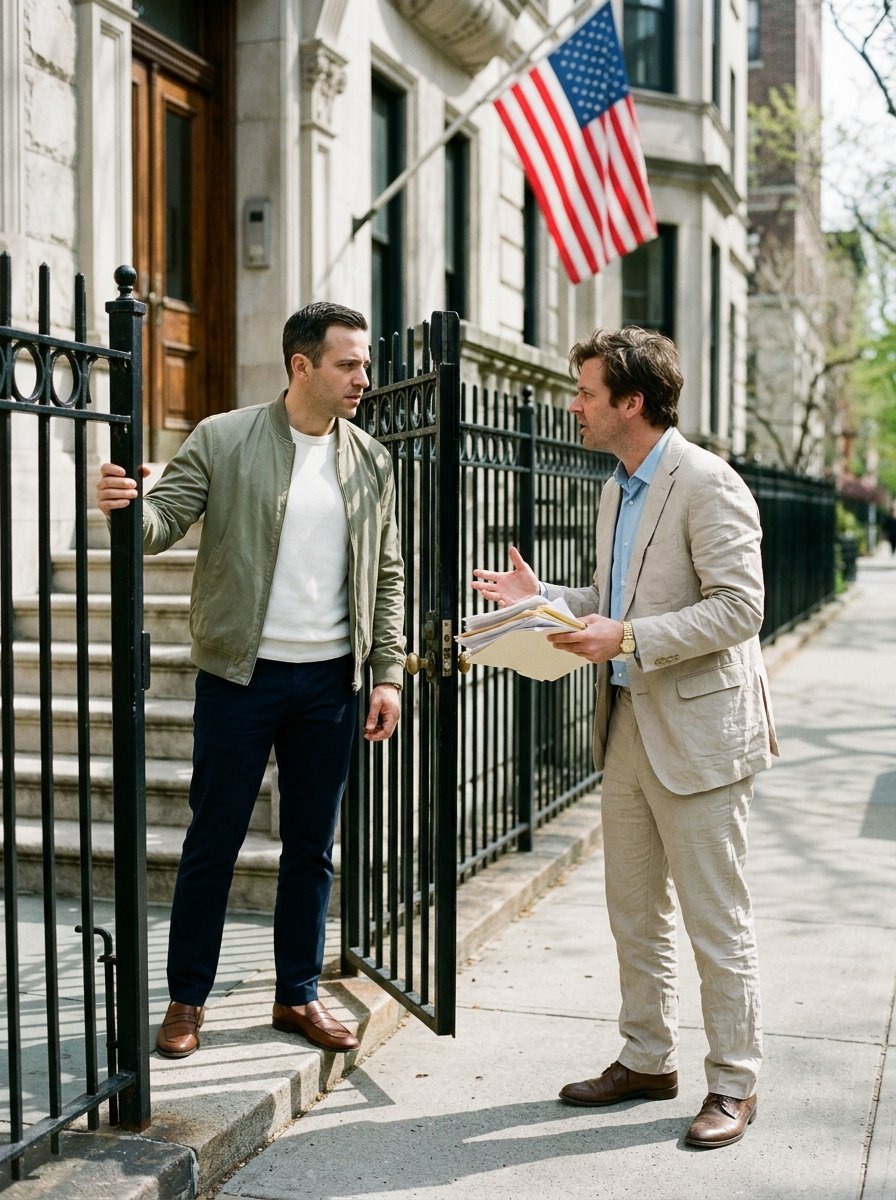
I opened the gate, stepped out just far enough for him to see me, and said the first words I’d spoken to him in over a year.
He blinked when he saw me.
“Cole?” he asked, like he couldn’t quite believe I was real.
I didn’t say anything at first. Just looked at him.
He’d lost weight, but not in a healthy way. The kind of weight loss that comes from stress and too many sleepless nights. His once perfect haircut had grown shaggy, and his clothes, designer, sure, were wrinkled and a little too worn around the cuffs.
He looked like a man trying to wear the last pieces of a life that didn’t fit him anymore.
“Man,” he said, forcing a laugh. “I didn’t even know you lived here. I I saw the place online when I was looking for rentals and thought, no way this is Kohl’s.”
But then the gate opened, and he trailed off, glancing around at the pristine front garden, the black rod iron fencing, the polished brass plate with the Linux name.
I stayed quiet, letting him talk himself into knots. I wasn’t going to make this easy for him.
“I didn’t come to fight,” he said finally. “I just… Things haven’t been great lately. I made some investments that didn’t pan out. Got burned on a crypto deal and the house, mom and dad’s place, I had to sell it. The market tanked and I’m underwater on some debts. I thought maybe maybe we could talk.”
I crossed my arms. “Talk about what exactly?”
He hesitated.
“Look, I know things got weird after the will. I was just caught off guard, man. I didn’t mean all that stuff I said.”
“You didn’t mean it?” I repeated, not raising my voice, not even moving. “You’ve been saying things like that since we were kids, Ryan. The only difference is now you’re broke and you think I forgot.”
He shifted uncomfortably. “That’s not fair.”
“What’s not fair,” I cut in, “is growing up in a house where your parents let you believe you were better because of DNA. What’s not fair is giving everything to a son who did nothing but take and leaving nothing for the one who actually showed up when it counted.”
He looked down, jaw clenched. “So, this is revenge then? You’re going to leave your brother out in the cold?”
I smiled, but there wasn’t any warmth in it. “You’re not my brother. You made that real clear.”
Ryan stepped forward. “Okay. Okay, look. I messed up. I know that, but you’ve got money now. You can help. I’m not asking for a handout, just a place to stay. Just until I get back on my feet.”
That’s when it hit me.
He didn’t know. Not really.
He didn’t know the full picture. I don’t know if he thought I won the lottery or sold a startup or something, but he had no idea where the money came from or what it represented.
So, I asked, “Do you know who lived here before me?”
He shook his head.
“My biological parents,” I said slowly. “This was their home. They passed away in a crash a few weeks after mom and dad passed. Turns out they’ve been watching from a distance my whole life. And they left everything to me. Millions, properties, stocks, a foundation. You know what else they left? Letters. Dozens of them. They wrote to me every year. They loved me from afar, even if they never got the chance to say it in person.”
Ryan stared at me like he was trying to do the math, trying to process what I just told him.
“You’re saying they were rich?”
“I’m saying,” I replied, “that I finally found out what it’s like to be wanted, to be chosen. Not out of convenience, not out of pressure, but out of love.”
He didn’t say anything. He just stood there, mouth half open like someone had unplugged the batteries mid-sentence.
And then, with all the grace of a drowning man, he tried again.
“I’m sorry, Cole. Seriously, I was a jerk growing up. I was jealous. I guess you always seemed so together. You didn’t need anyone. And I I don’t know. I guess I thought if I pushed you out, I’d feel more like the favorite.”
“You were the favorite,” I said simply. “But I don’t think it made you happy, did it?”
He looked away.
I could have ended it there, shut the gate, turned around, and walked back into the warmth of the life I was finally building for myself.
But something in me paused, not out of sympathy, not even pity, just closure.
“Wait here,” I said.
I walked back inside down the hallway lined with framed sketches my birth mother had drawn. Landscapes, wild flowers, silhouettes of me as a toddler, she must have imagined from memory.
I opened a drawer in the study and pulled out a single envelope.
Inside was a photocopy of the original Lennox will and a letter from their attorney verifying the transfer of assets.
I brought it back and handed it through the gate.
Ryan opened it with shaky fingers, eyes scanning the document. And when he reached the bottom, his face went pale.
“This isn’t real,” he whispered.
“It’s very real.”
He clutched the paper, then looked up at me, suddenly furious. “So what? You’re just going to stand there on your throne and watch me drown?”
I didn’t flinch. “I watched you swim while I sank for most of my life. I think you’ll manage.”
His lips curled, but he didn’t say anything else. Just stood there for a long moment, then slowly turned and walked away, the papers fluttering slightly in the wind.
I watched until he reached the sidewalk, until the streets swallowed him up.
And just when I turned to go back inside, my phone bust an unknown number.
When I didn’t recognize New Mexico area code, the voice on the other end was calm, careful, and what they said next changed everything.
The voice on the line was female, soft-spoken, but steady.
“Is this Cole Lennox?”
My throat tightened. “Yes. Who is this?”
There was a pause.
“My name is Elena. Um, I was your biological mother’s attorney, Ava Lennox. I’m calling you because something came up. Something not included in the original estate package.”
I closed the door behind me slowly. The sound of it shutting echoing through the entry hall like the thud of a gavvel.
“I thought I already had everything. The properties, the accounts, the letters.”
“Yes, those were all part of the formal estate,” Elena said, “but there were safeguards. Ava and George were very particular about privacy and legacy. There were things they didn’t even want disclosed in their wills. But per Ava’s instructions, I was to contact you if and only if you were approached by your adoptive family after the inheritance was transferred.”
I blinked, confused. “You mean they knew this would happen?”
“I wouldn’t say they knew, but they expected it. Ava had an instinct about people. She figured that once the dust settled and certain people realized you were no longer the wallet with a pulse, as she put it, they’d come crawling.”
I almost laughed, but it got caught somewhere in my chest.
“So, what exactly am I being contacted for?”
“She left you something else,” Elena said. “Something private, not to be handled by the estate firm. She didn’t want it in legal hands or on any paper trail. I have it in a lock box in my personal office in Santa Fe.”
“What is it?”
“I think you should come see for yourself,” she said. “I can have it ready by tomorrow. There’s also someone you need to meet. Ava’s wishes were very specific about that, too.”
I sat down slowly on the leather couch, heart thudding in a strange rhythm.
“Who am I meeting?”
Another pause. This one longer.
“Elena,” I prompted.
She sighed. “Her name is Maria and she’s your sister.”
I froze. The room went still.
“No,” I said. “No, that’s not possible. I was told I was their only child.”
“That’s what the wolf said,” she replied gently. “Because legally, you were. Maria’s existence was complicated. Ava gave birth to her when she was just 19, before she ever met George. It was a closed adoption. She spent years trying to track her down and didn’t find her until shortly before you turned 25. By then, Maria was married, had children of her own, and didn’t want her life disrupted.”
“And now?” I asked, barely above a whisper.
“Now things have changed. Maria reached out just days after Ava passed. She wanted to talk. She’s ready.”
I stood up without realizing it, pacing in front of the massive bay windows that looked out over the Linux courtyard.
“So what? You’re telling me I have a sister I’ve never met who’s just now coming out of the woodwork right after I inherit millions?”
“I understand how that sounds,” Elena said. “But Maria doesn’t want money. In fact, she made it very clear she doesn’t care about the inheritance. She just wants to talk. And Ava wanted the two of you to meet. She wrote that if anything were to happen to her, you should be given a letter, one that explains everything.”
I let the silence linger for a beat before I said, “Text me your address. I’ll be on a flight by morning.”
The next day felt surreal. I barely slept, replaying every word from that call in my head.
A sister, a whole other branch of my life tucked away in the shadows like an unopened chapter.
I had always assumed my biological parents were childless before me. That their decision to give me up was a one-time heartbreak.
But now I had to confront something stranger. I wasn’t alone in the way I thought I was.
When I arrived at the law office in Santa Fe, a sandstone building nestled in the hills outside the city, Elena was already waiting in the front lobby. She was in her late 50s with kind eyes and a quiet, perceptive demeanor.
She didn’t waste time with small talk.
“She’s in the back,” Elena said. “But before you see her, Ava asked that I give you this.”
She handed me a thick envelope yellowed with time and sealed with red wax. My name was written in Ava’s handwriting, careful, even, and unmistakably maternal.
My fingers trembled as I broke the seal and unfolded the pages inside.
The letter was long, seven pages handwritten. Ava told me about her life before George, about Maria’s birth, about how young and scared she was when she made the decision to give her up.
She described the pain, the regret, and the years she spent searching. She spoke about how finding me later in life had been a miracle, one she never thought she deserved.
She explained why she never tried to reach out directly.
“I didn’t want to disrupt the life you were building, but we watch from a distance. Every birthday, every graduation, we were proud of you.”
I had to stop reading twice just to breathe. My eyes were burning and I couldn’t stop the quiet shaking in my hands.
She ended the letter with a simple request.
“Meet your sister. Not because I asked it, but because you deserve to know you were never alone. Not really. And neither was she.”
I wiped my face, folded the letterfully, and nodded to Elena.
“I’m ready.”
She led me down the hallway to a private conference room.
The door opened slowly and inside stood a woman maybe 6 years older than me. Her dark hair was pinned up, her eyes tired but warm.
She looked up when I walked in, and we just stared at each other for a moment.
No one moved.
Then she gave me a sad smile and said, “So, you’re Cole?”
I nodded. “And you’re Maria?”
She looked like she wanted to say something else, but just then her phone buzz. She glanced down, frowned, and turned it face down without answering.
“I’m sorry,” she said. “It’s been a weird week. I almost didn’t come, but I wanted to meet you. I needed to meet you.”
I sat down across from her.
“Did you know about me?”
“Not until about a year ago,” she said. “Ava sent a letter. Said she didn’t expect anything, just that she wanted me to know she had another child. I didn’t respond right away. I wasn’t ready. Then, after the plane crash, I guess I realized time’s not something you can buy more of.”
I nodded slowly, the weight of it all still sinking in.
“So, where does that leave us?”
Maria looked me dead in the eye. “That’s what I want to figure out. But there’s something else. Something you should probably know before we go any further.”
I leaned in, heart starting to pick up.
She reached into her purse and pulled out a photograph, faded, old with worn corners. She slid it across the table.
And when I saw who was standing in the background of that photo, behind Ava, behind Maria, I felt the bottom drop out of my stomach because I recognized him.
I stared at the photograph, heart pounding in my chest like a war drum. It was grainy, clearly taken decades ago, but the face in the background was unmistakable, cropped near the edge, arms crossed and partially turned away, was Dennis, the man I’d called dad my entire life.
The same Dennis who used to tuck me in when I was little. The same man who once taught me to tie my shoelaces, who took me on bike rides, who later signed a will, leaving me nothing.
Maria saw the recognition in my face before I said a word.
“So,” she said, her voice low. “You see it, too?”
I looked up slowly. “Why was he there?”
Maria sighed, folded her hands, and leaned forward.
“That photo was taken in Albuquerque. 1994, about a year before you were adopted. Ava didn’t know it was taken. Someone else in her circle snapped it at a dinner party. When she found it years later, she almost threw it away. She thought she was seeing things, but it was him. Dennis. She never figured out why he was there or how he was connected to anyone in that room.”
I ran my hand through my hair trying to process what that meant.
“Are you saying my adoptive father knew Ava?”
“We don’t know how well,” Maria said. “But yeah, that’s what Ava suspected. After she found the photo, she went digging. She found out Dennis used to work for a pharmaceutical company in New Mexico in the early ‘9s, the same company Ava consulted for before she built her own firm. Their paths crossed more than once.”
“Wait,” I said, sitting up straighter. “Are you saying the adoption wasn’t random? That he knew who I was?”
Maria hesitated. “That’s exactly what I’m saying. Ava was convinced it wasn’t a coincidence, but by the time she realized it, it was too late. You were already with Dennis and Linda. She tried to reach out, but they cut off all communication. It’s why she and George moved their operations east and disappeared from public view. She didn’t want to risk your life being upended.”
My pulse thutdded in my ears.
All my life, I thought Dennis and Linda had just happened upon me, that I’d been placed into their arms by chance or providence.
But now, this changed everything.
It meant Dennis had chosen me, but not out of kindness, out of control.
“Why wouldn’t they just tell me?” I asked, voice cracking a little. “Why would they go through all that and then treat me like an outsider?”
Maria’s face softened.
“Ava wondered the same thing. But you said they never treated you like you were really theirs, right?”
“Yeah,” I said bitterly. “They reminded me of that everyday.”
“Maybe that’s the thing,” she said. “Maybe Dennis wanted to keep you, not because he loved you, but because he wanted to hurt Ava.”
I stared at her. “You’re saying I was a pawn.”
She nodded slowly. “Or leverage or revenge. Ava never figured it out completely, but she carried the guilt for years. That she lost you to them.”
I didn’t know what to say. I felt like my brain was trying to rewrite my whole life page by page as I sat there.
Maria reached over, placed a hand on mine.
“I’m not saying this to hurt you. I just think you deserve the truth. Ava didn’t want to leave this world with secrets, and I think she hoped we’d find each other, even if it was late.”
I squeezed her hand gently, and for the first time in a long time, I felt something settle inside me, a piece clicking into place.
“Thank you for telling me,” I said quietly. “I needed to hear it even if it hurts.”
We talked for hours after that. She showed me more letters Ava had sent her, shared photos, told me about her kids, her life, her regrets, and I told her mine, the broken holidays, the fake smiles, the loneliness.
For the first time, I didn’t feel like I had to explain myself to someone.
She just got it.
Eventually, she asked the question I didn’t expect.
“So, what are you going to do about Ryan?”
I exhaled slowly. “Honestly, I don’t know. He came crawling the second he lost everything. And the way he looked at me like I was just a safety net, like I owed him.”
“You don’t,” she said. “You owe you. Whatever gives you peace, that’s the only thing that matters.”
A week later, I flew back to New York.
I’d left Ryan’s call unanswered while I was gone, and I came back to five more voicemails and a text that simply said, “Please, Cole, I’m losing everything.”
When I pulled into the driveway of the brownstone, I saw him waiting on the front steps, duffel bag beside him, hoodie pulled up, looking like a kick dog.
He stood when he saw me.
“Cole, thank God, man. I didn’t know if you were even coming back.”
I parked, got out, and stood in front of him.
“This isn’t your home, Ryan.”
“I know, I know,” he said quickly, hands raised. “I’m not here to stay. I just… look, I’m sorry, okay? For everything. For the things I said at the will. For the stuff I did growing up. I was a kid, man. I didn’t know what I was doing.”
“You were still saying that stuff two years ago.”
“I know.”
He looked down. “I was jealous. You had your life together. You didn’t need them the way I did.”
I raised an eyebrow. “You mean you needed their money?”
He didn’t respond. Just stared at the ground.
“I know about Dennis,” I said.
He looked up sharply.
“I know he knew Ava. I know I wasn’t adopted by accident. He took me to get back at her and he never loved me. Not really. And Linda just followed his lead. But you? You made a choice every single day to make sure I knew I didn’t belong.”
His jaw clenched. “I didn’t know about any of that.”
“That’s the point,” I said. “You didn’t want to know. You just wanted to win.”
Silence stretched between us.
Then he said, “So what now? You slam the door in my face. Let me fall.”
I looked at him, at the man who had once been my brother in name, if not in spirit, and I made my decision.
“No,” I said. “I’m going to give you one chance.”
His eyes lit up.
“I’m setting up a charitable foundation under Ava and George’s name. It’s going to support underprivileged kids and young adults who were displaced like I was. I’m hiring people who understand hardship, who know how to build something from nothing. And I’m willing to give you a job entry level, starting from scratch. You’ll get a salary, but nothing fancy. You’ll report to someone else. And if you mess up, you’re out. No safety net. No more bailouts. You take this seriously or you walk.”
He blinked at me. “You’re serious.”
“Dead serious.”
He looked away, shoulders slumped. “What if I’m not cut out for it?”
“Then you figure it out,” I said. “Like I did, like everyone has to. Or you walk away and I don’t hear from you again.”
He was quiet for a long time.
Then he nodded slowly. “Okay, I’ll do it.”
It’s been 8 months since then.
Ryan took the job. He’s been quiet, reserved, but he shows up. He’s learning slowly, and I’m watching, not as his savior, not as his brother, but as someone who knows what it’s like to rise from nothing.
Maria and I talk every week. I’ve visited her family twice. Her kids call me Uncle Cole, and for the first time in my life, that title feels like it means something.
The brownstone is still home, but it’s not a castle built from revenge anymore. It’s a place of memory, of healing, of legacy.
Sometimes late at night, I read Ava’s letters again. There’s one line I always come back to.
“You were never a mistake. You were our second chance.”
And maybe now, finally, I get to be someone else’s.
Maybe that’s what family is supposed to be. Not blood, not paper, but choice.
And this time I’m choosing peace.