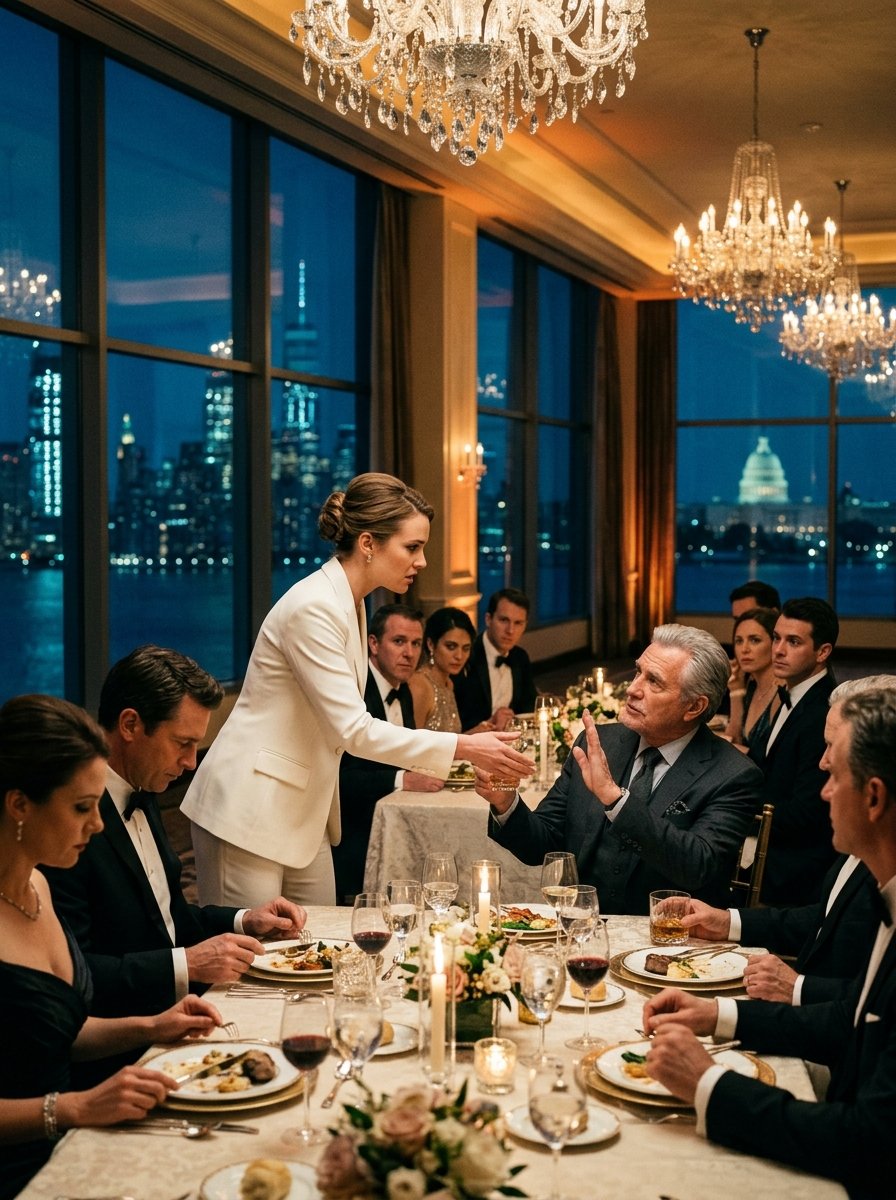
Chapter 3 — Grant Mocked Evelyn at Dinner—Then Project Aegis’s Missing Warning Surfaced
Cole requested one final meeting.
Evelyn agreed.
They met in a quiet coffee shop near Dupont Circle.
“You know what Dad is saying,” he said.
“No.”
“That you did this because of dinner.”
“I recused myself because of dinner.”
Cole looked exhausted.
“The company could lose Aegis.”
“If it does, people independent of me will decide why.”
“You found the original discrepancies.”
“Before I knew Grant was your father.”
“I know.”
That answer surprised her.
Cole looked down.
“I saw the dates.”
For several seconds neither spoke.
Then Cole said, “I should’ve defended you.”
“Yes.”
“I’ve spent my whole life managing him.”
“You mean obeying him.”
“Sometimes I can’t tell the difference anymore.”
Evelyn understood that more than she wanted to.
Her own childhood had taught her how easily a family could decide whose voice mattered.
But understanding Cole did not require marrying him.
“I hope you figure it out,” she said.
“You’re still leaving?”
“I already left.”
Their engagement ended without another argument.
Project Aegis took considerably longer.
The government did not simply hand Whitmore’s expected $600 million award to someone else overnight.
The procurement underwent further review. Technical and responsibility questions had to be resolved under the applicable process, and Whitmore had opportunities to provide explanations and documentation.
The internal records eventually established something more nuanced than the dramatic scandal Grant’s personality seemed built to invite.
Priya had warned him.
Grant had not ordered her to delete the warning.
He had not personally rewritten the supplier certification.
But he had pushed management to preserve the submission schedule after being told the documentation was insufficient.
Several employees then made decisions under that pressure that produced representations the government could not accept without further substantiation.
Whitmore’s board opened its own review.
Priya provided her emails and contemporaneous notes.
The program director acknowledged that schedule pressure influenced how the supplier issue was handled.
Grant insisted his instruction to “determine what can be supported” meant exactly that.
The investigators considered his explanation alongside the rest of the evidence rather than treating one sentence as a confession.
Ultimately, the original Whitmore proposal did not proceed on the timetable Grant had announced at dinner.
The company faced corrective requirements and internal governance consequences. Grant stepped back from direct oversight of major government bids while the board strengthened compliance review.
A restructured competition followed.
Whitmore remained free to pursue future work if it satisfied the required standards.
There was no theatrical lifetime ban.
No handcuffs at the gala.
No government official declaring Evelyn victorious.
There didn’t need to be.
Priya left Whitmore several months later for a senior quality role elsewhere.
Before she left, she asked to meet Evelyn.
“I’ve wanted to know something,” Priya said.
“What?”
Chapter 4 — Grant Mocked Evelyn at Dinner—Then Project Aegis’s Missing Warning Surfaced
“Did you really call from dinner and stop the award?”
Evelyn laughed.
“No.”
Priya smiled.
“I didn’t think so.”
“I disclosed my conflict and got out of the decision.”
“That’s much less exciting.”
“Most correct procedures are.”
Priya stirred her coffee.
“I sent that warning three times.”
Evelyn looked at her.
“Why?”
“Because every time someone summarized it upward, it became softer.”
First, documentation insufficient.
Then, documentation needs clarification.
Then, administrative supplier issue.
By the time the concern reached people discussing schedule, it sounded almost cosmetic.
Priya had sent the final email directly to Grant because she wanted the CEO to see the original wording.
He saw it.
And he chose schedule pressure rather than ordering the issue fully resolved before submission.
That was what the review eventually established.
Months later, Evelyn received orders for another assignment.
On her final week in Washington, Elaine Whitmore asked to see her.
Evelyn almost declined.
Then curiosity won.
Elaine arrived alone.
“I owe you an apology.”
“For the dinner?”
“For many dinners you weren’t at.”
Evelyn waited.
Elaine admitted that Grant had spent decades establishing the hierarchy of every room.
Employees learned it.
His children learned it.
She learned it.
Silence became easier.
“Cole learned from me,” Elaine said.
“That doesn’t make his choice yours.”
“No. But I showed him how to survive his father by disappearing.”
Evelyn thought of her own mother whispering pride at a dark kitchen table because she had never learned to say it loudly.
Families could teach silence as efficiently as they taught language.
“I hope you stop disappearing,” Evelyn said.
Elaine nodded.
“So do I.”
A year after that dinner, Evelyn was no longer engaged to Cole.
Grant no longer controlled Project Aegis.
And Priya’s warning had become part of a much larger institutional lesson about why uncomfortable information had to reach decision-makers without being diluted along the way.
Evelyn kept one memory from the dinner.
Not Grant’s insult.
Not the moment she took out her phone.
It was Cole saying, “Yes, sir.”
For eighteen months, Evelyn had believed his failure to ask about her work meant he did not care about status.
Eventually she understood something less flattering.
He had never been curious enough to discover who she was when knowing required effort.
Grant had made the same mistake more aggressively.
He decided Evelyn was unimportant before learning anything about her.