Brock was still laughing as he counted the bills.
“Nobody bales small squares anymore, Jana,” he said, folding my three hundred dollars into his shirt pocket. “You’ll see.”
We were standing in Grandpa’s machine shed the first week of June, with both big doors rolled open and the morning sun pouring in across the dirt floor. Swallows darted in and out of the rafters. The shed smelled like old grease, mouse nests, and seventy years of hay dust.
In the middle of it, under a gray tarp, sat Grandpa’s baler.
It was a New Holland 268 Hayliner. Grandpa bought it new in 1962 from the implement dealer in Marysville for $1,840. The paint had faded from red to a dusty pink, and the yellow trim was flaking like old fingernail polish. Two of the tires were flat. One of the pickup teeth was bent sideways like a broken finger.
“It’s a boat anchor,” Brock said. “The scrap man was coming Thursday. You just saved him a trip.”
My cousin Brock is thirty-eight, broad-shouldered and sunburned, with a John Deere cap and a phone that never stops buzzing. He farms two thousand acres of corn, beans, and wheat in Marshall County, Kansas, and puts up hay with a pair of big round balers that each cost more than my house. To Brock, old iron is just clutter between him and the next thing.
“You’re going to sink more money into this thing than it’s worth,” he said. “Parts alone. And then what? You’ll bale for a week, it’ll break, and it’ll sit in your yard until somebody else hauls it to scrap.”
“Maybe,” I said.
“Who’s even going to buy small squares? Everybody went to rounds twenty years ago.”
I didn’t argue. I just pulled out my phone and took a picture of the serial number plate on the side of the baler, so I’d have it for my records.
My name is Jana Lindeman. I’m forty-one. I work the front desk at the veterinary clinic in Marysville, and I’ve done it for eleven years.
Half our clients have horses.
And every single one of them complains, sometimes while I’m running their credit card for a Coggins test, that nobody sells small square bales anymore. Round bales weigh eight or nine hundred pounds. You need a tractor with a bale spear to move one. If you’re a sixty-year-old woman with two old geldings in a pasture behind your house, a round bale is useless. It sits out in the rain and molds, and half of it goes to waste.
Small squares weigh fifty pounds. One woman can lift one. You can stack them in a pickup bed and toss one flake at a time over a fence.
There are a lot of sixty-year-old women with two old geldings in Marshall County.
I didn’t say any of that to Brock. He was family, and he’d already decided I was being sentimental. I let him think so.
“I’ll write you a bill of sale,” I said. “So it’s official.”
He rolled his eyes. “For three hundred bucks?”
“For three hundred bucks.”
I tore a page out of the little notebook I keep in my purse and wrote it out on the hood of his pickup: For $300 received, I sell one New Holland 268 Hayliner baler, serial number 10614, as is, to Jana Lindeman. I dated it, and he signed it, still shaking his head.
“You’re as stubborn as Grandpa,” he said.
“Thank you,” I said, and meant it.To understand why I paid three hundred dollars for a pink boat anchor, you need to know about my grandfather.
Arvid Lindeman is eighty-eight years old. He farmed a hundred and sixty acres south of Marysville for sixty-one years: wheat, milo, a few cows, and hay. He’s a tall, stooped, quiet Swedish Lutheran with enormous hands and a soft voice. He didn’t say much, but when he did, people leaned in to hear it.
He had two children. My mother, Karin, and her younger brother, Lars, who was Brock’s father.
Uncle Lars died in 1988, when Brock was five and I was eight. A tractor rolled on him on a creek bank in October. I don’t remember much about the funeral except my grandfather sitting in the front pew, not moving, with his big hands flat on his knees.
After that, Grandpa farmed with Brock. Brock grew up in Grandpa’s shadow, riding in the tractor cab, learning everything from him. When Brock was old enough, he took over the land, then rented more, then bought more. Now he farms two thousand acres and has three hired men.
My mother married a schoolteacher and moved to Topeka. I married Curt, a truck driver for the farmers’ co-op, and stayed in Marysville. We have two boys, Tucker, sixteen, and Reed, thirteen.
When my boys were little, I worked summers, and Grandpa watched them. He took them out to the hayfield. They rode the hay wagon behind that New Holland baler while Grandpa drove the tractor, and the bales came up the chute one after another, thump, thump, thump. Grandpa hummed “Bringing in the Sheaves” the whole time, off-key, the same three lines over and over.
Tucker was seven the first summer. Reed was four and had to wear a little life jacket on the wagon so Grandpa could grab him by the straps if he wobbled.
They were the happiest summers of their lives. Mine too.
Grandpa quit baling small squares when he was eighty-one. His shoulders gave out. He sold his cows and leased the hayground to Brock, who baled it in rounds. The New Holland went into the machine shed under a tarp.
Last fall, Grandpa fell in his kitchen and broke his hip. After surgery at the hospital in Manhattan, the doctor said he couldn’t live alone anymore. In January, he moved into Prairie View, the assisted living home in Marysville, in a small room with a window that looks out on the parking lot.
It costs $5,900 a month. Grandpa’s Social Security and his small pension from the grain elevator where he worked winters cover about $2,300. His savings cover the rest, for now.
Before he moved, he sat at his kitchen table with his attorney, Mr. Haugen, and signed a few papers.
He leased his hundred and sixty acres to Brock for five years at $95 an acre in cash rent. That’s $15,200 a year, paid in two installments, and it goes straight to Prairie View.
And he signed all his farm machinery over to Brock by bill of sale. Two old tractors, a disc, a grain drill, a hay rake, a hay wagon, and the baler.
“Brock’s the farmer,” Grandpa told me. “It ought to go to the farmer.”
So it was legally Brock’s to sell. I wasn’t going to fight family over it.
I just bought it.
Nobody had told Grandpa that Brock was scrapping it. I knew why. Brock didn’t want to explain, and I didn’t want to be the one to break Grandpa’s heart.
That night at supper I told the boys.
Tucker set down his fork. “You bought Grandpa’s baler?”
“For three hundred dollars.”
“Does it work?”
“Not even a little.”
Reed was quiet for a moment. Then he asked, “Can we fix it?”
Curt looked at me across the table. He’s a big, quiet man who doesn’t waste words.
“You’ve got a plan,” he said. It wasn’t a question.
“I’ve got a plan,” I said.We hauled the baler home on a borrowed flatbed trailer on Saturday and parked it in our pole barn.
Then we stood around it, the four of us, and looked at it.
The baler was a mess. Mice had nested in the twine box. The bale chamber was full of seven-year-old hay so packed and moldy that Tucker had to chip it out with a crowbar. The tires were rotten. The pickup reel was missing three teeth. The plunger was rusted to the walls.
And the knotters wouldn’t tie.
The knotters are the heart of a square baler. They’re the little mechanical hands on top of the bale chamber that wrap two strands of twine around each bale and tie a knot in each one, automatically, every time a bale comes through. If the knotters don’t work, you don’t get bales. You get a pile of loose hay on the ground.
Reed tried cranking the flywheel by hand while Tucker fed a strand of twine through. The knotter spun, the twine went around, and nothing tied. The twine just fell off in a loose loop.
“Well,” Curt said, “that’s the whole problem right there.”
I called Cordell Mattson.
Cordell is seventy-four and lives a mile down the gravel road from us. He was the head mechanic at the New Holland dealership in Marysville for thirty-four years before it closed in 2009. He’s small and wiry, with forearms covered in old burn scars and a laugh like a rusty gate. He’d fixed Grandpa’s baler more than once back in the eighties.
He came over the next morning with a red toolbox the size of a coffin.
He walked around the baler once, slowly, running his hand along the side the way you’d touch an old horse.
“Arvid’s 268,” he said. “I’d know it anywhere. He bent that pickup tooth on a fence post in ’79. I told him to replace it. He never did.”
“Can you fix it?”
Cordell laughed his rusty-gate laugh.
“I can’t fix it,” he said. “But I can show these two boys how to fix it. Which is better.”
For three Saturdays in a row, Cordell came over at eight in the morning with his toolbox and a thermos of black coffee and taught my sons how a knotter works.
He showed them the billhook, the curved steel finger that grabs the twine and turns it into a loop. He showed them the twine disc that holds the strand in place, and the tucker fingers that push the twine into position. He showed them the knife that cuts the twine after each knot. He had them take every piece apart, clean it in a coffee can full of diesel fuel, check it for wear, and put it back together.
“You can’t rush a knotter,” Cordell said. “It’s like a pocket watch. Everything has to happen in the right order, at the right instant, or it doesn’t happen at all.”
The boys skinned their knuckles. They got grease in their hair, on their shirts, and somehow on the ceiling of the pole barn. Reed cut his thumb on the twine knife and needed a butterfly bandage from my clinic first aid kit.
I ordered parts online from a company in Iowa that specializes in old New Holland balers: a new set of pickup teeth, two new tires, a twine disc, bearings, and a rebuild kit for the plunger. It came to $640, plus shipping. I paid for it from the household checking account and wrote it in a little ledger I started keeping in a spiral notebook on the kitchen counter. On the cover I wrote: HAYLINER.
On the third Saturday, Reed found the real problem.
He was lying on his back on the hay wagon with a flashlight, looking up into the knotter assembly, while Tucker slowly turned the flywheel by hand.
“There,” Reed said suddenly. “Stop. Look at the knife.”
Cordell climbed up beside him and peered in. Then he whistled through his teeth.
“Well, I’ll be. The twine knife’s worn. It’s cutting the twine a hair too early, before the billhook finishes the knot.” He clapped Reed on the shoulder. “Thirteen years old, and you found it before I did. You’ve got the eye.”
Reed turned bright red.
The new twine knife cost $34. Cordell installed it with the boys watching. Then he fed a bale’s worth of old loose hay into the chamber by hand while Tucker turned the flywheel.
The plunger pushed. The hay packed. The needles came up through the bale chamber, carrying twine. The knotters spun.
Click. Click.
A bale slid out the back of the chute and dropped onto the floor of the pole barn. Two strands of orange twine were wrapped tight around it, each one tied in a neat, perfect knot.
Reed jumped down off the wagon, grabbed the bale by both strings, and held it over his head like a trophy.
“It tied!” he yelled. “It tied!”
Tucker whooped. Curt clapped. Cordell laughed so hard he had to sit down on an overturned bucket.
I stood in the doorway of the pole barn and cried a little, where nobody could see me.
Pages:
4Now I needed hay.
Our place is only fifteen acres, and most of it is house, yard, and pole barn. I’d known from the beginning that I’d need somebody else’s field.
I knew exactly whose.
Retta Kopp is seventy-six. She’s a widow who lives in a little white farmhouse up Spring Creek, about three miles north of us. Her husband, Walt, died six years ago. Since then, her thirty-five acres of smooth brome hayfield had sat uncut. Nobody had baled it in six summers. It had gone tall and shaggy, and the county weed inspector had sent her two letters about the thistles along the fence line.
I knew Retta from the clinic. She brought in her old border collie, Banjo, for his arthritis shots every month.
I drove up there on a Sunday afternoon and sat in her kitchen with a cup of weak coffee.
“I’ve got a baler,” I said. “An old one. And two boys. I’d like to put up your brome this summer. For a share.”
Retta squinted at me over her glasses. She has a sharp, wrinkled face and doesn’t suffer fools.
“What kind of share?”
I’d thought about it. The standard deal around here for hay on shares is that the landowner gets a third and the person doing the work gets two-thirds. But I wanted it in dollars, not bales, because Retta didn’t have horses or cattle anymore. What would she do with a third of the hay?
“I sell the bales,” I said. “You get twenty-five percent of whatever I take in. I pay for everything: fuel, twine, repairs, all of it. And I’ll mow the thistles along your fence line so the county stops sending you letters.”
Retta drummed her fingers on the table.
“Walt always said a deal you can’t write down isn’t a deal,” she said.
“Then let’s write it down.”
So we did. That week, I paid a lawyer in Marysville, Mrs. Ochsner, $175 to draw up a simple one-page hay lease. It said I had the right to cut and bale hay on Retta’s thirty-five acres for one year. Retta would get twenty-five percent of gross sales, paid monthly. I’d carry liability insurance, keep the field in good condition, and control the thistles.
I called my insurance agent, Gene Hollis at the Farm Bureau office, about adding liability coverage for haying on someone else’s land.
“You’re running a hay operation now, Jana?” Gene said, sounding amused.
“A small one.”
“With your boys?”
“Tucker’s sixteen. Reed’s thirteen. Reed’s only going to stack on the wagon and in the barn. He won’t be driving anything with a power takeoff.”
Gene was quiet. “Good. Keep it that way. I’ve seen too many kids hurt around balers. You keep those shields on and that PTO shaft covered, and nobody reaches into that pickup while it’s running. Ever.”
“I know, Gene. My uncle died on a tractor.”
“I know he did,” Gene said softly. “That’s why I’m saying it.”
He added a farm liability endorsement to our homeowner’s policy for $186 a year. I wrote it in the HAYLINER ledger.
Then I needed a tractor. Our old lawn tractor wasn’t going to pull a baler.
Cordell solved that too.
“I’ve got a John Deere 4020 sitting in my shed doing nothing,” he said. “Runs fine. Just needs somebody to drive it. You can use it this summer if you pay for the fuel and change the oil when you’re done.”
“Cordell, I can’t…”
“You can,” he said. “Arvid let me use his hay rake for eleven years after I quit farming and never charged me a dime. I figure I owe the Lindemans a summer.”
Pages:
We cut Retta’s brome on the twelfth of June.
It was hot as an oven. A south wind came off the plains at thirty miles an hour, perfect drying weather. Brock lent me his old sickle-bar mower. He didn’t say much when he dropped it off, just “Try not to break it,” and drove away fast. We laid the brome down in long green swaths across the field.
Two days later, we raked it into windrows with Grandpa’s old side-delivery rake. Brock let me borrow that too. It was technically his now.
On the third day, we baled.
I’ll never forget it.
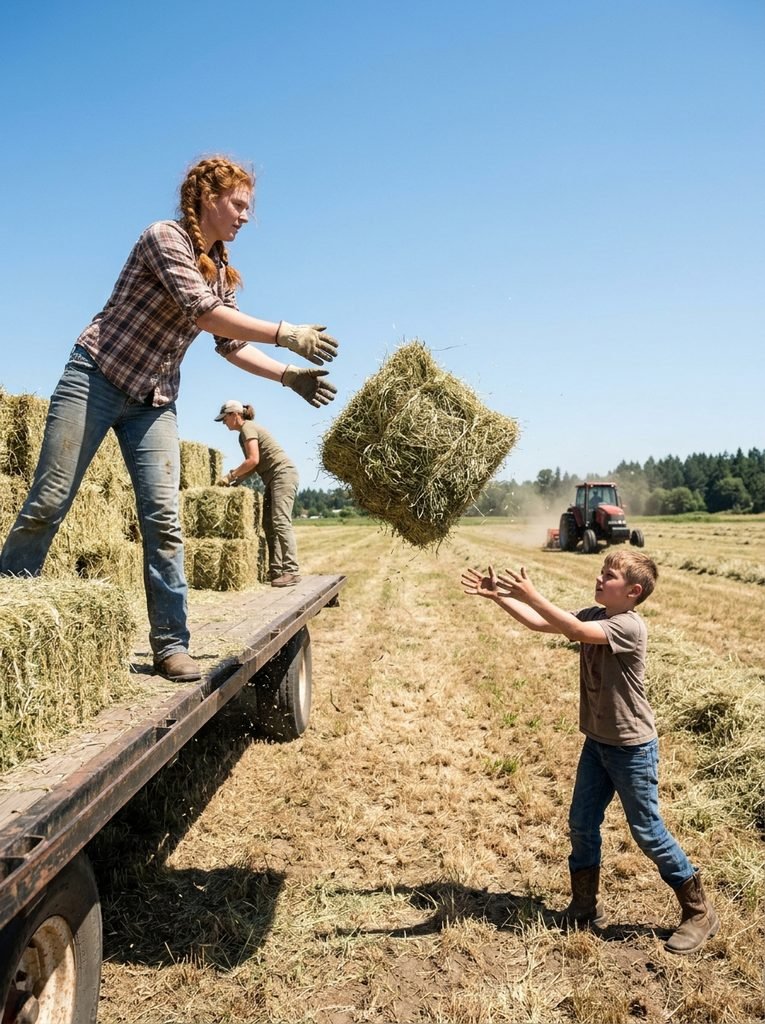
Tucker drove Cordell’s green John Deere with the baler hitched behind it, wearing his Royals ball cap backward and a pair of safety glasses Gene Hollis had made me promise he’d wear. The old New Holland thumped along behind, picking up the windrow. The pickup teeth swept the hay up into the chamber, and the plunger packed it with a deep, steady thump-thump-thump, like a heartbeat.
Bales came out the chute one after another and slid up onto the wagon behind.
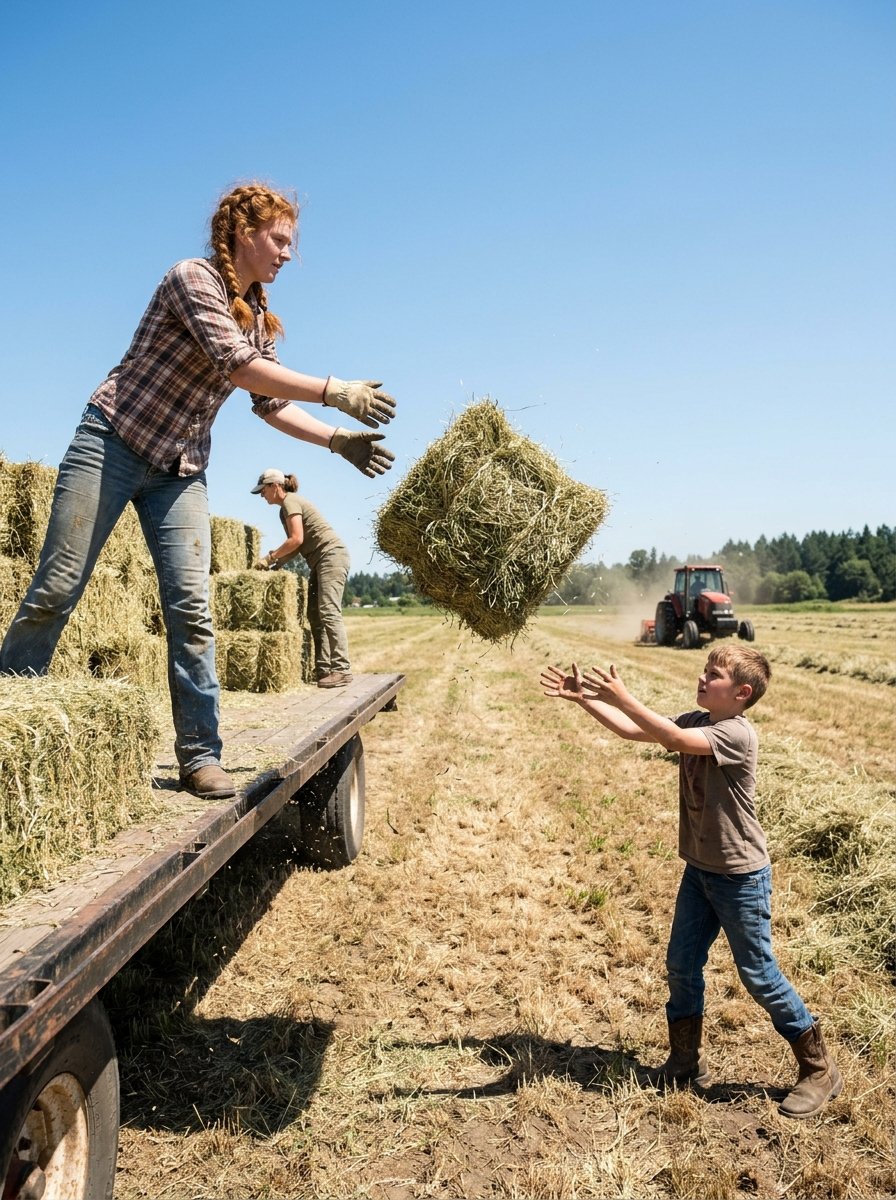
I stood on the hay wagon in leather work gloves, catching each bale as it came off the chute and stacking it, five high, in a crisscross pattern so the load wouldn’t shift. Reed stacked beside me, his small arms straining.
The sun beat down. Sweat ran into my eyes. The air smelled of fresh-cut brome, sweet and green and dusty.
And somewhere around the fourth load, without thinking about it, I started humming.
“Bringing in the sheaves, bringing in the sheaves, we shall come rejoicing…”
Reed looked over at me. Then he started humming too.
Tucker couldn’t hear us over the tractor. But when he looked back over his shoulder at the wagon, he was grinning.
We put up four hundred and twelve bales that first day.
By the end of June, we’d baled the whole thirty-five acres. One thousand nine hundred and forty bales of first-cutting brome, stacked to the rafters in our pole barn and in the empty hay loft of Retta’s old barn.
Then I pinned one notice on the corkboard at the Marshall County Farmers Co-op feed store, on a three-by-five index card in black marker.
SMALL SQUARE BALES. Brome, first cutting, no rain, barn stored. $9/bale. You haul. Call Jana.
And my phone number.
I paid a dollar for the thumbtack. I didn’t write that in the ledger.My husband Curt drives a grain truck for the co-op four days a week, ten hours a day. On his three days home, he became the delivery service.
People who didn’t have their own trucks called and asked whether we could deliver. Curt charged a dollar a bale for delivery within ten miles and loaded our old Chevy flatbed with eighty bales at a time. He drove all over Marshall County from breakfast to supper.
The first call came the day after I pinned the card. It was a woman from Blue Rapids with three Quarter Horses, who bought forty bales. The second was a 4-H girl in Frankfort with a show pony, who bought twenty. The third was a man in Axtell who raised Boer goats.
By the Fourth of July, my phone didn’t stop ringing.
I’d come home from the clinic at six and there’d be eleven voicemails. Retired couples with two horses and a donkey. A riding stable outside Seneca that needed two hundred bales. A woman who raised rabbits. A family with a Shetland pony named Butterscotch who’d been feeding him lawn clippings and moldy rounds and was in tears on the phone because she’d finally found someone who sold small squares.
I kept track of everything in the HAYLINER ledger. Every bale sold, every name, every check, every cash payment. Every month, I wrote Retta a check for her twenty-five percent and hand-delivered it with a receipt.
The first check, for July, was $2,340.
Retta looked at it for a long time at her kitchen table.
“Walt never got this much for that field,” she said. “Not once.”
“Horse people pay for quality,” I said. “And you can’t get small squares anywhere else in the county.”
She folded the check and put it in her cardigan pocket.
“Banjo’s arthritis shots,” she said, a little gruffly. “And the property taxes. Walt always worried about the property taxes.”
Then, sometime in mid-July, the calls changed.
It started with a woman from Waterville. She said, “Oh, thank goodness. I called Brock Lindeman first. He’s got all that hay ground. And he said he only does rounds, but there’s a woman in Marysville who does small squares, and he gave me your number.”
Then it happened again. And again.
Horse people were calling Brock. The biggest hay producer in the county, with two round balers, three hired men, and two thousand acres. Everybody who needed hay called Brock first.
And Brock had to tell every one of them, “I don’t do small squares. Call my cousin Jana.”
Every single time.
By August, my friend Linda at the feed store told me that Brock had started telling people my number before they even finished asking.
“He’s got it memorized,” Linda said, grinning. “He doesn’t even look it up anymore.”
Pages:
7We cut a second time in late July.
Second-cutting brome is finer and leafier than the first, and horse people love it. We put up another nine hundred bales. Combined with what was left of the first cutting, that was enough to keep selling through August.
The boys worked every day it didn’t rain. Tucker drove the tractor. Reed stacked. On the days I was at the clinic, Cordell rode along in the tractor cab with Tucker, just to keep an eye on things. Mostly, I think, he did it for the company.
I paid the boys. Twelve dollars an hour for Tucker, ten for Reed. I wrote it all in the ledger and paid them by check every Friday, the same way the clinic paid me. By the end of the summer, Tucker had earned $2,640 and Reed had earned $1,910.
Curt and I sat them down at the kitchen table one night in August.
“Here’s the deal,” Curt said. “You keep half of what you earned to spend however you want. The other half goes into a Roth IRA.”
“A what?” Reed asked.
So I explained it the way my accountant, Marv Pettit, had explained it to me in June when I called to ask how to handle the hay money on our taxes. When you’re young and you’ve earned real wages from a real job, you can put that money into a special retirement account. It grows for fifty years, and when you take it out at retirement, you don’t pay taxes on it.
“Fifty years?” Tucker said. “I’ll be sixty-six.”
“And that thirteen hundred dollars,” I said, “if it grows like the stock market usually does, could be worth more than forty thousand dollars by then.”
Tucker stared at me. “From baling hay?”
“From baling hay.”
We opened two custodial Roth IRAs at the bank in Marysville the next Saturday, one for each boy. Tucker put in $1,320. Reed put in $955.
Reed asked the banker, a young woman named Ms. Tran, if he could see where his money was. She showed him the account on her computer screen. He looked at it for a long time without saying anything.
“Grandpa’s baler made that,” he finally said.
“You made that,” Ms. Tran said. “The baler helped.”
Pages:
8On the second Saturday in August, Curt delivered the last load of the summer to a riding stable near Seneca.
Eighty bales. When he unloaded the last one into the stable’s barn, the owner, a woman named Patrice, wrote him a check.
When Curt got home, he set the check on the kitchen table in front of me and said, “That’s it. Last one.”
I opened the HAYLINER ledger and counted, the way I count everything.
Two thousand bales sold. Not one left in the pole barn.
Two thousand bales at $9 each: $18,000. Plus $1,460 in delivery fees Curt had collected.
Then I added up the expenses, line by line, on a fresh page.
Retta’s twenty-five percent of the hay sales came to $4,500. Parts for the baler, $640, plus the twine knife, $34. Fourteen bales of baler twine at $38 each, $532. Diesel fuel for Cordell’s tractor, $980. Oil and filters for Cordell’s tractor, $86. A new sickle section for Brock’s mower after I hit a rock, $45. The hay lease from Mrs. Ochsner, $175. The insurance endorsement, $186. The boys’ wages, $4,550. The baler itself, $300.
Total expenses: $12,028.
Total income: $19,460.
Net: $7,432.
Marv Pettit said I’d report it on a Schedule F on our tax return, as farm income, and that I’d owe self-employment tax on the profit. “Set aside about twenty-five percent for taxes, Jana,” he said. “And keep that ledger forever. If the IRS ever asks, that notebook will make you look like a genius.”
I set aside $1,900 in a separate savings account for taxes.
That left $5,532 and one pink baler that worked.
I sat at the kitchen table that night after everyone went to bed and looked at the last page of the ledger.
Then I picked up my phone and called Prairie View.
“This is Jana Lindeman, Arvid’s granddaughter,” I said to the night nurse. “I’d like to sign him out on Saturday afternoon. For a few hours.”
“Of course. Is it a special occasion?”
“Yes,” I said. “It is.”That Saturday, I drove into Marysville at one o’clock and signed Grandpa out at the front desk of Prairie View.
He was waiting in his room in a wheelchair, in his good blue shirt and suspenders, his white hair combed. Since the hip, he could walk only a few steps with a walker. But his eyes were sharp, and he smiled when he saw me.
“Jana. Where are we going?”
“For a drive.”
“A drive where?”
“It’s a surprise, Grandpa.”
He studied my face for a long moment. Then he nodded slowly, the way he did when he decided to trust somebody.
I got him into the passenger seat of my Buick and folded his wheelchair into the trunk. Then we drove north out of town, past the grain elevator and the Lutheran church where he’d been baptized, married, and where he’d buried his son. We took the gravel roads up Spring Creek toward Retta’s place.
He didn’t say anything. He just looked out the window at the fields going by. Brock’s soybeans, green and knee-high. A neighbor’s milo just starting to head out. Cattle standing in the creek shade.
I turned into Retta’s field and parked at the gate.
Retta’s thirty-five acres of brome lay in front of us in long, straight windrows. It was the third cutting, cut on Wednesday and raked that morning, sweet and green and dry, curving across the field in golden-green lines.
At the far end of the field sat Cordell’s green tractor, idling. Hitched behind it was a dusty pink New Holland 268 Hayliner.
Tucker was in the tractor seat in his backward ball cap. Reed stood on the hay wagon behind the baler in his work gloves. Curt and Cordell leaned against the hay wagon. Retta sat on the tailgate of her old pickup at the edge of the field with Banjo beside her.
Grandpa went completely still.
“That’s my baler,” he said.
“Yes, Grandpa.”
He leaned forward in the seat, his big, spotted hands gripping the dashboard. “That’s my 268.”
“The boys fixed it,” I said. “With Cordell. They put up two thousand bales this summer, Grandpa. We sold every one.”
He didn’t answer. He was staring at the baler.
I rolled down his window. It was a hot, still afternoon, and the air smelled of fresh-cut brome.
I picked up the little handheld radio Cordell had given me.
“Okay, Tucker,” I said. “Go ahead.”
Down at the end of the field, Tucker reached back and engaged the power takeoff.
The old baler shuddered. The flywheel began to turn. The pickup reel started spinning. Then the plunger caught, and the sound came drifting across the field to us, deep and steady.
Thump. Thump. Thump.
Like a heartbeat.
Tucker eased the tractor forward. The pickup teeth swept up the first windrow. A minute later, the first bale slid out the back of the chute and up onto the wagon, and Reed caught it and stacked it.
Grandpa closed his eyes.
His hand came off the dashboard, found my arm, and held on.
Pages:
We sat there for a long time without talking. The tractor and baler worked their way slowly up the field toward us, thump, thump, thump, the bales sliding up onto the wagon one after another. Reed stacked them in a perfect crisscross pattern, five high.
Grandpa kept his eyes closed. His lips were moving a little.
I leaned closer.
He was humming. Off-key, the same three lines over and over.
Bringing in the sheaves, bringing in the sheaves…
I had to look away out the driver’s side window for a minute.
When I looked back, I saw a figure walking across the stubble toward us from the north end of the field.
It was Brock.
He’d parked his big white Ram pickup on the road by Retta’s mailbox and was walking slowly across the cut field toward my car, his hands in his pockets, his John Deere cap pulled low. I learned later that Linda at the feed store had told him what we were doing that afternoon. I’d mentioned it when I bought the twine.
He reached the car and stopped on Grandpa’s side, beside the open window.
He didn’t say a word.
Grandpa opened his eyes and turned his head slowly. He looked at Brock for a long time. His grandson. The boy he’d raised in a tractor cab after Lars died. The farmer he’d signed over all his machinery to.
Brock took off his cap.
Then Grandpa started to speak.
“Brock,” he said. His voice was soft and rough. “Do you know who the last person was to run that baler before your cousin’s boys?”
Brock swallowed. “You were, Grandpa. In 2017.”
“No.” Grandpa shook his head slowly. “I mean the last person besides me.”
Brock didn’t answer.
“Your father,” Grandpa said. “Lars. August of 1988. The summer before the accident. He baled this same field. Walt Kopp’s field. Walt hired us to put up his brome that year because his baler broke.” He looked out across the field at the old pink baler thumping along. “You rode on the wagon that summer, Brock. You were five years old. Your father stacked and you sat in the middle of the load like a little king. You fell asleep on the bales on the way home every night.”
Brock’s face went white.
“I don’t remember,” he said.
“I know you don’t,” Grandpa said. “You were five.”
Down in the field, the baler thumped. A bale slid up onto the wagon. Reed caught it.
“When your father died,” Grandpa said, “I almost sold that baler. I couldn’t look at it. Every time I hitched it up, I saw him on the wagon. But your grandmother said, ‘Arvid, that baler is the last thing Lars touched that still works. Don’t you dare sell it.’ So I kept it.” He paused. “And I kept baling with it. Every summer. For thirty years. For him.”
Brock put his hand over his eyes.
“When I signed the machinery over to you last winter,” Grandpa said, “I didn’t tell you about the baler. I thought you’d know. I thought you’d remember.” His voice cracked. “I should have told you. That’s on me, not you.”
“Grandpa,” Brock said. His voice broke. “I sold it to scrap. For three hundred dollars.”
“I know,” Grandpa said. “Retta told me. She came to visit me at Prairie View in July.”
I turned and stared at him.
“You knew?”
“I’ve known since July,” Grandpa said, and the corner of his mouth twitched. “Retta Kopp can’t keep a secret to save her life. She told me the Lindeman baler was running in Walt’s field again. She said, ‘Arvid, your granddaughter’s boys are making hay.’” He looked at me. “I’ve been lying in that bed for six weeks waiting for you to come get me.”
I laughed and cried at the same time.Brock was crying too, standing in the stubble beside my car with his cap crushed in his hand. My big, sunburned, phone-addicted cousin, who farms two thousand acres and never cries.
“I’m sorry, Grandpa,” he said. “I didn’t know. I swear I didn’t know about Dad.”
“I know you didn’t.” Grandpa reached out the open window with his big, spotted hand and laid it on Brock’s arm. “You were busy being a farmer. You’re a good one. Better than I ever was. But you think everything old is in your way.” He squeezed Brock’s arm. “Some old things are holding you up.”
Brock nodded, unable to speak.
The tractor reached our end of the field. Tucker throttled down and disengaged the PTO, and the baler slowed and went quiet. In the sudden silence, I could hear meadowlarks in the grass along the fence line.
Tucker climbed down from the tractor. Reed jumped off the hay wagon. They came walking across the stubble toward the car, sweaty and dusty, hay in their hair.
“Hi, Grandpa,” Reed said shyly.
“Reed.” Grandpa’s face lit up. “You found the twine knife.”
Reed stopped, stunned. “How did you know that?”
“Cordell told me. He came to visit too.” Grandpa grinned. “Everybody in this county came to visit me this summer except the two of you. You were too busy making hay.”
“Sorry, Grandpa,” Reed said.
“Don’t be sorry. That’s the best reason there is.”
Brock was staring at the boys, then at the baler, then at Grandpa. Finally, he cleared his throat.
“Jana,” he said hoarsely. “I want to buy it back.”
“No.”
“I’ll pay whatever you want. A thousand. Two thousand.”
“It’s not for sale, Brock.”
“Jana, please. It was my dad’s…”
“I know,” I said gently. “And now it’s Tucker’s and Reed’s.” I looked at him. “But I have a better idea.”
He wiped his eyes. “What?”
“You get a hundred phone calls a year from horse people who want small squares,” I said. “You told me so yourself. You give them my number every time. Linda at the feed store says you’ve got it memorized.”
He flushed red.
“So next summer,” I said, “instead of giving them my number, let’s go into it together. You’ve got hay ground. Two hundred acres of brome and alfalfa you put up in rounds that you sell for sixty dollars a bale to cattlemen. You could set aside forty acres of it for small squares. We bale it with this baler. The boys and I do the work. You get a share of every bale, same as Retta.”
Brock looked at me for a long time.
“How much did you make this summer?” he finally asked.
“Seven thousand four hundred and thirty-two dollars net,” I said. “On thirty-five acres of somebody else’s brome. With a three-hundred-dollar baler.”
Brock let out a long breath. He looked out across Retta’s field at the old pink baler.
“I make about a hundred and fifty dollars an acre on my round bales,” he said slowly. “After costs.”
“I made two hundred and twelve an acre,” I said. “Net. On a field nobody had cut in six years.”
He was quiet a long time.
Then he laughed. It was short and wet and surprised.
“Nobody bales small squares anymore,” he said.
“I know,” I said. “You told me.”We put up the rest of Retta’s third cutting that afternoon, about three hundred bales. Grandpa watched every one of them from the passenger seat of my Buick with the window down, humming “Bringing in the Sheaves.”
Brock didn’t leave. He stood at the end of the field with his hands in his pockets for a while, watching. Then, without saying anything, he climbed up onto the hay wagon beside Reed and started stacking.
My cousin, who farms two thousand acres and has three hired men, stood on a hay wagon in his good jeans and his John Deere cap and stacked small square bales by hand in the August sun.
I watched Reed show him the crisscross pattern. I watched Brock get it wrong, then get it right. I watched him stop, halfway through the load, and stand very still with a bale in his arms, looking at nothing.
Later he told me what he’d been thinking. He’d been trying to remember sitting on top of a load of hay as a little boy, falling asleep on the way home.
“I still can’t remember it,” he said. “But I can feel it. Does that make sense?”
“Yes,” I said. “It does.”
When we finished, I drove Grandpa back to Prairie View. It was almost six. The aides helped him back into his wheelchair, and I pushed him down the long hallway toward his room.
At his door, he stopped me.
“Jana.”
“Yes, Grandpa?”
“Thank you.” His voice was rough. “For buying it. For not telling me. For letting me hear it one more time.”
“It’s not one more time,” I said. “It’s every summer, Grandpa. I’ll come get you every summer. As long as you want.”
He looked up at me with his watery blue eyes.
“Then I’d better live a while longer,” he said.
I kissed his forehead and left him there by his window, looking out at the parking lot, still humming.That winter, Brock and I sat down at Mrs. Ochsner’s office in Marysville and signed a hay partnership agreement.
It was simple, two pages. Brock would set aside forty acres of his best brome and alfalfa ground for small square bales. I’d do the baling with the 268, with the boys. Brock would provide the tractor, fuel, and twine. I’d handle sales and deliveries. We’d split the gross proceeds sixty-forty, sixty to me, forty to him. Each of us would carry our own liability insurance.
“Sixty-forty?” Brock said, reading it. “You’re taking the bigger share?”
“I’m doing the work,” I said. “You’re providing the ground and the iron. That’s how it goes with shares.”
“Grandpa would say you’re right,” he grumbled. But he signed.
Mrs. Ochsner charged us $225 to draw it up, and we split it.
Brock also did something I didn’t expect. In December, he called me.
“I want to give you something,” he said. “Come out to Grandpa’s machine shed.”
When I got there, he’d rolled open both big doors. In the middle of the shed sat Grandpa’s old hay wagon, the one my boys had ridden on when they were little, and Grandpa’s old side-delivery rake.
“I’m signing these over to you,” Brock said. “The wagon and the rake. They go with the baler. They always did.”
He’d written out a bill of sale on the back of a feed store receipt: One hay wagon and one New Holland side-delivery rake, given to Jana Lindeman, for one dollar and love.
“One dollar and love?” I said.
“Mrs. Ochsner said you have to put something for it to be legal,” Brock said, red in the face. “So I put a dollar. And the other part was just true.”
I gave him a dollar bill from my purse. He folded it and put it in his shirt pocket, the same pocket where he’d put my three hundred dollars in June.
Then he reached into his pocket again and pulled out a folded check. It was for $300, made out to me.
“What’s this?”
“The money you paid me for the baler,” he said. “I can’t keep it. It was never mine to sell. Not really.”
I looked at the check for a long time. Then I folded it back up and handed it to him.
“Put it toward Grandpa’s Prairie View bill,” I said. “That’s where his money ought to go.”
Brock looked at me. Then he nodded slowly.
“Okay,” he said. “Okay.”
Pages:
That was two years ago.
Grandpa is ninety now. He’s still at Prairie View, still in the room by the window, still humming “Bringing in the Sheaves” off-key. He’s slower than he was. Last winter he had pneumonia, and for a week we weren’t sure. But he pulled through, and when the nurse asked him how, he said, “I’ve got hay to watch in June.”
Every summer, on the first day of baling, I sign him out and drive him to the field. Some years it’s Retta’s. Some years it’s one of Brock’s forty-acre fields along the Big Blue River. I park at the gate and roll down his window, and he watches the old pink baler thump across the field with his eyes closed and his hand on my arm.
Last summer, between our partnership with Brock and Retta’s thirty-five acres, we put up four thousand two hundred bales. We sold every one before Labor Day, at ten dollars a bale now. There’s a waiting list of thirty-one names in the back of the HAYLINER ledger.
Tucker is eighteen. He started at Kansas State this fall, studying agricultural mechanics. Cordell says Tucker can rebuild a knotter faster than anyone he’s ever trained. Tucker’s Roth IRA has a little over $5,000 in it now. He says he’s not touching it until he’s sixty-six, like Grandpa told him to.
Reed is fifteen. He drives the tractor now that he’s old enough, and he’s the one who keeps the knotters tuned. He says he wants to be a veterinarian, like the doctors I work for. He spends his hay money on textbooks.
Retta Kopp still gets her twenty-five percent check every month in summer. She told me last fall she’d paid off the property taxes on her farm for the next three years, all at once, for the first time since Walt died.
“He’d be tickled,” she said. “Walt always said that brome was the best on Spring Creek.”
Cordell rides in the tractor cab on baling days with a thermos of black coffee. He says he’s supervising. Mostly he naps.
And Brock comes every first day of baling. He leaves his hired men running the round balers on his own land, drives over in his white Ram, and climbs up onto the hay wagon in his good jeans to stack small squares by hand.
Last June, on the first day of baling, I was standing at the gate beside Grandpa’s open car window when Brock climbed down off the wagon and walked over.
“Grandpa,” he said. “I remembered something.”
Grandpa opened his eyes.
“Last night,” Brock said slowly. “I was dreaming. And I was little, sitting on top of a load of hay. It was getting dark. There was a man stacking bales below me, and he was singing. Off-key.” Brock’s voice cracked. “He was singing ‘Bringing in the Sheaves.’”
Grandpa’s face crumpled.
“That was your father,” he whispered. “Lars always sang that. He got it from me.”
Brock stood there in the field with his cap in his hand and tears running down his sunburned face.
“I know,” he said. “I know it was.”
Then the old baler thumped behind us, and a bale slid up onto the wagon, and Reed caught it.
And my grandfather closed his eyes, took my arm, and started to hum.
Thump. Thump. Thump.
Like a heartbeat.
Nobody bales small squares anymore.
Except us.
Pages: