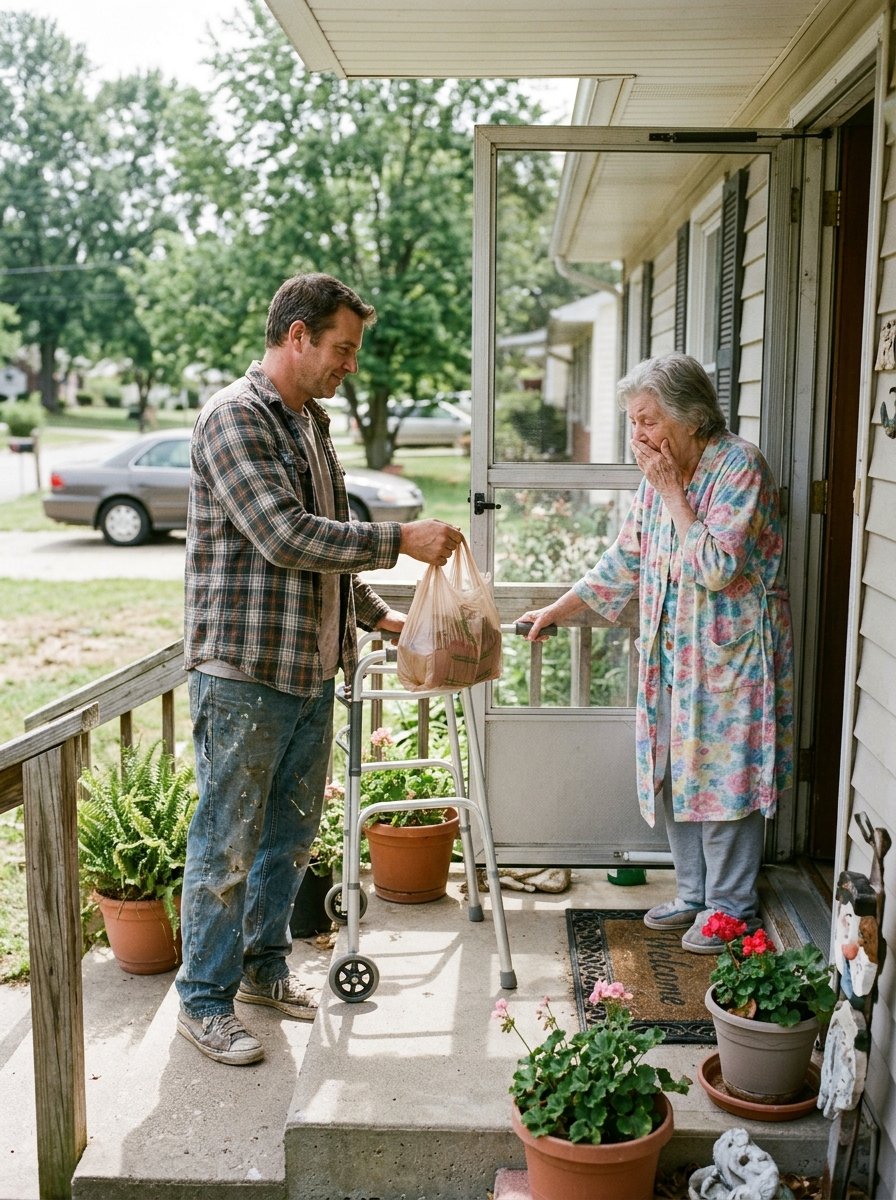
My Son Sold My Car for $3,200 While I Was in the Hospital. Two Days Later, the Buyer Showed Up at My Door With Something Unexpected.
The Spare Tire
“I told him I was a retired cop,” the man said, “and that I’d found something in the trunk that didn’t look like personal papers. I told him I’d be glad to hand it over to the sheriff, or to the owner, whichever he preferred.”
He turned his cap in his hands.
“He hung up.”
I held on to my walker. My knees had gone soft.
“My name’s Dale Pruitt,” he said. “Can I come in? I’d like to be here when he comes. If you want.”
I looked at the bag on the table. A grocery bag from Kroger, wrapped in Walt’s old green bath towel, the one with the burn mark.
“Yes,” I said. “Please.”
My name is Peggy Larson. I’m seventy-nine. I worked thirty-one years as a bookkeeper for a lumberyard in Dayton, Ohio. I’m good with numbers. I’m bad at saying no to my son.
Walt and I married in 1968. He drove a delivery truck for a bread company. He was a quiet, patient man with big hands. We had one child, Kevin, born in 1975. Walt died in 2014, of a stroke, in his chair, with the Reds game on.
Before he died, in the hospital, he held my hand and said, “Peg. Don’t keep it all in the bank. Keep some where only you know.”
I thought he was rambling. He wasn’t.
After the funeral, I put $9,000 in a Kroger bag, wrapped it in a towel, and hid it under the spare tire of the Toyota. That was our funeral money, his and mine. Every month for ten years, I added what I could from my pension. Fifty. A hundred. Some months, nothing.
By March, it was $41,000.
I never told Kevin. I never told anyone.
Kevin is forty-nine. He’s tall like his father, with a pleasant face and a nervous laugh. He’s sold cars, insurance, and a hot-tub franchise. Nothing lasts. He’s divorced. He owes people money. He’s never once said so.
I’d lent him more than I could count. $2,000 here, $800 there. I kept a list in my head. I didn’t write it down, because a written list is an accusation.
He had a key to my house, for emergencies.
In March, I fell in the kitchen. I was reaching for a pot. My hip made a sound like a branch breaking. I lay on the linoleum for two hours before the neighbor heard me calling. They took me to Miami Valley in an ambulance. Eleven days in the hospital. Three weeks in rehab.
Kevin visited twice.
Both times, he asked about the car.
“Mom, you’re not going to be driving for a while. Maybe ever.”
“It’s fine where it is.”
“It’s just sitting there. It’ll die. The battery.”
“I’ll deal with it when I’m home.”
“I’m only saying.”
The second time, he stood at the foot of my rehab bed with his hands in his pockets. He looked at the window.
“You know the insurance is, what, eighty a month? For a car you can’t drive.”
“I know what it costs, Kevin.”
“I could help. If you wanted.”
“Help how?”
He shrugged. “Sell it. Get you something smaller when you’re better.”
“No.”
He didn’t push. That should have told me something. He’s a man who pushes.
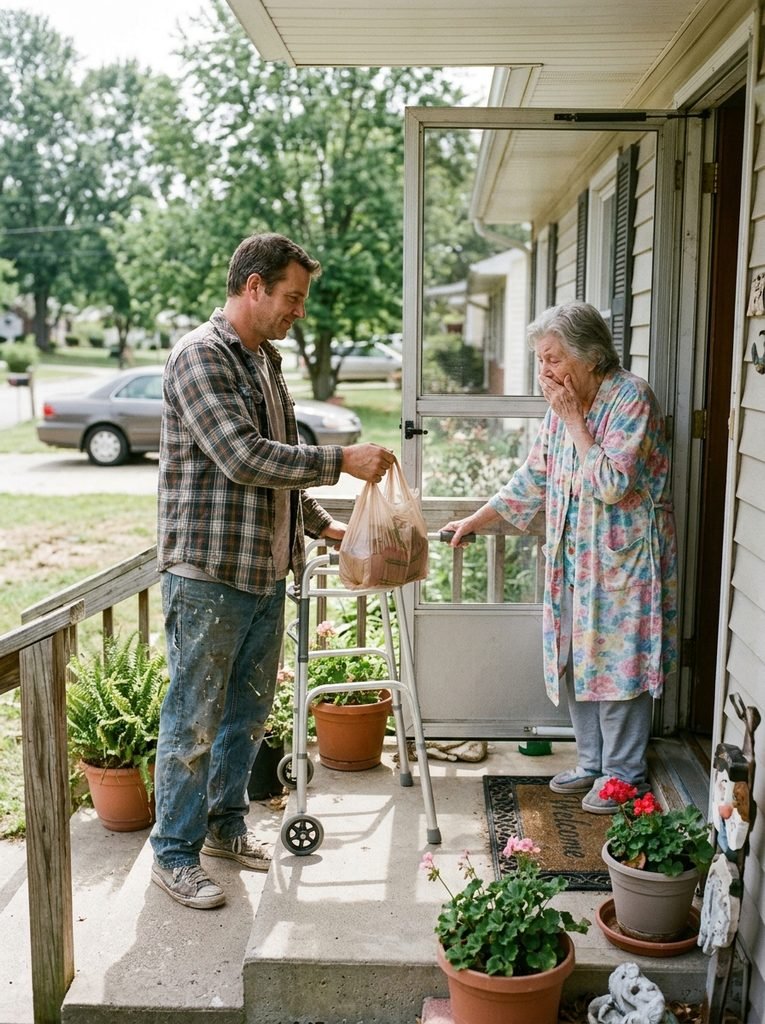
A nurse drove me home on a Tuesday. A kind girl named Imani, twenty-six, with a long braid. She helped me up the walk with my walker. At the end of the driveway, I stopped.
It was empty.
Not just the car. The oil stain was there. A little rectangle of cleaner concrete where the Toyota had sat for sixteen years.
“Mrs. Larson?” said Imani. “Are you all right?”
“Where’s my car?”
“I don’t know, ma’am.”
I stood there for a full minute. A mockingbird was working the hedge.
I went inside. I sat at the kitchen table. I called Kevin.
“Oh, yeah,” he said. “I sold it.”
I didn’t say anything.
“Guy on Facebook. Three thousand two hundred. It was a good price, Mom. You weren’t using it.”
“Where’s the money?”
“I had some bills. I’ll pay you back.”
“When?”
“Soon.”
“Kevin.”
“I’ve got a thing, Mom. I’ll call you.”
He hung up.
I’d like to tell you I was angry. I wasn’t. I was something flatter and colder. I put my hands on the table and looked at them. They’re spotted and thin, and they’ve signed ten thousand checks.
I didn’t think about the three thousand. It was a bad price. The Toyota was worth about $4,500.
I thought about the trunk.
The spare tire well. The towel. Forty-one thousand dollars.
If I called Kevin and said, the car had money in it, he’d drive straight to the buyer. He’d say it was a mistake, he’d say it was “personal papers,” and the buyer, a stranger, would hand it over, because who wouldn’t. Kevin would have it by dinner. He’d spend it by Christmas.
If I called the police, they’d ask what was in the trunk. They’d ask why I’d kept it. They’d ask, probably, whether I was sure about my memory. I’m seventy-nine. I’d just had a fall.
So I sat. I made tea. I didn’t drink it.
I thought of Walt. Where only you know.
I’d told the one person I couldn’t. I hadn’t told him. It was the car that had told.
Wednesday, I didn’t sleep. I lay in the dark and listened to the clock.
I’d done the arithmetic. It’s what I do. Forty-one thousand was my burial, and Walt’s, with a little left. It was ten years of pension, a dollar at a time. It was ten years of Kevin asking, and me saying “I don’t have much.”
I’d lied to my son for ten years so he’d leave something alone.
And he’d sold it for $3,200, without looking.
I don’t think I cried. I think I lay there thinking: he doesn’t even know what he sold. It was the worst part. Not the theft. The not-knowing.
At six, I got up. I made toast. I sat by the phone.
At nine on Thursday, someone knocked.
Dale Pruitt sat at my kitchen table with a cup of coffee he didn’t touch. He was forty-six, broad-shouldered, with a gray crew cut and a face like a closed door that had opened a crack. He’d been a Montgomery County deputy for twenty years, until a back injury in 2019. Now he did drywall.
“I bought it for my daughter,” he said. “She’s seventeen. She just got her license.”
“What’s her name?”
“Marisol.”
“That’s pretty.”
“Her mother picked it.” He smiled faintly. “I got the Toyota Sunday. Kevin met me in a Walmart parking lot. He was in a hurry. He said his mother had passed, and he needed to move the car.”
I held very still.
“He said I passed?”
“He said you’d died. In March.” Dale’s jaw tightened. “That’s why I only paid thirty-two hundred. I thought I was doing the family a favor.”
I put my hand over my mouth.
“I’m sorry, ma’am. I should’ve asked more questions. I’m a cop. I know better.”
“You were being kind.”
“I was being lazy.”
“Dale.” I wiped my eye. “You’re sitting in my kitchen with forty-one thousand dollars. I’d say that’s the opposite.”
He didn’t smile. He looked at the bag.
He told me how he’d found it.
Wednesday afternoon, driving Marisol home from school, the Toyota got a flat on Route 48. He pulled over. He opened the trunk. He pulled up the carpet, and found the spare tire in its well.
“It was heavy,” he said. “Heavier than a spare ought to be. I lifted it out. And there was a bag. Wrapped in a towel.”
“What did you think?”
“I thought, drugs.” His voice was dry. “Twenty years on the job. You see a bag in a trunk, that’s where your head goes. I put it on the shoulder. I opened the towel.”
“And?”
“It was bills. Hundreds and twenties. Rubber-banded. A little envelope on top, with a label in pencil.” He pulled something from his shirt pocket and set it on the table. A small brown envelope, soft with age. “Peg and Walt. Funeral.”
I looked at it.
Walt’s handwriting. I’d forgotten I’d kept it. He’d written it in 2014, in the hospital, on the back of a Kroger receipt, and I’d copied it onto an envelope.
“I sat on the side of Route 48 with forty-one thousand dollars,” said Dale. “My daughter in the front seat. Cars going by. I counted it twice.”
“You could’ve kept it.”
“I could have.”
“Nobody would’ve known.”
“Marisol would’ve.” He turned his cup. “She was watching me. She’d asked, ‘Dad, what is it?’ And I’d said, ‘It’s somebody’s.’ And she said, ‘Whose?’”
“I took the registration out of the glove box,” he said. “Your name. This address. I drove here that night. I sat in the car outside. It was nine o’clock. I saw the porch light. I thought, an old lady lives here. I thought, she’ll be scared if I knock at nine.”
“I’d have been.”
“So I went home. I slept badly. And at eight this morning, your son called.”
“He called you?”
“He had my number from the Facebook ad. He said, ‘Hey, man, I think I left something in the trunk. Personal papers.’” Dale’s voice went flat. “I said, ‘What kind?’ And he got, he sort of laughed. He said, ‘Just some old stuff of my mom’s. Nothing important.’”
“But he wanted it.”
“He wanted it bad. His voice was tight. He asked if I’d cleaned the trunk out.” Dale paused. “I said yes. I said I’d thrown everything away. And he went quiet.”
“What did he say?”
“He said, ‘Everything?’”
I closed my eyes.
“That’s when I knew,” said Dale. “A man who doesn’t care about old papers doesn’t say ‘everything’ like that.”
“So you told him you were a cop.”
“I told him I’d found something in the trunk that didn’t look like papers.” His eyes were steady. “I said I’d be glad to turn it over to the sheriff. Or to the rightful owner.”
“And he hung up.”
“Fast.”
I sat for a long time. A clock ticked. A fly worked the window.
“He’ll be here in an hour,” said Dale. “I think. He knows where you live. And he’ll have worked out that I’ve seen the name.”
“What do I do?”
“What do you want to do?”
I’d been asked that perhaps four times in my life. I looked at the bag on the table. At the little envelope. At the towel with its burn mark, where Walt had set down a hot iron in 1987 and said a word I won’t repeat.
“I’d like to hear him say it,” I said.
“Say what?”
“What he did.”
Dale nodded slowly.
“Then I’ll stay,” he said. “In the next room. I won’t say anything. But I’ll be where I can hear.”
“That seems fair.”
“Ma’am, one thing.”
“Yes?”
“If he asks where it is, I think you should say you don’t know.”
“Why?”
“Because I’d like to see what he does when he thinks it’s gone.”
I looked at him.
“You’re a very sly man for a drywaller,” I said.
“It’s the badge,” he said. “You don’t give it back.”
I made Dale hide in the pantry. It’s a narrow room off the kitchen, with a door that doesn’t close all the way. He stood there for fifty minutes with a can of green beans at his shoulder, in his work boots, with his hat in his hand. I put the bag on the top shelf of the linen closet, behind the spare blankets. I took out the towel and folded it on the table, as if it were nothing.
At 10:52, I heard a car in the drive.
It was a white Chevy truck, an old one, with a cracked taillight. I knew the engine. It had a knock that Walt used to say was a bad lifter.
I sat at the kitchen table, in my robe, with my walker beside me and a cup of cold tea. I folded my hands.
The key turned in the lock.
Kevin came in the way he always does, quick and bright, with a smile on his face, calling “Mom?” in the voice of a man delivering good news.
He stopped in the doorway.
He’s tall, six-one, with a sandy mop of hair going gray and a fleece vest that didn’t fit anymore. He had a day’s stubble. His eyes went over the kitchen, once, fast. The counters. The stove. The table.
The towel.
I watched his face. He saw it, and he knew it, and something in him went tight.
“Hey, Mom.”
“Hello, Kevin.”
“You’re up.”
“I’ve been up.”
“How’re you feeling?”
“Like a woman whose son sold her car.”
He laughed. It came out thin. “Come on. I said I was sorry.”
“You didn’t.”
“I meant to.”
“You told the buyer I was dead.”
Nobody breathed. In the pantry, I heard a very faint creak, like a floorboard settling.
Kevin’s face went white from the forehead down.
“I didn’t say that.”
“He said you did.”
“He’s lying.”
“He’s a retired deputy sheriff.”
“I, Mom, I don’t know what he told you.”
“He told me you called this morning.” I kept my voice level. “He said you’d left something in the trunk.”
He pulled out a kitchen chair and sat. He did it slowly, like a man lowering himself into cold water. He put his hands on the table. They weren’t steady.
“It was a misunderstanding,” he said.
“What was?”
“The car. I thought, you weren’t going to drive it. I was trying to help.” His voice sped up. “I had a guy who needed a car. It was a good price.”
“It was a bad price.”
“It was fair.”
“It was four hundred and fifty dollars a year for each year I’ve owned it. Sixteen years.”
“Mom.”
“And you said I’d died.”
“I didn’t, I mean, I said you were, in a facility. I said you weren’t coming back.”
“That’s the same thing.”
“It isn’t.”
I looked at him. My son. A grown man in a fleece vest, with a tired, boyish face and Walt’s chin.
“What did you leave in the trunk?” I said.
He didn’t answer.
“Kevin.”
“Nothing.”
“You called a stranger at eight in the morning about nothing?”
“I thought, I had a, it was papers.”
“What papers?”
“Just stuff.”
“What stuff?”
He opened his mouth. His eyes slid to the towel. Then to the cabinets. Then to me. And I watched him realize, a second too late, that he’d never in his life lied to me and had it work.
“Did you know about the money?” I said.
His whole body went still.
“What money?”
I waited.
“Mom. I don’t know what you’re talking about.”
“There was forty-one thousand dollars in the spare tire well.”
It wasn’t a question. I said it flat, like a number in a ledger.
His chair scraped. He half rose, and sat again. His mouth was open. His face had the strange gray look of a man who’s missed a step on a dark staircase.
“Forty-one thousand?”
“Yes.”
“In the car?”
“In the trunk. Under the spare.”
“You kept, Mom. You kept forty-one thousand dollars in a car?”
“Your father told me to.”
He put both hands over his face.
I’d braced for a lot of things. I’d rehearsed anger, and denial, and a long hurt speech. What I hadn’t braced for was the sound he made. It was a thin, cracked, awful noise, half laugh, half sob, like a boy who’s dropped a plate.
“I sold it,” he said, through his fingers. “I sold it for thirty-two hundred.”
“Yes.”
“With forty-one thousand dollars in it.”
“Yes.”
“Oh my God.”
It was, I’ll admit, a strange moment. I’d sat in my kitchen for three days, picturing Kevin as a thief. I’d imagined him knowing. I’d imagined him casing the trunk, taking the money, selling the car to hide it.
I hadn’t pictured this. A man of forty-nine at my table, face in his hands, laughing and crying, because he’d thrown away a fortune without knowing.
“Kevin,” I said. “Why did you call him this morning?”
He lowered his hands. His eyes were red.
“I, I found a receipt.”
“A receipt.”
“In your desk. From the, it was a Kroger receipt. From 2014. It said, ‘Funeral. Under spare.’” His voice shook. “In Dad’s handwriting.”
I closed my eyes.
I’d put it in the drawer. I’d forgotten. I’d kept the envelope but not the scrap it was copied from. Kevin had a key. He’d gone through my desk, I realized, on Monday, after the sale. Looking for papers. For a title. For money.
He’d found Walt’s note.
“I read it, and I thought, spare tire?” Kevin said. “The car. I’d just sold the car. And I called him, and he said he’d cleaned it out, and I thought, it’s gone. It’s all gone.”
“You thought there was money.”
“I didn’t know how much.”
“But you went looking.”
“I was looking for papers.” He pressed the heels of his hands against his eyes. “I’m in trouble, Mom.”
There it was.
I didn’t say anything. I let it hang in the kitchen, with the ticking clock and the faint, forgotten smell of toast.
“How much?” I said.
“What?”
“The trouble.”
He didn’t answer for a long time. Outside, a lawn mower started up, a few houses down.
“Thirty-eight thousand,” he said.
“To whom?”
“A guy.” He laughed, shakily. “A, it’s a loan. A private one. I took it in January. For, there was a thing with a business.”
“The hot tubs.”
“The hot tubs.”
“I told you not to.”
“I know.”
“What’s the interest?”
“Twenty percent.”
I closed my eyes.
“A month,” he said.
“Kevin.”
“I know.”
“That’s, God, that’s seven thousand six hundred a month.”
“I know what it is.”
“You’d have to pay him back in a year or lose.”
“I’d lose the truck. And the house. Well, the apartment. And he, the guy, he’s got a, he doesn’t care for people who don’t pay.”
I put my hand flat on the table.
“So you sold my car.”
“For three thousand. It wasn’t enough.” His voice broke. “It was never going to be enough. It was just a, it was a month’s interest.”
I looked at him for a long time.
I’m seventy-nine years old. I’d raised him alone through his teens, after Walt’s truck route got cut. I’d gone to every game. I’d sat in the bleachers in my work clothes. I’d given him $2,000 for a security deposit, and $1,400 for a transmission, and $800 for a lawyer, and a thousand things I’d never counted.
I’d never said no. I’d said I don’t have much.
I’d been lying to him for thirty years. I’d made myself small, so he’d feel big.
“Kevin,” I said.
He lifted his head.
“I’d have helped you.”
He stared.
“If you’d asked. I’d have said yes. To the first thirty thousand, anyway.” I took a breath. “I’d have sat down with you and said, ‘Let’s figure it out.’ I’d have gone with you to the bank.”
“You don’t have thirty thousand.”
“I have forty-one.”
His face went blank.
“I had forty-one,” I said. “In a trunk. And I’d have given you whatever you needed. If you’d said, ‘Mom, I’m drowning.’”
“Mom.”
“Instead you sold my car and told a man I was dead.”
He started to cry.
I let him. I want you to know I did. I sat at my own table, in my robe, with my hands folded, and I watched my son cry. It wasn’t pretty. His whole face came apart. He bent over the table with his arms wrapped around his head, shoulders heaving, and made a sound like a very young child.
“I’m sorry,” he said. “I’m so sorry. I’m sorry, Mom.”
“I know.”
“I didn’t know you’d, I didn’t think you’d, I thought you’d be gone.”
“Did you want me gone?”
“No!” He raised his head. “No. God. I didn’t. I wanted you to, I wanted you to be okay. And I, I thought, you can’t drive, and it’s sitting there, and I thought, it’s a favor.”
“A favor.”
“I know how it sounds.”
“It sounds like a lie you told yourself.”
He put his face back in his hands. He nodded.
“I think I’ve been telling myself lies for about thirty years,” he said, muffled.
“So have I.”
He looked up.
“I told you I didn’t have much,” I said. “For years. I said it every time. I thought it was kind.”
“It wasn’t a lie.”
“It was.” I took a breath. “I had thirty thousand in the bank, and forty-one in the trunk. I said, ‘I don’t have much.’ I wanted you to stop asking.”
His mouth opened. Nothing came out.
“I made it so you couldn’t know me,” I said. “And then I was angry when you didn’t.”
I heard a small sound from the pantry. A cough, quickly stifled. A creak.
Kevin’s head turned.
“Who’s that?”
“A friend.”
“What friend?”
“Come out, Dale,” I said.
The pantry door swung open. Dale Pruitt stepped out. He had a can of green beans in one hand. He stood in the kitchen doorway in his boots and paint-spattered jeans with his hat in his other hand, and his big, tired face was perfectly calm.
“Morning,” he said.
Kevin went white all over again.
“You’re him. From the, from the Facebook.”
“Dale Pruitt.”
“You were in the pantry.”
“Yes, sir.”
“You listened to everything?”
“Most of it.”
Kevin stood up. His chair went over. He took a step toward the door, and stopped. He looked at me, then at Dale, then at the table, and I watched all the fight go out of him at once, like air from a tire.
“Is this a trap?” he said.
“No,” I said. “It’s a witness.”
Dale set the can of green beans on the counter. He took a chair, righted Kevin’s, and sat in it. He folded his big hands.
“Kevin,” he said. “I’m going to tell you something. And then your mother’s going to tell you something. And then I’d like you to think.”
Kevin didn’t move.
“I found the money. Wednesday. I counted it. I could’ve kept it. I didn’t.” His voice was low and even. “I drove it here. It’s in the closet. Your mother’s got it. It’s all there.”
“All of it?”
“Every dollar.”
Kevin sat down heavily. He put both hands over his mouth.
“Why?”
“Because it’s hers.”
“You didn’t have to.”
“I did, though,” said Dale. “My daughter was watching.”
Kevin laughed. It was a ragged, wet, helpless sound.
“I’d also like to say,” said Dale, “that I’m a retired deputy. I’ve seen what happens to men who take from their mothers. It doesn’t end the way they think.”
“I didn’t take it.”
“You sold the car.”
“I didn’t know.”
“I believe you.” Dale studied him. “That’s the only reason I’m not on the phone to a friend at the sheriff’s office.”
Kevin sat very still.
“A friend at the sheriff’s office,” he repeated.
“There’s a thing called elder financial exploitation,” said Dale. “It’s a felony in Ohio. Selling a vehicle that isn’t yours, while the owner’s in the hospital, and telling the buyer she’s passed away. That could be theft. It could be fraud.”
“She’s my mother.”
“That makes it worse, in a way.”
“It’s my mother’s car.”
“It was her car,” said Dale gently. “You sold it.”
Kevin put his head on the table.
I felt something move in my chest. A cold, hard, sore thing, like a stone I’d been carrying.
“Dale,” I said. “May I?”
He nodded.
I turned to my son.
“Kevin. Look at me.”
He lifted his head. His eyes were bloodshot. His face was wet and gray.
“I’m going to tell you what I’m going to do. And I’d like you to hear all of it.”
He nodded.
“I’m not calling the sheriff.”
His shoulders dropped.
“I’m not saying I won’t. I’m saying I haven’t. There’s a condition.”
“Anything.”
“First. You’ll go to the buyer’s lender, the one with the twenty percent. You’ll tell him you can’t pay.”
“Mom, he’ll…”
“I know what he’ll do. He’ll threaten you. He’ll say things. He’s a man who lends at twenty percent a month. He’s not an honest man, and he’s not allowed to hurt you.” I held his eyes. “In Ohio, that rate is illegal. It’s usury. You can walk away from it.”
He stared.
“I did some reading,” I said. “Last night. I couldn’t sleep.”
“Mom.”
“You’ll see a lawyer. A real one. I’ll pay for the first hour. Her name’s Marguerite Okafor. She’s a friend of Dale’s wife.”
Dale nodded slowly. “She’s good.”
“She’ll tell you what your options are. I’d guess you’ll end up paying about twenty thousand, spread over time, at a fair rate. Not thirty-eight.”
“I don’t have twenty thousand.”
“No,” I said. “You’ll earn it.”
“Second,” I said. “You’ll sit with me. Every Sunday. In this kitchen. And you’ll tell me what you owe, and what you’ve borrowed, and who. For as long as it takes.”
He looked at me.
“I’m not giving you money. I want to be clear about that.”
“I know.”
“I’m giving you a person.”
“Mom.”
“And third.” I took a breath. “You’ll go to the Pruitts’ house, and you’ll apologize to Dale’s daughter.”
Dale’s head came up.
“Marisol,” I said. “She’s seventeen. She’s driving my car. She was told, by a man at a Walmart, that its owner had died. She’s been sitting in a Toyota thinking it belonged to a ghost.”
Kevin’s face crumpled.
“She’ll want to hear it from you,” I said.
“I will.”
“Not an email.”
“I’ll go in person.”
“Good.”
Dale had put his hand over his mouth. I saw his eyes were wet.
It took a year. It wasn’t tidy.
Kevin went to Marguerite Okafor on a Monday. She’s sixty, with a gray bob and a laminated sign that says PAPERWORK FIRST. She read his loan documents in forty minutes and said, in a dry, level voice, “Mr. Larson, this is the most illegal contract I’ve seen since 2009.”
The lender’s name was Gordon Pruitt, no relation to Dale. He ran a “bridge financing” operation out of a strip mall in Beavercreek. His rate was 240 percent a year. In Ohio, that’s far above the legal limit. After three letters from Marguerite, he settled for $19,500, to be paid over three years at six percent. He wrote Kevin a note. No hard feelings.
Kevin sold the truck. He took a job at a Honda dealership, in the service department, at $19 an hour. He’d told me, once, in my kitchen, “It’s the first work I’ve done with my hands since high school.” He took the bus.
He came on Sundays. At first he sat at the table with a ledger and a pen, like a man at a trial. Every week, he’d read me the numbers. Paid $400. Balance $17,100. I’d nod. I’d make a pot roast. He’d eat three helpings.
In June, he said, “Mom. Can I ask you something?”
“Go ahead.”
“Why’d you keep it in the car?”
“Your father told me to.”
“Why did he?”
I’d thought about it for ten years.
“He said, ‘Keep some where only you know.’”
“Why?”
“I think he knew you’d ask.”
Kevin put down his fork.
“He knew?”
“He loved you. And he knew you.” I smiled faintly. “He said it kindly.”
The visit to Marisol was in May.
I wasn’t there. I’d asked Dale, and he’d said, “Let him do it alone.” But Dale told me about it afterward, over a cup of coffee, in my kitchen, with his hat on his knee.
Kevin had driven his borrowed Corolla to the Pruitts’ house in Kettering. It was a small yellow ranch, with a basketball hoop and a lawn that needed mowing. He’d stood on the porch for ten minutes. Dale’s wife, Rosa, a small, round, kind woman, had finally opened the door.
“Mr. Larson?”
“Is Marisol home?”
She was. She came out in a school sweatshirt, with a braid and big serious eyes. She stood in the doorway with her arms folded.
“You’re the one who sold my car,” she said.
“I am.”
“My dad told me.”
“I’m sorry.”
“For what?”
“For all of it.” Kevin’s voice cracked. “I told the man my mother had died. I wasn’t telling the truth.”
“Why?”
“Because I wanted him to feel bad. So he’d pay less.”
Marisol stared at him.
“That’s the worst reason I’ve ever heard,” she said.
“I know.”
“It’s mean.”
“It was.”
“My dad says you’re sorry.”
“I am.”
She considered him for a long moment. She’s seventeen. She’d been told, by her father, that this was a man who’d made a mistake.
“I’d like to keep driving it,” she said. “If your mom says okay.”
“It’s hers to say.”
“I know.” She unfolded her arms. “Tell her thank you.”
“I will.”
“And tell her I’m sorry about the, about the dying thing.”
Kevin made a sound. He put a hand over his eyes.
“She isn’t dead,” said Marisol, carefully. “She’s very much alive. I looked her up.”
“She is.”
“That’s good.”
“It is,” said Kevin. “It’s very good.”
I made a decision that summer.
I’d been thinking about it. Dale and Rosa and I had talked, on a Sunday, in my kitchen. Marisol had come, too, with a casserole. She’d put it on the counter and said, shyly, “I made it. It’s tuna.”
It was awful. We ate it.
“I’d like to give you the car,” I said.
Marisol stared. Dale put down his fork.
“Mrs. Larson, we can’t.”
“You bought it.”
“For three thousand.”
“Which Kevin kept. I haven’t been paid.” I smiled. “I’d like to correct that.”
“I’ll pay you,” said Dale.
“No.”
“Peggy.”
“You returned forty-one thousand dollars.” I folded my napkin. “I’d say that’s a down payment on a lot of Toyotas.”
“I did what anybody would’ve done.”
“Nobody did,” I said. “I’ve lived seventy-nine years. I’ve looked.”
Dale’s chin trembled. He looked at the table.
“It’s got a hundred and sixty thousand miles,” he said, gruffly. “It needs a timing belt.”
“Then it’s a good car.”
“It’s a very good car.”
“Keep it,” I said. “For Marisol. And when she’s done, give it to somebody who needs one.”
Marisol put her face in her hands.
There was something else.
I’d decided it in March, in the dark, after Dale left. I’d sat at my kitchen table, alone, with the bag in my lap. I’d counted the bills one by one. Forty-one thousand. It’s a lot of paper. It smells like old cloth.
Walt had said, Keep some where only you know. I’d done it. I’d done it so long that I’d forgotten why.
I’d wanted to protect Kevin from his own weakness. That’s what I’d told myself. In truth, I’d been protecting myself from being asked. It’s easier to say I don’t have much than to say I’m afraid to give it.
I took out a pen.
I wrote a letter. It took two hours. It was to Kevin, and it was short. I sealed it in an envelope and put it in the bag, on top of the bills.
On the Sunday after he paid off the last of his loan, I gave it to him.
It was the following April. A bright, warm day, with the dogwoods out. He’d come for dinner. After the pot roast, I went to the closet and took out the Kroger bag. I’d rewrapped it in Walt’s towel.
I set it on the table in front of him.
He looked at it. His face changed.
“Mom.”
“Open it.”
“I can’t.”
“It isn’t a test.”
He unwrapped the towel. His hands shook. He looked at the bills, the rubber bands, the envelope on top.
“It’s the funeral money.”
“It is.”
“It’s yours.”
“It’s mine,” I said. “And it’s Walt’s. And I’d like you to have a part of it.”
“Mom, no.”
“Not all. Twenty. I’ll keep twenty-one. For the funeral, and a little more.”
“I don’t want it.”
“I know.” I smiled. “That’s why.”
His eyes filled. He looked at the envelope. It had Kevin on it, in my shaky hand.
“Read it.”
He slid a thumbnail under the flap. The paper rustled. Inside was a single sheet of lined notebook paper, folded in thirds.
Kevin,
Your father told me to keep some where only I knew. I did. I kept it so well that I kept it from you.
I think that was a mistake. I was afraid that if you knew what I had, you’d stop knowing me. I think I was wrong.
I’d like you to know that I love you. I’d like you to know that you can ask me. About anything. At any hour.
The money is for you, and for the funeral, and for whatever comes after. I’d like us to decide together.
Your mother
P.S. The towel is Dad’s. It has a burn mark. He never told me how it got there. I’ve always wondered.
He read it twice. He put his hand over his mouth. A tear slid down his cheek and fell on the towel.
“I know how,” he said, hoarsely.
“What?”
“The burn.”
I stared.
“It was me. I was eleven. I was ironing a shirt for school, and Dad came in, and I was scared. I put the iron down on the towel. He never said. He just picked it up and folded it and put it away.”
I laughed. It broke in the middle.
“He told me it was a secret between us,” said Kevin. “He said, ‘Don’t tell your mother.’”
“I never knew.”
“He kept it for you.”
“He kept a lot.”
“He did.” Kevin wiped his face with the back of his wrist. “I think I’ve been trying to figure out how to say sorry for thirty-eight years.”
“You just did.”
“It’s not enough.”
“It’s a start,” I said.
He’s still on the bus, mostly. He bought a used Honda in the fall, with a loan he took out himself, at a fair rate, with a bank. He’s paid it down by half. He comes on Sundays and does the dishes. He fixed the back step, last July, without being asked. He told me it was “something Dad would’ve done.”
I put the twenty thousand in a trust. It’s for him, after I’m gone, with a bank as trustee, and a clause that says he gets it in installments, if he’s still the man he’s become. I’d have liked to give it all at once. Marguerite said, kindly, “Peggy, you’ve done it your way for sixty years. Try mine.”
I did.
The rest is in a bank, in my name, with a card in my purse that says In case of emergency, call Kevin. He’s the first number.
Last month, a Thursday, a car pulled into my drive. A little silver Toyota, the same one, with a new tire and a patched bumper. Marisol got out, eighteen now, with her braid down her back and a box in her hands.
She climbed my steps. I opened the door before she knocked.
“Mrs. Larson. I got into State.”
“Oh, honey.”
“Nursing. I got a scholarship.” She held out the box. “I wanted to show you first.”
It was a cake, from a bakery, with CONGRATS, ME on it in blue frosting. I laughed so hard I had to hold the doorframe.
We ate it at the kitchen table, with plastic forks. Marisol told me about the dorm and the roommate and the clinicals. I told her about the lumberyard, and Walt, and the burn on the towel. At four, she stood.
“I have to go. Dad’s making dinner. It’s tuna.”
“God help him.”
“I told him not to.” She grinned. She hesitated at the door. “Mrs. Larson?”
“Yes?”
“I’m going to leave the car.”
I stared.
“I’ll be at school. I won’t need it. And I thought, you might.” She put the keys in my hand. They were warm. “It’s your car. It always was.”
“Marisol, I can’t drive.”
“You will.”
“I’m seventy-nine.”
“You’re going to learn to walk without the walker. I’ve seen you. You’ve been practicing.”
I had. In the hall, at night, when nobody was watching.
“Then you’ll want a car,” said Marisol. She kissed my cheek. “I’ll come back at Thanksgiving. I’ll make you drive me to the grocery store.”
She left. I stood on the porch with the keys, watching her walk down the drive in the late light. At the road, she turned and waved.
I sat in the Toyota that evening.
I did it alone. I got down the steps on my cane, a long, slow, careful process, and across the grass to the driveway. I opened the door. I lowered myself into the driver’s seat, which smelled of vanilla air freshener and a teenage girl’s shampoo.
I put my hands on the wheel. They were thin and spotted.
I turned the key. The engine caught, with a small, familiar cough. I sat there with it running, in the warm dusk, looking at the garage door, and thought of a man in a hospital bed.
Keep some where only you know.
I reached down. I pulled the lever for the trunk. It popped with a small, dry click.
I got out slowly. I walked around to the back. The lid was up. Inside, the carpet was pale and clean. I lifted it. The spare tire sat in its well, round and black and dull.
I stood there a long time.
Then I took a small envelope from my cardigan pocket and set it on top of the tire. It was a plain brown one, soft at the edges. On it, in pencil, I’d written two words in my own hand.
For Kevin.
Inside was a key. A little brass house key. It opens the back door.
I closed the trunk. I stood in the driveway in the dusk, with my hand on the warm roof of the car, and heard, from the house next door, a screen door bang and a child laugh.
Then I went in, and I made two cups of tea.
I left the second one on the table, in case he came.