“My daughter-in-law changed the locks on my mountain home, moved her
“My daughter-in-law changed the locks on my mountain home, moved her
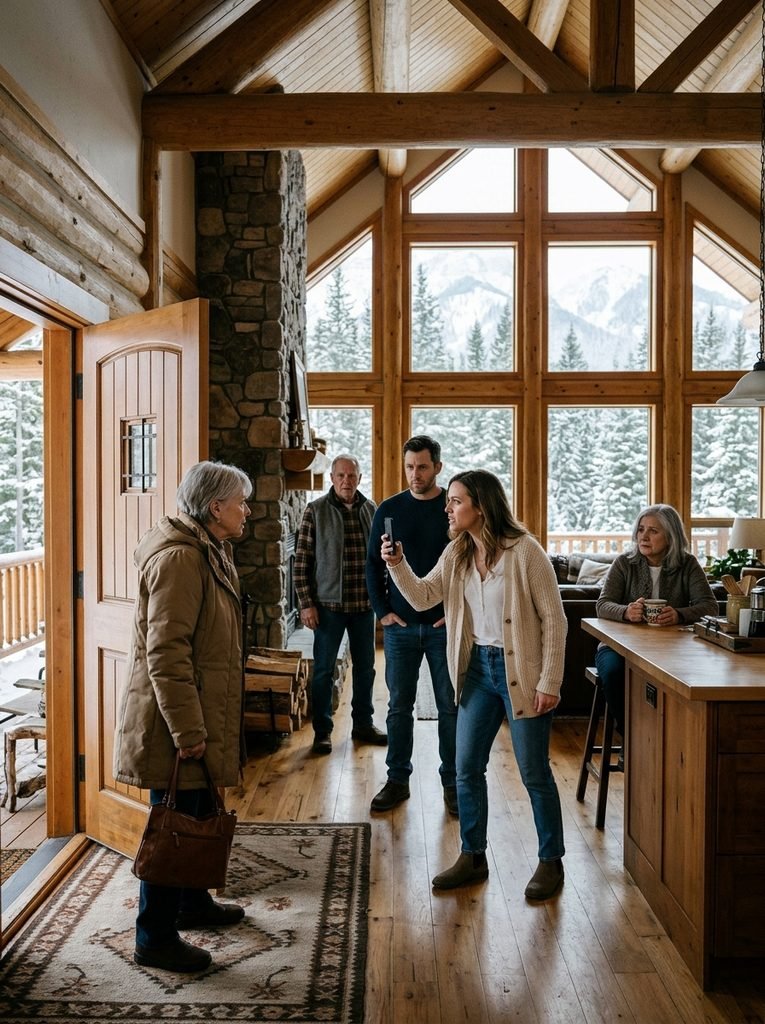
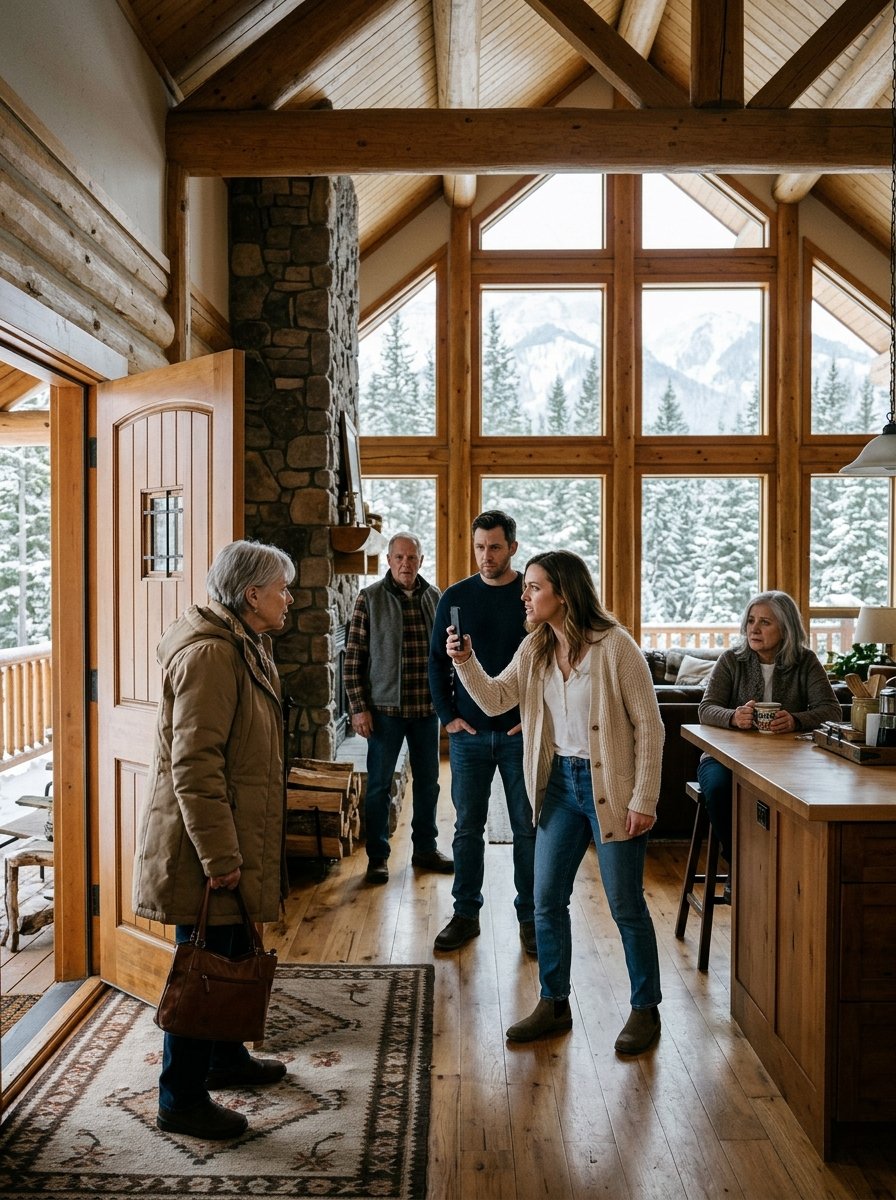
parents into my bedroom, then called the police and accused me of trespassing inside the house I owned. “Leave now, you old trespasser,”
Brittany shouted, holding her phone inches from my face. “This is our house now.” She stood in my kitchen wearing my cashmere cardigan while her mother
drank from my best mug. My family photographs had been
ripped from the mantel, my late husband’s portrait lay facedown beside the fireplace, and my only son stood silently behind his wife.
I looked directly at him. “Tell them who I am.” Evan lowered his eyes and said nothing. When the deputies
arrived, Brittany handed them a lease and demanded they remove me. One officer turned toward me
and asked whether I had any proof that the house belonged to me. I slowly reached into my purse and
pulled out a black envelope. The instant Brittany’s father saw the law firm’s name printed across it, the color drained from his face. Before the deputy could open it, a floorboard creaked upstairs. My frightened grandson appeared
on the landing, clutching a bent screwdriver while the door to my late husband’s private study stood
open behind him. His voice shook. “Grandma… don’t let them find what they
were taking from the safe.” The deputy locked the front door, opened my envelope, and froze when he reached the third page.”
The deputy’s thumb stopped halfway down the paper.
For several seconds, the only sound in the house was the hard ticking of the old clock above the fireplace and the thin mountain wind pressing against the windows.
Brittany’s father took one step backward.
The deputy looked at him.
Then at Brittany.
Then at Evan.
“Everybody stays exactly where they are.”
Brittany gave a brittle laugh.
“You can’t detain us in our own home.”
The deputy did not answer her. He turned the third page toward his partner.
His partner read it once, then again more slowly.
I knew exactly what they were seeing.
The first page in that envelope was a certified copy of my deed.
The second was the current county property record showing that no transfer had ever been made.
The third was the reason Brittany’s father had gone pale.
It was an emergency preservation order signed the previous afternoon.
My attorney had obtained it after a title company contacted me about a request to prepare documents using my home as collateral.
The request had not come from me.
It had come from Brittany’s father.
And attached to it had been a copy of the same so-called lease Brittany had just handed to the police.
The judge’s order prohibited Evan, Brittany, her parents, or anyone acting for them from removing, transferring, selling, concealing, destroying, or accessing property belonging to me until the court could determine whether attempted financial exploitation had occurred.
The deputy lowered the page.
“Ma’am,” he said to Brittany, “step away from the counter.”
Her smile vanished.
“This is ridiculous.”
“Step away from the counter.”
Her mother slowly put down my mug.
Porcelain clicked against granite.
My grandson was still frozen at the top of the stairs.
The bent screwdriver trembled in his fist.
I looked up at him.
“Come down to me.”
His eyes darted toward Brittany.
That tiny hesitation hurt more than I expected.
A child should never have to decide whether crossing a room to his grandmother is an act of disobedience.
“It’s okay,” I said.
He descended one stair at a time.
When he reached the bottom, he did not run.
He walked.
Carefully.
Like someone moving through a room full of broken glass.
Then he pressed himself against my side.
I felt his heart hammering through his sweatshirt.
The second deputy moved toward the staircase.
Brittany’s father blocked him.
“There’s nothing upstairs.”
The deputy stopped.
“Move.”
“I said there’s nothing—”
“Sir.”
One word.
Quiet.
Final.
Brittany’s father moved.
The deputy climbed the stairs.
Brittany turned on my grandson.
“What did you do?”
His fingers closed around the fabric of my sleeve.
“Do not speak to him,” I said.
Her head snapped toward me.
For the first time since I had entered the house, she seemed to understand that I was no longer trying to persuade her of anything.
I was finished persuading.
I was finished asking.
I was finished waiting for my son to remember how to be my son.
Evan stood near the kitchen doorway with both hands hanging uselessly at his sides.
His face looked gray.
“Mom—”
I raised one hand.
He stopped.
The deputy upstairs called down.
“I need my partner up here.”
The room changed.
Not loudly.
No one screamed.
But something invisible dropped through the center of us.
The first deputy folded the court order and placed it carefully back on the table.
“Stay here.”
He climbed the stairs.
Brittany immediately reached for her phone.
I saw the movement.
So did my grandson.
“She’s going to call him,” he whispered.
Brittany froze.
The deputy turned from the stairs.
“Call who?”
My grandson swallowed.
His gaze dropped to the floor.
Brittany stepped toward him.
“He doesn’t know what he’s talking about.”
I moved between them.
The child’s breathing became shallow behind me.
The deputy came back down one step.
“Buddy, you don’t have to answer her. Look at me.”
My grandson looked up.
“Who was she going to call?”
His voice almost disappeared.
“The man who was coming tomorrow.”
Brittany’s father swore under his breath.
Evan looked at his wife.
“What man?”
She did not look back.
That was the first moment I saw genuine fear in my son’s face.
Not fear of losing the house.
Not fear of the police.
Fear that the story he had told himself was beginning to come apart.
The deputy descended.
“What man?” he repeated.
My grandson lifted his shaking hand and pointed at Brittany’s father.
“He said the man would bring papers. He said Grandma would be gone before anybody could stop it.”
Silence.
Evan stared at his father-in-law.
“What papers?”
“No one said that,” Brittany’s father snapped.
My grandson flinched.
I felt it through his shoulders.
I turned.
“Sweetheart, where did the screwdriver come from?”
His eyes filled.
For a moment he could not speak.
Then he held it out.
It was one of my husband’s old tools.
The yellow handle was scarred from decades of use.
“I heard them in Grandpa’s room.”
His lower lip shook.
“They told me I wasn’t allowed in there anymore.”
Brittany shut her eyes.
Only for a second.
It was enough.
My grandson continued.
“They locked the study after dinner. Then Grandpa’s old alarm started making a little beeping sound. I knew you said nobody was supposed to touch that safe.”
I had told him that years ago.
Not as a warning.
As part of a story.
His grandfather used to keep legal papers, military medals, old coins, and private letters inside it. When my grandson was little, he had once asked whether there was treasure in the safe.
My husband had laughed and told him, “Only the boring kind that becomes important when adults stop behaving.”
I had forgotten those words.
My grandson had not.
“I waited until they went downstairs,” he whispered. “The study door was stuck. I tried Grandpa’s screwdriver.”
He looked at the bent shaft.
“I’m sorry.”
I took the tool from him.
“You have nothing to be sorry for.”
A noise came from upstairs.
A drawer sliding.
Then the deputy appeared at the landing.
His expression was different now.
Professional.
Controlled.
But hard.
“We’ve got property boxed on the bed. Jewelry. Financial records. Original estate documents. There are open containers beside the safe.”
Brittany’s mother covered her mouth.
Evan whispered, “What?”
His wife turned toward him.
“Don’t.”
That single word told him more than any explanation could have.
His face collapsed.
“You told me you were organizing Mom’s things.”
Brittany stared at him.
“I was.”
“You said your parents were helping because she had too much stuff.”
“They were.”
“The jewelry?”
No answer.
Evan stepped closer.
“The documents?”
Brittany’s father cut in.
“Watch yourself.”
Evan turned on him.
“No. You watch yourself.”
It was the first force I had heard in my son’s voice all day.
Too late for me.
But not too late for the truth.
Brittany’s father pointed toward me.
“She was sitting on an empty house worth a fortune while you two were drowning. Someone had to think practically.”
My grandson pressed closer behind me.
Evan went very still.
“What did you do?”
Brittany finally exploded.
“What we had to do!”
Her voice struck the wooden beams and came back sharper.
“You think I was going to keep watching her live up here alone in a house this size while we paid rent? You think I was going to let all of this just sit here until she died?”
The words remained in the room.
Until she died.
Even Brittany seemed to hear them after she said them.
Her mother lowered her head.
Evan stared at his wife as though someone had replaced her while he was looking away.
Brittany’s breathing quickened.
“I didn’t mean it like that.”
“Yes, you did,” I said.
She looked at me.
I did not raise my voice.
“That is exactly how you meant it.”
Her face twisted.
“You have always treated me like I wasn’t good enough for this family.”
I almost laughed.
Instead, I walked toward the fireplace.
My husband’s portrait was still lying facedown on the stone hearth.
I bent and lifted it.
There was a scratch across one corner of the wooden frame.
I brushed dust from the glass with my thumb.
“When you married my son,” I said, “I paid the deposit on your first apartment.”
Brittany’s jaw tightened.
“When your car died, I bought the replacement you said you needed for the baby.”
Evan closed his eyes.
“When you went back to work, I kept your child three afternoons a week for almost two years and never once asked you for money.”
I placed the portrait upright.
“You called me generous then.”
Brittany said nothing.
“You only began calling me controlling when I stopped saying yes.”
Her eyes flashed.
“You have more than you need.”
“And there it is.”
No one moved.
I turned to Evan.
“The sentence you have both been too ashamed to say plainly.”
His eyes filled.
“Mom—”
“You decided my comfort was excess because you wanted it.”
He looked at the floor.
I stepped closer.
“You changed my locks?”
A long pause.
Then he nodded.
Barely.
“Yes.”
The answer entered me like cold water.
I had known.
Of course I had known.
But knowledge and confession are different injuries.
“You gave them access to the study?”
His mouth opened.
Closed.
“I gave Brittany the old alarm code.”
My grandson stared at his father.
Evan saw it.
That was when he broke.
Not dramatically.
No shouting.
His shoulders simply folded.
“I thought we were moving in temporarily,” he said. “She told me you were going to sell after winter. She said you’d agreed to let us stay.”
I looked at him.
“Did you ever hear me agree?”
“No.”
“Did you call me?”
“No.”
“Did you ask?”
His face crumpled.
“No.”
I nodded.
“Then you did not believe her.”
He looked up.
“You wanted to.”
The distinction destroyed the last defense he had.
The deputy returned to the kitchen and spoke quietly into his radio.
Brittany’s father started toward the hallway.
“Sir, stop.”
“I’m leaving.”
“No, you’re not.”
“You have no right—”
“An active court order identifies you by name, and we have items upstairs that appear to have been removed from a secured safe. You’re staying until this is sorted out.”
Brittany’s father looked at the front door.
Then at the windows.
The mountain beyond the glass had disappeared into low gray cloud.
For the first time, this house felt less like something he had conquered and more like a locked room containing every choice he wished he could take back.
Brittany began crying.
Not softly.
Angrily.
She pointed at me.
“You’re going to destroy your own family over a house.”
My grandson moved before I did.
He stepped out from behind me.
“No.”
His voice was small.
Everyone turned.
He swallowed.
“You did.”
Brittany went silent.
The child looked terrified by what he had said.
But he did not take it back.
A few minutes later, another vehicle pulled into the driveway.
A supervisor arrived.
Then an investigator.
The house filled with muted radio voices, shoe soles against hardwood, photographs being taken, questions asked one person at a time.
I sat with my grandson at the dining table.
The table where my husband had taught him to play cards.
The table where Evan had once announced that Brittany was pregnant and cried because he was so happy.
Now a deputy placed my husband’s old screwdriver inside a clear evidence bag.
My grandson watched it disappear.
“I ruined it,” he whispered.
“No.”
I covered his hand.
“You used the wrong tool for the right reason.”
He looked at me.
Then his eyes moved toward his father.
Evan was sitting alone near the fireplace.
No one had told him to sit there.
He simply seemed incapable of standing.
The investigator eventually approached me.
She lowered her voice.
“We need to talk about whether your son had knowledge of what was happening upstairs.”
Evan heard her.
I knew because his head lifted.
Every mother has moments when love asks for protection.
This was not one of them.
This was a moment when love asked for truth.
I looked directly at the investigator.
“Write down exactly what happened.”
Evan’s lips parted.
I continued.
“He changed the locks without my permission. He gave his wife access. He allowed her parents to occupy my bedroom. He watched while she called me a trespasser in my own home.”
My voice shook on the last sentence.
I let it.
“And when I asked him to tell you who I was, he said nothing.”
Evan covered his face.
The investigator waited.
I looked at my son.
“If there are consequences for that, I will not lie to save him from them.”
Brittany stared at me as though I had committed the betrayal.
Evan lowered his hands.
His eyes were red.
“You shouldn’t.”
I had not expected him to say that.
He stood.
“You shouldn’t protect me.”
Brittany swung toward him.
“Evan.”
He ignored her.
“I knew Mom hadn’t given permission.”
The room went still.
His wife’s face drained.
“Stop talking.”
He turned toward the investigator.
“I knew.”
His voice cracked.
“I told myself it was temporary. I told myself Mom would forgive us once we were settled. Brittany said if we could just get into the house, Mom wouldn’t have the heart to throw us out.”
“Evan, shut up.”
He looked at Brittany.
“No.”
A strange calm moved across his face.
“I have been shutting up for months.”
She stared at him.
He pointed toward the mantel.
“You took down her family pictures.”
“You helped me.”
“I know.”
“You gave me the code.”
“I know.”
“You signed the utility forms.”
“I know.”
Her voice rose.
“You wanted this too!”
His eyes closed.
“Yes.”
The admission was almost inaudible.
Then he looked at me.
“I wanted the house enough to pretend I didn’t understand what we were doing to you.”
There are apologies that ask to be forgiven.
And there are apologies that finally stop asking for anything.
My son’s was the second kind.
I did not go to him.
Not yet.
The worst truth arrived twenty minutes later.
The investigator came downstairs holding a brown expanding file.
My grandson stiffened when he saw it.
“That was in the safe,” he said.
I recognized it immediately.
My husband had kept our original estate documents in that file.
The investigator set it on the table.
Inside were my deed, insurance papers, investment certificates, copies of our wills, and an envelope I had never seen.
But those were not what made Brittany’s father begin breathing through his mouth.
Beneath the file, officers had found a second folder.
New.
Cheap.
Filled with photocopies.
A preliminary loan application.
A property valuation.
A draft authorization giving Evan supposed authority to act on my behalf.
And three pages carrying a signature that looked like mine.
It was not mine.
Evan stared at it.
“What is that?”
Brittany said nothing.
Her father did.
“It was only a draft.”
Evan looked at him.
“You forged her name?”
“No one filed anything.”
“You forged my mother’s name?”
Brittany grabbed Evan’s arm.
“We needed leverage.”
He pulled away so fast she stumbled.
“Leverage?”
Her face changed.
The softness vanished.
So did the tears.
What remained was the woman who had stood in my kitchen holding a phone inches from my face.
“We were going to lose everything!”
“What everything?”
“Our life!”
Evan stared at her.
“We rent a three-bedroom house.”
“We have debt you don’t know about.”
His face emptied.
“How much?”
Brittany looked away.
Her father said, “This is not the place.”
Evan rounded on him.
“How much?”
No one answered.
The investigator did not need to.
Later, investigators would find the numbers.
Credit cards.
Private loans.
A failed investment Brittany and her father had hidden.
Money borrowed against vehicles.
Bills routed to accounts Evan rarely checked because Brittany had insisted she was better with finances.
The mountain home had not been their rescue plan.
It had been their last asset to consume.
And the cruelest part was that Brittany had planned for me to appear incapable of managing it.
A draft petition found among the papers described me as confused, forgetful, and vulnerable.
It claimed I had invited strangers onto the property.
It claimed I had misplaced money.
It claimed I had become hostile toward family members trying to help me.
The woman who had called the police to accuse me of trespassing had been building a record.
Not to remove me for one night.
To erase my credibility.
Evan read two paragraphs.
Then he sat down.
His hand went to his mouth.
Brittany whispered his name.
He did not look at her.
My grandson began to cry.
Quietly.
I pulled him against me.
That was the moment Brittany finally understood what she had lost.
Not the house.
Not the money.
Her audience.
Her husband would no longer repeat her version.
Her son would no longer mistake fear for obedience.
Her parents could no longer act as though entitlement were a legal document.
And I would never again confuse keeping peace with keeping a family.
By sunset, Brittany and her father were taken away for further questioning after the investigator found enough evidence to seek additional warrants.
Her mother left separately with an officer after giving a statement.
Before she stepped through the front door, she stopped beside me.
She was no longer wearing my robe.
She had changed back into her own clothes.
My mug sat washed beside the sink.
“I should have stopped her,” she whispered.
I looked at her.
“You should have stopped yourself.”
She lowered her eyes.
There was nothing more to say.
Evan remained.
No one had arrested him that night.
That did not mean there would be no consequences.
The investigator made that clear.
When the last police vehicle disappeared down the mountain road, darkness had settled over the trees.
My grandson had fallen asleep on the sofa beneath one of my husband’s old wool blankets.
Evan stood in the foyer with a duffel bag.
He had packed only his own things.
He placed a new brass key on the console table.
The key to the lock he had installed.
“I’ll pay to replace everything.”
I looked at him.
“That isn’t why you need to leave.”
“I know.”
His voice was hoarse.
Snow had begun to fall beyond the glass doors.
He put on his coat.
Then stopped.
“I kept thinking I was choosing my marriage.”
I said nothing.
He stared at the floor.
“But I was really choosing whoever was angriest in the room.”
That sounded more like my son than anything he had said all day.
I felt my throat tighten.
He looked toward the sleeping child.
“Can he stay with you tonight?”
“Yes.”
“Thank you.”
He reached for the door.
“Evan.”
He turned.
For one second, hope appeared on his face.
It hurt to see it.
“I love you.”
His eyes closed.
A tear slipped down his cheek.
“But you do not have permission to come into this house again unless I invite you.”
He nodded.
“I understand.”
“And love will not cancel what happened.”
“I know.”
“If you want a relationship with me again, you will build one without keys, without money, and without asking me to make this easier for you.”
His jaw trembled.
“Okay.”
I opened the door.
Cold air moved between us.
My son stepped outside.
This time, when the door closed, I locked it myself.
The legal consequences unfolded slowly.
Brittany’s father’s attempted financing scheme gave investigators a trail he could not explain away.
Emails.
Applications.
Copies of my signature.
Messages discussing the value of the property.
Instructions about removing original papers from the safe.
The lease Brittany had given the deputies was proven fraudulent.
The signature had been copied from a document I had signed years earlier when I helped Evan refinance a vehicle.
Brittany had kept a scan.
Her father had altered it.
They had counted on one thing more than any forged paper.
They had counted on me being too humiliated to fight my own family publicly.
They were wrong.
Months later, prosecutors filed multiple charges connected to attempted fraud, forgery, conspiracy, and removal of property from my home.
Brittany’s father lost the professional license he relied on for much of his consulting work.
The lender he had approached terminated every pending application connected to him.
Civil judgments followed.
Assets were frozen.
The scheme that had been intended to rescue him financially instead exposed every debt he had been hiding.
Brittany accepted a plea rather than face trial on every count.
Part of the agreement required restitution and a formal acknowledgment that she had no ownership interest in my home.
There would be no future claim.
No invented lease.
No family understanding.
No verbal promise reconstructed after my death.
Nothing.
Her downfall was not that I had taken something from her.
It was that the legal record finally reflected what she herself had done.
Evan was never charged with forging my signature.
The evidence showed he had not known about the loan documents.
But his actions were not erased.
He admitted under oath that he changed my locks knowing I had never authorized it.
He cooperated fully with investigators.
He and Brittany separated.
I did not celebrate.
A marriage ending is still an ending.
My grandson loved both his parents.
I refused to make him carry adult hatred between households.
When he asked whether his mother was a bad person, I told him something I wished more adults had taught their children.
“People are responsible for bad things they do. You don’t have to turn someone into a monster to tell the truth about what happened.”
He thought about that.
“Can I still love her?”
“Yes.”
“Can I still be mad?”
“Yes.”
“At the same time?”
I touched his hair.
“Especially at the same time.”
Spring arrived late that year.
The snow melted from the roof in heavy silver sheets.
My husband’s study remained closed for almost three months.
I could not make myself go inside.
Then one Saturday morning, my grandson arrived carrying a small paper bag.
Evan waited beside the car.
He no longer approached the house without asking.
He no longer used our son as an excuse to cross boundaries.
That mattered.
My grandson placed the bag on the kitchen table.
Inside was the old bent screwdriver.
Straightened.
Cleaned.
The yellow handle polished.
“Dad found somebody who fixes old tools.”
I looked through the window.
Evan stood near the driveway with his hands in his coat pockets.
He did not wave.
He waited.
I walked outside.
He looked nervous.
“I didn’t know if you’d want to see me.”
“I didn’t know either.”
He nodded.
We stood six feet apart.
Then four.
No one closed the final distance.
“I found an apartment,” he said.
“I heard.”
“I’m seeing someone.”
I raised an eyebrow.
He almost smiled.
“A counselor.”
That small attempt at humor vanished quickly.
“I’m trying to understand why saying no to Brittany always felt more frightening than hurting you.”
I looked at him for a long moment.
“And?”
He swallowed.
“Because I knew you loved me enough not to punish me for disappointing you.”
The words landed softly.
“That made you safer to betray.”
His eyes filled.
“Yes.”
There it was.
No excuse.
No performance.
Just the ugly shape of what had happened.
I looked toward the house.
“Your father did that sometimes.”
Evan blinked.
I had never told him.
“He avoided conflict too. Not like you did. But enough that we had some difficult years.”
Evan stared at me.
“How did you forgive him?”
“I didn’t forgive him all at once.”
I met my son’s eyes.
“I watched what he did after he was sorry.”
The wind moved through the pines.
Evan nodded.
“I can do that.”
“We’ll see.”
It was not warm.
It was not cruel.
It was true.
That afternoon, my grandson and I opened the study.
Dust floated in a beam of sunlight.
The old desk stood exactly where my husband had left it.
His reading glasses still rested beside a dried fountain pen.
My grandson stopped near the safe.
“I hate this room now.”
I understood.
“So do I.”
He looked surprised.
I picked up the repaired screwdriver.
“Maybe we change that.”
We spent hours cleaning.
Not erasing.
Cleaning.
We returned files.
Polished shelves.
Put medals back into their wooden case.
My grandson found one of his grandfather’s old sweaters hanging behind the door and pressed his face into it.
“It doesn’t smell like him anymore.”
“No.”
He held it anyway.
Near dusk, while replacing documents inside the safe, I found the envelope I had noticed the night the police came.
It was thick.
Cream-colored.
My name was written across the front in my husband’s handwriting.
My hands stopped.
My grandson saw my face.
“What is it?”
“I don’t know.”
I sat at the desk.
The chair creaked beneath me.
For several minutes, I only held the envelope.
My husband had been gone long enough that I no longer expected new words from him.
Grief teaches you the inventory of what remains.
Photographs.
Voicemails.
Birthday cards.
A jacket.
A handwritten grocery list you cannot throw away.
It does not prepare you for an unopened letter.
I broke the seal.
The first line made me cover my mouth.
He had written it during his final winter.
He knew his health was failing.
He had not told me how afraid he was that I would give too much away after he died.
He wrote that Evan had a good heart but an old weakness: when conflict entered a room, he tried to pay for peace with whatever belonged to the person least likely to leave him.
He wrote that he had seen it when Evan was a teenager.
At college.
During his first years with Brittany.
He had worried that one day my generosity would be treated as an obligation.
Then I reached the final paragraph.
My grandson stood beside me.
I read it twice before I could speak.
My husband explained why he had insisted the mountain home remain solely in my name rather than placing it in a family trust.
I had always believed it was simple estate planning.
It was not.
He had done it deliberately.
Because he wanted one place in the world that no one—not even our son—could claim before I chose to give it.
At the bottom he had written one final sentence.
Not about property.
About me.
He said he hoped I would remember that being loved and being useful were not the same thing.
My vision blurred.
For months, I had believed the worst wound was discovering how badly Brittany wanted my house.
Then I had believed it was Evan’s silence.
But sitting at my husband’s desk, I finally understood something larger.
The house had never been his last gift to me.
The boundary was.
My grandson rested his head against my shoulder.
“Grandpa knew?”
“Not what would happen.”
I folded the letter carefully.
“But he knew me.”
That evening, I invited Evan inside for the first time since the police had come.
He stopped at the threshold.
“Are you sure?”
“Yes.”
He wiped his shoes before entering.
Such a small thing.
It nearly broke my heart.
We sat at the dining table.
I gave him his father’s letter.
He read it silently.
Halfway through, he pressed his fist against his lips.
At the end, he bowed his head.
“I hate that he knew this about me.”
I waited.
Then Evan whispered, “And I hate that he was right.”
I reached across the table.
Not far enough to take his hand.
Only far enough that he knew I could.
“He also said you had a good heart.”
Evan looked up.
“A good heart didn’t help you.”
“No.”
He absorbed that.
“Then I guess I have to become more than what Dad hoped I was.”
This time, I moved my hand the rest of the way.
His fingers closed around mine.
Neither of us said forgiveness.
We were not there yet.
But for the first time, we were walking toward the same place.
By summer, family photographs were back on the mantel.
Not exactly as before.
I changed the arrangement.
My husband’s portrait stood in the center.
Beside it was a new photograph of my grandson holding the repaired screwdriver and laughing so hard his eyes were closed.
There was also a photograph of Evan.
I had almost left it out.
Then I realized boundaries did not require pretending someone had never belonged to you.
They only required refusing to let love become permission.
One warm evening, my grandson and I sat on the porch while thunder rolled far beyond the ridge.
Evan had come for dinner.
He had asked first.
He brought groceries.
He cooked.
He washed the dishes.
Then he left before dark because he had promised he would.
At the end of the driveway, he turned.
Not toward the house.
Toward me.
“Goodnight, Mom.”
“Goodnight, Evan.”
No apology.
No dramatic embrace.
We no longer needed every meeting to become a trial.
My grandson leaned against the porch railing.
“Do you think Dad will ever get a key again?”
I looked at the brass lock catching the last light of sunset.
“Maybe.”
He smiled.
“Not soon?”
“Not soon.”
He laughed.
I did too.
The sound floated out across the mountain.
Behind us, through the open windows, the old clock above the fireplace struck eight.
My husband’s portrait stood upright.
The study door was open.
The repaired screwdriver rested inside the top drawer of his desk.
And the black envelope that had once made an entire room go silent was no longer hidden in my purse.
It lay filed safely beside the deed, the court order, and my husband’s letter.
Not because I expected another fight.
Because peace feels different when you know you can protect it.
I watched the evening settle over the pines until the mountains became dark blue shadows against the sky.
For the first time in a very long time, I did not feel like a widow guarding what remained of her old life.
I did not feel like a mother waiting for her son to choose her.
I did not feel like an old woman someone could move aside, speak over, or inherit while she was still breathing.
I simply felt at home.
My grandson slipped his hand into mine.
The porch light came on behind us.
And when I heard the front door close softly in the summer breeze, I did not turn around in fear.
I knew exactly who owned the house.
More importantly, I knew exactly who owned her life.