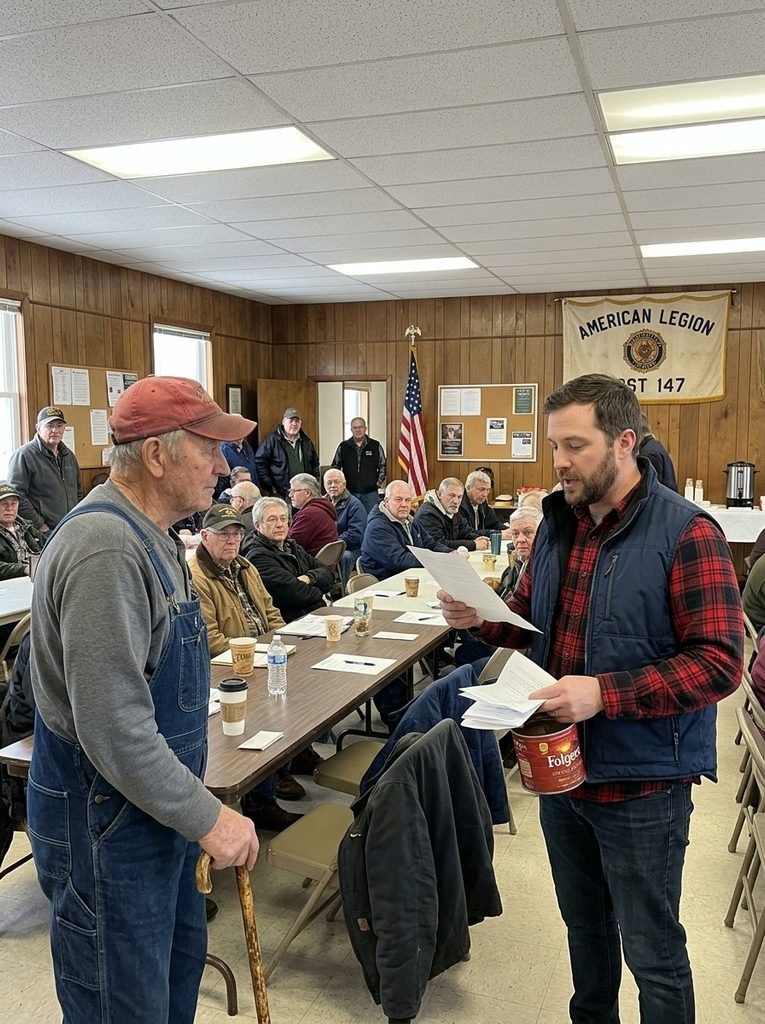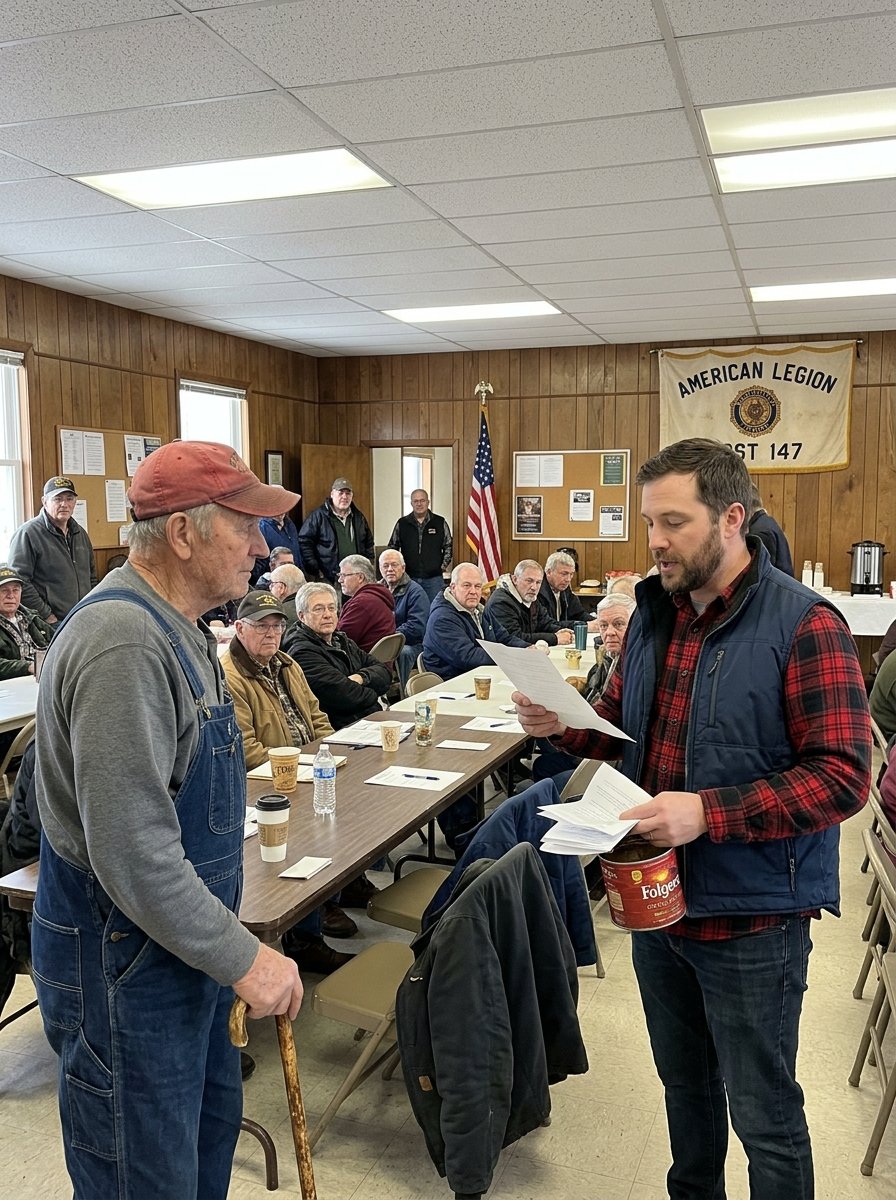
Derek held the coffee can up over his head like a trophy.
The whole American Legion hall went quiet.
Two hundred people sat at the long folding tables in Spencer, Iowa, with paper plates of ham sandwiches and potato salad in front of them. Farmers in seed caps. Their wives in cardigans. Their kids and grandkids, some of them home from as far away as Denver and Kansas City.
They’d all come for my brother Walt’s memorial lunch.
And my nephew was standing at the front of the room holding Walt’s old red Folgers can, with a stack of white envelopes tucked under his other arm.
Every person in that hall knew what was in that can.
“I’m sorry to have to do this here,” Derek said. He didn’t look sorry. “But I figured it’s easier to do it in person.”
He set the can down on the podium. He took the envelopes out from under his arm and fanned them out.
“These are demand letters,” he said. “From my attorney in Minneapolis. A lot of you owe my father money. Some of you have owed it for a very long time.”
Nobody moved. Nobody even breathed.
Out of the corner of my eye, I saw Marlene Johnson in the third row put her hand over her mouth.
“I’ve got three hundred and eleven IOUs in this can,” Derek said. “Totaling eighty-four thousand, six hundred dollars. I’m going to read some names, and I’d appreciate it if you’d come up and get your letter.”
He pulled the first envelope off the top.
That’s when an old man in the second row stood up.
Hank Sorensen. Eighty-eight years old. He farmed four hundred acres of corn and beans north of town for sixty years. He still wears his seed cap to church.
He had a folded piece of yellowed paper in his hand.
He walked up to the front of the room slowly, leaning hard on his cane. Every step echoed off the wood floor.
He stopped right in front of Derek.
“Son,” Hank said, “before you hand out any of those, your father gave me something in 1986. I think you should read it first.”
He held out the paper.
Derek frowned. He took it. He unfolded it.
I watched him read the first line.
And I watched his face go white as a sheet.
My name is Carol Becker Lindquist. I’m seventy-four years old. Walt was my big brother.
I knew what that letter said. I’d known for thirty-eight years.
And I’d been waiting six weeks for my nephew to read it.
Pages:
2
To understand what happened in that Legion hall, you have to understand my brother.
Walt Becker opened Becker’s Garage on Grand Avenue in Spencer in 1977. He was twenty-nine years old. He’d come home from the Army with a mechanic’s training, a pregnant wife named Joanne and $3,000 in savings.
He borrowed $22,000 from Clay County State Bank to buy the old Sinclair station on the corner. He put up a hand-painted sign. He hung his tools on a pegboard on the wall. And for forty-six years, he fixed every truck, tractor, combine and station wagon in Clay County.
He was the kind of mechanic who’d tell you not to fix something.
“That noise? That’s just your truck getting old, like me. Drive it till it quits. Come back then.”
He charged fair. He worked late. He kept a pot of coffee on the counter all day for anybody who wanted it, and he never once charged for a cup.
Then the farm crisis came.
If you didn’t live through the 1980s in rural Iowa, I don’t know how to make you understand it. Interest rates went to eighteen percent. Land values dropped by half. Farmers who’d been on the same ground for three generations lost everything to the bank in a single afternoon.
In 1985, there were auction signs on every road out of Spencer. Every Saturday, another family watched strangers bid on their grandfather’s tractor.
Nobody had any money. Nobody.
But trucks still broke down. Combines still threw belts in the middle of harvest. Tractors still blew head gaskets in April when you had to plant or lose the year.
And Walt fixed them anyway.
He’d finish the job. He’d write up the bill. And when the farmer stood there at the counter with his cap in his hands, looking at the floor, unable to pay, Walt would tear a page off his little yellow pad.
He’d write out an IOU. The date. The man’s name. The amount. Sometimes the man would sign it. Sometimes Walt didn’t even ask.
“Pay me when you can,” Walt would say.
Then he’d fold it up and drop it in the old red Folgers can on the shelf above the parts counter.
Everybody in town knew about the coffee can.
Most of them could never pay.
And Walt never once asked.
Walt died on a Tuesday morning in March. He was seventy-six.
He’d opened the garage at seven, the way he had every day for forty-six years. He made the coffee. He was bent over the engine of a 2009 Chevy Silverado belonging to the Lutheran pastor when his heart stopped.
The pastor found him. He said Walt still had a wrench in his hand.
Joanne had passed in 2017. Walt only had one child. His son, Derek.
Derek is forty-one. He moved to Minneapolis right after college and never really came back. He sells cybersecurity software to hospitals. He drives a Tesla. He came home for Christmas most years, and Walt was always so proud of him he could hardly stand it.
“My boy’s a big shot,” Walt would tell anybody who’d listen. “Works with computers. Smarter than his old man ever was.”
I don’t think Derek ever changed his own oil in his life.
Walt’s will was simple. He wrote it with the attorney in town, Margaret Haugen, back in 2018 after Joanne died. Everything went to Derek. The garage, the building, the tools, the house on Fourth Street.
And Walt named me executor of his estate.
“Derek’s too far away, Carol,” he told me when he signed it. “And you’re the only one in this family who can balance a checkbook.”
I’d been a bookkeeper at the Spencer co-op for thirty-three years. He wasn’t wrong.
So after the funeral, it was my job to inventory everything. File the papers with the Clay County court. Pay Walt’s last bills. And eventually, once the estate closed, hand it all over to Derek.
Derek flew in from Minneapolis three weeks after the funeral to start cleaning out the garage.
I was helping him.
That’s when he found the coffee can.
Pages:
It was a Saturday afternoon. Derek was in the back office throwing old parts catalogs into a black trash bag. I was at the front counter making a list of Walt’s tools for the estate inventory.
I heard him go quiet.
When I walked into the office, he was standing on a step stool holding the red Folgers can in both hands. The plastic lid was off. He was staring down into it.
It was stuffed so full of folded yellow paper that some of it spilled over the edge.
“Aunt Carol,” he said slowly. “What is this?”
“That’s your dad’s IOU can,” I said. “From the farm crisis. And after.”
He climbed down off the stool. He dumped the whole thing out on Walt’s old metal desk.
Three hundred and eleven little yellow slips of paper. Some of them so old the ink had faded to brown. Some of them signed. Some of them just names and numbers in Walt’s handwriting.
Derek picked one up and read it.
“March 12, 1985. Dale Kruger. Rebuilt transmission, 1979 Ford F-250. $1,140. Signed, Dale Kruger.”
He picked up another one.
“September 3, 1986. Harlan Petersen. Combine repair, header and feeder house. $2,860.”
He kept going. Faster and faster.
“Mom never told me about this,” he said.
“Your mom knew. Everybody knew.”
He pulled out his phone. He started typing numbers into the calculator. I watched him do it. Slip after slip after slip.
It took him almost an hour.
When he finished, he turned the phone around and showed me the screen.
$84,600.
“Aunt Carol,” Derek said. His eyes were bright in a way I didn’t like. “This is real money.”
“It was real money,” I said. “Forty years ago. To people who didn’t have any.”
“Some of these people have plenty of money now.” He held up a slip. “Dale Kruger? Isn’t his son the one who owns Kruger Implement? The John Deere dealership in Spencer and Spirit Lake?”
“Yes.”
“And Harlan Petersen. Didn’t his family just sell their land to a wind farm company?”
“I believe so.”
Derek started sorting the IOUs into piles on Walt’s desk.
I felt something cold settle into my stomach.
“Derek,” I said. “What are you doing?”
“I’m figuring out who can pay,” he said.
I need to tell you something about Derek that he didn’t tell me until much later.
He’d been laid off in January.
The cybersecurity company he worked for in Minneapolis got bought by a bigger company in California. Two hundred people lost their jobs in one Zoom call. Derek was one of them.
He hadn’t told Walt. He was too ashamed.
He had a mortgage on a $640,000 townhouse in Edina. He had $58,000 on credit cards. He had a car payment on that Tesla. His severance had run out in April.
He was drowning.
And he was standing in his dead father’s office holding a coffee can full of money that, in his mind, nobody else was ever going to claim.
I didn’t know any of that then. All I knew was that my nephew’s eyes looked like a man counting chips at a blackjack table.
The next week, Derek called me from Minneapolis.
“Aunt Carol, I talked to a lawyer up here. Guy named Brandon Hale. He does collections.”
I sat down at my kitchen table.
“And?”
“He says a lot of these are probably too old to collect. But some of the more recent ones might still be good. Especially the ones people signed. He says a signed IOU is basically a promissory note.”
“Derek, these are your father’s friends.”
“These are my father’s debtors,” he said. “There’s a difference.”
“Your father never asked one of them for a dime.”
“Well, my father’s not here anymore.” His voice cracked a little when he said it. Then it hardened. “And I am. Brandon’s drafting demand letters. Every name in the can. He says even the ones that are too old to sue on, a lot of people will pay just to make it go away. Especially if they’ve got money now.”
I didn’t argue with him.
I’d watched my brother for seventy-four years. Walt always said, “You can’t talk sense into a man who’s already counting. You’ve got to let him count all the way to the end. Then show him what he missed.”
So instead of arguing, I said, “Derek. Walt’s memorial lunch is the third Saturday in April. At the Legion hall. Everybody in town’s going to be there.”
“So?”
“So bring the can,” I said. “Bring the letters. You can hand them out in person. Save on postage.”
There was a long pause.
“You’re on my side?” he said.
“Bring the can, Derek,” I said.
Pages:
After I hung up with Derek, I drove to Margaret Haugen’s law office on Grand Avenue.
Margaret is sixty-seven. She’s been practicing law in Spencer for forty years. She wrote Walt’s will. She handled Joanne’s estate. She’s the kind of small-town lawyer who knows which farmers are feuding over fence lines and which ones are secretly paying for their neighbor’s kid’s college.
I sat down across her desk and told her everything. The coffee can. The $84,600. The lawyer in Minneapolis. The demand letters.
Margaret listened. Then she leaned back in her chair and took off her reading glasses.
“Carol,” she said. “First thing. Those IOUs aren’t Derek’s yet.”
“What do you mean?”
“Walt’s estate is still open. You’re the executor. Until the court closes the estate and you distribute the assets, everything Walt owned belongs to the estate. Including any debts people owed him.” She tapped her desk. “Which means those IOUs belong to the estate. And you’re the one who controls the estate. Not Derek.”
I sat very still.
“So Derek can’t send demand letters?”
“Not legally. Not on estate property. Not without the executor’s authority.” She almost smiled. “His Minneapolis lawyer either didn’t ask the right questions, or Derek didn’t tell him the estate was still open.”
“And the IOUs themselves? Are any of them still good?”
Margaret put her glasses back on.
“Iowa gives you ten years to sue on a written contract,” she said. “That includes a signed IOU. After ten years, the debt’s still there in a moral sense. But a court won’t enforce it.” She thought about it. “If Walt wrote any IOUs in the last ten years, those might be collectible. Anything from the farm crisis? Forty years old? There’s no court in Iowa that would touch those.”
“So most of them are worthless.”
“Legally? Most of them, yes.” Margaret looked at me over her glasses. “Carol, why do I get the feeling you’re not here for legal advice?”
I opened my purse.
And I took out a photocopy of a letter. Yellowed and creased. In my brother’s handwriting.
I’d had the copy since 1986. Walt gave it to me the same week he gave the original to Hank Sorensen.
I slid it across Margaret’s desk.
She read it. Then she read it again.
When she looked up, her eyes were wet.
“Oh, Carol,” she said. “Does Derek know about this?”
“No,” I said. “Walt never told him. Walt never told anybody but me and Hank.”
“What are you going to do?”
“I’m going to let Derek count all the way to the end,” I said. “Then I’m going to let Hank show him what he missed.”
Pages:
The third Saturday in April, the American Legion Post 303 hall was packed by eleven thirty.
The VFW auxiliary ladies made the lunch. Ham sandwiches on buns, potato salad, baked beans, Jell-O salad with little marshmallows, and three long tables of bars and cookies. The Lutheran pastor said a prayer. Somebody had set up a table at the front with a big framed photo of Walt in his blue work coveralls, grinning, holding up a wrench.
Next to the photo was a little sign the ladies made.
“Walt Becker. 1947–2024. Pay Me When You Can.”
Derek came in at noon.
He was wearing a fleece vest over a button-down shirt. He looked tired. There were dark circles under his eyes. He was carrying the red Folgers can in one hand and a manila folder full of white envelopes in the other.
He walked straight to the podium at the front of the room.
I sat at the front table with my reading glasses in my lap and my hands folded.
I’d told Hank Sorensen everything the night before. He came to my house after supper, and I showed him the photocopy, and he sat in my kitchen and cried like a child.
“I kept it, Carol,” he said, wiping his eyes with a handkerchief. “The original. All these years. It’s in my Bible.”
“I know you did, Hank,” I said. “Bring it tomorrow.”
And now, here we were.
Derek tapped the microphone. He held up the coffee can.
And he gave his little speech about demand letters and attorneys and three hundred and eleven IOUs and $84,600.
And then Hank stood up.
And now Derek was standing at the podium with Hank’s letter in his hands, and his face was white, and two hundred people were waiting in absolute silence.
His lips moved a little as he read.
Then he looked up. He looked straight at me.
“Aunt Carol,” he said. His voice was barely working. “Is this true?”
“Read it out loud, honey,” I said. “Everybody in this room deserves to hear it.”
Derek’s hands were shaking.
He looked down at the yellowed paper. He cleared his throat. And he read it into the microphone.
“November 28, 1986. Thanksgiving Day.
To Hank Sorensen, and to whoever else had a hand in this.
I found out this morning what you all did.
Clay County State Bank was going to foreclose on my garage on December 1st. I was eleven payments behind on my loan. $19,400. I hadn’t told anybody. Not even Joanne. I was going to let it go and move us to Des Moines and find work at a dealership.
This morning, Mr. Lindgren from the bank came to my house. On Thanksgiving. He handed me a piece of paper that said my loan was paid in full.
He wouldn’t tell me who paid it. But I’m not stupid, Hank. I saw your truck parked behind the bank Tuesday night. And Dale Kruger’s. And Harlan Petersen’s. And about thirty others.
I know none of you had $19,400. I know some of you sold cattle you couldn’t afford to sell. I know Marlene Johnson sold her mother’s piano. I know the Petersen boys skipped their deer hunt and gave up their gas money.
Every one of you owes me money in my coffee can.
And every one of you paid me back ten times over.
So here is what I want you to know. As of today, every IOU in that can is paid in full. Every single one. Yours and everybody else’s. Forever.
I’m going to keep them in the can anyway. Not because anybody owes me. But so I never forget who saved me.
If my boy ever finds that can after I’m gone, I hope somebody shows him this letter.
Your friend for life,
Walter Becker.”
Derek stopped reading.
The paper was trembling in his hands.
The Legion hall was completely silent. Then, from somewhere in the back, I heard a woman start to cry.
It was Marlene Johnson. She’s eighty-three now.
She’d sold her mother’s upright piano to Bev Larson in 1986 for $450 and given every penny to Hank in an envelope.
She never told anybody either. Not for thirty-eight years.
Pages:
9
Derek set the letter down on the podium very carefully.
He looked down at the red coffee can. Then out at the room. Two hundred faces looking back at him.
Dale Kruger, 84, sitting with his son, the John Deere dealer.
Harlan Petersen’s two boys, gray-haired now, who skipped their deer hunt in 1986.
Hank Sorensen, standing right in front of him, leaning on his cane.
“I didn’t know,” Derek said into the microphone. His voice cracked. “I swear to God, I didn’t know.”
“Course you didn’t,” Hank said gently. “Your dad never told a soul. That was Walt. He’d have rather died than have anybody think he was keeping score.”
Derek looked down at the manila folder in his hand. The stack of demand letters from his attorney in Minneapolis.
“I was going to send these to all of you,” he said.
“We know, son,” Hank said. “Word gets around.”
Derek closed his eyes.
Then he looked at me. I stood up from the front table and walked up beside him at the podium. I took the microphone.
“I’m Carol Lindquist,” I said. “Most of you know me. I’m Walt’s sister. And I’m the executor of his estate.”
I turned to Derek.
“Honey, I need you to understand something. Those IOUs in that can belong to your dad’s estate. Not to you. Not yet. The estate’s still open. I’m the one who decides what happens to them.”
Derek stared at me.
“Margaret Haugen explained it all to me,” I said. “And the law in Iowa says nobody can collect on a written IOU after ten years anyway. Nearly every slip of paper in that can is more than ten years old.”
I took a breath.
“But that doesn’t matter,” I said. “Because your father already decided. In writing. On Thanksgiving Day, 1986. Every IOU in that can was paid in full.”
I turned to the room.
“As the executor of Walter Becker’s estate,” I said, “I’m honoring my brother’s wishes. Every debt in that coffee can is forgiven. All three hundred and eleven of them. Forever. Margaret’s drawing up the paperwork Monday morning, and I’ll file it with the Clay County court myself.”
The room didn’t make a sound for a second.
Then Dale Kruger stood up. Then his son. Then the Petersen boys.
Then the whole room.
They weren’t clapping. They were just standing. Two hundred people on their feet in the Legion hall, for my brother.
Derek stood there at the podium with tears running down his face.
Then he did something I’ll never forget.
He picked up the stack of white demand letters. And one by one, slowly, in front of everybody, he tore every single one of them in half.
The rest of that lunch was something I’ll carry with me the rest of my life.
People started coming up to the podium. Not to get letters. To tell stories.
Dale Kruger told about the night in October of 1985 when his combine broke down with 300 acres of corn still standing and snow coming. Walt drove out at eleven at night with his toolbox and worked on that combine by flashlight until four in the morning. Dale’s IOU said $2,140.
“I tried to pay him back in 1994, when things got better,” Dale said. “Walt wouldn’t take it. He said, ‘Dale, that one’s already been paid. Don’t make me tell you twice.’ I never understood what he meant.”
He looked at Hank’s letter on the podium.
“Now I do,” he said.
Marlene Johnson came up with her granddaughter holding her arm. She stood in front of Derek and patted his cheek like he was a little boy.
“Your daddy fixed my husband’s truck nine times in 1985 and 1986,” she said. “We never paid him a nickel. I sold Mama’s piano because it was the only thing in our house worth anything. I’d do it again today.”
One after another, they came.
A man who’d been eight years old in 1986 told how Walt let him sit in the garage every day after school while his parents were at the bank trying to save the farm, and taught him how to change a tire.
He’s a diesel mechanic now. In Sioux City.
A woman told how Walt drove her to the hospital in Spencer in his tow truck when she went into labor and her husband’s car wouldn’t start. He wouldn’t even let her pay for the gas.
Hank Sorensen sat at the front table the whole time with his hand over his mouth, nodding.
When it was finally over, the VFW ladies started stacking chairs.
Derek was sitting alone at the front table with the coffee can in front of him and Walt’s letter in his hands. He’d read it about twenty times.
I sat down beside him.
“Aunt Carol,” he said, without looking up. “I got laid off in January.”
I didn’t say anything. I just waited.
“I didn’t tell Dad. I didn’t tell anybody. I owe almost sixty grand on credit cards. I’m about to lose my townhouse.” He laughed, but there was nothing funny in it. “I came home to bury my father, and I found a coffee can full of money, and I thought, finally. Finally, Dad’s going to bail me out one last time.”
“Oh, honey,” I said.
“I was going to send demand letters to the people who saved his life.” He put his face in his hands. “What kind of person does that?”
“A scared one,” I said. “You’re not the first man in this town to be scared about money, Derek. That’s what that whole letter is about.”
Hank Sorensen eased himself down into the chair on Derek’s other side. It took him a while.
“Son,” he said. “Can I tell you something your dad told me once?”
Derek nodded.
“Around 1998, I asked Walt why he kept that coffee can on the shelf. Everybody in town knew those IOUs were never getting paid. They were just taking up space.” Hank smiled. “Walt said, ‘Hank, that can’s not a list of who owes me. It’s a list of who I belong to.’”
Derek’s shoulders started shaking.
“Your dad never thought of himself as a businessman,” Hank said. “He thought of himself as part of this town. Same as the grain elevator or the water tower. The money didn’t matter to him. People did.”
They sat there together for a long time.
Then Derek wiped his face.
“What do I do now?” he said. “I can’t fix cars. I can’t even check my own tire pressure. Dad always did it for me at Christmas.”
Hank looked at him for a long moment.
“Well,” Hank said. “My grandson Tyler’s been running the shop at the Ford dealership in Spirit Lake for six years. He’s thirty-two. Best mechanic in the county, after your dad. And he’s been sick of working for a big outfit for a long time.” Hank shrugged. “Might be he’d want to run a little garage on Grand Avenue. If the owner was willing to hire him.”
Derek turned his head and stared at the old man.
“You’d do that?”
“I wouldn’t do anything,” Hank said. “Tyler’s a grown man. But I’d tell him to come talk to you.” He paused. “Your dad taught Tyler how to change his first oil, you know. He was nine.”
Derek looked down at the coffee can.
Then he picked up the red plastic lid. He pressed it down on the can with both hands. He set it gently next to Walt’s framed photo on the table.
“I’m not selling the garage,” he said quietly.
Pages:
On Monday morning, Margaret Haugen drew up the paperwork.
It took her about an hour. A formal written release, signed by me as executor of the Estate of Walter J. Becker, forgiving every debt owed to Walt by anybody in Clay County. All three hundred and eleven names, typed out on fourteen pages.
I signed it at her desk with the blue pen Walt gave me when I retired from the co-op.
Then Margaret filed it with the Clay County District Court in the courthouse across the street. The clerk, a young woman named Ashley, stamped it.
“My grandpa’s on this list,” she said, looking down at page nine. “Ronnie Schultz. He always said Walt was the reason he still had a farm.”
“Walt felt the same about him,” I said.
Over the next few weeks, Derek did a lot of things I didn’t expect.
He called his lawyer in Minneapolis, Brandon Hale, and fired him. He paid the $1,200 bill for the demand letters out of his own pocket.
He listed his townhouse in Edina for sale. It sold in June for $618,000. After paying off the mortgage, he had enough left to pay off every one of his credit cards. He sold the Tesla, too, and bought a used Ford F-150 from Kruger Implement. Dale Kruger’s son gave him the employee price.
And in July, Derek moved home to Spencer. Into Walt’s little house on Fourth Street.
He hired Tyler Sorensen to run Becker’s Garage. $68,000 a year, plus a 25 percent share of the profits. They signed the paperwork at Margaret’s office. Hank came along to watch, wearing his Sunday shirt.
Derek took a job doing IT for the Spencer hospital. Remote work, mostly. He set up a little desk in the back office of the garage, right where Walt’s metal desk used to be.
“Somebody’s got to answer the phone,” he told me.
When the estate finally closed in September, I handed Derek the deed to the garage at Margaret’s office.
He held it for a long time.
“Aunt Carol,” he said. “Will you come by Saturday morning? There’s something I want you to see.”
On Saturday morning, I drove down Grand Avenue.
The old hand-painted sign was still over the garage door. BECKER’S GARAGE. EST. 1977. Somebody had touched up the paint, so the letters were bright red again.
Tyler was in the first bay with his head under the hood of a 2011 Chevy Malibu.
Derek was standing at the front counter. There was a fresh pot of coffee on the hot plate. Styrofoam cups stacked beside it. A little handwritten sign taped to the wall above it.
“Coffee’s free. Always has been.”
And on the shelf above the parts counter, right where it had sat for forty-six years, was the old red Folgers coffee can.
Derek reached up and took it down. He handed it to me.
I pried off the lid.
All three hundred and eleven of Walt’s old IOUs were still inside. Folded up, yellowed, just the way he left them.
But on top, there was something new.
A small, crisp, white index card. In Derek’s neat handwriting.
“September 14, 2024. Sharon Pederson. Brakes and rotors, 2014 Honda Odyssey. $640. Pay me when you can.”
I looked up at my nephew.
“Single mom,” Derek said quietly. “Three kids. Her ex hasn’t paid child support in a year. She drives forty miles each way to work at the turkey plant in Storm Lake.” He shrugged. “Tyler did the brakes. I wrote the card.”
My throat closed up.
“Your dad would be so proud of you, honey,” I said.
Derek looked at the coffee can in my hands for a long moment.
“I hope so,” he said. “I’ve got a lot of catching up to do.”
He took the can from me, put the lid back on, and set it back up on the shelf where it belonged.
That was eight months ago.
There are forty-one new index cards in that coffee can now.
Derek told me last week that eleven of them have already been paid back. Some in cash. Some in other ways. A load of firewood. Four dozen eggs every Saturday. A farmer from Royal who came in and replaced the whole leaky roof on the garage for free because Tyler fixed his grain truck the week before harvest.
“That’s not how a business is supposed to work, Aunt Carol,” Derek told me, laughing.
“No,” I said. “That’s how a town is supposed to work.”
On the first anniversary of Walt’s death, the whole town came back to the Legion hall.
This time, nobody stood at the podium holding a coffee can.
This time, Derek stood up and read a list.
Not of who owed money. Of who had paid it forward.
Dale Kruger’s son had set up a fund at Kruger Implement. Any farmer in Clay County whose equipment broke down in planting or harvest, who couldn’t pay for parts right away, could get the parts on credit. No interest. No paperwork. “Pay me when you can.”
He named it the Walt Becker Fund. It had $40,000 in it.
The Petersen boys had used part of the money from the wind farm sale to set up a scholarship at Spencer High School. One graduating senior every year who wanted to go to trade school. Mechanics. Welders. Electricians. $5,000 a year.
It was called the Coffee Can Scholarship.
The first winner was Sharon Pederson’s oldest son, Caleb. He’s going to Iowa Lakes Community College in Emmetsburg in the fall. Diesel technology.
He stood up in the Legion hall in a borrowed sport coat and shook Derek’s hand.
“Thank you, Mr. Becker,” he said.
Derek looked like somebody had hit him in the chest.
“Nobody’s ever called me that,” he said afterward. “Mr. Becker was my dad.”
“Well,” I said. “Now it’s you.”
At the end of the night, Hank Sorensen stood up from his chair at the front table. He’s eighty-nine now. He uses a walker. But he still wears his seed cap.
He walked slowly to the podium. He took something out of his shirt pocket.
It was the original letter. Walt’s letter, from Thanksgiving Day, 1986. Yellowed and soft as cloth from thirty-nine years of being folded.
He handed it to Derek.
“This belongs to you now, son,” Hank said. “I’ve been keeping it for your dad. I think he’d want you to have it.”
Derek held it in both hands.
“Hank, I can’t take this. It’s yours.”
“I don’t need it anymore,” Hank said. He tapped his chest. “I’ve got it memorized.”
Then he smiled. And he said the last line out loud. From memory. In his cracked old voice.
“If my boy ever finds that can after I’m gone, I hope somebody shows him this letter.”
He looked at Derek.
“Somebody did,” Hank said.
Derek framed that letter. It hangs in the front office of Becker’s Garage now. Right above the coffee pot. Right below the old red Folgers can.
People come in and read it all the time. Farmers. Truck drivers. Tourists passing through on Highway 71 who stop for gas and a free cup of coffee.
Last month, a young man from Minneapolis in a fleece vest stood there reading it for a long time. Then he turned to Derek behind the counter.
“Is this real?” he asked. “Did a whole town really do that?”
Derek smiled. He reached up and took down the coffee can. He popped off the lid and showed the man the stack of new index cards inside.
“Still doing it,” Derek said.