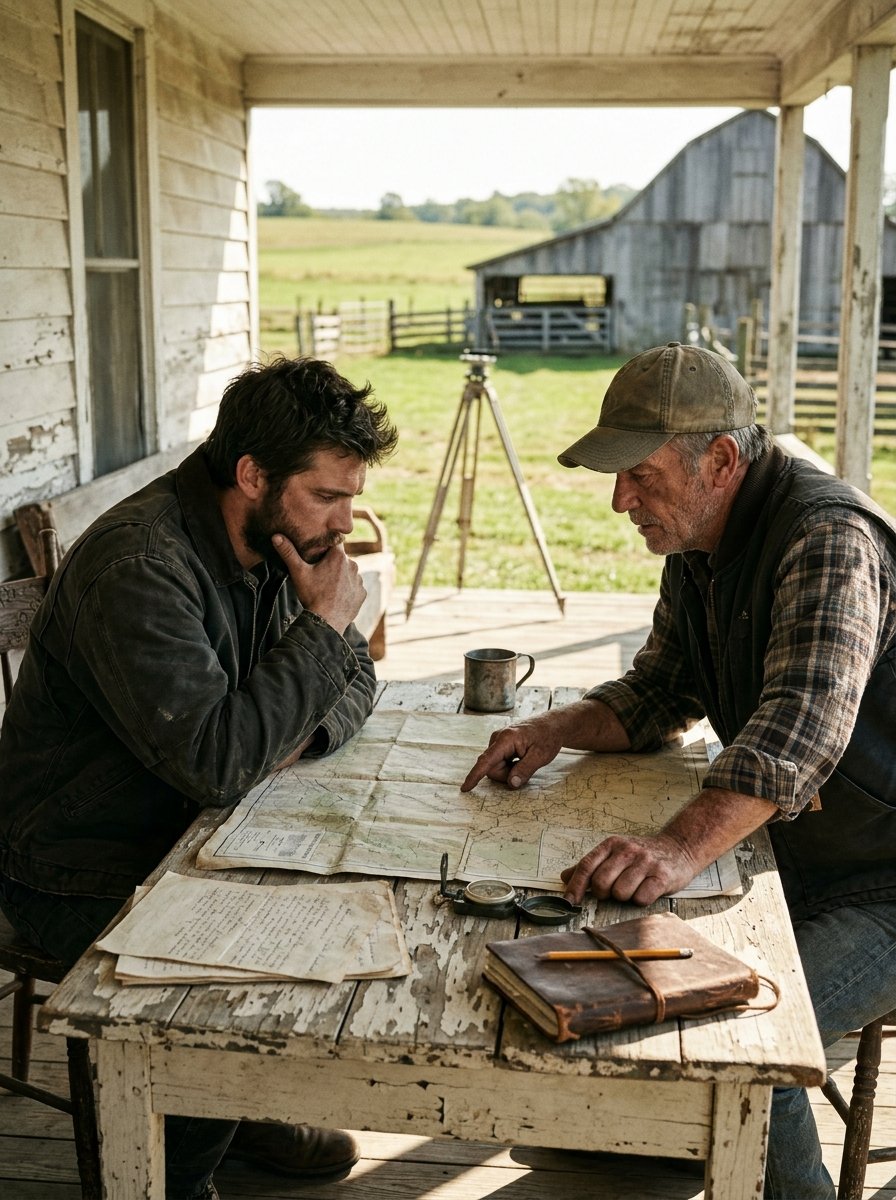
When My Brother Inherited Our Parents’ $1.5 Million San Diego House, Dad’s Last Gift To Me Was The Deed To An Abandoned Tennessee Farm And The Words, “At Least It’s Something.” My Wife Left Before I Even Packed. I Drove East Alone, Hired A Surveyor, And Learned Why Grandpa Henry Had Refused Every Offer For That Land.
I opened the report.
The first page meant almost nothing to me.
Parcel references.
Survey calls.
Recorded instruments.
Boundary corrections.
Cal watched me pretending to understand it for maybe thirty seconds.
“You’re an electrician, right?”
“Foreman.”
“Then stop reading that like a lawyer.”
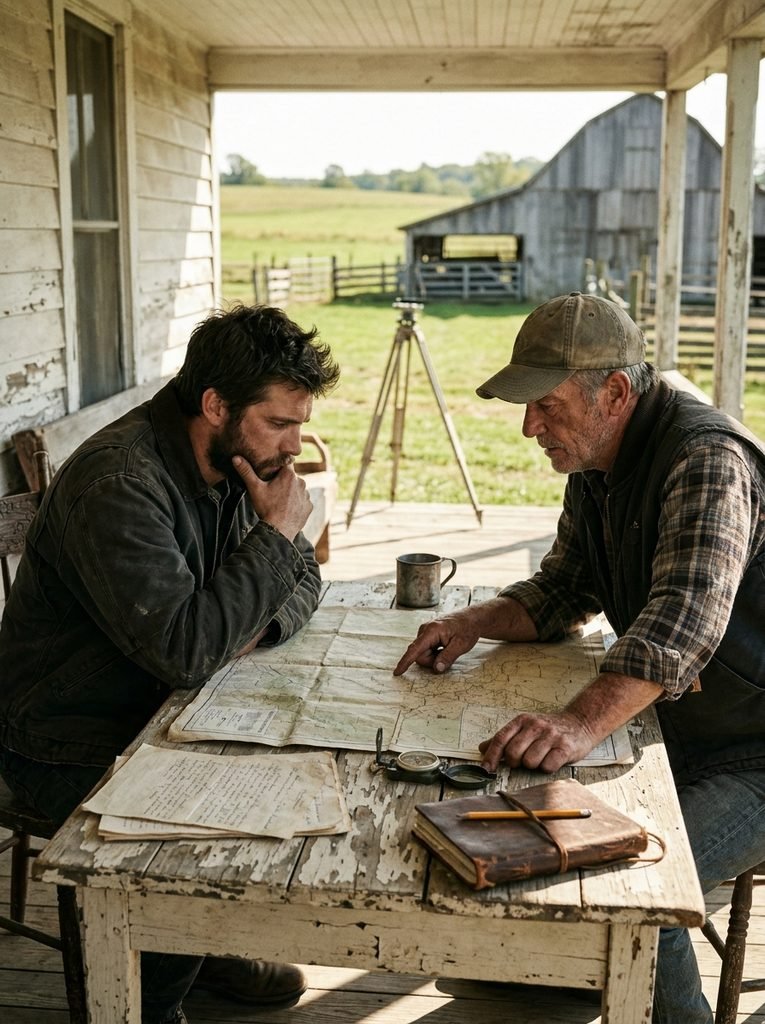
He pulled the report back and drew three rough shapes on the margin.
“This is the farmhouse tract.”
He pointed to the first shape.
“Just under eleven acres. House, barn, road frontage.”
The second was much larger.
“This is the pasture and ridge.”
Then he circled a narrow piece running along the state road.
“And this was separated in the legal description but never given its own modern tax parcel.”
“How much?”
“Thirteen-point-four acres.”
I looked at him.
“So the county lost thirteen acres?”
“No.”
Cal shook his head.
“County tax maps aren’t deeds. People make that mistake constantly.”
He explained that the tax map had combined some boundaries and failed to display the old frontage tract separately.
Nothing illegal.
Nothing magical.
Just old rural records that had never been cleaned up because nobody in my family had bothered to order a modern boundary survey.
The actual total was ninety-two acres and change.
Useful.
Interesting.
Not life-changing.
At least not yet.
I pointed to the easement reference.
“What was Henry protecting?”
Cal turned to another page.
“Eighty-one acres are under a conservation easement recorded in 1996.”
I stared at him.
“So I can’t develop it.”
“Mostly correct.”
“That’s why nobody bought it.”
“Wrong order.”
He tapped the report.
“Your grandfather put the easement on it because developers kept trying to buy it.”
I looked across the field again.
Cal continued.
“Back in the nineties, Columbia was already pushing this direction. One group wanted a hundred-plus home subdivision. Another wanted large residential lots all along the ridge.”
“And Henry blocked it.”
“Permanently.”
“Why?”
“You’d have to ask someone who knew him.”
“He’s been dead twenty-three years.”
Cal nodded toward the papers.
“Then you’re left with what he recorded.”
The easement restricted residential subdivision on most of the farm.
No dense housing.
No commercial strip.
No quarrying.
No clear-cutting the wooded ridge.
Agriculture was permitted.
Timber management under a plan was permitted.
The existing farmhouse could be restored or replaced within a designated building envelope.
Barns and agricultural structures were allowed.
And the separate thirteen-acre frontage tract?
That was outside the conservation boundary.
I pointed to it.
“So this part can be developed?”
“Subject to zoning, utilities, access, all the normal things.”
“Why leave it out?”
Cal shrugged.
“Maybe he wanted options.”
That afternoon, I called Grant.
He answered on the second ring.
“Did the farmhouse fall on you?”
“Not yet.”
“So?”
“The property is ninety-two acres.”
Silence.
Then, “Dad always said seventy-something.”
“He never had it surveyed.”
“What’s the difference?”
“Thirteen acres.”
“I can subtract.”
“Good to know California real estate has maintained standards.”
Grant ignored that.
“Worth anything?”
There it was.
Not How does it look?
Not Did Grandpa build that barn?
Worth anything?
“I don’t know yet.”
“Well, don’t dump money into it because you’re sentimental.”
I laughed.
“What?”
“That sounded exactly like Dad.”
Grant became quiet.
I regretted saying it almost immediately.
Not because it wasn’t true.
Because our father had been dead less than three months.
Finally Grant said, “Dad hated that place.”
“No. He ignored it.”
“Same result.”
“Do you know why Grandpa Henry put a conservation easement on it?”
Another silence.
“A what?”
So Grant hadn’t known either.
I explained.
He whistled softly.
“That makes it harder to sell.”
“Probably.”
“Figures.”
“What does that mean?”
“Henry never understood money.”
I looked out across ninety-two acres of land our grandfather had owned free and clear before either of us finished high school.
“Apparently he understood enough to keep it.”
Grant sighed.
“Ethan, don’t turn this into some family mythology. Dad gave you the place because he didn’t want it.”
The sentence landed.
He wasn’t trying to hurt me.
That was why it hurt.
“I know.”
“And I’m not saying that to be an ass.”
“You’re succeeding accidentally.”
“I’m saying don’t build your life around proving it wasn’t a bad inheritance.”
Leah had said almost the same thing.
That bothered me more than Grant could know.
After we hung up, I walked the perimeter until dark.
The farm did not care why Dad had given it to me.
That thought came slowly.
The creek ran whether Dad respected me or not.
The ridge held trees older than Grant.
The farmhouse sagged in the same direction regardless of what Leah thought.
For once, I was standing inside something my family had opinions about but no control over.
The next morning, an old red Ford pulled into the drive.
The woman behind the wheel was maybe seventy.
She wore jeans, rubber boots, and a faded University of Tennessee sweatshirt.
She got out holding a cardboard box.
“You Ethan?”
“Yes.”
“Ruth Bennett.”
I waited.
“Your grandfather used to lease twenty acres to my husband for cattle.”
That got my attention.
“You knew Henry?”
“Knew him well enough to argue with him.”
She handed me the box.
Inside were three rusted gate hinges, a coffee can full of fencing staples, and an old photograph.
Henry stood beside the farmhouse wearing overalls.
Next to him was a much younger Ruth and a man I assumed was her husband.
Behind them, the fields were open.
Fences straight.
Barn painted red.
“What is this?”
“Things Henry left in our shed that your father never came for.”
That sounded familiar.
Ruth climbed onto the porch without asking.
She looked at the house.
“Lord, George let it go.”
“My dad wasn’t interested.”
“I noticed.”
There was no judgment in her voice.
Just fact.
We sat.
I asked about the conservation easement.
Ruth smiled.
“So you found that.”
“You knew?”
“Half the county knew at the time.”
“Why did he do it?”
She looked toward the ridge.
“Because Morrow Development offered him more money than he’d ever seen.”
“How much?”
“Don’t remember.”
“Why would that make him protect the land?”
“Because they showed him the plan.”
I waited.
“Road cut through the creek bottom. Houses all along the slope. Ridge stripped for views.”
She shook her head.
“Henry said if he sold, he’d be dead ten years and nobody would remember there had ever been a farm there.”
“That sounds sentimental.”
“Oh, he was sentimental.”
She smiled.
“He was also stubborn as a nail.”
“What about the frontage tract?”
“That part wasn’t sentimental.”
I looked at her.
“Henry knew land had to pay for itself.”
She explained that my grandfather had deliberately kept the road frontage outside the easement.
He believed one day the town would grow close enough for that piece to become valuable.
If the family ever needed money to maintain the farm, they could sell or lease the frontage without carving up the rest.
“That was his plan?”
“According to Henry.”
“Did Dad know?”
Ruth hesitated.
That was answer enough.
“He knew.”
I laughed once.
Not because it was funny.
“Of course he did.”
“Your father and Henry didn’t agree about much.”
“I’m starting to see that.”
“George thought tying up land was foolish.”
Ruth looked at me.
“He wanted Henry to sell while prices were good.”
“And Henry refused.”
“Every time.”
After she left, I sat on the porch with the photograph.
Dad knew.
That was the part I couldn’t stop thinking about.
He knew the frontage had been left flexible.
He knew Henry had deliberately protected the rest.
Maybe he didn’t know what the property was worth now.
But he knew it had never simply been worthless.
And he still handed it to me like an apology.
At least it’s something.
For twenty minutes, I was furious with a dead man.
Then I did something I had been avoiding.
I called Leah.
She answered after four rings.
“Hi.”
“Hi.”
Neither of us knew what came next.
Finally she asked, “Are you in Tennessee?”
“Yeah.”
“How bad is it?”
“The house needs everything.”
“That bad.”
“The land is beautiful.”
She was quiet.
I told her about the survey.
Not the value.
There wasn’t one yet.
Just the extra acreage, easement, frontage parcel and what Ruth had said.
Leah listened without interrupting.
Then she asked, “How does that make you feel?”
I almost said vindicated.
That was the obvious answer.
Instead I said, “Angry.”
“At your dad?”
“Yes.”
“Because he knew?”
“Because he made it sound like trash.”
Leah breathed out.
“Ethan.”
“What?”
“You’re still doing it.”
My jaw tightened.
“Doing what?”
“Waiting for the property to tell you whether your father was wrong about you.”
I stood up from the porch chair.
“That’s not fair.”
“Maybe not.”
“You left.”
“I know.”
“You packed a suitcase because I wanted to inspect something I legally own.”
“I packed because I watched you spend our whole marriage acting like you were above caring that Grant was always first.”
“What does that have to do with the farm?”
“Everything.”
Her voice cracked slightly.
I hadn’t heard that before.
“I wasn’t scared we’d become poor farmers, Ethan.”
“You literally said that.”
“I was angry.”
“That makes it disappear?”
“No.”
She paused.
“I was scared you were about to turn your life into one more competition with your brother.”
I looked toward the field.
“I’m not competing with Grant.”
“You drove two thousand miles three days after I left.”
“That was about the land.”
“Was it?”
I didn’t answer.
Leah softened.
“I’m not saying don’t keep it.”
“Okay.”
“I’m saying figure out whether you want the farm or whether you want proof.”
That stayed with me after the call ended.
Two days later, an appraiser Cal recommended came out.
Her name was Marisol Vega.
She spent most of a morning walking the frontage, checking road access, utility locations and comparable sales.
The conserved acreage took longer.
Land with permanent restrictions did not price like subdivision property.
That was the point.
Her preliminary range put the farm as a whole somewhere between $930,000 and $1.1 million.
I read the number twice.
Not $1.5 million.
Not more than Grant’s house.
Close enough that the insult of “at least something” suddenly looked ridiculous.
The thirteen-acre frontage accounted for more than half the value.
A Nashville developer called me four days later.
I had no idea how he got my number.
His offer was $725,000 for the entire frontage parcel.
Cash.
Thirty-day close.
They wanted to build a small retail center and medical offices.
The preserved farm would remain behind it.
For twelve hours, I thought selling was the obvious answer.
I could take the money.
Put a portion into repairing the farmhouse.
Return to San Diego.
Fix things with Leah if she was willing.
Keep the remaining acreage as an investment.
I could prove Dad had underestimated what he handed me without giving up my life.
That evening, Cal came by with final monument locations.
I told him about the offer.
“Good money,” he said.
“You’d take it?”
“Not my land.”
“Helpful.”
He shrugged.
“What do you want it to be?”
“Money would be nice.”
“That’s not what I asked.”
Apparently every person in Tennessee had decided to become my therapist.
I walked down toward the creek.
At dusk, the farm became strangely quiet.
No freeway.
No planes descending toward Lindbergh Field.
No neighbor’s television through the wall.
Just insects, water and the occasional truck passing on the state road.
I tried to picture a strip center at the entrance.
It didn’t offend me.
That surprised me.
Henry had left that parcel outside the easement for a reason.
Using it wasn’t betraying him.
But neither was selling it automatically wise.
The next week, Ruth introduced me to her son, Wade.
He ran cattle on three nearby properties.
He wanted to lease forty-six acres of pasture.
The annual rent would not make me rich.
It would cover taxes, insurance and part of the basic maintenance.
A forestry consultant said the wooded acreage could be managed selectively without violating the easement.
The old barn could be saved.
The farmhouse could too, though the contractor laughed when I asked whether it would be cheap.
“You got a sense of humor,” he said.
I started building options instead of fantasies.
That felt different.
Grant called again.
This time he knew the appraisal range.
Apparently Dad’s former accountant had mentioned it after hearing I ordered a survey.
“Million dollars,” Grant said.
“Maybe.”
“Jesus.”
“Conservation restrictions matter.”
“Still.”
I waited.
Then he said, “Dad had no idea.”
“Yes, he did.”
“What?”
“He knew Grandpa protected the land. He knew about the frontage.”
“That doesn’t mean he knew today’s value.”
“I didn’t say it did.”
Grant became quiet.
Then he asked the question I had half expected.
“You selling?”
“I don’t know.”
“If you do, what are you thinking about doing with the money?”
“Why?”
“Curious.”
“Grant.”
He sighed.
“Fine. Because the house isn’t exactly free.”
I almost laughed.
Property tax.
Insurance.
Maintenance.
The roof was older than expected.
Grant had also taken a loan against the house to buy into another commercial project.
None of that was my problem.
He continued.
“I’m not asking for anything.”
“Good.”
“I’m just saying Dad wanted us both taken care of.”
This time I did laugh.
“What?”
“You got a $1.5 million house.”
“And you apparently got a million-dollar farm.”
“Which you called Henry’s bad decision two weeks ago.”
“I repeated what Dad said.”
“Convenient.”
Grant’s voice sharpened.
“Don’t make me the bad guy because Dad divided things.”
“I’m not.”
“Feels like it.”
I sat on the porch steps.
“Grant, I don’t want your house.”
“Okay.”
“And you’re not getting part of the farm.”
Silence.
“I didn’t ask.”
“You were approaching it.”
Another silence.
Then, reluctantly, “Maybe.”
It was the most honest thing either of us had said about the inheritance.
“Why?”
He exhaled.
“Because for a few minutes it felt unfair.”
I nearly responded immediately.
Then I stopped.
That was the whole family in one sentence.
“Yeah,” I said. “I know the feeling.”
Neither of us apologized.
But the conversation changed after that.
Grant admitted Dad had always favored him.
Not dramatically.
Not in some confession that repaired childhood.
Just fact.
“I knew,” he said.
“Why didn’t you ever say anything?”
“What would I have said? Sorry Dad likes me more?”
I laughed despite myself.
“Fair.”
“You always acted like you didn’t care.”
“I got good at that.”
“Yeah.”
We sat in silence across two time zones.
Then Grant said, “Keep the farm if you want it.”
“I wasn’t waiting for permission.”
“I know.”
That mattered too.
A month after I arrived in Tennessee, I flew back to San Diego.
Leah had moved into a furnished apartment near her office.
Half her clothes were gone from our house.
We met at a coffee shop in Point Loma.
She looked tired.
So did I.
“Did you sell?” she asked.
“No.”
Her eyebrows rose.
“You turned down $725,000?”
“For now.”
“Why?”
“I wasn’t ready to decide what the land was before I decided what I wanted.”
She smiled faintly.
“That sounds annoyingly healthy.”
“I’ve had too much porch time.”
We talked for nearly two hours.
Not about the farm at first.
About us.
She told me something I should have understood years earlier.
Every time Dad diminished me, I brought the anger home but refused to name it.
I worked longer.
Fixed things.
Paid bills early.
Took extra contracts.
Acted as though competence could make rejection irrelevant.
Leah had spent years watching me say I didn’t need validation while organizing my entire life around never giving anyone a reason to look down on me.
“You were right about some of that,” I said.
“Only some?”
“Don’t get greedy.”
She smiled.
Then I told her the part that mattered.
“I think I want to keep the farm.”
The smile faded.
“For investment?”
“No.”
She understood before I finished.
“You want to move.”
“I’m thinking about it.”
Her eyes dropped to the table.
“My job is here.”
“I know.”
“My mother is here.”
“I know.”
“I don’t want to live in Tennessee.”
“I know.”
There was no villain in the coffee shop.
No cruel wife waiting to be punished after discovering I had valuable land.
Just two people whose lives had suddenly stopped pointing in the same direction.
“Are you asking me to come?” she said.
“Yes.”
“Do you expect me to?”
“No.”
That hurt her.
I could tell.
It hurt me too.
She reached across the table and took my hand.
“I wish you had found something ugly there.”
I laughed once.
“Me too.”
“If it were terrible, you’d come back.”
“Maybe.”
“No.”
She shook her head.
“You’d still find something to fix.”
She knew me.
That was part of what made leaving painful.
We did not decide everything that day.
It took another month.
Counseling.
Long calls.
One weekend where Leah came to Tennessee and saw the farm herself.
She walked the creek.
Stood inside the old kitchen while a contractor explained that the floor joists were salvageable.
Watched sunset from the ridge.
She liked it more than she wanted to.
She still didn’t want to live there.
That was enough.
We agreed to separate.
No screaming.
No affair.
No hidden betrayal.
She had built a life in California she genuinely wanted.
I had discovered I wanted something I hadn’t known existed six weeks earlier.
Neither of us could keep the marriage without asking the other to surrender too much.
That was the cost.
I hated it.
I paid it anyway.
I sold our San Diego house six months later.
Leah received her half of the equity.
I used part of mine to restore the Tennessee farmhouse.
Not beautifully.
Not like television.
The roof came first.
Then plumbing.
Electrical was the only part I trusted myself to do without arguing with a contractor.
I kept the thirteen-acre frontage.
Instead of selling it outright, I signed a twenty-five-year ground lease on four acres to a regional medical practice building a small outpatient clinic.
The rest remained open.
The lease income covered more than the pasture rent ever could and left me with ownership.
Henry, I thought, would have approved.
Or maybe he wouldn’t.
I had finally stopped needing dead men to approve of my decisions.
That was the bigger change.
I took a job with an electrical contractor in Nashville.
Lower title.
Shorter commute than half the projects I had worked in California.
Better hours.
Wade leased the pasture.
Ruth continued arriving without warning and criticizing my fence repairs.
Grant visited the following spring.
He stepped out of his rental car wearing shoes completely inappropriate for mud.
I looked at them.
“San Diego has changed you.”
“San Diego has sidewalks.”
He stared at the farmhouse.
Fresh white siding.
New porch posts.
Old stone foundation.
The red barn in the distance had been stabilized but still leaned enough to look honest.
“You did all this?”
“Contractors did most of it.”
“You paid them.”
“That is how contractors generally work.”
He ignored me and looked across the field.
Cattle grazed near the lower fence.
Beyond them, the ridge remained wooded.
From the porch, you couldn’t see the clinic site because I had kept a thick tree buffer along the road.
Grant sat in one of the chairs.
For a while, neither of us spoke.
Then he said, “Dad would’ve hated that you were right.”
I looked at him.
“About what?”
“The place.”
I shook my head.
“I wasn’t right.”
Grant frowned.
“I thought it was worthless too.”
“So did I for about ten minutes.”
“You know what I mean.”
I did.
But I no longer wanted the story to be about winning against Dad.
“He was wrong about the land,” I said. “That’s not the same thing as me winning.”
Grant leaned back.
“You’ve become very Tennessee.”
“Careful.”
He smiled.
Then his eyes moved toward the accordion file sitting on the small table beside my chair.
Same cracked edges.
New rubber band.
I had kept the original deed inside.
Grant nodded toward it.
“You still carry that thing around?”
“Not around.”
I opened the folder.
Grandpa Henry’s deed sat on top.
Below it was Cal’s survey.
The conservation easement.
The ground lease.
The pasture agreement.
The building permits.
For years, that file had been proof of what Dad thought I deserved.
Now it was simply paperwork for a place I had chosen.
Grant picked up the original deed carefully.
“Dad said, ‘At least it’s something.’”
“I remember.”
“He said something to me too.”
I looked over.
“When?”
“After you left his house that day.”
Grant rubbed his thumb along the edge of the folder.
“He said you’d probably sell the farm without ever seeing it.”
I laughed quietly.
“That tracks.”
“I told him you wouldn’t.”
That surprised me.
“Why?”
Grant shrugged.
“Because you were the only one of us who spent summers here with Henry.”
I had almost forgotten that.
Three summers.
Ages fourteen, fifteen and sixteen.
Fence repair.
Sweating through T-shirts.
Learning to drive Henry’s ancient tractor.
Getting yelled at for leaving tools in wet grass.
Dad used to call those trips my “farm phase.”
“You remembered?”
“Of course I remembered.”
Grant handed the deed back.
“I was jealous.”
“Of Tennessee?”
“Of Henry.”
I stared at him.
“He liked you.”
That had never occurred to me as something Grant might envy.
“Dad had me,” Grant said. “Henry had you.”
Families could apparently spend decades misunderstanding the same set of memories from opposite directions.
Grant stayed two days.
We did not repair our entire relationship.
That would have been dishonest.
He still talked too much about money.
I still became defensive when he gave advice I hadn’t requested.
But on Sunday morning, he helped Wade replace a broken section of fence.
Ruined his shoes.
Didn’t complain.
When he left, he stood beside the rental car looking back at the house.
“You happy?”
The question made me pause.
I thought of Leah.
There were mornings I still woke expecting to hear her in the kitchen.
There were songs I skipped because they belonged to drives we had taken together.
There were days I missed the ocean so sharply that the Tennessee humidity felt like punishment.
Happiness wasn’t clean.
“No,” I said.
Grant blinked.
Then I smiled.
“Not all the time.”
He nodded slowly.
“Fair.”
“I’m where I want to be.”
“That sounds better.”
“It is.”
After he drove away, I went back to the porch.
The old deed was still on the table.
For most of my life, I thought inheritance meant being told what your family believed you were worth.
Grant got the house.
I got the forgotten farm.
One looked like love.
The other looked like leftovers.
But Henry had understood something Dad never did.
Land did not become valuable because somebody could put a price on it.
And a man did not become valuable because his father finally treated him like the favorite son.
By late afternoon, the cattle had moved toward the creek.
A truck passed on the state road.
The porch boards warmed under my boots.
I closed the accordion file and carried it inside.
Not because I needed to protect the evidence.
Because I didn’t need it sitting in front of me anymore.
The farm had stopped being the thing nobody wanted.
More importantly, I had stopped living like I needed to prove I wasn’t either.
Disclaimer: This story is fictional and created for entertainment purposes only. Any names, characters, places, or events are fictitious or used fictitiously. No real person or organization is intended to be portrayed.