At Christmas dinner, my dad threw me & my wheelchair-bound grandpa out into the freezing night; I thought we’d lost everything until Grandpa revealed the truth: he was a secret billionaire with over… $2.3 billion and 109 properties…
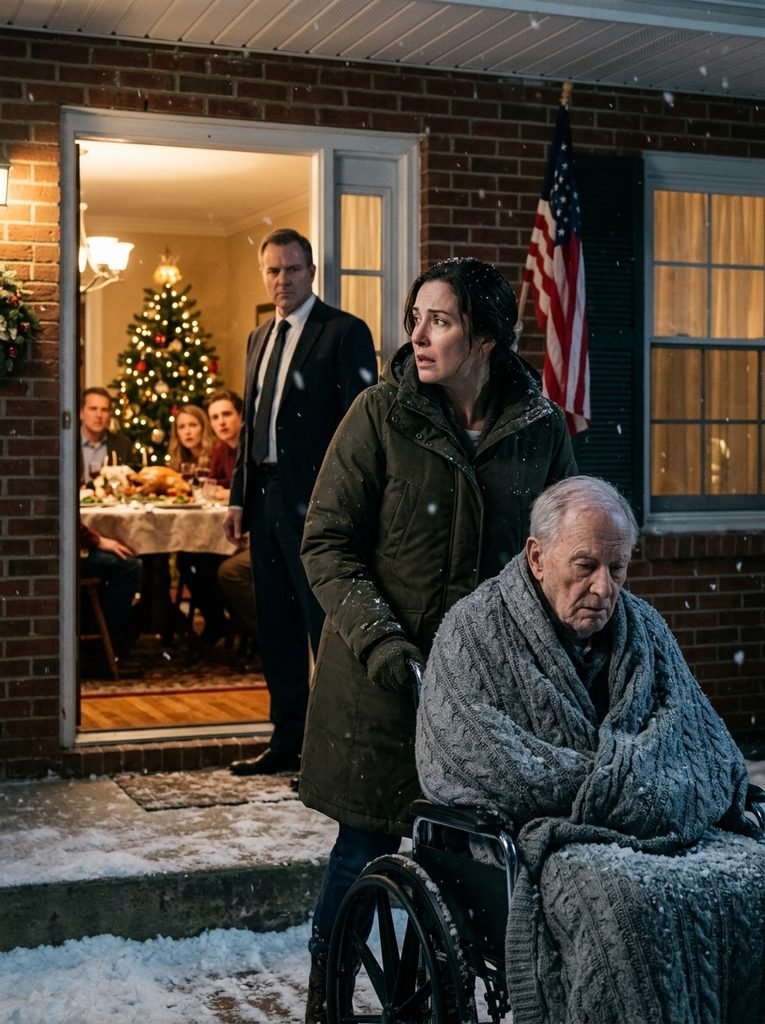
At Christmas dinner, my dad threw me and my wheelchairbound grandpa out into the freezing night. Not because we yelled, not because we ruined anything. Grandpa Walter only spilled gravy on the white tablecloth.
My father’s face twisted like the stain was worth more than us.
He grabbed my arm, shoved Grandpa’s chair across the marble floor, and locked the door while the guests kept chewing. Snow landed on Grandpa’s blanket. I thought we’d lost everything.
But that night, my father had no idea what he had just thrown away or whose name was already written all over everything.
Forever before that night, I still believed my family could be fixed.
My name is Daisy Monroe. I was 34, working breakfast shifts at a little diner and stocking shelves at a grocery store after dark.
Most mornings, I smelled like coffee, fryer oil, and cheap vanilla hand soap. Most nights, I came home with sore feet, a cold sandwich in my bag, and just enough energy to set my alarm and do it all again.
I was still pretty. People told me that.
Not in the glossy way my stepmother Viven was pretty, with her pearl earrings and perfume that floated into a room before she did.
Mine was the kind of pretty tired women carry without meaning to. Hair pinned up fast. Lip balm instead of lipstick. Eyes that looked calm because they had already cried in private.
My father, Richard Monroe, lived in a house that looked like it belonged on a Christmas card. Tall windows, polished floors, a dining room big enough to make every conversation feel like a performance.
He loved that house because people admired it.
And Richard loved anything that made him look powerful.
Grandpa Walter lived there, too.
That was the only reason I kept going back.
He sat in a wheelchair by the front window most afternoons. A gray knitted blanket over his legs.
I bought that blanket with tip money one winter when he told me his knees achd in the cold.
He acted like it was a luxury gift, held it to his chest, and said, “Daisy, sweetheart, you spend too much on me.”
But he always used it.
Grandpa had gentle hands, thin wrists, and a way of apologizing before anyone accused him of anything.
If he dropped a spoon, he said sorry.
If he needed help reaching a glass, he said sorry.
If Richard walked into the room already, Grandpa lowered his eyes like he had caused the weather.
That broke something in me every time.
Viven never defended him.
She would smile, adjust a flower arrangement, and pretend she hadn’t heard Richard’s little comments.
Too slow.
Too needy.
Too much trouble.
So when grandpa called me that Christmas afternoon and asked if I’d come to dinner, I said yes.
Not for my father.
For the old man with a gray blanket waiting by the window like I was the only warm thing left in that house.
By the time I arrived, the house smelled like roasted turkey, cinnamon, pine branches, and money.
Vivien opened the door wearing a cream silk dress and a smile that didn’t reach her eyes.
“Daisy,” she said, like my name was something she had found on the bottom of her shoe. “You made it.”
“I came to see Grandpa.”
Her smile tightened.
Inside, the dining room looked perfect.
Gold rimmed plates, crystal glasses, candles lined down the center of the table like tiny witnesses.
A few family friends sat around pretending not to study my thrift store coat.
Then I saw Grandpa Walter at the far end of the room.
He had the gray blanket over his knees. His hair was combed neatly, but his hands were folded too tight in his lap.
When he saw me, his face softened.
“There’s my girl,” he whispered.
I bent down and kissed his cheek.
His skin felt cold.
“Did they turn the heat down?” I asked.
He gave me that small, careful smile.
“I’m fine, sweetheart.”
Across the table, my father heard him.
Richard lifted his wine glass and said, “Walter is always fine when Daisy is here to fuss over him.”
A few people chuckled because they thought they were supposed to.
I didn’t.
Dinner started with forced laughter and silverware scraping against porcelain.
Richard talked about business, charity events, and how discipline separated strong people from weak ones.
Every time Grandpa tried to speak, Richard talked over him.
Every time I helped Grandpa cut a piece of turkey, Richard watched like I was embarrassing him.
Then it happened.
Grandpa’s hand trembled as he reached for the gravy boat.
I moved too late.
A dark splash landed on the white tablecloth.
The whole room went silent.
Grandpa froze.
“I’m sorry,” he said quickly. “I didn’t mean to.”
Richard set his fork down.
The sound was soft, but it hit my stomach like a door slamming.
“You can’t even sit through one dinner without making a mess,” he said.
“Dad,” I said, keeping my voice low. “It was an accident.”
His eyes snapped to me.
“Of course you’d defend him.”
Grandpa tried to push back from the table, humiliated.
“Richard, please. I’ll pay for the cleaning.”
That made my father laugh.
A short, ugly laugh.
With what, no one moved.
Viven stared at her plate.
The guests suddenly found their napkins fascinating.
I stood.
“Stop.”
Richard rose too, taller, louder, red with rage and shame.
“If you want to protect him so badly, Daisy, then take him with you.”
I thought he meant after dinner.
Then he walked behind Grandpa’s wheelchair and grabbed the handles.
And that was when I knew something terrible was about to happen.
“Richard, don’t,” Grandpa said.
But my father was already pushing him.
The wheelchair bumped hard against the dining room rug, then rolled across the marble floor toward the front door.
I ran after them, grabbing Grandpa’s medicine bag from the side table.
My father blocked me with one arm.
“He’ll need this,” I said.
Richard looked down at the bag like it was trash.
“Then maybe you should have thought about that before turning my house into a nursing home.”
My house, he said.
Not our house.
Not family.
His house.
He opened the front door, and the cold hit us like a slap.
Wind rushed in, blowing candle smoke sideways down the hall.
Grandpa pulled the gray blanket higher over his knees, his fingers already shaking.
“Dad, please,” I said. “It’s freezing.”
Richard shoved the wheelchair over the threshold.
Then he grabbed my arm and pushed me out after him.
I stumbled onto the front step.
Snow soaked through my shoes almost instantly.
Behind me, the door slammed shut so hard the wreath rattled.
I turned and pounded on the glass.
“Open the door. Grandpa can’t be out here.”
Inside, nobody moved.
The guests stared at their plates.
Viven stood near the staircase with one hand over her mouth, but she didn’t come closer.
Richard didn’t even look guilty.
He just reached over and turned to the lock.
That small click was louder than every word he had ever said to me.
I pushed Grandpa’s chair down the icy driveway, one hand on the handle, one hand holding the thin blanket around his shoulders.
He kept whispering, “I’m sorry, Daisy. I’m so sorry.”
“You didn’t do anything wrong,” I said.
But my voice broke.
My apartment felt even smaller when I brought him inside.
The heater coughed twice, then died.
I wrapped towels around his hands, boiled water, and warmed leftover soup from the diner.
He tried to eat, but the spoon trembled against the bowl.
Later, after he fell asleep, I sat on the kitchen floor and counted what I had.
A little cash, half a tank of gas, rent coming due, medicine running low.
I thought we’d lost everything.
Then near dawn, Grandpa opened his eyes and said, “Daisy, there’s something your father doesn’t know.”
I looked up.
His voice was weak, but his eyes were clear.
“Tomorrow,” he whispered. “I need you to drive me somewhere.”
The next morning, I drove Grandpa Walter out of the city.
He gave directions in a quiet voice.
Left after the old church, straight past the closed farm stand, right where the road bent toward the hills.
I kept glancing at him, waiting for an explanation, but he only held the gray blanket tight over his knees.
Then we stopped in front of a black iron gate.
Before I could ask whose property it was, the gate opened.
A guard stepped out, looked through the windshield, and straightened like he had seen a ghost.
“Mr. Monroe,” he said softly.
My hands froze on the steering wheel.
The driveway curved through tall trees and winter roses until a stone house appeared at the top of the hill.
Not flashy like my father’s mansion.
Older.
Quieter.
The kind of place that didn’t need to prove it mattered.
A woman in a dark coat hurried down the steps.
Her silver hair was pinned back, but tears were already in her eyes.
“Walter,” she whispered. “You came home?”
I looked at Grandpa.
Home.
Inside, the house smelled like polished wood, coffee, and old paper.
The woman, Ellaner, led us to a study with tall windows and shelves stacked with leather binders.
Grandpa asked me to close the door.
Then he said the words that split my life in half.
“Daisy, your father did not build the Monroe Fortune. I did.”
I stared at him.
He opened a drawer and placed two thick folders on the desk.
His hand trembled, but his voice didn’t.
“Richard was supposed to protect what I built. Instead, he moved money, changed contracts, hid payments, and used my name until I became inconvenient.”
My throat tightened.
“The accident?”
Grandpa looked away.
“I never had enough proof to say he caused it, but I had enough proof to know he benefited from it.”
The room tilted.
He opened the first folder.
Inside were summaries, property lists, legal letters, financial statements.
I saw numbers so large my mind refused to hold them.
Over $2.3 billion.
109 properties.
Apartments, land, commercial buildings, resorts, all held quietly, legally, far away from Richard’s reach.
“He was a secret billionaire,” I whispered, not even meaning to say it out loud.
Grandpa smiled sadly.
“No, sweetheart. I was a man who wanted to know who would love me when they thought I had nothing.”
I covered my mouth.
Then he opened the second folder.
“This is about Richard.”
Payments, bills, emails, contracts, signed statements, patterns that made my stomach turn cold.
“I kept copies,” Grandpa said. “Not to hurt him. To stop him if I ever had to.”
And now his eyes met mine.
“Now you decide.”
I didn’t decide out of anger.
Not fully.
Anger was there, burning under my ribs.
But there was something steadier beneath it.
I remembered Grandpa shaking in the snow.
I remembered that lock clicking.
I remembered my father looking at him like age had erased his worth.
“No more silence,” I said.
That afternoon, I met Noah Bennett, an old friend who worked in prosecution.
I didn’t ask him for revenge.
I asked him what was legal.
He read the first few pages with a polite frown.
Then he stopped blinking.
“Daisy,” he said, lowering his voice. “This isn’t just a family fight. I know this is serious financial misconduct, possibly elder financial abuse. If these records are real, your father is in trouble.”
“They’re real.”
Noah sat back.
“Then we do this carefully. Copies, chain of custody, lawyers, no threats, no public stunts.”
“Good,” I said. “I don’t want a stunt. I want him to hear the truth before it reaches everyone else.”
3 days later, Richard came home from a charity dinner with Viven on his arm.
I was waiting in his living room.
He stopped when he saw me.
Then he smiled like I was a stain he could wipe away.
“Daisy finally came to apologize.”
I stood beside the coffee table.
Two folders rested on the glass.
Grandpa’s gray blanket was folded over the chair behind me.
“No,” I said. “I came to give you one chance.”
Viven laughed under her breath.
“How dramatic!”
Richard loosened his tie.
“One chance for what?”
“To tell the truth about what you did to Grandpa.”
His face hardened, careful.
I opened the first folder and slid several pages across the table.
“These payments, these bills, these contracts, they weren’t mistakes.”
Richard barely looked.
“Walter’s confused. He’s old.”
“He’s not confused.”
“He poisoned you against me.”
I pressed play on a small recorder.
His own voice filled the room.
Cold, clear, arrogant, talking about taking control, talking about Walter being too weak to stop him.
Talking like family was just an obstacle in a suit.
Vivien’s face went pale.
Richard lunged for the recorder.
I picked it up before he reached it.
“It’s a copy,” I said. “Everything here is a copy.”
For the first time in my life, my father looked uncertain.
“What do you want?” he asked.
“That’s the sad part,” I said. “You still think this is about money?”
His eyes dropped to the second folder.
“What is that?”
“The thing you threw away.”
I opened it.
At first, he smirked.
Then he read the number.
The blood drained from his face.
“No,” he whispered.
“Over $2.3 billion,” I said. “And 109 properties, all protected, all legal, all outside your control.”
Viven stepped closer.
“Richard?”
He didn’t answer her.
He was still staring at the page like it had slapped him.
“He had that,” Richard said. “All this time, he had dignity. All this time.”
I said, “You just couldn’t see value unless it came with a price tag.”
His jaw clenched.
“I’m his son.”
“You were,” I said. “Then you left him freezing on Christmas night.”
His eyes flashed.
“You ungrateful little—”
The doorbell rang.
Richard turned.
Two legal representatives stood at the entrance with formal notices.
Noah was not there as my savior.
This wasn’t personal anymore.
It was procedure.
Richard was informed that records tied to his finances were under review.
Certain documents had to be preserved.
Certain accounts would be examined.
He was not to contact Walter about the estate.
Viven started crying.
“This is a misunderstanding.”
One of the representatives asked her about bills bearing her signature.
She stopped crying.
Richard looked back at me.
And there it was.
Not rage.
Fear.
“You’re destroying this family,” he said.
I picked up Grandpa’s blanket.
“No,” I said. “You destroyed it when you locked the door.”
Weeks later in court, Richard sat smaller than I had ever seen him.
The payments were shown.
The bills were explained.
The contracts were questioned.
Witnesses spoke.
His own words played back in a room where he could not silence anyone.
When the judge found him liable for serious financial wrongdoing and referred parts of the case for further criminal review, Richard turned toward Grandpa for one second.
He looked like a little boy who had finally been caught.
Grandpa didn’t smile.
Neither did I.
I just held his hand as the man who threw us into the cold finally learned what it felt like to be left outside the life he tried to steal.
After the hearing, nothing felt like victory.
Richard lost control of the estate related assets.
His public image cracked wide open.
The man who once measured everyone by usefulness was now answering questions he could not buy his way out of.
Viven was pulled into the investigation, too.
Not as a grieving wife, but as someone whose name appeared on bills she once pretended not to understand.
Grandpa Walter moved back into the stone house outside the city.
I moved with him.
Mornings there were quiet.
Coffee in the kitchen.
Elellaner trimming roses by the window.
Grandpa sitting in the garden with the gray blanket over his knees.
Sunlight resting on his face like forgiveness.
Some days he talked about the past.
Some days he only held my hand.
“I’m sorry you had to carry this,” he told me once.
I shook my head.
“You carried it alone for years. I just helped set it down.”
He lived long enough to see the estate secured.
Richard removed from the inheritance and the first document signed for a fund protecting seniors from financial abuse.
Then one morning, I brought him tea and found him asleep forever.
The blanket was still over his legs.
His hand rested on an old photo of me from high school.
The one where my hair was messy and my smile was too big for my face.
At his funeral, there were no cameras, no polished speeches.
Just workers, neighbors, old friends, and people I had never met crying like they had lost family.
That was when I understood.
Grandpa’s real legacy wasn’t over $2.3 billion or 109 properties.
It was every life he touched when nobody was watching.
So, I kept going.
I used the money to create scholarships, protect vulnerable elders, and treat every worker with the dignity Richard never understood.
I didn’t become powerful because I inherited wealth.
I became powerful because grandpa taught me what wealth was supposed to protect.
A year later, I stood in Grandpa’s rose garden with his gray blanket folded across the bench.
The air smelled like rain and soil.
And for the first time, the cold didn’t feel like punishment.
It felt like proof that I had survived it.
My father thought throwing us out would make us disappear.
Instead, it showed me who deserved to stay.
Real family doesn’t measure your worth by money, health, or usefulness.
Real family protects you when you’re weakest.
If you’ve ever had to protect someone from their own family, share your story in the comments and hit subscribe for the next story.
If you came here from Facebook because of this story, go back to the Facebook post, tap Like, and leave exactly this word in the comments: “Heartfelt.” That small action means more than it may seem. It directly supports the
storyteller and gives me more motivation to keep bringing you stories like this with the same care, effort, and heart.