MY HUSBAND SAID OUR TEENAGERS WERE LAZY—THEN I CAME HOME TO FIND THEM DOING HIS JOB
PART 1 — THE HOUSE I DIDN’T RECOGNIZE
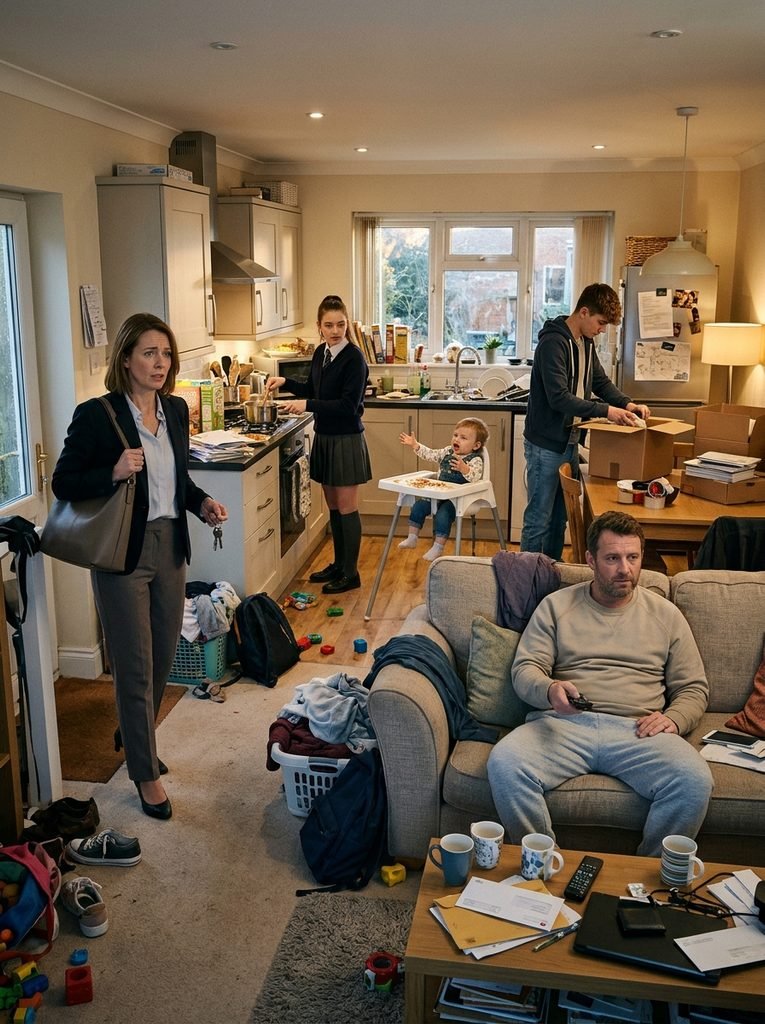
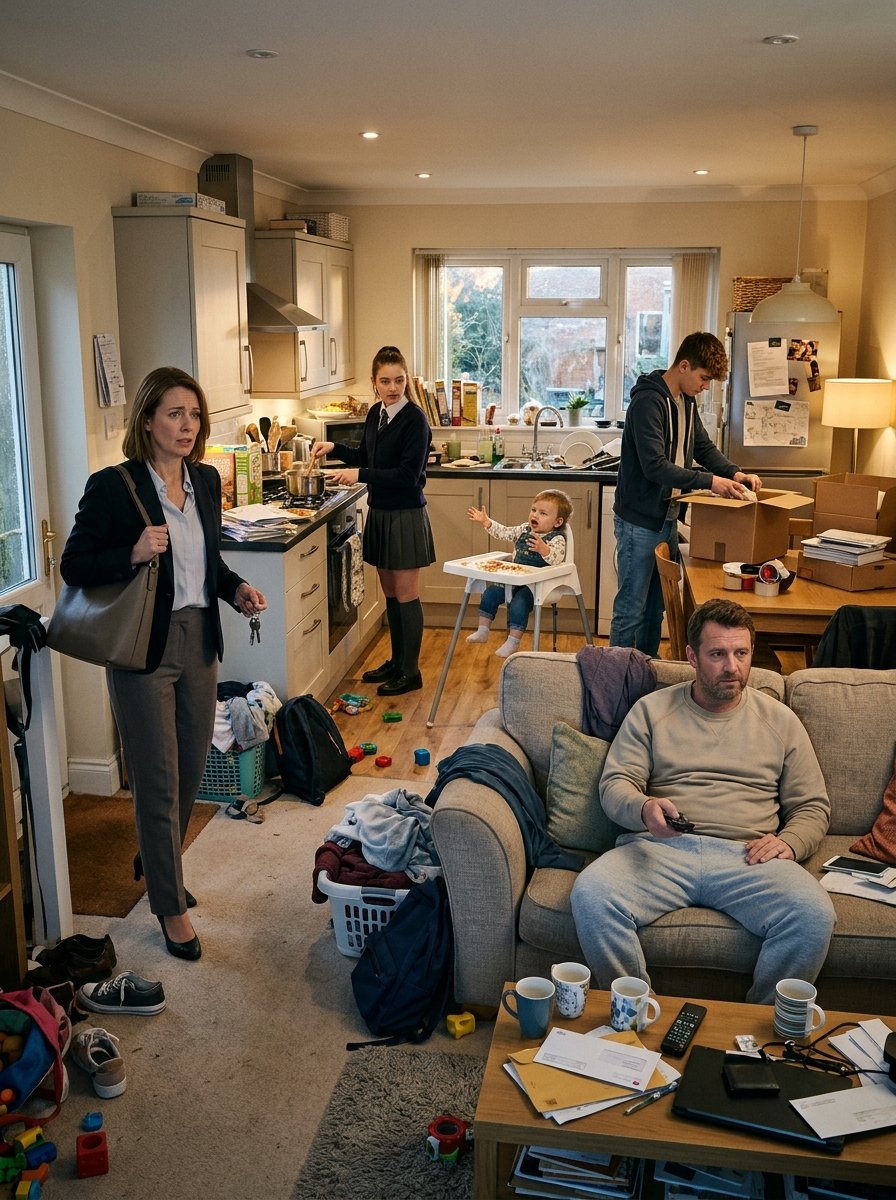
At 8:57 on a Friday night, my husband called our teenagers lazy while our fourteen-year-old son sealed his sixty-fourth shipping box.
Our seventeen-year-old daughter was still in her school uniform, feeding her little brother dinner with one hand and stirring a pot with the other. My husband was on the couch watching football.
I had been home for less than thirty seconds.
Packing tape ripped off a dispenser, again and again. Then came Grant’s voice from the living room.
“Dylan, that’s crooked. Do I have to explain a straight line to you too?”
I stood inside our front door, suitcase in my hand. I had driven back to Dallas from a three-day work trip to Austin after my last meeting was canceled, hoping to surprise everyone. Instead, I was looking at a dining room full of brown cartons and a kitchen I barely recognized.
Dylan was standing at the dining table, wearing the navy polo from his school. His homework binder lay open under a stack of shipping labels. The skin around his eyes looked tired, but his hands kept moving.
Hazel turned when she heard the suitcase wheels. There was tomato sauce on one sleeve of her uniform, and her hair had escaped its braid. Benji, our two-year-old, sat safely buckled into his booster seat at the kitchen table, reaching for another spoonful of pasta.
“Mom?” Hazel said.
She sounded scared.
Grant glanced over the back of the couch. “You’re early. You could’ve called.”
I looked from him to the children. “What’s going on?”
“Life,” Grant said, lifting his remote. “I’m teaching them to contribute. You know how they’ve been acting.”
I did know what he had been telling me. For six weeks, almost every evening, my phone had filled with complaints: Dylan wouldn’t finish his chores. Hazel had an attitude. Neither child appreciated how hard their father worked from home while I traveled for my job managing logistics for a hospital-supply company.
At first I had defended them. Then I had gotten tired. I had started sending messages like Please listen to your dad and Don’t make this harder on him. I could feel those words returning to me now, one by one.
“Dylan, put that down,” I said.
He looked at Grant before he looked at me.
“It’s all right,” I told him. “I’m asking you to stop.”
Grant muted the television. “He has a deadline. Those orders go out Monday.”
“Whose orders?”
“Wade’s company. I’m handling fulfillment. It’s my contract.”
Wade was Grant’s older brother. He ran Northline Welcome Supply, a small business that assembled welcome kits for offices and local companies. I knew Grant had been helping him through a rough stretch. I did not know our dining room had become an unpaid packing station.
“And why is Dylan handling your contract?”
“Because he needs to learn the value of work. It’s not complicated, Joanna.”
A bubbling sound came from the stove. Hazel rushed to turn the burner down. When she moved, I saw a basket of laundry at her feet and three folded stacks on the counter.
“How long have you been home from school?” I asked her.
“Since three-forty.”
“Have you had dinner?”
She glanced at Benji’s plate. “Not yet.”
Something tightened in my chest.
Grant sighed. “Don’t turn this into a production. They put everything off, and now they’re catching up.”
I took Benji’s tray out of Hazel’s way, checked that he was comfortable, and pulled a chair beside him. “Dylan. When did you start packing?”
“Five,” he said.
“Five this afternoon?”
He nodded. “I stopped to do the vacuuming. Then I came back.”
Grant spread his hands, as if Dylan had just testified in his favor. “See? He took breaks.”
“To vacuum?” I asked.
No one answered.
Hazel moved toward the refrigerator. “Mom, there’s something you need to see.”
A sheet of paper was held to the door with four magnets. Across the top, in Grant’s block handwriting, were the words MERCER HOUSEHOLD ACCOUNTABILITY PLAN. Beneath that were thirty-four separate assignments for Hazel and Dylan, with boxes for the days of the week and penalties for unfinished work.
Laundry. Dishes. Floors. Meal prep. Trash. Bathrooms. Kitchen counters. Grocery sorting. Packaging support. Shipping labels. Inventory counts.
At the bottom, in smaller writing, Grant had added: CHILDCARE AFTER SCHOOL — DAILY, AS NEEDED.
I read it twice. “Where are your jobs on this list?”
Grant rose from the couch. “My job is paying the bills. Your job is paying the bills. Their job is learning responsibility.”
“Hazel has school. Dylan has school.”
“And they’re perfectly capable of helping.”
“Helping isn’t the same as running the house.”
He lowered his voice. “Can we discuss this without an audience?”
Dylan made a tiny movement toward the packing tape. I saw it and hated what it meant: even with me standing there, he thought he might have to keep going.
“No more boxes tonight,” I said. “Go wash up. Hazel, make yourself a plate. I’ll finish here.”
Grant’s face hardened. “The truck doesn’t care about your feelings.”
“Then you’ll have to figure out the truck.”
For a moment, Instead of shouting, he picked up his phone and walked into the hallway. I heard Wade’s name before the door shut.
Hazel stood with her arms folded tightly around herself. “I tried to tell you, Mom.”
“Tell me what?”
“About all of it. But every time I called, Dad said you were too busy, and then you’d text us to listen to him.”
I wanted to deny it. I wanted to say there must have been a misunderstanding. But I remembered an unanswered message from Hazel that morning: Are you coming back tonight? Please?
I had replied with a heart and told her I would see her tomorrow.
“Why are you doing all this after school?” I asked. “You already have your classes and activities. What happened to Benji’s daycare?”
Hazel stared at me.
Dylan stopped in the kitchen doorway, his wet hands dripping onto the tile.
“Mom,” Hazel said carefully, “Benji doesn’t go to daycare anymore.”
I felt the room shift.
“What do you mean, anymore?”
“Dad canceled it,” she whispered. “September fourth. Six weeks ago.”
Behind us, the football crowd roared from the television Grant had left on.
And I realized that while I had been paying for someone to look after our youngest child, my husband had been making our other two children do it instead.
PART 2 — THE LIST OF THIRTY-FOUR
Grant returned from his phone call twenty minutes later to find the packing tape in a drawer and all three children eating at the table with me.
“Wade needs those boxes,” he announced.
“Then you can pack them,” I said.
He glanced at Dylan, clearly expecting the boy to get up. Dylan stared at his plate so hard that I could see the effort it took not to move.
“We’ll discuss it tomorrow,” Grant said through his teeth.
“No. We’ll discuss it when the kids are asleep.”
Hazel’s fork stopped halfway to her mouth. She looked at her father, then at me, trying to predict which version of the evening was coming next. That frightened me more than the mess.
I tucked Benji into his crib, helped Dylan find the missing pages of his science assignment, and sat with Hazel while she ate a second helping. At ten-thirty, after both teenagers had gone upstairs, Grant came into the kitchen carrying the chore chart.
“You’re embarrassing me in front of my own children,” he said.
“You made them finish your paid work after school.”
“My brother’s business is struggling. We help family.”
“Who is ‘we’?”
“I don’t need a lecture from someone who’s been out of town.”
I waited. Tonight, my work travel would not end the argument.
“Where did Benji go during the day?” I asked.
“He stays here with me. I work from home.”
“And after school?”
“The kids watch him for a while. They love him.”
“For how long?”
“You’re acting as though I tied them to the kitchen chairs.”
“For how long, Grant?”
He looked away. “Until dinner, mostly. Sometimes longer when work gets busy.”
“You told me he was still enrolled at Little Pines.”
“I told you the childcare was handled.”
He was right about the words, and wrong about everything they meant. I remembered asking whether the fall invoice had gone through. He had sent me a screenshot of our household budget with a green PAID box beside Childcare — $1,350. I had thanked him for taking care of it.
“Where is that money?” I asked.
“Don’t start accounting at eleven o’clock at night.”
“Then tomorrow morning. With the bank statements.”
Grant said nothing. He put the chore chart in the recycling bin and went upstairs.
I took it out.
On Saturday morning, Hazel came downstairs before anyone else. She found me at the dining table with a notebook and the rescued chart spread in front of me. Benji was asleep upstairs, and Dylan was still in bed.
“I didn’t mean to get everyone in trouble,” she said.
“You’re not in trouble.”
“Dad said you’d think we were being dramatic.”
“I was wrong to make you believe that. Tell me what happened.”
She sat down slowly. At first she talked in fragments. The first week after daycare ended, Grant had called it a temporary plan. He would watch Benji while they were at school, and they would help for an hour when they got home. In exchange, he had promised more freedom on weekends.
Then Wade needed help with a rush order. Grant asked Dylan to assemble a few boxes. The next week there were more. Hazel was told to manage dinner and laundry because her brother was “doing the real business work.” The chore chart came after Grant complained that the house looked neglected.
“Every time we finished something, there was something else,” Hazel said. “If Dylan was packing, I got his chores. If I had homework, Dad said I should’ve started earlier.”
“What happened when you told him it was too much?”
“He’d text you that we were refusing to help.”
My stomach turned. I found the messages on my phone. September ninth: Hazel rolled her eyes when I asked for one simple thing. September twenty-second: Dylan’s getting so lazy I don’t know what to do with him. October twelfth: I need you to back me up. These kids are taking advantage of me.
Each time, I had replied from a conference room or a parking garage, sure that supporting my husband meant supporting our family.
On October twelfth, I had written to Hazel, Please stop making things harder for Dad.
She had sent back only one word: Okay.
I set my phone face down.
“I’m sorry,” I said.
Hazel’s eyes filled, but she shrugged as if apologies were a luxury she didn’t know how to accept.
“I didn’t want you to lose your job,” she said. “Dad kept saying he was the only one holding everything together while you were away.”
“You didn’t have to protect my job by giving up your life.”
“He said we were almost adults.”
I reached across the table. “Almost adults are still allowed to be children.”
Dylan appeared in the doorway, hair flattened on one side. “Are we allowed to tell her about the boxes?”
Hazel looked at him. He looked at the chart. Neither looked toward the stairs.
“You’re allowed to tell me anything,” I said.
Dylan fetched his phone. He had photographed finished cartons because Grant accused him of losing count. There were pictures of labels, checklists, and numbered stacks from at least five separate evenings. One showed the dining-room clock reading 9:18 p.m. on a school night.
“Why didn’t you just stop?” I asked, then immediately wished I could pull the words back.
Dylan’s mouth tightened. “Because he said he’d tell you I wasn’t helping, and you always told me to listen.”
That was a fair answer. A devastating one.
He swiped through another few pictures and enlarged one of a paper lying beside the boxes. It had Northline’s logo, a customer order number, and a line marked FULFILLMENT — ASSEMBLY, LABELING & SHIPPING PREP.
At the bottom was a total I couldn’t ignore.
$1,200.00.
“Is that what Wade was charging the customer?” I asked.
Dylan shook his head. “I think it’s what Dad was getting paid. He told Uncle Wade the crew was finished.”
“What crew?”
My son looked at his sister.
“Us,” he said. “We were the crew.”
PART 3 — THE DAYCARE WE WERE STILL PAYING FOR
By Saturday afternoon, the story Grant had told me was already falling apart. What frightened me was how ordinary the evidence looked.
There was a budget spreadsheet, two bank transfers, and a husband who had counted on me being too busy to compare them.
For years, Grant and I had divided our responsibilities in a way that seemed sensible. I handled the mortgage and long-term savings; he handled weekly expenses, childcare payments, and the household calendar. We both had access to our joint checking account, but when he sent me a monthly summary, I usually checked the total and trusted the details.
On September third, $1,350 had left our account. On October second, another $1,350 had followed. Both transfers were listed as payments to NORTHLINE WELCOME SUPPLY LLC, my brother-in-law’s business.
In Grant’s spreadsheet, those same amounts appeared under Childcare — Paid.
I printed both pages and laid them side by side.
“Explain this,” I said when Grant came into the dining room.
He glanced at the papers. “Wade needed a short-term loan.”
“From our childcare money?”
“From our money. Benji was home with me. We weren’t paying for daycare. That freed up cash.”
“You told me we were still paying for daycare.”
“I said the childcare expense was covered.”
I put my finger on the green boxes in his spreadsheet. “You marked it paid. Twice.”
He leaned against the doorway. “You’re making it sound sinister. I was moving money around to keep us afloat.”
“Are we not afloat?”
“That’s not what I meant. Wade had a customer delay a payment. I knew he’d pay us back.”
“And you didn’t ask me because?”
“You would’ve said no.”
There it was. One truthful sentence, delivered almost by accident.
I remembered his promise that we would make every big decision together.
“You knew I’d say no,” I repeated, “so you used money we’d set aside for our child and made me think it was gone to the daycare.”
“It’s temporary.”
“Six weeks of our children’s lives aren’t temporary. They happened.”
He scoffed. “Dramatic. They’re not working in a mine.”
“They’re doing your paid contract, keeping our home running, and caring for a toddler after school. You can stop minimizing it.”
Grant walked away before I finished. I heard a door close in the garage.
On Sunday, I asked the teenagers to show me what a normal weekday had looked like since September. I made breakfast while they talked, and this time I didn’t interrupt them with an excuse for their father.
Grant watched Benji in the mornings, often with cartoons playing in the den while he worked at his desk nearby. After the older kids came home, he turned over most of the childcare and household work to Hazel. If she needed twenty minutes for an assignment, Dylan took over. If Dylan had a science-club meeting, Grant called it an indulgence and told him to come home instead.
No one had left Benji alone, and both teenagers insisted they loved playing with him. But loving their brother was not the same as being available every afternoon, no matter what they needed for school.
Dylan opened a notebook where he had begun recording shipping quantities. He had dated entries for several weeks, each with counts of completed kits and labels. “Dad said if the numbers didn’t match, he’d start taking away weekends until they did.”
“Did he?”
“He took away my Saturday with Caleb because I finished twenty-seven instead of thirty.”
“Why didn’t you tell me?”
Dylan looked down. “I thought I had to earn the right to complain.”
I had to excuse myself to the kitchen for a moment. I stood at the sink, breathing slowly, because he was fourteen and should have been worrying about science projects and whether his friend Caleb liked the same video games. He should not have been wondering whether he had earned the right to tell his mother he was overwhelmed.
On Monday, October nineteenth, I called Little Pines Child Development Center. The director, Elisa Romero, knew our family. Her voice changed when I asked why Benji hadn’t been there for six weeks.
“Mrs. Mercer, Grant submitted a withdrawal notice on August twenty-first,” she said. “Benji’s last day was September fourth. I remember because he hugged his classroom teacher twice before he left.”
“Was there a balance due for September or October?”
“No. The final charges were settled before his last day. We haven’t billed your family for either month.”
I thanked her and asked for a copy of the withdrawal confirmation. She sent it to me that afternoon. Grant’s name was on the form as an authorized parent; notifications had gone to the address he used as the primary contact. There had been no computer trick, no forged signature. He had been entitled to withdraw our son. He simply hadn’t told me.
I sat in my parked car outside my office and read the confirmation until the screen dimmed.
Then Elisa called again.
“There’s something else,” she said. “When Grant withdrew Benji, he mentioned that your older children would help after school. I asked if he meant occasionally. He said it was a family arrangement.”
“And you believed him?”
She paused. “I didn’t have a reason to think he was misleading you.”
Neither had I, I wanted to say. But that wasn’t true anymore.
After work, I stopped at the grocery store and bought the ingredients for Dylan’s favorite tacos. I wasn’t trying to fix six weeks with dinner. I just wanted to make a meal without one of my children being responsible for it.
When I got home, Hazel was sitting at the kitchen table with her laptop open to a college-planning folder. She shut it quickly when I entered.
“What’s that?” I asked.
“Nothing. Just school stuff.”
She started to stand, as though she had been caught wasting time.
“Stay,” I said. “I’ll cook.”
She didn’t move. I could see a subject line reflected in the dark edge of her screen: North Texas Futures Scholars — Interview Confirmation.
I smiled before I understood. “Honey, you got an interview? Why didn’t you tell me?”
Hazel’s face went pale.
“Mom,” she said, “the interview was last Thursday.”
PART 4 — THE INTERVIEW SHE MISSED
For one wild second, I thought I had misheard her.
“Last Thursday? October fifteenth?”
Hazel nodded. She kept her hands flat on either side of the laptop, as if holding the table steady.
The North Texas Futures Scholars award was one Hazel had told me about in August. It was a local foundation scholarship worth up to $3,000 a year for four years, based on academic performance, financial need, and continued eligibility. She had written three essays, requested two recommendations, and spent a weekend revising her application until every sentence sounded like her.
I’d driven her to the library so she could print a clean copy of her portfolio. I had bought her a navy blazer from a thrift store, and she had tried it on in front of the hallway mirror, grinning because the sleeves fit perfectly.
“They picked you for an interview,” I said slowly. “And I didn’t know?”
“Dad knew.”
“Tell me. All of it.”
Her interview had been scheduled for 4:30 on Thursday afternoon, during the second day of my trip. Hazel planned to take it from her bedroom. She’d tested her laptop camera, prepared answers with her school counselor, Ms. Benton, and placed the blazer on the back of her desk chair.
Grant had promised to look after Benji for half an hour.
At 4:17, Wade called. A driver was waiting for a batch of boxes at the local shipping depot. Grant announced he was leaving immediately and told Hazel to keep an eye on Benji until he returned.
“I told him I had the interview,” Hazel said. “He said it was just a video call and I could do it while Benji played.”
She had tried. She brought Benji upstairs, set out his toys in her room, and opened the meeting link. But he was two, tired from the afternoon, and wanted her attention. When the interview host admitted her to the waiting room, he began crying for his father. She sent Grant a message asking him to come back, then another.
Grant didn’t return before the scheduled slot ended.
“I couldn’t answer those questions and take care of him at the same time,” Hazel said. “I didn’t even get through the first one. I apologized to the coordinator and left.”
She handed me her phone. I read the messages with their timestamps, then the polite email she’d received afterward: the panel was unable to complete her interview, and her application would be marked incomplete unless an accommodation was approved.
“Why didn’t you call me?”
“I did. It went to voicemail.”
I opened my call history. There it was: October fifteenth, 4:21 p.m., one missed call from Hazel between two work meetings. I had seen it and sent a quick text: Everything okay? Ask Dad if it’s urgent.
I stared at my own words.
“I was scared you’d say I should’ve managed it better,” Hazel whispered. “Dad said if I made a big deal out of it, you’d have to leave work, and then everyone would suffer.”
“I never wanted you to think that.”
“But I did.”
There was no defense against that sentence. She had lived inside the meaning of my messages, not the meaning I had intended.
I pulled out the chair beside her. “I’m sorry I believed him when he said you were being difficult. I should have asked you what was happening. I should’ve listened.”
She studied me as though apologies had fine print.
“I wasn’t trying to get out of helping,” she said. “I just wanted half an hour.”
“You deserved that half hour. You deserved help with Benji. And you deserved a parent who made sure you could take your interview.”
Her face crumpled then. For weeks she had spoken calmly, as if each fact required permission. Now she covered her eyes and cried. I held her while she tried to say she was sorry for crying, and I told her she had nothing to apologize for.
I didn’t promise the scholarship would come back. I wouldn’t give her one more thing she might trust that I couldn’t deliver.
Instead, we made a plan.
The next morning, I met Ms. Nia Benton, Hazel’s school counselor, before my workday. Hazel came too. She explained what had happened in her own words, and Ms. Benton listened without making her repeat the most painful parts.
“A missed interview isn’t automatically the end,” Ms. Benton told her. “The foundation may allow a make-up when circumstances outside an applicant’s control interfered. I can’t guarantee it, but I can help you ask.”
Hazel drafted the email herself. It was clear and professional, without pleading. She acknowledged missing the slot, explained she had unexpectedly become responsible for a toddler, and requested reconsideration. Ms. Benton offered to confirm her preparation and the timeline.
While Hazel was in class, I went through the papers Dylan had saved. He had a stack of completed packing checklists with dates, quantities, and Grant’s initials. I sorted them beside the Northline work order that had shown $1,200.
The document wasn’t a bill to Northline’s customer. It was an invoice from Grant to Wade’s company, dated October twelfth: Fulfillment management and packaging services — $1,200.
The service dates overlapped evenings when Hazel had been doing laundry and Benji’s dinner while Dylan filled cartons. Beside the work order, in Grant’s handwriting, were two words: Crew complete.
That afternoon, Grant returned from a client meeting and found me studying the invoice.
“You went through my business papers?” he demanded.
“Dylan found them on the family printer. The invoice is for work he did.”
“I supervised him. That was my contract.”
“Did Wade pay you?”
Grant folded his arms. “It’s none of the kids’ business.”
“I’m not asking for the kids. I’m asking as your wife.”
“Wade and I settle up when the money comes in.”
He spoke smoothly, but he wouldn’t meet my eyes.
I picked up my phone and called Wade. I put the call on speaker.
He answered on the third ring. “Hey, Jo. Everything all right?”
“I have a question about Grant’s October invoice. Has he been paid the $1,200?”
Silence stretched across the room.
Then Wade said, “Of course. I transferred it to his personal account on Monday. Didn’t he tell you?”
PART 5 — THE MAN WHO GOT PAID
Grant reached for my phone, but I moved it out of his way.
“Wade,” I said, “I need to know what you hired Grant to do.”
My brother-in-law hesitated. “Manage a large order. Assembly, quality checks, labels, shipment prep. He said he’d put together a crew. Why?”
“Because his crew is seventeen and fourteen. They’ve been coming home from school and packing your boxes while he watches television.”
Another silence. This one was longer.
“No,” Wade said. “Grant told me he had help. I thought he meant people he hired.”
Grant stepped closer to the phone. “Wade, don’t get involved in our family argument.”
“You made me involved,” Wade said. His voice had lost its easy warmth. “Those are my orders you’re talking about. Joanna, can we meet tomorrow? I want to show you what I have.”
After I ended the call, Grant began pacing.
“You just made me look incompetent to my biggest client.”
“Wade is your brother. You told him you hired help.”
“I didn’t say I hired anyone. I said I had a crew.”
“You were talking about our children.”
“They’re my children too.”
“That doesn’t make their time yours to sell.”
He stopped pacing. “You know what? Fine. I’ll do every box myself. Then you’ll see how hard it is to run this house while you’re gone.”
My salary covered the mortgage and health insurance. I refused to make this a contest over which adult worked harder.
“You could have told me you needed help,” I said. “You could have asked me to rearrange my schedule. You could have hired someone for the contract.”
“We couldn’t afford it.”
“Then you couldn’t afford to accept the contract.”
His expression changed, just for a second. Not anger. Recognition.
The next day, Wednesday, October twenty-first, I met Wade at a coffee shop near his warehouse. He brought a thin folder and left his phone face down on the table.
“I owe you an apology,” he said before I could sit. “I should have asked who was doing the work. I trusted Grant because he’s my brother. That was careless.”
Wade showed me a signed service agreement. Northline had hired Grant as an independent contractor for a defined batch of office welcome kits. The fee was $1,200, paid after the October order passed quality review. There was no requirement that my children participate. Wade had budgeted the job on the assumption Grant would do the work himself or arrange appropriate help.
Wade also showed me the payment confirmation from October twelfth. The recipient was Grant Mercer, with a bank account ending in four digits I didn’t recognize. It was not our joint account.
“He asked me to pay him there,” Wade said. “Said it kept his contract income separate for taxes.”
Paired with the emails calling the kids lazy, the explanation made me sick.
Then Wade opened a second page. It was the record of his loan from our household funds: $1,350 on September third and $1,350 on October second.
“Grant told me you both agreed,” he said. “I asked him specifically, because I know you two plan everything together. He said it was money you’d saved by changing the childcare arrangement.”
“I didn’t know the childcare arrangement had changed.”
Wade took off his glasses. “Joanna, I didn’t know that.”
For the first time since Friday, I believed a grown man was telling me the whole truth. It didn’t absolve him of accepting a large family loan without seeing anything in writing, but he was looking at the problem instead of explaining it away.
“Can you repay the $2,700?” I asked.
“Not all at once. The delayed client payment is clearing in stages. I can put the repayment schedule in writing and send the first $675 next week. No more borrowing from you or Grant.”
“I want the agreement written down.”
“You should.”
He promised to move future packing orders to an adult fulfillment team and offered to send records of every order Dylan might have worked on. I told him the children were done working for Northline, permanently.
Wade didn’t argue.
Before I left, he said, “Grant used to talk about how smart Hazel was. How Dylan could fix anything. I didn’t know he was turning that into this.”
“I didn’t know either,” I said. “That’s the part I have to live with.”
On my way home, I stopped outside the school to pick up Dylan from science club. He came out with a paper bridge he’d built from folded strips and tape. He held it carefully in both hands.
“It supported eleven pounds,” he told me. “Ms. Hart said if I change the triangles, it might hold fifteen.”
I had forgotten the sound of him talking about something he loved. For weeks, our conversations had been about whether he had finished a chore.
“Show me when we get home,” I said.
He looked surprised. “Don’t you have to work?”
“Not right now.”
That evening, Grant saw the paper bridge on the table and asked why Dylan had gone to club when the last batch of cartons still needed sorting. Dylan’s face went blank.
“He went because he wanted to,” I said. “And the cartons are your responsibility.”
Grant laughed without humor. “So now he gets rewarded for doing nothing?”
Dylan set down his pencil. His voice was quiet, but every word was clear.
“Dad, if I’m doing nothing, why did Uncle Wade pay you twelve hundred dollars for my work?”
Grant stared at him. I waited for an answer that never came.
Dylan picked up his bridge and walked upstairs.
Later, Grant stood at the bedroom door and said, “If I lose this contract because you went behind my back, that will be on you.”
I looked at the bed where we had slept beside each other for sixteen years.
“No,” I said. “The contract is on you. The money is on you. And what happened to our children is on both of us to repair.”
He shook his head. “You’re tearing this family apart over a few chores.”
I didn’t raise my voice.
“No, Grant. I’m finding out how long you were willing to let our children carry it without us noticing.”
PART 6 — THE RECEIPTS ON THE TABLE
By Friday, October twenty-third, the dining table had been cleared of shipping boxes. I covered its surface with documents instead.
The thirty-four-task chart lay at one end. Next came the daycare withdrawal form, our bank statements, Wade’s signed acknowledgment of the loan, and the $1,200 invoice with its payment confirmation. I had also printed the messages Grant had sent me about the kids and the dates on Dylan’s packaging logs.
I knew what I needed to say.
Before Grant came home, I met with a family-law attorney for an initial consultation. She explained that I should keep copies of financial records I was entitled to access, avoid draining joint accounts in anger, and think through the children’s needs before making any decision about living arrangements.
I arranged for my future salary deposits to go into a new account in my name, while leaving funds in the joint account for existing bills. I changed my own passwords and began handling Benji’s childcare enrollment directly. I wasn’t preparing a revenge scene. I was making sure another ordinary-looking spreadsheet couldn’t hide a decision that changed our children’s lives.
At six-thirty that evening, Grant walked into the dining room and stopped.
“What is this? A trial?”
“A conversation with records,” I said. “Sit down.”
He pulled out a chair, looked at the papers, and gave a short, disbelieving laugh. “You’ve really been busy.”
“You told me Hazel and Dylan were lazy. Here are their after-school assignments. You told me the childcare was paid. Here are the transfers to Wade. You told me the shipping contract wasn’t settled. Here is the payment to your personal account.”
“You’re making me sound like a criminal.”
“I’m telling you what happened.”
“I wasn’t gambling it away. I was helping my brother keep his business open.”
“With money you said had gone to our toddler’s daycare.”
“I was home with Benji! He was cared for!”
“During the day, yes. Then you gave the responsibility to two kids who had schoolwork and lives of their own.”
He rubbed his forehead. “Hazel can babysit. She’s seventeen.”
“Occasionally, when she agrees and has time. Not every afternoon because you chose a second job you couldn’t finish.”
“It’s good for them to learn what sacrifice looks like.”
That sentence nearly broke my composure. I thought of Hazel standing in her blazer, laptop open, asking for thirty minutes. I thought of Dylan counting cartons after nine at night, afraid to stop because his father might call him useless.
“Sacrifice isn’t something you can assign to someone else without telling them what they’re paying for,” I said.
Grant leaned back. “You don’t understand what it’s like to have my income dry up while yours keeps climbing. Wade needed help. I needed work. Every time I looked around, there was more to do.”
There was the part of the truth he’d never said aloud. His consulting work had slowed that summer. He was ashamed of asking me to carry more of the bills. Instead, he had quietly made the children carry more of everything else.
“I would have talked through the money with you,” I said. “I would have helped you find a plan. You decided lying was easier.”
“I thought I could fix it before you noticed.”
“You could have stopped when Hazel told you about her interview.”
He looked toward the stairs. “She could’ve taken the call with Benji in the room.”
“She tried.”
“Then she should have tried harder.”
I stood. For a moment, I was so angry I could not speak.
“Stop,” I finally said. “She was seventeen. You were the parent. The responsibility was yours.”
His eyes flickered, but he did not apologize.
I gave him the boundaries I had written down. Neither teenager would pack another order or be routinely responsible for childcare. Household chores would be limited, age-appropriate, and discussed with them rather than imposed as punishment. We would make a full accounting of the money moved to Wade and the money Grant had received. He would not make unilateral childcare or financial decisions and then tell me they had been agreed upon.
“You can’t dictate all of this,” he said.
“Then we need space while we work out whether we can make decisions together at all.”
Grant stared at me. “Are you asking me to leave?”
“I’m saying we can’t keep living exactly as we were. I need you to stay somewhere else for now, and we need a calm plan for Benji and the kids.”
He stood up so abruptly that his chair scraped the floor. “Fine. I’ll go to Marcus’s spare room. Maybe you’ll appreciate what I do when I’m gone.”
“I already appreciate what parenting requires. That’s why I’m here.”
He packed a bag and came downstairs while Dylan was reading on the sofa and Hazel was helping Benji stack plastic blocks. Grant looked at the children and, for the first time all week, seemed to understand they were listening.
“I love you,” he told them. “I hope you know that.”
“I know you say it,” Hazel replied.
It wasn’t cruel. That made it harder to hear.
Grant left without slamming the door. When the house went quiet, I expected relief. What came instead was grief for the family I’d thought we were and worry about the family we might become.
We ate grilled cheese for dinner. Dylan left a plate on the counter, then jumped up to wash it, but I asked him to sit down and finish his homework. He looked at me twice before he believed I meant it.
At 9:06 p.m., my phone lit up with a new email. The sender was North Texas Futures Scholars.
The subject line read: Decision Regarding Alternative Interview Request — Hazel Mercer.
I called Hazel into the kitchen, and together we opened it.
PART 7 — THE SECOND CHANCE
Hazel read the email three times before she looked at me.
The foundation had approved one additional interview slot: Tuesday, October twenty-seventh, at 4:30 p.m. The exception did not guarantee an award.
Hazel pressed her fingers against her lips, then let out a breath that shook. “They said yes.”
“They said you can show them who you are,” I told her. “That’s all you wanted in the first place.”
She nodded, blinking fast. “What if I freeze?”
“Then you take a second, breathe, and start again. They asked to interview you because they liked what you wrote. You’re the same person who wrote it.”
That night, she moved her blazer from the back of her closet to the front. I saw her smoothing its sleeves and understood what that small gesture meant: she had allowed herself to imagine a future again.
On Monday, Benji started at Cedar Grove Children’s Center, a licensed program near my office that had an unexpected opening in his age group. I had toured the classrooms, met his teachers, reviewed the policies, and completed the enrollment forms myself. I kept his schedule in a shared family calendar I could actually see.
The first morning, he held my hand all the way to the classroom door. When his teacher knelt to welcome him, he looked back at me, uncertain.
“You’ll come back?” he asked.
“Every time,” I said.
I stayed long enough to help him settle, then went to work. At pickup, he showed me a painting made of green handprints and told me about a toy truck that belonged to everyone. I nearly cried in the parking lot.
My manager agreed to adjust my travel schedule while I sorted things out at home. I didn’t have to quit the job I’d worked so hard to build. I had to stop treating it as a reason I couldn’t ask questions at home. The distinction was painful, but necessary.
Hazel used the school counselor’s office for her new interview. Ms. Benton arranged a quiet room with a reliable connection, so Hazel wouldn’t have to worry about a door opening or a toddler needing her. I offered to drive her there, but she preferred to walk from her last class and meet me afterward.
“I want to do it myself,” she said.
“Then that’s how we’ll do it.”
At 4:24 on Tuesday, she sent me a photograph of her notebook. The first page contained three questions she’d written in purple ink: What do I want to study? What problem do I want to help solve? What has taught me to keep going?
I typed, You know the answers. I love you.
For twenty-eight minutes, I sat in my car outside the school and didn’t touch my work phone. When Hazel came through the doors, her shoulders were back, but she was chewing the inside of her cheek.
“Well?” I asked.
“One of them asked what leadership meant to me,” she said as she buckled her seat belt. “I told her it wasn’t getting other people to do everything you wanted. It was noticing when someone needed help and not making them feel small for needing it.”
I watched the windshield because I could feel tears coming.
“That’s a good answer,” I managed.
“I think so too.”
She leaned her head against the seat and smiled for the first time without checking whether anyone approved.
Wednesday brought another small victory. Dylan stayed after school to work on his paper bridge with Ms. Hart. He had changed the design, added supports, and decided to enter it in the school’s engineering showcase. That evening, he covered our table with measurements and asked me to hold one end of the ruler.
“I can’t believe this is the only tape I have to use,” he joked, lifting a clear school-supply dispenser instead of the heavy packing tool.
We laughed, and then we both went quiet because the joke was true.
On Thursday, Grant texted Hazel: I heard you got another interview. I’m proud of you. Can we talk?
She brought the phone to me. “Do I have to answer?”
“No. You can decide when you’re ready. You don’t owe him a conversation to make him feel better.”
“I still love him.”
“I know. Loving him doesn’t mean you have to pretend this didn’t happen.”
She thought about it and sent back: I did the interview. Please don’t ask me how it went yet.
Grant replied, Okay. I understand.
I hoped he would mean it tomorrow too.
On Friday, October thirtieth, the first $675 repayment arrived from Wade. He sent a copy of the written agreement confirming that the remaining balance was still owed to our household. I moved the payment toward Benji’s childcare costs and filed the receipt with the other records.
Wade had also hired an adult fulfillment service for his next order. He emailed to say there would be no more business deliveries to our house. I showed the message to Dylan, who read it and said, “Good. I don’t want to smell cardboard for the rest of my life.”
I wanted the children to have back more than their weekends. I wanted them to feel that their time belonged to them.
Grant and I met briefly that weekend with a written list of household costs and a plan for regular time with Benji. We did not agree on the future of our marriage. He admitted that he had lied about the daycare, but when I asked about Hazel’s interview, he lowered his eyes and said, “I thought I could finish the delivery and come right back.”
“You didn’t,” I said.
“I know.”
“And the next time she tells you something matters, I need you to believe her before it’s too late.”
He didn’t offer an excuse. That was new, though I knew it wasn’t the same as change.
On Tuesday, November third, Grant transferred the $1,200 he had received from Wade into savings accounts for Hazel and Dylan, $600 each. He wrote them separate notes acknowledging that he had profited from their work and had been wrong to do it. Neither child was asked to forgive him in return.
The money didn’t give Hazel back her missed interview or Dylan back his evenings. It was one concrete admission that their labor had value, and that he had treated it as though it belonged to him.
Two days later, a new message appeared in Hazel’s college-planning inbox. It was from the scholarship foundation.
This time, I let her open it first.
PART 8 — THE ONLY DEADLINE LEFT
On Thursday, November fifth, at 4:11 in the afternoon, my daughter shouted my name from the kitchen.
For six weeks, a shout from the kitchen had meant something was wrong: a meal had to be finished, a box count didn’t match, or Benji needed someone while Grant had another task to assign.
This shout sounded different.
I hurried in and found Hazel standing beside the table, her laptop open and her hands trembling. Benji was safely playing with large blocks on the rug a few feet away. Dylan looked up from his science notes.
“Mom,” Hazel whispered, “read it.”
The letter began by congratulating her. North Texas Futures Scholars had selected her for a renewable scholarship worth up to $12,000 across four years, subject to the program’s enrollment and academic requirements.
I read the amount twice before it registered. Hazel gave a small, disbelieving laugh, and then we were holding each other so tightly that Dylan came around the table to join us.
Benji looked up, confused, and announced, “Hug!”
So we made room for him too.
For once, we celebrated without checking whether the dishes were done first. There were no cartons, no one counting completed jobs before we were allowed to feel happy.
“I thought I’d ruined everything,” Hazel said against my shoulder.
“You didn’t ruin anything. You earned that interview twice, and you earned what came after it.”
She pulled back. “I know. I just didn’t think I’d get the chance to prove it.”
That was the moment I understood why the letter mattered so much. The scholarship would help with the cost of college, of course. But to Hazel, the letter was also evidence that an opportunity once taken from her did not have to define the rest of her life.
We ordered her favorite pizza that evening. Dylan insisted on choosing dessert, and I let him, even though his choice involved an unreasonable amount of chocolate. Benji fell asleep at his normal bedtime. When the older two stayed up to watch a movie, no one called them lazy.
The next day, Friday, November sixth, I took the old chore chart out of my desk drawer. I had kept it as part of the documentation. Now I laid it beside a fresh sheet of paper and asked Hazel and Dylan to sit with me.
“I want us to make a plan,” I said. “Not because you owe me for living here. Because we share a home, and everyone should know what they can reasonably handle.”
Dylan eyed the blank sheet. “How many boxes?”
“Zero.”
“Shipping labels?”
“Also zero.”
Hazel smiled. “Does this plan include our homework?”
“It includes making time for your homework. Your activities, too. And time to do absolutely nothing sometimes.”
We talked about ordinary chores. Dylan would handle the trash and help with dinner cleanup on two evenings. Hazel volunteered to do her own laundry and help plan one family meal each weekend, provided she was free to trade days during exams. I would handle childcare arrangements and make sure the adults, not the teenagers, were responsible for keeping them.
We made one more rule: no one had to earn the right to say they were overwhelmed.
Hazel took a marker and wrote it along the bottom of the page.
That afternoon, I met Grant at a quiet café. He looked tired. He asked about the children before he asked about us.
I told him Dylan was preparing for an engineering showcase and Benji was settling into his new classroom. I didn’t tell him about the scholarship until I said Hazel had given me permission to share the news.
When I told him she’d been selected, his eyes brightened. “I knew she could do it.”
“She did it because she worked for it,” I said. “And because someone finally made room for her to try.”
He looked down at his coffee. “I deserve that.”
“This isn’t about scoring points, Grant. I need to know you understand what happened.”
He was quiet a long time.
“I was ashamed,” he finally said. “My work was drying up. You were doing well, and Wade needed help, and I thought I could fix everything without asking anybody. When the kids started helping, it was convenient. I told myself it was teaching them something. Then I got used to it.”
“And when they told you it was too much?”
“I called them lazy because I didn’t want to hear it.”
It was the first time he’d said that plainly.
“You have a lot to repair,” I told him. “With them. With me. A payment and an apology don’t finish it.”
“I know.”
Maybe he did. Maybe he was only beginning to. He had arranged an appointment with a counselor and agreed to put our financial decisions in writing while we lived separately. Those were steps, not guarantees. I wasn’t going to announce that our marriage was healed because he had finally admitted the truth.
I would judge what happened next by what he did, consistently, when no one was watching.
That evening, Hazel came downstairs carrying the thrift-store blazer she’d worn for her interview. She asked whether I could help her hang it somewhere safe until she needed it again.
I opened the hall closet and cleared a space between my work coat and Dylan’s old rain jacket. The blazer hung there, simple and navy and full of possibility.
“Mom?” Hazel said.
“Yeah?”
“You don’t have to apologize every day. I know you’re trying.”
I turned toward her. “I’m going to keep trying whether you remind me or not.”
She stepped forward and hugged me. It wasn’t forgiveness wrapped in a perfect bow. It was a beginning, and I was grateful for it.
Later, I stood in front of the refrigerator. The new list was short enough to read at a glance. Above it were a crayon drawing by Benji, Dylan’s engineering-showcase information, and a note Hazel had written to remind herself to complete her college application.
I used to think a good family was one where everyone worked hard enough to keep the house running.
Now I know a good family is one where the adults don’t make children carry what the adults refuse to hold.
For weeks, the only deadlines on that refrigerator had belonged to my husband.
That Friday, the one Hazel cared about most was her college application.
And both of my teenagers had the whole evening to themselves.
END