A Boy Paid $70 for a 17-Ton Gear Cutter Everyone Said Was Scrap —the Navy Paid $286,000 for 12 Gears
A Boy Paid $70 for a 17-Ton Gear Cutter Everyone Said Was Scrap —the Navy Paid $286,000 for 12 Gears
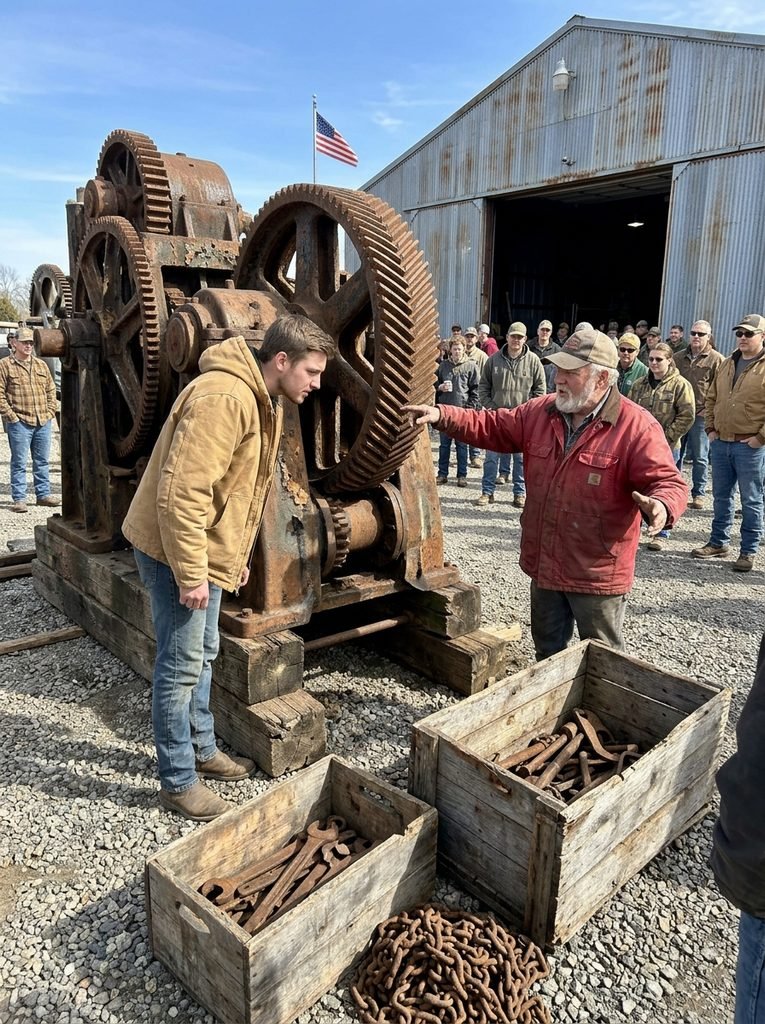
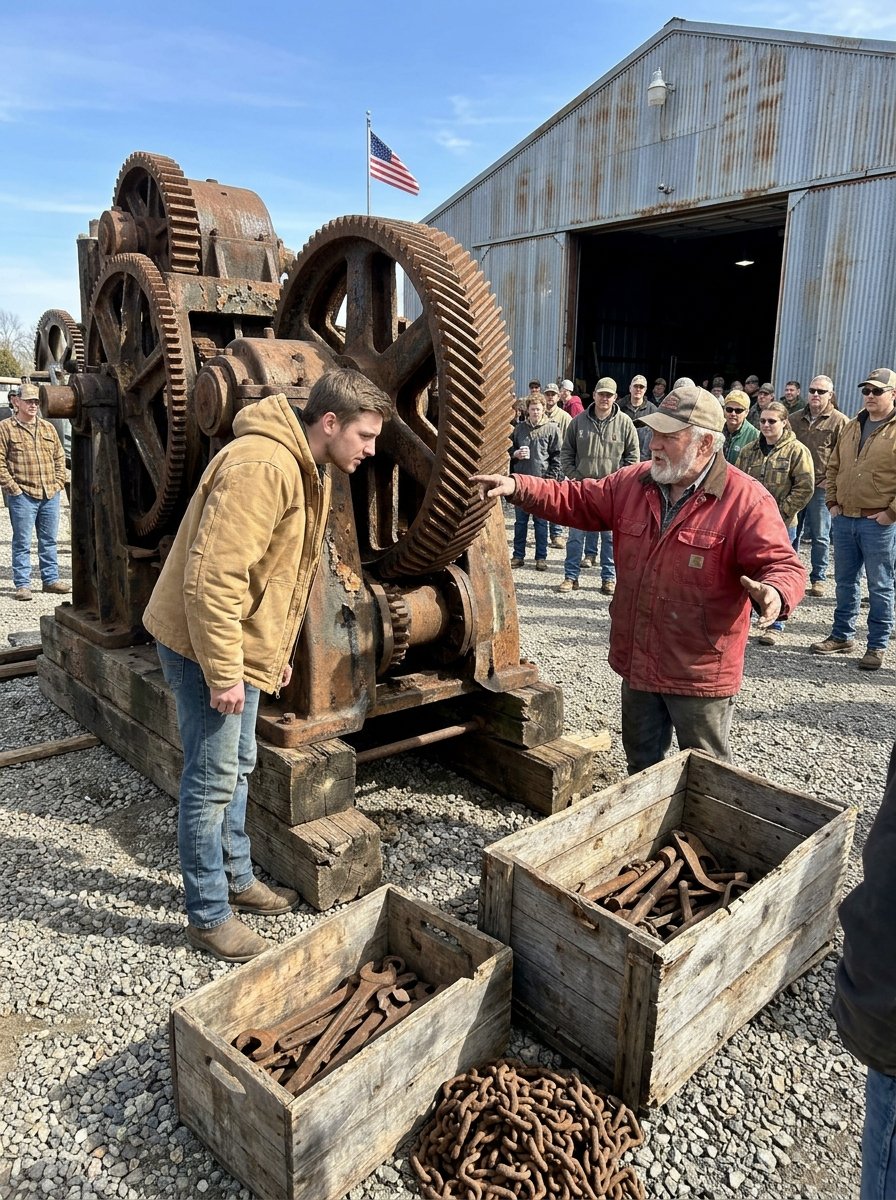
Sold for $70. Gordon Pike slapped the side of his red quilted vest and laughed loud enough to turn the whole auction aisle. 17 tons of boat anchor and the boy hasn’t even got a boat.
The laughter rolled through the abandoned factory bay. Men who had spent their lives buying lathes, presses and worn out farm equipment leaned around one another to see the new owner. 12-year-old Noah Bennett stood beside a gear cutting machine larger than his mother’s sedan.
He had just spent 70 of the $76.40 he owned. The machine’s broad cast iron base was striped with rust. A dented sheet steel hood covered its working head.
Its electrical cabinet had been disconnected years earlier and dust lay so thick along the lower ledges that someone had written scrap in it with one finger. Noah put his palm against the cold casting while the laughter moved around him. His late grandfather’s brown work jacket hung past his wrists and the bill of his faded cap shadowed his eyes.
He did not laugh with the crowd. He did not ask the auctioneer to cancel the sale. Gordon Pike pushed forward.
At 56, he owned Pike Equipment and Salvage, sat on the county fair board and had bought enough factory machinery that people in Maple Crossing, Ohio usually accepted his opinion as fact. He pointed toward the narrow loading doorway. Tell you what, son.
I’ll bring my cutting torch around. We’ll take that long head off and bust the base into pieces. Then maybe you can haul your mistake home before you’re old enough to drive.
Several men laughed again.”No, thank you, Mr. Pike.” Noah said.”It needs to stay together.” That answer amused them even more.
The auctioneer lowered his clipboard and looked over his glasses.”Young man, the north building has to be empty by noon Monday. Every lot, no exceptions.” It was Saturday afternoon.
The gear cutter weighed 17 tons. Its tooling chest was bolted to the base. The factory’s heavy electrical service was dead, and Noah had arrived in his mother’s 14-year-old sedan.
Beneath one lifting eye, almost hidden under blackened grease, was a shop-made brass tag no larger than two fingers. Noah looked at it once more and kept his hand against the iron. He had bought the machine.
Now, he had less than two days to save it from the easiest way out. Subscribe to Sold for Nothing for another auction story and tell us what town you’re watching from. The auction was taking place at Lake County Transmission Works on the east side of Maple Crossing.
For 78 years, the factory had made shafts, couplings, housings, and gears for mills, mines, boats, and heavy industrial equipment. Its newer departments had struggled on after the oldest part of the plant closed, but that spring the remaining orders ended.
The owners sold the property and everything not nailed down went under the auctioneer’s gavel. By early afternoon, buyers had carried away tool cabinets, welders, vices, drill presses, and nearly every portable machine that could fit on an ordinary trailer. The 17-ton cutter remained in bay four because nothing about it was ordinary.
The northern bay had been locked for 14 years. Its loading door was barely wider than the machine’s projecting head. Removing the cutter whole meant hiring riggers, clearing a path through broken pallets and dead equipment, crossing an uneven threshold, and finding another building with a floor strong enough to hold it.
Even Gordon had decided its scrap value might not cover the trouble. The auctioneer had begun at $500. No hands rose.
He asked for 200. Then, 100. Gordon folded his arms over his red vest and announced that a man would need to be paid $100 to take it.
The crowd liked that answer. Noah had not come to buy machinery. His mother, Anna, was collecting two steel shelving units for an elderly neighbor.
While she settled that purchase with the clerk, Noah wandered only as far as she had allowed and stopped beside the great covered cutter. He liked machinery, though he had never operated anything more dangerous than a push mower. He earned spending money mowing lawns, washing grass from mower decks, and sorting bolts at Ray Mercer’s repair shop.
His grandfather, Walt, had taught him that the first duty around any machine was to keep his hands away from what he did not understand. The second duty was to look. So, Noah looked.
The factory floor around the cutter was stained where water had entered beneath a broken window, but the sheet metal covers were still secured. Heavy brackets joined the tooling chest to the base. Somebody had smeared preservative around the seams before the bay was closed.
Then, Noah saw the brass tag beneath the lifting eye. He wiped away one streak of grease with the edge of a folded shop towel. Stamped into the metal were four characters and two words: 60 DH, no relief.
He had seen those words before, not in a book from school, not online. He had seen them in the little black notebook that his grandfather kept above the workbench in his garage. Beside the words was a pencil drawing of two rows of slanting gear teeth meeting in the middle like a trail of sharp V’s.
The auctioneer dropped his request again.”Anybody start me at $50?” Noah’s heart beat so hard that he heard it above the restless crowd. He owned $76.40.
It had taken most of a summer to earn.”70.” He said. He had meant to say it firmly, but the whole amount came out in one nervous breath.
The auctioneer stared at him. Anna turned from the clerk’s table. Gordon Pike laughed first.”Let the boy have his anchor.”
He told the others.”Education costs money.” No one challenged the bid. The gavel fell.
At the clerk’s table, Noah flattened three 20s and a 10 with both hands. Because he was 12, the auctioneer required Anna to sign the receipt acknowledging the purchase and removal deadline. She read the lot number twice.”How much do you have left?”
She asked. Noah emptied his pocket into his palm. A $5 bill, $1, a quarter, a dime, and five pennies rested there.”6.40.”
Anna looked from the coins to the enormous machine. She worked in the laundry at Maple Crossing Regional Hospital where steam marked the walls and heavy carts left her shoulders sore.
She had learned to make a small paycheck answer several questions at once.”And where,” she asked quietly,”are you planning to put 17 tons of iron?””I haven’t solved that part yet.” At least he told her the truth. He led her to the brass tag and explained that Grandpa Walt had written the same phrase.
Anna rubbed her thumb over the stamping. Her father had worked at Lake County Transmission Works for 36 years. He had died two winters earlier, leaving tools, notebooks, and more practical lessons than money.”This could be nothing but an old label,” she said.”I know, and you don’t open it.
You don’t climb on it. You don’t let anybody connect power to it.””Yes, ma’am. Nothing moves until a capable adult says how.””Yes, ma’am.”
Anna studied the narrow doorway, the rusted base, and Gordon Pike’s men still laughing near the loading apron. Then, she asked the only useful question available.”Have you called Mr. Mercer?” Ray Mercer arrived Sunday morning in a faded work truck.
He wore the same oil-stained cap Noah remembered from Walt’s funeral and carried a folding rule instead of an opinion. Ray ran Mercer Machine and Heavy Repair 2 miles outside town. His shop repaired quarry conveyors, mill drives, farm equipment, and industrial machinery too large for ordinary garages.
He had a rigging crew, hydraulic jacks, machinery skates, a winch truck, and a lowboy trailer rated for loads that made pickup owners step aside. He also had the sense to walk the entire route before promising anything. Ray measured the cutter.
He measured the doorway, the threshold, the clear height, the turn outside the bay, and the cracked concrete on the loading apron. He knelt to study the base and found its lifting points. Then, he walked the route again.”It can come out whole,” he said at last,”but it won’t come out quickly.”
Anna asked what the haul would cost.
Ray looked toward Noah, who stood with Walt’s notebook tucked inside his oversized jacket.”Walt rebuilt the winch drive on my first recovery truck,” Ray said.”I didn’t have money for the part, and a new truck would have put me out of business.””He didn’t ask me to sell the truck first.””That was a long time ago,” Anna said.”Debts don’t get smaller
because they get old.”
Ray had an unused annex beside his main shop. Decades earlier, it had held a large planer. The concrete foundation remained, along with wide service doors and overhead lifting rails.
He offered to place Noah’s cutter there until they learned what it was. The hauling cost could wait, but he wanted it written down. If the machine proved useless, they would decide honestly what came next.
Noah held out his hand. Ray looked at Anna first. She nodded.
Then, he shook the boy’s hand as though the owner were exactly the person standing before him. The crew arrived before daylight Monday. They cleared loose boards and scrap from the aisle.
Steel plates bridged weak sections of floor. Hydraulic toe jacks lifted the machine a fraction at a time while the men built stacks of oak cribbing beneath it. They never trusted 17 tons to one jack, one cable, or one man’s guess.
Noah stayed behind the yellow boundary Ray had marked on the floor. He held the auction sheet and recorded each loose accessory as the crew removed it from nearby racks. Two arbors, one steady, four wooden cases, a steel ring fixture wider than a kitchen table.
None of it left his sight, and none of it went near his hands until a worker declared it safe. When the machinery skates took the weight, the cutter began to move. It did not roll like a truck.
It crept. The winch cable hummed. The steel plates complained beneath the skates, and every few feet Ray stopped the pull to check the load.
Gordon Pike watched from the tailgate of his pickup.”Did you buy a school lunch?” he called to Noah,”Or the whole school?” A few men laughed.
The load reached the doorway and stopped. The projecting head appeared too high on one side and too close to the jam on the other. Gordon spread his arms for the audience.”There it is, $70 trapped in the building.”
Ray did not answer him. He ordered the cable slackened, checked the cribbing, and had the crew shift the machine less than an inch. They reset one plate, changed the pull angle, and tried again.
The highest corner passed beneath the doorway with room no wider than a man’s thumb. Nobody laughed then. Outside, the cutter settled onto the lowboy.
The crew blocked the base, secured it with rated chains and binders, and checked every restraint twice. The tooling cases traveled on a separate truck. The ring fixture was cradled so it could not shift.
As the convoy crawled down Main Street, people stepped out of Dorsey’s Diner and the feed store to watch. Gordon followed for three blocks, telling anyone near enough that Mercer was hauling a 12-year-old scrap pile on a trailer worth more than the load. Noah rode with Anna behind the lowboy.
Through the windshield, he could see the bolted tooling chest still attached to the base. The machine had reached the road without a torch touching it. At the annex, Ray’s crew placed the cutter on the old industrial foundation and blocked access around it.
The covers remained closed. The chest remained latched. Ray hung a plain card from the boundary chain.
Property of Noah Bennett, paid in full. Only then did Noah begin recording what could be examined safely. He copied numbers from exposed plates, measured the machine’s overall dimensions, and photographed the brass tag.
He asked before brushing dirt from any lettering and kept his hands away from shafts, levers, and covered mechanisms. That evening, he opened Walt’s notebook on the kitchen table. Beside it lay a roofing estimate Anna had been moving from one unpaid stack to another.
Rain had opened a brown stain over her bedroom, and a bucket beside the bed caught the drops during storms. The house payment came first. The roof waited.
Walt’s notebook smelled faintly of oil and basement dust. Most pages contained ordinary work, bearing sizes, repair dates, part numbers, and reminders written in blunt pencil. Near the center, Noah found the drawing he remembered.
One gear had straight teeth. The next had teeth that slanted in one direction. The third showed two opposing rows meeting in the center.
Walt had written beneath it,”No room for relief. Keep the pair together.” Noah remembered sitting on a stool while his grandfather drew the same shapes on a brown paper sack.
A fast-turning engine could not always drive a slow, heavily loaded shaft directly. Gears changed speed and carried power. Slanting teeth engaged gradually and smoothly, but a single slant also pushed sideways along the shaft.”Put opposite slants together,” Walt had explained,”and those sideways forces opposed each other.”
Some double helical gears had a clearance groove through the center, so ordinary cutting tools could run out without colliding. Others met in an unbroken V. Walt had tapped that unbroken center with his pencil.”That middle decides what kind of machine can make it,” he had said.
Noah showed Anna the page.”The tag says 60,” he said.”I think that means it could handle a gear close to 60 in DH.””DH could mean double-helical, and no relief could mean no groove in the middle.””Could?”
Anna repeated.”Yes, ma’am.””Do you know whether the machine still works?””No.””Do you know what’s under the cover?””No.””Do you know if anybody needs a gear like that?””No.” Each answer made the kitchen quieter. Then, Noah pointed to Walt’s last line.”If Mr. Pike cuts the head off, we’ll never find out.”
Anna looked at the roofing estimate beneath the notebook. She drew it out carefully and placed it to one side, giving her father’s pages a flat place on the table.”Then, we’ll ask someone who understands it,” she said. The next evening, Noah returned to the annex.
He placed a clean rag over the little brass tag to protect it from drifting dust. For several days, the whole town seemed to enjoy the story more than he did. At Dorsey’s Diner, Gordon described a boy trying to buy the Navy with lawn mowing money.
At the feed store, he estimated how many mouse nests could fit inside the covered head. By Wednesday, children at school were calling Noah”Anchor Boy.” One student asked whether the machine could sharpen pencils.
Noah folded his lunch sack into a narrow square and said nothing. Thursday afternoon, Gordon came to the annex without an audience. He stood outside the boundary chain and studied the cutter more carefully than he had at the auction.”I’ve been thinking about your situation,” he said.”You paid 70.
I’ll give you 150 where it stands. That’s $80 profit and a cheap lesson besides.” He took out a checkbook.”I’ll handle removal.
Your mother won’t owe Ray for hauling and you can go back to buying things that fit in a garage.” Noah looked at the checkbook. $150 sounded enormous beside the $6.40 in his jar.”No, thank you, Mr. Pike.”
Gordon’s smile remained, but only around his mouth.”You understand that old tag doesn’t make this thing valuable.””Yes, sir.””You think you know better than every equipment man at that sale?””No, sir. I think I should find out what it is before I sell it.” Gordon closed the checkbook.”Suit yourself, anchor boy.”
That night rain struck the bedroom window. Noah sat at Walt’s old workbench and listened to water land in the bucket upstairs, one drop at a time. Anna’s laundry shoes stood by the back door.
She had taken three extra evening shifts that month to stay ahead of the mortgage and the winter heating bill.”I could have given you the $70,” Noah said when she entered the garage. Anna sat beside him.”It wouldn’t have fixed the roof.””It would have helped.””Yes. What if the tag is the only good part?
What if Grandpa wrote about another machine? What if this one’s ruined inside?” Anna did not tell him he was certain to become rich.
She did not pretend Walt had never been wrong. She placed her hand over Noah’s closed notebook.”Then we’ll find that out properly. The following morning, Noah stopped rehearsing replies for the children at school.
Instead, he wrote a clean list of the markings he could read. After class, Anna drove him to the Maple Crossing Historical Society. Mrs. June Bell kept the town’s factory newsletters, union photographs, building plans, and donated ledgers in a former courthouse room that always smelled of paper and furniture polish.
Noah did not ask her to search for a valuable machine. He showed her the brass tag photograph, Walt’s station number, and the identifying plate. That gave her something real to follow.
They opened three gray archive boxes before Mrs. Bell found a photograph marked Bay 4 1968. The gear cutter stood in the background without its sheet metal hood. Its working assembly stretched over a broad circular table.
Beside it was a ring-shaped fixture like the one Ray’s crew had transported from the factory. A younger Walt Bennett stood near the machine with one hand on that ring. Noah forgot to breathe for a moment.
The caption identified the equipment as a 60-in double helical gear generator used for marine reduction work. Mrs. Bell found another newsletter describing a repair contractor that had sent a difficult gear to Maple Crossing because the original tooth form met at the center.
Altering that center would have required changes to more than one part of the gearbox. The article did not say the machine was unique. It did prove that its special arrangement had once performed real work.
Then, they found the final Bay 4 inventory. Under Walt’s station number, it listed a matched cutter set, master setting pieces, gauges, arbors, a large wheel locating fixture, and a dedicated attachment. A preservation entry recorded that exposed working surfaces had been cleaned, coded, wrapped, and covered before the bay closed.
Whether those items still existed was another question. On the back of a later historical society newsletter, Mrs. Bell found the name Elaine Porter. Elaine was a marine gearing engineer who had once helped the society identify machinery in photographs from the old factory.
The listed company had merged, but Mrs. Bell located the naval repair contractor that now handled Elaine’s work. Noah left a message. He gave his name, the machine’s station number, the exact wording on the brass tag, and the fact that the covers and tooling chest remained unopened.
The call came while Anna was making supper. Elaine asked Noah to read the tag slowly. 60 D H no relief.
Is the main assembly complete? It looks complete from the outside, ma’am. Did its tooling chest come with it?
Yes, ma’am. It’s still bolted on. Has anyone connected power?
No, ma’am. Has anyone opened the head or cleaned the working surfaces? No.
Her voice changed when he read the preservation entry and the inventory of matched cutters. I’m searching for capacity for a marine job, she said. That does not mean your machine can perform it.
An old photograph can’t tell me its alignment, condition, or accuracy. I understand. But if the inventory is correct, I need to see it before anybody separates those assemblies.
Elaine could come Saturday with drawings and a representative from the naval repair contractor. Noah invited the auctioneer, Mrs. Bell, and several retired factory workers whose names appeared in the newsletters. Then he carried one invitation to Pike Equipment and Salvage.
Gordon read it aloud at the counter.”Formal inspection of the boat anchor,” he announced.”Coffee provided, I hope.” His employees laughed. After Noah left, Gordon asked his office clerk if she had ever heard of Elaine Porter.
Friday afternoon, he returned to Ray’s Annex with a new offer.”Four thousand dollars,” he said.”Immediate payment. No hauling bill for your mother, no restoration gamble, no waiting. That’s a fair return on a lucky purchase.”
Four thousand dollars could cover months of house payments. It could buy shingles and lumber, though perhaps not all the labor. Noah looked toward Anna.
Her face revealed nothing, but she understood the number as well as he did.”Would you keep the machine together?” Noah asked. Gordon glanced at the covered head.”That would depend on what makes business sense.
I’d like to hear what Mrs. Porter says first, sir.” Gordon slipped the check back into his vest.”You may not get this offer twice.””I understand.” After he left, Anna straightened the collar of Walt’s oversized jacket around Noah’s neck.
Neither of them said what four thousand dollars might have done. On Saturday morning, borrowed folding chairs from Maple Crossing Methodist Church faced the cutter from behind Ray’s safety boundary. Work lights stood along one wall.
A folding table near the entrance held paper cups, coffee, the factory photograph, and the original auction sheet. Nearly as many adults filled the Annex as had crowded around Noah at the sale. For the first time, he wished the inspection could happen in private.
If the chest were empty, or water had entered the covers, or his grandfather’s notes referred to some missing part, the whole town would watch him learn it. Gordon arrived last in his red vest.”Good,” he said.”The anchor does come with refreshments.” Two people smiled.
Nobody gave him the laughter he expected. Elaine Porter entered wearing a neat gray work jacket and carrying a hard measuring case. A contractor representative followed with a drawing tube and a document portfolio.
Elaine walked directly to Noah.”You’re Mr. Bennett, the owner?” No adult had called him that without joking.”Yes, ma’am.” She shook his hand before speaking to Ray.
Then she began at the machine’s base and worked upward. She checked the identifying plate against the factory photograph. She examined preserved joints, fastening points, and signs of damage from the move.
Ray explained the rigging route and where his crew had supported the casting. Elaine photographed the attached chest brackets. She measured the working table.
She read the brass tag twice and inspected the old preservative visible at the seams. She did not claim that a label proved accuracy. She did not call the cutter rare, valuable, or operational.
She simply measured before she judged. Her method quieted the room. At last, Elaine closed her case and returned to Noah.”I would like to remove the protective covers and open the tooling chest.
There may be heavy parts under stored tension, so Mr. Mercer’s crew will handle the work. Do I have your permission?” Noah looked at Anna.
She gave his sleeve a light squeeze.”Yes, ma’am.” Ray’s crew placed the first cover bolt in a metal tray. One lower fastener refused to turn.
Gordon shifted forward as if expecting the inspection to become a demolition. Ray stopped the crew. They soaked the threads, supported the hood differently, and worked the fastener from both sides.
The bolt released with a dry snap. A chain hoist took the hood’s weight. The dented steel rose slowly and revealed a second skin beneath it.
Oilcloth darkened by preservative and tied around the working assembly. The smell reached the chairs first. Waxy oil.
Old canvas. Cold iron. Elaine put on gloves and loosened the wrapping at one accessible edge.
Ambergris clung beneath it. She wiped a narrow strip with a clean pad. Smooth metal appeared.
The orange rust that striped the outer base had not followed the machine beneath its coverings. A former factory worker leaned forward with both hands on his cane. More oilcloth came away.
Two opposed cutter assemblies emerged. One arranged to work from the left and the other from the right. Their slides were coated, but intact.
Engraved reference marks remained sharp enough to read under the work lights. Elaine pointed only after the room could see the parts. A helical tooth slants across a gear.
She said,”That gives smoother contact, but it also creates a push along the shaft. Put two opposite helices together and those pushes oppose each other. That is the herringbone pattern Mr. Bennett found in his grandfather’s notebook.”
She indicated the paired arrangement.”These two cutting systems approach from opposite directions. On the right machine and with the right tooling, they can generate both sides so the teeth meet through the middle. The part Grandpa called no relief, Noah said.
Elaine nodded. No center clearance groove. That is the difficult part.
The bolted chest came next. Raisman supported the heavy lid while Elaine released its catches. The hinges groaned and the lid rose above fitted wooden nests stained nearly black by oil.
At first, the shapes inside looked like bundled metal. Then Elaine removed one wrapping. A large cutter lay beneath it, its edges protected and its identification marks visible.
The fitted space beside it held the matching cutter for the opposite hand. Another compartment contained gauges and setting pieces. A drawer held change gears, clamps, and arbors tagged with the same station number as the cutter.
The most important spaces in the inventory were not empty. Elaine called each number. Noah stood outside the working boundary with the old list and checked it off.
Matched cutter, right hand. Here. Matched cutter, left hand.
Here. Master setting piece. Here.
Large wheel locating fixture. Ray’s crew lifted the upper tray. Beneath it lay the ring-shaped fixture shown in the bay four photograph.
The elderly former factory worker stood without seeming to know he had risen. I helped Walt set that, he said. His voice was barely louder than the humming lights.
That’s the one. Under the fixture was a flat service envelope. The paper had browned at the corners, but the pencil label remained readable.
W. Bennett, final setup and preservation record. Anna covered her mouth.
Elaine carried the envelope to the table and opened it there. Inside were alignment readings, cutter references, lubrication notes, and a final sketch of the paired head. Walt had recorded what he had coded, what he had blocked, and which surfaces would have to be checked before any return to power.
The notes did not make the machine operational. They made a responsible attempt possible. Elaine’s colleague unrolled the current job drawing beside Walt’s record.
Across the page stretched a wheel approximately 54 in in diameter. Its teeth slanted inward from both sides and met in a continuous V. The shape matched the little pencil drawing in Noah’s notebook.
Before discussing the drawing, Elaine asked Ray’s crew to lubricate two accessible points for a controlled manual check. The adults fitted a hand device to the proper shaft and cleared everyone from the mechanism. The first pressure produced nothing.
For one long second, the machine seemed as dead as Gordon had declared it. Ray stopped. Elaine checked Walt’s block notes and found a transport brace that remained engaged beneath the preservative.
The crew released it. They tried again. A shaft turned.
One slide moved. Then the opposed assembly traveled through part of its range with a slow, even mechanical sound. Metal passed metal after 14 silent years.
Someone’s paper cup crumpled softly in the still room. Gordon lowered his coffee and did not raise it again. Elaine returned to the drawing.”A high-speed engine and a propeller do not want to turn at the same speed,” she explained.”Reduction gears allow the engine to operate rapidly while the output shaft turns more slowly with heavy torque.
These replacement wheels are for the reduction gearboxes of six older Navy harbor tugs. She touched the uninterrupted center line. The repair program requires 12 gears made to the original continuous herringbone form.
Each is about 54 in across. Shops can cut large gears. Shops can cut helical gears.
Some can cut herringbone gears. The problem is finding available equipment with the necessary diameter, the correct method for the center, suitable tooling, and room in its schedule before the repair window closes. So, nobody else can make them?
Someone asked. That is not what I said, Elaine replied. Other manufacturing routes exist, but the vendors approached for this package have declined it because of capacity, center clearance limitations, or schedule.
This machine appears to have the working envelope and the dedicated equipment that could make the job practical here. She looked toward Noah. Appears is important.
The machine must be assessed, aligned, and commissioned. Its accuracy must be demonstrated. The first finished gear must pass dimensional and contact inspection.
If it fails those requirements, the order does not proceed. Ray folded his arms. My shop can provide the foundation, qualified machinists, and supporting equipment.
We’ll need electrical work and outside services. The naval repair contractor can provide the approved requirements, material, inspection plan, and acceptance process, Elaine said. The contractor representative opened his portfolio and placed a written proposal on the table.
Noah saw Gordon’s eyes follow the paper. The man spoke for the record. Conditional upon successful commissioning, an accepted first article, and compliance with the stated delivery requirements, the proposed order for 12 finished gears is $286,000.
The number entered the annex and seemed to remove all its ordinary sounds. $286,000. Anna gripped the edge of her chair.
Ray took off his cap. The auctioneer looked down at the copy of his sales sheet, where $70 appeared beside Noah Bennett’s name. Gordon Pike said nothing.
After several seconds, the auctioneer cleared his throat. That’s quite a job for a boat anchor. A short laugh crossed the room.
This time it did not belong to Gordon, and it did not land on Noah. Noah looked at Elaine. If we make them, does the machine stay together?
That is exactly what the work requires, she said. He turned to Anna. Can we do it?
She did not answer until she had read the conditions herself. We can let qualified people try. The written agreement took another week.
Anna signed on Noah’s behalf where the law required an adult. Ray’s operating company would perform the work, employ the machinists, and manage the shop. Noah would retain ownership of the cutter.
The job would pay an equipment use fee and an agreed share of earnings after restoration, labor, materials, transport, outside services, and other costs. No one pretended the full $286,000 belonged in a 12-year-old’s pocket. No one pretended the machine belonged to anyone but him.
Commissioning began with cleaning and measurement. Ray’s machinists opened oil passages, inspected bearings, checked the foundation, and tested the travel of each assembly. An industrial electrician replaced unsafe wiring, installed modern protection, and verified every circuit before power reached the old motor.
Elaine compared the surviving setup records with the job requirements. The contractor arranged approved steel blanks, material documentation, heat treatment, and outside inspection services. Noah watched from the marked visitor area after school.
He copied dates into Walt’s notebook and learned the names of parts without touching moving ones. On the third powered trial, a motor bearing ran hot. Ray stopped the machine before the temperature could climb farther.
The sudden silence brought back every laugh from the auction aisle. Noah stared at the disabled cutter and wondered whether the clean surfaces and complete tooling had only carried them to a more expensive failure. Ray placed the removed bearing on a workbench.”See the damage here?”
he asked. Noah nodded.”A repairable part is not a verdict on the whole machine. The bearing required skilled work.
The oiling arrangement required another. Neither problem disappeared because the order was urgent. The team repaired the drive, checked its alignment, and ran it again under controlled conditions.
The temperature held. A test piece came before a production blank. The machinists verified movement, tooth form, spacing, and contact.
Adjustments followed. Measurements followed those adjustments. Only then did the first 54-in steel blank reach the machine.
The cutter began its work slowly. Teeth did not appear at once. Each stroke removed another narrow curl of metal, and each indexed movement placed the next cut where the drawing required it.
One system generated a slant from one side. Its paired partner formed the opposing direction. Over hours, the broad wheel changed.
Bright chips collected behind guards. Oil moved over the cutting zone. Two fields of slanting teeth advanced toward the center until the pattern met in a clean, uninterrupted line, a true herringbone.
Noah stood behind the boundary with his hands in his jacket pockets. The iron that Gordon had offered to break for scrap was doing the one thing that gave every preserved part meaning. The first gear still had to pass inspection.
Technicians measured its geometry and compared tooth positions. They checked the contact pattern against the mating requirements. Reports traveled between Ray’s shop, the contractor, and the repair program.
Noah was home when the telephone rang. Anna answered, listened, and silently handed him the receiver. Ray had asked to tell the owner himself.”The first article was accepted,” he said.
Noah sat down on the kitchen floor. The remaining 11 gears entered the schedule. The annex lights were often on when Anna drove home from the hospital laundry.
Ray hired two experienced former Lake County machinists for the production run. Their names went on time sheets, and their skills were paid for. Gratitude had brought the machine to the annex.
It did not replace wages, inspection, or responsibility. Noah helped only with safe office work. He photographed each completed wheel from the visitor line and kept a notebook page for every serial number.
Elaine returned for operations requiring her judgment, and the contractor’s inspectors checked the records. One gear needed additional finishing before it passed. That delay reminded everyone that the cutter had not become magical.
Each wheel had to earn acceptance separately. The line of approved blanks grew shorter. The row of protected finished gears grew longer.
When the 12th wheel passed final inspection, Noah was at school. Ray waited until he reached the shop before placing the completed batch list beside the original auction receipt. $70 on one page, 12 accepted gears on the other.
The contractor confirmed payment of the $286,000 order. The Navy had paid for manufactured parts that its repair program needed. It had not bought Noah’s machine.
The gear cutter remained on its foundation. Gordon came into Ray’s office the following week on ordinary business. The auctioneer happened to be there drinking coffee while the last shipping documents were prepared.
Gordon saw the signed acceptance list. He took off his red cap, though he kept the vest on.”I was wrong about that machine.” he said.
The words were plain. He did not turn them into a joke. Noah closed Walt’s notebook.
Mr. Mercer and the men got it working. Ray glanced at him, but did not correct the answer. Noah had protected the opportunity.
Skilled adults had made the opportunity perform. Both things were true. When the job account was complete, Ray and Anna sat at a folding table in the annex.
The gross order had paid for 12 finished gears. From it came material, restoration, hauling, skilled labor, heat treatment, electrical work, inspection, outside services, taxes, shop costs, and a reserve to keep the cutter maintained. Noah’s equipment payment and agreed share did not make the Bennett family fabulously wealthy.
It did something better suited to what they needed. At the bank, Anna paid the remaining balance on their small house. The clerk handed her the released note, and she held it in both hands before folding it carefully into her purse.
Roofers arrived the next week. They stripped away the failing shingles, replaced damaged wood, and sealed the house before the next hard rain. Noah carried the bucket from beside his mother’s bed to the back porch.
Anna gave up the extra laundry shifts she had taken to protect the house payment. The first evening she came home before supper, she stood in the kitchen as though she had forgotten what that hour looked like through her own windows. Ray tried to refuse payment for the deferred haul.
Noah insisted.”A debt doesn’t get smaller because it gets old.” He reminded him. Ray looked at Anna, then accepted the check.
Some earnings remained reserved for the machine’s maintenance. Some went into an education account for Noah. The family kept its old sedan, its ordinary kitchen, and its place in Maple Crossing.
Noah made one additional request. The cutter should stay available for useful work, and his grandfather’s name should remain with it. Ray ordered a modest brass plate.
Preserved by Walt Bennett. Recovered by Noah Bennett. Returned to service at Mercer Machine.
After the naval batch shipped, Ray held a Saturday open house. The Methodist Church lent the same folding chairs, but now they faced a clean, guarded working area instead of a covered wreck. Mrs. Bell displayed the old Bay Four photograph beside pictures of the 12 completed gears.
Former factory workers brought children and grandchildren. The contractor sent a short acknowledgement that the gears had entered the Navy repair program. Noah showed a younger boy the drawing in Walt’s notebook.
The angles cancel the sideways pressure, he explained tracing where the two rows met. Oppose it, Ray corrected gently from behind him. Not always cancel every force in the whole system.
Noah nodded and repeated the right word. He was not presented as a master machinist. He was 12 years old standing at the beginning of a great deal he still needed to learn.
Gordon came through the annex door wearing his red vest. He waited behind the other visitors instead of walking to the front. When he reached Ray, he asked quietly whether another production run had been scheduled.
His voice carried only to the people standing nearby. After the demonstration, the operators stopped the cutter, isolated the controls, and declared the area safe. Noah received permission before crossing the boundary.
He approached the same gray casting he had touched at the auction. At $70, it had been cold iron under his palm while adult laughter moved around him. Now, he placed his hand on that spot again.
The iron was warm from work. Anna stood nearby in her clean Saturday coat. Across the aisle, Gordon Pike removed his cap and looked at the little brass plate bearing Walt Bennett’s name.
Subscribe to Sold for Nothing for the next forgotten lot waiting to do its work.