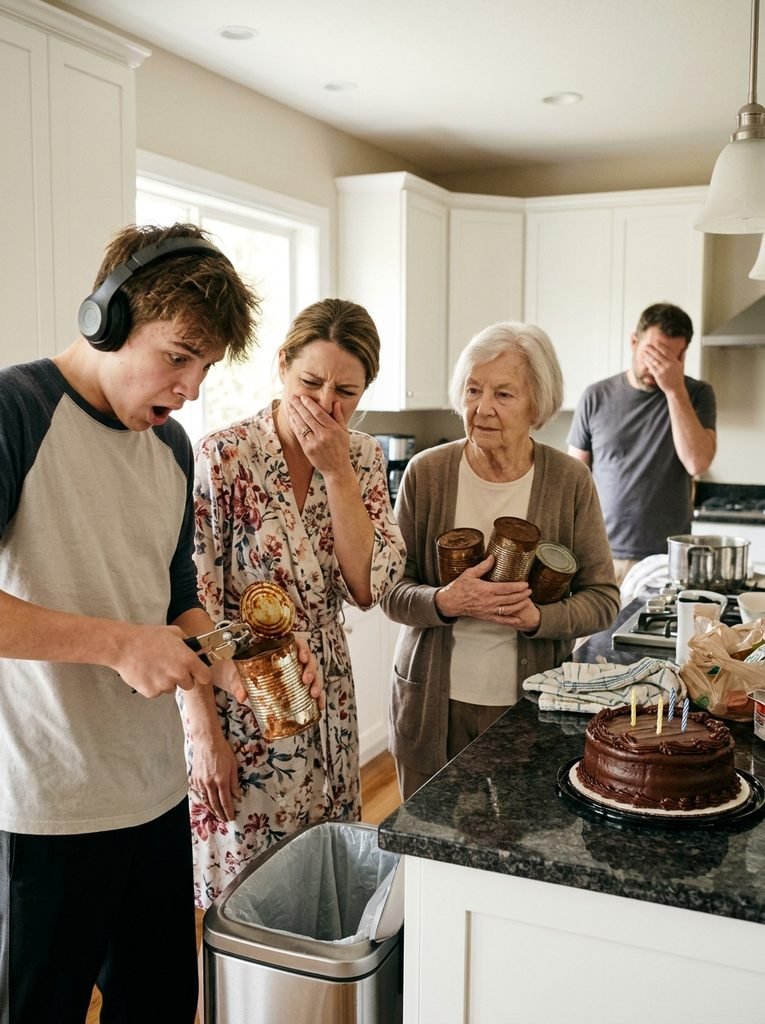
Vanessa carried the coffee can into her kitchen, lifted the lid of the trash bin with one manicured hand, and dropped it in.
I heard it go. The plastic clunk of the lid. A soft slither of old coffee grounds and eggshells. Then a dull thud at the bottom of the bin.
“There,” she said, wiping her hands on her silk robe. “Now. Are you staying for cake or not?”
I stood in the middle of her enormous white kitchen with my purse hooked over my arm and two more coffee cans pressed against my chest. My good wool coat was still buttoned to the throat.
It was my eightieth birthday. And my daughter-in-law had just thrown away twenty-eight thousand, four hundred and ten dollars without knowing it.
I’d like to tell you I said something sharp. I didn’t. I just stood there and felt a small, flat, gray stillness settle over me, the way it always did in that house.
My son, Rob, stood behind his wife in a gray sweater with his reading glasses pushed up on his forehead. He looked at the trash bin. He looked at me.
He didn’t say a word.
That was the part that hurt. Not her laugh. Not the trash bin. His silence. I’d watched that silence for twenty-six years. Every Christmas. Every Thanksgiving. Every time Vanessa said something sharp and Rob found something fascinating in the grain of the hardwood floor.
I should tell you who I am. For twelve years, nobody had bothered to ask.
My name is Marion Pruitt. I was a payroll clerk at Dayton Tire and Rubber for thirty-six years. Every Friday for thirty-six years, I counted other people’s money into little brown envelopes, and I was never once a nickel short.
I’m good with a column of figures. I’m not good at being looked at.
My husband, Walter, drove a Wonder Bread route for forty years. Forty years of four o’clock alarms. He died twelve years ago in March, of a stroke, at a red light on Wayne Avenue. The bread truck rolled forward at four miles an hour and came to a stop against a mailbox. Nobody was hurt.
The paramedic held my hand at the hospital and told me, very gently, that Walter was gone before the light ever turned green.
He left me a paid-off brick ranch on Alder Street. A pension that pays $1,106 a month. And Social Security of $1,412.
I’ve lived on that for twelve years. I clip coupons. I wash and reuse aluminum foil. I’ve never once gone into debt.
And I’ve never once let anybody see that it was hard.
Pages:
2Rob is my only child. He’s 53 now, a regional sales manager for a medical supply company. He has Walter’s broad shoulders and Walter’s habit of studying his dinner plate whenever a hard thing gets said at the table.
He’s a gentle man. He has never once in his life finished an uncomfortable conversation.
His wife, Vanessa, is 50. She calls herself a “wellness consultant.” She’s glossy and quick, with a voice that stays pleasant the whole time it’s cutting you. She tells people she comes from a family in Oakwood with a boathouse. She likes to joke that she “married down,” and every single time, Rob laughs.
They have four children. Tyler is sixteen. Madison is fourteen. And the twins, Ben and Lucy, are nine.
I see them at Christmas. Sometimes. Vanessa says the kids are “so scheduled.”
The list came three weeks before my birthday.
It arrived in a cream-colored envelope with my name typed on the front. Not handwritten. Typed. It wasn’t a card. I opened it at my kitchen table with my reading glasses on and a cup of tea going cold beside my elbow.
At the top, in bold letters, it said: APPROVED GIFT IDEAS FOR THE CHILDREN.
Tyler: gaming console, $499.
Madison: designer earbuds, $349.
Ben: tablet, $329.
Lucy: tablet, $329.
At the bottom, Vanessa had added it up in her neat handwriting. Total: $1,506.
And underneath that, in her slanted script, one more line.
“Rob and I feel the kids deserve to be treated. Since you don’t do much for them otherwise, this would be a nice way to show up for once. V.”
I read it twice.
Since you don’t do much for them otherwise.
I thought about the mittens I knitted for every one of them, every single winter. The birthday checks. Ten dollars. Twenty, when I could manage it. The four Sundays a year I drove forty minutes through Centerville to sit on the very edge of a white sofa I was afraid to wrinkle.
I thought about Walter. He’d have folded that list in half, set it on the counter and said, “Well, Marnie. That’s a number.”
I didn’t cry. I’d like that on the record.
I set the list down on the table and smoothed it flat with both palms. The same way I’d smoothed a million pay stubs.
Then I went down to the basement.
Pages:
Behind the Christmas boxes, in the corner by the water heater, on a shelf Walter built with his own hands in 1979, sat four old Folgers coffee cans.
Red plastic lids. Rubber bands gone brittle with age. A strip of masking tape across each lid, with a name written in my own handwriting, faded now to a dull brown.
TYLER.
MADISON.
BEN & LUCY.
The twins shared one, because they were born eleven minutes apart, and I’d run out of cans.
I’d been filling them since the day each of those children was born.
I never told anybody. Not Rob. Not Vanessa. Not my sister in Columbus. Nobody.
It started with Tyler.
He was born at Kettering Medical Center in March of 2008. I remember walking down that long hospital corridor after I held him for the first time, with a birthday card from my sister in my purse that had a $200 check inside. I’d been saving it for something. I didn’t know what.
And standing in that corridor, by the vending machines, a thought came to me as clear as a church bell.
A child ought to have something that’s only his.
The next Monday, I put on my good blouse and drove down to Heritage Federal on Main Street with that $200 check.
A gray-haired, courtly man named Raymond Obi sat me down at his desk. He listened to me explain what I wanted. Then he looked at me over the top of his glasses.
“Mrs. Pruitt,” he said, “the safest way to do this is a custodial account under the Ohio Transfers to Minors Act. The money belongs to the child. You manage it as custodian until he comes of age. Nobody else can touch it.”
“Nobody?”
“Not even his parents,” Raymond said. “Not without a court order from a judge.”
I nodded slowly. “Not even the parents.”
“Not without a judge.”
I signed the forms in blue ink with my steadiest hand. Raymond notarized them himself, pressing his heavy seal into the paper. When he slid the folder into his file drawer, I saw him write something on the tab in pencil.
Marion’s cans.
It was the single most private thing I’d ever done in my whole life.
Pages:
4Every month after that, I made a deposit.
Twenty dollars. Thirty, some years. When Walter’s small life insurance policy paid out after he died, I put fifty a month in each account for a whole year.
When Madison was born two years after Tyler, I opened a second account. When the twins came, a third.
I did without.
In the winter of 2014, my good wool coat finally wore through at the elbows. I stood in the coat aisle at Elder-Beerman with a navy blue one in my hands. $129, on sale. I held it for a long time. Then I hung it back on the rack and went home and patched my old coat with brown corduroy.
That month, each of the cans got an extra thirty dollars.
In 2019, I cracked a molar. The dentist said I needed a crown. $1,100. I asked him to just pull it instead. $185. He looked at me like I was crazy.
“Mrs. Pruitt, are you sure?”
“I’ve got plenty of other teeth,” I said.
I took every single birthday check my sister ever sent me and put it in a can.
And every January, when the statements came in the mail, I’d sit at my kitchen table and update the little passbooks by hand, in pencil. I’d slip them into the cans with yellowed tissue paper, put the lids back on, wrap the rubber bands around twice, and carry them back down to the basement.
I never once thought of them as a surprise. I thought of them as a floor. Something solid under those children’s feet that nobody could ever pull out.
That afternoon, after I read Vanessa’s list, I carried all four cans up the basement stairs, one at a time, and set them in a row on my kitchen table, right beside that typed piece of paper.
I took out my pencil and checked every figure against the January statements.
Tyler, sixteen years: $31,412.60.
Madison, fourteen years: $21,880.15.
Ben and Lucy, nine years, together: $28,410.66.
I added them up the way I’d added up payroll for thirty-six years. Twice, to be sure.
$81,703.41.
All of it from a pension check, a Social Security check, and a woman who washed her aluminum foil.On the morning of my eightieth birthday, I sat at my kitchen table in my best Palmer penmanship and wrote three letters.
I’m not a woman of many words. The letters were short. I folded each one in thirds and put it in a can, on top of the passbook and the custodial agreement with Raymond’s notary stamp.
Then I put on my good wool coat, the patched one, and drove to Rob’s house with the cans on the passenger seat.
It was a bright, brisk Saturday in October. Their house sits at the end of a cul-de-sac in a development called Heron Ridge. It’s a white-columned colonial with a three-car garage and a fountain in the front yard that nobody ever turns off.
I parked at the curb. I carried the cans up the long walk in my arms, two at a time.
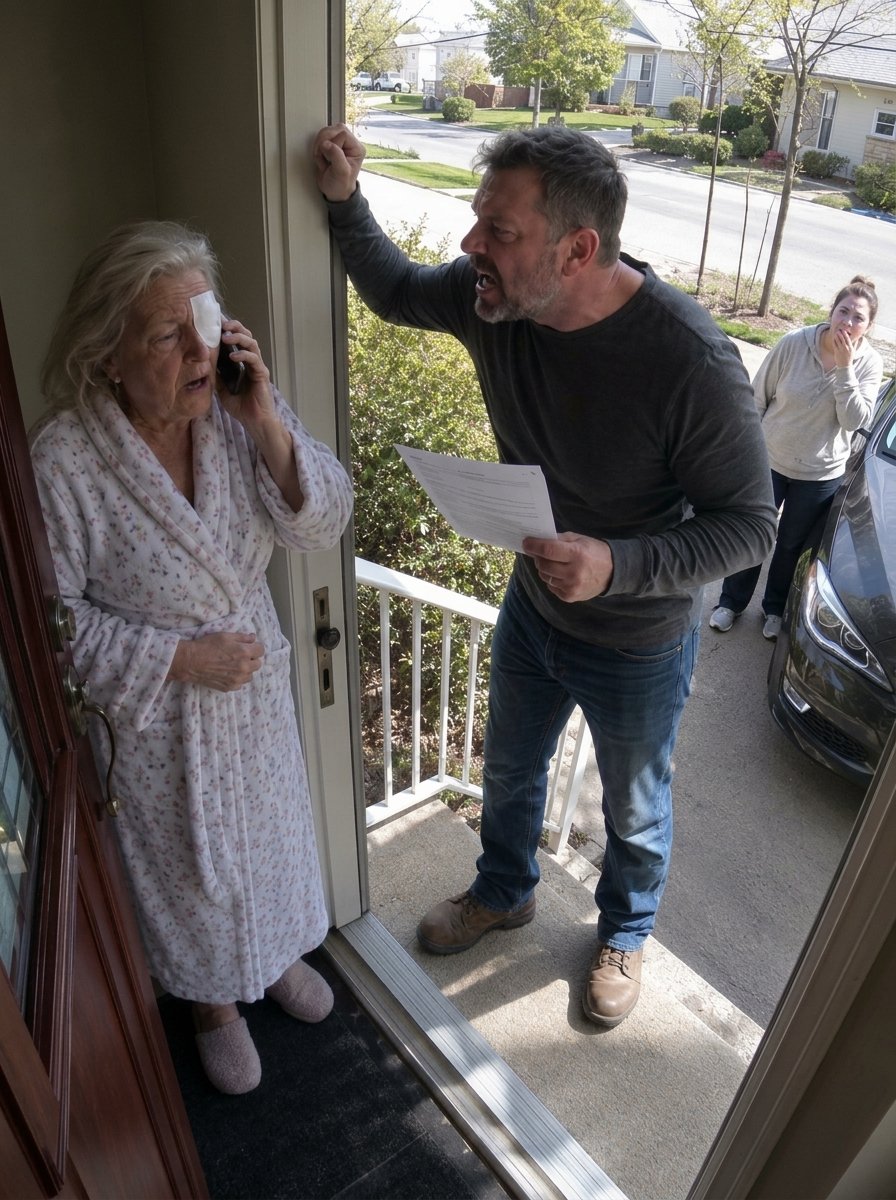
Vanessa opened the door in a silk robe, with her hair wrapped up in a towel.
She looked at the cans. Then she looked at me.
“What is this?”
“Gifts for the children,” I said.
She took one out of my arms. She shook it. Something shifted inside.
“Coffee cans,” she said.
“Yes.”
“You got the list, Marion.”
“I did.”
She laughed. It wasn’t a nice laugh. It was bright and short, like a coin dropped on a tile floor.
“Honestly,” she said. “This is exactly what I’m talking about. The kids are going to be humiliated.”
That’s when Rob came up behind her. He looked at the cans. He looked at me.
“Happy birthday, Mom,” he finally said. To the cans.
“Thank you, Rob.”
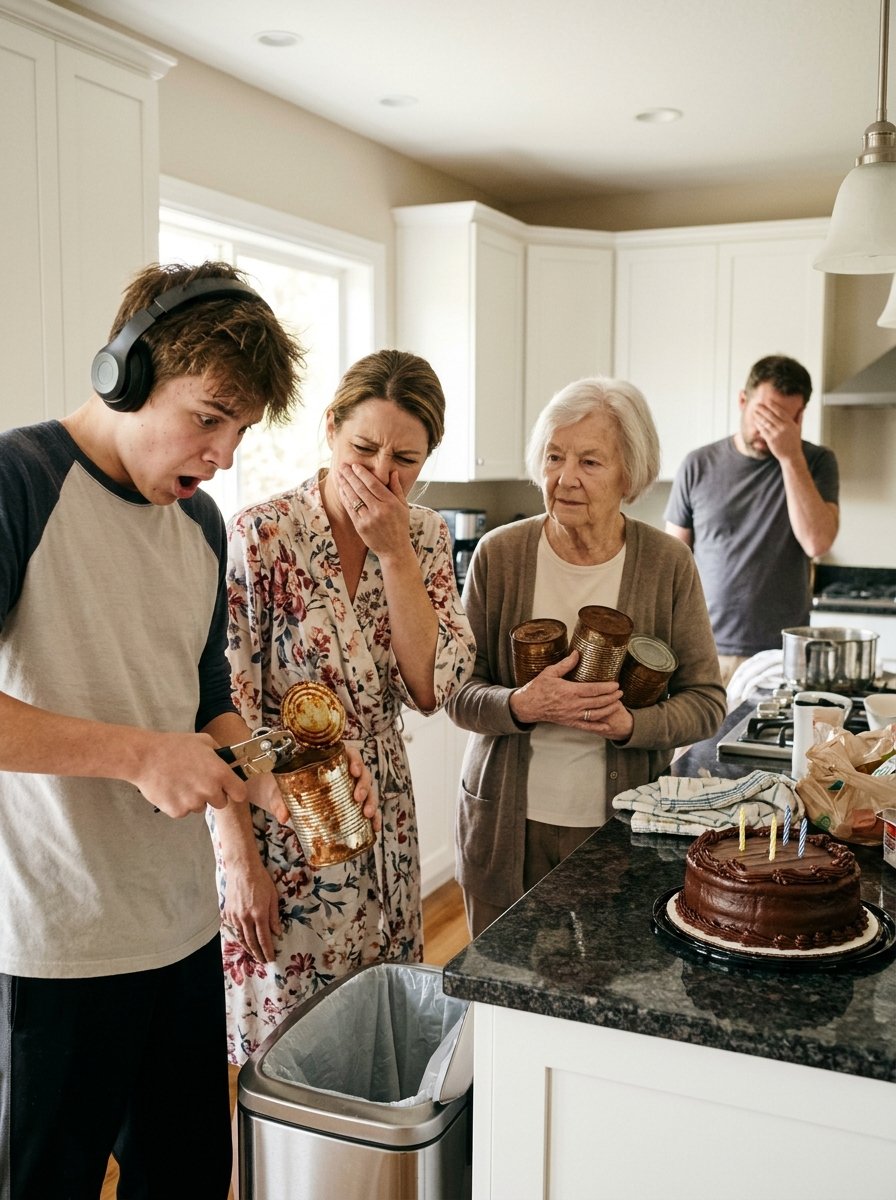
And then Vanessa carried the twins’ can into the kitchen and dropped it in the trash.
So there I stood, holding the other two cans, with that gray stillness all over me.
And then I heard footsteps on the stairs.
Tyler came down two steps at a time. Sixteen years old. Taller than his father now, with Walter’s long jaw and a thatch of dark hair. He had headphones around his neck and a faded Wright State T-shirt on.
He saw me, and his whole face opened up like a window.
“Hey, Grandma! Happy birthday!”
He crossed that kitchen in three long strides and hugged me so hard he lifted me an inch off the tile. He smelled like soap and cold air.
He was the only one in that house who did.
“Happy birthday,” he said again, into my hair.
“Thank you, sweetheart.”
He stepped back. He looked down at the cans in my arms.
“What are those?”
“Something for you,” I said. “And your sister. And the twins.” I swallowed. “Your mother thinks they’re garbage.”“They’re coffee cans, Tyler,” Vanessa said from the counter.
Tyler looked at his mother. Then he looked at the trash bin. I watched his eyes catch the faint red curve of a plastic lid sticking up through the coffee grounds.
He walked over. He lifted the lid of the bin. He reached in, past an eggshell and a wad of paper towel, and pulled out the twins’ can.
A coffee ground clung to the lip.
“Tyler, put that down,” Vanessa said. “It’s dirty.”
He peeled off the rubber band.
He pulled off the lid.
I watched him look inside. I watched a sixteen-year-old boy’s face go still. Then slack. Then something else entirely.
He reached in with two fingers and lifted out the little passbook. He opened it.
“Grandma,” he said slowly. “What is this?”
“Read it, dear.”
He squinted at the faded purple numbers, typed by a machine that doesn’t even exist anymore.
“It says Ben and Lucy Pruitt. Custodial account. Balance…” He stopped. He read it again. “Twenty-eight thousand, four hundred and ten dollars.”
The whole kitchen went dead silent.
The only sound was the ice maker in the big stainless steel refrigerator, dropping a load of ice into the bin.
“Mom,” Tyler said quietly. “You need to come look at this.”
Vanessa sighed, loud and theatrical, and crossed the tile floor in her slippers.
She looked.
I’d been waiting for something, I think. A flush of shame. A burst of laughter. A cold, clipped, “I see.”
What came out of her instead was a small, cracked sound. Like a plate hairline-splitting in a hot sink.
She put one hand flat on the granite island. She put the other one over her mouth.
“Rob,” she said. In a voice I’d never heard her use. “Rob, come here.”
My son came and stood behind his wife. He looked over her shoulder at the passbook in his son’s hands.
He had an expression on his face I hadn’t seen since he was seven years old and found a wallet on the sidewalk outside the Kroger with three hundred dollars in it.
“Mom,” he said. “How long?”
“Since the day each of them was born.”
“Is this… is it…”
“It’s real,” I said. “It’s at Heritage Federal, on Main Street. Raymond Obi set it up. There’s a notary stamp. It’s all in the can.”
Tyler had pulled out the folded letter. He opened it. And he read it out loud, in a low, unsteady voice.
Pages:
7“Dear Ben and Lucy,” Tyler read. “I’m eighty today, and I don’t have much to give. But I have this. Your grandfather and I always thought a child ought to have something that was only his. I put a little in every month since the day you were born. It isn’t a lot. It’s what I had. When you turn eighteen, it’s yours to do with as you please. Not your parents’. Yours. I only ask that you remember a woman who washed foil and loved you very much. Grandma.”
His voice cracked on the word “foil.”
He lowered the paper. He looked at me. His eyes were swimming.
“Grandma,” he said. “Is there… mine too?”
“Yours was the first.”
“How much?”
“Read it, dear.”
He took the other can out of my arms. He peeled the lid off with hands that were shaking now. He pulled out the passbook and opened it, and I watched him find the last line.
“Thirty-one thousand,” he whispered. “Four hundred and twelve dollars. And sixty cents.”
Madison had appeared at the top of the stairs in an oversized hoodie with her earbuds in. She’d stopped dead on the top step. She pulled one earbud out.
“What?”
“Grandma saved it,” Tyler said, without taking his eyes off the passbook. “For us. Since we were born.”
Vanessa sank down onto one of her designer barstools. She had the twins’ passbook in both hands, and she was staring at that page like she’d never learned how to read.
Her robe had fallen open at the collar. The towel had slipped off her head, and her wet hair hung down in a limp, tangled tail.
She looked ten years older. In that bright kitchen light, she looked like a very frightened girl.
“Marion,” she said. Her voice was thin. “I don’t understand. How could you, on your…”
“On my income.”
“On your income.”
“It’s a Social Security check,” I said. “And a little pension. Twenty-five hundred a month, together. If you don’t buy things, it adds up.”
“But you never…”
“I never said.”
“You let me think…”
“I let you think whatever you liked,” I said. I said it gently. “It’s something I’ve done my whole life.”
She put her face in her hands.
“I wrote you a list,” she said, muffled. “I typed you a list. I told you that you don’t do anything for them. I put it in writing.”
“You did.”
“Oh, God.”
“It’s all right, Vanessa.”
“It isn’t!”
“No,” I agreed. “It isn’t. But it’s done.”Rob had walked over to the big window over the sink. He stood with his back to all of us, his hands shoved in his pockets, looking out at the fountain and the maple trees.
His shoulders. Walter’s shoulders. They’d drawn forward and down.
“Rob,” I said.
“I should have said something,” he said to the window.
“Yes.”
“When she… when Vanessa threw it out.”
“Yes.”
“I just stood there.”
“I know.”
“I’ve been standing there for twenty-six years, Mom.” His voice cracked right down the middle. “At every holiday. Every time. I thought if I just kept still, it’d all… it would just resolve itself.”
“That’s how your father operated.”
He gave a short, wet laugh. “Dad would fix the leak and never mention the flood.”
“He’d have made a joke about it.”
Rob turned around. His eyes were red. He crossed the kitchen and stood right in front of me. A big, soft-faced man in a gray sweater, with his arms hanging down at his sides like he didn’t know what to do with them.
“I’m so sorry,” he said. “I’m so sorry I didn’t see you.”
“I know, sweetheart.”
“I’m fifty-three years old.”
“It’s not too late.”
He put his arms around me. I felt him shaking. I held on, right there in my daughter-in-law’s kitchen, among all that marble and stainless steel, with a coffee can still in one hand and the smell of somebody’s cinnamon candle in the air.
And I thought about a little boy of seven, holding my hand in a hospital corridor while we waited for news about his grandfather’s first heart scare. How tight he held on. How he never let go.
There was a long, ragged hour after that.
Vanessa cried. Rob cried. Madison sat down on the top step of the staircase, tucked her earbuds into her hoodie pocket, and listened to every word with her chin resting on her knees.
The twins came up from the basement, where they’d been playing a video game, and stood in the kitchen doorway in their socks.
“What’s wrong with Mom?” Lucy asked.
“Nothing, sweeties,” Vanessa said, wiping her face with the sleeve of her robe. “Nothing. Come here.”
They came. She pulled them both into her arms.
Ben, with a gap where his front tooth used to be, looked up at me over his mother’s shoulder.
“Grandma, is that for us?”
“It’s for both of you.”
“Is it candy?”
“It’s better than candy.”
He frowned. “What’s better than candy?”
I thought about it for a moment.
“A little bit of time,” I said. “Turned into something you can hold.”
He considered this with great seriousness.
“Okay,” he said.
Vanessa laughed, wetly, into his hair.
And that was the first moment I thought the whole thing might hold.I want to be honest about what happened next.
I didn’t forgive her. Not that day.
I sat at her kitchen table with a slice of store-bought birthday cake, which was dry, and a cup of coffee, which was weak. I listened to her tell me she was sorry, over and over, in that small, cracked voice.
I said, “I know.” I said, “Thank you.”
I never said it was all right. Because it wasn’t.
Toward the end, after the twins drifted back down to the basement and Madison went up to her room with her passbook clutched in both hands like a hymnal, Vanessa looked up at me.
“Can I ask you something?”
“Yes.”
“Why didn’t you ever tell us?”
I thought about it for a long time.
“Because I thought you’d say it was nothing,” I said. “I thought you’d look at the number, and then look at my coat, and decide it didn’t count.”
Her face went white.
“I would never have… I wouldn’t have…”
“You’d have been kind about it,” I said. “And I’d have felt like a charity case.”
She was quiet.
“Marion,” she said finally. “I called you a woman who doesn’t do much.”
“You did.”
“I’ve never been so ashamed of anything in my whole life.”
“You said it in writing, Vanessa. Typed.” I smiled, tired. “I kept it. I thought I might frame it.”
She laughed and cried at the same time and put her face back in her hands.
I asked for three things before I left. I’ll tell you what they were, since you’re probably wondering.
I asked at her kitchen table, with Rob sitting beside her and Tyler leaning in the doorway listening.
“First,” I said. “Those accounts belong to the children. They are not to be touched. Not for tuition. Not for a car. Not for a rainy day. Not for you, not for me, not for anybody. If you have questions, Raymond Obi at Heritage Federal will be glad to explain the law to you.”
Vanessa nodded, wiping her eyes. “Of course.”
“Second. I’d like to see my grandchildren. Not just at Christmas. On a Sunday. Once a month. At my house, in my kitchen, with no schedule.”
“Yes,” Rob said, before she could. “Yes, Mom.”
“And third.” I looked right at Vanessa. “I’d like you to come too. Without a list.”
She started to cry all over again.
“Marion, I’d… I would like that.”
“I’ll make a pot roast.”
“I’d like to learn how.”
“It’s not complicated,” I said. “It’s mostly waiting.”
She let out a wet, startled bark of a laugh.
“I’m not very good at waiting,” she said.
“No,” I said. “Neither was I. It took me eighty years.”The Monday after my birthday, I drove down to Heritage Federal on Main Street.
Raymond Obi is 74 now. He’s semi-retired, but he still comes in three mornings a week to handle “his old folks,” as he calls us. He stood up when I walked in and came around his desk to take both my hands.
“Marion,” he said. “Rob called me Saturday night. Then Tyler called me Sunday. Then Vanessa called me this morning at eight o’clock sharp.” He smiled over his glasses. “I take it the cans have been opened.”
“They have.”
“How did it go?”
“She threw one in the trash,” I said.
Raymond’s eyebrows went up so high they nearly reached his hairline.
“The trash.”
“Tyler fished it out.”
Raymond sat back down slowly. He shook his head. “Well. I always did like that boy.”
I’d come to do one more piece of business. I’d been thinking about it all weekend.
“Raymond,” I said. “I’m eighty years old. If something happens to me before the twins turn eighteen, who looks after their money?”
“You can name a successor custodian,” he said. “Somebody who takes over if you can’t serve. It’s just one form.”
He pulled it out of his drawer and slid it across the desk.
I’d thought about it carefully. Not Rob. Rob would mean well, but Rob had stood still for twenty-six years. And not Vanessa. Not yet.
I wrote my sister’s name. Dorothy Kessler, Columbus, Ohio. She’s 76 and the sharpest woman I know. She’d sent half those birthday checks in the first place.
Raymond notarized it, pressing his heavy seal into the paper.
“There,” he said. “Now nobody touches those cans but you, Dorothy, or the kids themselves.”
I stood up and buttoned my patched coat.
“Thank you, Raymond. For everything. For sixteen years.”
He walked me to the door. On the way, he stopped by a filing cabinet and pulled out a worn manila folder. On the tab, in faded pencil, it still said: Marion’s cans.
“I’m going to keep this one in my desk,” he said. “Right on top. Until I retire for good.”
Pages:
11They came to my house on the first Sunday of November.
I’d cleaned for three days straight. I set the dining room table with my mother’s good china, the set with the little blue flowers, and put a bowl of mums from the yard in the middle. I made a pot roast the size of a football.
At four o’clock, a minivan pulled into my driveway. Four children came tumbling out. And then a woman in jeans and a plain gray sweater, with her hair pulled back in a ponytail and no makeup on at all, holding a pie in both hands.
“It’s from the bakery,” Vanessa said at my front door. “I didn’t trust myself.”
“It looks lovely.”
“Marion, I’m so sorry about the…”
“Come in,” I said. “It’s cold.”
She stood in my little front hallway, among the coat hooks and the old umbrella stand, and looked at the framed photographs along the wall. Walter in his Wonder Bread uniform, grinning. Rob at six, with a missing front tooth. A family portrait from 1999, all of us in front of a Christmas tree.
“There’s none of me,” she said quietly.
“I’ve never had one made.”
She turned around. “Would you like to?”
I looked at her. A tall, handsome, undone woman in a gray sweater, holding a bakery pie in both hands like an offering.
“Yes,” I said. “I would.”
The children sat down at my dining room table. They’d never been in my dining room before. Not once. They looked at the china, and at the old oak sideboard, and at the faded rose wallpaper my mother picked out in 1961.
Lucy reached toward the gravy boat. “Can I touch it?”
“You may.”
She ran her finger along the edge. “It’s got a chip.”
“It’s had that chip since 1962.”
“Why don’t you get a new one?”
“I like this one.”
She thought about that, running her small finger back and forth across the crack.
“It’s got a story,” she said.
“They all do, sweetheart.”
At the far end of the table, Tyler sat very straight with his hands on his knees. He’d been quiet all afternoon. When the pot roast was gone and the pie was cut and the twins had been sent out to the backyard to chase a ball, he cleared his throat.
“Grandma.”
“Yes, dear.”“I looked up my account online,” Tyler said. “And I called Mr. Obi at the credit union, and he explained the custodial part to me.” He swallowed. “Thirty-one thousand dollars.”
“It’s yours when you turn eighteen.”
“I’m sixteen.”
“Two more years.”
“I don’t want it.”
I blinked.
“I mean, I do. I’m going to take it. But I want to say something first.” He took a breath. His voice was shaking. “I never knew you did this. I thought… I thought you didn’t really… Mom always said you didn’t…”
He stopped.
“I’m sorry I believed her.”
“You were a child,” I said.
“I’m sixteen.”
“You were a child when it started.”
He shook his head hard. “I want to do something. For you.”
“You don’t owe me anything, Tyler.”
“I know,” he said. “That’s why I want to.”
His eyes were wet.
“Grandma. What do you want?”
The whole dining room went quiet. In the kitchen, I heard Vanessa stop moving dishes. Rob, standing at my sink with his sleeves rolled up, went completely still.
I thought about it. I thought about a long, small life. About a ledger with every line balanced. About a navy blue coat on a sale rack at Elder-Beerman in 2014.
“A coat,” I said.
Tyler stared at me. “A what?”
“A winter coat. I haven’t had a new one in a very long time.”
He just looked at me.
And from the kitchen doorway, I heard a sound. A wet, startled, helpless sound. Like a laugh and a sob wrestling each other.
Vanessa.
“Marion,” she said. Her voice cracked. “I’ll take you. This Saturday. To Macy’s. And I’d like… I’d like to buy it for you.”
“No.”
“Please.”
“Vanessa.” I looked her right in the eye. “You may take me. You may sit with me while I try on every coat in that store. You may hold my purse. But I’ll pay for it.”
She laughed and cried at the same time.
“That’s fair,” she said.
Pages:
We went on a bright, cold Saturday in December.
She drove the minivan with the heater on and the radio playing Christmas carols. We parked at the Mall at Fairfield Commons, and she walked beside me through the doors, slow, matching my pace step for step.
At Macy’s, a young saleswoman named Dolores led us over to a long rack of wool coats.
I tried on fourteen coats. Dolores told me later that was a store record.
Vanessa held my purse the entire time. She didn’t say much. She stood with her arms folded, watching me in the three-way mirror. When I put on the fifth one, a charcoal gray wool with a soft fur collar, she finally spoke.
“That one.”
“It’s too fine,” I said.
“It’s you.”
I checked the tag. “It’s three hundred and ten dollars.”
“Marion.” She put her hand on my arm. “It’s a coat.”
I looked in the mirror. A small, white-haired woman in a charcoal gray coat looked back at me with her chin up.
I bought it. I paid with a check from my own checking account, written in blue ink. Dolores folded it in white tissue paper and laid it in a long white box tied with a red ribbon.
“Happy birthday,” she said.
“It was in October.”
“Happy belated, then.”
I laughed. Out loud, right there at the register.
In the parking lot, with the coat box on my lap and the heater ticking, Vanessa sat very still with both hands on the steering wheel. She didn’t start the van.
“I’d like to tell you something,” she said.
“Go ahead.”
“My mother was a very warm woman. Her name was Dorothy. Like your sister.” She smiled a little at that. “She raised me in a little house in Fairborn. Not Oakwood. I’ve been telling people Oakwood for thirty years.”
I turned my head and looked at her.
“We had nothing,” Vanessa said. Her voice was steady and very careful. “She worked two jobs. Waitress in the morning, cleaning offices at night. And she taught me one thing above everything else. Never look poor. Never let anybody see.”
She pressed her lips together.
“The boathouse was my aunt’s. We went there once. I was nine.”
“I see.”
“When I married Rob, I thought I’d finally arrived. I thought if I could just keep it all together, the house, the look, the kids’ clothes, nobody would ever see where I came from.” Her eyes filled. “I didn’t know there was another way to be.”
“There are a good many ways to be,” I said.
“I know that now.”
“Where is she? Your mother?”
“She died in 2011.” A tear slid down her cheek. “I never once took her shopping.”
I reached over and put my hand on top of hers on the steering wheel. Her hand was cold and thin and trembling.
“Then I’ll take you,” I said. “Sometime. We’ll go to the Goodwill on Brown Street and buy you a ridiculous hat.”
She laughed through her tears.
“I’d like that very much,” she said.
Pages:
1Tyler called me in January.
“Grandma,” he said. “Can I ask you something?”
“Always.”
“I’ve been thinking about what to do with the account. When I turn eighteen.” His voice was steady. Grown-up. “I want to go to Wright State. Engineering. It’d cover most of it, with the scholarship I’m going for.”
“That’s a fine idea, Tyler.”
“But I want to put some away. For you.”
“Tyler…”
“No, wait, listen.” He took a breath. “You put twenty dollars a month away for me for sixteen years. I want to do the same thing. For somebody. A kid, maybe. At the school. Somebody who doesn’t have anybody doing it for them.”
I sat very still in my kitchen with the phone pressed against my ear. My new charcoal coat was hanging on the hook by the back door.
“I want to start a can,” he said. “Of my own.”
I couldn’t speak.
“Grandma?”
“I’m here,” I said, when I could. “I’m very here.”
“Is that dumb?”
“It’s the least dumb thing I have ever heard in my life.”
He laughed, nervous.
“Will you help me pick out the can?”
“I’ve got a great many cans,” I said.
“I thought you might.”
It’s been a year now.
Rob and Vanessa come to dinner on the first Sunday of every month. Sometimes with all four children. Sometimes just the two of them. They sit at my table among the chipped china and the faded rose wallpaper.
Vanessa learned how to make pot roast. It’s gotten better. She still hovers over my oven like it might get up and wander off if she looks away.
Last month, she brought me a present wrapped in brown paper. It was a framed photograph. A family portrait, taken at a studio in Kettering. The six of them, standing in front of a plain gray backdrop.
And right in the center, in a charcoal wool coat with a fur collar, stood a small white-haired woman, smiling.
“It’s you,” Vanessa said, a little shy.
“I can see that.”
“You said you’d like one.”
I held that frame for a long time.
“It’s very good,” I said.
I hung it in my front hallway, right beside Walter in his Wonder Bread uniform. The two of them look at each other across a long, narrow strip of rose wallpaper. And I find, every time I pass by, that I nod to them both.Madison has started sewing.
She showed up at my house one Sunday in March with a shoebox full of fabric scraps. “Grandma,” she said, in her fourteen-year-old voice, staring at her shoes. “Would you teach me?”
I taught her the running stitch. The backstitch. How to mend a hem so nobody can tell. She makes little things now. A pouch. A bookmark. A patchwork square. She’s given me three of them. They’re stuck to my refrigerator with magnets.
The twins have discovered my basement.
They come on Sundays with flashlights and explore behind the Christmas boxes like it’s a cave. Last week, Ben found Walter’s old red toolbox and carried it all the way upstairs in both arms like it was treasure.
Lucy found a stack of my old payroll ledgers from 1984. She spent a whole hour reading them out loud in a dramatic voice, like a queen reading a royal proclamation.
“Pruitt, Marion,” she announced. “Overtime. Four hours. Grandma, you were SO organized.”
“I was a clerk,” I said.
“You were a queen.”
I laughed so hard I had to sit down.
The coffee cans live on my kitchen shelf now.
They came back to me. Vanessa carried them over herself in a canvas tote bag, on the first Sunday after Christmas.
“I thought you’d want them,” she said. “As a reminder.”
I’d have liked to say no. I took them.
They’re empty now. The passbooks are locked in Raymond’s vault at Heritage Federal, safe and sound. I washed the cans and dried them and set them in a row on the shelf above my kitchen sink. Four red-lidded Folgers cans with faded masking-tape names.
And right beside them, a fifth one. Brand new. Still shiny. With a fresh strip of masking tape across the lid.
TYLER.
He’s filling it. Every Sunday he brings me a handful of ones and fives from his job bagging groceries at Dorothy Lane Market, and we count it together at my kitchen table.
Last month, it held forty-one dollars and a button.
“What’s the button for?” I asked him.
“It’s from Dad’s old jacket.” His face went pink. “He said I could keep it. For luck.”
“That’s a fine addition.”
“I thought so.”
We sat at my kitchen table, just the two of us, in the late afternoon light, counting dollar bills into a coffee can. Out the window, the maple tree in my backyard had gone bare. A cardinal sat in its branches, red as a drop of blood against the gray.
“Grandma,” Tyler said.
“Yes, dear.”
“Do you think it’ll work? A can, I mean. For somebody else.”
I thought about a long hospital corridor at Kettering Medical. A $200 birthday check. A winter I went without a coat.
“I think,” I said slowly, “it’s the only thing that ever has.”
He nodded. He snapped the red lid shut. He wrapped the rubber band around it, carefully, twice.
And I sat in my kitchen at eighty-one years old, in a gray wool coat I finally bought for myself, and watched a sixteen-year-old boy who looks just like his grandfather reach up and set a coffee can on the shelf.
It made a small sound when it touched down. A soft, dull, hollow clunk.
I have never in my life heard a better one.
Pages: