A Tornado Destroyed Our Barn, but My Father-in-Law Kept the Insurance Money, So Our Neighbors Came Together to Help Us
The first truss went up at 7:40 in the morning.
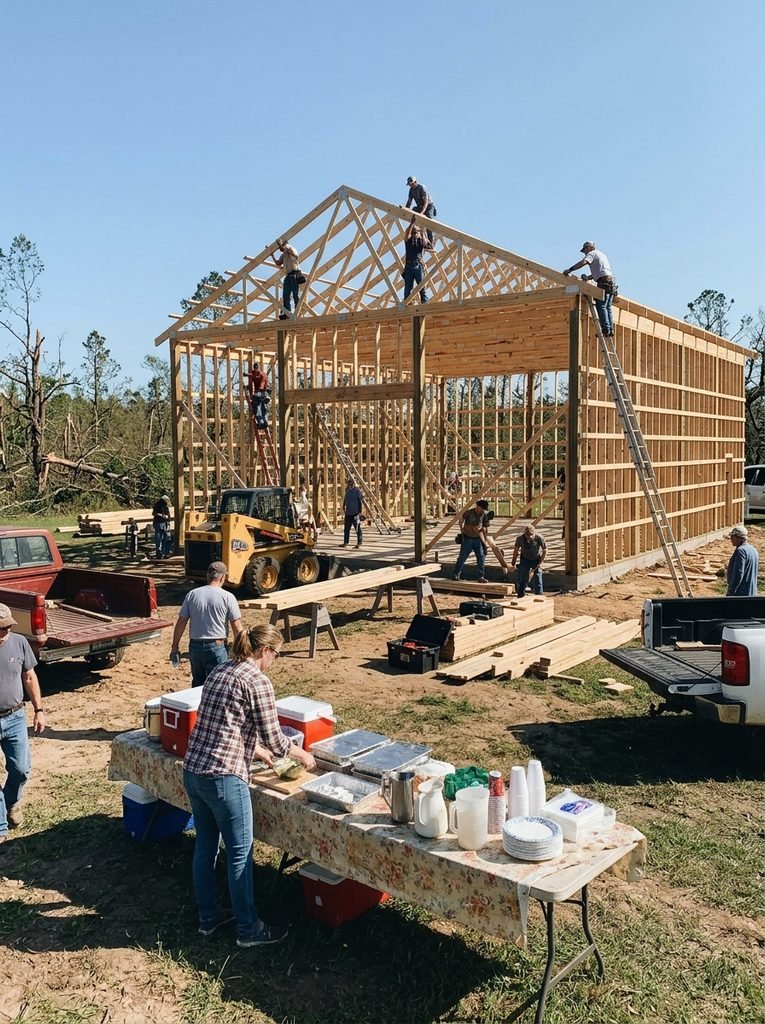
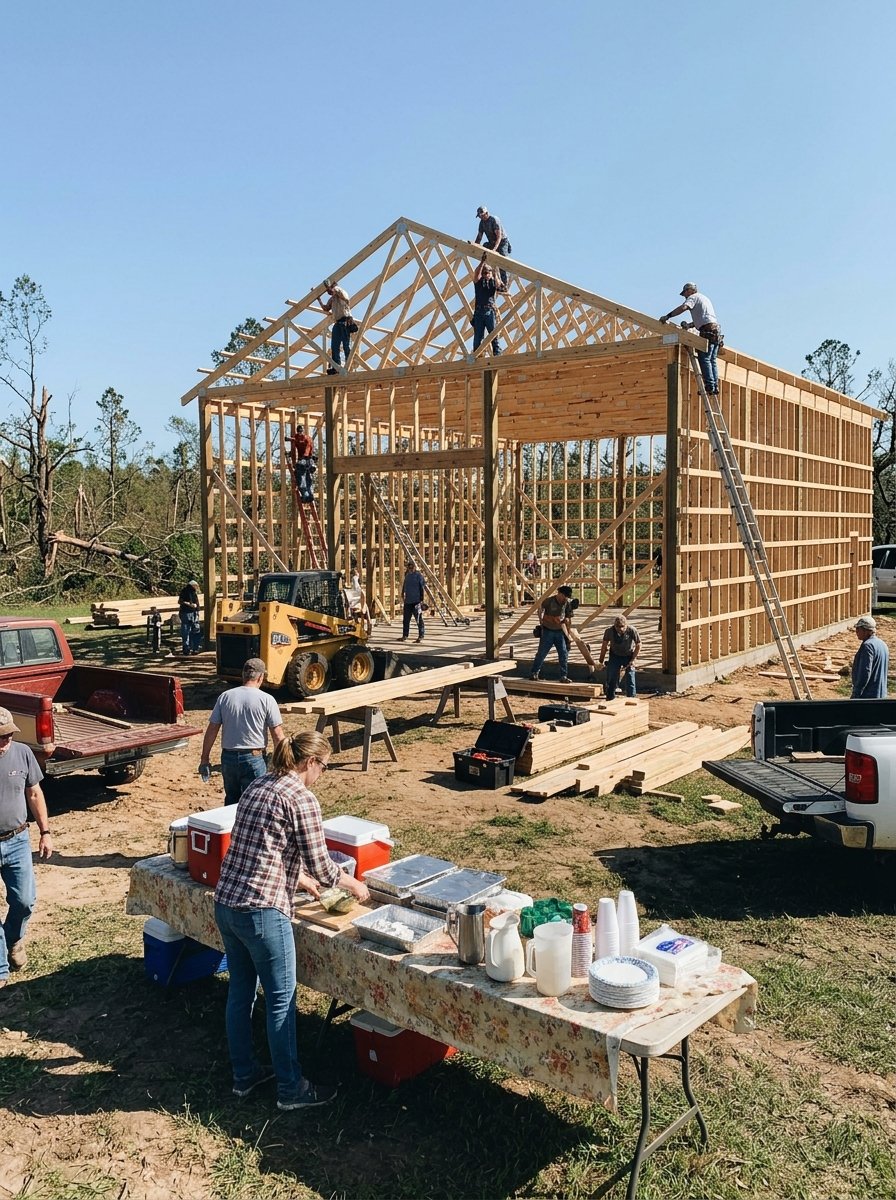
I know the time because I looked at my watch. I wanted to remember it. Eleven men on ropes and pike poles, and Pete Hanson standing in the middle of the barnyard with his arm up like a conductor, calling out, “Easy. Easy. Now walk her up.”
And the truss rose. Slow. A big triangle of yellow pine against the gray sky, swinging a little, then settling into place on the top plates with a soft thump you could feel in your feet.
Somebody whistled. Somebody else whooped. Then the whole barnyard was clapping, seventy people in work boots and seed caps, clapping for a piece of wood.
I stood in the wet grass with a roaster of scrambled eggs.
Eighteen-quart Nesco roaster, plugged into an orange extension cord that ran all the way back to the machine shed. Four dozen eggs, a pound of shredded cheddar, a little milk. Another roaster beside it full of sausage. Two coffee urns on a sheet of plywood laid across sawhorses.
I was supposed to be serving. I couldn’t move. I just stood there with a serving spoon in my hand and watched that truss settle.
Our barn had been flat for eleven weeks.
My name is Lorrie Bauer. I’m forty-six years old. I’ve been married to Dwayne Bauer for twenty-two of those years, and I’ve lived on this farm outside Cedar Bluff, Nebraska, for every one of them.
I came here from Omaha. A town girl, my father-in-law called me, the first time Dwayne brought me home. I didn’t know a heifer from a steer. I didn’t know you don’t wear white shoes to a hog sale. I learned.
I learned most things on this place. I learned them in that barn.
But I’m getting ahead of myself.
To tell you why seventy people showed up on a Saturday in July to put a roof back over our heads, I have to tell you about the Thursday it got taken off.
And I have to tell you about Vernon.
Chapter Two: The Thursday
The twister came on a Thursday in April. The eighteenth. A little after five in the afternoon.
We’d been watching the sky since lunch. It had that color it gets in spring. Green underneath, like a bruise. The air was warm and heavy and smelled like rain and wet dirt. The radio had been saying “conditions favorable” since noon.
Dwayne was out in the barn with the calves. We’d had fourteen that spring. Angus crosses, most of them less than three weeks old. He was bedding them down with fresh straw, because the weather was turning.
I was in the kitchen. I had a meatloaf in the oven.
The siren in Cedar Bluff went off at 5:06. You can hear it from our place on a still day, four miles away, faint and wavering.
I went to the back door. I looked west.
It was coming across the Ostrander quarter. A gray rope hanging down out of the clouds, swinging back and forth like a snake trying to make up its mind. It was maybe two miles off. Then it wasn’t. Then it was a mile and a half and getting wider, and the sound was coming with it.
People say it sounds like a train. That’s not right. It sounds like everything at once. Like the whole sky is tearing.
“Dwayne!” I screamed. “Dwayne!”
He came out of the barn at a dead run. Caleb was right behind him. Our son was ten that spring, and he went everywhere his dad did. I didn’t even know he was out there.
We made it to the basement. Down the outside steps, through the old cellar door, into the corner under the stairs where we keep the lantern and the jugs of water and the weather radio. Dwayne pulled Caleb and me down and put his body over both of us.
Then the house shook.
It shook like a dog shaking water off. The windows upstairs blew in. I heard glass. I heard something huge hit the side of the house and keep going. My ears popped so hard I thought my head would split.
And then it was gone.
The whole thing took maybe forty seconds.
When we came up, the house was standing.
Most of the windows were gone. The porch roof was in the front yard. A tree limb the size of a car was lying across the hood of my Buick. Shingles everywhere, like somebody dumped a box of playing cards over the farm.
But the house was standing.
Then Dwayne turned around. And he made a sound I’ll never forget.
The barn was gone.
Not damaged. Not leaning. Gone. Folded down like a hand closing. The whole big red gambrel roof had come down on top of itself, and the walls had gone out sideways under it, and now it was just a pile. A heap of red tin and broken beams and hay and mud, taller than me.
The haymow. The calf pens. The workbench. Dwayne’s grandfather’s tools on the pegboard. The 1952 Farmall Super C that Dwayne was restoring in the corner, three winters’ worth of work.
All of it under the roof in the mud.
And the calves.
Dwayne ran to the pile. He started pulling at the tin with his bare hands. It was jagged. It cut his palms open. He didn’t stop.
“Dwayne!” I grabbed his arm. “Dwayne, stop. You can’t. It’s not safe.”
“They’re in there, Lorrie. They’re in there.”
He pulled loose and went back at it. I stood there holding Caleb’s hand. Caleb was crying. I don’t think I was. I don’t think I could.
The neighbors came within twenty minutes. That’s how it is out here.
Marv Ochs, from a mile east, in his old Chevy. The Hanson boys with a skid loader. Ruthie and Gary Stahl with a chainsaw and a first aid kit. They cleared the tree off the road. They wrapped Dwayne’s hands. And they started taking that barn apart, one sheet of tin at a time, until it got too dark to see.
They got eleven of the calves out. Alive.
Three didn’t make it.
Dwayne carried each of those three out himself and laid them in the bed of the pickup. Then he sat down on the tailgate in the dark, with his bandaged hands in his lap, and put his head down, and didn’t move for a long time.
Chapter Three: The Name on the Policy
You need to understand how things are set up on this place. It matters for everything else.
The farm is in Vernon’s name. Most of it.
Vernon Bauer is Dwayne’s father. He’s seventy-four. He was born on this land, in the front bedroom of the house his grandfather built in 1912, the house Dwayne and I live in now. When Vernon married Dwayne’s mother, June, they built a newer house a half mile up the road, on the home quarter. Ranch style, brick. That’s where Vernon lives now, alone, since June died three summers ago.
When Dwayne and I got married, Vernon said we could have the old house and farm the ground. All of it. Four hundred and eighty acres of corn and beans, plus the cow-calf operation.
He didn’t give it to us. He rented it to us. Cash rent, at a family rate. We pay him every March and every November. We put up our own machinery, our own seed, our own fertilizer, our own labor. We fixed the house. We fixed the fences. We fixed everything that broke for twenty-two years.
But the land is Vernon’s. The house is Vernon’s. The barn was Vernon’s.
And the insurance was in his name too.
It was a farm policy through the Farm Bureau. One policy, covering everything. The house, the barn, the machine shed, the grain bins. Vernon was the named insured. Always had been. He’d bought it in 1971 and never changed it.
We paid our share of that premium every year. Dwayne wrote Vernon a check for it every January. Twenty-one hundred and forty dollars last year, for the buildings on our end of the place. I have every canceled check in a shoebox in the closet. I keep good records. I always have.
But the policy didn’t say Dwayne. It didn’t say Lorrie. It said Vernon H. Bauer.
The adjuster came out the following Tuesday. A young man from Lincoln named Brett, in a polo shirt and khakis, with an iPad and a laser measuring tape. He walked around the pile of our barn for two hours, taking pictures.
“Total loss,” he said. “Obviously.”
“How much?” Dwayne asked.
Brett tapped his iPad. “The policy has replacement cost coverage on the outbuildings. Sixty by eighty, gambrel roof, wood frame, haymow. Plus contents.” He looked up. “Your dad’s going to be getting a check for about eighty-six thousand, I’d estimate. Maybe a little more after we figure the contents.”
Dwayne let out a breath I think he’d been holding for five days.
“That’ll about do it,” he said. “That’ll about put her back.”
The check came three weeks later. On a Friday. Eighty-six thousand, four hundred dollars.
It was made out to Vernon.
Of course it was. His name was on the policy.
He drove down to our place that afternoon in his white Ford F-250 and parked by the pile of red tin where the barn used to be. He got out and stood there with the envelope in his hand.
Dwayne came out of the machine shed. He was wiping his hands on a rag. He’d been working on the planter.
“That the check?” he said.
“That’s the check,” Vernon said.
“Good, Dad.” Dwayne smiled. The first real smile I’d seen on him since the twister. “That’ll about do the barn. I called Pete Hanson already. He says if we get the lumber ordered by June, he can…”
“Well, now,” Vernon said.
He said it slow. The way he says things when he’s about to say no but wants you to think he’s still deciding.
“Well, now,” he said again. “The policy’s got my name on it, son.”
Dwayne stopped.
“I know it does.”
“So the money’s mine,” Vernon said. He folded the envelope and put it in the chest pocket of his chore coat. He buttoned the pocket. “Legally. My name. My premiums. My barn.”
“Dad, we paid half those premiums. For twenty years.”
“You paid me rent,” Vernon said. “What I did with it was my business.”
Then he got back in his white Ford and drove home.
Chapter Four: The Slab
Three weeks later, a cement truck went past our place.
I was out hanging laundry. It was the middle of May, warm and windy, the kind of day you can dry a whole load of sheets in an hour. I heard the truck coming down the gravel from the east. A big red and white Ready Mix truck from Cedar Bluff, with the drum turning.
I watched it go by. I thought maybe somebody up the road was pouring a sidewalk.
It turned in at Vernon’s home place, a half mile north.
I stood there with a clothespin in my mouth and a wet pillowcase in my hand.
Then another cement truck went by. And another. Four of them, that morning.
By noon, I could see it from our back porch, if I stood on the top step. A long flat gray rectangle behind Vernon’s brick house. Where his garden used to be. Where June grew tomatoes for forty years.
A slab. Forty by sixty.
The steel came the week after. A flatbed semi from a building company in Grand Island. I watched them unload it with a crane. Red steel beams and white sheets of metal siding and big rolls of insulation.
By the first week of June, it was standing. A brand-new pole shop, forty by sixty, with a fourteen-foot overhead door and a walk-in door and windows down both sides. Red trim. White siding. A cupola on top with a weathervane shaped like a tractor.
Dwayne’s cousin Rick told us the rest. Rick works at the co-op and hears everything.
Concrete floor with in-floor heat. Two hundred amp electric service. A bathroom with a shower. A wood stove. A woodworking bench and a welder and a brand-new lift for working on trucks.
“Must have cost him eighty, ninety thousand,” Rick said. “Easy.”
He built himself a new shop.
With the money that was meant to put our barn back up.
That night, I lay in bed next to Dwayne in the dark. The bedroom window was still covered in plywood from the twister, because we hadn’t been able to afford all the glass yet. It was so dark I couldn’t see my hand.
“Dwayne,” I said. “You have to talk to him.”
He didn’t say anything.
“Dwayne. That was our barn. That was our money too. We paid those premiums. I have the checks.”
“I know.”
“Then go talk to him. Or call a lawyer. Or something.”
He was quiet so long I thought he’d fallen asleep.
“He’s my dad,” he said, in the dark.
“I know he is.”
“I’m not going to court against my own dad over a barn, Lorrie.”
I didn’t argue. I wanted to. I lay there with my fists clenched under the sheet and my heart pounding.
But I knew he was right about one thing. The money was legally Vernon’s. His name. His land. His premiums, on paper.
I’d even called a lawyer, the week before. Without telling Dwayne. A woman named Carol Ritter in Columbus who does farm law. I sat in my car in the co-op parking lot and told her everything.
She was kind about it. But she didn’t sugarcoat it.
“If he’s the named insured and the owner of the building, the proceeds are his,” she said. “Your rent agreement doesn’t give you a claim to them unless it says so in writing. Does it?”
“There’s no written agreement,” I said. “It’s family. It’s a handshake.”
She was quiet for a second.
“Then I’m sorry, Mrs. Bauer,” she said. “No lawyer’s pulling that money out of a poured slab. And even if there was a way,” she paused, “you’d be suing your husband’s father. On a family farm. I’ve seen what that does. You can’t sue your father and still have a father.”
Chapter Five: Hollow
So I stood in our empty barnyard and felt hollowed out.
That’s the only word I have for it. Like somebody had reached in and scooped out everything inside me and left the shell standing.
Every morning I’d go out to do chores and there’d be nothing there. Just a big square of bare dirt where the barn used to be, and the concrete footings sticking up out of it, and a pile of salvaged lumber we’d stacked by the machine shed.
The calves were living in a temporary shelter Dwayne threw together out of cattle panels and a tarp. It flapped all night in the wind. You could hear it from the house.
We’d lost more than a building.
The haymow had three hundred bales of last year’s alfalfa in it when it went down. All of it soaked and ruined. We had to buy hay to get the cows through to pasture. Two hundred and ten dollars a ton, from a man in Kearney.
Dwayne’s grandfather’s tools. A whole pegboard of them, some of them from the 1920s. We dug out maybe half. The rest were bent or broken or gone.
The Farmall Super C. Three winters of Dwayne’s evenings. Crushed under a beam.
And three calves.
We figured it up one night at the kitchen table. What it would cost to rebuild ourselves, without the insurance.
Pete Hanson came over and helped us. Pete’s a carpenter in Cedar Bluff, about sixty, who’s built half the barns and pole sheds in this county. He sat at our table with a yellow legal pad and a calculator.
“If you hire it all out,” he said, “you’re looking at a hundred and ten, a hundred and twenty. Easy. Labor’s half of it.”
“We don’t have that,” Dwayne said.
“I know you don’t.” Pete tapped the pad. “But if you just bought the materials? Lumber, trusses, steel roof, siding, hardware? And did the work yourselves?” He wrote some numbers. “Forty-one thousand. Give or take.”
Forty-one thousand dollars.
We didn’t have that either. But we could borrow it. I went to Farm Credit in Columbus the next week and sat across from a loan officer named Dennis with thick glasses and a pocket protector. I brought my shoebox of records. Twenty-two years of them.
Dennis looked through it all for a long time.
“You keep very good books, Mrs. Bauer,” he said.
“I was a bookkeeper,” I said. “In Omaha. Before I married a farmer.”
He approved a forty-one-thousand-dollar operating loan, secured against our cattle and our machinery. Seven-point-two percent. Ten years.
Seven-point-two percent on money we shouldn’t have had to borrow.
But even with the materials, we couldn’t do the labor. Not the two of us. A sixty-by-eighty barn with a gambrel roof takes a crew. Pete said it would take Dwayne alone two summers, working every evening and weekend. And that was if he didn’t fall off the roof and break his neck.
“We’ll figure it out,” Dwayne said.
But I could see in his face he didn’t think we would.
There’s one more thing I should tell you about those weeks.
In the pile of salvaged lumber by the machine shed, there was one beam I wouldn’t let Dwayne cut up or burn. An old oak post. Eight by eight, hand-hewn, with adze marks still on it. Twelve feet long.
It was one of the original posts from the 1912 barn. Dwayne’s great-grandfather cut it out of a tree on the creek bottom and squared it with an axe. When they re-roofed the barn in the fifties, they’d kept the old posts.
It came out of that pile almost perfect. Not even cracked.
And about four feet up from the bottom, carved into the wood with a pocketknife, there were initials.
V.H.B. 1959.
Vernon Henry Bauer. Nine years old.
Dwayne found it while we were digging. He stopped and ran his thumb over the letters.
“Dad carved that,” he said. “He told me about it once. He got whipped for it. Grandpa said a barn post wasn’t a school desk.”
He looked at it for a long time.
Then he went and got his cordless drill and a pry bar, and he carried that post out of the pile himself, and laid it on two sawhorses in the machine shed.
“That one goes back in,” he said.
Chapter Six: The Feed Aisle
In the second week of June, I went to the co-op in Cedar Bluff for mineral.
Fifty-pound bags. The cows go through it fast in summer. I had my cart in the feed aisle at the back of the store and I was trying to lift a bag off the bottom shelf, and it was heavier than I remembered, and I was in a bad mood about everything.
“Here,” somebody said behind me. “Let me get that before you throw your back out.”
Old Marv Ochs.
Marv is eighty-two. He’s farmed the quarter east of us since 1965. He’s six foot four and built like a corn crib, even now, with hands like shovels and a voice like a cement mixer. He was one of the first ones at our place the day of the twister. He was the one who wrapped Dwayne’s hands.
He picked up that fifty-pound bag of mineral like it was a loaf of bread and set it in my cart.
“Thank you, Marv.”
“How’s Dwayne?”
“Fine,” I said. I always say fine.
He looked at me for a long time with his faded blue eyes.
“When’s Dwayne putting that barn back up?” he said.
I didn’t answer right away. I looked down at my cart.
“I don’t know, Marv,” I said finally. “We bought the materials. Pete figured them up. But it’s just Dwayne and me. Pete says it’ll take two summers.”
Marv grunted. He leaned against the shelf of dog food.
“Two summers,” he said. “That’s a long time for calves to be under a tarp.”
“I know.”
He didn’t ask about the insurance. He didn’t ask about Vernon’s new shop. He didn’t have to. Everybody in Cedar Bluff knew. You can’t pour a forty-by-sixty slab four miles from town without everybody knowing.
But Marv didn’t say a word about it. He just stood there by the dog food, scratching his chin.
“Well,” he said. “I’ll tell you what. I got a free Saturday coming up and nothing to do but aggravate my wife. If Dwayne wants a hand, you tell him to call me.”
Then he winked and walked off toward the checkout with a bag of chicken scratch under his arm.
I stood there in the feed aisle with my cart.
And the whole thing turned over in my head. All at once. Like a coin flipping.
I couldn’t fight Vernon. Dwayne wouldn’t let me, and the law wouldn’t let me, and I didn’t have the heart for it anyway. I couldn’t make him give back the money. I couldn’t make him tear down his shop.
But I had something Vernon didn’t have.
I had a road full of people who knew what a barn was.
Chapter Seven: Seventy
I started calling that night.
I sat at the kitchen table after supper with the church directory and the 4-H phone list and a legal pad. Dwayne was out checking cows. Caleb was watching TV.
I called Marv first. To tell him I’d taken him up on it.
“Good,” he said. “When?”
“I don’t know yet. A Saturday. Soon as we get the trusses delivered.”
“I’ll be there,” he said. “Who else you got?”
“Nobody yet. You’re the first.”
“Well,” Marv said. “Get busy, girl.”
So I got busy.
I called Pete Hanson next. I asked him if he’d be willing to run a crew. I told him I could pay him something.
“Lorrie,” he said. “I’ve built barns in this county for thirty-eight years. You know how many old-style barn raisings I’ve been to? Where the whole road comes out and puts it up in a day?”
“How many?”
“Two,” he said. “One in 1979 and one in 1986. And I was a kid at both of them.” He paused. “I’ll run your crew. For free. And I’ll bring my boys.”
I called the Hanson brothers, Pete’s nephews, who farm south of us. I called Gary and Ruthie Stahl. I called the Lindqvists, the Ostranders, the Meyers, the Kaczmareks. I called the Lutheran pastor. I called the Catholic priest, because the Kaczmareks were Catholic and I figured he might want to know.
I called the fire department, because three of them were farmers and they had a bucket truck. I called the shop teacher at the high school, who had a whole class of boys who needed a summer project. I called the 4-H leader.
I never said one word against my father-in-law.
I want that understood. I never said Vernon. I never said insurance. I never said shop.
I just said we were putting the barn up ourselves. Old style. In a day. And we could use some hands.
By the end of the first night, I had twenty-three names on my legal pad.
Dwayne came in from checking cows around ten. He saw me at the table with the phone and the legal pad and the church directory.
“Who are you calling?”
“Everybody.”
He looked over my shoulder at the list. His face changed.
“Lorrie,” he said slowly. “What are you doing?”
“We’re putting the barn up,” I said. “On a Saturday. In July. Old style.”
He stared at me.
“You didn’t tell them about Dad,” he said. “Did you?”
“Not one word.”
He stood there for a long time. Then he pulled out a chair and sat down next to me. He picked up the church directory and opened it to the W’s.
“You forgot the Weidners,” he said.
By Thursday I had lost count past fifty.
People called people. That’s how it works out here. Gary Stahl called his brother-in-law in Fullerton. Ruthie called her quilting group. The shop teacher brought eleven boys. The Lutheran ladies said they’d bring salads. The Catholic men’s club said they’d bring a pig.
A man I’d never even met called me on Wednesday night. He said he was from Belgrade, thirty miles away.
“I heard about your barn,” he said. “My granddad’s barn went down in the ‘75 tornado and the whole county put it back up. I was six. I carried nails.” He cleared his throat. “I’d like to come carry some more, if that’s all right.”
The trusses came on a flatbed on the Tuesday before. Thirty of them. Big triangles of yellow pine, engineered in Grand Island, stacked like giant ribs on the grass by the old footings.
The steel came on Wednesday. Red, to match the old barn. Dwayne wanted red.
The lumber came on Thursday. Posts, girts, purlins, rafters. Pete stood in the barnyard with his clipboard and checked off every piece.
“We’re ready,” he said Thursday night. “If the weather holds, she goes up Saturday.”
Chapter Eight: Friday
So I baked all Friday.
Eleven pans of bars. That’s the number. I counted. Because you don’t ask seventy people to lift your barn and feed them crackers.
Scotcheroos. Lemon bars. Seven-layer bars. Special K bars. Monster cookie bars. Two pans of Rice Krispie treats for the kids. A pan of rhubarb dream bars from my mother-in-law June’s recipe, which she taught me the first summer I was married, when I couldn’t even make Jell-O.
I started at five in the morning. I didn’t stop until eleven at night. Every surface in my kitchen was covered with nine-by-thirteen pans. The counters. The table. The top of the deep freeze in the back porch.
Ruthie Stahl came over at noon to help. Then Darlene Ostrander. Then Pete Hanson’s wife, Joyce, with three dozen eggs and a crock pot of sloppy joe meat.
We worked in my kitchen all afternoon with the windows open and the radio on. Nobody talked much about why we were doing it. Nobody had to.
Around four o’clock, Darlene was cutting lemon bars at the counter, and she said, without looking up, “You know Vernon’s shop has in-floor heat?”
The kitchen went quiet.
“I know,” I said.
“Cost him eleven thousand just for the boiler. Rick told my husband.”
I didn’t say anything. I kept stirring the Scotcheroo topping.
Darlene looked at me. Then she nodded, once, and went back to cutting.
“Well,” she said. “Our barn’s going to have something better.”
“What’s that?” Ruthie asked.
“Us,” Darlene said.
That night I sat on the back porch steps with Dwayne. It was hot and still. The fireflies were coming up out of the grass in the pasture. Caleb was asleep upstairs.
Across the barnyard, I could see the trusses in the moonlight. Stacked and waiting.
“Lorrie,” Dwayne said. “What if nobody comes?”
“They’ll come.”
“What if it rains?”
“Then they’ll come Sunday.”
He was quiet for a long time.
“What if Dad hears about it?” he said.
I looked at him in the dark.
“He’s already heard,” I said. “Rick works at the co-op. Everybody in Cedar Bluff knows.”
“And?”
“And nothing,” I said. “He hasn’t called. He hasn’t come by.”
Dwayne looked north. Toward the half mile of dark fields between us and his father’s house. Toward the new shop, which you could see from our porch at night, because Vernon had put a yard light on a pole beside it.
The light was on. A little white star on the horizon.
“I don’t want this to be about him,” Dwayne said quietly. “I don’t want it to be a fight. I just want a barn.”
“It’s not a fight,” I said. “It’s a barn.”
Chapter Nine: The Raising
They started coming at 6:45 in the gray light.
I was standing at the kitchen window with my first cup of coffee. It was barely light. Mist lying in the low spots in the pasture. A meadowlark singing on the fence post.
Then I saw headlights. Down the gravel from the east. One truck.
Then another one behind it. Then another.
Then a line of them. All the way back to the corner. Pickups and SUVs and a church van and a flatbed with a skid loader on it and old Marv’s Chevy. Headlights coming down the gravel road in the fog like a parade.
I set my coffee down. My hands were shaking.
By seven o’clock, the barnyard was full.
People everywhere. Men in work boots and seed caps and tool belts. Teenage boys from the shop class, yawning. Women in jeans carrying casserole dishes and lawn chairs. Kids running around the machine shed. Three dogs.
Pete Hanson stood on the back of a flatbed trailer with a bullhorn.
“All right, people,” he said. “We’re going to raise a barn today. Old style. I want the young bucks on ropes. I want anybody with experience on the frame. I want the ladies to keep us fed and keep us from falling off. And nobody, I mean nobody, goes up on a truss without a harness. Understood?”
Seventy people said “Yes, sir,” all at once.
The posts went in first.
Twenty-eight of them, set in the old concrete footings, bolted down with steel brackets. Pete had a crew of six men walking them up one at a time with ropes and braces.
The last post was the old oak one. Dwayne’s great-grandfather’s post, with the adze marks and the carving.
Dwayne carried it himself. Him and Marv and two of the Hanson boys. They set it at the northeast corner, by the big door. Where it had stood for a hundred and twelve years.
Dwayne put his hand on it for a second. Then he stepped back.
“All right,” he said. “Let’s build a barn.”
The first truss went up at 7:40.
I told you about that already. I told you how I stood in the wet grass with my roaster of eggs and couldn’t move. How the whole barnyard clapped.
Then the second one went up. Then the third. Pete calling out from the middle, “Walk her up. Easy. Hold her there.” The young guys on the ropes. The old guys on the ladders, nailing. The shop class boys handing up boards.
By nine o’clock, the whole frame stood against the sky.
You’ve never seen anything like it if you’ve never seen a barn raising. The bones of a building, standing up out of nothing. All the posts and the girts and the trusses, yellow wood against a blue sky, and people crawling all over it like ants on a sugar cube.
And the sound. Hammers going everywhere, all at once, a hundred different rhythms. Saws whining. Somebody’s radio playing country music. Pete’s bullhorn. Kids shrieking.
I ran food the whole morning. Eggs and sausage and coffee. Then bars. Then more coffee. Then lemonade, because the sun came out and it got hot.
And my husband laughed up on that frame.
I heard it from the food table. I looked up and he was straddling a truss, twenty feet up, in his harness, with a hammer in his hand. Marv was on the truss across from him. Marv had said something, I don’t know what. And Dwayne threw his head back and laughed.
A big, loud, honest laugh. I could hear it over all the hammers.
I hadn’t seen Dwayne laugh since April.
I had to set down the coffee pot and turn around for a minute. Ruthie Stahl put her hand on my back and didn’t say anything.
The steel went on the roof by eleven. Red. Sheet after sheet, handed up and screwed down. You could see the color coming across the roof like a sunrise.
Then, a little before noon, I heard the white Ford.
Chapter Ten: Three Passes
Vernon’s truck. I know the sound of it.
A 2016 F-250 with a diesel engine and a loose heat shield that rattles at low speeds. I’d heard it come down our road a thousand times in twenty-two years.
I was standing at the food table cutting more lemon bars. I looked up.
The white Ford was coming from the north. From his place. Down the gravel at a walk. Maybe five miles an hour. The driver’s window was down.
He drove past our driveway. Slow. His head turned toward the barnyard. Looking.
I saw what he saw.
Seventy of his neighbors. Seventy people he’d known his whole life. Marv Ochs, who he went to grade school with. Pete Hanson, who built his house. The Lutheran pastor. The Kaczmareks. The Stahls. Shop class boys whose grandfathers he’d hauled cattle with.
All of them raising a barn he had the money to raise.
On a farm with his name on it.
Nobody stopped working. Nobody waved. Nobody said anything.
But everybody saw him. I watched it go across that barnyard like a wind across a wheat field. People’s heads turning, just a little, and then turning back to their work.
Up on the frame, Dwayne saw him.
I watched my husband freeze, with his hammer raised. For one second. Then I watched him make himself bring it down. Bang. And again. Bang. He made himself keep working. He didn’t look at the road again.
The white Ford went on past. All the way to the corner.
Then it turned around in the Ostranders’ field approach and came back by. Slower this time. Maybe three miles an hour.
Vernon was looking right at the frame. At the red roof going on. At the old oak post in the northeast corner.
Then he went on past, back north, toward home.
I let out a breath.
I thought that was all we would get. Two slow passes. That was more than I’d expected. Vernon Bauer is not a man who comes around.
They broke for dinner at half past twelve.
Out here, dinner is the noon meal. Supper is at night. That’s something else I learned when I moved from Omaha.
Pete blew a whistle. Everybody climbed down off the frame. They came across the barnyard sweating and sunburned and laughing, and the women had the tables all set up under the big cottonwood tree by the house. Sloppy joes and the Catholic men’s pig. Potato salad and baked beans and three kinds of Jell-O. Eleven pans of bars.
Seventy people sat down at plywood tables on sawhorses. Pastor Lindqvist said grace. Everybody started eating.
And I heard the white Ford come down the road a third time.
This time it didn’t go past.
It came down from the north at a walk, the way it had before. The heat shield rattling.
And it came even with the driveway.
And the brake lights came on.
Seventy people stopped eating. Seventy forks in midair.
The engine shut off. That big diesel. The silence after it was enormous.
Vernon opened his door.
He stood there in the open door with his hand on it. Seventy-four years old. In his Sunday-at-home clothes. Faded jeans and a plaid snap shirt and his good seed cap, the one from the elevator in Cedar Bluff that he only wears for town.
He stood there for a long time. Looking at all of us under the cottonwood tree.
Nobody said a word.
Then he shut the truck door.
And he walked up the drive.
Past the cars and pickups parked along the fence. Past the cottonwood tree and the plywood tables and seventy of his neighbors with their forks in the air. Past Marv. Past Pete. Past me.
He didn’t look at any of us.
He walked straight across the barnyard to the frame. To the northeast corner. To the old oak post with the adze marks.
And he put his old hand flat on it.
Chapter Eleven: V.H.B.
He stood there with his hand on that post for a long time.
His back was to us. I couldn’t see his face. All I could see was his shoulders in his plaid shirt, and his big old hand, spread out flat against the oak, right about four feet up from the ground.
Right where the carving was.
Dwayne got up from the table. Slowly. He set down his sloppy joe.
I watched him walk across the barnyard to his father. He walked like a man walking up to a horse he isn’t sure about. Careful. Quiet.
He stopped a few feet behind Vernon.
“Dad,” he said.
Vernon didn’t turn around.
“You saved it,” Vernon said. His voice was rough. “The post. You saved it.”
“It came out of the pile almost perfect,” Dwayne said. “Not even cracked.”
Vernon moved his hand. His thumb found the carving. V.H.B. 1959. He traced the letters, one by one.
“Dad whipped me for this,” he said. “With his belt. In the haymow. Said a barn post wasn’t a school desk.”
“I know. You told me.”
“I was nine,” Vernon said. “I wanted something on this place to have my name on it.”
He was quiet for a long time.
Then he turned around.
His face was wet. I’d never seen Vernon Bauer cry. Not at his own wife’s funeral. Not when his dog got hit on the road. Not ever.
He looked at his son. Then past his son. At the seventy people sitting under the cottonwood tree, holding their forks.
“I built a shop,” he said. Loud enough for all of us to hear.
Nobody said anything.
“With the insurance money,” Vernon said. “For this barn. I built myself a shop. With in-floor heat. And a bathroom. And a lift.”
His voice cracked.
“And I sat in it this morning,” he said. “All by myself. In my nice new shop. With the in-floor heat on. In July.” He laughed, a terrible sound. “And I could hear you all from up there. Hammers going. Half a mile away. I could hear you all the way up to my place.”
Dwayne didn’t say anything. He didn’t move.
“After June died,” Vernon said, “I didn’t know what to do with myself. Fifty-one years I got up every morning and she was there. And then she wasn’t. And you were running the place, son. You and Lorrie. You didn’t need me for anything. I’d drive down here and you’d already fixed whatever I came to fix.”
He looked at the post again.
“So when that check came, I thought, I’m going to have something that’s mine. Something that’s got my name on it. Someplace to go in the morning.” He shook his head. “I told myself it was my money. My name on the policy. I told myself it was fair.”
“Dad…”
“It wasn’t fair,” Vernon said. “You paid half those premiums for twenty years. I knew it. I cashed every one of your checks.”
He looked out at the crowd under the cottonwood tree.
“Seventy people,” he said. “Seventy people came for my boy’s barn. In one week. I bet nobody even had to ask twice.”
Nobody answered. Marv set his fork down on his paper plate.
“Nobody’s ever going to come build anything for me,” Vernon said quietly. “Not like this. I know that. I earned that.”
He looked back at Dwayne.
“I’m sorry, son,” he said.
Dwayne stood there for a long moment.
Then he reached out and put his hand on the post too. Right next to his father’s. Their hands flat on the oak, side by side. Same big knuckles. Same cracked skin. Same thumb, almost touching the carving.
“There’s a hammer in the machine shed,” Dwayne said. “If you want to help.”
Vernon looked at him.
“We’re putting the siding on after dinner,” Dwayne said. “Pete could use somebody who knows how to run a straight line.”
Vernon’s chin was shaking. He nodded. He couldn’t talk.
Then Marv Ochs stood up from the table under the cottonwood tree. Six foot four, eighty-two years old, with sloppy joe on his chin.
“Well, come on, Vernon,” Marv said. “Get yourself a plate first. Lorrie made eleven pans of bars and we ain’t even made a dent.”
Chapter Twelve: The Afternoon
Vernon ate dinner under the cottonwood tree with seventy of his neighbors.
Nobody said anything about the shop. Nobody said anything about the insurance. Pastor Lindqvist passed him the potato salad. Ruthie Stahl gave him the biggest piece of the Catholic men’s pig. Somebody’s grandson asked him if he really went to school with Marv, and if Marv was always that loud.
“Louder,” Vernon said. “He got thrown out of the Christmas program in 1956 for singing ‘Jingle Bells’ in the middle of ‘Silent Night.’”
The whole table roared.
I brought him a plate of bars. One of each kind. He looked at the rhubarb dream bar for a long time.
“That’s June’s recipe,” he said.
“She taught it to me. The first summer.”
He picked it up. He took a bite. He chewed it slowly, with his eyes closed.
“You make it better than she did,” he said. “Don’t tell anybody.”
“I won’t.”
He looked up at me. Really looked, for maybe the first time in twenty-two years.
“I called you the town girl,” he said. “When Dwayne first brought you home.”
“I remember.”
“You’re not a town girl,” he said. “You haven’t been for a long time. You’re the one who called everybody, aren’t you?”
I didn’t answer.
He nodded slowly.
“I’d never have thought of it,” he said. “I’d have just let it sit there. Two summers. Calves under a tarp.” He set down the bar. “June would have thought of it. She’d have done exactly what you did.”
He worked all afternoon.
He worked harder than the shop class boys. He ran a chalk line down the side of the barn and showed them how to keep the siding straight. He climbed a ladder, at seventy-four, with Dwayne holding the bottom, and screwed down a sheet of red steel on the gable end. Pete Hanson made him wear a harness. Vernon grumbled about it the whole time.
Around three o’clock, I saw him and Dwayne standing together by the big door. Measuring something. Arguing about it. Dwayne laughing. Vernon shaking his head.
The way they used to, before June died.
By six o’clock that evening, the barn was done.
Not finished. There was still work to do inside. Calf pens and the haymow floor and the electric. But the shell was done. Posts and trusses and red steel roof and red steel siding and a big sliding door on the north end and the cupola on top.
The cupola was Vernon’s idea. Around four o’clock, he got in his white Ford and drove up to his shop and came back with it in the bed of the truck. A wooden cupola, painted white, with a copper roof.
“I was going to put this on the shop,” he said. “Never got around to it. Seems like it belongs here more.”
Pete’s crew raised it up with ropes and bolted it on. When it was up, Vernon stood in the barnyard with his hands on his hips and looked at it for a long time.
Then he went back to the old oak post in the northeast corner.
He took out his pocketknife. An old Case knife with a yellow handle. He opened it.
He looked at Dwayne. Dwayne looked back at him.
“Go ahead,” Dwayne said.
Vernon knelt down in the dirt. His knees cracked. Right under his own initials, below V.H.B. 1959, he carved something new.
D.V.B.
Then he handed the knife to Dwayne.
Dwayne knelt down beside him. He carved under that.
L.A.B.
My initials. Lorrie Ann Bauer.
Then Dwayne waved Caleb over. Our son, ten years old, sunburned, covered in sawdust. Dwayne held his hand on the knife while Caleb carved, carefully, one letter at a time.
C.D.B. 2025.
The neighbors left at dusk. One truck at a time, down the gravel road with their headlights on. Just like they’d come.
Every single person stopped and shook Dwayne’s hand on the way out. Most of them shook Vernon’s too.
Marv was the last to leave. He came up to me at the food table, where I was scraping the last of the bars into a Tupperware.
“Good barn,” he said.
“Thank you, Marv. For everything.”
He looked over at Vernon, standing by the barn with Dwayne, both of them looking up at the cupola.
“You never said one word against him,” Marv said. “All week. On the phone. To anybody.”
“No.”
“I noticed that,” Marv said. “Everybody noticed that.” He put his big hand on my shoulder. “That’s why they came, Lorrie. Not because of what he did. Because of what you didn’t say.”
In September, Vernon went to see Carol Ritter in Columbus. The farm lawyer. The same one who told me in May that no lawyer was pulling money out of a poured slab.
He didn’t tell us he was going. We found out when she called and asked us to come in.
He’d had her draw up a deed. The old home place. The house we’d lived in for twenty-two years, the barn, the machine shed, the grain bins, and the hundred and sixty acres around them.
To Dwayne and Lorrie Bauer. As joint tenants.
“It’s a gift,” Carol told us across her desk. “He wants it done now, not when he dies. He’ll file a gift tax return with the IRS, because it’s over the annual exclusion. But it comes out of his lifetime exemption. There’s no tax due.”
Dwayne stared at the deed. He couldn’t speak.
“There’s something else,” Carol said. She slid over another paper. “He had the Farm Bureau change the insurance. Your buildings are on a separate policy now. You’re the named insureds.” She looked at me over her glasses. “Both of you.”
Vernon was sitting in the waiting room when we came out. In his good seed cap. With his white Ford parked out front.
Dwayne stopped in front of him. He didn’t say anything. He just held up the deed.
“Should’ve done it twenty years ago,” Vernon said. “When you got married. I was afraid if I let go of it, I wouldn’t have anything left.”
“Dad…”
“I’ve still got the home quarter. And my house.” He almost smiled. “And a real nice shop with in-floor heat. You ought to come up sometime. It’s a good place to work on a tractor.”
That winter, Dwayne and Vernon rebuilt the Farmall Super C. The one that got crushed in the barn.
They did it in Vernon’s shop. Every night after supper. Dwayne drove up the road at six-thirty and came home at ten, smelling like grease and coffee. The in-floor heat was on. Vernon had a radio going and a pot of coffee on a hot plate and a stool by the workbench that he said was Caleb’s, for whenever he wanted to come.
Caleb went every Saturday.
It’s April again now. A year since the twister.
The barn’s done. All of it. Calf pens and haymow and electric. We had fourteen calves again this spring. All of them under a real roof, bedded down in fresh straw. Not a tarp in sight.
The Farmall Super C sits in the corner where it used to sit. Restored. Red paint so fresh it shines. Vernon drove it down the road from his shop himself, at five miles an hour, with Caleb sitting on the fender.
Last Thursday was the anniversary. The eighteenth.
I went out to the barn at five o’clock, about the time the siren went off a year ago. The sky was clear. Blue. No green underneath.
The barn door was open. Inside, it smelled like hay and new wood and calves. Fourteen of them, lying in the straw, chewing.
I went to the northeast corner. To the old oak post.
I put my hand on it. Flat. The way Vernon did.
Under my palm, I could feel the carvings. Five lines of them now. A great-grandfather’s adze marks. A nine-year-old boy’s initials from 1959. A son’s. A wife’s. A grandson’s.
Then I heard it.
Coming down the gravel from the north. A loose heat shield, rattling at low speed.
I went to the barn door. The white Ford was coming down the road at a walk. Window down.
It came even with our driveway. And the brake lights came on. And it turned in.
Vernon parked by the machine shed. He got out. He had a pan in his hands, covered in tinfoil.
“Rhubarb’s up,” he said. “Thought I’d try June’s bars. They didn’t come out right.” He held out the pan. “Thought maybe you could tell me what I did wrong.”
I took the pan. I lifted the foil. They were burned on one edge and soggy in the middle.
“Too much rhubarb,” I said. “And your oven runs hot.”
He nodded seriously, like I’d told him the price of corn.
“Come on in,” I said. “I’ll show you.”
We walked up to the house together. Him and me. The town girl and the old man. Past the barn with its red roof and its white cupola and the big north door standing open to the April evening.
At the back porch steps, he stopped. He turned around and looked at it.
“Good barn,” he said.
“Good barn,” I said.
He went up the steps ahead of me and held the door.