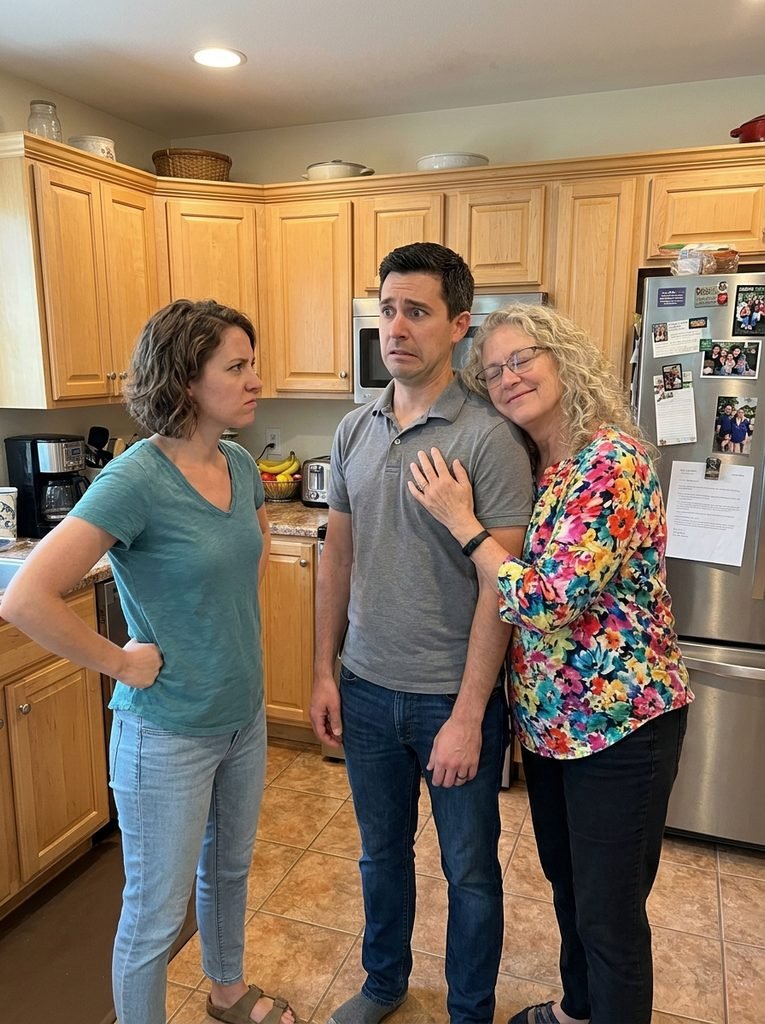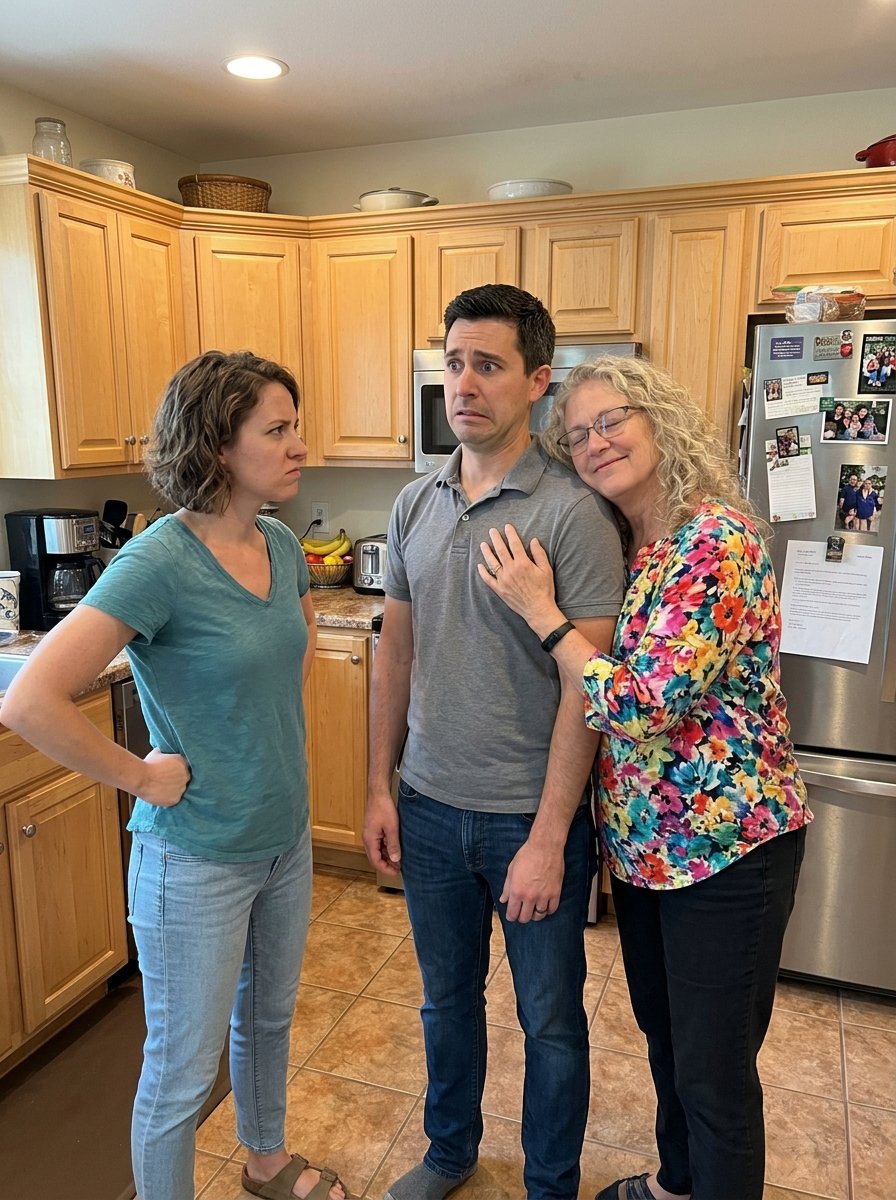
The kitchen was gone.
Where my mother-in-law’s oak cabinets had hung for thirty years, there were bare studs and torn drywall. Where the laminate countertops had been, there was nothing but cracked concrete subfloor and a tangle of copper pipes
capped with red plastic. Wires dangled from holes in the ceiling. The old double sink sat in the driveway next to a twenty-yard dumpster full of splintered wood and pink fiberglass insulation.
It was 4:30 on a Thursday afternoon in late April in Westerville, Ohio. The demolition crew from Buckeye Kitchen & Bath had just loaded their sledgehammers into the truck and pulled away. The air smelled like sawdust and old grease.
My husband, David, stood in the middle of the wreckage, brushing drywall dust off his navy polo shirt and grinning like a man who’d just built something instead of paying to tear it apart.
“Look at this, Rach,” he said, spreading his arms. “Can you believe it? By June, Mom’s going to have the kitchen she’s wanted her whole life. Quartz countertops. Soft-close drawers. One of those big farmhouse sinks.”
He was so proud. He’d spent two days taking off work to supervise the crew, and he’d posted three photos to Facebook with the caption, “Family first. Always.”
I walked across the gritty subfloor until I was standing right in front of him in the middle of the ruins. I looked him straight in the eye.
“David,” I said quietly, “did your mother tell you she listed this house for sale last week?”
The grin slid off his face.
“What?”
“The house,” I said. “Your mother’s house. The one we’re standing in. Did she tell you it’s going on the market in June? With a ‘brand-new chef’s kitchen’?”
I watched it hit him. First confusion, then disbelief, then the slow, sick dawn of understanding.
The color drained out of his face until he was nearly as white as the dust on his shirt.
“That’s not true,” he said.
I took my phone out of my back pocket, opened the listing, and turned the screen toward him.
Pages:
2My name is Rachel Brennan. I’m thirty-one, and I’m a dental hygienist at a family practice in Worthington, just north of Columbus.
David and I had been married three years that spring. We met at a friend’s Fourth of July cookout, when he spilled an entire bowl of potato salad on my sandals and then spent twenty minutes on his knees with a roll of
paper towels apologizing. He was funny and warm and a little clumsy. He sold commercial HVAC systems for a company in Dublin, Ohio, and he still called his mother every single night at nine o’clock.
I thought that last part was sweet. A man who loves his mother will love his wife, people always say.
Nobody tells you what happens when he loves his mother more.
David’s father died when he was fourteen, of a heart attack, on a Tuesday afternoon while he was mowing the lawn. After that, it was just David and his mother, Linda, in a three-bedroom split-level in Westerville. Linda worked as a receptionist at an insurance office and raised David by herself. She reminded him of that at every holiday dinner for the rest of his life.
“I gave up everything for that boy,” she’d say to whoever was sitting nearby, patting David’s hand. “Everything.”
David would beam. I’d smile and pass the mashed potatoes.
For the first two years of our marriage, I didn’t mind the nightly phone calls, or Linda showing up unannounced on Saturday mornings with a casserole and opinions about how I folded towels. I didn’t even mind when she called David to come over and change a lightbulb she could have changed herself.
Then there was the money.
It started small. Linda’s car needed new brakes, and David paid $640 out of our joint checking account. Her property taxes were due, and David covered $1,900. “Just this once,” he said. “She’s on a fixed income.” Her furnace died in January. David worked in HVAC, so that one I understood. He installed a new one at his employee discount, and we paid $3,200 for parts.
I didn’t argue much. She was his mother, she was a widow, and she’d raised him alone. I told myself that’s what family does.
But I noticed things.
I noticed that Linda went on a cruise to Cozumel with her friend Sharon the same month David paid her property taxes. I noticed the new leather couch in her living room. I noticed the Vera Bradley bags, the weekly manicures, and the brand-new Kia Telluride in her driveway that she said she leased “for a steal.”
I noticed, and I didn’t say anything, because every time I tried, David got hurt.
“Rachel, she raised me by herself. You have no idea what that was like.”
So I stopped trying.Our anniversary trip was supposed to be different. It was supposed to be ours.
For our first two anniversaries, we hadn’t done anything. Money was tight, we’d just bought our little ranch house in Clintonville, and David said we’d make up for it. So two summers ago, sitting on our back porch with a bottle of cheap wine, we made a plan.
We’d save for one year, every extra penny, and on our third anniversary we’d go to Maui for ten days. We’d stay at a resort in Ka’anapali with an ocean-view room. We’d snorkel and hike to waterfalls and do absolutely nothing
for the first time since our honeymoon, which had been three nights in Gatlinburg because that was all we could afford.
We opened a separate savings account at our credit union, Kemba Financial, and labeled it MAUI in the app. Every two weeks, I transferred $200 from my paycheck. David transferred $150 from his, when he remembered.
I picked up extra Saturday shifts at the dental office, and every dollar from those shifts went straight into MAUI. I stopped buying lunch and packed leftovers every day for a year. I sold my old road bike on Facebook Marketplace for $380 and put that in too.
By March, the MAUI account had $11,400 in it. I knew the exact number, because I checked it almost every night before bed. It was the happiest number in my life.
I booked everything in February: round-trip flights from Columbus to Kahului for $1,640, with ten nights at the resort in an ocean-view king room, prepaid at a discount. A sunset catamaran cruise. A snorkel trip to Molokini
Crater. I printed out the confirmations and stuck them on our refrigerator with a magnet shaped like a pineapple.
David kissed me in front of the refrigerator. “Best wife ever,” he said.
Five weeks later, he sat me down at our kitchen table on a Sunday night.
“Rach, I need to talk to you about something,” he said.
I knew from his face that it was bad.
“I canceled the trip,” he said.
I stared at him. “What?”
“The flights, the hotel, all of it. I called on Friday and canceled everything.” He took a breath. “Mom needs a new kitchen. It’s falling apart. The cabinets are coming off the walls, the countertops are cracked, and the dishwasher leaks. She’s been living like that for years, and she never complains. And I realized we have the money right there, sitting in an account doing nothing.”
“Doing nothing,” I repeated. “David, that’s our anniversary. We saved for a year.”
“I know. And we’ll save again. But a trip is just a temporary luxury. A kitchen is something she’ll use every day for the rest of her life.” He reached across the table for my hand. “She’s my mother, Rachel. She gave up everything for me. Family comes first.”
I pulled my hand back. “I’m your family.”
His face hardened. “Don’t do that. Don’t make me choose. You’re being selfish.”
“Selfish,” I said.
“She’s a sixty-three-year-old widow on a fixed income. You’re thirty-one. You’ve got your whole life to go to Hawaii.”
My eyes were burning, and my jaw locked so hard my teeth hurt.
“How much did the cancellation cost?” I asked.
He looked away. “The hotel refunded most of it. The flights gave us a credit. We lost about eleven hundred in fees.”
“And the rest of the money?”
“I moved it Saturday. All of it. I already gave Mom’s contractor the deposit. Eleven thousand.”
That was all of it. A year of packed lunches, extra Saturday shifts, and my bicycle, gone in one weekend.
I didn’t scream or throw anything. I didn’t say a single word. I just nodded, got up from the table, went into our bedroom, and closed the door.
I lay on the bed in the dark and listened to David call his mother at nine o’clock like always.
“She’s upset, Mom. She’ll get over it.”
Pages:
4I didn’t get over it. I got curious.
The next morning, I logged into our credit union account on my phone before work. The MAUI account showed a zero balance. On Saturday, the entire balance had been transferred to David’s personal checking account. On the same day, a check for $11,400 went out to Buckeye Kitchen & Bath LLC.
The MAUI account was a joint account. David had every legal right to withdraw from it, and I knew that. Ohio doesn’t care whose paycheck the money came from if both names are on the account.
But I wanted to know exactly what $11,400 had bought.
So that afternoon, on my lunch break, I called Buckeye Kitchen & Bath.
“Hi, this is Rachel Brennan,” I said. “My husband, David, hired you for a kitchen remodel at his mother’s house in Westerville. I’m handling some of the paperwork. Could you email me a copy of the contract?”
The receptionist was cheerful and helpful. “Oh, sure. The Brennan job on Hollyhock Lane? I’ll send it right over.”
Ten minutes later, the contract was in my inbox. It was six pages long. I read it in my car in the dental office parking lot, eating a cold turkey sandwich, and I felt my stomach slowly turn to ice.
The total contract price for the remodel was $36,800. It included custom shaker cabinets, quartz countertops, a farmhouse sink, a tile backsplash, new stainless appliances, recessed lighting, and luxury vinyl plank flooring.
Our $11,400 was just the deposit, about thirty percent. The remaining $25,400 was due in two installments, at cabinet installation and on completion.
On the last page, under “Customer,” there were two signature lines. The first said “Linda Brennan, Property Owner.” It was blank.
The second said “David Brennan, Responsible Party.” It was signed.
I read the paragraph above it three times.
“The Responsible Party agrees to be personally liable for all amounts due under this Agreement, jointly and severally with the Property Owner. In the event of nonpayment, Contractor may pursue collection against the Responsible Party and may file a mechanic’s lien against the Property as permitted by Ohio law.”
David hadn’t just given away our anniversary fund. He’d personally guaranteed another $25,400 his mother would owe, and he’d done it without telling me.
I sat in my car until the end of my lunch break, staring at that signature.
Then I drove to Linda’s house after work. I didn’t tell David. I just wanted to look at this kitchen that was apparently falling apart.
Linda wasn’t home. Her Telluride wasn’t in the driveway. But I still had the spare garage code David gave me years ago for emergencies, so I let myself into the garage to leave a note.
That’s where I saw the sign.
It was leaning against the wall behind her recycling bins, still wrapped in clear plastic: a red and white real estate sign on a metal post. COMING SOON, it said, and under that, Karen Delgado, Delgado Realty Group, with a phone number.I sat in my car in Linda’s driveway and searched the address on Zillow.
It popped up immediately. A Coming Soon listing had been posted eight days earlier: 412 Hollyhock Lane, Westerville, Ohio. Three bedrooms, two baths, 1,840 square feet. Estimated list price: $389,000.
The description said: “Coming June! Beautifully maintained split-level in sought-after Westerville school district, featuring a BRAND-NEW CHEF’S KITCHEN with custom shaker cabinetry, quartz countertops, farmhouse sink, and stainless appliances. Move-in ready! Don’t miss this one!”
The listing photos were all of the outside of the house and the living room. There were no photos of the kitchen yet, because the brand-new chef’s kitchen didn’t exist. It was going to be built with my anniversary money.
I zoomed in on the Zillow price history. Linda’s house was last appraised at $331,000 for tax purposes. With a brand-new kitchen, she was asking almost $60,000 more.
I looked up the property records on the Franklin County Auditor’s website. Linda owned the house outright. The mortgage had been paid off eight years ago with David’s father’s life insurance policy. Her name was the only one on the deed.
So when the house sold, every dollar would go to Linda.
I sat in her driveway in the dark for a long time. Then I opened Facebook and looked at Linda’s page, which I’d muted two years earlier.
Her most recent post was from three weeks before. It was a photo of Linda on a beach in a wide-brimmed straw hat, beside a tanned silver-haired man in a Hawaiian shirt. The caption said: “Naples, Florida, here I come! ❤️ Can’t wait to start this next chapter with my Frankie! Big news coming soon!”
Linda had a boyfriend in Florida named Frank. She was moving there and selling her house. And she’d let her son cancel his anniversary trip and guarantee $25,400 of debt to put a brand-new kitchen in a house she was about to sell for a profit she’d keep entirely for herself.
She hadn’t told him, because if he knew, he’d never have done it.
I drove home. David was on the couch watching the Cavaliers game.
“Where were you?” he asked.
“Running errands,” I said.
I went into the bathroom, locked the door, and sat on the edge of the tub. I could tell him right then. I could march out to the living room with my phone, show him the listing and the sign and the Facebook post, and blow everything up.
But I knew exactly what would happen. David would call his mother. Linda would cry. She’d say it was all a misunderstanding, that she was just “thinking about” selling someday, that the realtor jumped the gun, that I was trying to turn her son against her. David would believe her, because he always believed her. And the demolition would go ahead on schedule anyway, because the deposit was paid.
No. David needed to see it himself, standing in his mother’s destroyed kitchen with drywall dust on his shirt and his name on a contract for $36,800, so that there was nowhere for him to look except the truth.
The demolition was scheduled for Thursday. I could wait three days.
Pages:
6Those three days were the longest of my marriage.
David was in a great mood. He hummed in the shower. He talked about the kitchen at dinner every night: the cabinet color Linda picked, “Swiss Coffee,” the brushed nickel hardware, the big apron-front sink.
“She’s so happy, Rach,” he said on Tuesday night. “I haven’t heard her this happy since Dad died.”
I bet she is, I thought.
On Wednesday, I took my lunch break in the car and called an attorney. Her name was Denise Patterson, and she practiced family law in a brick office building on High Street in Worthington. My friend from the dental office had used her for her divorce. I wasn’t planning on a divorce, but I needed to know where I stood.
Denise listened to the whole story. When I got to the part about the “Responsible Party” clause, she made a small sound.
“Can you email me that contract?” she asked.
I did. She read it while I waited on the phone.
“Okay, Rachel,” she said. “Here’s the situation in plain English. The joint savings account is the simplest part. Ohio treats joint accounts as belonging to either owner, so David could legally withdraw from it. That’s frustrating, but it’s not illegal. But this contract is a bigger deal. David signed as a personal guarantor of his mother’s debt. If she doesn’t pay the remaining $25,400, the contractor can sue David personally. And if they get a judgment against him, they could potentially garnish his wages or go after your joint accounts.”
“Could they come after me?”
“You didn’t sign this contract, so you’re not personally liable for it. But in Ohio, debts that one spouse takes on during the marriage can still affect marital property. Your joint accounts, for instance. And if you two ever divorce, a court would have to decide who’s responsible for this debt.”
“So what do I do?”
“Right now? Three things. First, open a checking account in your name alone and have your paycheck deposited there, so your earnings aren’t sitting in an account a creditor can reach. You’re allowed to do that. You can still contribute to household bills. Second, don’t sign anything related to this remodel. Third, have a very honest conversation with your husband about what he signed.”
“There’s something else,” I said, and I told her about the real estate sign, the Coming Soon listing, and the boyfriend in Naples.
Denise was quiet for a long moment.
“Rachel,” she said finally, “I’m a lawyer, not a therapist. But it sounds to me like your mother-in-law knowingly used her son’s money to increase the sale price of a house she’s about to sell. And she let him personally guarantee the rest, without telling him she was moving.”
“Is that illegal?”
“It’s not illegal for her to sell her house. But it might be fraud in the inducement if she made false statements to get him to sign. If David wants his money back, he may have options. He’d need his own attorney for that, though. Not you, and not me.”
“Thank you,” I said.
“One more thing,” Denise said. “You said the demolition is tomorrow?”
“Yes.”
“Once those cabinets come out, there’s no going back. The contractor will have earned a good chunk of that deposit. If you want to stop this, today would be the day.”
I thought about it for a long time after we hung up.
Then I made my decision. I didn’t want to stop the demolition. I wanted David to see what his mother really was, with his own eyes, in a way he couldn’t explain away.
The kitchen was going to be torn out either way. Linda had signed up with the realtor. That house was getting a new kitchen and going on the market in June whether I said something on Wednesday or Thursday. The only question was whether David would finally see the truth.
Pages:
7So on Thursday, I took the afternoon off and drove to Westerville.
I stood on the edge of Linda’s kitchen while three men from Buckeye Kitchen & Bath ripped out the oak cabinets with crowbars. I watched them unbolt the old dishwasher, which didn’t leak at all, by the way. I watched them pry up the laminate countertops, which had exactly one tiny chip near the stove. I watched them haul it all out the side door to the dumpster.
The kitchen David said was falling apart had been perfectly fine. Dated, sure, with oak cabinets and almond appliances from 1994. But nothing was coming off the walls.
Linda wasn’t there. She’d gone to Naples for a long weekend, David said, to “visit a friend.” She’d left him in charge.
By 4:30, the kitchen was bare studs and concrete.
And then I asked David the question.
“Did your mother tell you she listed this house for sale last week?”
I showed him the Zillow listing on my phone.
He took it from my hand. He scrolled through it once, slowly, then again. I watched him read the words “BRAND-NEW CHEF’S KITCHEN.” I watched him see the estimated price of $389,000 and the “Coming June!” banner across the top.
“This is a mistake,” he said. “This has to be a mistake. Somebody posted the wrong house.”
“Go look in her garage,” I said.
He looked at me. Then he walked through the empty doorway, down the three steps to the garage, and over to the recycling bins.
I heard him stop.
When he came back, he was holding the real estate sign in its plastic wrap. COMING SOON. Karen Delgado, Delgado Realty Group.
His hands were shaking.
“There’s more,” I said quietly. I pulled up Linda’s Facebook post and handed him my phone again.
Naples, Florida, here I come! Can’t wait to start this next chapter with my Frankie! Big news coming soon!
David stared at the photo of his mother in her straw hat with a silver-haired man in a Hawaiian shirt he’d never met and never heard of.
“Who is Frank?” he whispered.
“I don’t know,” I said. “But I think your mother’s moving to Florida to be with him. And I think she’s selling this house to pay for it. And I think she let you pay for a new kitchen so she could sell it for sixty thousand dollars more.”
David sat down on an overturned five-gallon bucket in the middle of his mother’s gutted kitchen and put his face in his hands.
Pages:
For a long time, the only sounds were a dog barking somewhere down the street and the tick of the cooling dumpster in the driveway.
Then David said, very quietly, “She told me the cabinets were falling off the walls.”
“I know.”
“She told me she was scared to use the dishwasher because it might flood the basement. She cried on the phone about it, Rachel. She said she’d been afraid to ask me for help because she knew we were saving for something special.” He looked up at me, and his eyes were red. “She knew about Maui. She knew. She asked me how much we’d saved. I told her eleven thousand. And two weeks later, she called me crying about the kitchen.”
I sat down on another bucket next to him.
“David,” I said, “did you read the contract you signed?”
“Some of it. Mom said it was standard.”
I pulled up the contract on my phone and turned to the last page.
“Total contract price: $36,800,” I read. “You put down $11,400. The remaining $25,400 is due in two payments. And you signed as the Responsible Party. That means if your mother doesn’t pay, they can come after you. Personally.”
David stared at the screen.
“Thirty-six thousand dollars?” he whispered. “She told me the whole thing was eleven. She said eleven would cover everything.”
“She lied to you.”
He was silent for a long time.
“Why didn’t you tell me?” he asked finally. “If you knew all this. Why did you let them tear everything out?”
It was a fair question, and I’d thought about it for three days.
“Because if I’d told you on Monday, you would’ve called your mother,” I said. “She would have cried and told you I was making it up, or that the realtor made a mistake, or that she was just thinking about selling someday. And you would’ve believed her, because you always believe her. The demolition would have happened anyway, because you’d already paid the deposit, and I would have been the selfish wife trying to ruin your mother’s dream kitchen.”
He flinched.
“You called me selfish,” I said quietly. “When you canceled our anniversary. You said a trip was a temporary luxury, and family comes first.”
“I remember.”
“I’m your family, David. I’m your wife. I packed leftovers for lunch every day for a year. I worked Saturdays. I sold my bike. And you gave all of it to your mother without asking me, because she cried on the phone.” My voice cracked. “And she lied to you to get it.”
David put his face back in his hands, and his shoulders started to shake.
I’d never seen my husband cry. Not at our wedding, and not when his grandmother died. I’d never seen him cry until that afternoon, sitting on a paint bucket in the ruins of his mother’s kitchen.
I put my hand on his back and let him.
Pages:
That night, at exactly nine o’clock, David’s phone rang. It was his mother, calling from Naples like always.
David looked at the screen for a long time. Then he answered and put it on speaker.
“Hi, sweetheart!” Linda’s voice was bright and happy. “How did the demo go? Did you get pictures? Send me pictures!”
“It went fine, Mom,” David said. His voice was flat. “The kitchen’s gone.”
“Oh, I’m so excited! I can’t wait to see it when it’s done. You’re the best son in the world, you know that?”
“Mom,” David said. “Who’s Frank?”
There was a pause on the line, a long one.
“What?” Linda said.
“Frank. The man in your Facebook picture. In Naples.”
Another pause. Then a nervous laugh. “Oh, Frankie. He’s just a friend, honey. A friend from church. He moved down there a couple years ago.”
“And the house, Mom? The real estate listing? Coming June, brand-new chef’s kitchen, $389,000?”
The silence on the line was total.
“Who told you about that?” Linda’s voice had gone cold.
“Does it matter?”
“It was Rachel, wasn’t it? She’s been trying to turn you against me since the day you married her.”
I opened my mouth, but David held up his hand.
“Mom, I found the sign in your garage. I read the listing. I saw the Facebook post.” He took a breath. “Are you selling the house?”
Linda was quiet for a long moment. When she spoke again, her voice was different. It wasn’t bright or cold. It was defensive.
“Yes,” she said. “I’m selling the house. Frank and I are getting married in September. I’m moving to Naples. I was going to tell you.”
“When?”
“After the kitchen was done.”
“Why after?”
She didn’t answer.
“Because if I’d known,” David said slowly, “I wouldn’t have paid for it.”
“David, honey, you don’t understand. The realtor said with a new kitchen, I could get fifty, sixty thousand more for the house. Frank and I want to buy a condo on the water. I needed that money. And you had all that savings just sitting there.”
“It wasn’t sitting there, Mom. It was our anniversary. Rachel and I saved for a year.”
“Oh, you can go to Hawaii anytime,” Linda said dismissively. “You’re young. I’m sixty-three. How many chances am I going to get?”
David closed his eyes.
“And the contract?” he said. “You told me the whole remodel was eleven thousand. It’s thirty-six thousand eight hundred. I signed as responsible for the rest.”
“Well, I’ll pay the rest when the house sells. That was always the plan.”
“Then why did you have me sign as the responsible party?”
Silence.
“Because the contractor wouldn’t do it without a guarantor,” Linda finally said. “My credit score isn’t great since I leased the Telluride. And you have such good credit, sweetheart.”
David hung up the phone without saying goodbye.
He sat at our kitchen table staring at the black screen for a long time.
“She used me,” he said. “My whole life, she’s been telling me she gave up everything for me. And she just used me.”
I didn’t say anything. I didn’t need to.
Pages:
The next morning, David called in sick to work. It was the first sick day he’d taken in four years.
He sat at the kitchen table with a legal pad and his laptop and made a list. He called Buckeye Kitchen & Bath and asked to speak to the owner, a burly man named Rick Kowalski who’d been remodeling kitchens in Columbus for twenty-two years.
David put him on speaker and explained everything: the listing, the sale, the lies about the cost.
Rick was quiet for a moment. “Mr. Brennan, I’m sorry. I really am. I’ve seen a lot of family stuff in this business. But I’ve got a signed contract, and my guys already did two days of demo and hauled a full dumpster. I’ve got cabinets on order from a shop in Amish country that are non-refundable. I’m already into this job about nine grand.”
“I understand,” David said. “I’m not trying to get out of paying for work you’ve done. I just want to understand my options.”
“Well, here’s what I can do,” Rick said. “If your mother signs the contract as owner and takes over full responsibility, I’ll release you as the guarantor. But only if she gives me something secure for the balance. A cashier’s check, or a written agreement with the title company to pay me directly out of the sale.”
“Can you do that? Get paid at closing?”
“Happens all the time with house flips,” Rick said. “The title company holds back what’s owed to me and cuts me a check before anybody else sees a dime. Belt and suspenders.”
That afternoon, David made an appointment with an attorney of his own, a real estate lawyer named Gregory Hammond, recommended by Denise. Gregory listened to the story, read the contract, looked at the Zillow listing, and nodded slowly.
“Mr. Brennan, your mother knowingly made false statements to you to get you to pay a deposit and sign a personal guarantee,” he said. “She told you the remodel would cost eleven thousand when it was nearly thirty-seven. She told you she needed it for her own use when she was preparing to sell. She concealed the sale from you because she knew you wouldn’t pay if you knew. In Ohio, that could be fraud. You’d have a strong claim to get your $11,400 back.”
“I don’t want to sue my mother,” David said.
“I understand. Most people don’t. But you don’t necessarily have to sue her. You can make a demand, in writing, through an attorney, and offer her a way to fix it before anybody goes to court.”
“What kind of way?”
“A written agreement,” Gregory said. “She signs a promissory note to repay your $11,400 from the proceeds of the sale. We record a memorandum of the agreement with the county so the title company sees it. And she signs an irrevocable escrow instruction telling the title company to pay you, and Mr. Kowalski, directly at closing, before she receives anything. She also takes over the contract as owner, and Mr. Kowalski releases you as guarantor.”
“And if she refuses?”
Gregory took off his reading glasses.
“Then I’d advise you to consider filing suit to recover your deposit and asking the court for a lien on the property. With the sale coming up in June, she’d have every reason to settle quickly. Buyers don’t like lawsuits attached to houses.”
David looked at me. I was sitting in the chair next to him, holding his hand.
“What do you think, Rach?”
“I think,” I said, “it’s your mother, and it’s your decision. But I think you should get the money back. Not for the trip. For you. So she knows she can’t do this to you again.”
He nodded slowly. “Send the letter,” he told Gregory.Gregory’s letter went to Linda by certified mail and email on the following Monday. It was three pages long. It was firm, calm, and polite, and it was very clear.
Linda called David forty minutes after the email arrived. He didn’t answer. She called eleven more times that afternoon, and he didn’t answer any of those either.
That night at nine o’clock, she called again. This time, he picked up.
“How could you do this to me?” Linda was sobbing. “A lawyer? You sent a lawyer after your own mother? After everything I gave up for you?”
“Mom,” David said quietly, “you lied to me to get my money. You let me sign a contract for thirty-six thousand dollars without telling me you were moving. You let me cancel my anniversary trip with my wife. And you were going to sell the house and keep everything.”
“I was going to pay you back!”
“When?”
She didn’t answer.
“The letter doesn’t ask for anything unfair,” David said. “Just the $11,400 back from the sale, and for you to take over the contract so I’m not on the hook for your kitchen. That’s all. You’ll still have plenty of money for your condo in Naples.”
“And if I don’t sign?”
David closed his eyes. I’d never seen him look so tired.
“Then I’ll file a lawsuit, Mom. And the buyers will find out when the title search comes back.”
There was a long silence on the line.
“I don’t even know who you are anymore,” Linda said finally.
“I think,” David said, “that’s the first time you’ve ever really looked.”Linda signed eleven days later.
She hired her own attorney, a man from Westerville who reviewed Gregory’s agreement and apparently told her she’d be crazy not to sign it. I never learned exactly what he said. But on a rainy Friday in May, Linda signed a promissory note for $11,400, payable from the sale proceeds. She signed an irrevocable escrow instruction to the title company. She signed a new contract with Buckeye Kitchen & Bath as owner, and Rick Kowalski signed a written release removing David as guarantor.
She didn’t come to the signing in person. She signed at a UPS Store in Naples with a mobile notary and overnighted everything back to Gregory’s office.
The kitchen was finished in early June. I saw pictures on the Zillow listing when it went live: white shaker cabinets painted “Swiss Coffee,” gleaming quartz countertops, a big white farmhouse sink, and brushed nickel hardware.
It was beautiful. I’ll give her that.
The house sold in nine days for $394,500, over asking, to a young couple with a baby on the way.
At closing, the title company paid Buckeye Kitchen & Bath the remaining $25,400 and paid David $11,400 by wire transfer into his account at Kemba Financial, before Linda received a single dollar.
David moved all $11,400 into a new savings account that same afternoon. He opened it in both our names, and he labeled it in the app.
MAUI. AGAIN.
He showed me the screen that night at our kitchen table.
“I lost eleven hundred dollars in cancellation fees,” he said. “I’ll make that up myself. Out of my paychecks. You’re not putting in another cent until it’s back.”
“David…”
“I mean it, Rach.” He reached across the table and took my hand. “I owe you a lot more than eleven hundred dollars. I owe you an apology I don’t even know how to say.”
“Try,” I said.
He was quiet for a long time.
“I’m sorry I called you selfish,” he said. “You weren’t selfish. You were the only person in my life who was actually looking out for me. My mom spent thirty years telling me she gave up everything for me, and I spent thirty years trying to pay her back for it. And when she lied to me, you saw it. You saw it, and you waited until I could see it too.” He swallowed. “I’m sorry it took watching her kitchen get torn out for me to see what was right in front of me.”
“I’m sorry I made you find out that way,” I said.
“Don’t be,” he said. “If you’d told me on Monday, I would’ve believed her. You were right. I needed to stand in that kitchen.”David and I started couples counseling in July with a therapist in Clintonville named Dr. Amara Okafor, who specializes in what she calls “enmeshed family systems.” In our first session, she asked David to describe his relationship with his mother. He talked for forty-five minutes straight.
At the end, Dr. Okafor said gently, “David, it sounds like your mother taught you that love is a debt. That you owe her for raising you, and that the payments never end.”
David stared at her. “That’s exactly what it feels like.”
“And Rachel,” she said, turning to me, “it sounds like you learned to stay quiet so you wouldn’t make him choose.”
“Yes,” I said.
“The goal here isn’t for David to stop loving his mother,” Dr. Okafor said. “It’s for both of you to understand that your marriage is the family now. Your mother is a relative. You can love her. But she doesn’t get a vote on how you spend your money, your time, or your anniversaries.”
David nodded slowly.
He changed some things after that. He stopped calling his mother every night at nine. Now he calls her on Sunday afternoons. When she asks for money, which she still does, he says no. Last month, she called about her new condo’s HOA fees. David listened, said he was sorry she was stressed, and told her she’d have to work it out with Frank.
She hung up on him. He let her.
Linda married Frank in September, on a beach in Naples. We weren’t invited.
David found out from Facebook, the same way I’d found out about Frank. He looked at the photo for a long time: his mother in a white sundress and a crown of flowers, Frank beaming beside her, the Gulf of Mexico sparkling behind them.
“She looks happy,” he said finally.
“She does,” I said.
“I hope she is.” He closed the app. “I just can’t be the one paying for it anymore.”We went to Maui in April, one year late.
David booked everything himself this time: the same resort in Ka’anapali and the same ocean-view room. He even rebooked the sunset catamaran and the Molokini snorkel trip. He printed out every confirmation and stuck them on our refrigerator with the pineapple magnet.
The MAUI. AGAIN. account had $12,900 in it by then. David had replaced the eleven hundred in cancellation fees from his own paychecks within four months, and then kept going.
On our fourth anniversary, we sat on the beach at sunset with our feet in the warm sand, watching the sky over Lana’i turn orange and pink and purple. A pod of spinner dolphins jumped out in the distance.
“Rach,” David said. “Can I ask you something?”
“Sure.”
“When you walked up to me in Mom’s kitchen, in the middle of all that mess, what were you thinking?”
I thought about it. I remembered the bare studs and the dangling wires, the dust on his navy polo shirt, and his proud, oblivious smile.
“I was thinking that I love you,” I said. “And that I was about to break your heart. And that it was the only way I could think of to save us.”
David was quiet for a long time, watching the dolphins.
“It worked,” he said.
“Did it?”
“I’m sitting on a beach in Maui with my wife,” he said, reaching for my hand. “I think it worked.”
The sun slipped below the horizon. The sky went deep blue, and the first stars came out over the Pacific.
Somewhere in Naples, Linda was probably sitting on the balcony of her waterfront condo with Frank, in a home bought partly with the money from a kitchen her son paid to build.
I didn’t hate her anymore. I didn’t really feel anything about her at all.
A year earlier, my husband had sat across our kitchen table and told me a trip was a temporary luxury and family comes first. He was right about one thing. Family does come first.
He just had to stand in the dust of his mother’s gutted kitchen to understand who his family was.
Pages: