“Hey, bro. My bad. Totally forgot.”
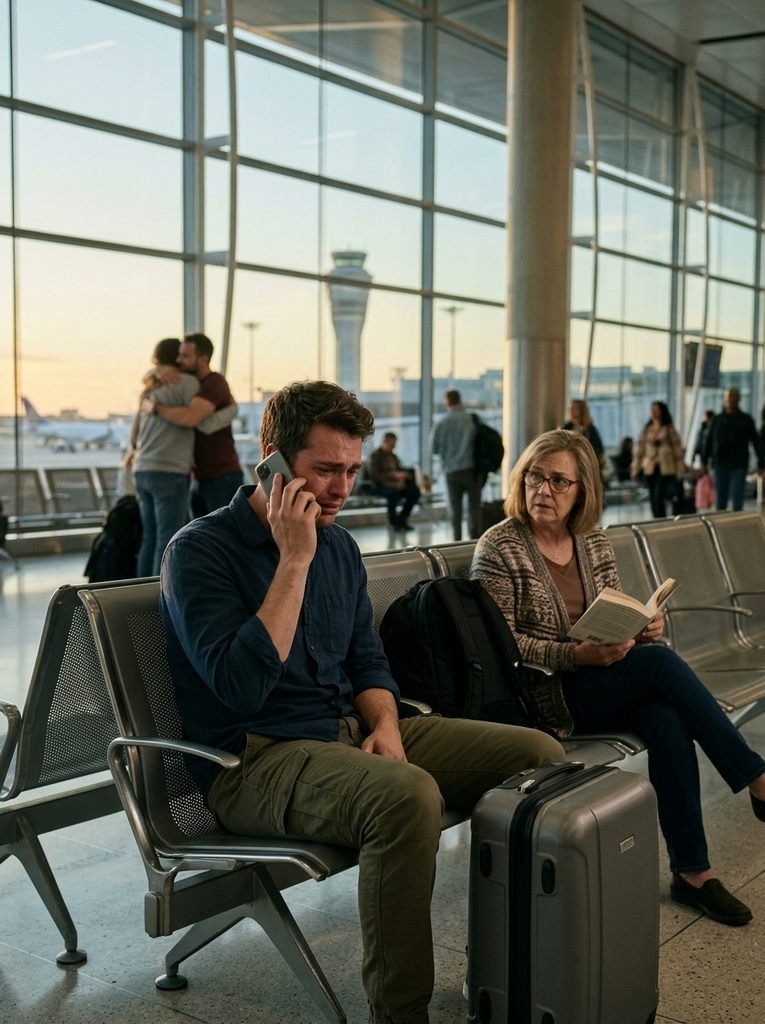
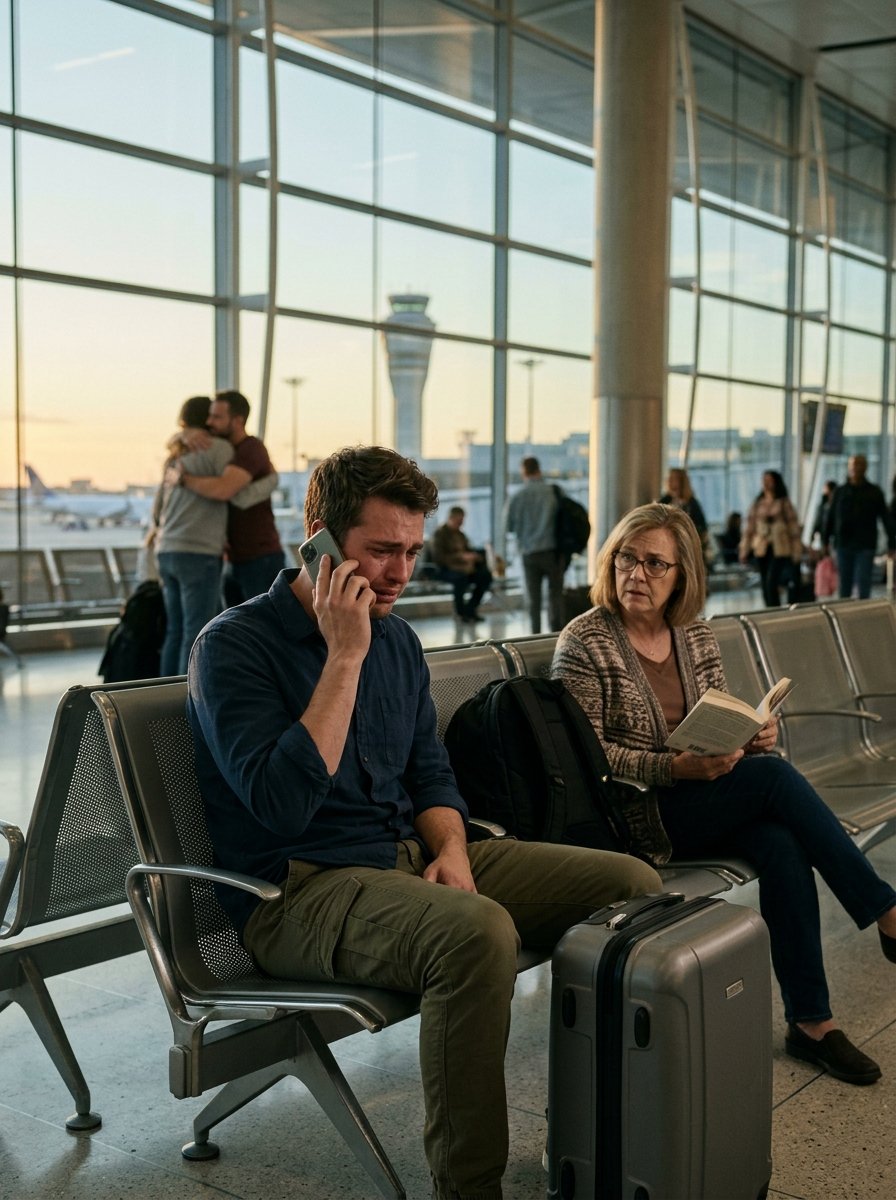
That was my brother’s explanation after I’d spent five hours sitting on a metal bench outside the Columbus airport.
I held the phone against my ear. Behind his voice I could hear music and people laughing. Travis sounded completely relaxed, like he’d forgotten to pick up milk on the way home.
“Ryan? You still there?”
I stared down at my suitcase, wedged between my shoes. My phone was at six percent. All around me, families were running into each other’s arms. A little girl in a pink jacket shrieked “Daddy!” and launched herself at a
man in a rumpled suit. An old man laughed out loud at a sign his granddaughter was holding: WELCOME HOME, GRANDPA. YOU STILL OWE ME FIVE BUCKS.
It was 8:45 on a Thursday night in October, and the sun had gone down an hour ago.
“I mean, I can come get you now,” Travis said. “Britney and I are at her friend’s place. Maybe in an hour or so?”
Another hour. He wanted me to keep waiting while he finished his night.
And then I started laughing.
Not because anything was funny. It came out of me in a long, cracked, helpless wave, loud enough that a woman with a stroller looked at me sideways and steered around my bench.
“That’s hilarious,” I said, still laughing.
“Seriously, Ryan. I can come.”
“Nah. Have a good night, Travis.”
I hung up.
Then I did something I’d never done in thirty years. I didn’t go home.
My name is Ryan Hale. I’m thirty, and I’m a network engineer from Ohio. My job is keeping systems running. When the servers at a hospital or a bank go down at two in the morning, I’m the one who gets the call and makes sure the lights stay on.
That’s been my job in my family too.
Travis is my older brother. He’s thirty-three, tall, and charming, the guy everybody notices the second he walks into a room. In our family, he’s always been the star.
When I was twelve, I won the school science fair with a working water filtration system built from soda bottles and charcoal. I carried the blue ribbon home and held it out to my mother. She barely glanced at it, because she was on the phone telling my aunt that Travis had made the varsity baseball team.
At my college graduation dinner, at an Olive Garden in Dublin, Travis tapped his glass halfway through the meal and announced he’d just passed his real estate licensing exam. My mother burst into tears of pride. Everyone at the table turned to congratulate him.
Under the table, my father squeezed my shoulder.
“I’m proud of you, son,” he said quietly. “Four years. Engineering. You did that.”
Years later, when I was promoted to senior network engineer at a company in Columbus, with a raise to $94,000 a year, I told Travis on the phone. He said, “Nice, nice. Hey, can you help me move a couch Saturday?”
So I learned to expect very little and keep giving anyway.
My dad was the one who noticed. Keith Hale was a plumber for thirty-one years. He drove an old blue Ford F-150 with 240,000 miles on it and a toolbox in the bed that weighed more than I did. He was a big, quiet man with forearms like fence posts. He worked hard, went to bed at nine, and kept every promise he ever made.
“A man’s word is the only thing he owns that nobody can repossess,” he used to say.
When he said he’d be somewhere, he was there. Every time. Every science fair, every band concert, every parent-teacher conference. He’d show up in his work clothes, smelling of pipe dope and coffee, and sit in the back row with his cap in his hands.
Two years before that night at the airport, my father died after fourteen months with pancreatic cancer.
After he was gone, his house felt like the last place on earth where I still belonged.
Dad left a simple will, drawn up years earlier by a lawyer in Grove City. Everything was to be divided equally between his two sons.
There wasn’t much. There was a checking account with about $11,000 in it, most of which went to the funeral home. There was a $25,000 life insurance policy through the plumbers’ union, which we split evenly. There was his old blue truck, which Travis took because, as he put it, “You’ve already got a car.” And there was the house.
It was a three-bedroom brick ranch on a quiet street outside Columbus, with a detached garage, a chain-link fence, and a vegetable garden in the backyard where Dad grew tomatoes every summer. He and my mother bought it in 1994 for $87,000. When they divorced in 2006, he refinanced to buy out her share, and he spent the next fifteen years paying it off. He made the last mortgage payment eighteen months before he got sick. I was there when he did it. He framed the bank letter that said PAID IN FULL and hung it in the hallway.
When the estate went through probate in Franklin County, the house passed to Travis and me as co-owners, half each. The new deed listed both of our names, as tenants in common.
At the time, I didn’t really know what that meant. I’d learn.
“We should both live there,” Travis said after the funeral, standing in Dad’s kitchen with a beer. “It’s paid off. No mortgage, no rent. We’d be idiots to sell it.”
He was right about that, at least. So we agreed to live there together.
The plan was simple. We’d split everything fifty-fifty: the property taxes, the homeowner’s insurance, the utilities, the groceries, the repairs. I set up a shared spreadsheet on Google Drive, because I’m a network engineer and that’s what we do. I even color-coded it.
For the first couple of months, it worked.
Then Travis “forgot” his half of the electric bill. Then he was “between paychecks.” His real estate career hadn’t exactly taken off. He’d sold two houses in three years and spent most of his commission checks before they cleared. Then the lawn became my job. Then the repairs. Then the cooking, the grocery shopping, the trash.
Then Britney showed up.
Britney was his girlfriend, a dental hygienist with long blond extensions and a laugh like a car alarm. At first she stayed a couple of nights a week. Within a few months, she was there almost every night. She never paid for anything. She ate my groceries, used my laundry detergent, and turned the thermostat up to seventy-four in January.
She also rearranged the house without asking. She moved Dad’s recliner to the garage because it “didn’t go with the vibe.” She took down the framed mortgage letter in the hallway and hung a canvas print that said LIVE LAUGH LOVE.
And one Saturday, while I was at work, she threw away my father’s tackle box.
I came home and found it in the garbage can by the side of the garage: Dad’s old green metal tackle box, full of fishing lures he’d collected over forty years. Hand-tied flies. A red-and-white spoon he’d used to catch a nineteen-pound walleye on Lake Erie in 1998. Rusty hooks wrapped in tiny paper envelopes with his handwriting on them.
I pulled it out of the trash after dark, when nobody could see me, and wiped the coffee grounds off it with a dish towel. My hands were shaking.
“She was just helping clean,” Travis said with a shrug when I brought it up. “It looked like junk, bro.”
“It was Dad’s.”
“I know. But come on. You don’t even fish.”
I started staying late at work. I’d sit in my car in the office parking garage, eating drive-through tacos and scrolling my phone until nine or ten at night, because going home meant walking into a house that didn’t feel like mine anymore.
The house Dad had left to both of us had turned into Travis and Britney’s place. I was the unpaid caretaker.
One night I updated the spreadsheet out of habit. Then I added up the totals.
In the twenty months since we’d moved in, I’d paid $19,840 toward the house. Travis had paid $4,310.
I was covering roughly eighty percent of everything.
That included the property taxes, which came due twice a year. Franklin County billed the house $3,960 a year, split into two installments of $1,980. I’d paid all four installments since Dad died. Every time I asked Travis for his half, he said he’d “get me back next month.”
He never did.
My friend Connor saw the spreadsheet over beers one night at a bar in the Short North. Connor and I had been friends since freshman year at Ohio State. He worked in commercial property management and could spot a bad deal from across a room.
He scrolled through it on my phone for a long time. Then he set it face down on the bar.
“Ryan. You’re paying for the privilege of being invisible in your own home.”
“He’s my brother.”
“He’s your roommate who doesn’t pay rent. Your brother would at least water the tomatoes.”
I laughed it off. I made excuses. Travis was going through a rough patch. Real estate was slow. He was still grieving Dad, in his own way.
I kept making excuses right up until the day I sat on that bench.
My company sent me to Denver for two weeks to oversee a network migration at a hospital system. It was a big project, the kind that gets your name noticed by the people who decide promotions.
The night before I left, I stood in the kitchen and asked Travis for three things.
“Water Dad’s tomato plants. Every other day. They’re the last ones he planted, and they’re still producing.”
“Got it.”
“Take the trash to the curb on Tuesdays.”
“Easy.”
“And pick me up from the airport on October 12th. My flight lands at 4:15.”
“Sure, bro. No problem.”
He even wrote it on a yellow sticky note and stuck it on the refrigerator: RYAN AIRPORT OCT 12 4:15.
The morning of the 12th, I texted him from the Denver airport: Landing at 4:15. See you at arrivals.
He replied with one word: Bet.
My plane touched down at 4:22. I collected my suitcase from baggage claim and walked out to the pickup area around five.
No Travis.
I texted him from outside Door 6: Here. Where are you?
Nothing.
I called. It went straight to voicemail.
At first I figured traffic was bad. Columbus rush hour on a Thursday can be brutal.
At six, I called again. Voicemail. I called Britney. Voicemail.
At seven, I called my mother.
“Honey, I’m sure he’s on his way,” she said. “You know how traffic gets.”
“Mom, it’s been two hours. He’s not answering.”
“Maybe his phone died. Don’t jump to conclusions, Ryan. Your brother loves you.”
Even then, she had an excuse ready for him. She always did.
So I sat on that bench while the sun went down. I watched parents hug their kids and couples kiss by the curb. My phone battery dropped to ten percent, then eight, then six.
At 8:45, Travis finally called.
You already know what he said.
I booked a room at a Marriott two miles from the airport using the last of my phone battery. It cost $189 for the night. I took an Uber for $14, ate a nineteen-dollar turkey club from room service, plugged in my phone, and slept nine hours straight.
When I woke up, I lay in that crisp white hotel bed and stared at the ceiling for a long time.
I didn’t feel angry. That was the strange part. I felt light, like I’d been carrying a backpack full of bricks for two years and somebody had finally cut the straps.
I called Connor at eight in the morning.
“He forgot,” I told him. “Five hours. He was at a party.”
Connor was quiet for a second. “Where are you?”
“A Marriott by the airport.”
“Good. Stay there.” I heard him moving around. “Listen, my company manages a building in Grandview. There’s a studio apartment that just opened up. Six-forty a month. Clean, quiet, washer and dryer in the building. You want to see it?”
I thought about Dad’s house. The LIVE LAUGH LOVE canvas. The thermostat at seventy-four. Britney’s laugh echoing down the hallway at midnight.
“Yeah,” I said. “I want to see it.”
I signed the lease three days later. A twelve-month lease at $640 a month, plus a $640 security deposit. I paid the first month and the deposit with my debit card. The leasing agent handed me two silver keys on a ring, and I held them in my palm like they were made of gold.
Clean floors. White walls. A kitchen the size of a closet, but my kitchen. My own keys. Nobody waiting for me to cover their bills.
I drove to Dad’s house on a Tuesday afternoon when I knew Travis would be at a showing and Britney would be at work. I packed my clothes, my laptop, my books, and a few things from my room. Then I went out to the garage and got Dad’s green tackle box. I took the framed PAID IN FULL letter out from behind a stack of Britney’s boxes in the hall closet.
On the way out, I stopped in the backyard.
Dad’s tomato plants were dead. Brown, shriveled stalks hung off their wire cages. The soil was cracked and dry. Nobody had watered them in two weeks.
I stood there a long time.
Then I got in my car and drove to my new apartment.
Four days passed before Travis texted me. It wasn’t to ask where I was.
Yo did you pay the electric bill? Got a notice on the door.
I stared at the message for a full minute.
The electric account was in my name. I’d set it up after Dad died, because Travis’s credit was too low for the utility company to open an account without a $300 deposit. I’d been paying it every month on autopay.
That morning I’d canceled the autopay.
Handle it, I typed back.
I also called American Electric Power and asked how to take my name off the account at the house, since I no longer lived there. The woman on the phone was very kind.
“We can close the account in your name,” she said. “If someone else is living at the property, they’ll need to open a new account in their own name. We’ll send a notice to the address so service isn’t interrupted without warning.”
“Please do that,” I said.
Pages:
5Ten days after I left, Travis finally opened the door to my old bedroom and saw that it was empty. He called me that night.
“Dude, where the heck are you?”
“I moved out.”
There was a long silence.
“You moved out? When?”
“Ten days ago, Travis. The day after you left me at the airport.”
“That’s what this is about? The airport thing? Bro, I said my bad.”
“It’s not about the airport.”
“Then what’s it about?”
I didn’t know how to explain twenty months of spreadsheets, dead tomato plants, and a tackle box in the trash in a single phone call. So I didn’t try.
“I needed my own space,” I said.
Another pause. Then the question I knew was coming.
“Okay, but are you still paying your half of the bills?”
I almost laughed again.
“No, Travis. I’m not paying bills for a house I don’t live in.”
“You can’t just leave! What about the electric? The trash? The water bill came, and it’s like a hundred and forty bucks. And the grass is getting long, and the gutters are…”
“Figure it out,” I said. “You’re thirty-three years old.”
“This is messed up, Ryan. You’re just abandoning me.”
“I’m not abandoning you. I’m moving out of a house where I paid eighty percent of everything and got treated like the help.”
“That’s not fair.”
“Twenty months, Travis. I kept a spreadsheet. I paid $19,840. You paid $4,310. You want to talk about fair?”
He was quiet.
“I’ll send you the spreadsheet,” I said. “Goodnight.”
My mother called two days later.
“Ryan, honey, Travis told me what happened. I think you should talk this through with him. He never meant anything by the airport. You know how he is.”
“I do know how he is, Mom. That’s the problem.”
“He’s your brother. Your father would want you two to stick together.”
That one hurt. Because I knew exactly what Dad would have wanted. He would have wanted Travis to show up at the airport.
“Mom, Dad kept every promise he ever made. Travis can’t keep a promise to water a tomato plant. I’m done carrying him.”
“You’re being very hard on him.”
“Somebody has to be.”
She sighed the way she always did when I disappointed her.
For the next few months, life got quiet and good. I worked. I went to the gym. I cooked dinner in my tiny kitchen and ate it at a little table by the window that looked out on a maple tree. Connor and I started playing pickup basketball on Sunday mornings. I started sleeping through the night.
I didn’t hear much from Travis. A text here and there. Did you take the extra garage door opener? (I hadn’t.) Where’s the Wi-Fi password? (It was on a sticker on the router, where it had always been.)
I set Dad’s tackle box on the shelf above my desk, where I could see it while I worked.
Then, four months after I moved out, on a gray Tuesday in February, my phone rang. It was a number I didn’t recognize.
“Ryan? It’s Marcus. Marcus Webb. I play softball with Travis.”
I vaguely remembered him, a big, friendly guy who sold insurance.
“Hey, Marcus. What’s up?”
“Look, man, I don’t want to get in the middle of anything. But I was over at the house Saturday watching the game, and there’s a stack of mail on the kitchen counter about this high.” I could almost hear him holding his hand a foot off the table. “I saw an envelope from the Franklin County Treasurer. It said FINAL NOTICE in red letters. I asked Travis about it, and he just said, ‘It’s junk, don’t worry about it.’”
My stomach went cold.
“Marcus, did you see what it was for?”
“Property taxes, I think. Delinquent. I didn’t want to snoop, man. But I figured you’re on the deed too, right? You’d want to know.”I looked it up that night. Franklin County puts property tax records online. I typed in Dad’s address, and the parcel record came up.
The first-half tax payment, due in January, was unpaid. So was the second half from the previous year, the one due in June, which I’d assumed Travis had paid after I left because I’d reminded him about it twice.
He hadn’t.
With the penalties and interest, the delinquent balance was $4,216.38.
There was a note on the record: Delinquent. Certified to the delinquent tax list.
My hands went numb. I’d worked with enough property managers through Connor to know that delinquent taxes don’t just sit there forever. The county adds penalties and interest. It publishes your name on a delinquent tax list. And if taxes stay unpaid long enough, the county can file to foreclose on the property and sell it to collect what’s owed.
My father had paid on that house for twenty-seven years. He’d framed the letter that said PAID IN FULL. And my brother was going to let the county take it because he wouldn’t open his mail.
And it wasn’t just Travis’s house. Half of it was mine.
I called the Franklin County Treasurer’s office the next morning on my lunch break. A patient woman named Mrs. Delgado walked me through it.
“Yes, the parcel is delinquent,” she said. “Three notices have been mailed to the property address. There’s still time to pay before any foreclosure action, but I’d strongly encourage you to address it soon. You can also look into a payment plan.”
“Can I pay just my half?”
“I’m sorry, sir. The tax is owed on the whole parcel. We can’t split it between owners. Whoever pays, pays the full amount.”
I hung up and sat in my car staring at the steering wheel.
There it was again. If I paid, I’d be bailing Travis out for the hundredth time. If I didn’t pay, I could lose my half of my father’s house.
I called Connor that night.
“Don’t just pay it,” he said. “Not yet. Talk to a real estate lawyer first. There are ways to protect yourself so you’re not just throwing money into a hole. I know a guy.”
The guy was a real estate attorney named Howard Brennan, with an office in German Village. Connor’s company used him for title issues and disputes between co-owners.
Howard was in his late fifties, bald, with wire-rimmed glasses, a Cleveland Browns mug on his desk, and the calm voice of a man who has seen every kind of family fight there is. His consultation fee was $250 for the first hour.
I brought everything: the will, the probate documents, the recorded deed, a printout of the county tax record, and the spreadsheet with twenty months of payments, every one backed by a bank statement.
Howard read for a long time without speaking. Then he took off his glasses.
“Mr. Hale, let me explain where you stand. You and your brother own this house as tenants in common, fifty percent each. That means each of you has an equal right to use the whole property, and each of you is responsible for your share of the carrying costs: the taxes, the insurance, the necessary repairs.”
“He hasn’t paid any of it.”
“I can see that.” He tapped the spreadsheet. “This is very good documentation, by the way. Most people come in here with a shoebox of receipts and a bad memory.”
“I’m a network engineer. We document everything.”
He almost smiled. “Here’s the important part. In Ohio, when one co-owner pays more than his share of the taxes and other necessary costs to protect the property, he can generally seek to be reimbursed from the other co-owner. The law calls that contribution. Your records may support a claim for a significant amount of what you’ve overpaid.”
“Okay.”
“And there’s a bigger picture. Any co-owner who no longer wants to share ownership can ask a court to divide the property. That’s called a partition action. With a house, you can’t exactly cut it in half. So in practice the court typically orders the property sold, and the proceeds are divided between the owners, often after adjusting for things like unpaid taxes or one owner’s overpayments.”
I swallowed. “So I could force a sale. Of Dad’s house.”
“You could ask the court to,” Howard said carefully. “But that’s usually the last resort. Lawsuits are expensive and slow, and they’re hard on families. In my experience, the best outcome is a negotiated agreement. One owner buys the other out, or both agree to sell. Often the lawsuit never has to be filed at all. A clear letter from an attorney is enough to get everyone’s attention.”
He leaned back in his chair.
“So, Mr. Hale. What do you actually want?”I thought about it for a long time.
I thought about the blue ribbon. The Olive Garden dinner. The sticky note on the refrigerator. Five hours on a bench.
“I don’t want to destroy him,” I said finally. “I just want to stop being responsible for him. I want my name off the problem.”
Howard nodded slowly. “That’s a very reasonable thing to want.”
“And I don’t want the county to take the house. My dad paid for that house. He worked twenty-seven years to pay for it.”
“Then here’s what I’d recommend.” He picked up a pen. “First, we protect the property. Have you checked the homeowner’s insurance?”
I blinked. “The insurance?”
“If taxes aren’t being paid, I’d bet other bills aren’t either. If that house burns down and there’s no insurance, your half is worth whatever the lot sells for.”
I pulled out my phone and logged into the insurance company’s website. Dad’s old policy with Ohio Mutual had been transferred into both our names after probate. I’d paid the annual premium of $1,140 the first year. Travis had promised to pay the second year.
The policy status said: CANCELED — NONPAYMENT. Effective date: December 3rd.
For two months, my father’s house had been sitting there with no insurance at all.
I turned the phone around so Howard could see it.
He winced. “Then that’s the first call you make when you leave this office.”
I called the insurance agent from the parking lot. Her name was Sheila Park, and she’d written Dad’s original policy back in 1994.
“Oh, Ryan,” she said when I explained. “I’m so sorry. We sent three notices to the house. Your brother never responded. I can write a new policy today. Since there was a lapse in coverage, the premium will be a little higher. I can get you covered for $1,320 a year.”
“Do it,” I said. I paid the full premium with my credit card and had her email me the declarations page. I saved it in a new folder on my laptop labeled DAD’S HOUSE.
Then I drove home, logged into the Franklin County Treasurer’s website, and paid the delinquent property taxes in full: $4,216.38.
It hurt. But I wasn’t paying for Travis this time. I was protecting my half of my father’s house. And now I was doing it with a lawyer, with receipts, and with a plan.
Howard’s letter went out by certified mail the following Monday.
He’d shown me a draft first. It was three pages, clear and calm. It laid out the history of the payments, with my spreadsheet attached as an exhibit. It stated that I had paid $4,216.38 to bring the property taxes current and $1,320 to restore homeowner’s insurance on the property, after both had lapsed because of nonpayment. It said I was seeking reimbursement for Travis’s share of those costs, and of the costs I’d overpaid since our father’s death.
Then it set out three options.
One: Travis could buy out my fifty percent interest at fair market value, determined by an independent appraisal, with credit to me for his unpaid share of expenses.
Two: we could agree to list the house for sale together, split the proceeds equally, and settle the unpaid expenses at closing.
Three: if we couldn’t reach an agreement within sixty days, I would ask the Franklin County Court of Common Pleas to order a partition of the property.
The letter ended with a paragraph Howard had added at my request:
Mr. Ryan Hale has asked me to convey that he would much prefer to resolve this matter directly with his brother, without litigation. He remains open to a conversation at any time.
The certified mail receipt came back to Howard’s office signed by Travis on Thursday.
That afternoon, my phone rang fourteen times in two hours.
I let it ring. I was in a meeting about firewall configurations, and for the first time in my life, my brother’s emergency could wait until I was done.
When I finally walked out to my car, I listened to the first voicemail.
“Ryan, I just got some papers from a lawyer. What is this?” His voice was high and shaky. “It says something about a court? About selling Dad’s house? Call me back. Seriously. Call me back right now.”
The second voicemail was angrier.
“You’re suing me? Your own brother? Over some bills? Mom’s going to lose her mind.”
The third was barely a whisper.
“Ryan, please. I don’t understand what any of this means. Please just call me.”I called him back that night from my apartment, sitting at the little table by the window, with Dad’s tackle box on the shelf above me.
He picked up on the first ring.
“Ryan. Thank God. What is this? Are you really suing me?”
“Nobody’s suing anybody yet, Travis. Did you read the whole letter?”
“I read the part about the court.”
“Read the rest of it.”
I heard paper rustling. He was quiet for a long time.
“The taxes,” he finally said. “You paid the taxes?”
“Four thousand, two hundred sixteen dollars. They were delinquent, Travis. The county had sent three notices. Marcus saw the final notice on the counter. If they’d stayed unpaid, the county could eventually have foreclosed on Dad’s house.”
“I thought those were junk mail.”
“They said FINAL NOTICE in red.”
He didn’t answer.
“And the insurance,” I said. “Did you know the homeowner’s insurance was canceled in December? For two months, that house had no coverage. If there’d been a fire, or a pipe had burst, we’d have gotten nothing. Dad’s house. Nothing.”
I heard him breathe in sharply.
“I didn’t know,” he said. “Ryan, I swear to God I didn’t know.”
“You didn’t open the mail.”
“I didn’t open the mail,” he repeated, very quietly.
For a while neither of us spoke.
“So what happens now?” he asked. “Are you really going to make them sell it?”
“I don’t want to, Travis. I want you to pick one of the options. If you want to keep the house, you can buy out my half. If you can’t, we sell it together and split the money. Either way, I’m done paying for a house I don’t live in, and I’m done being the only adult in it.”
“I can’t buy you out. You know I can’t. I don’t have that kind of money.”
“Then we sell it.”
“It’s Dad’s house, Ryan.”
“I know whose house it is,” I said, and my voice cracked for the first time. “I’m the one who watered his tomatoes. You let them die.”
Silence.
“I’m sorry about the tomatoes,” Travis said.
It was the first time I could remember him apologizing for anything without the word “but” attached.
My mother called the next day, exactly as Travis had predicted.
“Ryan, a lawyer? Against your own brother? What would your father think?”
“Mom, did Travis tell you the taxes were delinquent?”
A pause. “He mentioned there was some confusion about a bill.”
“There was $4,216 in unpaid property taxes and penalties. The insurance was canceled. The county could have taken the house. I paid all of it to protect it. And for twenty months before that, I paid eighty percent of everything while he and Britney lived there for free.”
She was quiet.
“I didn’t know it was that bad,” she said finally.
“Nobody ever asks, Mom. Everybody just assumes I’ll handle it.”
“You always have.”
“That’s exactly the problem.”
She didn’t argue. For the first time in my life, my mother didn’t have an excuse ready for Travis.
Howard arranged for a licensed appraiser to inspect the house so both of us would know what it was actually worth. The appraiser, a careful woman named Linda Torres, spent two hours there with a tape measure and a camera. Travis let her in. I wasn’t there.
Her report came back three weeks later. The house was valued at $264,000. It would have been more, she noted, if it weren’t for the overgrown yard, a leaking gutter, a water stain on the bedroom ceiling, and a cracked window in the garage.
Travis called me after he read the report.
“Two hundred sixty-four thousand,” he said. “Dad paid eighty-seven.”
“He paid a lot more than that, Travis. He paid on it for twenty-seven years.”
“Yeah.” He was quiet. “Ryan, I tried to get a loan. To buy you out. I went to two banks.”
I hadn’t expected that.
“What happened?”
“My credit score’s 541.” He laughed bitterly. “I’ve got collections from a credit card I stopped paying. And there’s an electric bill in collections from before Dad died that I forgot about. The loan officer looked at me like I’d tracked mud on her carpet. She said, ‘Mr. Hale, I’d suggest working on your credit for a couple of years.’”
“I’m sorry, Travis.”
“Don’t be. It’s my fault.” He took a breath. “I think we have to sell it.”Two weeks later, we met at Howard’s office to sign the agreement. It was the first time I’d seen my brother in five months.
He’d lost weight. He looked tired. He wore a wrinkled button-down shirt, and for the first time I could remember, he didn’t walk into the room like he owned it. He sat down across from me and looked at the table.
“Hey,” he said.
“Hey.”
Britney wasn’t with him. I learned later that she’d moved out in March. She’d taken the flat-screen TV, the LIVE LAUGH LOVE canvas, and, according to Travis, “every single towel in the house.”
Howard walked us both through the agreement. Travis had hired his own lawyer for an hour to review it, on Howard’s advice, so nobody could ever say he didn’t understand what he was signing.
We’d list the house together with a local real estate agent. Travis would not be the listing agent. Howard had gently pointed out that his license had lapsed anyway, because he hadn’t completed his continuing education hours. Travis would keep living in the house until it sold, but from now on he’d pay the utilities himself, in his own name, and keep the yard mowed.
At closing, after the real estate commission and closing costs, the proceeds would be split. But before the split, I’d be reimbursed from Travis’s half for his share of the taxes and insurance I’d paid to save the house, $2,768.19, and for part of the expenses I’d overpaid during the twenty months we lived there together.
Howard and I had gone over the numbers carefully. My spreadsheet showed I’d overpaid by about $7,765. Howard thought I could probably recover most of it in court, but it would cost thousands in legal fees to fight for it.
I looked at my brother across the table, staring at the papers with his jaw clenched.
“Make it five thousand,” I told Howard. “For the overpayments. Plus the taxes and insurance.”
Travis’s head came up. “Ryan, the spreadsheet says almost eight.”
“I know what it says.”
“Why would you…”
“Because I want this to be over,” I said. “And because Dad wouldn’t want us fighting over every dollar in a lawyer’s office. He’d want it fair. Not perfect. Fair.”
Travis looked at me for a long moment. His eyes were wet.
“Okay,” he said. “Five thousand.”
He signed first. I watched him read every page before he initialed it, his lips moving slightly the way Dad’s used to when he read the newspaper.
The house went on the market in May, listed at $269,900. Our agent, a no-nonsense woman named Carol Fitch, told us to fix the gutter, repair the ceiling stain, and replace the cracked garage window before the photos.
Travis did all three himself.
He watched YouTube videos and borrowed a ladder from the neighbor. He used Dad’s old tools from the garage, the ones still in the battered red toolbox with KEITH HALE stenciled on the lid. He sent me photos of each finished repair with captions.
Gutter fixed. Didn’t fall off the ladder. Dad would be shocked.
Ceiling patched. Took three tries. Looks okay?
I wrote back: Looks good, Trav. Better than okay.
On a Saturday in late May, the weekend before the open house, I drove over to help him clean out the garage.
It was the first time I’d been back since the day I moved out. The yard was freshly mowed, with crisp edges along the sidewalk. Somebody had planted marigolds in the bed by the front porch.
Travis was waiting in the driveway in an old Ohio State T-shirt, holding two cups of gas-station coffee.
“I didn’t know how you take it anymore,” he said, handing me one. “I got you cream and two sugars. That’s how you used to take it.”
“That’s still how I take it.”
He nodded, looking pleased with himself.
Pages:
We worked in the garage all morning. It was full of forty years of Dad: coffee cans of screws sorted by size, coils of copper pipe, a dented metal lunchbox, and a calendar from a plumbing supply company still turned to the month he went into hospice.
Around noon, Travis pulled a cardboard box off the top shelf and set it on the workbench.
“Ryan. Look at this.”
Inside were dozens of envelopes and folded papers, all in Dad’s blocky handwriting.
They were ribbons. My science fair ribbons. Every one. The blue one from sixth grade, a red one from eighth grade, the regional first-place ribbon from my sophomore year of high school. My college acceptance letter from Ohio State. A program from my graduation with my name circled in pen. A printout of the company newsletter announcing my promotion to senior network engineer.
At the bottom was a sheet of yellow legal paper, folded in thirds. Written across the top in Dad’s handwriting: RYAN — THINGS HE DID.
It was a list. Dozens of items, each with a date, in his careful print, going back to when I was seven.
Fixed the neighbor’s computer. Wouldn’t take money.
Science fair, 1st place. Water filter. Mom missed it. I didn’t.
Drove 3 hrs in snow to bring me home from the hospital after the gallbladder.
Paid for half my chemo copays. Thinks I don’t know. I know.
I put my hand over my mouth.
Travis was reading over my shoulder. He was very quiet.
“He kept all of it,” he said. “Every single thing.”
I couldn’t speak.
“There’s one for me too,” Travis said, reaching back into the box. He pulled out another folded sheet of yellow paper and opened it. TRAVIS — THINGS HE DID.
It was shorter. Much shorter.
Made varsity baseball.
Got his real estate license.
Pulled me out of the ditch on Route 23, 2015.
At the bottom, in shakier handwriting from near the end, one more line:
He’ll figure it out. He’s slower than Ryan. But he’ll get there. Somebody just has to stop catching him.
Travis read it three times. Then he sat down hard on an overturned bucket in the middle of the garage, put his face in his hands, and cried.
I didn’t know what to do. I’d never seen my brother cry. Not at the funeral, not at the reading of the will. Not once.
I sat down on the concrete floor next to him.
“Somebody just has to stop catching him,” Travis said through his hands. “That’s you, isn’t it? That’s what you did. You stopped catching me.”
“I guess so.”
“I left you at the airport for five hours.” His voice broke. “I was at Britney’s friend’s house playing beer pong. I saw your texts, Ryan. I saw them. I thought, he’ll get an Uber. He always figures it out.”
“I did figure it out.”
“I know. You moved out, and I didn’t even notice for ten days.” He wiped his face with the back of his hand. “I’m so sorry, man. For the airport. For the bills. For the tackle box. For all of it.”
I looked at him, my older brother, sitting on a bucket in our father’s garage with tears running down his face.
“I know, Trav,” I said. “I know.”
Pages:
The house sold in eleven days to a young couple named Daniel and Priya Okafor, who were expecting their first baby in September. They offered $272,500, above the asking price. Their inspector found nothing serious.
At the final walkthrough, Priya stood in the backyard and looked at the empty garden bed by the fence.
“Did someone used to grow vegetables here?” she asked.
“Our dad,” Travis said. “Tomatoes. Every summer.”
“Oh, I love that,” she said. “I’m going to grow tomatoes.”
Travis and I looked at each other. Neither of us trusted our voice.
The closing was on a Wednesday in late June at a title company in Westerville. Travis wore a tie. I’d never seen him in one outside a funeral.
The closing attorney, a brisk woman named Ms. Abernathy, walked us through the settlement statement line by line. I read every number, because I always do. The real estate commission was $16,350. Closing costs and the transfer tax came to about $3,100. After that, the net proceeds came to $253,050.
Then came the credits. From Travis’s half, I received $2,768.19 for his share of the property taxes and insurance, plus the $5,000 we’d agreed on for the overpaid expenses. Ms. Abernathy wrote it all down exactly the way Howard and I had negotiated.
When it was done, my share came to $134,293.19. Travis’s came to $118,756.81.
Travis looked at the number for a long time.
“I’ve never had this much money in my life,” he said quietly.
“Don’t spend it all on beer pong,” I said.
He laughed, a real laugh, the first one I’d heard from him in months.
Before we left, Ms. Abernathy slid two keys across the table toward the buyers. Daniel Okafor picked them up and held them in his palm, exactly the way I’d held the keys to my studio apartment eight months earlier.
In the parking lot afterward, Travis stopped me beside my car.
“I want to tell you what I’m doing with the money,” he said. “Not because you have to approve it. I just want somebody to know. So I can’t back out.”
“Okay.”
“I paid off the collections already. Both of them. Yesterday. I called the companies myself.” He pulled a folded piece of paper out of his pocket. “I’m putting twenty thousand into a savings account I can’t touch for
emergencies. I signed up for a credit counseling program through a nonprofit in Columbus. And I’m going back to finish my continuing education hours to get my real estate license reactivated. For real this time.”
He unfolded the paper and showed me. It was a budget. A real budget, handwritten, in columns. Rent. Utilities. Groceries. Car insurance. Savings.
At the top, he’d written: TRAVIS — THINGS HE’S GOING TO DO.
I looked at it for a long time.
“Dad would like that,” I said.
“Yeah.” He folded it carefully and put it back in his pocket. “I hope so.”
I put most of my share into a high-yield savings account and an index fund, the way Dad would have wanted. Slow and steady. No flash.
Then, in August, I used $48,000 of it as a down payment on a two-bedroom townhouse in Grandview, four blocks from my studio. The deed was recorded in my name alone. I read every page at the closing and initialed each one.That was eight months after I sat on that bench at the airport.
On the first warm Saturday of the following spring, I planted tomatoes in a raised bed on the tiny patio behind my townhouse. Better Boys and Early Girls, the same kinds Dad always grew.
Travis came over to help. He showed up on time, actually ten minutes early, with a bag of potting soil over his shoulder and two coffees in a cardboard tray. Cream and two sugars.
He’d moved into a one-bedroom apartment in Hilliard and was working as a real estate agent again, with his license reactivated. He’d closed three deals since January. He was dating a nice, quiet woman named Elena, a middle school science teacher, who laughed at his jokes but also made him split the check. His credit score had climbed to 628.
“Still not great,” he told me. “But it’s going the right direction.”
We spent the afternoon on our knees in the dirt, planting tomatoes. Halfway through, Travis sat back on his heels and wiped his forehead with his wrist.
“Hey,” he said. “Your company’s sending you to that conference in Atlanta next month, right?”
“Yeah. Why?”
“What day do you fly back?”
I looked at him. “The fourteenth. I land at 6:10.”
He took his phone out of his pocket, opened his calendar, and typed it in. Then he set an alarm. Then he set a second alarm, an hour earlier. Then he held the phone up so I could see the screen.
PICK UP RYAN. AIRPORT. 6:10 PM. DO NOT FORGET. SERIOUSLY.
I laughed. This time, it was actually funny.
“You don’t have to do that, Trav. I can get an Uber.”
“I know you can,” he said. “You can always figure it out. That’s kind of the point.” He put the phone away. “But I want to be the guy who shows up.”
On the fourteenth of the next month, my plane from Atlanta touched down at 6:04, six minutes early. I collected my suitcase and walked out through Door 6 at 6:31.
Travis’s car was already at the curb, hazard lights blinking. He was leaning against the passenger door in a clean shirt, holding a piece of cardboard with something written on it in black marker.
WELCOME HOME, RYAN. I REMEMBERED.
People walking past laughed. One woman took a picture.
I stood on the sidewalk with my suitcase and looked at my brother holding that ridiculous sign, and I started laughing all over again.
“How long have you been here?” I asked.
“Forty-five minutes,” he said. “I didn’t want to risk traffic.”
He took my suitcase and put it in the trunk. Then he opened the passenger door for me like a chauffeur, with a little bow.
On the drive home, the sun was going down over Columbus. He told me about a house he was trying to sell in Upper Arlington, and I told him about the conference. Somewhere along I-670, he went quiet.
“Ryan?”
“Yeah?”
“Thanks for not catching me.”
I looked out the window at the city lights coming on one by one.
“Thanks for finally landing,” I said.
When he dropped me off at my townhouse, I went straight through the kitchen and out to the patio. The tomato plants were knee-high and full of small yellow flowers. Somebody had watered them while I was gone. The soil was dark and damp.
On the edge of the raised bed sat a yellow sticky note held down by a rock.
Watered them Tues, Thurs, Sat. Didn’t forget. —T
I folded the sticky note and took it inside. Then I opened Dad’s green tackle box on the shelf above my desk, the one Britney had thrown in the trash, and tucked the note inside, right next to the red-and-white spoon that caught a nineteen-pound walleye on Lake Erie in 1998.
Dad always said a man’s word is the only thing he owns that nobody can repossess.
It took my brother thirty-four years and a lawyer’s letter to learn that.
But Dad was right about him too. He was slower than me.
But he got there.