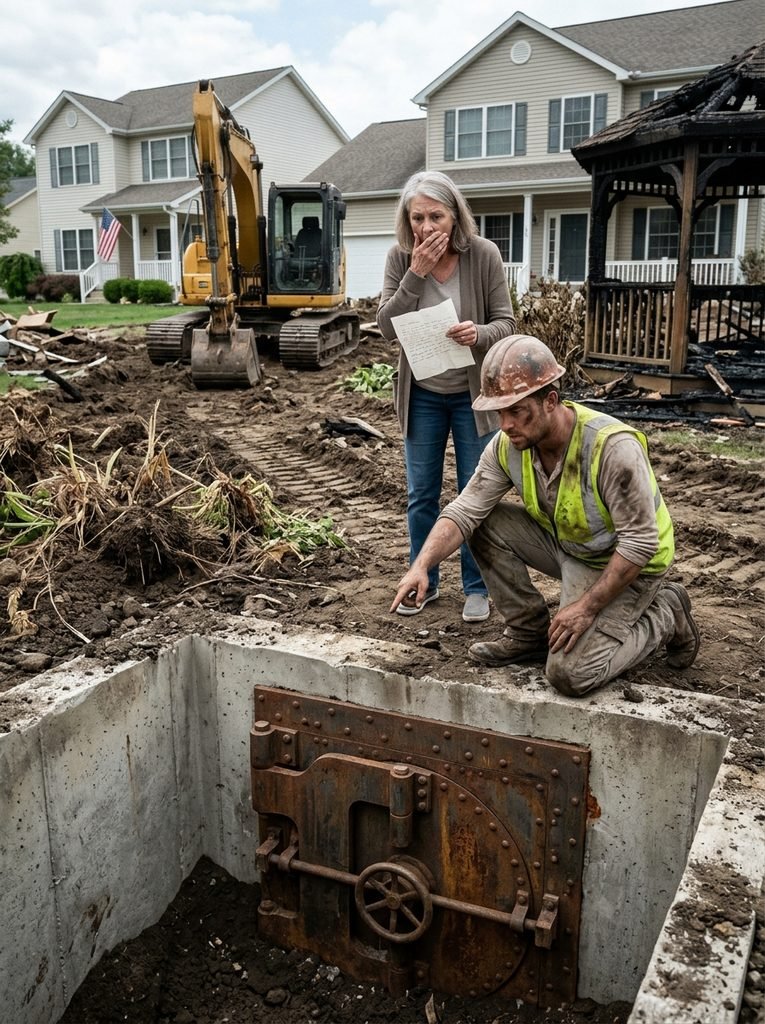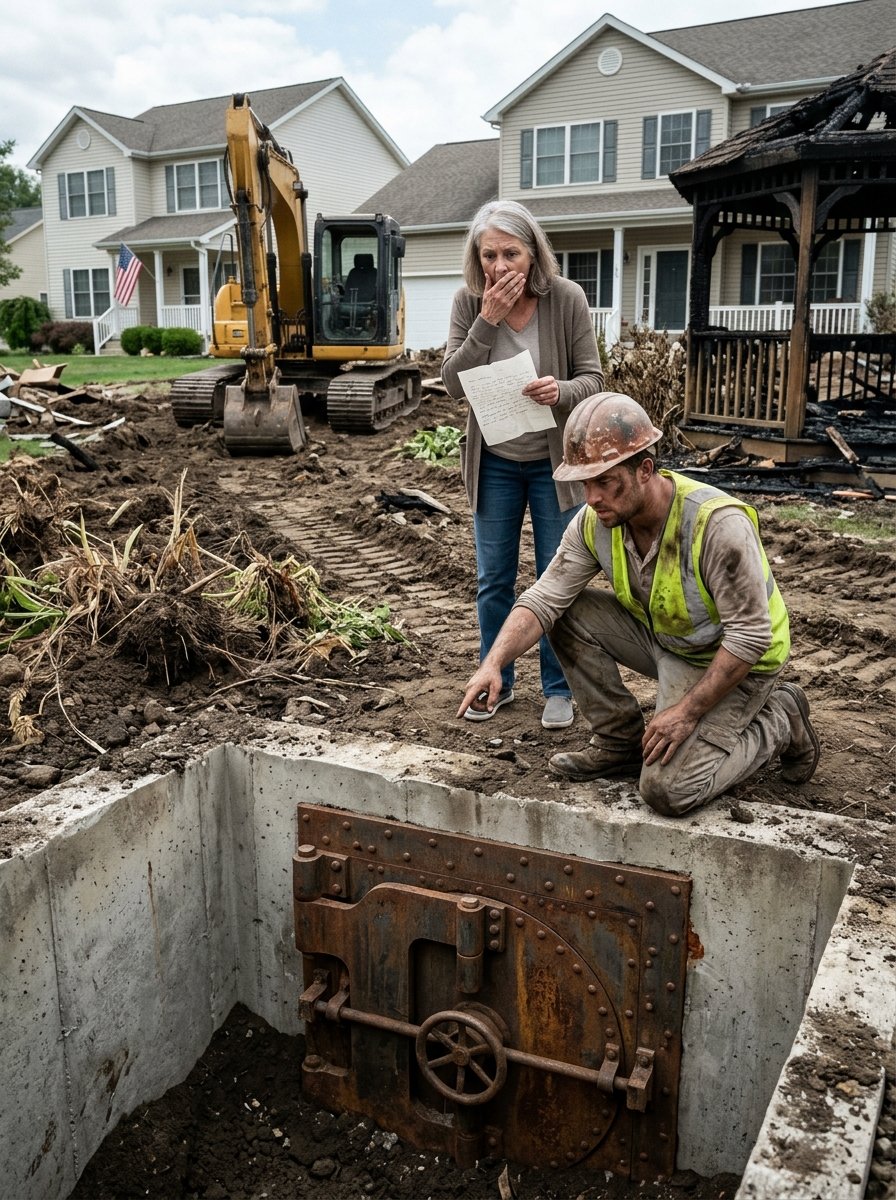
My husband cared for his garden for 50 years. When he passed away, my son set everything on fire and said: “Cry and accept it: it’s time to start a profitable business here!” But when the contractor began to dig, he shouted: “Madam, I found something unbelievable!”
I never thought I’d watch my own son destroy the thing my husband loved most in this world. But there I was, standing in my bathrobe at 7 in the morning, watching Cedric pour gasoline over Harold’s prize-winning roses.
“Cedric, please,” I whispered, my voice barely audible over the crackling flames. “Please don’t do this.”
He didn’t even look at me, just kept dousing the flower beds with that horrible liquid. His face said in that cold expression I’d been seeing more and more since Harold’s funeral 3 weeks ago.
“Mom, you need to accept reality,” he said, striking another match. “Dad’s gone. These plants aren’t bringing him back. And frankly, we need the money more than we need a garden.”
The roses went up first. Harold’s beloved David Austin roses that he’d babyed for 15 years, pruning them every spring, talking to them like they were children.
I watched the orange and pink petals curl and blacken, and it felt like watching Harold die all over again.
“Those roses won the county fair,” I said, stepping closer. “Your father was so proud.”
“My father was a dreamer,” Cedric interrupted, moving toward the vegetable garden. “Look where it got him. Look where it got you. This house is falling apart, Mom. The roof leaks. The foundation is cracking. We’re sitting on prime real estate and you want to keep playing in the dirt.”
I grabbed his arm, trying to stop him from lighting the tomato plants.
“Harold spent every morning out here. Every single morning for 15 years. This was his sanctuary.”
Cedric shook me off so roughly I stumbled backward.
“Harold’s dead, Mom, and his sanctuary isn’t paying the bills.”
The way he said Harold’s name—not Dad or Pop like he used to when he was younger, but Harold, like my husband was just some stranger—sent a chill through me.
When had my son become so cold?
“I’ve already spoken with a developer,” Cedric continued, watching the flames spread to the herb garden. “Thompson Commercial Properties. They’re interested in building a strip mall, restaurants, maybe a pharmacy, real businesses that’ll bring in real money.”
“But this is our home,” I said, feeling tears start to burn my eyes. “Your father built that gazebo with his own hands. He planted every single one of these.”
“This isn’t a home, Mom. It’s a money pit. And I’m not going to stand by and watch you flush away my inheritance on sentiment.”
His inheritance.
Not our family legacy. Not the place where he’d learned to ride a bike. Where Harold had taught him to throw a baseball.
His inheritance.
I watched my lavender bushes catch fire. The ones Harold had planted because he knew the scent helped me sleep.
The smoke was making my eyes water. Or maybe those were tears. I couldn’t tell anymore.
“The developer wants to close by the end of the month,” Cedric said, finally looking at me.
His eyes were flat, calculating.
“I need you to sign the papers, Mom. The sooner we get this property cleared, the better price we’ll get.”
“I won’t sign anything,” I said, my voice stronger than I felt. “This was Harold’s pride and joy. I won’t let you.”
“You don’t have a choice.”
Cedric’s voice was matter of fact, like he was discussing the weather.
“Dad left the property to both of us. Remember? 50/50. And I’m willing to sell my half. Thompson’s already made an offer. If you don’t cooperate, they’ll just buy me out and deal with you as a minority partner.”
My heart sank.
I’d never paid much attention to the legal details when Harold set up the will. I’d trusted him to handle everything like I always had.
Now I was paying for that trust.
“Besides,” Cedric added, kicking at a burning maragold, “what are you going to do? Maintain this place by yourself? You’re 65 years old, Mom. You can barely handle the grocery shopping.”
That hurt worse than watching the garden burn.
Harold had always helped with the heavy lifting, the driving, the complicated parts of daily life. Without him, I felt lost, overwhelmed by simple tasks that had once seemed effortless.
“I can learn,” I said weakly.
Cedric laughed, but there was no humor in it.
“Learn what? How to mow 3 acres by yourself? How to fix the irrigation system when it breaks? How to pay property taxes with your social security check?”
Each question hit like a physical blow because I didn’t have good answers.
Harold had handled the yard work, the maintenance, the finances. I’d been content to let him manage everything while I focused on the house, the cooking, the quiet domestic routines that had filled our 40 years together.
“The insurance money from Dad’s life insurance will only last so long,” Cedric continued. “And then what? You’ll lose this place anyway, except you’ll have nothing to show for it.”
He was probably right about the money.
Harold’s medical bills in his final months had eaten through most of our savings. The life insurance payout seemed like a lot at first, but I was learning how quickly expenses added up when you were living alone.
“I just need some time,” I said, watching the flames consume Harold’s prize-winning sunflowers. “To think, to figure things out.”
“Time is money, Mom, and money is something we don’t have much of.”
Cedric pulled out his phone and showed me a photograph.
“This is what Thompson wants to build here. See? It’s going to be beautiful, modern, useful.”
The picture showed a generic strip mall with beige siding and lots of asphalt.
Nothing like the living, breathing garden Harold had created with his own hands.
“People need places to shop, places to eat,” Cedric said. “This garden doesn’t serve anybody except the bugs and the birds.”
“It served your father,” I whispered. “It served me.”
“Yeah, well, you’re not the only people in the world.”
The casual cruelty in his voice made me step back.
This wasn’t the son I’d raised, the little boy who used to help Harold plant seeds and water the seedlings.
This was a stranger wearing my child’s face.
By the time the fire burned itself out, there was nothing left but charred earth and the bitter smell of smoke.
40 years of Harold’s careful cultivation reduced to ash in a single morning.
“I’ll give you a week to think it over,” Cedric said, brushing soot off his hands. “But I’m moving forward with or without you, Mom. The contractors are coming Monday to start clearing the debris.”
He walked away without looking back, leaving me standing in the ruins of Harold’s garden.
I knelt down and picked up a piece of charred wood from the gazebo Harold had built for our 25th anniversary.
It crumbled in my fingers, leaving black smudges on my palms.
That’s when I noticed something odd.
In the far corner of the garden, where Harold’s compost pile used to be, the ground looked different, disturbed, like someone had been digging there recently.
But Harold had been too sick to work in the garden for months before he died.
So, who had been digging in our backyard?
The contractors arrived at dawn on Monday, just like Cedric had promised.
I watched from my kitchen window as they unloaded their equipment: a small excavator, shovels, and something that looked like a metal detector.
The lead contractor, a weathered man named Jim, knocked on my back door around 8.
“Mrs. Patterson,” he said, removing his baseball cap. “Your son hired us to clear this lot. He said you might have some concerns.”
Some concerns?
Like watching strangers dig up the place where my husband had spent the happiest hours of his life.
“How long will this take?” I asked, wrapping my cardigan tighter around my shoulders.
“Couple weeks, probably. We need to remove all the root systems, level the ground, maybe bring in some fresh top soil. Your son wants it ready for commercial development.”
I nodded, not trusting my voice.
Behind Jim, I could see his crew setting up their equipment right where Harold’s vegetable garden used to be.
“We’ll try to keep the noise down during the day,” Jim continued. “And if we find anything unusual—old pipes, septic issues, that sort of thing—we’ll let you know before we proceed.”
Unusual.
That word stayed with me as I spent the morning trying to ignore the sound of machinery outside my windows.
Because there had been something unusual about Harold’s behavior in his final months.
Things I’d dismissed at the time because I was so focused on his declining health, like how he’d suddenly become secretive about certain parts of the garden.
For years, Harold had loved showing off his plants to anyone who would listen. Neighbors, delivery drivers, even telemarketers who called during his gardening hours would get a full tour if they showed the slightest interest.
But in the last six months of his life, he’d become protective, almost possessive about specific areas.
The compost corner, for instance.
Harold had always maintained a neat compost pile near the back fence, turning kitchen scraps and yard waste into rich soil.
But last spring, he’d started working back there alone.
Late at night, when he thought I was asleep, I’d catch glimpses of him through the bedroom window, hunched over with a flashlight, digging in that same spot over and over.
When I’d asked about it, he’d just smiled that tired smile he wore so often near the end and said he was working on a special project for after he was gone.
I’d assumed he meant planting something that would bloom in my memory of him.
Harold was sentimental that way.
But now, watching the excavator tear through that exact spot, I wondered if there had been more to his midnight gardening than I’d understood.
Around noon, Cedric showed up with coffee and sandwiches for the work crew.
He barely acknowledged me, but I heard him talking to Jim about timeline and costs.
“The sooner you can get this cleared, the better,” Cedric was saying. “Thompson Properties wants to break ground in 30 days.”
30 days.
Harold had been dead for less than a month, and Cedric was already erasing every trace of him.
“Should be doable,” Jim replied. “Though I have to say, this is some of the richest soil I’ve ever seen. Your dad really knew what he was doing out here.”
“Yeah, well, rich soil doesn’t pay the bills,” Cedric said, echoing the same cold pragmatism he’d shown when he burned the garden.
I went back inside, unable to watch anymore.
But around 3:00 in the afternoon, I heard Jim calling my name from the backyard.
When I looked out, he was standing near the excavator with a puzzled expression.
“Mrs. Patterson, could you come out here for a minute?”
I found him holding a small metal box about the size of a shoe box, but heavier.
It was dirty, but looked relatively new, with a simple latch closure.
“We found this about 3 ft down, right where that compost pile used to be,” Jim explained. “Looks like someone buried it there pretty recently. The soil around it was definitely disturbed.”
My hands were shaking as I took the box.
It had weight to it, like there was something substantial inside.
“Should we keep digging in that area?” Jim asked. “Or do you want to check with your son first?”
“No,” I said quickly. “Don’t mention this to Cedric. Not yet.”
Jim raised an eyebrow but nodded.
“Your call, ma’am. We’ll work on the other sections today.”
I carried the box inside, my heart pounding.
Harold’s special project.
This had to be what he’d been working on during those late-night sessions in the garden.
I set it on the kitchen table and stared at it for nearly an hour before I found the courage to open it.
Inside, wrapped in plastic bags to protect them from moisture, were dozens of documents.
Bank statements, legal papers, photographs, and a letter addressed to me in Harold’s careful handwriting.
“My dearest Dolores,” it began. “If you’re reading this, then I’m gone. And I pray you found this before anyone else did. I’ve discovered some things about Cedric that I didn’t have the heart to tell you while I was alive. But you need to know the truth about our son.”
My hands were trembling so badly I could barely hold the letter steady.
Harold’s writing was shakier than usual, clearly written during his illness, but every word was deliberate.
“I’ve been watching our bank accounts more carefully since I got sick. And I’ve noticed some irregularities. Money disappearing in small amounts, always when you were out running errands or at your book club. At first, I thought it was just confusion on my part. You know how the medications made my thinking fuzzy sometimes.”
I remembered those medications, the way they made Harold drowsy and forgetful.
I’d taken over more of the daily responsibilities because he seemed so overwhelmed by simple tasks.
“But I started keeping better records and the pattern became clear. Cedric has been taking money from our joint checking account. Small amounts, $50 here, 100 there, but it adds up to nearly $8,000 over the past 2 years.”
$8,000.
I felt sick.
No wonder our finances had been tighter than usual.
I’d blamed Harold’s medical expenses, the rising cost of groceries, the general strain of living on a fixed income.
“I confronted him about it 3 weeks ago,” the letter continued. “He didn’t deny it. He said he was just borrowing what would be his inheritance anyway, and that we wouldn’t miss such small amounts. He seemed to think he was entitled to our money simply because we’re his parents.”
I could picture that conversation, could imagine Cedric’s casual arrogance, his assumption that our resources belonged to him.
“But what really worried me, Dolores, was his attitude when I told him I wanted the money back. He became angry, almost threatening. He said I was being selfish, that I should be thinking about his future instead of hoarding money I wouldn’t live to spend.”
The casual cruelty of that comment—Harold wouldn’t live to spend the money he’d worked his entire life to save—made my chest tight with anger.
“I realized then that Cedric doesn’t see us as his parents anymore. He sees us as obstacles to his inheritance. And I’m afraid that after I’m gone, he’ll pressure you into signing over everything we’ve worked for.”
Harold had known.
Somehow, even in his weakened state, he’d seen through Cedric’s manipulation and prepared for what was happening right now.
“The other documents in this box are copies of our financial records, including evidence of Cedric’s unauthorized withdrawals. I’ve also included some legal papers that might be important, our original will, the property deed, and some investment documents that Cedric doesn’t know about.”
Investment documents.
Harold had never mentioned any investments beyond our modest savings account.
I set the letter aside and looked through the other papers.
Bank statements showing the pattern of missing money Harold had described.
Photographs of checks with Cedric’s signature, checks I didn’t remember approving.
And then, at the bottom of the box, a Manila envelope marked, “For Dolores only.”
Inside the envelope were documents from an investment firm I’d never heard of.
According to the statements, Harold had been slowly moving money from our joint accounts into a separate investment portfolio.
Money that Cedric didn’t know existed.
The final balance made me gasp.
Over the past 10 years, Harold had accumulated nearly $200,000 in investments.
Money from his pension, careful savings from our household budget, even profits from selling his prize-winning produce at the farmers market.
A sticky note in Harold’s handwriting was attached to the final statement.
“This is for your security, my love. Cedric can’t touch this account because it’s in your name only. Use it to keep the house, the garden, whatever makes you happy. Don’t let anyone pressure you into giving up the life we built together.”
I was crying by then, tears of gratitude mixed with grief and anger.
Harold had been protecting me even as he was dying, setting aside resources to ensure I wouldn’t be at Cedric’s mercy.
But there was one more item in the box that made my blood run cold.
A small digital recorder, the kind Harold used to record his thoughts when his handwriting became too difficult.
A sticky note on top read, “Play this alone.”
I found Harold’s old headphones and pressed play.
His voice, weak but determined, filled my ears.
“Dolores, I’m recording this because I need you to understand how serious this situation is. Yesterday, Cedric came to visit while you were at the grocery store. He asked me directly when I was planning to die because he has some business opportunities that require immediate cash flow.”
My heart stopped.
Cedric had asked his dying father when he planned to die.
“He showed me some real estate listings, expensive properties he wants to flip for profit. He said he needs his inheritance now, not later, because the market won’t wait for me to die naturally.”
Harold’s voice broke slightly on those last words.
“I told him he’d have to wait like everyone else, and that’s when he got angry. Really angry, Dolores. He said I was being selfish, that I’d already lived my life and now I was preventing him from living his.”
I pulled off the headphones, unable to listen anymore.
Cedric had been circling like a vulture, waiting for Harold to die so he could cash in.
And now, less than a month later, he was pressuring me to sell everything we’d built together.
Outside, I could hear the excavator still working, tearing up more of Harold’s garden.
But now I knew there might be more buried treasures, more evidence of my husband’s love and foresight.
I looked at the investment statements again, calculating quickly.
With Harold’s secret nest egg, I had enough money to fight Cedric’s development plans.
I could hire lawyers, pay for independent appraisals, maybe even buy out his half of the property.
But first, I needed to know what else Harold had hidden in his garden.
If there was one buried box, there might be others.
The sun was setting by the time Jim knocked on my door again.
He looked excited, almost breathless.
“Mrs. Patterson, we found something else. Something bigger this time. You’re going to want to see this.”
“Madame, you need to see what I found.”
Jim’s voice echoed across the backyard, urgent and almost panicked.
I rushed outside, still clutching Harold’s letter in my trembling hands.
The excavator had stopped, and the entire crew was gathered around a large hole near where Harold’s prized tomato plants used to grow.
“What is it?” I asked, my heart pounding as I approached the edge of the excavation.
Jim pointed down into the hole with a shaking finger.
“There’s a whole concrete structure down there, ma’am. Like a bunker or something, and it’s not old. This was built recently.”
I peered into the hole and gasped.
About 4 ft down, partially exposed, was what looked like a concrete vault.
It was roughly the size of a small room, with thick walls and what appeared to be a heavy metal door set into one side.
“Did your husband ever mention building anything like this?” Jim asked, his voice filled with bewilderment.
I shook my head, but even as I did, pieces started falling into place.
Harold’s mysterious late-night projects, his insistence on working alone in certain parts of the garden, the way he’d become secretive about his activities in the final months of his life.
“When do you think this was built?” I asked.
“Hard to say exactly, but the concrete looks fresh. Maybe within the last year or two. This would have been a major project. Somebody knew what they were doing.”
A year or two.
Right around the time Harold started acting differently about the garden.
Right around the time he began those midnight digging sessions.
“Mrs. Patterson,” Jim continued, “I think we should stop work until we figure out what this is. Could be a septic tank. Could be storage. Could be—well, I don’t know what it could be, but it’s not something you typically find in a residential backyard.”
Before I could respond, I heard the familiar sound of Cedric’s car pulling into the driveway.
My stomach dropped.
He wasn’t supposed to be here until later.
“Don’t say anything to my son about this,” I whispered urgently to Jim. “Not yet.”
Jim looked confused, but nodded.
“Should we cover it up?”
“Yes, quickly.”
The crew hastily threw a tarp over the excavation just as Cedric rounded the corner of the house.
He was carrying a briefcase and wearing the same predatory expression he’d had when he burned Harold’s garden.
“How’s the progress going?” he asked Jim, scanning the yard with satisfaction. “Looks like you’re making good time.”
“We’re moving along,” Jim replied carefully. “Should have the area cleared within the week.”
I noticed Jim didn’t mention the concrete structure, and I felt a rush of gratitude toward this stranger who was helping protect whatever secret Harold had left for me.
“Excellent,” Cedric said, opening his briefcase. “I brought the final contracts for Mom to sign. Thompson Properties wants to close as soon as possible.”
He pulled out a thick stack of papers and thrust them toward me.
“Just sign where the yellow tabs are, Mom. I’ve already reviewed everything.”
I looked at the documents without really seeing them, my mind still reeling from the discovery in the garden.
Harold had built something.
Something substantial.
Something he’d kept secret from everyone, including me.
“I need time to read through these,” I said, not taking the papers.
Cedric’s jaw tightened.
“There’s nothing to read, Mom. It’s a standard real estate contract. You’re selling your half of the property to Thompson Properties for fair market value.”
“What exactly is fair market value?” I asked.
“200,000 for your half. It’s a generous offer considering the condition of the land.”
200,000.
The same amount Harold had secretly invested for my security.
The coincidence seemed too perfect to be accidental.
“I’d like to get an independent appraisal,” I said.
Cedric’s eyes flashed with anger.
“An independent appraisal will just delay everything and cost us money. Thompson’s offer is fair, Mom. More than fair.”
“Then they won’t mind waiting a few days while I have the property evaluated properly.”
“Actually, they will mind,” Cedric snapped. “They have other projects they can invest in. If we don’t close this week, they’re moving on to something else.”
The pressure tactics were so obvious now that I knew what to look for.
Create urgency.
Limit options.
Make me feel like I had to decide immediately or lose everything.
Harold had warned me about this in his letter.
“I’m not signing anything today,” I said firmly.
Cedric’s face went red.
“Mom, you’re being ridiculous. This is the best offer we’re going to get for this property. If you wait, we might not get anything at all.”
“Then we wait.”
He stared at me for a long moment, clearly trying to control his temper in front of the contractors.
Finally, he forced a smile that didn’t reach his eyes.
“Fine. But I’m not going to let you sabotage this deal because you’re having some kind of emotional breakdown over Dad’s garden.”
Emotional breakdown.
The dismissive way he said it made my blood boil, but I kept my voice steady.
“I’m not having a breakdown, Cedric. I’m being careful.”
“Careful about what? It’s just land, Mom. Dirt and weeds.”
Just dirt and weeds.
He really had no idea what Harold had created here, what it had meant to both of us.
And he certainly had no idea what Harold had hidden beneath that dirt and weeds.
After Cedric left, muttering threats about missed opportunities and stubborn old women, I waited until the contractors finished for the day.
Then I asked Jim to stay behind for a few minutes.
“I need to see what’s down there,” I told him, pointing to the tarp-covered excavation.
“Ma’am, I really think we should call someone official before we go poking around.”
“This is my property,” I interrupted. “And that was built by my husband. I have a right to know what it is.”
Jim studied my face for a moment, then nodded.
“All right, but we go slow and careful. If there’s any kind of hazard down there, we back out immediately.”
We removed the tarp, and Jim set up a work light so we could see into the hole.
The concrete structure was even more impressive than I’d initially realized.
The walls were thick and professionally finished, with what looked like waterproof sealant around all the joints.
“This is serious construction,” Jim muttered, lowering a ladder into the excavation. “Your husband must have hired professionals to build this.”
But as I thought about it, I realized Harold probably hadn’t hired anyone.
He’d been a general contractor before he retired, skilled at all kinds of construction work, and he’d have wanted to keep this project completely secret.
Jim went down first, testing the stability of the structure and checking for any obvious dangers.
When he called up that it seemed safe, I climbed down the ladder with my heart pounding.
The underground room was larger than it had appeared from above, probably 10 ft x 12 ft, with a ceiling high enough for me to stand upright.
The walls were lined with metal shelving, and in the center of the room was a large, heavyduty safe.
But it was what was on the shelves that made me gasp.
Dozens of storage containers, each one carefully labeled in Harold’s handwriting.
Financial records 2018 to 2022.
Insurance documents.
Property deeds.
Investment records.
Portfolio 2.
Portfolio 2.
That meant there were even more investments than the ones I’d found in the buried box.
“Mrs. Patterson,” Jim said quietly. “Your husband built himself a bunker. This is the kind of place someone builds when they’re preparing for… well, for trouble.”
I opened one of the containers labeled Cedric evidence file and found it filled with photographs, bank statements, and what looked like legal documents.
My hands were shaking as I pulled out the first few items.
Photos of checks made out to cash and signed by me.
Except I’d never signed any of these checks.
Bank statements showing withdrawals I’d never authorized.
Credit applications in my name for accounts I’d never opened.
“Oh my God,” I whispered.
The evidence was overwhelming.
Cedric hadn’t just been stealing small amounts from our checking account.
As Harold’s letter had described, he’d been systematically defrauding us for years, forging my signature, opening credit lines in my name, even taking out a second mortgage on the house without my knowledge.
“Ma’am, are you all right?” Jim asked, seeing my distress.
I couldn’t answer.
I was too busy staring at a photograph of a loan document bearing my forged signature.
A loan for $50,000 that I’d never seen before.
But the worst was yet to come.
At the bottom of the container was a manila folder labeled insurance fraud, life insurance policy.
Inside, I found copies of correspondence between Cedric and Harold’s life insurance company.
Cedric had been trying to increase Harold’s life insurance coverage without telling us, submitting medical forms that downplayed Harold’s illness, and forged signatures on beneficiary change forms.
He’d been planning for Harold’s death, calculating how much money he could extract from it.
I sank down onto a storage crate, overwhelmed by the scope of my son’s betrayal.
This wasn’t just greed or impatience.
This was a systematic campaign of fraud that had been going on for years.
“Mrs. Patterson, we should probably get you out of here,” Jim said gently. “This is a lot to process.”
But I wasn’t ready to leave.
I opened the safe.
The combination was our wedding anniversary.
And found even more devastating evidence.
Harold had been documenting everything, building a legal case against our own son.
The safe contained original documents that Cedric thought had been destroyed, backup copies of financial records showing the true state of our assets, and detailed notes in Harold’s handwriting about each fraudulent transaction he’d discovered.
At the very back of the safe was another letter addressed to me.
“My dearest Dolores,” it began. “If you found this room, then you’ve also found the evidence of what Cedric has been doing to us. I built this place to protect the proof of his crimes because I knew he would try to destroy any evidence once I was gone.”
I could barely see the words through my tears.
“I discovered the extent of his fraud 3 months ago, and I’ve been collecting evidence ever since. He doesn’t know I found out about the second mortgage or the credit cards he opened in your name, or the insurance fraud attempts. I let him think he was getting away with it while I built our case against him.”
Harold had been playing a long game, pretending to be the sick, confused old man while actually orchestrating a careful legal strategy.
“I’ve consulted with a lawyer, discreetly of course, and we have enough evidence to send Cedric to prison for several years, but I also know you might not want to prosecute your own son, no matter what he’s done.”
Even dying, Harold had understood my heart better than I understood it myself.
“So, I’ve prepared two options for you. Option one: take all this evidence to the police and let justice take its course. Option two: use this evidence to force Cedric to return everything he’s stolen and leave you alone forever.”
I looked around the underground room Harold had built to protect me, filled with years of patient documentation and careful planning.
My husband had spent his final months not just fighting his illness, but fighting for my future security.
And tomorrow, I was going to use every bit of ammunition he’d left me.
But first, I needed to know exactly how deep Cedric’s betrayal went because something told me I hadn’t found the worst of it yet.
I spent the entire night in Harold’s underground room, reading through every document, every photograph, every piece of evidence my husband had carefully preserved.
By dawn, I understood the true scope of what Cedric had done to us and what he was still planning to do.
The second mortgage Cedric had taken out in my name was just the beginning.
Over the past 3 years, he’d systematically stolen nearly $100,000 from us through forged checks, fraudulent credit applications, and unauthorized loans.
But the most chilling discovery was a folder labeled future plans.
Inside, I found Cedric’s handwritten notes about his strategy for handling me after Harold’s death.
The words made my blood run cold.
“Mom won’t last long on her own,” one note read. “Probably develop dementia or other health issues within 2 to 3 years. Need to establish pattern of mental incompetence for guardianship proceedings.”
Guardianship proceedings.
He’d been planning to have me declared mentally incompetent so he could control all my assets.
Another note detailed his timeline.
“Sell property immediately after Dad dies. Move Mom to assisted living facility. Cheapest option possible. Liquidate all remaining assets. Should net approximately 5700k total.”
He’d calculated the value of my life, my independence, my dignity, and reduced it to a dollar amount in his notebook.
But Harold had been watching.
Harold had known.
The evidence folders contained recorded phone conversations.
Apparently, Harold had been recording Cedric’s visits during his final months.
I put on the headphones and listened to my son’s voice, cold and calculating, as he discussed his plans for my future.
“She can’t handle the property maintenance anyway,” Cedric’s voice said through the static. “And frankly, Dad, she’s already showing signs of confusion. Sometimes she forgets where she put things or she’ll ask me the same question twice. It’s probably early dementia.”
Harold’s voice, weak but firm.
“Your mother is grieving and stressed, not confused. There’s nothing wrong with her mind.”
“Well, that’s your opinion, but when you’re gone, I’ll be the one who has to deal with her decline. And I think a nice facility would be the safest option for everyone.”
A facility.
Like I was a problem to be warehoused, not a person with feelings and preferences.
The recording continued with Cedric pressuring Harold to sign papers giving Cedric power of attorney over both our finances.
Harold had refused, but I could hear the exhaustion in his voice, the toll this conflict was taking on him during his final weeks.
“You’re being stubborn, Dad. I’m trying to help you plan for Mom’s future, and you’re making this harder than it needs to be.”
“I’ve already planned for your mother’s future,” Harold had replied. “And it doesn’t involve you controlling her money or her life.”
That’s when I heard Cedric’s mask slip completely.
“Fine, but when you’re dead and she’s wandering around that house talking to herself, don’t expect me to clean up your mess. I’ll do what needs to be done with or without your permission.”
The threat was clear.
Once Harold was gone, Cedric planned to take control of everything, regardless of what I wanted.
I pulled off the headphones, shaking with rage and heartbreak.
This was my son, the baby I’d nursed through countless childhood illnesses.
The boy I’d cheered for at little league games.
The young man I’d been so proud to see graduate college and start his own business.
When had he become this monster?
But I didn’t have time to mourn the son I’d lost because the current situation required all my attention.
According to the timeline in Cedric’s notes, he expected to have me out of the house and into managed care within 6 months of Harold’s death.
We were already a month in.
I climbed out of the underground room as the sun was rising, carrying one of Harold’s evidence folders.
Jim arrived shortly after, looking concerned when he saw my red-rimmed eyes and exhausted appearance.
“Mrs. Patterson, did you stay out here all night?”
“I needed to understand what my husband left for me,” I said simply.
Before Jim could respond, we heard Cedric’s car in the driveway again.
But this time, he wasn’t alone.
I recognized the woman who got out of the passenger seat.
Janet Morrison, a local real estate agent known for her aggressive sales tactics.
“Good morning, Mom,” Cedric said, his voice artificially cheerful. “I brought Janet to help us finalize the property sale.”
Janet smiled at me with the kind of practiced sympathy reserved for elderly people who needed to be managed rather than consulted.
“Mrs. Patterson, I’m so sorry for your loss,” she said. “Cedric tells me you’re ready to move forward with selling the property. That’s very wise. Maintaining a large property at your age can be quite overwhelming.”
At your age?
The condescending phrase made my jaw clench.
“I haven’t decided to sell anything yet,” I said firmly.
Janet’s smile flickered.
“Oh, but Cedric said you’d already agreed to the Thompson Properties offer. I have all the paperwork right here, ready for your signature.”
She pulled out another stack of contracts, slightly different from the ones Cedric had shown me yesterday.
“What’s different about these papers?” I asked.
“Just some minor clarifications,” Cedric said quickly. “Nothing important.”
But I’d learned not to trust anything Cedric called minor.
I took the contracts and started reading them carefully, ignoring Janet’s impatient sighing and Cedric’s increasingly irritated fidgeting.
The differences weren’t minor at all.
These new contracts included clauses giving Cedric power of attorney over my finances, authorization for him to make decisions about my care and living arrangements, and language that suggested I was mentally incompetent to handle my own affairs.
“This says you have the authority to determine where I live,” I said, looking up at Cedric.
“It’s just a precaution, Mom. In case your health declines and you need help making decisions.”
“My health is fine.”
“For now,” Cedric said. “But you’re not getting any younger. And honestly, you’ve seemed a bit confused lately. Forgetful.”
Janet nodded sympathetically.
“It’s very common at your age, Mrs. Patterson. My own mother went through the same thing. Sometimes the kindest thing we can do for our elderly parents is help them make practical decisions before their judgment becomes compromised.”
Compromised.
They were setting up the narrative Harold had warned me about, establishing a pattern of supposed mental decline to justify taking control of my life.
“I’m not signing these,” I said, setting the papers down.
Cedric’s patience finally snapped.
“Mom, you’re being ridiculous. This property is too much for you to handle alone. You can barely remember to pay the utilities on time.”
That was a lie.
I’d never been late with a utility payment in my life.
But I realized it didn’t matter what was true.
Cedric was creating a story about my incompetence, and he’d tell that story to anyone who would listen until people started believing it.
“I think I understand the situation now,” I said calmly.
“Good,” Janet said, reaching for her pen. “Then let’s get these signed so you can move on to the next chapter of your life.”
“The next chapter of my life doesn’t include either of you,” I replied.
Both Janet and Cedric stared at me in surprise.
“I know about the second mortgage,” I continued, watching Cedric’s face go pale. “I know about the forged checks. I know about the credit cards you opened in my name. I know about all of it.”
Cedric recovered quickly, forcing a laugh.
“Mom, you’re confused. I don’t know what you think you found, but—”
I pulled out one of the photographs from Harold’s evidence file.
A clear image of a check for $3,000 made out to cash with my signature, except the handwriting was obviously Cedric’s.
“Are you going to tell me I signed this check?” I asked.
Cedric looked at the photo, and I watched his expression cycle through surprise, anger, and calculation.
“Where did you get that?”
“Your father left it for me, along with documentation of every fraudulent transaction you’ve made over the past 3 years.”
Janet was backing toward her car, clearly wanting no part of whatever family drama was unfolding.
“Mom, you don’t understand.”
“I understand that you’ve stolen nearly $100,000 from your own parents,” I interrupted. “I understand that you tried to increase your father’s life insurance without telling us. I understand that you’ve been planning to have me declared mentally incompetent so you can steal the rest of our assets.”
Cedric’s mask was completely gone now, replaced by the cold fury I’d glimped when he burned Harold’s garden.
“That money was going to be mine anyway,” he snarled. “You and Dad were just hoarding it, letting it sit in accounts earning nothing while I had real investment opportunities.”
“That money was for our security in our old age.”
“Your old age?” Cedric laughed harshly. “Mom, you’re already old. How much longer do you think you’re going to live? Another 10 years, 15? Why should that money sit in a bank when I could be using it to build something meaningful?”
The casual way he discussed my death, as if it were just an inconvenient delay in his business plans, took my breath away.
“I thought you were stealing because you were desperate,” I said quietly. “But you’re stealing because you think you deserve it.”
“I do deserve it,” Cedric shot back. “I’m your only child. Everything you have is going to come to me eventually anyway. I was just accessing it a little early.”
“Without permission. By forging my signature and committing fraud.”
“By being practical. Dad was too stubborn to see the big picture. But I thought you were smarter than that.”
I looked at this man who shared my DNA, but seemed to have none of my values, none of Harold’s integrity, none of the love and kindness I’d tried to instill in him during his childhood.
“Your father left me more than just evidence of your crimes,” I said. “He left me the means to fight you.”
For the first time, I saw uncertainty flicker in Cedric’s eyes.
“What do you mean?”
I smiled, thinking of Harold’s secret investments, his carefully planned legal strategy, his underground room full of protective evidence.
“I mean that your inheritance just became a lot smaller. And your freedom might be too, depending on what you do next.”
Cedric stared at me for a long moment, processing this new reality where his elderly mother wasn’t the helpless victim he’d expected.
“You can’t prove any of this,” he said finally.
I pulled out another folder from Harold’s collection.
This one containing bank records, photographs, and legal documents that would make any prosecutor’s case extremely easy to prove.
“Herold was very thorough,” I said simply.
That’s when Cedric made his final mistake.
Instead of backing down, instead of apologizing, instead of trying to make amends for what he’d done, he doubled down.
“Fine,” he said, his voice low and dangerous. “If you want to play hard ball, we’ll play hard ball. But remember, Mom, I know where you live. I know your routines. I know how vulnerable you are.”
The threat was unmistakable, and it was exactly what Harold had predicted would happen.
Cedric’s threat hung in the air like smoke from his father’s burned garden.
But instead of fear, I felt something I hadn’t experienced in years.
Power.
Harold had prepared for this moment.
And I was finally ready to use the weapons he’d left me.
“I think you should leave now,” I said quietly.
“This isn’t over, Mom.” Cedric’s voice was cold, calculating. “You can’t hide behind Dad’s ghost forever. And when you fall, and you will fall, don’t expect me to catch you.”
After he drove away, tires squealing in anger, I went back to Harold’s underground room.
There was one more folder I hadn’t opened yet, labeled emergency protocol.
Inside, I found detailed instructions in Harold’s careful handwriting along with business cards for lawyers, accountants, and private investigators.
“If Cedric threatens you directly,” Harold had written, “it means he’s desperate and dangerous. Follow these steps exactly.”
The first step was to call Detective Maria Santos, whose card was paperclip to Harold’s notes.
Apparently, Harold had been building a relationship with local law enforcement, sharing information about Cedric’s financial crimes while he was still alive.
Detective Santos arrived within an hour, a sharpeyed woman in her 40s who treated me with respect rather than the condescending sympathy I’d grown accustomed to from people dealing with elderly victims.
“Mr. Patterson contacted us several months ago,” she explained as we sat in my kitchen. “He was concerned about ongoing financial fraud, but wanted to document everything thoroughly before moving forward. He was very protective of you. Didn’t want you to know about the investigation until after his death.”
She pulled out a thick file.
“We’ve been building a case against your son for quite some time. Mr. Patterson provided us with extensive evidence of forged signatures, unauthorized loans, and identity theft. But we needed more to make charges stick.”
“How much more?” I asked.
“We needed proof that he was continuing the fraud after your husband’s death, and we needed evidence that he was attempting to gain fraudulent control over your assets.”
I thought about the contracts Cedric had brought that morning.
The ones giving him power of attorney based on false claims about my mental competence.
“Would those contracts be enough?” I asked, pulling them from the folder where I’d stored them.
Detective Santos examined the documents, her eyebrows rising.
“These are definitely fraudulent. Claiming you’re mentally incompetent without a medical evaluation. Attempting to establish guardianship without court proceedings. Yes, this gives us what we need.”
“What happens next?”
“Well, that depends on what you want to happen. We can arrest your son immediately, or…”
She paused, studying my face.
“Mr. Patterson mentioned that you might prefer a different approach.”
I thought about Harold’s two options, criminal prosecution or private justice.
Both had their appeal, but I knew which one Harold would have chosen if he were in my position.
“What would the different approach look like?”
Detective Santos smiled.
“Your husband was a very clever man, Mrs. Patterson. He set up what we call a honeypot, a trap designed to catch your son in the act of committing additional crimes while we document everything.”
She opened her file and showed me surveillance photos of Cedric entering my bank.
Cedric meeting with real estate agents.
Cedric at various offices around town.
“We’ve been following him since your husband’s death,” she explained. “He’s been trying to access accounts that don’t belong to him, forge additional documents, and establish legal grounds for taking control of your finances. Every move he makes digs him deeper into criminal liability.”
“But why haven’t you arrested him yet?”
“Because Mr. Patterson wanted to make sure you were protected first. He was worried that if we arrested Cedric immediately, your son might have hidden assets or co-conspirators we hadn’t discovered yet. This way, we catch everyone involved and recover every stolen dollar.”
I felt a surge of gratitude toward Harold’s careful planning.
Even in death, he was still protecting me, still thinking three steps ahead.
“There’s something else,” Detective Santos continued. “Mr. Patterson set up a legal trust that we’ve been monitoring. Every time your son tries to access accounts or forge documents, he’s actually triggering automatic notifications to our department and to his lawyer.”
“His lawyer?”
“The trust includes provisions for asset recovery and criminal restitution. If your son is convicted of financial crimes against you, the trust automatically seizes any assets he’s purchased with stolen money. His house, his car, his business accounts, everything goes back to you.”
Harold hadn’t just been collecting evidence.
He’d been building a financial snare that would recover every penny Cedric had stolen with interest.
“How long have you been watching him?” I asked.
“3 months. And in that time, he’s committed enough additional crimes to face serious federal charges: mail fraud, wire fraud, identity theft, elder abuse. We’re looking at 15 to 20 years in prison if he’s convicted on all counts.”
15 to 20 years.
I tried to imagine Cedric, my son, spending decades in prison because of his greed and cruelty.
The thought should have broken my heart, but instead I felt only a cold satisfaction.
“What do I need to do?”
Detective Santos pulled out a small recording device.
“Mr. Patterson anticipated that your son would escalate his behavior after threats and legal pressure didn’t work. We’d like you to wear this wire during any future interactions with him.”
“You think he’ll try something else?”
“Mrs. Patterson, your son has already committed multiple felonies and now he knows you have evidence against him. Desperate people do desperate things. We want to be prepared.”
That afternoon, as if on cue, Cedric called.
“Mom, I think we got off on the wrong foot this morning,” he said, his voice artificially calm. “Why don’t I come over tonight so we can talk this through like adults?”
I looked at the recording device Detective Santos had given me, then at Harold’s emergency protocol instructions.
“I think that’s a good idea,” I said.
Cedric arrived at 7, carrying a bottle of wine and wearing his most charming smile.
If I hadn’t spent the day reviewing evidence of his crimes, I might have been fooled by his performance.
“Mom, I owe you an apology,” he began, settling into Harold’s old chair as if he belonged there. “I’ve been under a lot of financial pressure lately, and I haven’t been thinking clearly.”
“Financial pressure?” I asked, thinking of the evidence showing his comfortable lifestyle funded by stolen money.
“The economy’s been rough on my business. I made some poor decisions, borrowed money I shouldn’t have. When Dad got sick, I panicked. And, well, I made some mistakes.”
Mistakes?
As if systematically defrauding your elderly parents for years was just an error in judgment.
“What kind of mistakes, Cedric?”
He poured himself a generous glass of wine, not offering me any.
“I borrowed some money from your account without asking. I know I should have talked to you first, but Dad was so sick and I didn’t want to burden either of you with my problems.”
“How much money?”
“Not much. Maybe 8 or 10,000 over the past year. I was planning to pay it back after my business recovered.”
8 or 10,000.
The actual amount was closer to a h 100,000, and we both knew it.
“That seems like a lot of money to borrow without asking,” I said carefully.
Cedric’s smile tightened almost imperceptibly.
“Well, it’s not like you and Dad were using it for anything important. It was just sitting in the bank earning nothing.”
“It was our retirement savings.”
“Mom, let’s be realistic. How much retirement do you have left? You’re 65 years old. Dad’s gone. You don’t need a huge nest egg anymore.”
The casual cruelty of his words, the suggestion that I was too old to deserve financial security, made my blood boil.
But I kept my voice steady.
“So, you think it was okay to take our money without permission?”
“I think families help each other,” Cedric said, refilling his wine glass. “And I think Dad poisoned you against me before he died. He filled your head with paranoid ideas about me trying to take advantage of you.”
“Did you take out a second mortgage on this house?”
Cedric’s handstilled on the wine bottle.
“Who told you that?”
“Is it true?”
He was quiet for a long moment, calculating his response.
“I may have explored some options for accessing the equity in the property, but nothing was finalized.”
Nothing was finalized.
Another lie.
The mortgage documents in Harold’s evidence files showed that Cedric had successfully borrowed $50,000 against the house using forged signatures.
“Cedric, I know about all of it. The checks, the credit cards, the insurance fraud attempts. Your father documented everything.”
His charming mask finally slipped.
“Fine. You want the truth? Here’s the truth. I took that money because I deserved it. I’m your only child, Mom. Everything you have is going to come to me eventually anyway. I was just accessing my inheritance a little early.”
“By committing fraud.”
“By being practical. Dad was a fool. Hoarding money he was never going to spend. At least I was using it productively. Investing it in opportunities that could benefit our whole family.”
“What opportunities?”
Cedric smiled.
But there was something cold and predatory in his expression.
“Real estate deals, business ventures, the kind of investments that require capital upfront but pay off big in the long run.”
“Using money you stole from us.”
“Using money that was going to be mine anyway.”
I could see the recording device’s tiny light blinking, capturing every word of his confession.
“What about the contracts you brought this morning?” I asked. “The ones claiming I’m mentally incompetent.”
Cedric leaned forward, his voice dropping to something almost threatening.
“Mom, you’re not getting any younger. Your memory isn’t what it used to be. Sometimes you seem confused, forgetful. It might be time to consider letting someone else handle the complicated financial decisions.”
“Someone like you.”
“I’m your son. I love you. I want what’s best for you.”
The lie came so easily, so smoothly, that I wondered how many times he’d practiced it.
“And what would be best for me?”
“A nice assisted living facility. Somewhere safe, where you don’t have to worry about maintaining this big house or managing complicated financial matters. Somewhere where professionals can take care of you.”
A facility where he could control my assets while I slowly died in institutional care.
“What if I don’t want to live in a facility?”
Cedric’s smile disappeared entirely.
“Mom, you might not have a choice. If your mental condition continues to decline, the court might have to step in and appoint a guardian to make decisions for you.”
“A guardian like you.”
“I’m the logical choice. I’m your next of kin and I understand your financial situation better than anyone.”
He understood it because he’d been stealing from it for years.
“Cedric,” I said quietly, “do you have any idea how much you’ve hurt me?”
For just a moment, something that might have been guilt flickered in his eyes, but it was gone so quickly.
I might have imagined it.
“Mom, I never meant to hurt you. Everything I’ve done has been for your own good.”
“My own good?”
Even now, facing the evidence of his systematic betrayal, he was trying to convince me that his crimes were somehow acts of love.
“I think you should leave now,” I said.
Cedric sat down his wine glass and stood up, but he didn’t move toward the door.
Instead, he took a step closer to my chair.
“Mom, you need to understand something. I’ve worked too hard and invested too much to let you destroy everything now. If you try to cause problems for me, if you try to interfere with my business dealings, there will be consequences.”
“What kind of consequences?”
His voice dropped to a whisper, but the recording device caught every word.
“You’re an old woman living alone in a big house. Accidents happen all the time. Falls downstairs, kitchen fires, heart attacks brought on by stress. It would be very sad, but not particularly suspicious.”
The threat was unmistakable.
My own son was threatening to kill me.
But instead of fear, I felt a strange sense of relief because Harold had predicted this, too.
And now I had everything I needed to destroy Cedric completely.
The recording device had captured everything.
Cedric’s confessions, his threats, his casual discussion of murdering his own mother.
As he walked toward the door, still believing he held all the power, I felt something I hadn’t experienced since Harold’s death.
Complete certainty about what came next.
“Good night, Mom,” Cedric said, pausing at the threshold. “Think carefully about what I said. You have until Friday to sign those property transfer documents.”
“And if I don’t?”
His smile was cold, reptilian.
“Then we’ll have to explore other options.”
After his car disappeared down the driveway, I sat in the silence of my kitchen, holding the recording device that contained his downfall.
Harold had planned for this exact moment, had known that Cedric’s greed would eventually drive him to desperation and threats.
I called Detective Santos.
“We got it all,” I told her. “The confessions, the threats, everything.”
“Mrs. Patterson, are you somewhere safe right now?”
“I’m home, but I don’t think I’m in immediate danger. Cedric thinks he has until Friday to convince me.”
“We’re going to arrest him tomorrow morning. The recording you just made, combined with all the evidence your husband collected, gives us more than enough for multiple felony charges.”
“What about the stolen money?”
“The trust your husband established will kick in automatically once your son is arrested. Every asset he purchased with stolen funds will be frozen and eventually transferred back to you. His house, his cars, his business accounts, everything.”
I should have felt satisfaction, but all I felt was exhaustion.
40 years of marriage, 37 years of motherhood, and it had come to this.
My own son threatening to murder me for money.
“Detective Santos, there’s something else Harold left for me. Something I think you should see.”
The next morning, I led Detective Santos and two federal agents down into Harold’s underground bunker.
They stood in amazement as I showed them the carefully organized evidence files, the recorded conversations, the detailed financial documentation of Cedric’s crimes.
“This is the most thorough evidence collection I’ve ever seen from a civilian,” one of the federal agents said. “Your husband missed his calling as a detective.”
“He was just a man protecting his wife,” I replied.
But there was one more revelation waiting in Harold’s sanctuary, in a folder labeled final instructions.
I found documents I’d never seen before.
Papers showing that Harold had quietly transferred ownership of our house into an irrevocable trust 6 months before his death.
According to the legal paperwork, I had lifetime use of the property, but ownership would pass to a charity upon my death, not to Cedric.
My son’s careful plans to inherit everything had been thwarted before Harold even died.
“He knew,” I whispered, staring at the documents. “He knew exactly what Cedric was planning, and he made sure it could never happen.”
Detective Santos examined the trust papers.
“Mrs. Patterson, do you realize what this means? Every crime your son committed was pointless. He was never going to inherit this property anyway.”
The irony was perfect.
Cedric had destroyed his relationship with his parents, committed multiple felonies, and thrown away any chance of a normal life, all for money he was never going to receive.
But Harold’s final gift was more than just financial protection.
In the very last folder, I found architectural plans for rebuilding the garden.
Every plant, every pathway, every carefully planned detail was documented in Harold’s precise draftsmanship.
“Plant this in the spring after I’m gone,” his note read. “But this time, you won’t have to do it alone.”
Attached to the plans was a contract with a local landscaping company, already paid for, ready to begin work as soon as I gave the word.
At 10:00 that morning, I watched from my kitchen window as Detective Santos and federal agents arrested Cedric in his driveway.
He was still in his bathrobe, probably planning to spend the day figuring out how to pressure me further.
The look of shock on his face as they handcuffed him was almost worth 40 years of his selfishness and manipulation.
Almost.
His wife, Sarah, a woman I’d barely gotten to know because Cedric never brought her around unless he needed something, came running out of the house in tears.
She looked genuinely surprised, which made me wonder how much she’d known about her husband’s crimes.
I never spoke to Cedric again.
He was convicted on 17 felony counts and sentenced to 22 years in federal prison.
The trust Harold had established recovered every penny he’d stolen, plus penalties and interest that nearly doubled the amount.
Sarah divorced him while he was awaiting trial, claiming she’d had no knowledge of his fraudulent activities.
I wasn’t sure I believed her, but it didn’t matter.
She disappeared from my life as completely as if she’d never existed.
The house that Cedric had purchased with stolen money was sold at auction.
His luxury cars were repossessed.
His business accounts were emptied to pay restitution.
Everything he’d built on the foundation of Mai and Harold’s trust was stripped away, leaving him with nothing but a prison cell and the consequences of his choices.
6 months after his arrest, I stood in my backyard watching professional landscapers recreate Harold’s garden from his detailed plans.
Every rose bush, every vegetable plot, every herb garden was being restored exactly as he’d envisioned it.
But this time, there were additions Harold hadn’t included in his original design.
The landscapers had found his underground bunker during the restoration and asked what I wanted to do with it.
“Keep it,” I told them, “but make some changes.”
I had the bunker converted into a climate-controlled root seller and seed storage facility.
The walls that once held evidence of my son’s crimes now held jars of homegrown vegetables and packets of seeds for future plantings.
The metal safe where Harold had kept his legal documents became my garden journal storage, filled with notes about what grew best in which seasons, which plants attracted beneficial insects, which varieties Harold had been most proud of.
The underground room that had once been a fortress of evidence became a sanctuary of growth and renewal.
I hired Jim, the contractor who’d first discovered Harold’s secrets, to build a small greenhouse near the back of the property.
Not because I needed the extra growing space, but because I enjoyed his respectful, straightforward way of dealing with me.
He never talked down to me, never suggested I was too old or too fragile for the work I wanted to do.
“Your husband would be proud of what you’ve built here,” Jim said one afternoon as we planted tomato seedlings in the greenhouse.
“I think he’d be proud that I finally learned to build something myself,” I replied.
The first spring after Harold’s garden was restored, I hosted a neighborhood potluck in the backyard.
23 people came, including several neighbors I’d barely spoken to during Harold’s lifetime.
I’d been so focused on caring for him during his illness that I’d forgotten how to have friendships of my own.
Margaret from next door brought homemade bread.
David from across the street contributed wine from his small vineyard.
Helen, the widow who lived at the corner, arrived with a casserole and stayed until midnight, helping me clean up and sharing stories about her own late husband.
“It’s nice to see this garden full of life again,” Margaret said as we watched children from the neighborhood play hide-and-seek among the flower beds.
“Harold always intended it to be shared,” I replied. “I just forgot that for a while.”
That night, as I sat on the rebuilt gazebo looking out over Harold’s restored garden, I felt something I hadn’t experienced since before his illness.
Complete peace.
Not just the absence of conflict, but the presence of genuine contentment.
I thought about Cedric alone in his prison cell, probably still convinced that he’d been wronged somehow.
I wondered if he’d ever understand what he’d lost.
Not just money or property, but the love of parents who would have given him anything if he’d simply asked instead of stealing.
But mostly, I thought about Harold’s final gift to me.
Not the money he’d protected, or the evidence he’d gathered, or even the garden he’d planned for my future.
His greatest gift was teaching me that I was stronger than I’d ever imagined.
At 65, I’d learned to manage my own finances, maintain my own property, and build my own friendships.
I discovered that I didn’t need anyone to take care of me.
I could take care of myself.
And when the time came to plant Harold’s memorial garden the following spring, I didn’t need to hire it done.
I planted every seed, every bulb, every seedling with my own hands.
The garden grew more beautiful each year.
But it was no longer Harold’s garden.
It was ours, mine and his together.
A collaboration between the living and the remembered, between the past we’d shared and the future I was building for myself.
5 years later, when real estate developers approached me about selling the property for commercial development, I smiled and politely declined.
The garden Harold and I had created wasn’t just a place of beauty.
It was a testament to the power of love, patience, and careful planning.
It was proof that some things are worth more than money, and some legacies can’t be stolen or sold or destroyed by people who mistake price for value.
It was home in the deepest and truest sense of the word.
And unlike my son, it was mine to keep forever.
Now, I’m curious about you who listen to my story.
What would you do if you were in my place?
Have you ever been through something similar?
Comment below.
And meanwhile, I’m leaving on the final screen two other stories that are channel favorites, and they will definitely surprise you.
Thank you for watching until here.
If you came here from Facebook because of this story, go back to the Facebook post, hit Like, and leave exactly “So moving” in the comments to support the storyteller. That small gesture means more than it may seem and gives the writer real motivation to keep bringing you more stories like this.
Disclaimer: This story is fictional and created for entertainment purposes only. Any names, characters, places, or events are fictitious or used fictitiously. No real person or organization is intended to be portrayed.