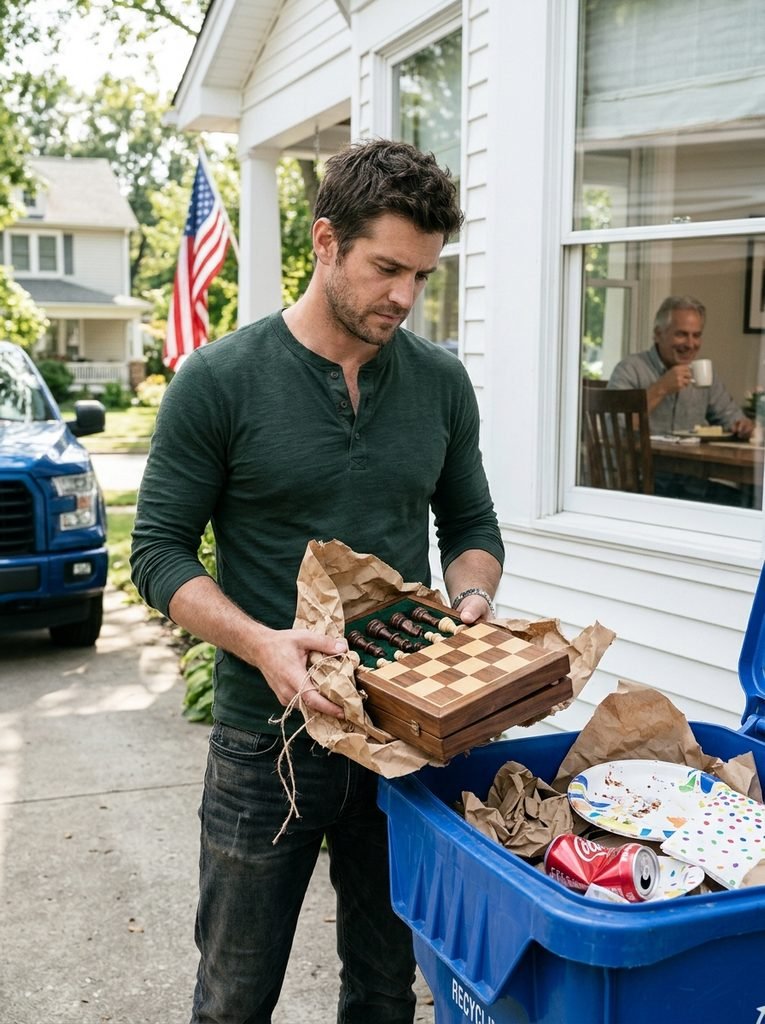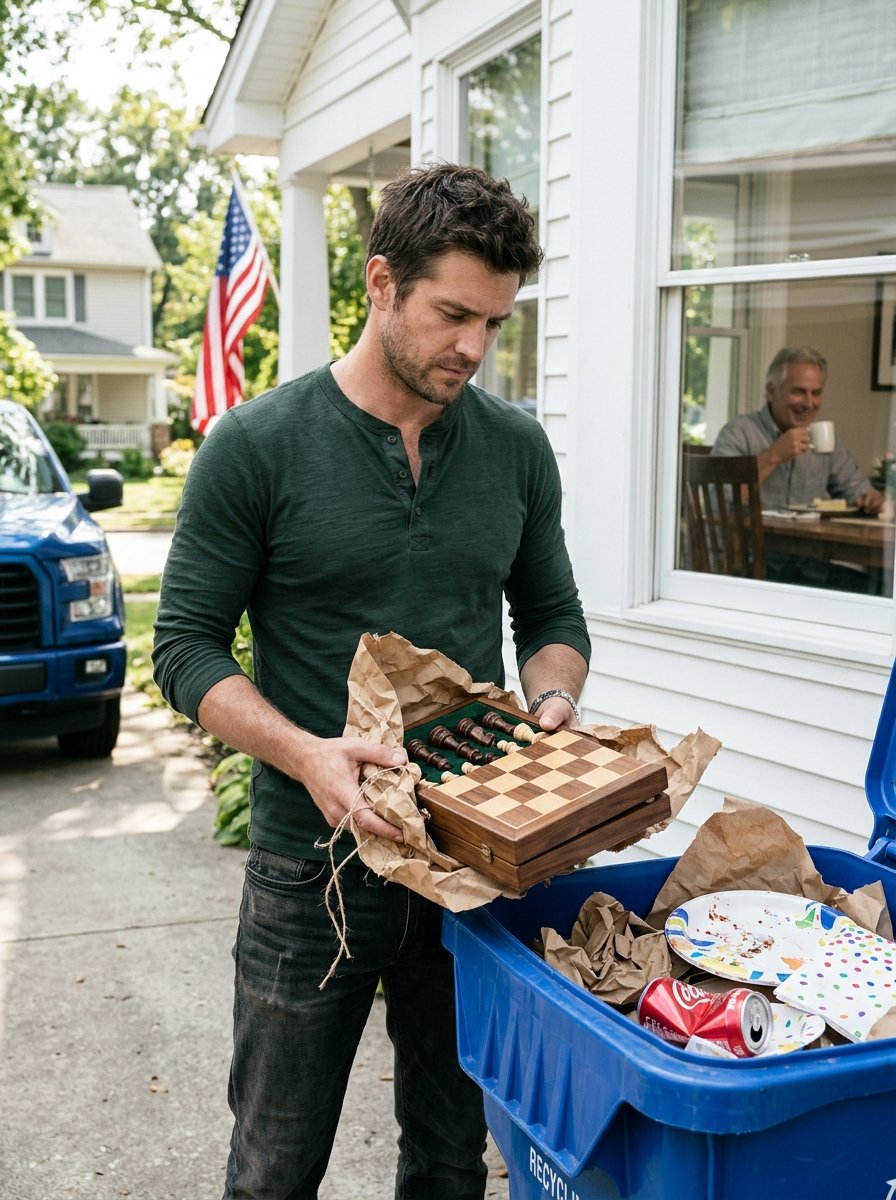
I spent three months building my dad a hand-carved chess set for his 60th. Found it in the trash the next morning, still in the wrapping. My brother’s store-bought watch was on his wrist. I didn’t say anything. I just never came back.
My name’s Michael. I’m 32. And I want to tell you about the moment I stopped trying to earn my father’s love.
Not because I ran out of love to give, but because I finally realized I was pouring it into a container that had no bottom.
And the thing that finally made it click wasn’t some dramatic argument or a screaming match at Thanksgiving. It was a trash can.
But I’m getting ahead of myself. Let me back up.
I grew up in a small town outside of Knoxville, Tennessee. My dad, Gerald, was the kind of man who believed that love was something you earned, not something you were owed.
He ran a small contracting business, built houses with his hands, and expected his sons to be cut from the same cloth.
My older brother, Trent, was three years ahead of me and everything my dad wanted in a firstborn. Tall, athletic, loud, confident, the kind of guy who’d walk into a room and own it before he even said a word.
My mom, Jolene, was sweet and well-meaning, but had this way of smoothing everything over that meant nothing ever actually got addressed.
She was the rug, and all the family’s problems got swept right under her.
Then there was me.
I was quieter. I liked books. I liked building things with my hands too, but not houses. I carved wood. Wood carving specifically.
I started when I was about 12, after my grandfather, my mom’s dad, taught me during a summer visit.
Grandpa Silas was this gentle, patient man who smelled like cedar and pipe tobacco. And he showed me how to take a block of wood and find the shape hiding inside it.
I fell in love with it.
By the time I was 16, I was making things that actually impressed people. Jewelry boxes, figurines, decorative pieces.
It was my thing. My quiet, strange, apparently unimpressive thing.
Because here’s the deal: my dad never cared about it. Not once.
Trent would come home with a second-place football trophy, and my dad would clear a spot on the mantle.
I’d come home with a blue ribbon from the state fair for a hand-carved eagle, and my dad would say, “That’s nice, bud,” and go back to watching the game.
I’m not saying he was cruel about it. He just treated my passion like a hobby that I’d eventually outgrow, like collecting rocks or playing with action figures.
Meanwhile, Trent’s interests were treated like destiny.
Trent went into the family business right after high school. Started working with Dad, learning the trade, and within a few years, they were like a two-man show.
They’d go to job sites together, eat lunch together, come home, and talk shop at the dinner table while I sat there eating my mashed potatoes in silence.
My mom would occasionally say something like, “Michael got an A on his English paper.”
And my dad would nod without looking up.
Cool. Thanks, Dad.
I moved out at 18, got a small apartment, worked at a hardware store during the day, and carved at night.
I started selling pieces online and at local craft markets. It wasn’t a fortune, but it was mine.
I also started teaching myself chess around that time.
I’d always been interested in strategy games, and chess became this meditative thing for me. I’d play online, study openings, lose a thousand times, and slowly get better.
And somewhere along the way, the two passions merged.
I started carving chess pieces.
My first full set took me about two months. It was rough, honestly. The knights looked more like dogs than horses, and the bishops were lopsided, but I kept at it.
By the time I was 25, I was making sets that people were buying for $400 and $500. Custom work, themed sets, tournament-quality boards.
I even had a small following online.
People appreciated the craftsmanship, the detail, the patience it took.
Everyone except my dad.
I’d bring pieces to family dinners. I’d show him photos. I’d tell him about orders I’d landed.
He’d give me the same thin smile and say something like, “That’s neat, Michael. So, Trent, how’s the Henderson job going?”
Every single time.
Like I was a commercial break between the parts of the show he actually wanted to watch.
Trent, to his credit, wasn’t actively trying to be the favorite. He just was.
He was the one who followed in Dad’s footsteps, who spoke his language, who could talk about load-bearing walls and permits over a beer.
I spoke a different language entirely, and my dad never bothered to learn it.
But I kept trying.
Every birthday, every Father’s Day, every Christmas, I made my dad something. A carved picture frame, a decorative box for his desk, a wall-mounted coat rack with hand-carved detail.
He’d say thank you, put it somewhere, and I’d never see it displayed.
I found the coat rack in the garage once, behind a stack of paint cans.
The picture frame was in a junk drawer.
The box was on a shelf in the basement, still wrapped in the tissue paper I’d put it in.
But I kept telling myself the same line.
Maybe the next one will be the one.
Maybe if I make something truly incredible, he’ll finally see me.
So, when my dad’s 60th birthday started creeping up on the calendar, I got an idea.
The most ambitious project I’d ever attempted: a full hand-carved chess set.
Not just any set.
Each piece was designed to represent someone in our family.
The king was modeled after my grandfather, Silas, the man who taught me everything.
The queen was my grandmother.
The bishops were my parents.
The knights were Trent and me.
The rooks were the two family houses, our childhood home and Grandpa’s cabin.
The pawns were carved to look like tools, each one different, representing the trades and skills our family was built on.
Hammers, saws, chisels, wrenches.
I spent three months on it.
Three months of staying up until 2:00 in the morning, sanding, shaping, detailing.
I hand-finished every piece with tung oil.
I built the board from walnut and maple, alternating squares with precision joints that would have made a furniture maker proud.
I even lined the inside of the box with velvet and engraved a small brass plate on the lid that read, “To Dad. 60 years of building things that last. Love, Michael.”
I wrapped it carefully in brown craft paper and tied it with twine.
I drove to my parents’ house the night of the party, feeling something I hadn’t felt in a long time.
Hope.
Real, stupid, vulnerable hope.
The kind that makes you feel like a kid again, even when you know better.
The party was nice. My mom had done the whole thing. Streamers, a cake from the bakery downtown, a playlist of my dad’s favorite country songs.
About 30 people showed up. Neighbors, guys from the job sites, a few cousins.
Trent was there with his wife Candace and their two kids.
I showed up alone.
I’d been single for about a year, which was another thing my dad liked to comment on.
“You’d find a girl if you put down the sandpaper once in a while.”
Hilarious.
When it came time for gifts, Trent went first.
He handed Dad a box, and inside was a watch. A nice one, sure. A Seiko. Probably 200 bucks.
My dad’s face lit up like Trent had just handed him the deed to a lake house.
He put it on immediately, held his wrist up, showed everyone.
“Now that’s a watch,” he said. “My boy knows what I like.”
Then it was my turn.
I handed over the wrapped box. It was heavy.
My dad took it, hefted it, and unwrapped it slowly.
He opened the lid.
He looked at the chess set.
He looked at the pieces.
He picked up the king, turned it over, set it back down, and he said, “Huh, that’s something.”
Then he closed the lid, set it on the table next to the cake plates, and said, “Who wants another beer?”
That was it.
That was the reaction to three months of my life, carved into wood and handed over on a velvet-lined prayer.
“Huh, that’s something.”
I stayed another hour.
I smiled. I made small talk. I watched my dad show off his new watch to everyone who walked by.
And then I went home.
I sat in my truck in the driveway for a while.
I didn’t cry. I was past crying about it.
I just felt hollow, like someone had scooped out everything inside me and left the shell sitting in the driver’s seat.
But that wasn’t even the worst part.
The worst part came the next morning.
I went back to my parents’ house the next morning because I’d left my jacket on the back of a kitchen chair.
It was early, maybe 7:30. I figured I’d slip in, grab it, maybe have a cup of coffee with my mom if she was up.
Simple, in and out, no big deal.
I pulled into the driveway, and the first thing I noticed was the trash cans.
They were at the curb because pickup was that morning.
Nothing unusual about that, but something caught my eye.
Sitting on top of the recycling bin, slightly tilted, was a brown paper bag.
And sticking out of it was a corner of brown craft paper.
The same craft paper I’d wrapped the chess set in.
I got out of the truck and walked over like my legs were moving on their own.
I pulled the bag open.
There it was.
The chess set, still in the wrapping.
The twine was still tied.
He hadn’t even opened it again after the party.
He’d just taken it off the table and thrown it away with the paper plates and used napkins.
Three months of work. Hours and hours of carving, sanding, finishing, engraving.
A family history rendered in wood, sitting in the trash next to a crushed beer can and a paper plate smeared with frosting.
I stood there staring at it.
The garbage truck was maybe two blocks away.
I could hear it grinding and beeping as it worked its way down the street.
In about five minutes, the whole thing would have been compacted and hauled to the dump, and I never would have known.
I picked it up.
I held it.
And then I looked up at the house.
Through the kitchen window, I could see my dad sitting at the table drinking coffee, wearing Trent’s watch.
He hadn’t even noticed me in the driveway.
He was just sitting there content, wearing the gift from the son who mattered.
I put the chess set in my truck.
I got in.
I drove away.
I didn’t grab my jacket.
I didn’t say good morning.
I didn’t cry or scream or punch the steering wheel.
I just drove home in complete silence.
Carried the chess set inside, set it on my workbench, and sat down on the floor.
I sat there for a long time.
That was the last time I went to my parents’ house.
I didn’t make an announcement.
I didn’t send a dramatic text or post some passive-aggressive thing on social media.
I just stopped showing up.
My mom called the next week to ask if I was coming to Sunday dinner.
I said I was busy.
She called the week after that.
I said I was working on a commission.
The third week, she called, and I let it go to voicemail.
Eventually, the calls slowed down.
She’d text now and then. The usual stuff.
“Miss you, honey.”
Or, “Dad’s grilling steaks this weekend if you want to come by.”
I’d respond with something short and noncommittal.
“Sounds good. We’ll see.”
I never went.
Trent called once about a month in.
“Hey, man. Mom says you’ve been MIA. Everything cool?”
I told him, “Yeah, just been swamped with work.”
He said, “All right, don’t be a stranger.”
And that was the end of it.
He didn’t push.
He didn’t ask again.
That was Trent for you. He cared, but not enough to be inconvenienced by it.
The thing that killed me, the thing that I kept turning over in my head like a rock in a tumbler, was that nobody asked why.
Nobody said, “Michael, did something happen? Are you upset about something?”
Nobody connected the dots.
Nobody noticed that I left the party quietly and never came back because that’s how invisible I was in that family.
You can’t miss what you never really saw.
About six weeks after the birthday, my mom finally showed up at my apartment.
She brought a casserole because, of course, she did.
Jolene’s answer to every emotional crisis was a 9-by-13 pan of chicken and rice.
She sat on my couch and asked me what was going on.
Why hadn’t I been around?
Was I sick?
Was I in trouble?
I almost told her.
I was so close.
The words were right there.
I found the chess set in the trash.
Mom, he threw it away.
He didn’t even unwrap it again.
But I looked at her face, and I knew exactly what would happen.
She’d get that soft, pained look.
She’d say something like, “Oh, honey, I’m sure he didn’t mean it like that. You know how your father is. He’s just not good at expressing himself.”
And then she’d go home and tell my dad that I was upset.
And he’d roll his eyes and say I was being sensitive, and nothing would change.
Nothing ever changed.
So instead, I said, “I’m fine, Mom. Just been really focused on work. I’ve got a lot of orders coming in, and I’m trying to build something here.”
She seemed satisfied with that.
She hugged me, told me she loved me, and left the casserole on the counter.
I ate it over three days.
It was good.
My mom’s cooking was never the problem.
Here’s what I didn’t tell her.
I’d found out something else during those six weeks.
Something I discovered entirely by accident while I was cleaning out my grandpa’s cabin.
Grandpa Silas had passed away about four years earlier, and the cabin had been sitting mostly untouched since then.
My mom asked me to go out there and see what needed to be done before they decided whether to sell it.
So, I went.
The cabin was exactly how I remembered it.
Smelled like cedar and dust.
His tools were still on the workbench.
His books were still on the shelves.
And in the back of the closet in his bedroom, inside an old lockbox, I found a stack of papers, letters mostly.
But buried in the pile was a document I’d never seen before.
Grandpa Silas’s will.
Not the official one that had been filed with the estate, the one that left everything to my mom and her sister, Aunt Dela.
This was an earlier version, a handwritten draft with a note clipped to it that said, “Updated version with attorney, August 2019.”
In this draft, Grandpa Silas had written a specific provision.
The cabin and the five acres it sat on were supposed to go to me.
Directly to me.
Not to the estate, not to be split, not to be sold.
To Michael.
Because, and I’m quoting from memory here, “He’s the only one who ever loved this place the way I did. And he’s the only one who will take care of it.”
I sat on the edge of Grandpa’s bed and read that line four times.
“The only one who ever loved this place the way I did.”
My grandfather saw me.
He saw me when nobody else did.
And he tried to make sure I’d have this place.
But somewhere between this draft and the final version, that provision disappeared.
I didn’t know why.
I didn’t know if my mom or Aunt Dela had talked him out of it, or if the attorney had simplified things, or if Grandpa changed his mind.
But the cabin was now technically my mom’s, and she was talking about selling it.
That discovery did something to me.
It cracked open a door I’d been keeping shut because it wasn’t just about the chess set anymore.
It was about a lifetime of being overlooked.
A lifetime of being the quiet one, the weird one, the one whose passions didn’t count because they didn’t come with a trophy or a paycheck that my dad could brag about at the bar.
It was about watching Trent get the spotlight, the praise, the attention, the inheritance of my dad’s approval, while I got head pats and afterthoughts.
And now I was watching the one place that ever felt like home, the cabin where my grandfather taught me to carve, the place where someone finally said, “You’re enough,” get put on the market so my mom could split the proceeds with Aunt Dela and probably hand half to Trent for some business expense.
Something shifted in me during those weeks.
I wasn’t angry exactly.
I was just done.
Done performing.
Done auditioning for a role I was never going to get cast in.
Done believing that if I just tried harder, loved louder, carved more beautifully, someone in my family would finally turn around and say, “Hey, we see you.”
I started making a plan.
Not a revenge plan.
Not at first.
Just a plan to take care of myself for once, to stop waiting for permission to matter.
And the first step was figuring out what happened to my grandfather’s original wishes for that cabin.
Because if Silas wanted me to have it, then maybe, just maybe, I could still make that happen.
And if my family had a problem with that, well, they’d have to actually notice me first.
The next few months were the loneliest and most productive of my life.
I threw myself into my work like a man possessed.
Not because I was running from something, although I probably was, but because for the first time, I was building something entirely for myself without looking over my shoulder to see if anyone was watching.
My online store had been doing okay before.
A few orders a month, some custom commissions, mostly chess sets and decorative pieces, but I’d always held back.
I priced things too low because I didn’t think people would actually pay what they were worth.
I turned down opportunities because they seemed too big or too risky.
I played small because that’s what I’d been trained to do.
Michael doesn’t take up space.
Michael is the quiet one.
Michael sits at the table and eats his mashed potatoes.
Not anymore.
I redesigned my website.
I invested in better photography for my pieces.
I raised my prices.
And I’ll be honest, I held my breath the first time I listed a chess set for $1,200.
But it sold in three days.
Then I made another one and listed it for $1,500.
Sold in a week.
I started getting inquiries from collectors, interior designers, even a guy who ran a high-end gift shop in Nashville.
He wanted to carry my work on consignment.
I said yes.
By month two, I was making more money from carving than I’d ever made at any job.
Not life-changing money yet, but real money.
Enough to quit the hardware store.
Enough to feel like maybe this thing I’d been told was a silly hobby was actually something special.
Imagine that.
The thing my dad dismissed as sandpaper and sawdust was turning into a legitimate business.
I also started going to the cabin on weekends.
Not officially.
My mom hadn’t sold it yet. She and Aunt Dela were still going back and forth about whether to list it or rent it out, so it just sat there empty.
I’d drive out on Saturday mornings, let myself in with the key Grandpa had given me years ago, and work at his bench.
There was something about being in that space that centered me.
The smell of the wood, the light coming through the window over the bench, the sound of nothing but birds and my own hands working.
It felt like Grandpa was still there, standing behind me, saying, “Slow down, Michael. Let the wood tell you what it wants to be.”
During one of those weekends, I met Elise.
She lived about a mile down the road from the cabin in a small house with a garden that looked like something out of a magazine.
I’d driven past it a hundred times as a kid, but never paid attention.
Elise was out front when I drove by, struggling with a fence post that had come loose in a storm.
I stopped to help because that’s what you do on a country road.
You don’t just wave and keep going.
She was 30, a veterinarian who worked at a large animal practice about 20 minutes away.
Dark hair, kind eyes, and this way of talking that was direct but never harsh.
She thanked me for the fence post, offered me a glass of iced tea, and we ended up sitting on her porch talking for two hours.
I told her about the carving.
She told me about a horse she’d saved the week before that everyone else had written off.
We didn’t talk about my family.
We didn’t talk about trash cans or chess sets or invisible sons.
We just talked.
And for the first time in a long time, I felt like someone was actually listening.
We started seeing each other regularly after that.
Nothing dramatic, no grand romantic gestures, just dinners, walks, long conversations.
She came to the cabin one day and watched me work.
She didn’t say anything for about 20 minutes.
Just sat there observing.
Then she said, “You disappear when you carve, like you go somewhere else. It’s beautiful to watch.”
Nobody had ever said anything like that to me.
Nobody had ever looked at what I did and called it beautiful.
I had to excuse myself to the bathroom for a minute after that one.
While my personal life was quietly blooming, I was also doing research.
I’d taken the handwritten draft of Grandpa’s will to an attorney named Sullivan Pratt.
Sullivan was a semi-retired estate lawyer who ran a small practice out of a converted house downtown.
He had white hair, a bow tie, and the demeanor of a man who’d seen every family fight the legal system could produce.
I showed him the document and explained the situation.
He studied it carefully.
He asked questions.
He made copies.
And then he told me something that changed everything.
The handwritten draft I’d found wasn’t just a rough version.
It was dated and signed.
And according to Sullivan, there were grounds to argue that the final will, the one that had been filed, didn’t properly reflect Grandpa’s intent regarding the cabin.
Specifically, there was a note in the margin of the draft that said, “Cabin to Michael, separate from estate. Discussed with Dela, she agrees.”
If Aunt Dela had indeed agreed to that provision and it was removed without proper documentation of a change in intent, there might be a legal basis to challenge the distribution.
I want to be clear here.
I wasn’t trying to screw my mom or Aunt Dela out of anything.
The estate had other assets, savings, some investments, the proceeds from Grandpa’s truck and equipment.
The cabin and the land were a piece of it, but not the majority.
What I wanted was what Grandpa wanted.
For the cabin to be mine.
For the place where I learned who I was to stay in the hands of someone who cared about it.
Sullivan told me it wouldn’t be easy.
Estate challenges rarely are, but he also said the handwritten document combined with any corroborating evidence of Grandpa’s intent could make a strong case.
He asked if there was anyone who could confirm that Grandpa wanted the cabin to go to me.
I thought about it, and then I remembered something.
Grandpa’s neighbor, a retired carpenter named Harland Box, had been his closest friend for 40 years.
They built a fence together, shared tools, watched each other’s places when one of them traveled.
If anyone knew about Grandpa’s wishes, it would be Harland.
So I drove out to see him.
Harland was 82 and sharp as a tack.
He lived in a small brick house about a quarter mile from the cabin, with a workshop in the back that made mine look like a cardboard box.
When I told him what I’d found, he didn’t seem surprised.
He sat back in his chair and said, “Your grandpa talked about that all the time. Said the cabin was for you. Said you were the only one in the family who understood what it meant to make something with your hands. He was real clear about it.”
I asked if he’d be willing to put that in writing or testify if it came to it.
He looked at me for a long moment and said, “Son, your grandfather was the best man I ever knew. If his wishes got lost in the shuffle, I’ll do whatever it takes to set it right.”
I drove home that night feeling something unfamiliar.
Not hope exactly.
I’d been burned by hope before.
It was more like momentum, like I’d been standing still for 32 years and finally started moving.
The business was growing.
Elise was in my life.
Sullivan was working on the cabin situation.
And for the first time, I wasn’t building something to impress my father.
I was building something for me.
Meanwhile, my family hadn’t noticed any of it.
My mom still texted occasionally.
Trent sent a meme once every couple of weeks.
My dad didn’t reach out at all.
Not once.
I’d been gone from their lives for almost four months, and the man hadn’t picked up the phone a single time, which told me everything I needed to know about where I stood.
But here’s the thing about being invisible for your whole life.
When you finally step out of the shadows, nobody sees it coming.
And what was coming next?
Well, let’s just say nobody in my family was prepared for it.
Least of all my dad.
Five months after the birthday party.
Five months of silence, growth, and quiet preparation.
That’s when everything started converging in a way that felt almost scripted by the universe.
If you believe in karma, this is the part where you start nodding.
Sullivan had been working behind the scenes, gathering documentation, filing the necessary motions to challenge the estate distribution regarding the cabin.
He’d obtained a copy of the final will from the probate court, and when he compared it side by side with the handwritten draft I’d found, there was a clear discrepancy.
The final will made no mention of the cabin going to me.
It simply lumped everything into the estate, split evenly between my mom and Aunt Dela.
But the handwritten draft, dated just three weeks before the final version, explicitly named me as the recipient of the cabin and the surrounding five acres.
Sullivan also discovered something interesting.
The attorney who’d prepared the final will, a guy named Gentry Moss, who had since retired, had notes in his file that referenced a phone conversation with my mother.
The notes were brief but telling.
They said, “Jolene called, discussed simplifying distribution, remove specific bequests, split everything equally.”
That was it.
One phone call.
My mother had called the attorney and asked him to simplify the will, which effectively erased my grandfather’s specific wish that I receive the cabin.
Now, I want to pause here because I know what you might be thinking.
Maybe my mom didn’t realize what she was doing.
Maybe she thought simplifying was just easier.
And maybe that’s true.
But here’s what bothered me.
She knew.
She had to have known.
Grandpa told people about his plans for the cabin.
Harland knew.
Aunt Dela apparently knew.
There’s no way my mother didn’t know that her own father wanted that cabin to go to his grandson.
And she let it get erased with a phone call.
Whether it was intentional or careless doesn’t really matter when the result is the same.
Sullivan filed a petition with the probate court to reopen the estate distribution and presented the handwritten document, Harland’s sworn statement, and the attorney’s notes as evidence.
He warned me that my family would be notified as part of the process.
I told him I was ready.
While the legal wheels were turning, something else happened.
My business exploded.
Not gradually.
Explosively.
A lifestyle blogger with about two million followers had purchased one of my chess sets as a gift for her husband and posted an unboxing video.
She spent four minutes on camera just marveling at the detail, turning each piece over, running her fingers along the board.
The video got over 800,000 views in a week.
My inbox flooded.
I had more orders than I could fill.
I had to set up a waitlist.
Within two weeks, I’d been contacted by a producer from a regional craft show on public television.
They wanted to feature me in a segment about artisan woodworkers.
I said yes.
Then a gallery in Asheville reached out about displaying a collection of my pieces in their annual handmade exhibition.
I said yes to that, too.
Then, and this is the one that still makes me shake my head, I got an email from a representative of a well-known actor.
I won’t name names, but let’s just say this person has been in multiple blockbuster franchises and apparently collects handmade chess sets.
They wanted a custom commission.
The budget they quoted was more than I’d made in some entire years of my life.
Elise was there through all of it.
She never made it about her.
She never said, “I told you so.”
Because she’d never had to.
She just showed up, helped me pack orders, organized my shipping schedule, and occasionally forced me to stop working and eat dinner like a human being.
One night, she looked at me across the table and said, “You know you deserve all of this, right?”
I told her I was starting to believe that.
She said, “Good, because I’m not going anywhere. And I refuse to date someone who doesn’t know their own worth.”
I would like the record to show that I did not get emotional at that moment.
I absolutely did not excuse myself to check on something in the workshop while my eyes happened to be a little dusty.
So there I was.
Business booming, a woman who actually saw me, a legal case in motion, and a life that was finally starting to look like something I had built on purpose rather than something that happened to me by accident.
And then my mom called.
Not a text this time.
A call I picked up because it had been a while.
And despite everything, she was still my mother.
“Michael, we need to talk.”
Her voice was tight.
Not angry exactly, but wound up like she was trying very hard to stay calm.
“I got a letter from a lawyer about your grandfather’s cabin. Can you explain to me what’s going on?”
I kept my voice even.
“I found a document in Grandpa’s cabin, a handwritten version of his will that says the cabin was supposed to go to me. I took it to an attorney, and he agrees there’s a valid claim. That’s what’s going on.”
Silence.
Then, “Michael, you can’t just go behind everyone’s back like this. This is a family matter.”
I almost laughed.
“A family matter? Mom, I’ve been gone for five months. Dad hasn’t called me once. Trent texts memes. You send casseroles. Nobody in this family has asked me a single real question about my life in years. So, forgive me if I don’t feel like running major life decisions through the family committee.”
She got quiet after that.
I could hear her breathing.
Then she said, “Your father is very upset about the cabin, about all of it. He says you’ve been distant and disrespectful.”
I gripped the phone so hard I’m surprised it didn’t crack.
Distant and disrespectful.
The man who threw away a three-month labor of love without even looking at it twice thought I was being disrespectful.
The man who hadn’t dialed my number in five months thought I was being distant.
“Mom, I have to go. The lawyer will handle the legal stuff. If Dad wants to talk to me, he knows my number.”
She said something else, but I was already pulling the phone away from my ear.
I sat there for a while, breathing.
Elise came in and sat next to me.
She didn’t say anything.
She just put her hand on my arm and waited.
After a few minutes, I said, “They’re going to make me the villain in this story.”
She said, “Then let them. You know who you are.”
Two days later, Trent called.
This time, he wasn’t casual.
“Dude, what are you doing? Mom’s freaking out. Dad’s talking about getting his own lawyer. You’re really going to sue the family over a cabin?”
I said, “I’m not suing anyone, Trent. I’m asking for what Grandpa wanted me to have. There’s a document that proves it. There’s a witness who confirms it. And there are notes from the original attorney that show the provision was removed after Mom called and asked to simplify the will. I’m not making this up.”
Trent was quiet for a beat.
Then he said, “Look, man, even if that’s true, is it worth tearing the family apart?”
And there it was.
The question that every family scapegoat gets asked.
Is it worth tearing the family apart?
As if the family wasn’t already torn.
As if the tears weren’t there long before I found a chess set in the garbage.
As if being ignored for 32 years was somehow less destructive than asking for what was rightfully mine.
I said, “Trent, I love you, but this family was torn apart a long time ago. You just didn’t notice because you were always on the side that was holding together.”
He didn’t have an answer for that.
The court date was set for three weeks out.
Sullivan was confident.
Harland was ready to testify.
The documentation was solid.
And for the first time in my life, I was going to walk into a room and demand to be seen.
Not as Michael the quiet one.
Not as Michael the disappointment.
Just as Michael, the grandson who was loved by a man who carved, and who carved because he was loved by that man.
But before the court date, my dad decided to do something he hadn’t done in five months.
He decided to come see me.
And what happened next is the conversation I’d been waiting for my entire life.
It was a Tuesday evening.
I was in my workshop finishing a commission, a medieval-themed set for a client in Portland, when I heard a truck pull into my driveway.
I knew the sound of that engine.
I’d grown up hearing it.
My dad’s old Ford, the one he’d had since before I was born.
The one he claimed he’d drive until they buried him in it.
I wiped my hands on a rag and walked to the front door.
Gerald was standing on my porch looking like he’d rather be anywhere else on the planet.
He was wearing jeans, a flannel shirt, and Trent’s watch.
Of course, he was wearing the watch.
“Can I come in?” he said.
I stepped aside.
He walked into my living room and looked around like he was inspecting a job site.
His eyes moved over the shelves where I displayed some of my pieces, the chess sets on the side table, the framed photos of me and Elise.
He didn’t comment on any of it.
“Sit down, Dad.”
He sat on the couch.
I sat in the chair across from him.
We looked at each other.
He spoke first.
“Your mother says you’re trying to take the cabin.”
“I’m not trying to take anything. I’m trying to honor what Grandpa wanted.”
He waved his hand dismissively.
“Silas was sentimental. He said a lot of things in his last years. Doesn’t mean they were all practical.”
“He wrote it down, Dad. He signed it. He told his neighbor. He told Aunt Dela. He wanted me to have the cabin. The only reason I don’t already have it is because Mom called the lawyer and had it removed.”
His jaw tightened.
“Your mother was trying to keep things fair.”
“Fair for who? Because it sure wasn’t fair for me. And it wasn’t fair for Grandpa.”
He leaned forward, elbows on his knees, and pointed at me in that way he always did when he was about to deliver what he thought was an unassailable point.
“Michael, you’re making a mountain out of a molehill. It’s a cabin. It’s old. Needs a new roof. The plumbing’s shot. It’s not worth what you think it is.”
“It’s worth everything to me. That’s the whole point. And the fact that you can’t understand that is exactly why we’re here.”
He stared at me.
I could see him trying to figure out when I’d grown a spine, when the quiet kid who ate his mashed potatoes and took his dismissals with a thin smile had been replaced by this person sitting across from him, calm and immovable.
“I didn’t come here to argue about a cabin,” he said finally.
“I came here because your mother is upset, your brother is upset, and honestly, Michael, I don’t understand what’s gotten into you.”
That’s when I decided to stop holding back.
“You want to know what’s gotten into me? I’ll tell you, but you need to actually listen, not nod and wait for your turn to talk. Actually listen.”
He sat back and crossed his arms, which was Gerald language for “I’m tolerating this.”
“I spent three months building you a chess set for your 60th birthday. Every piece was hand-carved. The king was modeled after Grandpa Silas. The board was walnut and maple. I engraved a brass plate on the lid. It was the single best thing I’ve ever made. I put more of myself into that gift than anything I’ve ever created.”
He blinked.
I could tell he barely remembered it.
“You opened it at the party, said, ‘Huh, that’s something.’ Set it on the table next to the cake plates and spent the rest of the night showing off the watch Trent bought you.”
He shifted uncomfortably.
“Michael, I said thank you.”
“You said, ‘Huh, that’s something.’ And then the next morning, I came back to get my jacket and found the chess set in the trash can at the curb. Still wrapped. You threw it away, Dad. You didn’t even give it to Goodwill or shove it in the basement. You put it in the garbage with the used paper plates.”
The room was dead silent.
I watched his face go through about four different expressions in five seconds.
Confusion, recognition, defensiveness, and then something I’d never seen on Gerald before.
Shame.
“I didn’t know,” he started.
“Didn’t know what? That throwing away a handmade gift from your son might hurt? That treating someone like they’re invisible for 32 years might have consequences? What exactly didn’t you know, Dad?”
He uncrossed his arms.
His hands went to his knees and just sat there.
He looked smaller than I’d ever seen him.
Not physically. Gerald was still a big man, but something inside him had contracted.
“I didn’t mean to throw it away,” he said quietly. “Your mother was cleaning up, and I thought it was, I don’t know, a decoration or something someone brought.”
“It had a brass plate that said ‘To Dad’ on it.”
He closed his eyes.
And for the first time in my life, I saw my father confronted with something he couldn’t dismiss or wave away.
The evidence was too clear.
The hurt was too real.
And I was sitting right in front of him, not flinching.
“I messed up,” he said.
“Yeah, Dad, you did. Not just with the chess set. Every carving I brought home that you ignored. Every ribbon I won that you never hung up. Every conversation you steered back to Trent while I was mid-sentence. You spent my whole life telling me in a thousand small ways that I didn’t matter. And when I finally stopped showing up, you didn’t even notice for five months.”
He didn’t argue.
He just sat there absorbing it.
And then he said something that surprised me.
“I don’t know how to fix this.”
“I don’t know if you can,” I said. “But I know what’s going to happen with the cabin. That property is going to come to me because that’s what Grandpa Silas wanted. And I have the paperwork and the witnesses to prove it. And I’m going to restore it. I’m going to fix the roof and the plumbing and the porch, and I’m going to use it as my workshop because that’s where I learned to be the person I am. And that person is someone worth knowing. Dad, you just never bothered to find out.”
He stood up slowly.
He looked at me for a long moment.
Then he looked at the chess sets on my shelf.
And I could see something shifting behind his eyes, like he was seeing them for the first time.
Really seeing them.
The detail, the artistry, the hours and hours of patient, precise work.
“These are beautiful,” he said.
And the way he said it, heavy and raw, like the words cost him something.
I almost believed he meant it.
“Thanks,” I said. “You can let yourself out.”
He left.
I stood at the window and watched his truck pull away.
Elise came out of the bedroom where she’d been giving us space.
She put her arms around me from behind and said, “How are you?”
I said, “I’m good. I’m actually really good.”
Three weeks later, we went to court.
Sullivan presented the handwritten will.
Harland testified, and the attorney’s notes were entered into evidence.
Aunt Dela, to my genuine surprise, testified that she remembered Grandpa talking about leaving the cabin to me and that she’d always been fine with it.
The judge ruled in my favor.
The cabin and the five acres were transferred to my name.
My mother cried in the hallway afterward.
Trent stood next to her looking uncomfortable.
My dad wasn’t there.
He’d refused to come.
But a week later, I got a package in the mail.
No return address, but I recognized the handwriting.
Inside was a framed photo I’d never seen before.
It was me at 12 years old, sitting at Grandpa Silas’s workbench, holding up a small carved bird with the biggest smile on my face.
On the back, in my father’s handwriting, it said, “I should have paid more attention.”
I put the photo on my workbench at the cabin, right where Grandpa would have wanted it.
It’s been about a year since all of that happened.
The cabin is restored.
New roof, updated plumbing, a proper workshop with good lighting and ventilation.
I work there most days now.
Elise and I moved in together into her place down the road because it turns out loving a veterinarian means you also get three rescue dogs and a cat named Hank who judges you from every elevated surface in the house.
I proposed to her last month on the cabin porch.
She said yes before I even finished the question.
My business is thriving.
Six-month waitlist, two more media features after the craft show, and a deal to sell a limited collection through a national retailer.
The chess set I made for my dad, the one I pulled out of the trash, sits in the cabin on a table by the window.
I never sold it.
It stays there as a reminder.
Not of what my father did, but of what I’m worth.
As for my family, it’s complicated.
My mom and I talk occasionally.
She’s trying.
Trent and I grab a beer now and then.
He still doesn’t fully get it, but he’s making an effort.
And my dad, we’re not close.
We may never be, but he came to the cabin once about two months ago.
Didn’t say much.
Just walked around, looked at the workshop, watched me carve for a while.
Before he left, he put his hand on my shoulder and squeezed.
That’s about as eloquent as Gerald gets.
I don’t need his approval anymore.
I spent 32 years carving things for a man who couldn’t see them.
Now I carve for myself, for Elise, for clients who appreciate the work, and for the memory of a grandfather who looked at a quiet kid with a block of wood and said, “Show me what you see in there.”
And every single day, I show.
If you came here from Facebook because of this story, please go back to the original Facebook post, give it a like, and comment exactly “Heartfelt” to support the storyteller. That small gesture means a great deal. Your encouragement reminds me that these stories matter and gives me the motivation to keep sharing more meaningful stories with you.
Disclaimer: This story is fictional and created for entertainment purposes only. Any names, characters, places, or events are fictitious or used fictitiously. No real person or organization is intended to be portrayed.