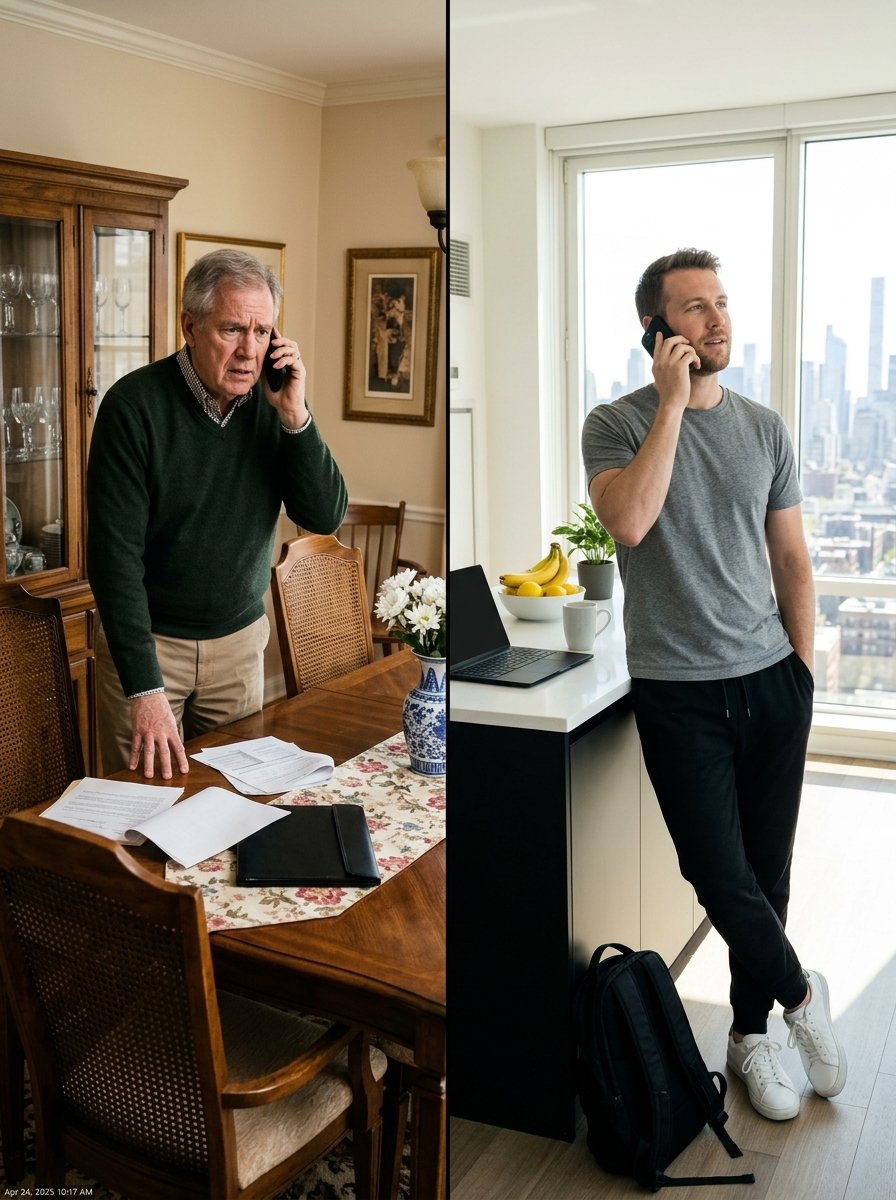
My Family Didn’t Notice I’d Moved to Utah for 7 Months Then Dad Ordered Me Home for My Brother’s Wedding and Threatened Me With the Will
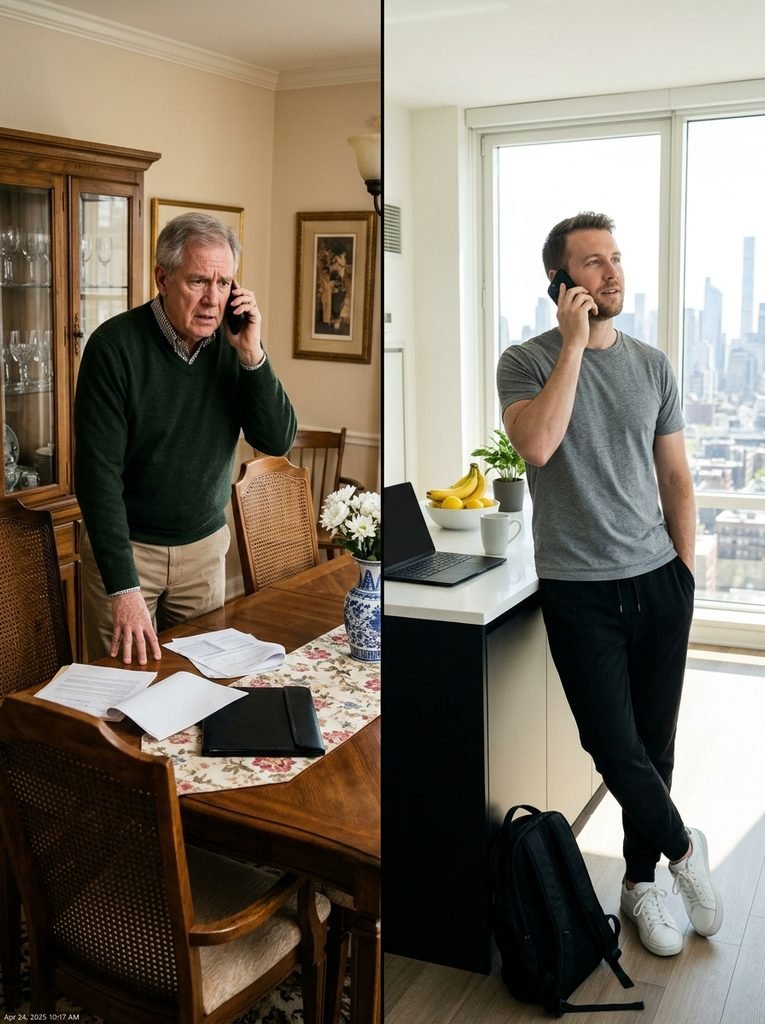
“If you don’t come to Houston this weekend, you’re out of the will.”
My father said it like he was reading a weather report. Calm. Certain. A man who’d never once in his life been told no by his youngest son.
I was standing in my kitchen in Utah with an oven mitt on one hand. My salmon had four minutes left on the timer. Outside the window, the sun was sinking orange behind the Wasatch Mountains.
And I laughed.
It wasn’t a bitter laugh. It was clean. Like air after a thunderstorm.
“You can’t cut me off, Dad,” I said. “I make more money than all of you combined.”
The line went completely silent.
I could almost hear him swallow.
My name is Ethan Walker. I’m thirty-one years old. I’m a senior cloud engineer.
And that phone call was the first time my father had spoken to me in seven months.
He hadn’t called because he missed me. He hadn’t called to ask how I was.
He didn’t even know I’d moved.
Seven months earlier, I’d packed up my entire life in Indianapolis and moved four states away to Salt Lake City. I never told my family.
And not one of them noticed I was gone.
The smell of cardboard has a way of getting into everything. Your skin. Your clothes. The air itself. It mixes with the dusty sweetness of old paint while packing tape screeches through the silence.
That’s what I remember most about the night I left.
I was kneeling on the floor of apartment 32A, the little one-bedroom in Indianapolis where I’d lived for four years. I pressed down a strip of tape across a box and smoothed it with my thumb until it stung.
My friend Olivia dropped another box down by the door, out of breath.
“Are you sure you don’t want to tell them you’re leaving?”
Her voice was half pleading, half disbelieving.
Across the room, our friend Marco laughed quietly.
“Tell them? Liv. They didn’t even notice when he stopped going home for Christmas.”
I looked around at what was left of my apartment. Bare walls. One lamp buzzing in the corner. The floor creaking under us like it was trying to remember footsteps.
“They don’t even remember where I live,” I said. “If I told them I was moving, it would just confuse them.”
Olivia frowned and tore off a new strip of tape.
“You’re serious.”
“Completely.”
The tape ripped again. Sharp as a memory.
And for a second, I was nine years old again, standing in the gymnasium at Briarwood Elementary in Houston.
My science fair volcano had smoked and bubbled exactly like it was supposed to. A crowd of parents and teachers leaned in while I explained the geological layers and how gas pressure builds up underground.
I won first place. A blue ribbon.
I waited all through dinner that night for somebody to ask me how it went.
My dad finally looked up from his plate.
“That’s nice, son,” he said.
Then he turned to my older brother, Cole.
“That pass you threw at practice today. Outstanding.”
And the lava in my memory hardened right there into silence.
I blinked back to the present.
Olivia was wrapping a stack of books in newspaper. She held something up.
“You still have this thing?”
It was my volcano. The same one. Red paint chipped. The paper label faded and peeling.
“Yeah,” I said. “That one taught me my very first lesson in being invisible.”
By midnight, the apartment was a hollow shell. Every trace of me sealed up in cardboard.
On the kitchen counter sat one last thing I hadn’t packed. An old letter, yellowed at the edges.
My student loan approval. From when I was eighteen.
I touched the paper lightly and heard my father’s voice in my head. The summer before college.
“We already used the college fund for Cole. You’re smart, Ethan. You’ll figure it out.”
So I figured it out.
Two part-time jobs. A dorm room the size of a closet at Purdue. And a student loan I carried for nine years like a bruise nobody could see.
I paid off the last of it eight months before I moved.
The cheap blue pen I signed that loan with still lived in my wallet. It weighed more than any promise my family ever made me.
At 12:01 a.m., I opened my laptop and sent my resignation email.
My job in Indianapolis was steady. Safe. Too safe.
I’d already accepted a new position at a cloud infrastructure startup in Salt Lake City. Starting Monday.
By 12:35, my suitcase was standing by the door with a white luggage tag looped through the handle. SLC.
Olivia hugged me quick. No speeches. No drama.
Marco handed me a paper cup of coffee from the gas station downstairs.
“You’ll text us when you land?”
“Maybe,” I said, half smiling.
Outside, the city was quiet. My breath fogged in the cold March air. A cab sat idling under the streetlight, exhaust curling up into the dark.
I looked back one last time at the door of 32A. At a life small enough to fit inside four walls.
“They’ll never even notice,” I whispered.
At the airport, the fluorescent lights hummed over empty gates.
I checked my phone one last time before boarding.
No missed calls. No texts. Not even a happy birthday. My birthday had been the week before.
When the boarding line moved, I joined it.
And I thought, tomorrow I’m going to live somewhere with mountains.
Pages:
Mornings in Salt Lake City had a kind of brightness I’d never seen in Indiana or Texas.
Sunlight so sharp it made the air taste clean.
My apartment in Sandy faced west, straight toward the Wasatch Range. Every day started the same way. Strong coffee. A quiet room. The low hum of my laptop booting up.
The company was called Cascade Compute. A cloud infrastructure startup that cared more about results than about whose son you were.
For once in my life, I didn’t have to prove I deserved a seat at the table.
During our Monday sprint meeting in my second month, my manager, Priya, stopped in the middle of a sentence.
“Ethan, you’ve been working on the cost optimization module, right? Can you walk the team through your fix?”
My throat went dry.
In my family, speaking up meant getting corrected. Here, it meant getting heard.
I walked them through it. Line by line.
When I finished, the room went quiet. Then everybody started nodding.
“That’s a really solid solution,” Priya said.
That approval hit me harder than I expected. Clean and simple recognition.
No comparisons. No “but your brother.”
That afternoon, I laced up my trail shoes and ran Parley’s Trail. The path wound through open fields where the snow was just starting to melt.
I ran until my lungs burned the good way. The city shrinking behind me. The mountains growing taller ahead.
For the first time in my life, I felt grounded.
Back home, I video called my grandmother. Mary Ellen Walker. My father’s mother. She lives in Lafayette, Indiana, in the same little brick house where my dad grew up.
Her face filled the screen. All silver hair and sharp blue eyes.
“You look good, sweetheart,” she said. “Are you eating right?”
I laughed. “Better than I ever did back there, Grandma.”
She smiled like she already knew everything.
“Don’t you feel guilty for choosing peace,” she said. “Some people mistake silence for distance. But sometimes silence is the healthiest answer there is.”
Grandma was the only one in my family who knew I’d moved. The only one who ever asked.
We talked until the mountains outside my window turned violet.
After she hung up, I sat in the dim light for a long time, listening to the city below.
The quiet didn’t feel like loneliness anymore.
It felt like proof that I could exist without anybody’s permission.
Seven months went by like that.
I worked. I ran. I hiked on weekends. I made friends at the office. Olivia and Marco flew out to visit twice and fell in love with the mountains.
At work, I rebuilt the company’s whole data pipeline. It saved Cascade almost five million dollars in its first year.
They promoted me to senior engineer. They gave me a raise. They gave me stock.
And when the company’s Series C funding round closed that fall, my stock options were suddenly worth more than I’d ever imagined I’d see in my life.
I didn’t tell anybody. Except Grandma.
My phone never rang. Not once. Not from Houston.
Then one evening in October, it did.
The number flashed on my screen while I was cooking dinner.
Dad.
I let it ring once. Twice.
Then I answered.
His voice came in sharp. The way it always did when he’d already decided what I owed him.
“You need to come home this Saturday,” he said. “Houston. Cole’s future in-laws want to meet the whole family before the wedding. It’s important we all show up. Look unified.”
I leaned against the counter, glancing at the oven timer.
“You want me to fly to Texas this weekend?”
“You will fly to Texas this weekend,” he corrected me. “You’re his brother. Family matters.”
I took a slow, deliberate breath.
“Dad,” I said. “I’ve been living in Utah for seven months.”
Dead silence on the line. Like the call had dropped.
Then came the sound I remembered from my whole childhood. The controlled explosion of his temper.
“You WHAT? You moved without telling anybody? How dare you do something that drastic without telling your family! What’s your address?”
I looked out the window at the orange sky sinking behind the mountains.
“Do you even remember my old address?” I asked quietly. “The one in Indianapolis? Where I lived for four years?”
He hesitated. Only for a second.
But that second told me everything.
“That’s not the point,” he snapped.
“It is the point,” I said. “You never cared enough to know where I lived. Why would I tell you where I live now?”
He sighed. His voice dropped low.
“If you don’t come, you’re out of the will.”
And that’s when I laughed.
And told him I made more money than all of them combined.
The silence on the line went on and on.
When my father finally spoke again, the anger was gone.
In its place was a sudden warmth that made my skin crawl.
“Ethan,” he said. “Son. You know we’ve always been proud of you. You’ve done so well for yourself. That’s all we ever wanted for you.”
I looked at the call timer on my phone screen.
Five minutes and twelve seconds.
That’s how long it took my father to go from command, to threat, to flattery.
I ended the call before he could say another word.
The apartment was very still afterward.
The oven timer went off. The smell of salmon and lemon filled the kitchen.
I sat down at my desk and set the phone in front of me.
Five minutes and twelve seconds.
That was the whole lifespan of their authority over me.
I didn’t realize I was smiling until my cheeks started to hurt.
Ten minutes later, the texts started.
First from Mom.
Your father is just upset. Don’t overreact.
Then from Cole.
Come on, man. Just one dinner. It means a lot to everybody.
Attached to Cole’s message was a screenshot. He’d forwarded part of an email thread from his fiancée’s family.
The subject line said Background Information.
My name was right there in the middle of a paragraph.
The brother, Ethan Walker, appears absent from all recent family photos and social media. We’d like to understand why.
Below it was a link. To my mother’s Facebook page.
I clicked it.
Post after post after post. Our family, smiling. Christmas morning. Easter brunch. Fourth of July on the lake. Cole’s engagement party.
Dad. Mom. Cole.
Not me.
Not once. Going back eight years.
I sat there staring at that screen, the photos glowing in the dark.
They hadn’t forgotten me by accident.
They’d erased me on purpose.
And now Cole’s future in-laws were asking why. And my family needed me to fly to Houston and stand in their photos, so nobody would find out.
I closed the messages. I turned my phone face down on the desk.
Outside, the last of the sunlight faded off the glass.
The day had ended.
So had something much older.
I didn’t go.
Saturday morning came quiet and bright. I’d planned to hike up near Park City that day.
But my phone wouldn’t stop vibrating.
Forty-seven missed calls by 9:15 a.m. Most of them from my mother.
I poured a cup of coffee, sat by the window, and let the phone buzz itself into silence.
When it finally stopped, I opened her newest message.
Last night was a disaster. People thought you were sick or dead. Please call.
I scrolled further.
She’d sent photos from Houston. The family dinner at the country club. Half-empty tables. Centerpieces wilting under the patio heat lamps.
Then an email came in from my cousin Rachel. Forwarded by accident, judging by the chain.
Dinner got called off. The bride’s parents never showed up. Apparently they found out about the missing brother.
I took a sip of coffee. It had already gone cold.
On reflex, I opened Mom’s Facebook again.
Every single post that might have once mentioned me, or shown an empty spot where I should have been, was gone. Deleted overnight.
Then a text from Cole.
She’s asking questions, man. You could help me fix this. Just one video call. Say hi. Tell her you’re super busy with work.
I typed back: I’m not your cover story.
Then I deleted it before I hit send.
A few minutes later, a text came in from a number I didn’t recognize.
It was the fiancée. Her name was Brooke.
Are you really Cole’s brother? Why haven’t I ever met you? Why did he tell me you were working overseas?
The honesty of that question cut deeper than any insult my family had ever thrown at me.
I started to answer her. But what was there to explain?
That some people are born into families where love has to be earned? And some are born into families where it just isn’t offered at all?
I set the phone down.
Around noon, Grandma called.
Her voice was soft. But there was steel underneath it.
“I saw the pictures from that dinner,” she said. “Your mother’s telling everybody you embarrassed the family. You didn’t, honey. The truth embarrassed them all by itself.”
I let out a long breath.
“They’re coming apart, aren’t they, Grandma?”
“Yes,” she said. “And none of it is your fault.”
Later that afternoon, I opened my laptop to check my email.
One subject line stopped me cold.
Walker Family Education Trust: Account Records.
It was from a bank in Houston. I’d never had an account there.
I opened it.
Attached was a statement. For the Walker Family Education Trust. A college fund my grandfather had set up before he died, when Cole and I were little.
The document stated it clearly, right there in black and white. The trust was created for the education of both grandsons. Cole Walker and Ethan Walker. In equal shares.
And every single dollar of it had been paid out to Cole. Every withdrawal signed by my father. Alan Walker.
Tuition at Texas A&M. A new truck. A semester abroad in Barcelona. Fraternity dues. A down payment on Cole’s townhouse.
And at the very bottom, a note from the bank.
Account closed. Flagged for audit irregularities.
I leaned back in my chair.
All those years of “We can’t afford two tuitions, Ethan.”
It was never true. My grandfather had left money for both of us.
My father just decided I didn’t need my half.
I sat there a long time.
Then another notification popped up.
An email. Sent from my own old Gmail account. One I hadn’t used since college.
It was a formal reply to a wedding RSVP.
Mr. Ethan Walker sincerely regrets that he is unable to attend due to international business travel.
My mother had written it. She still had my old password. She was pretending to be me.
I stared at it in half disbelief, half pity.
They’d built a world so fragile that just my absence was cracking it wide open.
By evening, the messages slowed down.
I opened a blank folder on my desktop. I saved every screenshot. Every message. Every email.
Not to use against them. Just to remember how far I’d come.
Outside, Salt Lake’s evening light shifted from gold to blue.
I didn’t feel angry anymore. I didn’t even feel sad.
I felt clean. Like I was standing on high ground after years of drowning in someone else’s expectations.
My phone blinked once more. One last message from Mom.
Please let us talk. We can explain everything.
I didn’t open it.
I closed the laptop, pulled on my jacket, and walked outside toward the trailhead.
The air smelled like pine and coming rain.
And I realized something as I walked. Freedom wasn’t the silence they’d given me for seven months.
Freedom was the silence I chose to keep.
The wedding was three weeks later. At a fancy outdoor venue outside Houston.
That morning, Salt Lake City was washed in thin sunlight.
I made my coffee. Opened my laptop. Told myself I wasn’t going to check my phone.
It rang before my coffee even cooled.
Grandma.
Grandma had flown down to Houston for the wedding. She was eighty-three. Cole was still her grandson, and she said she’d be there for him no matter what.
Behind her voice I could hear chaos. Shouting. Glasses clinking. Somebody crying.
“Ethan,” she said. “Cole’s arguing with Brooke’s parents. Out in the parking lot. They found out about you.”
I stood very still, my coffee cup halfway to my mouth.
“Found out what about me?”
“Why he’s been hiding a brother for years. And somebody showed them the bank records. The trust. The one where only one grandson got a dime.”
For a long moment, I just listened. To her voice. To the wind brushing against my window.
“And?” I finally asked.
Grandma sighed.
“They know your parents lied. About all of it. They’re furious.”
My cousin Rachel had texted me a link earlier in the week. A livestream of the ceremony, for relatives who couldn’t make it.
I pulled it up.
The video was shaky. A manicured lawn. Rows of white chairs. White roses everywhere. Men in linen suits sweating in the Texas heat.
My mother was sitting in the front row, crying.
My father stood beside her. His face was pale. Stretched into a brittle smile.
The bride’s parents’ chairs were empty.
The officiant was talking into a microphone that kept screeching with feedback, trying to calm the crowd down.
My phone buzzed. Cole.
They think I’m heartless. They’re canceling everything. Are you happy now?
I looked at those words for a long time.
Happy?
That wasn’t the feeling.
It was quieter than that. Like watching a house burn from a mile away. Close enough to see the flames. Far enough away not to feel the heat.
I set the phone down and closed the video.
By that evening, the news had spread beyond Houston.
There was an article on a local news site.
Prominent Houston Builder’s Son’s Wedding Called Off Amid Family Financial Questions.
I didn’t click it.
Olivia sent me a screenshot anyway.
They made their own mess, she wrote. Guess the truth finally RSVP’d.
That night, Olivia and Marco happened to be in town. They’d flown out for a ski trip. We had dinner on my patio under the string lights. The air was cool and clear.
I told them everything. How Brooke walked out. How my dad was trying to spin it as a misunderstanding.
Marco poured the wine and shook his head.
“You didn’t even have to do anything, man. They collapsed under their own lies.”
I smiled a little.
“Maybe that’s what justice actually looks like,” I said. “When you spend your whole life pretending, the minute reality catches up, there’s nothing left to hold on to.”
After they left, I washed the dishes slowly. One at a time. Like I was putting away the last pieces of someone else’s drama.
My phone buzzed. Dad.
For a second, I thought about answering. Just to see which voice he’d use this time.
Command. Threat. Or sweetness.
Instead, I silenced it.
The next morning, the story was on the business page of the Houston Chronicle.
Walker Construction Under State Investigation for Tax Irregularities Linked to Family Trust.
The Walker name. Once attached to one of the most respected contracting companies in Houston. Now paired with words like investigation and audit and fraud.
My father had always wanted the perfect family picture. The kind of photo people frame for other people to admire.
But every photo fades when the light hits it long enough.
Theirs had finally burned out.
And for the first time in my life, I didn’t feel any urge to fix it.
The weeks after the wedding were quiet at first.
Then came the flood.
Calls from numbers I didn’t recognize. Voicemails piling up until my inbox was full and stopped accepting new ones.
I ignored them all.
One afternoon, I found a plain white envelope in my mailbox. No return address.
Inside was a check. For one hundred and twenty thousand dollars.
Signed by my father. Drawn on the account of Walker Family Holdings.
In the memo line, he’d written: For your education. I’m sorry.
I held it up to the light.
The ink shimmered. But the apology felt hollow.
I left it on my kitchen counter while my phone started ringing again. Dad. Mom. Cole. One call after another until the ringtone stopped being a sound and turned into background noise.
That night, Grandma left me a voicemail.
“You don’t have to carry this, sweetheart,” she said. “They’re paying for their own choices now. Let them.”
Her voice got softer.
“You’ve done enough.”
I sat in the dark and listened to it three times.
The next morning, another envelope came. This one thicker. Handwritten. The curvy, familiar loops of my mother’s handwriting.
Inside was a letter on lined notebook paper.
We made mistakes. Please understand. We only ever wanted the best for both of you. Family is complicated. But we love you.
It was signed: All of us.
I didn’t finish reading it.
I folded it in half and dropped it in the recycling bin.
Later that afternoon, a notification came from my bank.
I’d deposited the hundred-and-twenty-thousand-dollar check that morning. I’d decided my grandfather’s money should finally go where he meant it to go. I was going to give every cent of it away. To scholarships.
The bank notification said: Returned item. Insufficient funds. Account closed.
The check had bounced.
I laughed out loud, all alone in my kitchen.
Even their apologies bounced.
The next week, an email came from a law firm in Houston.
Mr. Walker, we represent your parents. We request that you refrain from discussing private family financial matters publicly.
I deleted it.
I hadn’t said a single word about them. Not online. Not at work. Not to anybody but Grandma and two friends.
The truth didn’t need my help spreading.
That night, Grandma called again.
She was quiet for a long time before she spoke.
“Ethan,” she said. “I think it’s time you knew something.”
“What is it, Grandma?”
“I’m the one who sent those trust records. To Brooke’s parents. Two days before the wedding. And to you.”
I didn’t say anything.
“Your grandfather set up that fund for both of you boys,” she said. “Equal shares. He made me promise before he died that I’d make sure it was done right. And I trusted your father. For years, I trusted him.”
Her voice shook.
“Last spring I finally asked the bank to show me the records. When I saw what he’d done, I couldn’t sleep for a week. That money was supposed to put you through school. And you were working two jobs and taking out loans while your brother drove around in a new truck.”
“Grandma,” I said. “You knew they’d hate you for it.”
“They already do,” she said. “But I’d rather be hated for telling the truth than loved for keeping a lie. That girl deserved to know what family she was marrying into. And you deserved a clean start.”
After we hung up, I went and stood by the window.
The air outside was cold. The kind of cold that clears your lungs.
Behind me, my phone buzzed again. Another call. Another message. More words that couldn’t change anything.
I let it ring.
When it stopped, the silence filled the room again.
Pure. Heavy. Deliberate.
Somewhere far away, my family was trying to rebuild a picture that didn’t exist anymore.
Here in my apartment, I let the quiet settle over me.
Sometimes the deepest kind of justice isn’t punishment.
It’s peace.
Five months later, I’d moved again.
A small house in Park City. Thirty minutes up the canyon from Salt Lake. With a porch, and a yard, and a view of the ski runs.
I bought it with my own money. My name, alone, on the deed.
Rain was falling over Park City one evening in March when I finished my last report of the day.
The house was quiet except for the hum of my computer fan and the patter of rain against the windows.
I leaned back to stretch my neck.
My phone lit up.
Alan Walker.
For a full minute, I just watched it ring.
After months of silence, it felt almost theatrical. Like the universe had picked this exact storm to cue him back into my life.
I answered.
His voice was low. Uncertain. I’d never heard him sound like that.
“Ethan. I’m not calling to argue.”
The words sounded rehearsed.
“I just want to explain some things.”
I waited. The rain outside turned into a steady hiss.
“There was pressure,” he said. “Cole was always easier to be proud of. He needed more help. You were independent. You always were. We figured you’d be fine.”
I stared out the window as lightning flickered over the mountains.
“You mean the pressure that made you spend Grandpa’s money for both of us on just one of us?” I said. “The same pressure that made you lie to me for thirteen years?”
The silence on the line was louder than the thunder.
I could hear him searching for words that didn’t exist.
“I thought you’d make it anyway,” he finally said. “I was afraid if we split it, Cole wouldn’t survive out there. You were tougher.”
I took a slow breath.
“So love in our house came with interest rates,” I said quietly. “And you invested in whichever son you thought would give you the better return.”
He didn’t argue.
The line crackled.
And then I heard a sound I had never heard from my father before. Not once in thirty-one years.
A sob. Broken and small.
“Now I’ve lost both my sons,” he said.
“No, Dad,” I said. “You just don’t get to own either of us anymore.”
I opened my desk drawer and looked at the cheap blue pen I’d used to sign my student loan at eighteen.
“I learned to build a life without your help,” I said. “And I learned to stop asking you to see me.”
The storm got louder through the phone. I could hear muffled voices behind him. My mother, trying to talk over him.
Then my father’s tone changed.
Desperate. Practical.
“We’re losing everything, Ethan. The company’s gone. The bank’s taking the house. Brooke left Cole two months after the wedding didn’t happen. If you could just buy the house back. In your name. We could keep the family’s reputation alive.”
It was almost funny. How easily he slid from confession straight into negotiation.
“If I were still broke,” I asked him, “would you have called me tonight?”
He didn’t answer.
His silence told me everything I needed to know.
Then, faintly through the static, my mother’s voice.
“Ethan, honey, we could come to Utah. We could come see you. We just want to make things right.”
I closed my eyes.
“Don’t,” I said. “Stay wherever you are. Anywhere is fine. As long as it’s not my home.”
I ended the call. Right in the middle of her sentence. Before anybody could turn guilt into one more transaction.
The clock on my screen said 10:13 p.m.
I poured a glass of wine from a half-finished bottle and walked out onto the back porch.
The mountains were hidden behind the rain. Dark shapes swallowing the horizon.
The air was cold and clean.
I stepped out past the overhang and let the rain soak through my shirt.
I didn’t feel angry anymore. Just a quiet kind of release. The kind that doesn’t leave an echo.
I held my hands out, palms up, and let the rain wash over them. Like it could rinse away every invisible fingerprint they’d ever left on me.
Forgiveness, I realized standing there, wasn’t about letting them back in.
It was about not letting them write the rest of my story.
I stayed out there until the thunder faded, and the only sound left was the steady rhythm of rain on my roof.
Eighteen months after I left Indianapolis, summer sunlight was flooding my kitchen in Park City.
The air smelled like cut grass and coffee.
I was scrolling through my inbox when one subject line made me stop.
Congratulations: Cascade Compute Innovation Award.
I read it twice. Then I smiled.
On the counter next to my coffee mug sat the old science fair volcano. Red paint chipped. The paper label carefully taped back on.
The thing they forgot now sat right in the middle of my home.
I walked through the house slowly that morning, noticing all the small changes I’d made.
The white walls now hung with framed maps of Utah’s hiking trails. My desk was lined with thank-you cards from students in the free online coding course I’d started teaching on Tuesday nights. Kids from rural towns. First-generation college students. Kids who were doing it alone.
No family photos. No ghosts.
Just space. Clean and bright.
My laptop chimed. A video call.
Grandma’s face filled the screen. Her smile warm and steady.
“Well, look at you,” she said. “Living like a grown man with no chaos behind him.”
I laughed. “That’s the goal, Grandma.”
She sipped from her teacup.
“You ever think about visiting Indiana? Your grandfather’s headstone could use some company.”
I thought about it.
“I’ll come when I want to,” I said. “Not because I should.”
She nodded. Satisfied.
“That’s exactly what I hoped you’d say.”
She set her teacup down.
“You know, I kept every letter you wrote me from college. The ones where you told me about the nights you didn’t think you’d make it. Working the overnight shift at the library and then going straight to class.”
Her eyes were wet.
“I always knew you’d find your way somewhere like this. Your grandfather would be so proud. You’re finally living the life you deserved.”
Pages:
After she hung up, I walked out into the backyard.
The grass stretched all the way to the edge of the trees at the base of the mountain. The sun was sliding low, turning the whole sky honey gold.
I thought about that night in the airport in Indianapolis. Checking my phone for a call that never came.
I had no idea where I was going back then. I only knew I couldn’t stay.
My phone buzzed in my pocket.
A number with a Houston area code.
I looked at it for a second. Then I deleted it without listening.
No anger. No satisfaction. Just stillness.
Some doors don’t need to be slammed.
They just stay closed.
Two weeks later, a letter came in the mail from Grandma.
Inside was a cashier’s check, and a single handwritten note.
I’ve moved most of my savings into a scholarship fund. In your name. For students like you. The ones who have to do it alone. Your grandfather would want it this way. This time, it’ll go where it’s supposed to go.
The check wasn’t huge. Fifteen thousand dollars.
It didn’t have to be huge.
I felt a lump rise up in my throat.
I set Grandma’s note right next to the volcano on the kitchen counter.
“Guess we finally put that science fair ribbon to work,” I whispered.
I added five times that amount from my own stock sale that same week. And Cascade Compute agreed to match it.
The Walker Scholarship for Independent Students gave out its first four awards that fall. Four kids who were working two jobs and putting themselves through school.
Grandma flew out to Utah for the ceremony. She sat in the front row in her good navy dress.
I was the only Walker on that stage. And she was the only Walker in the audience.
It was enough.
A few weeks later, a reporter from Salt Lake Magazine emailed me. She wanted to do a feature. “From Student Debt to Startup Success: The Ethan Walker Story.”
I wrote back politely and said no.
I wasn’t interested in telling a story about pain. I’d spent too long living it.
I just want to keep moving forward, I wrote.
That same evening, another envelope arrived. An invitation to my fifteen-year high school reunion in Houston.
I smiled. I folded it once.
And I dropped it straight into the recycling bin.
The past didn’t need my RSVP.
Before bed, I wrote a thank-you card to Grandma.
I don’t need family to know my worth. I only need people who actually see me. Thank you for always being one of them.
I sealed it and set it by the front door to mail in the morning.
Then I turned off the lights.
Outside, the night hummed softly. The porch light cast a warm circle over the grass.
In the dark window, I caught my own reflection. A man standing in a house he built without anybody’s permission. Surrounded by a quiet that finally belonged to him.
I glanced one more time at the volcano on the counter. Its chipped red paint glowing under the stove light.
It was a forgotten science project once.
Now it was proof that even the things people leave behind can outlast the people who ignored them.
I don’t have an inheritance anymore. I don’t have apologies that matter. I don’t have an audience waiting for some big reunion.
I have a home at the foot of a mountain. Steady and bright. Friends who fly across the country to sit on my patio. A grandmother who calls every Sunday. And four kids in college this year who won’t have to do it completely alone.
For most of my life, I thought love was something you had to earn. I thought if I just worked harder, achieved more, stayed agreeable and quiet, one day my family would finally look at me and see someone worth keeping.
But that day was never coming.
And what I thought was rejection turned out to be the invitation to start over somewhere better.
Leaving wasn’t dramatic. It was quiet. Just as quiet as the way they ignored me.
One night, I stopped waiting for them to understand me. And I decided to understand myself instead.
I thought that would make me colder.
It didn’t.
It made me lighter.
And that’s what I finally understood about freedom.
It isn’t the moment you walk away.
It’s the moment you stop looking back.