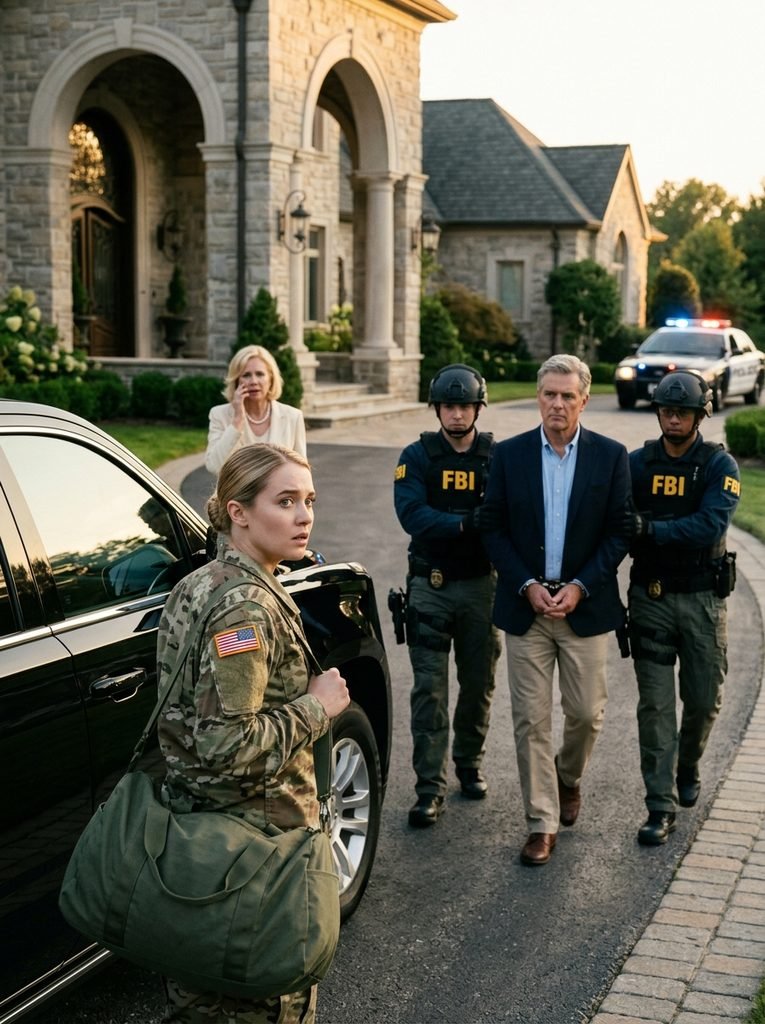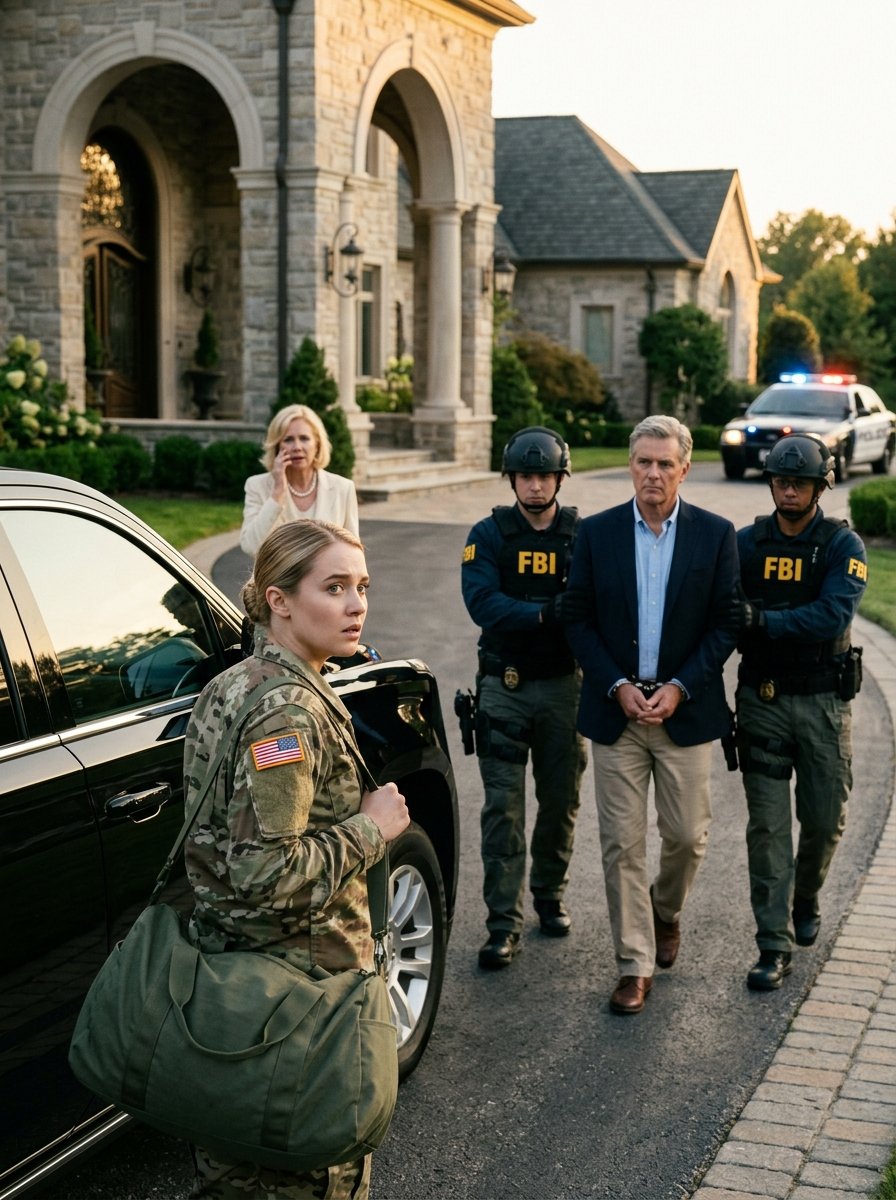
I had been home from Baghdad for barely eleven minutes when I noticed my $154,200 Mercedes sitting in my parents’ driveway
“I had been back from Baghdad for just eleven minutes when I spotted my $154,200 Mercedes parked in my parents’ driveway—the very same SUV I had secured in locked storage fourteen months before. My mother stood next to it,
clutching the key fob, and said, “You’re overreacting.” I didn’t argue. Seven minutes later, FBI vehicles sealed off both ends of the street, and my father was being placed in handcuffs.
My name is Colonel Mara Ellison.
The first thing that caught my attention wasn’t my mother.
It was the scratch just above the rear wheel.
Three inches long.
Bare silver beneath the black paint.
My duffel bag fell from my hand.
“Why is my vehicle here?”
Mom gripped the key fob even tighter.
“You’ve only just arrived. Come inside.”
“That SUV was in bonded storage. No one could release it without my authorization.”
Behind her, my father appeared on the porch.
“Technically,” he replied, “that’s not entirely correct.”
That single word sent a chill through my veins.
Three months earlier, while stationed in Baghdad, FBI Special Agent Daniel Cho had presented me with a falsified power of attorney carrying my signature.
Someone had been gaining access to accounts under my name.
And now my Mercedes was parked right in front of me.
Mom let out a sigh.
“Your father took care of certain matters while you were away. Your brother needed a vehicle. We drove it to business meetings.”
That was when I spotted a parking sticker on the windshield.
RIVERSTONE EXECUTIVE CLUB.
I recognized that name.
Riverstone Logistics Group had been listed on a military reimbursement I had supposedly authorized while I was actually stationed in Mosul.
That single invoice had led investigators to dozens of others.
Shell corporations.
Federal housing grants.
Military subcontractor payments.
Millions of dollars.
And every trail eventually pointed toward one mailing address.
A Richmond post-office box registered by my father.
Mom snapped her fingers in my direction.
“Quit making such a big deal out of this.”
I lifted my duffel bag and headed toward the street.
Then I sent Daniel Cho a text.
Vehicle located and confirmed.
His response arrived almost instantly.
Remain outside.
Only minutes later, black SUVs rolled into the neighborhood.
Without sirens.
Federal agents stepped out in force.
The color drained from Mom’s face.
Daniel walked across the street.
“We have a federal warrant to search the property.”
Dad backed away from my Mercedes.
“This isn’t necessary.”
Daniel faced him directly.
“Richard Ellison, turn around and put your hands behind your back.”
My father glared at me.
“What have you done?”
Then Daniel spoke in a low voice.
“We recovered the Riverstone ledgers.”
My father immediately stopped resisting.
An agent secured the handcuffs around his wrists.
Mom staggered backward.
“I don’t understand what’s happening.”
Just then, another agent rushed out of the house with a laptop sealed inside an evidence bag.
“We located the credential station.”
My stomach clenched.
“What credential station?”
Daniel turned toward me.
“Someone recreated your authentication system inside your father’s office. We recovered a duplicated access token.”
“And a biometric scanner.”
“That couldn’t function without my fingerprint.”
Daniel remained silent.
Then I noticed my mother’s hand tucked deep inside her cardigan pocket.
“Mom. Show me what’s in your hand.”
Slowly, she pulled it free.
Clutched in her fist was a small transparent plastic bag.
Daniel took it from her.
Inside lay a delicate silicone membrane.
A molded fingerprint.
My fingerprint.
Suddenly, I remembered the care package she had sent me overseas.
Cookies.
Socks.
And a “family keepsake card” she had insisted I press my fingertips against.
My father abruptly yelled, “Elaine was responsible!”
Mom snapped back, “Keep your mouth shut.”
Daniel opened the laptop the agents had recovered.
Then his expression shifted.
“Mara, there’s something else.”
Displayed on the screen was a federal wire authorization.
$8,417,000.
Authorized by:
LT. COL. MARA ELLISON.
Scheduled for release:
Tomorrow, 08:00 Eastern.
The digital signature had been generated less than an hour before my flight touched down.
I turned toward my mother.
She looked directly into my eyes.
Then, speaking loudly enough for every FBI agent standing on that street to hear, she declared:
“Mara, it’s time you stopped pretending you had nothing to do with this.”
PART 2: The words hung in the air, and for the first time in my life, I looked at my mother and saw a stranger. Every FBI agent on the street turned toward her, while my father stood motionless in handcuffs. Daniel Cho stepped between us and asked her to explain exactly what she meant.
Mom lifted her chin. “Your daughter authorized those payments,” she said, pointing at me. “She gave us access before she deployed, and now she’s trying to blame her own family.”
I didn’t raise my voice. “Then show them the original authorization, Mom.” Her lips parted, but no answer came. Daniel quietly instructed an agent to preserve every device in the house, including my mother’s phone.
My father suddenly shouted, “Elaine, you said the transfer wouldn’t happen until Friday!” The street fell silent. Mom spun toward him, realizing too late that he had just connected her directly to the eight-million-dollar transaction.
Daniel looked at me. “The transfer is scheduled for tomorrow morning, but we believe someone is trying to move the money tonight.” He showed me a preliminary report listing three shell companies, each connected to Riverstone Logistics. One company had received payments for military equipment that had never been delivered.
Then an agent emerged from the house carrying a locked metal case. Inside were counterfeit identification documents, several encrypted storage drives, and a folder bearing my full military name. My stomach tightened when Daniel opened it and
revealed copies of my deployment orders, travel records, and security credentials.
Someone had been tracking every move I made. But the most disturbing discovery was a handwritten note tucked beneath the documents. In my father’s handwriting, it read, “If Mara returns before the transfer, use the backup statement.”
“What backup statement?” I asked.
Daniel’s expression hardened. “We found it on your mother’s laptop.” He turned the screen toward me, revealing a prepared confession claiming I had orchestrated the
entire fraud and recruited my parents to help conceal it. The document was dated three weeks before I left Baghdad.
Mom began to cry, but I noticed she wasn’t looking at me. She was staring at the laptop, where a new notification had just appeared.
TRANSFER CONFIRMED: AUTHENTICATION ACCEPTED.
Daniel grabbed his phone. “That’s impossible. We haven’t released anything.”
Then he looked at me with sudden alarm.
“Mara, someone is using your credentials right now—and it isn’t your father or your mother.”
PART 3: Daniel Cho grabbed the laptop and ordered every agent on the street to secure the property. The transfer authorization was still active, and the system
showed that someone had successfully passed the final authentication check. I
stared at the screen, recognizing the security sequence as one I had personally designed for military financial operations. Whoever was behind this wasn’t simply stealing my identity; they understood exactly how to make the fraud look
legitimate. And they had planned for the possibility that I would come home and expose everything.
“Can you trace the authentication source?” I asked Daniel. He nodded and called the technical team, while another agent rushed to contact the federal office
responsible for the pending transfer. We had less than twelve hours before the money was scheduled to move, and every minute mattered. Then a technician’s voice crackled through Daniel’s phone, delivering a discovery that changed the entire investigation.
The access request hadn’t originated from my parents’ house. It had come from a secure terminal registered to a federal contracting office in Virginia. I knew the
building immediately because I had attended a classified financial security briefing there two years earlier. Only a handful of authorized officials could access that
terminal, and none should have been using my credentials. Daniel looked at me and asked the question I had been dreading: “Mara, who inside that office knows your authentication procedures?”
Before I could answer, my father spoke from beside the FBI vehicle. “You don’t understand what you’re dealing with.” Daniel ordered him to remain silent, but Dad kept talking. He claimed someone had approached him fourteen months earlier with
an offer to solve our family’s financial problems in exchange for temporary access to my records. According to him, the person promised that no real money would be moved without his permission.
“Who made the offer?” I demanded. My father lowered his eyes and whispered a name: Deputy Director Thomas Vance. I recognized it immediately because Vance had once supervised a federal investigation involving military procurement fraud. He had also been present during the briefing where I explained how compromised credentials could be used to authorize fraudulent payments.
Daniel’s expression turned grim as he relayed the name to headquarters. Within minutes, the FBI began coordinating with investigators who could lawfully secure the terminal and preserve its access logs. Meanwhile, agents searched my father’s office and discovered a second phone hidden inside a false bottom of his desk. Its messages contained payment instructions, meeting arrangements, and repeated references to something called Operation Glass House.
Then the technician called again. The team had traced the latest authentication request to a remote session linked to the Virginia terminal, but the connection was already being shut down. Someone on the other end knew investigators were
watching. Just before the session disappeared, a final message flashed across the screen: “The daughter is home. Activate contingency.”
My mother suddenly stopped crying. She looked directly at Daniel and said, “You need to protect Mara, because the people behind this won’t stop at stealing her identity.” For the first time that evening, her fear seemed genuine rather than
rehearsed. She admitted that she had kept the silicone fingerprint because she had been told it was insurance against a future investigation, but she insisted she hadn’t understood the full plan.
I wanted to believe her, but the evidence against both my parents was too substantial to ignore. Daniel reminded me that their statements would have to be verified independently, and I agreed. Then an agent approached with the recovered phone, showing us one final message sent only minutes before the authentication attempt. It contained a meeting location, a time, and a sentence that made my blood run cold: “If Vance is exposed, eliminate the original witness.”
Daniel slowly lifted his eyes from the screen. “Mara, the meeting is scheduled for tomorrow morning, and the witness is identified by name.” He turned the phone toward me. There, beneath the message, was my full name, my rank, and a
photograph taken outside my military headquarters just days before I left Baghdad. Whoever had organized the fraud hadn’t merely anticipated my return. They had already planned what would happen after I discovered the truth.
—END OF Chapter 1, —PRESS NEXT PART IN BOTTOM OF PAGE TO READ NEXT Chapter
—END OF Chapter 1, —PRESS NEXT PART IN BOTTOM OF PAGE TO READ NEXT Chapter
The cold evening breeze swept down the quiet suburban street, carrying the sharp scent of damp pine and cooling asphalt. Agents continued searching my parents’ house, carrying out sealed plastic evidence containers.
Daniel Cho studied my face under the amber glare of the streetlights, his radio crackling with encrypted transmissions from Washington headquarters. He knew my training made me calm under pressure, but this hit closer than any ambush.
My mother remained pressed against the hood of an unmarked sedan, her cardigan pulled tight against the damp Virginia night. Her defiance had evaporated entirely, replaced by the hollow, trembling realization of imminent federal prison.
My father sat in the back of the cruiser, his forehead resting heavily against the reinforced safety partition. The polished metal handcuffs gleamed whenever passing headlights swept across his folded, defeated hands.
“The hit order didn’t come from a burner phone, Mara,” Daniel said quietly, holding up his tablet to show the live signal analysis. “It routed through an internal DOD intranet relay server in Arlington.”
“Vance is running out of exits,” I replied, staring at the photograph of myself taken in Baghdad. “He knows the transfer failed, which means he is already moving his escape assets tonight.”
A tactical van pulled up to the curb, its doors sliding open to reveal three senior agents carrying tactical communications gear. They set up a field command center right on my parents’ manicured lawn.
Inside the house, technicians unplugged my father’s primary desktop, bagging every cable, peripheral device, and external flash drive. Fourteen months of systemic deceit were being categorized and labeled into clear, numbered evidence sleeves.
I looked at my Mercedes sitting in the driveway, its gleaming black paint now bearing the indelible scar of their carelessness. That three-inch silver scratch felt like a permanent reminder of how easily trust can shatter.
Daniel called his field supervisor at the Washington Field Office, authorizing an emergency preservation order for every server connected to Vance’s office. “We need twenty-four-hour surveillance on Vance’s primary residence in McLean immediately,” he stated firmly.
The voice on the speaker was tight with urgency. “Director Vance cleared his desk two hours ago, Cho. His security detail reports he dismissed them early for an unscheduled off-site meeting.”
My military instincts immediately took over, cutting through the personal pain of my family’s betrayal. “He’s running the contingency protocol mentioned in the text. He’s heading for the secondary transfer terminal tonight.”
Daniel looked up sharply, motioning his lead tactical agent over. “The text said to eliminate the original witness if Vance was exposed. That meeting location isn’t just an escape route; it’s an ambush.”
“Let him think the plan is proceeding,” I said, stepping closer to the tactical monitor. “If he believes I’m still standing here arguing with my parents, he won’t expect us at the rendezvous.”
My mother looked up from the sedan, her voice cracking as she spoke to the agents. “Mara, please listen to me. Vance told Richard he had eyes everywhere inside the Pentagon’s logistics division.”
I walked over to her slowly, keeping my distance as an investigator rather than an estranged daughter. “You traded fourteen years of my service record for a golf club membership and forged bank accounts.”
“We were drowning in debt, Mara,” she pleaded, tears cutting through her makeup. “Your father made bad investments during the market downturn. Vance promised no one would ever get hurt if we cooperated.”
“You pressed a silicone mold over my thumb while pretending to send me family cookies,” I replied coldly. “You built an entire gallows for my military career and put my name on the trapdoor.”
She lowered her head, unable to meet my eyes, while an agent gently pushed her into the back of a second vehicle. There was nothing left to say; the betrayal was documented in cold digital code.
Daniel handed me a secure federal communicator and a tactical vest from the rear compartment of his SUV. “Protocol says you sit this out as a material witness, Colonel. But you know his tactical habits.”
“Vance was my supervisory liaison during the European procurement audit three years ago,” I said, strapping the Kevlar tight over my field jacket. “I know how he thinks, and I know his emergency protocols.”
The field technician waved us over to the rear of the tactical van, where satellite feeds flickered across two large monitors. “We just caught a ping from the burner phone linked to Operation Glass House.”
The signal originated from an abandoned marine supply warehouse along the James River, twenty miles outside the city perimeter. It was an isolated industrial property registered to another Riverstone shell company established four years ago.
“That’s where the off-grid server is housed,” I observed, pointing at the river access docks behind the warehouse footprint. “He can finalize the wire transfer manually and escape via the waterway before dawn.”
Chapter 3
Daniel checked his service sidearm, racked the slide, and looked at the assembled five-man federal response team. “We have federal arrest warrants for Thomas Vance and everyone listed on the Glass House distribution manifest.”
We rolled out into the midnight traffic, traveling in a three-car convoy without emergency lights or sirens to maintain absolute operational surprise. The Virginia highway was dark, slick with intermittent rain that smeared across the windshield.
Sitting in the passenger seat, I checked the digital ledger files Daniel had extracted from my father’s hidden safe. Every military shipment I had signed off on in Iraq had a mirrored, forged counterpart in Virginia.
Medical supplies, vehicle armor plates, secure radios, and tactical generators had been billed twice through federal accounts. Millions intended for troops in combat zones had flowed directly into Riverstone offshore accounts in Grand Cayman.
“Your father wasn’t the mastermind, Mara,” Daniel said softly as we turned off the highway onto an unpaved industrial access road. “He was just a convenient front with access to your childhood records.”
“That doesn’t absolve him,” I answered, watching the tall pines give way to rusting chain-link fences and decaying corrugated metal buildings. “He knew exactly what uniform I wore and what those supplies meant.”
The convoy stopped half a mile from the warehouse gates, cutting all vehicle running lights as the agents deployed silently into the tree line. The damp river air felt heavy and cold against my exposed face.
Through night-vision optics, the warehouse appeared dark, but thermal imaging revealed heat signatures near the river loading dock. A high-performance offshore cabin cruiser was tied to the decaying wooden pilings, its twin diesels idling quietly.
“He’s already preparing to board,” Daniel whispered into his throat microphone, signaling the tactical units to advance in a pincer formation. “We move on my count, non-lethal priority, but defend yourselves if fired upon.”
We advanced along the rusted exterior wall, stepping over discarded shipping pallets and twisted metal rebar with practiced tactical silence. Every step reminded me of night patrols in northern Iraq, except the enemy wore civilian suits.
A side entrance stood slightly ajar, the security latch taped back with heavy-duty black industrial duct tape to allow rapid egress. Inside, the warehouse smelled of stagnant river water, old motor oil, and burning computer components.
Across the vast concrete floor, a portable satellite uplink terminal glowed bright blue against the shadowed, cavernous metal walls. A tall figure in a tailored dark overcoat stood over the keyboard, typing commands with frantic speed.
Beside him stood two armed private security contractors wearing black tactical jackets, their submachine guns slung across their chests. They were watching the
main warehouse entryway, completely unaware that we had breached the secured river access door.
“FBI! Federal agents! Drop your weapons and step away from the terminal!” Daniel’s voice boomed through the metal rafters with thunderous authority. Flashlights cut through the dark, pinning the three figures in blinding white beams.
One contractor foolishly reached for his tactical sling, but the federal assault team moved with overwhelming, practiced precision. Two beanbag rounds cracked through the warehouse, dropping him instantly to the concrete before he could shoulder his weapon.
The second contractor immediately dropped his hands onto his head, falling to his knees and shouting his surrender over the echoing commotion. Only the man in the dark overcoat remained standing beside the glowing field monitor.
Deputy Director Thomas Vance slowly turned around, shielding his squinting eyes from the blinding glare of our high-intensity tactical lights. Even cornered in an
abandoned river warehouse, his silver hair was combed back with aristocratic precision.
“You’re too late, Cho,” Vance said, his voice smooth and entirely devoid of panic despite the weapons pointed directly at his chest. “The international clearing house batch file processed thirty seconds ago through Zurich.”
“Step away from that console, Vance,” I commanded, stepping forward out of the shadows with my weapon lowered but firmly ready. His eyes widened slightly as he recognized my uniform beneath the black tactical vest.
“Colonel Ellison,” he murmured, offering a thin, condescending smile that made my jaw tighten with controlled military discipline. “I must admit, your unexpected early arrival from Iraq caused a rather inconvenient logistical disruption tonight.”
“You stole my identity, framed my family, and siphoned funding meant for active frontline units,” I said, stepping closer to the terminal table. “And you signed a hit order against an active-duty military officer.”
Vance let out a dry, bitter chuckle, shaking his head slowly as an agent stepped forward to snap heavy steel handcuffs onto his wrists. “Your father was a pathetic, greedy gambler, Mara. He practically begged me for an angle.”
Daniel leaned over the satellite workstation, tapping several keys to inspect the live terminal status while our technicians secured the data cables. A broad, triumphant grin slowly spread across the FBI agent’s tired, shadowed face.
Chapter 4
“He didn’t beat the clock, Mara,” Daniel announced, turning the monitor toward us so the live transfer logs were clearly visible. “The federal preservation freeze we
filed at headquarters kicked in three minutes before his authorization sequence ran.”
The bright red warning text flashed rhythmically across the black screen: TRANSACTION ABORTED BY FEDERAL MONETARY OVERSIGHT COMMAND. The eight-million-dollar wire had hit a dead-end firewall and
bounced directly into a federal holding escrow account.
Vance’s polished composure finally shattered, his eyes darting frantically toward the river dock where his escape boat drifted uselessly against the wooden pilings. Federal marine patrol boats suddenly swept around the river bend, their blue strobes lighting up the dark water.
“You have no idea how deep this network goes, Ellison,” Vance hissed through clenched teeth as agents searched his designer coat pockets. “You’ll spend the next ten years testifying in closed congressional hearing rooms just to clear your name.”
“I’ve survived mortar fire in Fallujah and roadside ambushes in Mosul, Vance,” I replied, staring directly into his venomous eyes. “Testifying against corrupt bureaucrats in Washington will be the easiest duty assignment of my entire military career.”
Two federal agents marched Vance toward the awaiting transport van, his expensive shoes scuffing against the gritty concrete floor of the warehouse. His private contractors were loaded into a separate tactical vehicle behind him in absolute silence.
Daniel and I remained beside the glowing terminal while the cyber forensic team began making bit-by-bit physical clones of every hard drive. The evidence gathered tonight would unravel shell operations stretching across five separate states and three federal departments.
“We found the primary authorization logs,” Daniel said, scrolling through encrypted messaging archives recovered from Vance’s personal satellite phone. “Your father really believed the money was coming from a private venture fund Vance controlled.”
“My father chose willful blindness because he wanted an easy way out of his debts,” I said, looking out toward the river. “Greed makes people believe whatever lies protect their fragile comfort, even if it destroys their own children.”
The eastern horizon was beginning to glow with pale ribbons of orange and grey light as our convoy left the river district. The sun was rising on a morning that was supposed to have marked my professional and legal ruin.
Instead, we arrived at the FBI Washington Field Office just as morning commuters began filling the wide avenues of the capital. Television news crews were already
gathering outside the main entrance, alerted to a major federal corruption bust.
Inside the secure briefing room, Daniel placed a thick cardboard evidence folder on the long wooden conference table directly in front of me. On the cover was my name, stamped with a bold red diagonal marking: EXONERATED.
The federal prosecutor assigned to the case walked into the room, shaking my hand with genuine professional respect and quiet gratitude. “Colonel Ellison, your rapid
response and technical analysis prevented the largest defense procurement theft this fiscal year.”
“What happens to Richard and Elaine Ellison?” I asked, keeping my voice level, though the question weighed like lead in my chest. The law had to be applied
impartially, even when the accused shared my own blood and last name.
“Your father is facing conspiracy and identity fraud charges, though his cooperation against Vance’s political network will likely reduce his sentence,” the prosecutor explained. “Your mother will face accessory charges for fabricating biometric evidence and attempting to misdirect agents.”
I nodded slowly, understanding that their actions carried real, unavoidable legal consequences that no daughter could, or should, attempt to erase. They had made their choices when they opened my storage unit and stole my identity.
Later that afternoon, Daniel walked me out to the motor pool where my Mercedes had been delivered by federal transport after forensic clearance. The crime scene
technicians had carefully vacuumed every surface, cataloged every fingerprint, and wiped the interior clean.
I ran my fingertips over the three-inch scratch on the rear fender, feeling the rough edge where the silver undercoat met black paint. It was damage caused by deceit, but the vehicle was still intact, running, and fundamentally solid.
“The Army Criminal Investigation Division officially closed their inquiry an hour ago,” Daniel said, leaning against the driver’s door with a warm smile. “General
Morrison personally signed your promotion recommendation to full Colonel this morning.”
“Thank you, Daniel,” I said, offering my hand, which he took in a firm, respectful grip. “You listened to me when everyone else was ready to accept forged signatures and convenient lies.”
“Good investigators follow the evidence, Colonel, not the convenience,” he replied honestly. “Take some leave. You’ve been fighting continuous battles since the day you deployed to Baghdad fourteen months ago.”
I climbed into the driver’s seat, adjusted the rearview mirror, and listened to the powerful twin-turbo engine rumble smoothly to life. For the first time in over twenty-four hours, the suffocating tension in my shoulders began to dissolve.
Chapter 5
I drove out of the federal garage and merged onto the open interstate, heading west toward the Blue Ridge Mountains and away from Richmond. The road stretched out clean, bright, and completely unburdened beneath the warm Virginia afternoon sky.
My parents had attempted to trade my honor and reputation to purchase their own shallow reprieve from their self-inflicted failures. But honor isn’t something stored on an encrypted hard drive or manufactured in a silicone mold; it is earned through service and truth.
As the city skyline faded behind me in the distance, I rolled down the window and let the cool mountain air rush into the cabin. My name had been cleared, my
integrity remained unbroken, and for the first time in years, I was truly home.