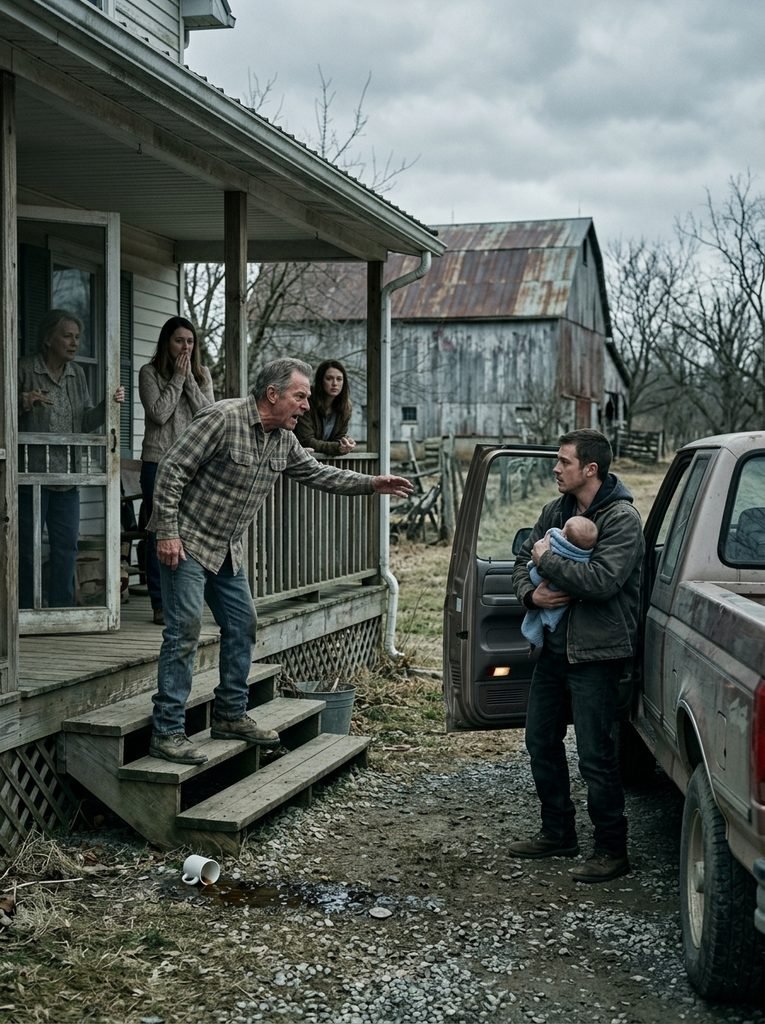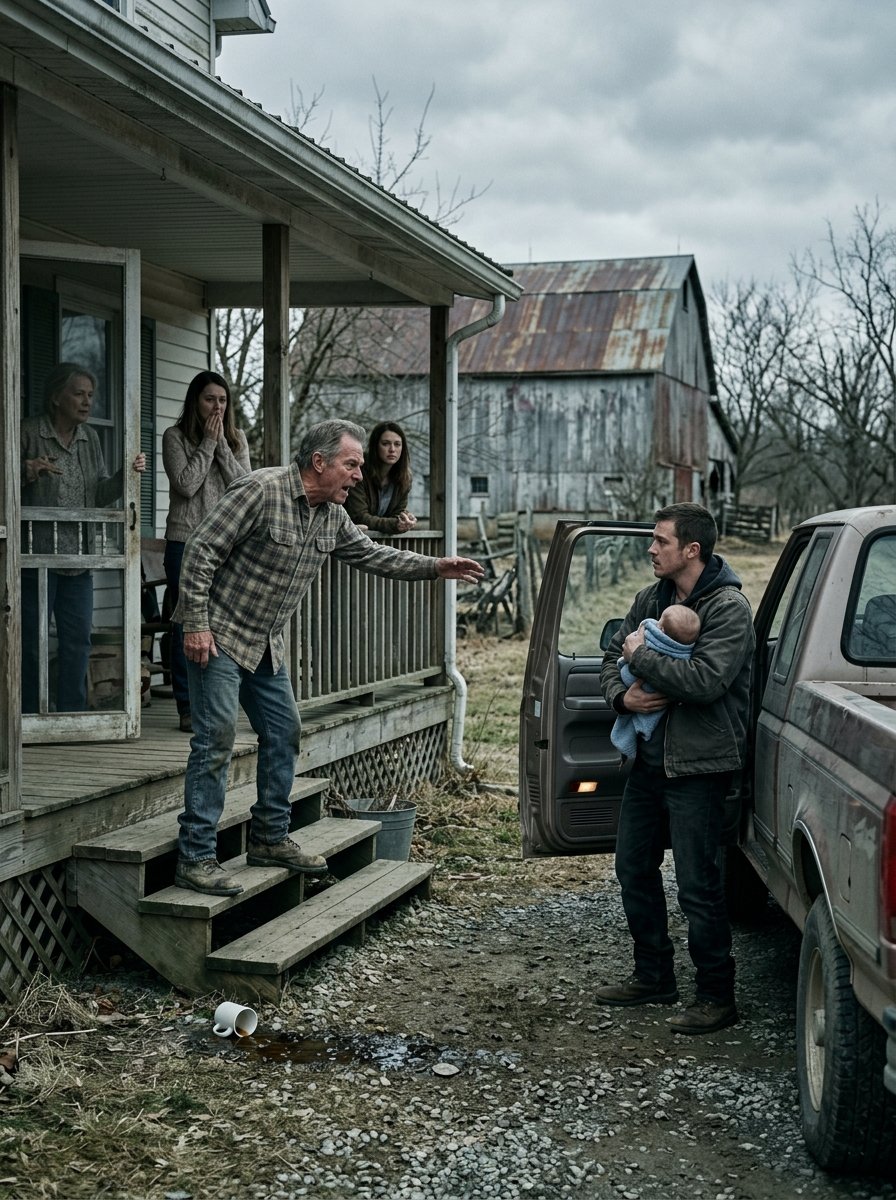
A boy described with “no father or mother” was taken in by a struggling farmer and raised as his own son. Twenty-five years later, when that boy came back, what he brought with him left everyone speechless…
Part 1 of 3
PART 1
The baby was still crying when George first heard him from the rented cornfield.
At first he thought it was a small bird caught in the thick ditch grass along the perimeter. The sound was simply too weak to belong to anything strong enough to survive the coming chill of the evening.
The field smelled of heavy diesel, wet turnip dirt, and summer rain hanging low over the muddy rows. George had been working since long before sunrise, bent over the cold earth with red clay caked onto his heavy work boots and his blue chambray shirt stiff with dried sweat.
He owned almost nothing worth bragging about to the folks down at the hardware store. Not the land he farmed, not the rusted John Deere tractor parked near the shed, and not even the small white house at the edge of the county road, at least not in any way that made him feel secure when the bills came in.
Every month, the farm rent came first before anything else could be considered. Then came the livestock feed, then the gas for the truck, and then whatever groceries he could afford from the markdown bin at the general store.
The cry came again, floating across the damp air. This time, George knew without a doubt that the sound was human.
George dropped his metal hoe into the mud and followed the sound down toward the drainage ditch, his heart pounding faster against his ribs with every step he took.
He found the newborn lying near the muddy rows, wrapped tightly in a faded blue flannel blanket that smelled of rain, fresh earth, and old cotton.
The umbilical cord was still raw and fresh at his tiny belly. His small pink fists opened and closed against the damp evening air as if he were trying to grab onto the world before it slid away from him completely.
George stood over the tiny bundle for a long second and did the brutal math that fifty years of poverty had trained into his bones.
He thought of formula, diapers, heating oil in January, doctor visits, and school clothes for a growing boy. A man who regularly ate saltine crackers and broth for dinner had no business picking up a baby that the world had already discarded in the mud.
Then the baby let out another cry, thin and completely broken, and something deep inside George broke right along with it.
He knelt in the wet dirt, reached out his calloused hands, and lifted the child with trembling fingers.
“You are not alone now, little man,” George whispered softly into the quiet evening.
The baby immediately grew quiet against his warm chest, resting his tiny head against the wet canvas of George’s jacket. That was the very first miracle George had ever truly believed in.
By 7:18 p.m., George was standing at the emergency intake desk at Valley View Community Hospital with thick mud on his canvas jeans and sheer panic in his tired eyes. The intake nurse looked up from her computer monitor, looking from George’s disheveled frame down to the bundle in his arms and then back again.
“Is this your child, sir?” the nurse asked, her pen hovering over the clipboard.
George opened his mouth to speak, and for the first time in his life, he understood how a protective lie could be far more honorable than the cold truth.
“I found him,” George said plainly, keeping his voice steady despite his racing pulse.
The nurse nodded slowly and wrote the words unknown male infant across the top of the white intake form. Within twenty minutes, a county deputy named Officer Wayne arrived to take a short official report.
George answered every single question as simply and honestly as he could while sitting on the hard plastic chair.
“Where exactly did you find the child, George?” Officer Wayne asked, clicking his pen as he looked over his notepad.
“Down near the lower corn field, right by the drainage ditch,” George answered, cradling the baby against his chest.
“And what time was this, roughly?” Officer Wayne continued, scanning George’s worn appearance.
“Around sunset, just as the rain started coming down heavy,” George replied softly.
“Did you notice anyone driving away or walking near the tree line?” the officer inquired further.
“No, sir, I did not see a single soul out there,” George said.
“Did you touch anything else down in the ditch besides the child and that blue blanket?” the deputy asked.
“No, I just picked him up and came straight here,” George confirmed.
Officer Wayne looked down at George’s mud caked boots, his frayed collar, and the crushed baseball cap held tightly in his lap.
“You understand that county child services will have to get involved in this immediately, right?” Officer Wayne said, his voice dropping into a solemn tone.
“I understand,” George nodded quietly without arguing or begging for special treatment.
When a young pediatric nurse stepped forward to gently take the baby away for an examination, the newborn let out a cry so sharp that George’s body moved purely on instinct. He pulled the baby a fraction closer to his chest before he even realized what he was doing.
The nurse saw the look in his eyes and softened her expression immediately.
“Just give him another minute with you,” the nurse said gently to the deputy.
George sat in the brightly lit hospital waiting room until well past midnight, holding a paper cup of lukewarm coffee that went completely cold before he took a single sip. An overhead television played an old game show with the volume turned all the way down.
The waxed linoleum floor smelled heavily of industrial bleach and disinfectant. Every time a hospital staff member walked past with a clipboard, George looked up with hope in his eyes.
The next morning, the social workers at county child services officially opened a case file for the foundling.
By noon that same day, the whole town of Pine Ridge had opened its loud mouth.
Small rural towns never seem to need actual facts when they already have plenty of opinions to share. Down at the local general store, while George was buying cloth diapers on store credit, a few local farmers standing by the coffee machine lowered their voices just enough to ensure George heard every word.
“George has completely lost his mind this time,” one older farmer muttered to his companion.
“The man cannot even keep his own roof from leaking when it pours,” the second man agreed with a solemn nod.
“Kids who grow up without a real mother or father always end up wrong in the end, mark my words,” the first farmer added.
George set the package of cloth diapers down on the wooden counter without saying a single word to the gossipers.
The female cashier, who knew down to the exact penny how little money George had in his bank account, did not ask if he wanted to buy anything else that morning. She simply pulled out her small leather notebook and wrote the total amount next to his name, tracking his desperate attempt to make it to Friday.
“Thank you, Mary,” George said quietly as he picked up the bag.
“You take care out there, George,” Mary replied, offering him a sympathetic nod.
George walked out into the bright sunlight without turning around to acknowledge the men by the coffee maker. People who have never had to count loose pennies to buy a loaf of bread always seem to have endless advice for a hungry man.
That evening, George sat at his small laminate kitchen table while the baby slept peacefully inside an old wicker laundry basket lined with clean cotton towels. The faded blue blanket lay draped across the back of a wooden chair, freshly washed and still slightly damp at one corner.
George had no wooden crib, no decorated nursery, and no grand financial plan that would impress anyone sitting behind a oak desk at the county building.
When the baby stirred in his sleep, George reached down into the basket and laid one thick finger into the baby’s tiny palm. The newborn immediately wrapped his whole hand around George’s finger and held on tight.
George looked down at the tiny face and decided to name him Sam. He chose the name because it sounded solid and steady, like something built to endure terrible weather.
His older sister, Brenda, came over to the house early the following week. She stood on the squeaky front porch with her arms crossed tightly over her chest while the small American flag tied to the wooden railing tapped against the house in the autumn wind.
Brenda had always proudly believed that she was the practical member of the family. However, practical, when coming out of Brenda’s mouth, usually just meant being cruel with a clean conscience.
“You still have plenty of time to hand him over to the state,” Brenda said, staring at the baby with cold disapproval.
George stood firmly in the doorway with little Sam resting peacefully against his broad shoulder. The baby had a small smear of dried milk on his cheek, and George had not slept more than two hours at a time for seven straight days.
“Hand him over to who, Brenda?” George asked quietly, shifting his weight on the porch.
“To the people whose actual job it is to handle these disasters,” Brenda barked back immediately.
“He needs a home, Brenda,” George replied.
“He needs a proper home with people who actually have real money,” Brenda snapped back, gesturing wildly toward the yard.
“I can provide for him just fine,” George said, holding the baby closer.
“Look at yourself, George,” Brenda sneered coldly. “Find him a couple that is much younger and far better off than you will ever be. He is not your blood, and you do not know what kind of broken people he came from.”
George looked past his sister toward the dusty gravel driveway, where his rusted mailbox leaned heavily to one side near the overgrown field. He had grown up alongside Brenda his entire life, and he knew the specific tone her voice took when she was genuinely worried about something.
This tone was not worry at all; it was pure embarrassment that her brother was making a public spectacle of his poverty.
“He came straight out of the wet mud,” George said, staring her right in the eyes. “And I was the one who picked him up.”
Brenda’s face hardened into a bitter scowl as she realized he would not yield.
“You are going to completely ruin your miserable life for a child who will probably never even thank you for it,” she declared angrily.
George looked down at little Sam, who blinked up at him with unfocused blue eyes.
“Then I guess that is between me and my own life, Brenda,” George replied calmly.
That cold afternoon marked the absolute beginning of twenty-five long years of quiet war between them. It was not the kind of war fought with loud shouting matches every single day, but rather the far worse kind.
It was a war constructed out of sharp side comments made in tight kitchens, cruel looks shared at public school pageants, and bitter sentences spoken just loudly enough for George to hear them clearly.
Brenda never once spoke the name Sam when she could refer to him as that boy instead. At family holiday cookouts, she would casually ask the neighbors whether George had ever heard anything from the boy’s real family.
During Christmas gatherings, she deliberately gave Sam a cheap pair of tube socks one year while whispering to George that he should not get too attached to blood that was not his own.
George never once threw his sister off his property. He never raised his hand in anger, and he never gave her the immense satisfaction of seeing the deep fury she kept trying to provoke in him.
Instead, George would simply carry Sam into the warm kitchen, heat up a baby bottle in a saucepan of hot water, and keep moving forward with his life.
Real love is not always soft and sweet. Sometimes love is waking up at 4:30 in the morning to repair broken barbed wire fences with a baby strapped securely to your chest.
Sometimes love is wearing split leather boots through the frozen snow so a little boy can have hot lunch money at school. Sometimes it is signing parent or guardian on a crumpled school permission slip with a hand that shakes from exhaustion, and then handing the paper back to the teacher anyway.
Sam grew up with the cold truth kept close enough to touch every single day. He always knew that he had been found in a muddy drainage ditch, because George never tried to turn the event into a magical fairy tale.
“You were left behind by someone,” George told him when Sam was finally old enough to ask questions about his past. “And then you were kept by me. Both of those things are completely true, Sam, but only one of them gets to decide who we are going to be.”
Sam carried that single sentence in his mind for years to come.
When Sam was six years old, he drew a colorful picture in school showing George standing proudly beside his rusted green tractor, and he wrote the word Dad in large crooked letters right above George’s head.
When Sam was nine years old, he got into a sudden fistfight on the school playground because another boy had called him a ditch baby in front of the whole class. George had to sit beside him in the principal’s office, holding his dusty work cap in his hands while the school secretary clicked her ballpoint pen and the state flag stood silently in the corner.